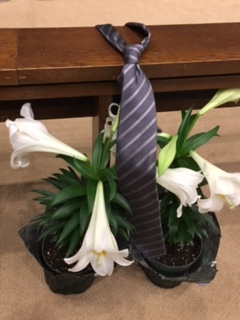
Easter 2017 — my Easter necktie is missing. In fact almost all of my neckties have disappeared. Perhaps they didn’t make the move from LaPorte to Bloomington with us. Perhaps they ended up in the items we sent to Goodwill.
Every day I discover doodads, socks, books and photos that made the move to Bloomington. In boxes or drawers, they appear. So far, however, no neckties. Most of the discoveries are items I didn’t know were missing.Most are things I can do without. I had thought we had given away so much — but not important things like Easter ties.
The time had come — I always wear a bright tie that symbolizes the joy of the day. For more than four decades I have worn such a tie on Easter. I think “Why would one go to an Easter service dressed otherwise? My Easter ties were usually gold or yellow or a mix of other bright colors as part of my celebration the day of resurrection.
I looked. I pondered. I looked again. Nope, not there. Not in the closet, the dresser, the storage room. Not there. I was left with only three ties packed for other more somber events. These were ties to be worn for a lecture at a university, a funeral, an important business luncheon. (I chuckled at the thought that maybe these three things are all alike!)
No more time to search. The hour was on us — time to go to church — still no Easter tie. Elaine was waiting for me! This never happens. Quickly I chose from the three ties remaining — a gray number, with muted white stripes. It was a tie I had worn to a couple of funerals. This would have to do. Off to church.
Driving I thought perhaps this is exactly the right tie to wear on Easter Day 2017. How does one celebrate during these days of disorientation and discouragement? What does one do when the world seems to be spinning toward more violence and deception. Maybe, just maybe, it represents the idea that celebration this Easter involves getting ready for the new business at hand. Maybe it is a time to for educating, not lecture, but serious thought and dialogue with others. Maybe there are things too important, things to mourn this Easter, like the death of a dear friend, or the threats to truth.
Earlier that morning I sent the message: One word counters a million Potus tweets: EASTER. Let it be our word, our verb. May hope & truth Easter in us as a witness beyond today. I believe it. Easter is to be understood as a verb… we are to practice resurrection as Wendell Berry suggests.
That was it! We arrived at St. Marks UMC in time. Jimmy Moore preached a marvelous Easter sermon. He made it clear. He was pastoral and warm and wise. The sermon didn’t avoid the hard truths of a world where meanness and bigotry are on the rise. (I am so grateful to attend a church that speaks the truth in love and challenges parties of all ideological stances to consider the way the gospel calls for a bigger, more generous view of the neighbor and the stranger and the enemy.)
Jimmy’s sermon avoided bright shinny objects (and, I thought, he seemed to know I didn’t need a brightly colored Easter ties). He offered examples of those who persist in seeking God’s kingdom even when faced with enormous difficulties. He spoke of the ministry of Palestinian Elias Chacour. He told of Chacour’s call for hope amid despair and his persistence in explaining that the man from Galilee will make appearances if only we can see them.
So, for the time being at least, instead of looking for neckties, I will look for the Christ present in the world around. I will speak against the phony uses of threat and bigotry. This will be my Easter business for the year ahead. It is to see the Christ alive today in places where I had missed this gift in the past.
Over the years one situation or another has been labeled the “New Normal.” This was $3 a gallon gasoline in 2002 (something that is about to be true again), TSA personal searches prior to boarding an airline (this, sadly came true) or extreme weather events (something I fear is indeed truer month by month).
“New Normals” have included some positive things and some tragic. We have witnessed on-line shopping, self driving cars, same day delivery by drones, gay marriage, uber transportation, school shootings, melting glaciers, electronic banking and social media of endless variety.
There is, however, a “New NonNormal” that is afoot in our nation and patriotic Americans, especially people of faith, must resist it. Any normalization in our culture and institutions that is not factual, thoughtful or ethical must be identified as outside the norms of our national identity. Much has been said about the dangers of “normalization” within the presidency of Donald Trump. Agreed. There is much that must be identified as NonNormal and therefore opposed. Let’s be specific. We will not accept lies, programs based on prejudices rather than facts, or knee-jerk twitter-created public policies.
Good reader, lets join millions of others who will not accept the normalization of such things as torture, the denial of climate change, the practicing discrimination against religious or ethic minorities, preventative health care being taken away from millions of the poor, the demeaning or violation of women, the acceptance of gun violence or undermining the importance of quality journalism.
Yes, the list could go on and on and on. Let’s make it simple. Can we agree that truth is essential to our democracy and our way of life? Can we agree that careful, factual information is vital to progress — whether this is information related to climate change, our news media or our national intelligence agencies? Can we agree that national policies should be based on quality, iterative research — whether on tariffs, immigration or education reforms?
Simply this, it is NonNormal, if we don’t — tell the truth, gather our facts, and propose programs based on sound research. To proceed otherwise is the “New NonNormal.”
Tell the truth,
Gather the facts,
Act based on good research information.
To do otherwise, must be understood as an unacceptable New NonNormal.
This is the season when many Christians read scripture from the second chapter of Matthew’s gospel. It is the story of the Magi’s visit, the fleeing of Mary, Joseph and the baby to Egypt and the slaughter of innocent children by Herod.
What a contemporary, compelling and relevant story from Jesus’ infanthood this is for us. More, I have been thinking about all the ways a “globalist Jesus” is demonstrated by his entire life. His story begins as that of a refugee. His teachings and ministry clearly move past borders of any nation, ethnicity or social class. While it appears his adult ministry was limited to Galilee and Judea, what the gospels record is a Jesus who, in our day, could be accused of being a globalist. He is one who continues to surprise his listeners with the vision of God’s people as people who are boundary breakers, who travel as sojourners with those who are excluded or on the margins of a society.
Consider the powerful parable of the Good Samaritan, or think of the words of the Sermon on the Mount. Or, take a moment to repeat the Lord’s Prayer. Slowly now, listen to each word and phrase. “Our father… thy kingdom come… on earth… give us… forgive us as we forgive…”. It is a prayer that is communal more than individual. Then there are those words of the so-called Beattitudes filled with global prejudices. Take time to read Matthew chapter 5 or Luke 6. Open your Bible, dust it off first if necessary. Am I wrong? Clearly the man Jesus could be charged with being a globalist and unpatriotic when it comes to any single nation or ideology.
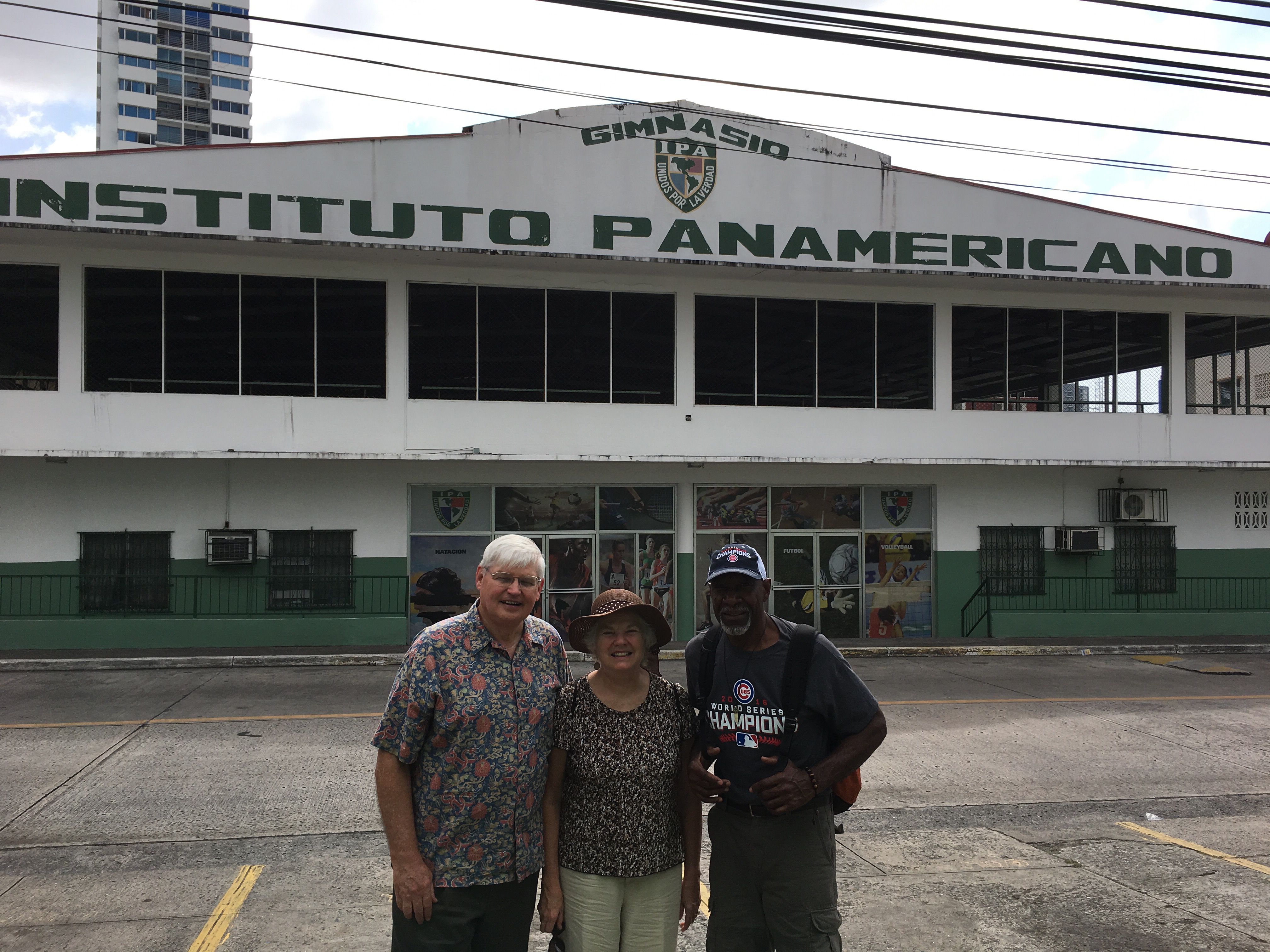
Today I write from Panama City, Panama. It has been decades since I last visited and 47 years since Elaine and I taught at the Instituto Pan Americano (IPA). IPA is a remarkable Methodist school known for bilingual and multicultural education.
Panama is a very different country than I first experienced in 1969. Much wealthier in some respects, still struggling in others. The skyline of the city is resplendent with high rise banks and luxury hotels – stretching in every direction. I can’t help but reflect on the contribution IPA has made to the emergence of Panama as an international financial center (for good and ill). Being global or multicultural isn’t a path to solve all problems. In fact, new difficulties are created that require wise and humane systems of social, cultural and religious activity.
Those who know Panama can see in the distance, in the photo taken on New Years Day 2017, a photo of Ancon Hill. Until 1977 this location was the U.S. home of the military’s Southern Command. From Ancon headquarters many Latin American dictators were supported and some democracies subverted all in the name of U.S. security. Yes, many good things were also supported but as they say — “it’s complicated.” Surely Panama’s history (for good or ill) cannot be told apart from the story of the American empire.
And, so we arrive at the ethical challenges of seeing Jesus as a globalist. Easy answers about building walls, adding tariffs, registering those who seem different, choosing sides so that the whole world can be categorized as friend or enemy, certainly have an appeal. They can even win elections and bring certain persons to power. However, such perspectives are contrary to the teachings of the globalist Jesus.
I am intrigued and concerned with the increased influence of the so-called “militantchurch” phenomena in Roman Catholicism these days. They are more nationalist than “catholic.” They are more protectors of privilege, even bigotry, than followers of the Jesus of the Bible. Or, what of the recent bigotry of the likes of Franklin Graham or Jerry Falwell Jr. when it comes to this Jesus? I read what they write and listen to what they say and rarely if ever hear a reference to this Jesus. Nor do any of these pseudo-gospeliers seem to ever refer to the teachings of Augustine or Francis of Assisi. Augustine wrote extensively about a Jesus who so engaged and loved the whole world so that we might seek to avoid violence and find an ethical path when living with empire. Francis offered a way of peace with others and all creation. Two more globalist followers of the globalist Jesus were they.
Clarence Smart with Phil & Elaine, 2017.But what about me? What about my cohorts? My critique of the militantchurch or of the apparently gospel-blind fundamentalist comes too easily. When I visited IPA with Clarence Smart and Adrienne Mims recently I found myself wondering if the mainline church of today is able or willing to hear the call of the globalist Jesus? Where is the evidence?
We seem to be tongue-tied by recent world events, more concerned about growing local congregations in our local places than starting schools, hospitals or agricultural programs reaching the global realities all around. Local can be a good focus but never the exclusive focus. I remember the missionaries and local leaders in Panama back 47 years ago. They spoke as ones who knew the reality of Jesus the globalist. They wrestled with the reality of empire and the tough ethical questions of development, economic or otherwise.
I remember the hundreds of students who would bring their tuition money each month, coins wrapped in handkerchiefs. Fathers had driven buses charging 5 cents a ride and mothers were maids working 10 hour days and there was the hope of something better. But it was complicated — no simple “art of the deal” here.
Which child is to be educated? What of cultural traps that made some more special than others or the different imbalanced pay scales used by the canal company that kept some poorer than others? And what of militarism, U.S. intervention, drug cartels, the laundering of money? Followers of a globalist Jesus understood the need to be “wise as serpents and peaceful as doves.” No easy task in a world full of Manichaean temptations. My missionary mentors and indigenous church leaders taught me to think globally as well as locally.
Today, too many of our bishops write columns about cultivating the inner spiritual life, cautioning against critique of church practices, and remain mum when it comes to the assault on the poor and the sick. They want to “get to know our congregations” but seem to miss the realities of the communities in crises surrounding these churches. The focus is all inward, about “me and my church.” Surely IPA would have never been founded as a bilingual and multicultural Christian school had this been the focus 100 years ago by Methodists in Indiana. Spirituality is both inwardly focused and outwardly lived. Both. That’s the point.
In my home state of Indiana there is an opioids drug abuse crises, an innocent man goes unpardoned by Governor Mike Pence, a repeal of the ACA is likely meaning the option of reasonable preventative health care for the poor will end. Ironically this repeal, in the name of economic concern, can lead to the closing of many smaller hospitals in our less wealthy communities — thereby creating more unemployment. What has the United Methodist Church in the state, with more than 1100 congregations had to say or do about any of this? Crickets…. nothing… instead, only a focus on individual spirituality and congregational development. This is the self centered message of an anxious church to a troubled world. Christ have mercy. Sadly, ironically, this can become an ever spiraling downward process into self absorption, protectionism and irrelevance. Will we hear and follow Jesus the globalist?
Some today seek to make the term globalist a negative one. I disagree. Disciples who follow a globalist Jesus are more needed today than ever before in my lifetime.
Dear Ellie, Gus, Zack and Colin,
I wanted to write you for a couple of reasons. First, I wanted to say that I love you and tell you how special you are to me. You are wonderful grandchildren and have great parents – they love you too.
Secondly, I wanted to write because the election of Donald Trump as president has made me sad and has caused me to think about you so much ever since. So here are some things I want to say to you now:
1. It’s going to be okay. There are some scary things about this election but it is going to be okay. Your parents and grandparents are going to keep working on this.
2. From all we have seen, Mr. Trump is not a very nice man. He has cheated people, told lots of lies and says things about people who are different that hurt them. He thinks having lots of money makes him important but doesn’t use his money much to help others.
Many years ago, long before you were born, I read a book called “All I Needed to Know I Learned in Kindergarten.” It was a good book and a fun book to read. Here are some of the things that book talked about.
a. Be friendly and kind;
b. Share with others;
c. Don’t tell lies – tell the truth;
d. Don’t cheat;
e. Pay attention;
f. Learn to read and think about what you read;
g. Don’t push people down;
h. Treat others the way you want to be treated, and,
i. Laugh and have fun!
Maybe Mr. Trump didn’t graduate from kindergarten, or maybe he never learned these things if he did. Maybe he once knew some of these things and has forgotten them now. He is an old man like me and he should know these things. But in the way he lives, he doesn’t act like he ever learned them.
We don’t always win games, or prizes or elections. When we lose it hurts, but we keep trying.
Just because bad people sometimes win doesn’t mean they are right.
And, sometimes bad people can change. Let’s hope Mr. Trump can change. But I am not going to let him trick me and I am going to watch him very closely so that he won’t trick me or others.
I am also going to work really hard to make sure other people who remember what they learned in kindergarten will be elected in the future and we get Mr. Trump out of our lives as soon as possible.
Who knows, one day one of you might be president. I already know this about you – you are smart and nice and will always remember what you learned in kindergarten.
Chicago Cubs Vs. Cleveland’s Indigenous Peoples Demeaning Mascot
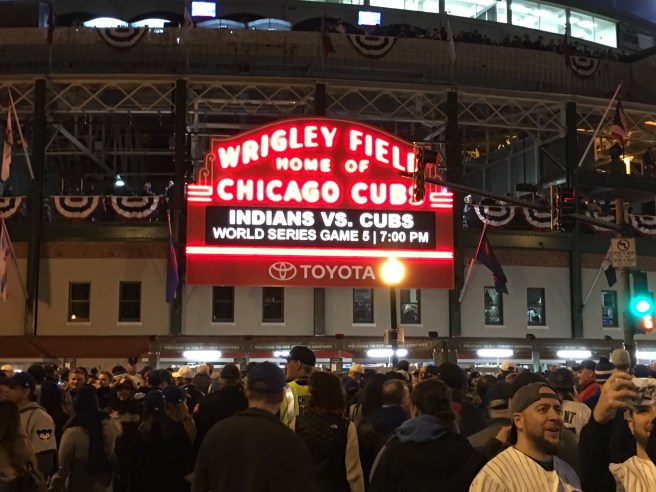
Okay, so that we are clear, I am a lifelong Chicago Cubs fan. There was a time when as a preadolescent I had a brief fling with the Cincinnati Reds and, I confess, I admired the St. Louis Cardinals for a brief period, but it was always, first and foremost, the CUBS! So you can imagine how marvelous it was to sit with my daughter at game five of this year’s world series with Cleveland and see my beloved team win a world series game there for the first time in seventy-eight years!
It was magical — nerve-wracking but magical. After the Cubs had a great year (the best in baseball with 103 wins) they are struggling against that Cleveland team. The Cubs are up against some extraordinary pitching, especially from a guy named Miller who is the best closer I have seen in, well, forever.
I will not mention the name of the Cleveland team because… well… because of… this:
Cleveland’s Chief Wahoo
Come on Cleveland, time to clean up this image of your mascot. I have often defended you as a fine city. You are not “a mistake by the lake.” In recent visits I have marveled at the vibrancy that has come to your downtown and the renewal taking place in many neighborhoods. You have had some good political leaders and some not so good (Stokes, Kucinich, Voinovich, Campbell, Jackson). I won’t mention which I think were the good ones. You have many fine educational and cultural institutions. Of course, there is also the Rock and Roll Hall of Fame!
I admit to being a Chicago partisan in this World Series but just a few months ago I was pulling for the Cavs to surprise everyone and come back from a 3 to 1 deficit to become the world champions in the NBA. THEY DID! So, now, a few hours before game six, I will be pulling for a similar comeback, this time for my dear Cubbies. I am pulling for the Cubs to beat the team I shall call the Cleveland Indigenous Peoples Impersonators.
Is the Chief Wahoo image racist? Of course it is! Don’t pretend differently. Ask the people who have the most right to be offended. The National Congress of American Indians published a poster recently that covers the situation all too well. Just imagine:
Anything more need to be said?
So, win or lose, Cleveland friends, please clean up this racist name and image. It’s an important step. Go to the website of the National Congress of American Indians to learn more (National Congress of American Indians).
Oh yes, and those of you NFL fans of a certain football team in Washington D.C. known as the R*dskins — you too can join in the fun of eliminating such demeaning symbols.
These may appear to some to be small matters; not significant. Some may say I am being “politically correct.” Others may say I should focus on matters of more substance like the Sioux Nation’s efforts to protect land and tribal rights at Standing Rock in North Dakota. I get that and I also think this is all a part of the same package — names of mascots, environmental threats, and small bigotries are all a reflection of our nation’s sinful acts against the First Peoples and our continuing discriminations. It is our enduring embarrassment and, yes, it will require more than just changing a mascot’s name.
As I write, game six of the Series is only a couple of hours away. So, Go Cubs, Beat the Cleveland Indigenous Peoples Impersonators!
First — this apology to my non-United Methodist friends and readers. We United Methodists are amid some “denominational challenges” just now. I have written this letter as a way to encourage some of our more traditional and conservative leaders to answer five questions about their purposes and basic intentions. You see, I fear this “new effort” known as the Wesleyan Covenant Association in North America is merely a building of a highway for schism among folks in our denomination divided by our views around homosexuality. My prayer is that raising these questions may help identify some of the distortions often made by these, my friends, who claim to be more “Biblical, evangelical, and Wesleyan” than others of us. Forgive this interlude in my blog entries — please check out the recent post on my embarrassing moments as a pastor. It is much more fun… and probably more enlightening.
+++++++++++++++++++++++++++
Dear Friends of the Wesley Covenant Association,As I read the names of the founding sponsors of the Wesley Covenant Association, I know many of you — have known you for years. You have been colleagues in our work as United Methodists. You are committed pastors, known theological educators and activist organizers in the Confessing Movement and the Good News Movement in United Methodism. Now you offer a new organization, a new association. Hopefully your claim that the Wesley Covenant Association is a re-booting, a move toward re-discovery, a signal of readiness to traverse beyond the tread-worn battles of the past is true. I pray you join me in the realization that the younger, rising generation of United Methodist seems rather disinterested in a rehearsal of the same old arguments, using the same labels and categories. Our battles still may appear to be unresolved, but there is little doubt they are increasingly insignificant in the lives and faith of our grandchildren. I would be helped if you could answer five questions. They are ones asked before, at various times and places. Not yet having received an answer I repeat them now – this time with a renewed sense of urgency as I fear the WCA may be simply a laying of the predicate for a schism in our denomination.These questions of you are not rhetorical. I sincerely would like to hear from you:
If “evangelical,” what is the “good news” you share?
If “evangelical,” why so little attention to Christian experience, to personal conversion? Why so little mention of the transforming love of Jesus Christ for persons and society?
If Wesleyan, why the silence about ministry with the poor?
If uniquely “Biblical Christian,” what is the basis of scriptural interpretation? What is the hermeneutic employed?
If Wesleyan, what of John Wesley’s concern about schism and his clear guidance to learn from others who differ as expressed in “A Plain Account of Christian Perfection”?
Answers to these questions would help me know if I might be included in the “covenant” you seek to draw. You see, I fear your appropriation of the word “covenant” is more of a way to exclude and narrow than it is a way to a hope-filled future. It is a misdirection away from the more profound meaning of covenant that comes from scripture. The covenant, I believe we share is much broader and more profoundly enduring than that which can be restricted by a few paragraphs in the ever-shifting-language of The United Methodist Book of Discipline. Using the word “covenant” in this narrow way may be beneficial to an ecclesial political agenda. It may serve to set folks like me outside of “the elect.” I reject this use of covenant language in this way. I will not be thus separated by your linguistic legerdemain.It was after all, conservative theologian, Richard John Neuhaus, of blessed memory, who taught the essential difference between “contract” and “covenant.” Our faith covenant binds us together by something deeper and more profound than contractual language can ever contain.A contract is limited to the temporal, “quid pro quo” reality. It is an effort to control and claim exclusive authority over things that are passing, temporal. It seeks to hold us together, by our past rules, limited language and small understandings. It is a way to count up grievances and deny our commonweal. It suggests the interpretation of scripture is the exclusive possession of one party and only this view will be acceptable for all United Methodists. A “contract” seeks to limit vision, thwart new expression, block new insights walling them in to past categories and perspectives.Covenant is not contract. Covenant is God’s gift for us ALL — something that draws us into the future, TOGETHER; it is the power of God’s Spirit at work in the world and it is beyond our ability to limit this. Covenant continually ReCenters us in Christ. Bonhoeffer wrote clearly of the church being centered in Christ where boundaries drawn by those who seek to limit the expansiveness of God’s activity in the world will not hold. Believing we all belong to Christ and this is our true covenant hope, I remain, your brother,Philip Amerson
“That Dumb Preacher” and the Gift of Embarrassment
Fifty years ago this past summer I was provisionally ordained as a Methodist pastor. Young and determined to change the world, I was “set aside” for ministry by Bishop Richard C. Raines in a pomp-filled ceremony in the Indiana University Auditorium.
I. U. Auditorium
I was ready to change the world — and I was so little aware of the way the world would change me. Now there is time to look back, to reflect, to laugh and learn anew.
These past five decades as a clergy person have been filled joy and sadness. All in all, it has been good ride, especially as I came to value the whimsy in life. It has been good, in part, because of many moments of embarrassment. Yes, I said embarrassment. It keeps one humble. One sees in these times both the stodgy excesses of organized religion and one’s own foolish efforts at vocational perfection. Here is my top ten list — memories of times I played the role of “that dumb preacher.”
One Saturday in June, presiding at the fourth wedding of the day, at the point of exchanging the vows, I heard myself say, “Will you Jennifer, take Mike, to be your husband.” Even before I saw the confused and terrified look in the bride, Susan’s, eyes, I knew that she was not “Jennifer” and he was not a “Mike.” And, I couldn’t remember their names. I searched papers tucked in my Bible. It took an eternity — probably 20 seconds before I could match the couple with their true identities. I suspect that for years following, maybe even these decades later, Susan must have thought, “that poor, dumb preacher.”
Rushing to complete my daily visits on another day, I decided to drop by the funeral home, speak words of condolence to members of my congregation who had lost a loved one. I was not presiding at the funeral, but as pastor I wanted to support these folks. I entered the visitation room, circulated, greeted several folks not recognizing anyone. As I met the grieving widow and children it became clear that this was the wrong visitation — I was even at the wrong funeral home! Turning to make a quick exit, the daughter asked, “How did you know my father?” No words came for several seconds. Then I muttered, “Oh, I knew of him.” Blushing, I made my rapid exit.
Oh, friends, this is an all too familiar experience for me. More than once I have stopped by a hospital room to visit with a patient only to discover I was engaging the wrong person. Often, in a shared room, I prayed with the roommate before learning he or she was not the person I had intended to visit. I still smile thinking of the nice Jewish man who, after I had prayed, said he appreciated the prayer and knew his rabbi appreciated it too!
Then, there are the multiple misadventures with cordless microphones. On more than one occasion, I continued to “broadcast” when I should have turned the darn thing to “OFF.” Let’s just say that needing some relief, I quickly slipped out of one service as a colleague was praying. Moments later the congregation heard a great flushing sound. These were not the rushing waters from Elijah. These waters poured across the sound system drowning the prayer!
Rarely was I more embarrassed than the time I received a call from a couple in a nearby state park who, with family and friends, waiting for me to officiate at their outdoor wedding. We had visited earlier, done counseling together, and… yes, all was ready. Except, I had the wrong date on my calendar! Fortunately I was able to rush to the park (almost an hour away) in time to confirm what a non-ordained uncle had already done pronouncing them married. I greeted everyone, heard the story of the improvised ceremony, asked the uncle to “say it again” and then confirmed it by shouting “yes, to what he said!” I prayed a prayer, signed the wedding license and was the brunt of multiple jokes as we enjoyed slices of cake.
We were celebrating the 70th wedding anniversary of a dear couple on a Sunday. I broke my unwritten rule of never offering an open microphone to another. This seemed safe enough. Speaking to the couple in front of me I said, “It must be great to have 70 happy years together?” The woman grabbed the mike and before I knew what was happening she said, “Well, actually, he ran around a lot on me during the first years of our marriage.” The congregation roared with laughter. Too late. Nothing else would be remembered by any of us that Sunday.
And, what could go wrong with wearing a new suit to worship? Well… somehow the tailor didn’t tie off the knots along the leg seams. As I greeted folks after the first service, I felt a breeze along my leg up to the crotch. It was, so to speak, open territory. What to do? Fortunately we wore robes in the next two services. Not many noticed my alabaster legs beneath the robe. I wore a robe all the way home that day!
I was a guest pastor, covering worship for a friend who served in a more liturgical tradition than my own. On arrival, I was surprised to learn that I was not only to preach but also to preside at the eucharist — at all five services! Let’s just say I wasn’t prepared. At the first service, I realized too late I had consecrated an empty chalice. More to the point at the end of the morning I learned that I didn’t need to empty the contents of the chalice after every worship service! I don’t recall much of the sermon in service number five — I am certain it was brilliant, even if some words were slurred.
Advice to young pastors — don’t attempt an infant baptism if your hands are already full. As I recall there was a microphone, hymnal, the baptism certificate, a candle for the family, and… oh yes, the baby! I thought it was all balanced and ready just as the baby’s pacifier fell out of her mouth. Just above the baptismal font I reached to catch the pacifier. The baby came down as well. She was baptized on the wrong end! The certificate, hymnal and microphone were also baptized that day. I did catch the pacifier — after all, what is truly important?
Sitting on the steps outside the door of our core-city congregation, I was waiting for a ride home. Before I knew it three small children were beside me… then crawling over my lap and shoulders. Snotty noses and grimy fingers were running through my hair. The papers in folders on my lap were opened and explored. I tried to engage the children, offering a pen to draw on my papers. One little girl who had plopped beside me looked up and said, “You don’t know what to do with us, do you?” Somewhere today that little girl, now an adult, must think back on “that dumb preacher.”
Wesley UMC, University of Illinois
Much has changed over the past fifty years. Mainline denominations, like my own, are regarded by many as more and more “sidelined” denominations. We grow anxious, serious, more determined. We focus on the latest organizational/leadership development programs designed to help us avoid decline. Meanwhile we miss the larger movements of the Spirit that reach over decades. We fail to see the basic demographics of our social settings and, mostly, we miss the joy and humanity all around, and within, us.
Our institutions have much to be embarrassed about. In fact, too often we seek to measure our value by the wrong metric. Last winter I was fortunate enough to preach at one of the grand old churches of our denomination — Wesley UMC at the University of Illinois. I had just attended an event where there was hand wringing about our need to be a global church and about worship attendance in the U.S. continuing to decline. All of this is true. Still, I couldn’t help but laugh out loud after the sermon in Champaign, Illinois, as dozens of international students came by to visit with me after that worship service. I was aware that our global reach might be wider than our limited vision could see. Too serious, too anxious, we should be embarrassed by our clumsy failures to hear the words, “you don’t know what to do with us, do you?”
I would not argue that we should not seek to be relevant. I would, however, suggest a much lighter touch. Some laughter might be good for the soul of the church — some acknowledgement of our embarrassing moments. Maybe more humanity and a focus on awkward, surprising, relationships could help. A little less certitude and a little more embarrassment is in order. I have shared ten of my own embarrassing moments — there are dozens more I could offer. This will do for now. Enjoy… and consider what the little wiggly girl sitting on the church steps said. I think she is right. We just don’t know what to do with all the vibrant and bouncing protoplasm all around us. I think we may miss our embarrassment of riches.
Maligne Lake, Jasper National Park, Alberta Canada
Peak Crazy
Today’s New York Times (September 28, 2016) asks if our national psyche has reached a “peak craziness” with regard to our penchant for accepting conspiracy theories. “Peak Craziness” was a new concept for me. A search shows that it is not a widely used idea; however, I find it a helpful one. It suggests a reaching of a distorted, foolish summit or high point in human experience and discourse.
Upon reading the NY Times commentary it was clear that while conspiracy theories aren’t a new phenomenon in our society, the changes in the way we receive our news and the power of social media, give a credence to conspiracy theories that is dense in saliency and reach. Our “news” comes at us fast and furiously and these theories become an ordering mechanism for the hurried, anxious or fearful.
One couldn’t help but chuckle on Tuesday morning when Donald Trump complained that his microphone had malfunctioned during his recent debate with Hillary Clinton. Trump went on to say that “he didn’t want to believe in conspiracy theories” and wondered why he had microphone problems and Mrs. Clinton did not. It is no surprise, I guess, that the candidate who has been the most active in bringing our nation to a peak craziness around conspiracy theories would suggest that any failure on his part is the result of some conspiracy. Truth is, that both Mr. Trump and Secretary Clinton have painted pictures of “vast conspiracies” as part of their election narrative.
While I give more credence to Ms. Clinton’s concerns — whether about the crazed conjecturing about Benghazi, White Water, missing emails, etc. — it seems that she gives too much attention to some vast plot or “hidden hand” that determines present and future circumstance. Of course, Mr. Trump’s conspiracy theories are more pernicious — filled with racism and xenophobia. In fact, the record is clear, Trump’s “birther” conspiracy comments, freighted with bigoted attempts to undermine Barack Obama’s legitimacy as president, was a major factor in his staying in public consciousness. We will no doubt hear of other “conspiracies” as Mr. Trump plays a kind of ideological bumper cars with the truth and our national psyche.
Spirit Island: Maligne Lake, Jasper National Park
Thinking about the idea of Peak Craziness reminds me of our recent visit to Maligne Lake in Jasper National Park. Mary Schaffer is said to be the first person of European ancestry to “discover” Maligne Lake. Using a map provided by Samson Beaver, a First Nations chief of the Stoney People, Mary Schaffer’s small party found this nonpareil site. The glory of the lake and the surrounding peaks filled them with wonder. An artist, Mary Schaffer, spoke of this as a place beyond ever fully capturing by words or brush. Depending on where one stands there are peaks and glaciers in every direction surrounding the lake.
Near the glacier-fed headwaters is Spirit Island. The island is a sacred ground for the First Nations people who spoke of this as the temple of the gods.
One wonders if the humanly constructed “peaks of craziness” in our national psyche are blocking our view, preventing us from seeing the genuine peaks of wonder all around. Perhaps we need to spend more time on our own Spirit Islands to to see the true beauty of this election season. There they are, towering beyond all our conspiracy theories, the peaks of shared humanity, the remarkable wonder of democracy — even when messy — and the towering responsibility of citizenship.
Let’s live as a Spirit island people, who work and vote in a world as free of conspiracy peaks as possible.
Autumn is in the air. Just a touch in some places. Still enough to know change is ahead. So, change. I awoke this morning with five questions about change on my mind. As the leaves turn color and the fresh garden tomatoes dwindle, it seems right to wonder about the future. These are my provincial, idiosyncratic musings in mid-September. Call these my “dancing with irony” questions. Both autumn and anomaly are in the air. So, here goes:
1. Will it jinx the Chicago Cub’s chances for a world series victory, after waiting over a century, by talking about their great year with marvelous pitching and fine young players? Woops, I may have just done it!
2. Should Simone Biles, the astonishing 19-year-old gymnast, be given an additional gold medal (or two or three more, and a lot more press coverage) for just being an extraordinary athlete and remarkable human being in a world where Ryan Lochte captures more headlines?
3. Why are so many of the folks eager to protect the United Methodist Church from changing the Book of Discipline, the very same ones who take any mention of being United Methodists out of their congregation’s names and off their websites and church signage?
4. Are the people who believe President Obama is a secret Muslim the same folks who believe Donald Trump is a practicing Christian?
5. How is it that a recent CNN/ORC poll found 50% of respondents asserting that Donald Trump was “more honest and trustworthy” and only 35% thought Hillary Clinton was “more honest and trustworthy,” when careful analysis by PolitiFacts says that 53% of Trumps statements should be rated “false” or “pants on fire” and only 13% of Secretary Clinton’s statements should have this rating?
Might misogyny have something to do with it? Forgive me, sorry, I promised only five questions.
An unexpected gift came to my doorstep this week. Unexpected. And, actually, it wasn’t delivered to the mail box or, like an Amazon package, to my doorstep. Rather it came when I was away from home; discovered while traveling in California. Elaine and I were in Sacramento.
The “Safe” — an empty pork and beans can
Early morning, out on my daily constitutional (the goal is to walk five miles a day), I was stepping along a stretch that looked promising. It was a grassy and green stretch. On one side was the I-5 interstate that runs the length of California. Sounds of rushing traffic — good folks no doubt on their way to work in the city — perhaps in state government. On the other side of the green way was a row of tall evergreen trees. Beyond them an empty field. The stretch, about four football fields long, ran between the Hilton and Marriott hotels. No paths, little appearance of use, just the promise of a good place to walk alone, I thought.
About half way between the Hilton and Marriott, tucked away under the trees, sunlight streamed like a silver web on the grass. It gyrated across my path. The light beckoned me come. I turned toward the trees and just a few steps away, hidden in underbrush, was a small encampment. Clearly someone’s abode — plastic bags, a water jug and a couple of bedrolls — these were obvious. Only the trees for cover. I called, “hello,” then thought it foolish. They likely wouldn’t welcome a visitor. With no response, I looked more closely. There were a couple of books including an old Bible and what, at first, appeared to be trash — four opened and empty tin cans. Looking more closely, in a Pork and Beans empty “safe,” was a rosary and 47 cents. Feeling guilty, embarrassed, about disturbing this hermitage, I quickly moved away.
Who lived here? For how long? Was this a “permanent” residence for a couple of homeless folks? The irony of this camp between two upscale hotels did not escape me. I walked on pondering questions about our society and wondering about these residents on the edge of survival tucked away between the comfortable respite of travelers like me. How had these homeless folks arrived at this situation? Bad luck? Addiction? Mental illness? How had our nation come to this point of ignoring the poor among us? Our bad luck? Our ideological addictions? Our mental illness?
A rosary and forty-seven cents – left in a pork and beans tin can. Returning along the path, I couldn’t help it. I returned. Looking around carefully to make certain I would not intrude. Still with no one “home,” I fished some cash from my wallet and added it to the modest stash in the pork and beans can.
I left quickly, and then that first strand of light fell again across the path way. I looked back to see an old broken mirror hinging from twine on a tree in the encampment that was reflecting the light. I stopped and prayed, praying as earnestly as I have in years. Yes, I prayed for these homeless folks. Yes, I prayed for our nation and world. More, I prayed for myself. My intrusion into this purgatory (or was it a haven?), this place of meager shelter, hidden away in our brutal and too often numbing world was illuminating. So many live on the edge. It was a heartbreaking reminder of the work yet to do. How many homeless in the U.S.? Eleven million? Or, as some say, thirty million?
I was also aware that my intervention might not be of value. Should I call a church or social workers? NO! Knowing all too well our systems of “helping,” I didn’t want to further endanger those who sought this place as sanctuary. Even though I had left a little money behind, I was not a hero. Nor were my motives heroic. There is too much in our society that encourages us to believe that we are the heroes and others are the victims. Our world is not as much of an either/or calculation as so many of our ideologies or theologies all too often communicate.
I wondered if this was a couple and if they had a child? Might that child be undocumented? Might that child be a refugee? A refugee like that child Jesus so long ago? Might it be a Joaquin, Jamal, Maria or Alice?
Returning to the hotel parking lot, there was another glimmer of light. Down, and there on the asphalt, was a lost key. My first thought was to carry it back to the camp. Leave it there with the rosary in the can. Then I realized the key might be for me. I was to remember — that because God loved me so, I was to live in responsible ways, always remembering those tucked away, out of sight, living on the margins. I was to live aware that because God loved those camped under the evergreen trees, I dare not stop speaking or working on the behalf of all. Now — here is the real surprise for me. In that moment there was JOY. The joy of remembering my faith, of knowing my calling. The JOY of having another key to my identity. Lost and found — Joy. Like an empty can, I had been provided so much by so many. I thought of those who had taught me so much — teachers, parents, friends, the homeless I had known over the years who “took me in.” I checked with the hotel desk and no one reported losing a key, so I dropped it in my pocket as a reminder.
Yes, I was so privileged. I had work to do. In a world where our political candidates seem determined to forget the homeless, in a world where our refugees are a small fraction of the refugees all across the planet, there is work to do.
I recalled C. S. Lewis who wrote of these moments: ” I call it Joy, which is here a technical term and must be sharply distinguished both from Happiness and Pleasure. Joy (in my sense) has indeed one characteristic, and one only, in common with them; the fact that anyone who has experienced it will want it again… I doubt whether anyone who has tasted it would ever, if both were in his power, exchange it for all the pleasures in the world. But then Joy is never in our power and Pleasure often is.” ― C.S. Lewis, Surprised by Joy: The Shape of My Early Life

 things I can do without. I had thought we had given away so much — but not important things like Easter ties.










 Returning to the hotel parking lot, there was another glimmer of light. Down, and there on the asphalt, was a lost key. My first
  Hands of the Strong