Democracy for Sale: Bargain Basement Price – Only $1,000
Dateline: October 7, 2026
A friend called a few minutes ago to ask if I had received my $1,000 check from the U.S Government? I thought she was joking, given the fact that DJT had promised everyone $5,000 on several occasions recently.
“No,” she said, “I didn’t believe it was real either, until I went to the bank and deposited it.” The clerk told her that “This is a real government check. Others have deposited them today as well.” It turns out the $1,000 was for a couple, at $500 each. So, maybe the cost of democracy, in confused mind of this democracy bribery racketeer is only, $500 per per person!
If you are like me, at first comes the shock and then an awareness that I should not surprised. This poor man has no moral compass. Our nation’s most corrupt “leader” believes he can actually bribe the American people. This deluded moralless man has turned the dignity and great history of our nation on its head… and now this insult to democracy? It must STOP.
Such an open attempt to payoff the American people, less than a month before an election that he appears to be losing, causes the knees to wobble and the mind to wonder how much more damage can be done to our nation’s soul.
This is real. My friend cashed the check and immediately wrote another to a local community group that offers meals and groceries to those facing deep financial hardship. Good for her! I don’t know who else is getting such checks, but if I receive one, I will do what she did and encourage others to not accept the venal, conscienceless, and corrupt world of DJT.
The Gospel of Mark, verse 8:36 sums this all up well: “What does it profit persons to gain the whole world but lose their soul?”
As two recently minted octogenarians, one Black and one White, we have spent our lives working for a more equitable and inclusive America. We have lived long enough to see changes our younger selves could scarcely imagine, and to know that progress is neither inevitable nor self-sustaining.
Today, we are troubled by attacks on the values and institutions that anchor democracy. Diversity, equity, and inclusion efforts are being dismantled. Cruelty, vulgarity, and disinformation are used to debase our national project. Haitian immigrants have lost Temporary Protected Status. Immigrants are held without trial, adequate medical care, or access to loved ones. Constitutional limits on executive power are tested daily, including the recent efforts to stifle the freedom of the press.
Equally troubling is the silence of too many in Congress, business, universities, and other positions of influence. Silence may feel safe, but history reminds us of its deferred cost.
We are friends shaped by lives devoted to justice. One of us grew up in the segregated Arkansas Delta, where his parents paid a poll tax to vote. The other grew up in Indiana, where routines reflected de facto segregation and nonwhite residents in “sundown towns” faced danger sanctioned by officials. We remember when opportunity was closed by law and custom—and when courageous people pushed those doors open.
At 80, it might be tempting to leave this struggle to another generation. We choose not to be silent, because democracy has never been a spectator sport, and citizenship has no retirement plan. Our words, actions, and votes can help shape the world future generations will inherit.
We must question, speak out against dissembling and deceit, and hold institutions and their leaders accountable. We must speak, and we must vote.
Our votes have value, just like our voices. We owe it to those who paved the way, some with their lives, and to those who will come after us.
Silence has a sound, but so does courage. May our voices, joined with millions of others, be powerful enough to let freedom ring.
Philip Amerson President Emeritus, Garrett-Evangelical Theological Seminary
Charlie Nelms Chancellor Emeritus, North Carolina Central University
Letter to editor to several press outlets, September 22, 2026
Many of our leaders seem to believe that the way to improve our public institutions is first to weaken, even destroy them. Universities, public schools, libraries, public health agencies—even churches—are treated not as inheritances to be carefully stewarded, renewed and improved but as enemies to be subdued.
Do you recall the ridiculous logic during the Vietnam era when we heard “We had to destroy the village to save it”? A similar impulse is visible today. When leaders have grievances with universities, public health agencies, or other public institutions, the answer too often is not reform but dismantling. Instead of broadening inquiry, they narrow it. Sadly, we are seeing such “logic” across many public settings, notably in our universities.
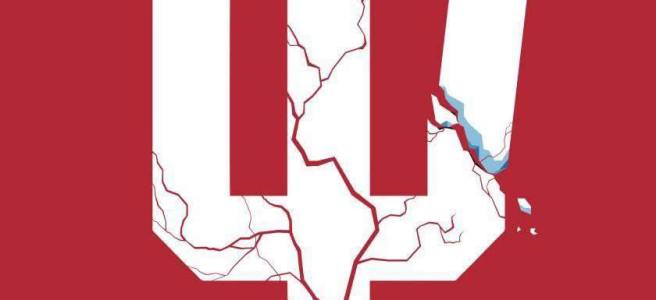
Indianapolis Star opinion writer Jacob Stewart recently argued (July 28, 2026) that the I.U.’s flagship school should be moved from Bloomington to the Indianapolis campus. There is no doubt that Indianapolis has become an increasingly important economic, medical, and technological center. Strengthening Indiana University’s presence there is both wise and necessary. But that need not come at the expense of Bloomington’s historic strengths, nor with and ignoring of the reciprocity between these two communities and institutions over the years..
It overlooks Bloomington’s contribution in supporting these improvements, especially as the primary resource for medical education and research in Indianapolis. Like so much of our current social and political discourse, this presumes a dichotomy, the false choice of one must be destroyed for higher education to thrive. There would be no world class medical education in Indianapolis without decades of focused resources being shared from Bloomington.
Rather than offering the promise of two first-rate institutions, one in Bloomington and another in Indianapolis, with differing strengths as in other state university systems, Mr. Stewart’s opinion assumes there must be a “winner” and a “loser.” It is not only sad and limited in imagination; it also carries within it the seeds of the Vietnam fallacy.
Two centuries of accumulated scholarship, teaching, and public service have made Bloomington one of the nation’s distinguished comprehensive universities. The opinion piece demonstrates limited imagination and misses the remarkable wholistic gifts of Indiana University as a comprehensive university. For Mr. Stewart to reduce Bloomington to a “pretty campus” while failing to acknowledge internationally recognized programs (music, business, public policy, languages, law, humanities, natural and social sciences to name a few and miss so many other places of excellence) is tragic enough. Worse, the opinion piece proceeds as if unaware of the many educational options currently being shredded and destroyed. Respected programs and leaders are being shunted aside with no explanation or clarity as to a comprehensive strategy. The historic ways alumni/ae elected some representatives to the I.U. Board was discarded in a last minute, with blunt force, legislative action that sought to destroy rather improve is overlooked.
The continuing research built on faculty excellence; a research corpus and alumni support cannot be so unilaterally sidelined. Instead of any understanding of higher education’s purpose and value to build up knowledge around what is good, true and beautiful, the recent monolithic project seems to be primarily to tear down. In this model, universities are reduced to being cultural and ideological feed lots with the focus is on producing the fattest bank accounts for the heard upon graduation.
Historically deep intellectual discourse results in vocations offering new insights in living that cannot be measured on a bank ledger. Often those with modest incomes after graduation make the more lasting and wider difference. Those who serve in public safety, research and teaching, faith leadership, or in environmental activities in forestry, water management or agriculture are also significant outcomes. Lives saved, cures discovered, poetry written, poor families finding new pathways to security, music that widens the heart and mind – all hold immeasurable value. Our current era may seek fat wallets as the sole goal of higher education, but our civilization and democracy are based more on the development of personal character and just societal practices enriching and strengthen the entire public.
What troubles me is that the debate over Indiana University is not unique. The same pattern appears whenever institutions become objects of grievance rather than stewardship. Public schools. Libraries. Museums. Public health. Even churches. Instead of asking, “How do we make our core institutions better?” increasingly it appears the question is, “Whom and what can we defeat?”
Democracies are not sustained by grievance alone. They are always under construction. They are sustained by imagination. They require citizens who know history well enough to avoid repeating it, theology deeply enough to recognize the dignity of those with whom they disagree, poetry that enlarges the heart, and music that reminds us harmony is something created—not imposed. Universities at their best exist to cultivate precisely those habits. We should expect them – and our government and academic leaders – to become wiser, more open, and more accountable.
As a graduate of Asbury Theological Seminary (1971) and one who served on the United Methodist University Senate for many years (2004-2012) I am all too familiar with the grievance mongering and binary thinking in an article by Dale Coulter in “First Things” journal.
Dale Coulter’s article promises to “unmask” the relationship between Asbury Theological Seminary and the United Methodist Church. Ironically, what remains masked is the much larger story—the shared history, the institutional changes on both sides, and the gradual replacement of missionary imagination with the politics of grievance. The article illustrates what I have come to think of as a binary grievance machine. Every disagreement requires heroes and villains, victims and persecutors, orthodox and apostate. That machine has been in operation for most of my adult life. The history told becomes selective and all nuance or possibility for cooperation disappears.
There is a sad ignorance in this article as to the history of the relationship between Asbury Seminary and Methodism over the years. My father graduated from ATS in 1944 and was required to do an additional year of study at an “approved school.” In his case it was Louisville Presbyterian. Dad spoke of this additional expectation as an important addition to his pastoral ministry and theology – which remained resolutely Evangelical. Serving on the University Senate, I know the efforts made to welcome a fuller relationship between ATS and the UMC during my years as pastor and seminary president.
This is missing from the so-called “unmasking” article. It was always the expectation that for a seminary to be “on the approved list” it should have UMC faculty, even if adjunct, teach the basic courses for ordination. ATS currently is refusing to do this… and they now want special treatment. Also missing in this flawed “unmasking’ is any admission that ATS has been on its own theological journey in recent decades. It has been transitioning toward a neo-Calvinistic theological stance. In my view, this is as much about the societal culture-wars being fought as it is about either institution’s (ATS or UMC) theology, polity, behavior and consistent practices.
There is no mention here of ATS’s loss of accreditation in the early 1950s for the dismissal of FINE Evangelical scholars like Claude Thompson for social reasons: let’s name one clearly – racism. Doug Fitch, one of the early ATS African American students would share with me the bigotry and abuse he faced at the seminary in those years. Racism and what I would call a cultural imperialism has been all too often a bubbling ugliness just beneath the surface. Look at the makeup of the faculty today – I will say no more. Even with all of this, there was a time when ATS struggled to begin to move in a more inclusive way and I value my experience at the seminary in this regard during those years.
So, it has been more than theology. The UMC is not the only institution going through change of institutional life… or in the case of racial equality on Asbury’s part a reluctance to change. When one compares Asbury with the transitions at another Evangelical school like Fuller Theological Seminary, in terms of seeking to welcome all, Asbury has been left in the dust. Asbury increasingly embraced theological and political commitments that many alumni—including me—believe narrowed rather than broadened its historic evangelical vision. It has opened the door to an easy Christian Nationalism and the use of wedge issues to divide, conquer and reduce the influence of Mainline Christianity in the last twenty years.
There is no mention here of the persistent attacks and push toward schism by always painting ATS as the victim, that have been employed by the Institute for Religion and Democracy or groups like the so-called Good News or Confessing Movements. They provided a perpetual set of dichotomies wherein they were the righteous and the United Methodist Church and/or many of its leaders were the truly unfaithful and intolerant ones. It was an impressive slight-of-hand that avoided the many irenic approaches for cooperation.
There is more, but let me end with this observation and question. My pride in ATS and Asbury University upon graduation in 1971 was the critical and imaginative role they played in missions around the world and the work with the underprivileged in this country. A high percentage of missionaries up to the 1950s and 1960s, in Methodism and many other denominations, were Asburians. We were told, “if you are called to be a missionary don’t stoop to be a king.” The likes of E. Stanley Jones, J. Waskam Pickett, James Matthews, Kilbournes, Corbitts, Seamands, Moores, Stewarts, Laws, Eddys and dozens more come to mind. I knew many of them and was privileged to work with some.
This “unmasking” article misses the tragic shift away from mission toward an ecology of cultural, commercial and political success sought after today. Where did that missional impetus disappear? Why is this change “masked” by all the talk of being a victim? Finally, let me ask it this way, the dismantling of much of USAID’s work has already been associated by many humanitarian groups with increased hunger, illness, and preventable deaths for millions around the world. Where is the outcry from today’s Asbury community and leadership? I can guarantee that those names mentioned above, along with thousands of Asbury-trained pastors, university professors, bishops, medical doctors, social workers, nurses and persons who believed in,, and supported Asbury over the decades are, and would be, appalled by this SILENCE.
Also missing is a recognition is that at bottom this is not a binary situation at all. I remember the fear I had as an Asburian that I would not be welcome – but along my long life, I found my fears were wrongly placed. It was not the UMC that sought to limit me, but my own failure to be open to the ways God is at work in both worlds – Asbury and the UMC. Asbury grads CAN still serve in the United Methodist Church. Like my father or me, they may need to do more study. Those who are open to a place of hope and the welcome of others will be surprised by the welcome that the UMC has for persons. All are welcome to this wider place of service. Asbury’s cultural captivity, let me call it the Babylonian captivity, is what is truly being masked. What is masked is the reality of God’s open-hearted and open-minded way of preparing Christian leaders today and for the future.
The deepest Wesleyan question has never been, “Who is right?” It has always been, “How is my love of God and neighbor being perfected in love?” That question is larger than Asbury or the United Methodist Church. It calls both to move beyond fear, beyond grievance, and beyond the divisions that impoverish Christian witness.
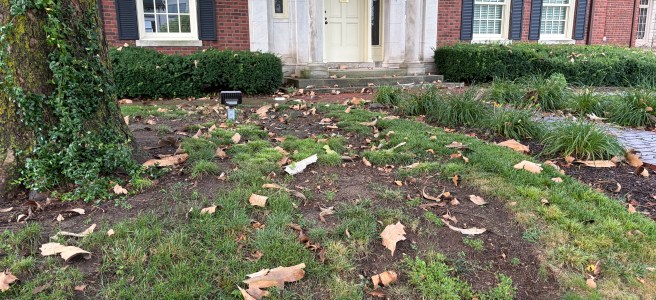
On the Fourth of July another thunderstorm swept across our neighborhood—the fourth storm in less than two weeks. Two of those events carried tornadoes across southern Indiana. This one spared us the worst of that violence, but a great sycamore near our house had shed broad sheets where bark was ripped away. The tree looked skinned, wounded.
I remembered an old children’s story that sycamore trees began shedding bark after Zacchaeus slid down from its branches when Jesus called him by name. Of course, that is not how sycamores work, and yet, like many children’s stories, it tells a deeper truth. Encounters with grace leave their mark.
This Fourth of July came during a season when it sometimes feels as though powerful winds are blowing through our public life as well. Customs once taken for granted seem fragile. Public trust is worn thin. We are told daily to fear one another, to choose outrage over understanding, and certainty over humility. Voting rights are being skinned away from our Constitutional commitments. The deep truths of our history are “being disappeared.” Military officers are being dismissed due to race or sex. The White House and the geography around it are being scarred by foolish bigotries, hubris, greed and discrimination.
Standing beneath that sycamore, I wondered where hope is to be found.
Then I looked down.
Beneath the broken bark, were tiny flowers quietly blooming. They had survived the storm. They possessed no great strength. They had not resisted the wind. They had simply continued doing what flowers have always done.
Their quiet persistence reminded me that the future is often shaped by small things.
We are tempted to believe history turns only on elections, court decisions, legislation, or powerful leaders. Those matter. Yet every healthy democracy also depends upon countless acts that never make the headlines: neighbors speaking honestly, citizens listening respectfully, teachers encouraging curiosity, parents teaching kindness, volunteers serving without recognition, strangers extending grace. Democracy depends on universities teaching for character and integrity — valuing the true, good and beautiful and not bending to the powerful winds of culture or politics while claiming they are bending only to some mythical “institutional neutrality.”
Columnist Thomas Friedman recently observed that our greatest challenge is not simply that we are a divided people, but that we are increasingly being divided by those who profit from fear and suspicion. Division has become a business model.
Yet love has always works differently.
Sometimes it is the small things, the small acts that make a true difference. At Christmas 1956 Joy and Michael Brown welcomed a young friend from Alabama named Nelle for dinner. Nelle worked ordinary jobs in New York while trying to become a writer. Knowing she could not afford to take time away from work, the Browns quietly placed an envelope on the Christmas tree for her. Their gift was not an extravagant amount. It was something far more valuable – time to write.
At first Nelle felt embarrassed. Then Joy Brown simply said, “We’ve seen your writing. We believe in you.”
Years later Nelle Harper Lee said, “All I heard was, ‘Our faith is in you.'”
That simple act became one of the small seeds from which the book “To Kill a Mockingbird” eventually grew.
Perhaps that is how God has always worked.
President John Kennedy kept on his desk a small plaque bearing the words of an old Breton fisherman’s prayer:
“O God, Thy sea is so great and my boat is so small.”
Many mornings those words feel especially true.
The sea before us is vast. The storms are real. Our own efforts often seem painfully small.
But perhaps we ask the wrong question.
Instead of asking whether our single act will change the world, perhaps we should ask whether today we can plant one more seed of hope, speak one truthful word, encourage one discouraged soul, offer one unexpected kindness, protect one vulnerable neighbor. Some days it feels as if our democracy and way of life is being put through a shredder. Where is there hope?
The morning after the storm, the flowers beneath the sycamore reminded me that small things endure.
And history—like the kingdom of God—is often changed not by spectacle, but by countless quiet acts of faithfulness.
Let’s talk about religion and politics. There—I’ve stepped into the deep end of a pool filled with controversy, disinformation, and predictable outrage. I have my ecclesiastical hip boots on, though I suspect they may not be high enough for the flooding of grievance and critique that will come rushing my way.
Even so, I proceed.
At eighty years old, I have spent much of my life as a pastor, teacher, and seminary president. I have seen faith inspire extraordinary courage, sacrificial service, and moral imagination.
I have also seen religious faith in many forms misused—sometimes by institutions, sometimes by clergy, and increasingly by politicians who seem eager to wrap themselves in religious language they neither fully understand nor faithfully practice.
The recent election of Pope Leo XIV offers one example. All too quickly, political voices—including Donald Trump and J. D. Vance—seemed eager to assess whether the new pope’s theology aligned with their own political assumptions.
That should concern all of us.
When politicians presume authority over theology, they reveal how faith has become less a source of humility and more a tool for ideological control.
And then there are the symbols. We have seen golden statues erected in honor of political leaders while some clergy voices insist there is no resemblance to the biblical warning about golden calves. One need not be especially liberal—or especially conservative—to find such spectacles deeply troubling.
But perhaps the deeper problem is our growing addiction to certainty.
I think of Charlie Kirk. His tragic death deserves mourning. It deserves condemnation and accountability. Violence is never a legitimate response to disagreement.
By all accounts, he was sincere and deeply committed to his beliefs. But sincerity is not the same as spiritual maturity.
I spent years working with young seminarians and emerging believers. One of the recurring traits of youthful faith is the conviction that every question has a simple answer and every doubt represents weakness.
But the opposite of doubt is not faith. The opposite of doubt is certitude.
Belief — and even the desire for everyone to believe like you –may be the beginning of the journey. It is rarely the destination.
The most remarkable persons of faith I have known were not armed with slogans. They didn’t use the Bible as a cudgel. They were deeply human, shaped by the mulitple complexities of life. They were people who wrestled with scripture, history, suffering, and mystery. They understood that God is always larger than our political tribes.
To be fair, not every public or political expression of faith is performative. I recall the integrity of Senators like Mark Hatfield, Paul Simon, Richard Lugar, and most recently, Ben Sasse.
We have two candidates running for the U.S. Senate currently who offer an alternative way: James Talarico, a seminarian in Texas, attempts to bring thoughtful faith into public life; Adam Hamilton, in Kansas, has shown that large congregations do not have to be built on grievance and fear.
There are signs that many Americans remain spiritually hungry. Worship attendance has improved since the pandemic. Some younger adults appear more willing to explore questions of meaning and purpose.
I hope that hunger finds fulfillment.
But I worry some are confusing religious visibility with religious vitality.
Too many congregations are closing. Too many seminaries struggle to survive. Too many graduates enter service professions that our economic and political systems discount.
And yet religious rhetoric grows louder by the day.
The late University of Chicago theologian Martin Marty often warned against giving away the store to satisfy whatever the marketplace says religion should become. He understood that faith loses its soul when it becomes a product designed to satisfy popular demand.
That warning feels urgent now.
Faith should challenge power—not seek proximity to it at any cost. Faith should produce humility—not arrogance. Faith should deepen our compassion—not sharpen our divisions.
And faith should never be reduced to a campaign prop, a social media brand, or a weapon used to identify who belongs and who does not belong. America does not need louder religion. It needs deeper faith.
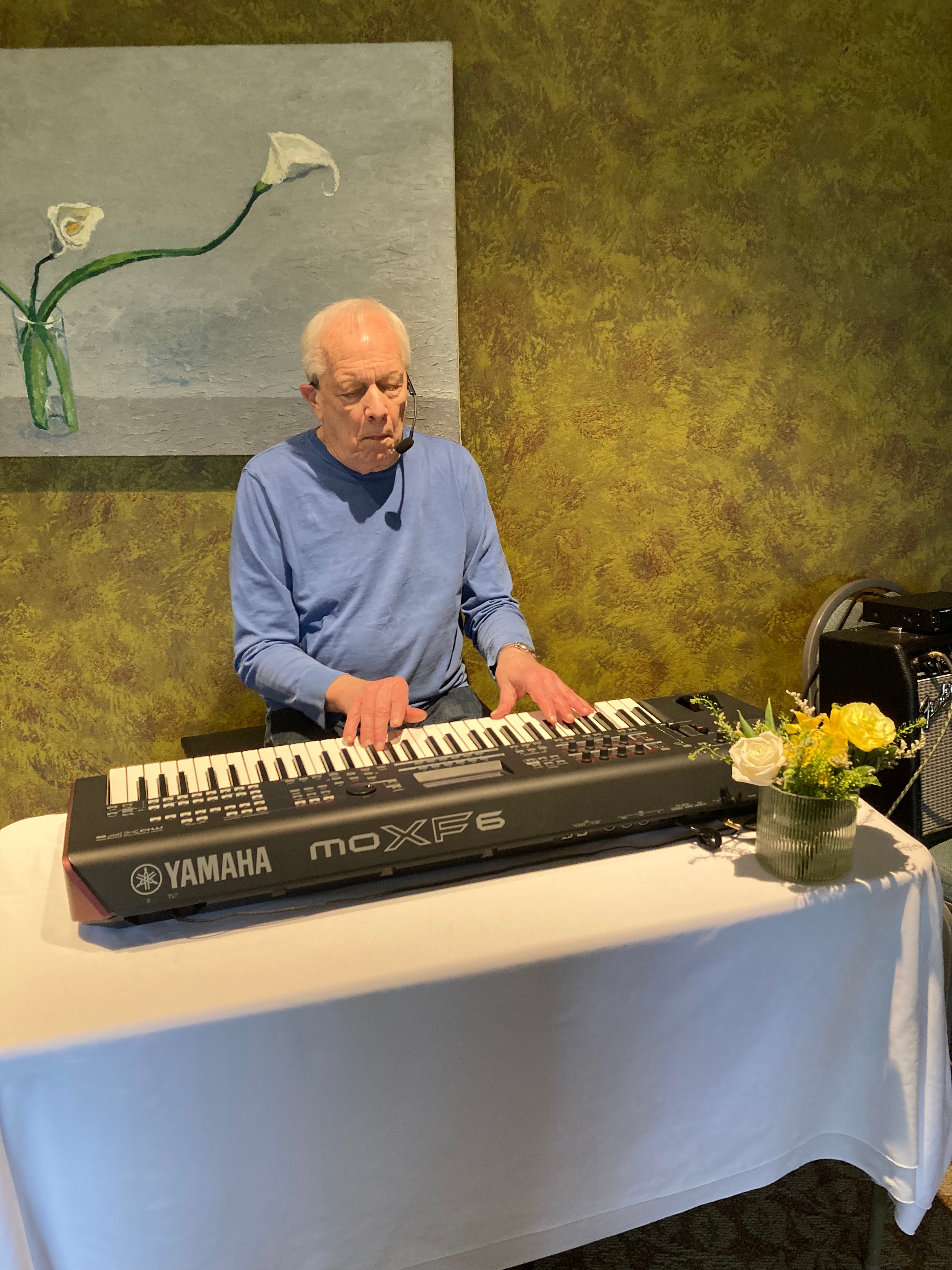
Recently in a retreat with pastors in New Harmony, Indiana, I saw again the power of music to heal and restore. Pastors gathered there told stories about sacred objects in their lives and ministry and the remarkable musician, Ken Medema, would then respond in improvising a song on the spot for each person. Often when the song ended there would be applause, sometimes laughter and other times dancing. On a few occasions, there was sustained silence. We knew we had come to a place of holiness, a thin place, a space where the eternal presence of the divine had touched each one present in that room. It was a sacred time of reflection and renewal. Music gave us space to catch our spiritual breath. Here we begin a series of reflections we will call “Canticles for Parish Ministry.” Below is Psalm #1.
++++++
In the movie “From Mao to Mozart: Isaac Stern in China” the internationally renowned, Polish-born, violinist addresses students in a master class in China: “What is music all about?” Stern asks and continues, “The instrument is only a means to an end; you don’t use music to play the violin, you use the violin to play music.”
I think of the many times I have been fortunate enough to experience the music of God’s people of faith. These stories are abundant… they will be shared in future canticles.
I recall the time a colleague was scheduled to lead a holy communion service early one Sunday morning. He was late; people were waiting; I was angry. Then the few gathered to receive the eucharist heard laughter approaching. Folks were coming up the stairs from the street into the sanctuary. Soon our small group was overwhelmed by the arrival of a dozen or so persons from the neighborhood. My colleague, a young pastor “who didn’t know any better” had shared communion with persons sitting on porches or waiting for a store to open. He then invited them to join us in the sanctuary for the service. You see, a congregation is the instrument, not the music.
Parishes are historically set in geographical bounds but in truth are not limited by space, the clock, or scheduled times of worship. Parishes cut cross the limits of time and space. I know of many small faith accountability groups that were begun over thirty years ago that still gather for meals, support and prayer… some gather weekly or monthly on-line.
Think of the music that baptized the streets of Minneapolis during the winter of 2026. Following the tragic deaths of Renee Nicole Good and Alex Pretti and the shooting of Julio Cesar Sosa-Celis, even then, amid tragedy, there was song. Song from many congregations and from many with no religious commitment at all. During the terror that ICE agents reigned across the metro area, people marched and sang and laughed and gave witness as a choir that could not be muted by violence. Some of the songs had been practiced before in the pews or choir lofts of congregations. Some songs were familiar, but not all. New music was created.
The fortunate pastor knows she is doing more than “playing” an instrument (the congregation) at worship on Sunday mornings or in ministry each and every day. She knows that with enough practice, congregations are made ready to offer up a true and much needed canticle of faith in times of terror and in times of blessing.
In the movie, Stern offers: “Every time you take up the instrument, you are making a statement, your statement, and it must be a statement of faith, that you believe this is the way you want to speak… Unless you feel that you must live with music, that music can say more than words, that music can mean more, that without music we are not alive, if you don’t feel all of that don’t be a musician.”
As pastor, as church member, if you don’t sense a congregation, a parish, can offer the music of the spheres, why be a pastor or member at all? Perhaps the primary task of pastor is to gather resources for the music of and by the parish. In my experience, the best examples of joy-filled music of faith often comes as a surprise after weeks of practice. It is, more-often-than-not, played from the outside in rather than from the inside out.
What is God already doing all around you? Many anxious church bureaucrats seek to save the instruments (congregations) without knowing, seeing or hearing the music, the romance, and the offerings of the people. Many remain blind to the opportunities all around.
Some turn away from an intended democracy of voices among members toward top-down management to control – for the short term. Or they may try quick fixes imported from elsewhere. Maybe they turn to consulting services and coaching projects for “congregational development.” Theseoften completely miss, or filter out the music, that to be heard all around. A false hope for preferring the instrument rather than the music of the surrounding parish. (See Geraldo Marti’s “The Church Must Abandon its Search for the Perfect Formula.[i])
I remember attending meetings where those around the table were asked to share a “glory sighting” experienced in recent days. I understood the purpose. However, it seemed so contrived. It seemed an invitation to limit the real and abundant gifts all around. It was too small in theology, too trivial in scope. One glory sighting only? Each time I was asked for my “glory sighting,” I thought of Elizabeth Barrett Browning’s words:
“Earth’s crammed with heaven,And every common bush afire with God, But only he who sees takes off his shoes; The rest sit round and pluck blackberries.”
We are experienced in turning congregations into instruments to be played while missing the continuing glory all around. There are benefits to “glory sightings” I guess – asking for one sighting may be a start, but it also too often turns into a narrow focus suggesting the pastor is a fixer and the coach is the expert. Congregational revitalization too often is sold as a solution to worried investors (denominational and congregational leaders). It seeks to better play the instrument, without asking what God’s music is, already in the hearts of those beyond these walls. It ends as a selling of premature funeral plans to those deaf to the music of the spheres.
Yale Divinity School theologian Willie James Jennings speaks of visiting a place where despair and futility was the accepted institutional analysis of members. Jennings spoke then of the joy of the discovery of the newness of God’s mercies discovered as the future was seen in new opportunities. He reports that the members came to understand they had been “leaving a whole lot of unused Gospel lying all around!”
When I saw the movie about Isaac Stern’s visit to China, I thought of a comment made by Robert K. Greenleaf, who wrote about Servant Leadership. Visiting with Greenleaf many years earlier he said that being a leader is a little like playing the violin, if you can’t hear the music, you shouldn’t try to play the instrument.
Communities contain the essentials of the ongoing human/divine encounter. They are sustained by people who weave and reweave common lives. These are the ones who live the music. These are the music makers because they hear the music of lives shared in harmony. They welcome an ongoing rebirth of a commonweal, suffused with songs, shared stories, timely rituals, friendships, brokenness, tears, language, homes, economic and social artifacts and so much more. These are canticles of human co-existence. Here is the conviviality of abundant life… lived even in the most horrid of settings.
Our vocations have been often updated by sighting the gifts of reciprocity and mutuality – dialogue, laughter, some tears and the gift of abundant joy and friendship. We have benefitted from the wisdom found in the approach known as Asset Based Community Development and our friendship with many practitioners, especially modern-day prophets like John McKnight and Jody Kretzmann.
We will say more in future Psalms, from The Canticle for Parishes. Stay tuned. Share your thoughts at philipamerson.com.
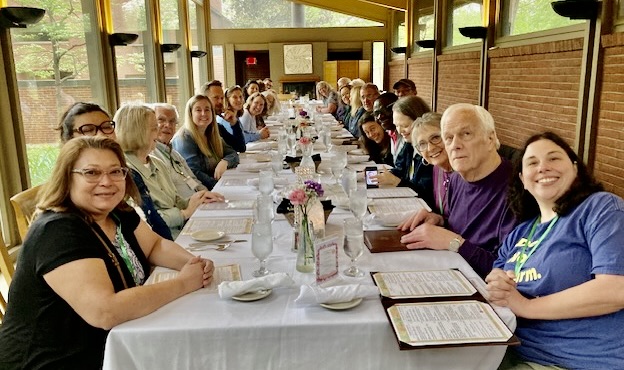
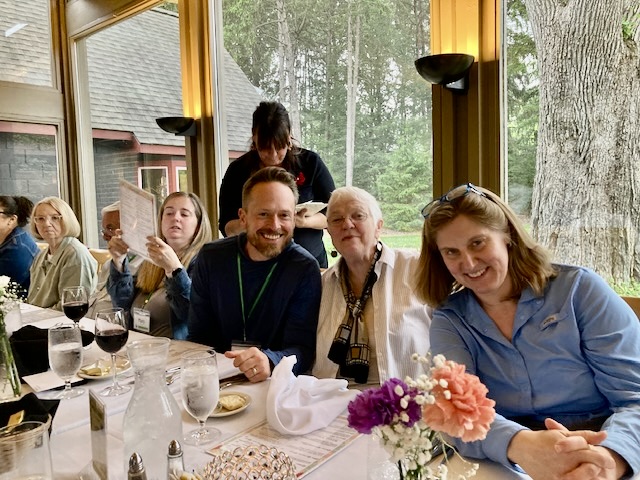
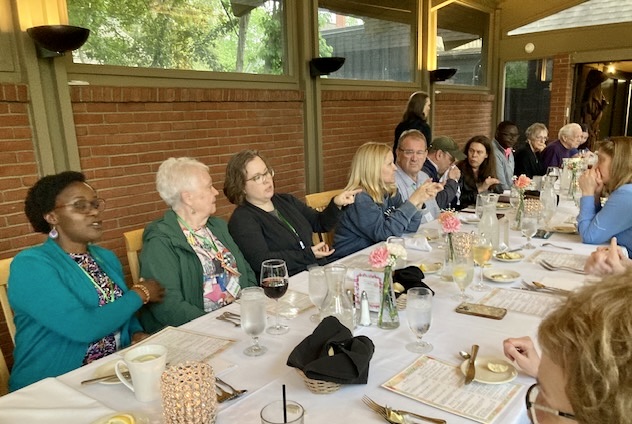
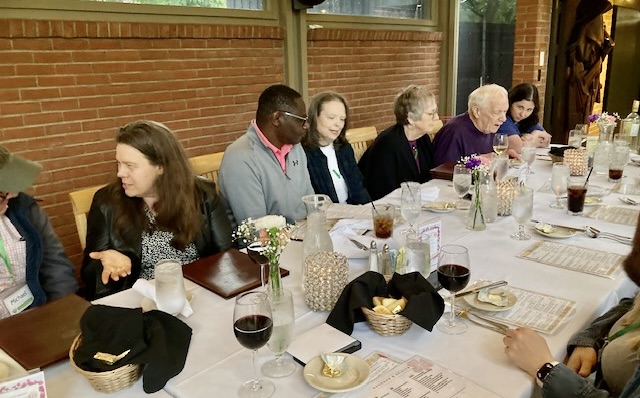
Attached Below are images from the April 2026 We Belong retreat in New Harmony, Indiana. We weere learning the practice of Accompaniment. If you would like to know more about future events you may contact me at phil@belongingexchange.org.
Little Donkey Sunday: this is what pastor Dan Caldwell at the Sacred Heart congregation in Bloomington, Indiana called it. Dan suggested this was a better name for the Sunday before Easter than Palm Sunday. I think he is right. Dan explained the waving of palms was mentioned only in John’s Gospel, but the picture of Jesus mounting a little donkey or colt is offered each of the gospels.
The parade for Jesus took place on the east side of Jerusalem, coming in from the Mount of Olives. The crowd gathered and shouted their hosannas. Jesus, feet dragging the ground, was riding a small donkey. What a picture! Is this a sign of conquest? On the other side of town, the Roman legions were riding their stallions and marching in columns to display their strength. The Romans were there to control any disturbances during Passover observances. One featured a man on a little donkey, a humble king as portrayed by the prophet Zechariah (Zechariah 9:9); the other was a spectacle of might, it was the military power of empire.
Over fifty years ago, my friend, Bill Wiley-Kellermann wrote of these two parades. Bill reminded us then – and now – of these two choices. People of faith face these today. Two divergent understandings of power, strength and right. Some like Secretary of Defense Pete Hegseth pray for “overwhelming violence” against the people of Iran. He marries the strength of empire with a half-baked-Christian-theology that suggests faith is defended by Patriot Missiles. Missiles that smash the homes and lives of innocent people, killing thousands, even children, what power do they display? On the other side of our nation there are the little donkey people. More humble, even silly, these people march in No Kings demonstrations.
Pastor Dan has it right. He helps me as I struggle with the many empires of my world. I struggle to place my faith in the love of neighbor demonstrated by Jesus, riding on a little donkey. I struggle with more than empires of national or world politics. There are the empires of the social service industry, of university leaders who succumb to racism and narrow ideology, of social-media-billionaires with algorithms that do harm, or of religious denominational authorities.
In our religious denominational empires, that come replete with bishops, general secretaries, synod execs, and superintendents there are too few who seem to remember the power of the little donkey. Instead, not all – but too many, march into town parading new structures and corporate plans that are detached from common sense and grass roots relationships. There is little or no listening to those members in the pew. With top-down stylings and business-shaped designs, they hunger to consolidate power. Frightened by a loss of market share, these religious leaders miss the glory all-around of little donkeys ridden by the faithful.
Let me close with Mary Oliver’s poem “The Poet Thinks of the Donkey”
On the outskirts of Jerusalem the donkey waited. Not especially brave, or filled with understanding, he stood and waited.
How horses, turned out into the meadow, leap with delight! How doves, released from their cages, clatter away, splashed with sunlight.
But the donkey, tied to a tree as usual, waited. Then he let himself be led away. Then he let the stranger mount.
Never had he seen such crowds! And I wonder if he at all imagined what was to happen. Still, he was what he had always been: small, dark, obedient.
I hope, finally, he felt brave. I hope, finally, he loved the man who rode so lightly upon him, as he lifted one dusty hoof and stepped, as he had to, forward. + Mary Oliver
+++++++
Too often, I am “tethered by the tree as usual.” That tree is named EMPIRE. I miss the little donkeys and their riders all around me. Might I be brave, along with the donkey.
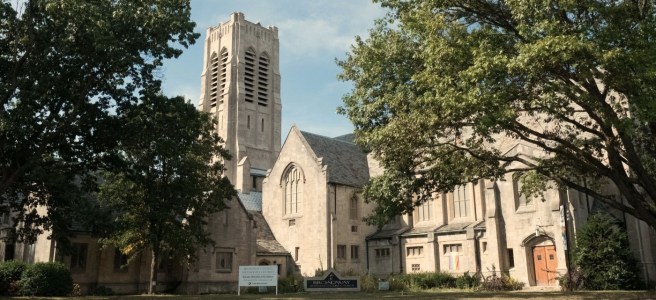
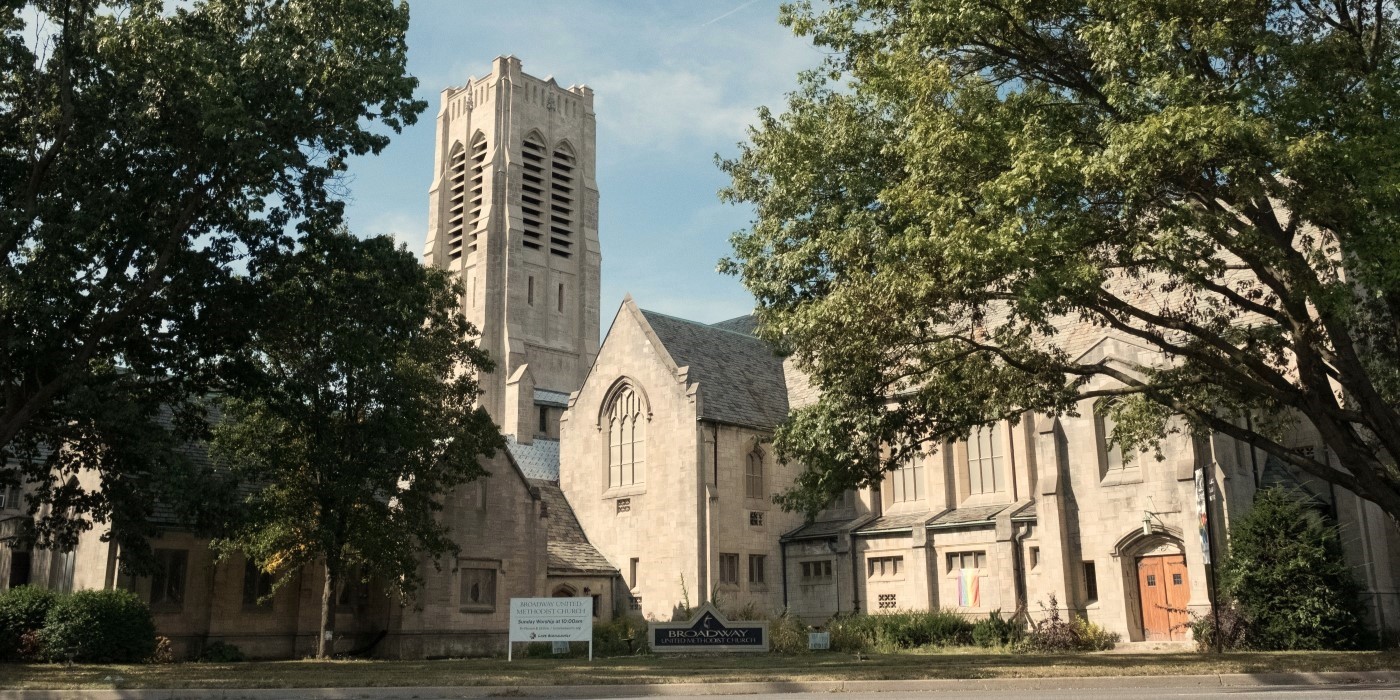
Admittedly naïve, the Christians at Broadway Church in Indianapolis in 1986 wrote: “As followers of Jesus Christ, responding to God’s love, our mission as the people of Broadway Church is to be a multicultural, Christian community that in its ministry seeks, welcomes, and values ALL people.” We knew it was a challenging aspiration, none-the-less the choice was to be a church that said it welcomed everyone – and acted like it. No matter. Everyone.
That congregation hasn’t done it perfectly, but over the decades it has claimed this mission. Still does. Yes, we were naïve, about our society, our world and the human condition… or were we?
Life would teach many lessons, some hard ones. The power of tribalism and fear-stoked resentment has too often overridden respect for all. It has even undermined alliances among western nations. Today we see bigotry and discrimination, dressed up as ICE agents with masked faces and camouflaged outfits, terrorizing our cities. Such threatening realities appear to trample on that simple mission statement.
Naïve? Surely so. Wrong as a witness to the love your neighbor message of Jesus? Not so then, not so, now. The Apostle Paul wrote of this in the earliest years of the church: “In Christ’s family there can be no division into Jew and non-Jew, slave and free, male and female. Among us you are all equal. That is, we are all in a common relationship with Jesus Christ. Also, since you are Christ’s family, then you are Abraham’s famous “descendant,” heirs according to the covenant promises.” (3:28-29 as rendered in The Message).
Twenty years ago, columnist David Brooks wrote of the coming death of multiculturalism. https://www.nytimes.com/2006/04/27/opinion/the-death-of-multiculturalism.html. Brooks spoke of what he saw as the excesses of multiculturalism where diversity was too easily celebrated and sometimes prevented true openness to all voices. He predicted multiculturalism would pass and we would see a “rebirth of liberal American nationalism.” I wonder what Brooks would say today of the trajectory he offered then?
Whether one points to the multiculturalism displayed in the Ruth and Naomi story, or to the multiple ways Jesus of Nazareth broke and transformed deep patterns of race, class or religious exclusion, or to the Pentecost events, multiculturalism and faithful Christian practices are intertwined.
At Broadway, shortly after that mission statement was written, a longtime member told me that grand old building of stone and stained glass might one day be gone, it might be razed, but the gift of knowing others who differed in a community of acceptance could never be erased. Perhaps that congregation at Broadway was not so naïve. It continues today as faithful to its mission. So do thousands of other gatherings and activities in the name of Jesus around the world. Naïve? Perhaps, it appears so, in the short term. However, as Eugene Peterson suggested, Christians are called to “a long obedience in the same direction.”