First, Confess The Sin of Racism

It is a clarifying moment… The x-rays are back from this laboratory. These hypothetical x-rays come from Super Tuesday of the 2016 presidential primaries. And what can be seen in these images? There it is — the often hidden, not-so-attractive, practices and support of racism. Surprisingly this racism comes from those who call themselves Evangelical Christians. It is painfully clear. Support for racial bigotry and discrimination is all too apparent in the way they vote and self-identify.
The voters have spoken: Donald Trump won seven of the twelve primary elections in states. He claimed the largest percentage of the so-called white Evangelical voters. Just hours before these elections Trump dodged questions about support he was receiving from the Ku Klux Klan and David Duke, a well known white supremacist. In what has become a typical media ploy, after he winked his appreciation for the racist support, Trump then changed his tune, saying that he had always opposed racism and, in typical form, he attacked the media saying that he was again being mistreated.
Can there be any doubt that behind the scenes and often breaking into the open racism has been employed to weaken the presidency of Barack Obama? Like many things, few people are as articulate in identifying such realities as is poet, novelist, conservationist Wendell Berry.

Berry writes: “A good many people hoped and even believed that Barack Obama’s election to the presidency signified the end of racism in the United States. It seems arguable to me that the result has been virtually the opposite: Obama’s election has brought about a revival of racism. Like nothing since the Southern Strategy, it has solidified the racist vote as a political quantity recognizable to politicians and apparently large enough in some places to decide an election…
Nobody can doubt that virtually all of the President’s political enemies would vehemently defend themselves against a charge of racism. Virtually all of them observe the forms and taboos of political correctness. If any very visible one of their own should insult the President by a recognized racial slur, they would all join in the predictable outrage. But the paramount fact of this moment in the history of racism is that you don’t have to denominate the President by a recognized racial slur when his very name can be used as a synonym.” (Wendell Berry, Louisville Courier-Journal, September 15, 2015. See more at: Berry, Revival of Racism.
I was stuck by a recent report from the Southern Poverty Law Center that provided the recent history of active hate groups in the United States. During the first eight years of the twenty-first century there were roughly 150 groups such as the Ku Klux Klan, White Nationalist, Racist Skinhead, and Neo-Nazi. Their numbers changed very little in the period between 2000 and 2008. However, in 2009, following the election of our president, the number of hate groups rose to over 500 — and today there are nearly 1,000 such groups in the United States!
I am not saying that white Evangelicals are all racists. Still it is more than a little suspicious that there is not more resistance among these folks to Mr. Trump’s dog whistle to the racist fringe. I still remember visiting a family farm, shortly after the election of Mr. Obama. These were good people, church going folks, active in state politics. I have known them for years. As we talked my friends began to share email “jokes” about our president. The language was crude, ugly, bigoted and demeaning projections. It was raw, blatant racism in the depiction of our president. I was stunned — didn’t join in the laughter and spoke only a halting word of disagreement. In hindsight, I wish I had said more. In hindsight, I understand there are such “God fearing” folks and how they could vote for Mr. Trump.
In his insightful study One Nation Under God Kevin Kruse of Princeton University outlines the way the Christianity shifted in the twentieth century to become a public spiritual spectacle, useful to politicians and corporate leaders to pursue their goals of power and wealth. Kruse cites William Lee Miller of Yale Divinity School who spoke of the American people who followed their president, Eisenhower, and “had become fervent believers in a very vague religion.” (Kruse, p. 68) Or, as Robert Bellah put it, “Is this not just another indication that in America, religion is considered a good thing but people care so little about it that it has lost any content whatsoever?” (Kruse, p. 68) This vague religiosity has been filled with many things — and as Evangelicalism has gained ascendancy too much of the “vague” content has been long on self concern and short on self criticism.
The vague content of American Christianity — Evangelicalism in this case, has been filled with patterns of thought and behavior that have almost no connection with the message or life of Jesus the Christ. In fact, the vague content has been filled with shabby self indulgent understandings that are amazingly at odds with the Sermon on the Mount or the Lord’s Prayer.

What would a beliefs x-ray show about a person’s real commitments?***
I do not seek to salvage this word “Evangelical.” The damage, the identity theft, has been done. Such a project belongs to others. Thankfully, they are already at work and know it will take generations to correct what has gone amiss. As suggested in an earlier post, these elections provide an x-ray into the flawed theological and faith perspectives of such Evangelicals. Sadly, the x-ray comes back saying the illness is at a critical stage. This religiosity is shaped more by culture, history and prejudice than it is by the scriptures or sound theology. Honestly, it is more a folk religion than a coherent faith practice.
What are we to do? What is the church to do? In his column, “The Governing Cancer of Our Time, ” David Brooks speaks of the rise of authoritarianism (Brooks, Governing Cancer). Over forty years ago, I served as part of a national research project on the church and racism. In this work we discovered the connections between authoritarianism, status concern and racism in its various forms. The question became how should the church, the People of God, respond?
We learned three important things:
- The church — especially the leaders in the church — must say NO to racism. That which is obvious and that which is more subtle. I wonder what difference it might have made if religious leaders and political leaders had stood up against Mr. Trump’s “birther” comments in 2008, or every year since? One can’t help but think that the current dilemma of the Republican Party was brought about by their own silence and disrespect all along the way.
- Sermons and study groups alone have little effect on changing racist attitudes or behaviors. (Sorry about this preachers and teachers.) However, when sermons and education are combined with activities that engage parishoners with persons of a different race, especially activities that seek cooperatively to address racism, real change is possible. We saw it in Chicago, South Bend, Fresno, Dallas and Los Angeles.
- Finally, a denomination’s commitment or congregation’s commitment to battle racism can be measured by the way budgets are made and expended. In 1974 we found that almost all congregations reported they spent more on toilet paper or light bulbs in a year than they did on efforts to address racism. Nothing much has changed over these four decades in this regard!
Silence. Vague content to our faith. Low commitment to change as evidenced in our practices and budgets. These things, good reader, may be among the reasons for our current embarrassment.
Phil A
++++++++++++
Attributions:
-
*Women viewing x-ray. Copyright: http://www.123rf.co/profile_rmarmion’>rmarmion / 123RF Stock Photo</a>.
-
**Photo of Wendell Berry from newsinfo.iu.edu, (Indiana University media)
-
***Simulated x-ray of brain. Copyright: <a href=’http://www.123rf.com/profile_scottff72′>scottff72 / 123RF Stock Photo</a>




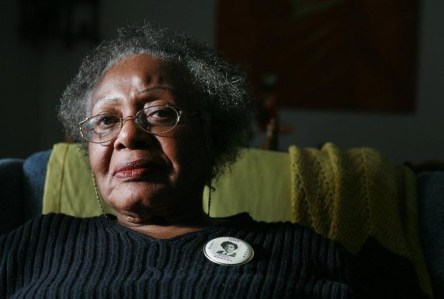
 My friend La Verta Terry taught me much. Mostly, she tried to teach me to speak the truth about difficult things with grace, elegance and style. I will never match her in this; but often I can hear her voice in my head cheering me on. And, like many of my dearest friends, she knew how to be a loving critic if I said or did something she thought might have been handled better. LaVerta, lived on the other side of the white-privilege Harper wrote about. They both knew the bitterness of racism and shaped beauty and meaning from the ugliness.


 The honest answer is NO. Absolutely not. I remember well the campaigns of George Wallace, Gene McCarthy, Ross Perot, John Anderson, and I remember my high school infatuation with Barry Goldwater. None of these are comparable. This is a time when facts seem to matter little. Anger, make that rage, is in vogue.



 No, it is not my call to determine whether Donald is a Christian… but we do know a great deal about who and what a Christian is expected to be from the scriptures and the great traditions of the church. Racism, bigotry and calls for revenge displayed by too many just don’t square with the person and teachings of Jesus. Right now — as we gain knowledge about others, equal care needs to be given to thinking clearly about what it means to be a Christian. Certainly the calls to exclude persons from the United States based on a religious test is unconstitutional. That is easy. For me, however, it is more important to ask, is it Christlike?