There are multiple reasons to ignore the Republican National Presidential Convention this week: Hurricane Laura battering the Gulf Coast; unrelenting wildfires in California, the death toll from the coronavirus passing the 180,000 mark, as millions of students from kindergarten to graduate school return to classes — and others face months of isolated online learning; concerns about future postal service as persons wait for needed checks and medications, another young black person, Jacob Blake, shot by police — this time shot in the back, seven times — and the streets of Kenosha, Wisconsin erupt in protest. Plenty of reasons to ignore the GOPs made-for-reality-television episodes.
Balcony in Barcelona, 2018
It can be overwhelming. Each of these tragic events deserves attention, human care and response. There are so many threats as so many innocent people face unexpected, life altering events.
Two images come to mind as I watched the Republican National Presidential Convention. The first is a balcony curtain seen in Barcelona two winters ago. It was, to my eyes, a delightful piece of whimsical art: two hands appear to be pulling back the curtains on a balcony. It represents the joy of discovering what might otherwise be hidden.
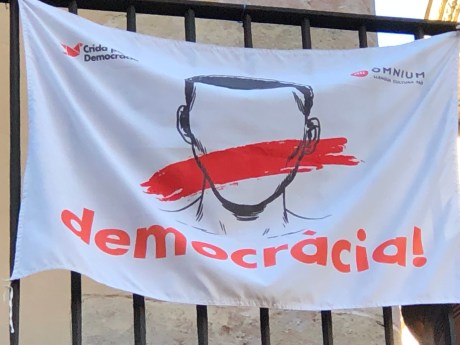
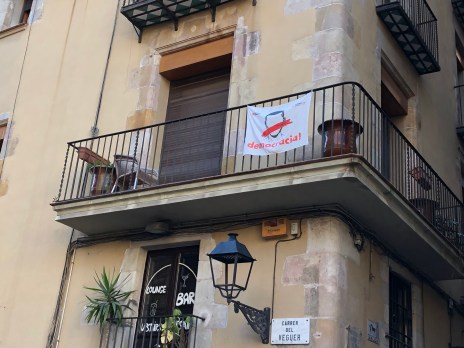
The other image is a photo taken on the same day in a nearby neighborhood. There were dozens of these banners, hanging from balconies and roof tops. The image is a blank face where a mouth has been smeared over and the word “democracia!” is printed below.
Democracia! This is a cry heard round the world in our time. From Hong Kong to Belarus to Damascus to Louisville and Kenosha the cry, too often muted and all too real, rings out.
As I watch snippets of the made-for-television Republican convention, there is little mention of the multiple tragedies that surround and threaten to overwhelm. In fact, these calls for democracia are not mentioned.
Folks are paraded in front of the cameras — grifters, cons, wanna-be-future-presidents. There are folks who seek profit or status by supporting the forced alternative reality that is being sold from the platform of fear and grievance. It is a world deconstructed of truth; a world of scarcity that is broadcast by folks who have more than enough.
All aimed at good persons, who have bought into conspiracy theories because they fear the future and, like too many people all across the world, they are willing to put their trust in a totalitarian idea… No worse yet, trust is put in a totalitarian and narcissistic man. He actually suggests we shouldn’t believe what others may say or think — trust him only as a source of truth. Forget science, ignore history, avoid moral thinking apart from a few made for grievance and simplistically answered dilemmas. He who, though you know he cheats and manipulates, still claims to be the one to bring the order and easy solutions you hope will one day come.
Truth is turned on its head — the immigrants who bring talent and a willingness to work are turned into the enemy. Young people who seek justice and protest out of conviction are turned into rioters. NATO becomes our enemy and Russian operatives who seek to undermine our common well-being are turned into our friends. After all, the supreme leader sends love letters to the North Korean dictator and speaks fondly of the tyrant in Turkey. He is “doing foreign policy differently” we are told and any appeal to human rights disappears. The scriptures are not read or studied; no. The “holy book” is but a symbol, a prop; it is held up like some talisman that can block out the truth contained in the great and true counter narrative within the book.
The idea that there is only one person who can fix things, all of the social disarray around is what this man openly stated four years ago. Today, in the United States the true believers are the Trumpists. Who would imagine, who could imagine, a political party that decided it needed no plans for the future, no party platform, especially when tragedies abound? Who could imagine? Would someone please pull back the curtain and let the realities of our situation be made apparent. Might “we the people” discover it is essentially our shared, widely enacted, response that can begin to bring renewed health and hope.
There are also well meaning, sincere folks. Persons I think of as “the genuine articles” who are given a cameo performance on the GOP stage. They have bought into the big lie. The lie that the world is an either/or place. Either you are with the supreme leader, and that is the only way to fix things, or you will lose your place of security, of status and order. There are multiple alternate paths for a people who might seek truth together; however we will have to work with persons who see some parts of reality differently. Pull back the curtain. There are options to being a Trumpist. It will require pulling back a curtain to see that those who differ are also Children of God, like you? The Trumpist wants to say all who differ are “socialists.” Such astonishing, deceptive, untruthful language is repeated over and over until good people believe the lie.
Democracy means we will have to work with others to solve the complex real world problems; we must, in fact, do it together. I so value the good folks who seem stuck in this trap of binary thinking — they are my neighbors, my friends, my family. Still, my reality is that our democracy is now being smothered.
It is like a giant pillow of grievance and fear is forced down across the face of our body politic. There is not room for protest, dialogue, compromise. As Bill Moyers put it “A democracy can die of too many lies. And we’re getting close to that terminal moment, unless we reverse the obsession with lies that are being fed around the country.” (See Bill Moyers on Truth).
A Call for Antiracist Commitments by Indiana United Methodists
Date: August 17, 2020
Dear Friends,
At the August 15th session of the Indiana Annual Conference the following motion was referred for consideration: “In preparing the 2021 budget for the Indiana Annual Conference, the Conference Finance and Administration Commission will set aside 10% of future program ministry budget(s) for antiracism work.”
Rationale: We have reached a kairos moment in the life our nation and church. Ours is a time of opportunity, transformation, and an occasion to clearly and directly address the enduring racism that besets our nation, state and church. In truth, racism is embedded in all of our systems: education, medicine, commerce, housing, law enforcement and, most tragically, even the church.
This motion to aside a tithe of conference program budget for antiracism efforts is an opportunity for United Methodists to lead in this critical work. It would demonstrate again our witness to racial justice through positive and constructive actions. We would thereby demonstrate our commitment to follow the Christ who welcomes all without reservation. Sadly, more than the vestiges of racism survive in our body. Racism continues to reshape our practices, our ministries and our structures. By wide majorities our members live and worship in racial enclaves. Membership reports, programming and attendance records since the beginning of the United Methodist Church in 1972 offer abundant evidence of our failure to extend our denomination’s welcome very far beyond that of being a church primarily focused on ministry with and for Whites. At the same time the racial and ethnic diversity of our state has greatly expanded while our percentages of persons from differing racial groups remains small.
This is an evangelistic and missional dilemma – and an opportunity. If Indiana’s youth see our church at all, there is scant evidence that Indiana United Methodism is modeled upon the beloved community of Jesus, where all are welcome. Antiracist commitments are seldom displayed, whether in camping, leadership initiatives, or church development programs. It is painful to ask the question, Where do we invest our dollars and our lives in specific and clear ways that confront the sin of racism in our society and in our own church? Persons of Color now make up more than sixteen percent of Indiana’s population, while our membership percentages of non-white persons is somewhere between three to five percent.
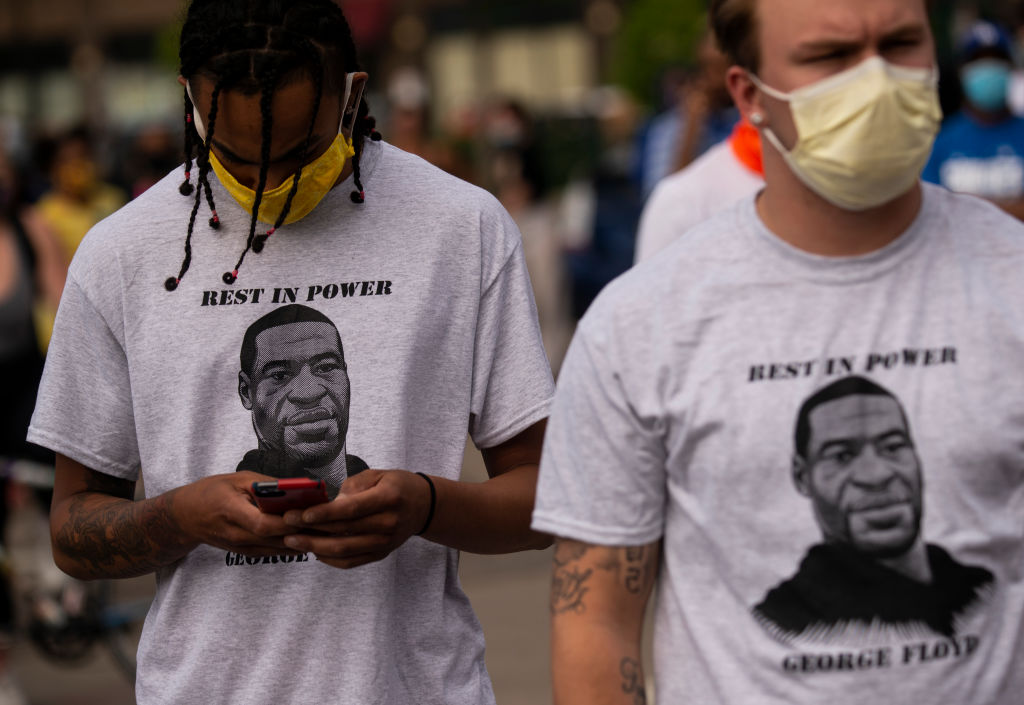
MINNEAPOLIS, MN – MAY 27: Two men wear shirts stating “Rest in Power George Floyd” outside the Third Police Precinct on May 27, 2020 in Minneapolis, Minnesota. The station has become the site of an ongoing protest after the police killing of George Floyd. Four Minneapolis police officers have been fired after a video taken by a bystander was posted on social media showing Floyd’s neck being pinned to the ground by an officer as he repeatedly said, “I can’t breathe”. Floyd was later pronounced dead while in police custody after being transported to Hennepin County Medical Center. (Photo by Stephen Maturen/Getty Images)
Tragically, it has taken the murders of George Floyd, Breonna Taylor, Ahmaud Abery, Elijah McClain, Sandra Bland, Tony McDade, Christian Cooper, Treyvon Martin, Eric Garner, and dozens of others, to awaken our nation to the profound violence and daily bigotry against African Americans. These murders, and dozens of others, are the most dramatic examples of the ways an acceptance of racism contributes to a societal assault on human decency. Indiana United Methodists have been far too passive. This is not a time to claim neutrality or blame some other forces for our tribal and de facto segregated lives. It is not sufficient to simply claim to be “non-racist.” This is a moment of gospel opportunity. This is, potentially, our Kairos moment, when the United Methodist Church in Indiana, can be true to the best of our history, our Evangelical theology, and our better angels. This is our time to act in bold, antiracist ways.
Fifty years ago, James Baldwin wrote “I will flatly say that the bulk of this country’s white population impresses me, and has so impressed me for a very long time, as being beyond any conceivable hope of moral rehabilitation. They have been white, if I may so put it, too long.” (New York Times, February 2, 1969)
Robert P. Smith’s book “White Too Long: The Legacy of White Supremacy in American Christianity,” published only this summer, draws on Baldwin’s perception. Smith’s research is both a deeply disturbing and helpful resource for Christians who seek to take the next steps in confronting the sin of racism. While much of this research is based on Smith’s own Southern Baptist background, there are ample illustrations for United Methodists and other mainline folks. Clear evidence of our racist complicity and our deeply embedded racist-worlds-taken-for-granted behaviors is provided. Fortunately, there are also examples offered of the ways congregations and judicatories have moved from simply talking about racism to taking specific steps to act in constructive and restorative ways to repair what has been broken and reach out in life giving ways.
This motion, offered and referred on August 15, is a call for the Indiana United Methodist Church to give witness and take responsibility for the damage done to all parties, Blacks (along with other “minorities”) and damage to Whites as well, for too long. It will require more than preaching to change prejudiced attitudes or attending workshops on inclusion and diversity. It will require more than a few token examples of racially integrated vacation church schools or charity work with the poor.
Antiracism work will involve structural changes, new partnerships and a stepping away from the paternalism that has shaped many of our ministries. This is a time for seeing the remarkable gifts and resources brought by persons of color already within our churches and in the neighborhoods and communities surrounding them. It is an opportunity to establish a new template for the long-term health of our congregations and conference that is marked by including new persons and groups. Such renewal work will require decades of effort and resources. It will be, however, a key investment in a stronger and healthier future for the church.
In earlier conversations, I have been appropriately reminded that Bishop Trimble does not need our counsel, advice or wisdom in matters regarding racism so much as he needs us to put action behind our words of hoped for racial reconciliation. I do not claim to be an expert so much as a long-time observer and a follower of Jesus; I am one who is captured by the hope of the gospel. Do I think such a change in the budget is easy or likely? No, and probably not. Even so, I believe a tithe toward antiracism ministries is essential to matching what we say with what we do – and to sustain United Methodism’s witness in the future.
How might this be done? There are dozens of ways our pastors and lay leaders can, and I believe would, respond to this call. Many more ways than we can imagine. Attached is a page of “possibilities” that briefly offer ideas for positive antiracism work in Indiana. Prayers for you and with you as you contemplate how best to respond to this time that calls for our repentance and action.
Sincerely,
Philip A. Amerson
+++++++++++++++++
Ten Examples of Potential INUMC Antiracist Activities
There are dozens of ways Indiana United Methodists can act in antiracist ways. These could begin to repair damage done over the decades by racial violence and brokenness. Such actions might be mixed and matched together through study, travel, outreach, witness, etc. A tithe from our conference program budget might:
1) Reestablish the work of a Commission on Religion and Race in the Annual Conference with funding for such work for the next decade.
2) Join with our United Methodist Hospitals and other health services in direct, hands-on and prayer-supported, engagement to address the high rates of infant mortality in Indiana. This is something that is particularly a problem in our minority communities.
3) Offer annual updates and workshops on the racial makeup of our congregations and populations in each county in a district. This would offer new insights for persons who mistakenly believe there is “no diversity in our community.” Several counties have seen significant increases in Hispanic and other non-white populations in the last decade; still many in our churches seem not to be aware.
4) Provide resources for at least two annual gatherings of persons of color in the conference, pastors and laity. Mostly they would get to know one another. Another goal could be to monitor conference actions; or another goal might be to design “learning journeys” with white clergy and laity where they could spend time in prayer, reflection, learning and planning for the future, together.
5) Review and update existing conference programs, in consultation with African American, Hispanic and Asian educators to offer more racially sensitive and appropriate approaches to strengthening our education, outreach and evangelism. Persons like the Rev. Vanessa Allen-Brown or Mr. De’Amon Harges and Ms. Seana Murphy of The Learning Tree in Indianapolis would offer valuable assistance.
6) Encourage every congregation in the conference to establish a partnership with another congregation or group of persons from a different racial or cultural background. This might include regular ways to fellowship and worship with Indiana AME, AMEZ and CME congregations. One can imagine how remarkable such gatherings these might be if guest lecturers shared insights regarding antiracism options.
7) Read, study and travel with others. For example, read the books by Bryan Stevenson (Just Mercy) and Robert P. Smith (White Too Long) and take a trip to the National Memorial for Peace and Justice in Montgomery, Alabama Or, read Jim Madison’s book on the Klan in Indiana and visit one of the sites, perhaps with a video or face-to-face conversation with Professor Madison.
8) Join the Community Remembrance Project sponsored by the Equal Justice Initiative to offer witness at each of the seven known lynching sites in Indiana. These are recorded at the National Memorial for Peace and Justice and a part of the Community Remembrance Project that seeks to set a Historical Marker at each site. There is also a gathering of the soil near each site to be placed on display along with the victim’s names at the museum. Wouldn’t it be “GOOD NEWS” to report that it was the UMC in Indiana that saw memorials placed and services of repentance held in each of location of a lynching.
9) Identify places where racism has damaged our witness (such as the troubled cross racial appointment at Old North Church in Evansville in 1985 or the closing of City Methodist Church in Gary) and/or locations where we once had a congregation of color that is now vacated. Hire persons to document these stories and/or share with the conference materials that are already available giving preference to researchers who are persons of color. Work with pastors in these settings to hold gatherings of repentance and reconciliation.
10) Ask the Indiana United Methodist Historical Society to research and publish a fuller account of the connections between Indiana Methodism and the Ku-Klux Klan, especially in the early 1920s. (In his 1994 United Methodism in Indiana, John J. Baughman wrote: “Particularly awkward was some local Methodist support for the infamous Ku Klux Klan in Indiana in the 1920s. Even now this is a no-no subject within the denominational history.”) Knowing this history, painful as it may be, can lead to honest acts of repentance and restoration. It is likely that several of our congregations could benefit from an honest knowledge such a history.
“Racial Prejudice is a sin.” So reads the lead sentence in an ad from a well meaning Christian institution. Yes, it is! “Good,” I thought. “Not sufficient,” was my second thought.
The ad was announcing a new educational program. Daily I read of a new degree program, or certificate, or workshop on racism. There are programs featuring inclusion and diversity; some offering cultural awareness. Good — many in our nation have been woke to our nation’s prevailing racism. Then, again I think, not sufficient.
Anti-racism work involves more than addressing individual prejudice, or practicing inclusion, or graduating from diversity training. The deeply embedded racist practices, white privilege and enduring structures of our society require more than changing bad attitudes or reorienting mental categories. I am helped by Isabel Wilkerson’s recent argument that our society is, in reality, a caste system.
In my tradition, the prayer for each day begins “New every morning is your love, great God of light, and all day long you are working for good in the world. Stir up in us desire to serve you, to live peacefully with our neighbors, and to devote each day to your Son, Our Savior, Jesus Christ the Lord.” Once woke, there is the need to keep awakening.
Setting aside my unpleasant thoughts about the marketing and commercialization of programs to address racism, it is clear that antiracism work will require more than a new curriculum, or a certificate or registration for a webinar. If we are to continue movement toward the Beloved Community we will be required to do some major overhauls, yes personally, but also in our institutions and economies.
As I have come to realize, over and again, my personal confession and repentance is only the prelude to a life-long reorientation. Recently I was asked if I was suggesting there is need for a “continual conversion.” In short, YES. As one friend suggests, this is “one-hundred-year-work.” It is as Eugene Peterson reminds us “A long obedience in the same direction.” Antiracism requires sustained commitment to institutional and cultural change. If you thought differently, I want to disabuse you of belief in any easy path. This is to say those eight week or eight month programs are… well, a small, good beginning, but only that.
In ways too numerous to list, we will always be learning, confessing, repenting, and re-imagining our common life and its institutions. In our podcast/videocast, Mike Mather and I suggest this lifelong commitment will involve Remembering Community — remembering our common Beloved Community.
While we don’t offer a certificate, a degree program, or a $135 workshop or webinar, Mike Mather and I invite folks to listen in and join the conversation. We are reflecting on our own racism and the deep caste-like patterns with which we have struggled in our ministries — personal, institutional and cultural. In the weeks ahead we will be looking at this along with the many stories from parish and community ministry.
In this weeks episode we speak of institutional racism, and of how two remarkable African American women, Hertha Taylor and Sadie Flowers, each acted in creative and joy-filled ways. Our call is to remember folks like these and to venture beyond the comfortable formats of small projects in “helping others,” that so many assume to be best. You can watch the video at: https://www.youtube.com/watch?v=sbFkguEMsSw.
We are “two old white guys.” United Methodist pastors with over 90 years of parish experience between us. In the attached podcast we think about racism and anti-racist work. We laugh, we confess our failures and we acknowledge the joy of ministry in places of diversity. Over the years we have spoken of the romance of work in a parish and its surrounding community. Here is a taste of what we have discovered.
If you find something here that parallels your journey — or even if there is something helpful, or something with which you disagree — make a comment, share your story.
Change, transformation, renewal, conversion are a part of the religious lexicon that is, I believe, too often lost in our time. In all of the calls for justice, it might be wise if we were open to considering the importance of transformation. Not just for those we believe to be wrong — but perhaps most importantly for ourselves.
In a recent United Methodist People podcast, the Rev. Dr. Brad Miller hosted a conversation with Indiana United Methodist Bishop Julius Trimble. If you are interested it can be found here: (http://Apple Podcasts:http://bit.ly/UMPeoplePodcast). I tell of something that happened nearly forty years ago am newly aware of the ways my heart and mind has been changed — and, I pray, continues to be reshaped by God’s transforming love for me and for all.
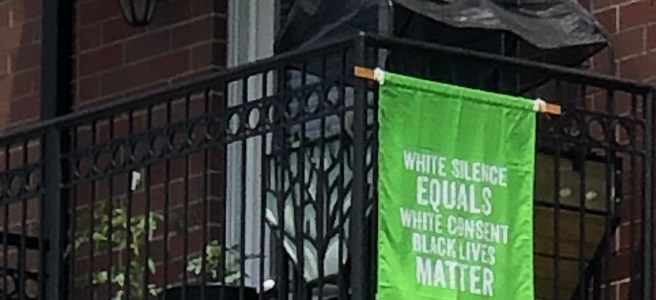
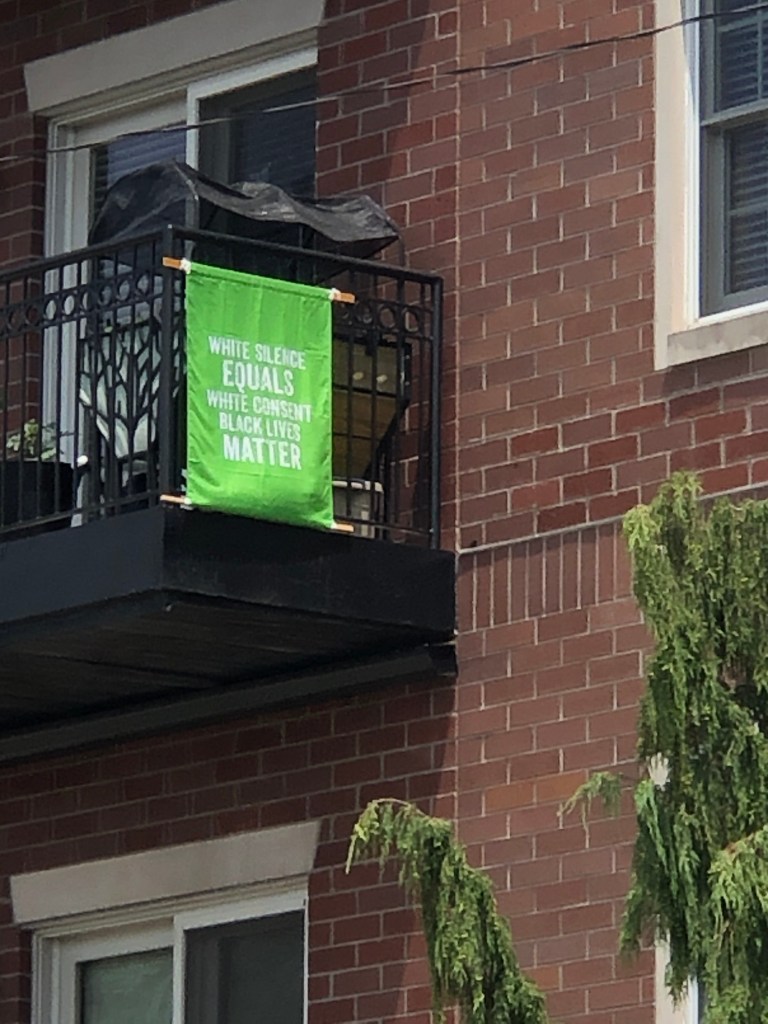
It is a tiny statement really. Our family’s banner during these days. It is a symbolic witness we make without leaving home – it is a banner hung from the patio of our condo. It reads:
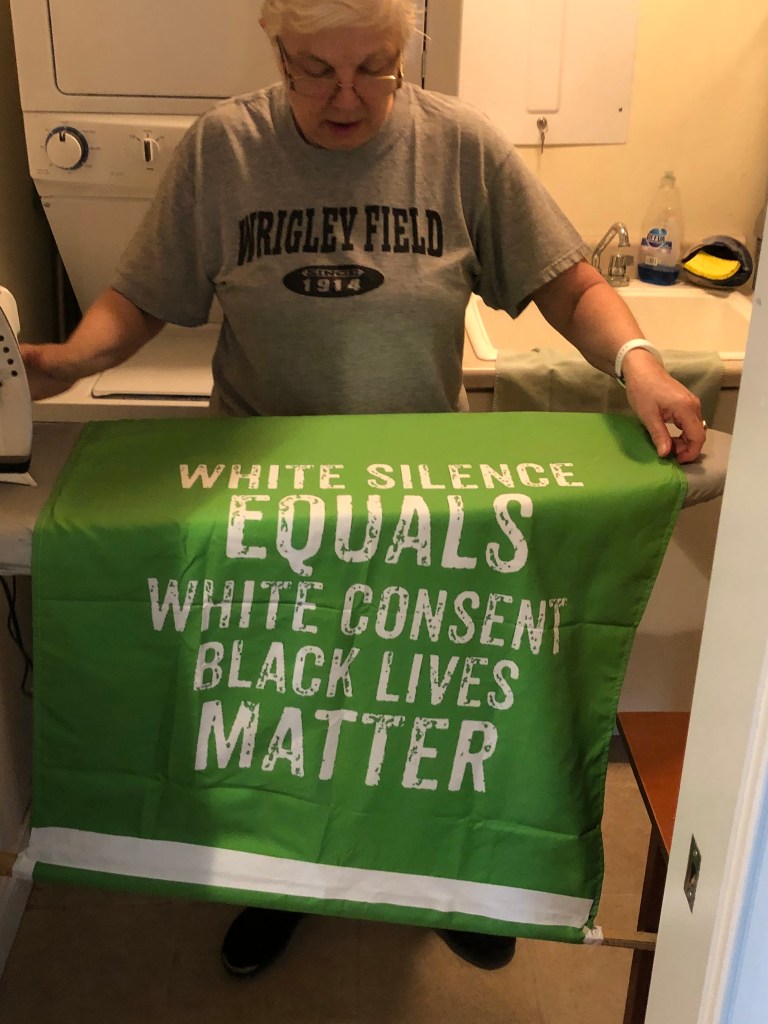
“White Silence EQUALS White Consent BLACK LIVES MATTER.“
Now retired, in our mid-70s, trying to be wise about our health we avoid large gatherings and the COVID-19 virus; even so, we cannot remain silent. In these times, even the stones now cry out “Black Lives Matter.” Hanging off a balcony is a banner celebrating Juneteenth, June 19, 1865, the day the word reached slaves in Texas that their freedom had arrived. This banner, now, is our way of saying to those who suffer under the racism in our time, “We see you, we hear you, we join with you.”
The first Juneteenth was 155 years ago and yet racism still dominates our nation’s narrative. This scourge has been persistent across the decades — improvements, yes — then retrenchment and steps backward, almost always. This is the case because we have allowed racism to be defined as individual prejudice or discrimination that is carried out by bad people. This makes it simple and we hear folks say, “We’ll I’m not a racist.” Either/or — simplicity at it’s best — There are good people like me and bad people like “them” and that’s all I need to know.
I recently reviewed the Kerner Report (1968). That document famously, and in hindsight, tragically warns, “Our nation is moving toward two societies, one black, one white – separate and unequal.” The report was a strong indictment of White America: “What white Americans have never fully understood but what the Negro can never forget – is that white society is deeply implicated in the ghetto. White institutions created it, white institutions maintain it, and white society condones it.”
The Kerner report outlined racism as more than individual prejudice or discrimination. Racism it said was embedded in systems of unequal power — these were group prejudices (often unrecognized by Whites) reinforced by institutions across our social landscape — educational, medical, ecclesial, judicial, law enforcement. In other words, pervasive. So, our little banner is indeed a small witness.
1968 – that was 52 years ago. We who hang this banner now, were in our early twenties when the Kerner report was written. We were inspired by Dr. King and the passage of Civil Rights Legislation. We believed racial justice would soon be realized across the land. The five decades that followed demonstrated how deeply racism is embedded in all of our institutions, our community practices, our churches, our political parties and in the psyche of too many across our nation.
So, we make this small witness now — as folks drive north on Walnut Street in our city, they can look off to the third floor of our building and there is the banner “Black Lives Matter.”
Let me encourage you to find your own small ways to demonstrate a commitment to be an antiracist. My last blog post suggested some ways to read and learn anew the dimensions of racism in 2020. We must Listen, Study, Pray, Act. One excellent resource helping us understand the deeply embedded systemic dimensions of racism are around us, like the air we breath, is the book Color of Law by Richard Rothstein. You can watch the video overview of Rothstein’s research at: https://www.youtube.com/watch?v=r9UqnQC7jY4&feature=youtu.be.
Do Black Lives Matter? Of course they do! This was an essential message in 1865, 1968 and even more so just now. So we hung the banner — our Juneteenth reminder. Elaine, always good with tape and an ironing board helped ready our small display. It now flaps in the wind — perhaps more tape is needed!
Perhaps like me you hear some say, “Well don’t all lives matter?” Of course they do, but that’s not the point. Not all of us face the systemic discrimination and inequality of power distribution in employment or financial security. Not all of us need to have “the talk” with our children about what to do or say if pulled over by the police. Not all of us experience the same level of health risks, whether it is the water in Flint, Michigan or the differential in healthcare highlighted by the current corona-virus pandemic.
Personally, to cope, I contextualize this, make a little joke in my head. The question “Don’t All Lives Matter?” is like a nutty scene where Jesus is preaching the Sermon on the Mount. In this Monty-Python-type-scene Jesus is announcing “blessed are the poor, the hungry, those who weep…” and a couple of well-dressed fellows in the back of the crowd, who haven’t missed a meal for years, shout out, “Hey Jesus don’t all lives matter?”
Actually this scene isn’t too far fetched. In Luke 4, just a couple of chapters earlier Jesus is preaching in his home town of Nazareth. Using the text from Isaiah 61 he proclaims:
Luke 4:18“The Spirit of the Lord is upon me, because he has anointed me to bring good news to the poor. He has sent me to proclaim release to the captives and recovery of sight to the blind, to let the oppressed go free, 19 to proclaim the year of the Lord’s favor.”
The folks in Nazareth responded by saying — “Hey, isn’t this Joseph’s son? What right does he have to come and claim that ‘today this scripture is fulfilled?’ Hey, Jesus, don’t all lives matter?“ They run him out of town! You see, they were like a lot of good Methodists, Presbyterians, Lutherans, Baptists, Catholics, Orthodox — and all you others — believers and nonbelievers. If you don’t understand this, you may never quite understand the Gospel Jesus came to proclaim — blessed are those who suffer exclusion.
In truth if all lives matter — equally — then those of us who have been so blessed need to sing, shout, hang banners, sign petitions, encourage our political leaders, write letters to those in power and, mostly, live our lives in ways that proclaim: “BLACK LIVES MATTER!”
Perhaps the murders of George Floyd in Minneapolis, Breonna Taylor in Louisville and Ahmad Aubrey in Bainbridge, Georgia have shaken our slumbering nation awake. Perhaps. Perhaps we have been woke and deep hungers for righteousness will now stir within our communities. Protesters have flooded our streets in anger and despair.
A courageous seventeen-year-old young woman videotaped the 8 minutes 46 seconds as George Floyd’s life ebbed away with an officer’s knee on his neck. “Eight minutes and forty-six seconds.” It is a cry from the streets; the length of time peaceful protesters take a knee; and, a way to summarize the injustice of four hundred years of racism in our nation.
Friends ask what they might do in response. Some clergy friends are preparing sermons on racism. They are surprised when I say, “Don’t preach that sermon, yet.” One surprised pastor said, “But this is exactly the time to preach against racism.” Perhaps he is right, but first, a warning.
Back in 1973-1975 I was part of a research team for Project Understanding. a national effort to address racism. My dissertation, written on this research, is Racism and Suburban Congregations: Strategies for Change. I recall my disappointment when the data showed the least effective way to change racist attitudes and racist institutional practices was through preaching. (The effect of preaching, by itself, is negligible). While the pulpit can be a helpful additional, backup resource, a reinforcement — a supplemental provider of encouragement — it was almost never a pivot point for change.
Sadly, teaching and educational approaches weren’t much better if enduring transformation is sought. Again education can be a supplemental benefit. And, only slightly better than these two are regular pulpit exchanges among racially diverse congregations.
The most effective approaches were discovered to be interracial teams working to address various civic or institutional matters that didn’t need to focus exclusively on racism. For many, probably most, this is counter-intuitive thinking. I had been taught that you change one’s attitude first and behavioral changes follow. Of course, the idea of behavioral change being the lead priority, was the research behind the Supreme Court’s desegregation decision in Brown vs. Board of Education.
There are multiple actions possible. Perhaps you could work on the Equal Justice Initiative to set up markers memorializing each of the lynchings in your state. (In Indiana there are 12 such known lynchings.) Perhaps you could join groups monitoring racist practices in education or housing or policing. Or, learn about and join the “white coats, black lives” actions of medical workers in your community. Start an interracial prayer or book group. Charity is not the goal here. You need to become the one who is tutored, and not the tutor. Turn off that natural White tendency to keep the power differential in your favor.
So, before you preach that sermon, especially if you are a White pastor to a predominantly White congregation, what can I suggest? First, do your homework. I understand the urge to go fight and speak for justice. Even so, you need to prepare yourself before encouraging others. More importantly you need to listen to African Americans and determine where you might take some action.
So, in this order then are steps to take — LISTEN, STUDY, ACT, all before you preach. If you don’t know African American leaders in your community, what are you waiting for? If you haven’t yet joined a protest, and can do this safely during the COVID-19 pandemic — perhaps this is the way to start. Or, join an opportunity to work for racial justice — and — get moving.
Dear White friends, don’t expect African Americans to tell you what to do. Instead, listen, carefully and humbly listen. Then study; then ACT. Only then will your sermons make a difference. Here are some resources for study:
Ibram X. Kendi’s fine book “How to Be An Antiracist” (2019) is a good place to start. We must move beyond the notion of being a non-racist to leaning how to live lovingly as an antiracist.
Mona Hanna-Attisha’s “What the Eyes Don’t See” (2019) is a story as told by a physician of the crises, response and hope from the Flint, Michigan water crises.
Jonathan M. Metzl’s “Dying of Whiteness: How the Politics of Racial Resentment is Killing America’s Heartland” (2019) is a collection of interviews on the deep underlying myths carried by white racism.
Will Willimon’s “Who Lynched Willie Earle: Preaching to Confront Racism” (2017) and “Fear of the Other: No Fear in Love (2016). There is also a five week video study for church groups.
Jim Wallis’ “America’s Original Sin” (2016) is a Biblical and theological analysis that offers hope for a different way.
Richard Rothstein’s Color of Law (2017) outlines the way housing discrimination has shaped our nation.
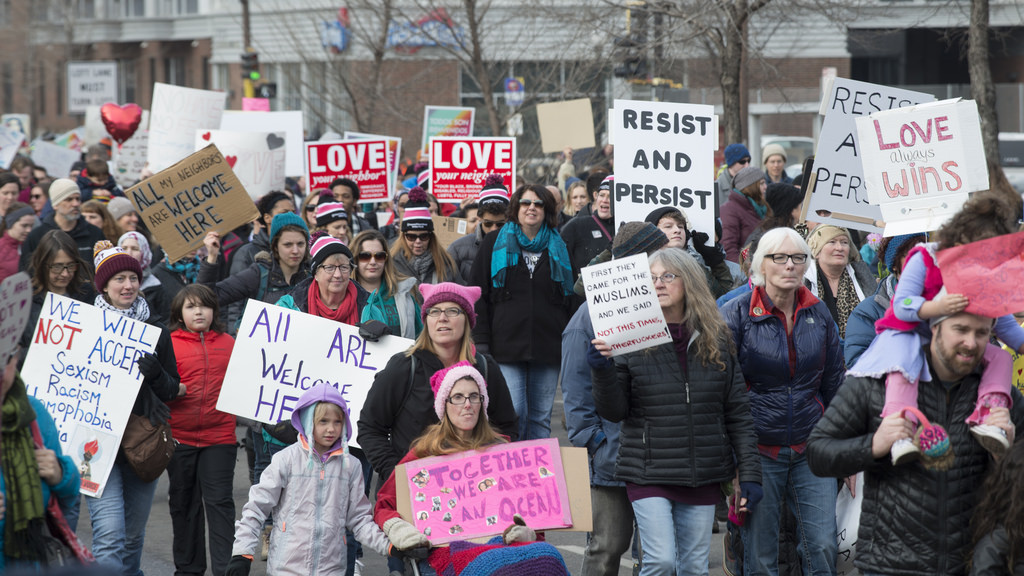
Demonstration Against Cruel Immigration Policies, Evanston, Illinois, 2017
It does appear this is a time of change, an inflection point, a time theologians speak of as Kairos time — when signs of God’s kingdom might become more manifest in our institutions and communities. So, before you preach, PREPARE. Listen, Study, Act and then preach away — all of you — ordained clergy and non-clergy. Let’s preach our hearts out, and do it as part of a deep and enduring narrative, that will bring to our grandchildren a lasting change.
As I watched the tragic scenes unfold across our nation in the wake of the murder of George Floyd, I remembered the phrase scratched on a napkin and slid toward me: “Words, words, words: Hamlet.” This writer of the quote in 1992 was Bill Hudnut, former long-time mayor of Indianapolis. Bill was a friend. I was pastor at Broadway United Methodist Church. We often had to agree to disagree. In considering the wounds to our nation’s soul just now, I think of Bill.
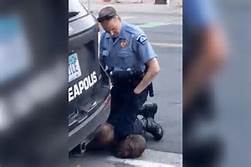
Officer Derek Chauvin on neck of George Floyd from Daily Guide Network, May 28, 2020
There have been too many words. I believe this is a message the rioters are tying to communicate — in imperfect ways, yes, but there have been too many words… words of promise, words to placate, words to delay. And, there have been too many words from the highest office in the land that harm and destroy. More, even worse, there have been words designed to incite violence. There are words tweeted in short attacks or enshrined in policies that reinforce the systemic racism of a nation that has never recovered from slavery, segregation and centuries of discrimination and shame.
MINNEAPOLIS, MN – MAY 27: Two men wear shirts stating “Rest in Power George Floyd” outside the Third Police Precinct on May 27, 2020 in Minneapolis, Minnesota. (Photo by Stephen Maturen/Getty Images as shared in United Methodist Insight, May 28, 2020)
Hudnut wrote the note “words, words, words” as we listened to the remarks of a popular young governor. The speaker was his opponent in 1992, as Bill challenged the young governor for his seat. Hudnut lost that race. The governor went on to another term; then was elected senator, like his father before him. As I recall all these years later, Hudnut was reacting to the governor’s word-salad related to a question about law enforcement and tragedies like the death of Michael Taylor. How might we better address police abuse? In 1987, Michael Taylor, a 16 year old, was handcuffed and in the custody of Indianapolis police officers when he was shot and killed. The officers claimed Taylor had somehow, with hands in cuffs, behind his back, grabbed one of their weapons. — So, they said, “they had to kill him.”
Michael Taylor’s murder remains an open sore for many in Indianapolis, myself included. George Floyd’s murder and the national response only displays that we have a pervasive and longtime pattern of such abuse. We have only formalized the “lynching culture” prevalent a century ago. In 1987 Bill Hudnut and I publicly disagreed about Indianapolis’ response in the Michael Taylor case.
William Hudnut GreatLakesMetros.wordpress.com
Don’t get me wrong — Hudnut was a wise voice, took a lot of heat for not being tough enough on crime and too friendly with the minority community. At the time, Bill challenged some prevalent police practices. Still, he was the mayor and thought his primary job was to keep the peace and the support of his party. In private, we talked on several occasions, we prayed together and he shared his profound sadness. Behind the scenes Bill took actions to improve police practices, including better public review — something that is still not sufficiently dealt with today.
“Words, words, words: Hamlet” is remembered now. At the time they were first shared with me, neither of us knew how much “the Rev. Bill Hudnut,” graduate of Princeton University and Union Theological Seminary, was a part of a dying breed. He was a Republican committed to racial justice and civil rights in word and DEED. A part of his story is told in Indiana History, “William Hudnut III versus the Reagan Administration” (https://indianahistory.org/stories/william-hudnut-iii-versus-the-reagan-administration/).
Hudnut with Oscar Robertson Indianapolis Star
The Republican Party lost its way. How can they claim to be the party of Lincoln or Grant? How? I wish it was this easy. If one can just blame someone else, it is too easy. Our nation has lost its way as well. Bill Hudnut was a practical politician — yes, he made compromises. He was right to have a jaundiced view of the language of the Democrats.
We have all lost our way. We somehow think that there is some easy way to undo the massive damage of racial injustice that is four centuries old in our land. “Words, words, words” Bill Hudnut rightly quoted from Shakespeare’s Hamlet. In every arena related to racial justice we have talked too much and accomplished too little. The deceit was implicit in the opening words to our constitution, written by a slave owner, who knew better but never emancipated his own slaves. “We hold these truths to be self evident, that all men (and women) all are created equal…” Perhaps our generation can do some bold things to make these sentiments more than words.
We have been offered a magic pill — Hydroxycloroquine. We are told by “him-who-will-not-be-named” that he takes “a pill daily” to protect from infection by the COVID-19 virus. This simplistic prescription is mimicked by Brazil’s President Jair Bolsonaro. Both men share certain anti-scientific, anti-democratic tendencies that result in disasters for their nations whether environmentally or in terms of public health. Brazil and the U.S. now lead the world in deaths from the corona virus, surpassing Italy, Spain, Russia and the United Kingdom. Still, these two men propose simplistic answers to complex challenges. Sadly this is accepted by millions as reasonable. Why not? It is easier than taking the time or thought to offer complex options that are more difficult to implement.
This prescription of C₁₈H₂₆ClN₃O as the magic pill would be sad enough, if it didn’t point to the multiple ways good science is being undercut in other human arenas. Quality scientific work is complex and, if done properly, usually doesn’t result in a single, easy-to-use form. However, hucksters across time and around the world still suggest they have the magic potent, “the cure.”
Like the salesman “Professor Harold Hill” in the Broadway Show The Music Man, contemporary hucksters abound. Often what is being sold can be beneficial, if used wisely. Hydroxycloroquine, medical research has demonstrated, can be beneficial to folks struggling with malaria or lupus. Now research shows that “this magic pill” may do more damage than good. Just as young people learning to play band instruments, as “Professor Harold Hill” prescribed to the good folks of the fictional River City, Iowa the remedy misses the mark. However, seventy-six trombones, new band uniforms or even one-hundred-and-ten-coronets are hardly effective cures to the so called social diseases as diagnosed by the huckster. A marching band might engender appreciation for music and even civic pride but will do little to change the behavior of young folks hanging out in pool halls or gambling on horse races.
Every day, I am amazed by the hucksters who deny research, good science and even basic logic. The simplistic solution is offered where other positive actions could be taken. There are so many ways we could act rationally that can make a difference. Instead of taking a daily pill, what if “he-who-will-not-be-named” modeled a healthier alternative and actually wore a mask, worked to provide a national testing and vaccine options, let medical experts speak openly to the nation or demonstrated compassion and wisdom for those who are suffering. No — that would be too complex, too scientifically informed.
I watch phony cures being offered in other venues. We keep seeking the “magic pill,” the simple answer to complex problems. For example:
What if we decided to seek a well-reasoned response to climate change? This would mean a comprehensive program moving away from fossil fuels. It would mean rebuilding infrastructure so some future tragedies like the dam failure this month in Michigan might be avoided as altered weather patterns bring more rain and floods.
Or, what if we addressed the need for universal health care? Tens of millions are suddenly out of work and without health insurance, isn’t this the occasion to move as a nation to address health care for all rather than simple encouraging “reopening” to get back to a “normal” that will leave tens of millions without health benefits?
Or, what if religious leaders stopped prescribing the “magic pill” of congregational development, or the perfect traditional doctrine, or a new leadership initiative or a restructuring? What if instead we focused on listening to and connecting with others, especially the poor? What if focus turned outward rather than seeking the one magic remedy of propping up their ever more irrelevant institutions?
What if as a nation we decided to offer safe housing to every citizen and stopped relying on shelters for those who languish in our alleyways, out-of-sight skid rows, or living out of a car?
What if we followed the excellent research available regarding opioid addiction and instead of making it a moral failure, or something that leads to imprisonment, we understood this as a health and medial problem?
We have done many remarkable and complex things before as a nation, in our corporate life, in our health care and religious institutions. There are examples like establishing the interstate highway system, public education, the Marshall Plan, the polio vaccine, the G. I. Bill, religious and legal circuit riders, or Medicare. The list goes on and on.
For now, however, I fear we are destined to a future where the small mindedness of magic pill thinking will prevail. We have moved the small-minded, ideologically rigid to the front of the line in too many arenas. It is the choice offered by too many political, corporate, healthcare and religious hucksters all eager to protect their power and profits.
Recently I raised three queries as to ways forward for people of faith responding to the COVID-19 pandemic. This posting focuses on the last question of the three: what shall we truly love and treasure in the future?
The first question (May 7th) was: Shall our choices be limited to Life or Livelihood? I told of my stealing a small pocket knife as a six-year-old, with the inscription on it: “God is Love.” My dad saw this, taught me a lesson about the true meaning of love and this has lead to a lifetime of learning the importance of moral choices. Life or livelihood is a false dichotomy. Still it has been promoted as a political agenda — “we must open,” we are told without clear plans for how this is best done. Now, in dozens of states in the U.S., we see the chaos of such either/or thinking. I know small business owners who are facing bankruptcy — it is heart wrenching, speaking with them. There are better ways to proceed that honor both livelihood and life as demonstrated in other nations just now. In the U.S. the political games continue.
Comprehensive guidelines for the common good, both in terms of public health and commerce, were offered in a 17-page document from the CDC two weeks ago. However, it was shelved by the White House. Governors, mayors and other leaders are left with an assortment of one page, scaled-down “suggestions” that arrived only today (May 15). These are vague directives full of “sorta-perhaps-you might-want-to-if-it-seems-right” guidance given in one page documents to separate groups. The message from the top is that we will love our “treasures,” more than life. Aid to small businesses, hospitals and cities may never arrive. The vulnerable ones (businesses and people) are set aside as so much “collateral damage.” And so… commerce, especially large corporate activities, has been pitted against the common good. If health officials are correct, we will see the results of this foolishness in two and three weeks when a resurgence of the virus appears — and even before that, tens of thousands more will succumb to the virus.
The second question (May 8) was: what shall we consider to be normal? Should our national and global experience in 2019, before the virus arrived, be considered normal? How long before we are past this pandemic? Is this a blizzard, long winter or ice age? For Christians we consider the question of idolatry — is money more to be treasured than the life of another? Believing this virus will not end soon, and wanting a better future than we have known, we asked what compass and a guide will help us live toward an even more flourishing future for all? Drawing on John Wesley’s counsel of “Do no harm, Do Good, Stay in Love with God” it was noted that even if we could go “back to normal,” we could do better than that.
Just ten days ago or so, we were approaching 60,000 deaths from the virus in the United States; today over 80,000 persons have died; conservative projections are that this will total over 100,000 by the end of May.
This brings us to the last question (May 15): what shall we truly treasure and love in the future? Let’s begin with basics — What is meant by “love” anyway? Few persons in the Wesleyan tradition have thought more about this than theologian Thomas Jay Oord. Dr. Oord suggests that love is “an intentional act, in relationship with others, that promotes the overall well-being.” In other words, love involves an action. It is in sympathetic or empathetic relationship with others, including God and the community. It is for the purpose of doing what is good for the whole. (See: “Thomas J. Oord on the Mystery and Definition of Love,” The Table podcast, 11/15/2018) Another valued theological voice is that of Steven Harper. Dr. Harper explores the lives of people of faith over the ages and offers regular insights into a theology of love in his postings at: https://oboedire.com/.
So, if love is anintentional act in relationship with others for the common good, how might we act now and in the future? How will we welcome the stranger? How will be live with hope, imagination and resilience? Ancient rituals thought essential like shaking hands, passing the peace, singing congregational hymns and corporate worship will be sidelined or radically modified. What of the sacraments of communion and baptism? How will we behave in loving ways to demonstrate a belonging to one another, offering words of meaning and the gifts of mutual empowerment? And what of ministries with the poor and the immigrant?
For this, I turn to you good reader. What do you imagine? How do you suggest we proceed? I will not leave you stranded with these questions. Let me turn to two persons who can help us “think forward together.”
The first is D. J. McGuire, who on a recent The More Perfect Union podcast, noted that in U.S. and world history we can see differing paths after a societal tragedy. For example, McGuire opines, “After WWI, the nations of Europe, especially Germany, were left in disarray and the U.S. turned to our own self-interest. President Wilson tried by failed — for many reasons — including his health. This led almost inevitably to the Great Depression, followed shortly by the Second World War.”
McGuire contrasts this with U.S. and international response following WWII. He observes that here “we aspired to something larger than our previous ‘normality.’ We sought to build international strength and an economy built to include many.” The years after WWII were not easy ones — there was the conflict in Korea, the nuclear arms race and deep systemic racism continued.
Even so, aspirational actions like the establishment of the Marshall Plan, the G. I. Bill, the Interstate Highway System, the establishment of the United Nations and dozens of other efforts from NATO, to NASA, to the Civil Rights Act, to cures or treatments for polio and tuberculosis. None of these efforts were perfect — like all human activities, there was corruption and abuse; however, the trajectory was set toward a better world and not merely a return to normal.
These were two almost contradictory impulses following a major crises. Within each trajectory there were (and are) multiple ways forward… many options.
The second voice is that of Rev. Mark Feldmeir, pastor of St. Andrew United Methodist Church in Highlands Ranch, Colorado. Mark calls us to a Politics of Compassion (https://www.gostandrew.com/resources/livestreaming/). It is a way of considering how love can be put into action. His sermons can be viewed on the church’s website and his book “A House Divided” will be released in September (Chalice Press).
Pando Aspen – actually one tree.
I will not rehearse aspects of Mark Feldmeir’s message here. Suffice it to say that he calls us to recognize our common humanity, our belonging to one another. He suggests that we shape our actions in terms of kinship, kenosis (or self-giving) and delight. Employing the metaphor of the large Pando of Aspen, which is actually one tree that spreads over miles in Fish Lake, Utah, he says: “Universal care, concern, and commitment fueled by creativity and collaboration are the keys to the salvation of the aspen grove. And to our own. We need the wisdom and compassion of the aspen that can only come from a deeper sense of connectedness and belonging, and a deeper commitment to the common good.”
Feldmeir goes on: “We may be inclined to believe that the antidote to this politics of contempt is a politics of compromise, which seeks to end disagreement and claim consensus. But in our politics, as in our religion, we have often made idols out of centrism and the ‘middle ground’… we can transcend a politics of compromise in favor of a politics of compassion, which fosters a way of relating to people and responding to real human issues with universal care, concern, and commitment.”
You see, good reader, we don’t have to create a Pandemic of Compassion — we already belong to one another. The question before our nation and world is whether we will have sufficient imagination to truly value and care for this gift… this place of belonging where we already reside. How will we act like we are aware that we are part of and called to love and care for this living creation?
Friend and gifted hymn writer Ruth Duck offers these words as we seek to spread a Pandemic of Compassion:
In Fear the World is Weeping
In fear the world is weeping, and longs with every breath. For life and hope and seeking, new paths beyond this death. And loving hearts are risking, their lives that we may thrive. Praise God for those who labor. O may they stay alive.
Our lives are bound together, in sorrow and in prayer. In life and hope and nature the Holy One gives air. Around the world show wisdom; with open hearts give care.
A new world calls us onward; sing hope now everywhere.







 Hands of the Strong