
All Saints Sunday: 11/1/2026, Bloomington, Indiana

All Saints Sunday: November 1, 2026, Bloomington, IN

Awakened early by a helicopter this morning, circling above. My heart sank. I feared I knew the reason. It turned out I was right.

Soon the news confirmed my fears – Seven people injured by gunfire nearby, on Kirkwood, only a few blocks away. I.U. had won an incredible football game over Minnesota — spirits were high — and alcohol (likely combined with other stimulants) was supercharging emotions in the night.

Two things entered my consciousness:

1) 80 years of experience, a little education and my seeing the flawed, inadequate civic approach of university for the community surrounding the campus provided a petri dish for such tragedies. Each year hundreds (sometimes thousands) additional students live off campus, placing stress on resources from housing to policing and cooperative approaches to civic life.

I am not suggesting these shootings were inevitable or the university’s recent practices are a direct causation, but I would argue they have become ever more likely as university ties to local governmnental, social and community services have been disintegrating. It was once the case that university leaders were regular participants in the ebb and flow of civic and social service life — thereby aware of the required interdependence, emerging challenges, or action needed and mutual responsibility.

2) This is a marvelous community, a beautiful part of God’s creation, blessed with a renowned center of higher learning. Still, I.U. AND the entire corporate, governmental, philanthropic and religious leadership of Bloomington need a re-think about approaches to life together. We need more than a university playing political games around “institutional neutrality” that ignores the value preparing persons of virtuous character as a primary goal, AND we need more than individualistic “case management” on the part of city and social service efforts.

Bloomington has been (and still is) a GRAND experiment in modeling for our nation the gifts of education that seeks the common good, values humane practices and builds “polycentric” structures of renewal and institutional vibrancy (as Nobel Prize winning I.U. professor Elinor Ostrom taught).

Not many years back, I visited with university leaders about this hope, for connectivity and imagining more welcoming and inclusive approaches to our civic life together — and my fears that the threats of racism, gun violence and bigotry were undermining the best of who we are. I learned later my hopes were “reported out” as “Phil wants the university to open a night club.”

Alas, sometimes, it takes a helicopter overhead to be reminded that we don’t need another night club — we need a university that has at its core, a commitment to teaching more than how to get a job and make money — we need a UNI-versity, where humane and constructive lives are demonstrated in a practiced way as it shares commitments, realities and joys with neighbors.
When the Winds Are So Strong

When the Winds Are So Strong

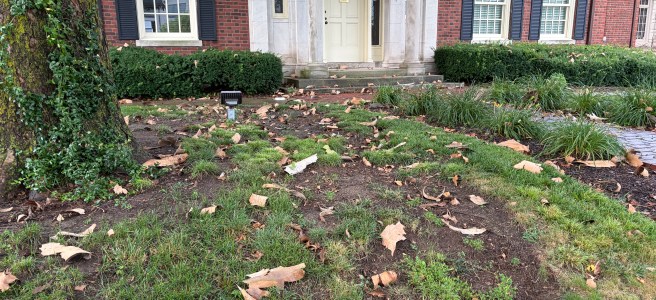
On the Fourth of July another thunderstorm swept across our neighborhood—the fourth storm in less than two weeks. Two of those events carried tornadoes across southern Indiana. This one spared us the worst of that violence, but a great sycamore near our house had shed broad sheets where bark was ripped away. The tree looked skinned, wounded.

I remembered an old children’s story that sycamore trees began shedding bark after Zacchaeus slid down from its branches when Jesus called him by name. Of course, that is not how sycamores work, and yet, like many children’s stories, it tells a deeper truth. Encounters with grace leave their mark.

This Fourth of July came during a season when it sometimes feels as though powerful winds are blowing through our public life as well. Customs once taken for granted seem fragile. Public trust is worn thin. We are told daily to fear one another, to choose outrage over understanding, and certainty over humility.  Voting rights are being skinned away from our Constitutional commitments.  The deep truths of our history are “being disappeared.” Military officers are being dismissed due to race or sex.  The White House and the geography around it are being scarred by foolish bigotries, hubris, greed and discrimination.

Standing beneath that sycamore, I wondered where hope is to be found.

Then I looked down.

Beneath the broken bark, were tiny flowers quietly blooming. They had survived the storm. They possessed no great strength. They had not resisted the wind. They had simply continued doing what flowers have always done.

Their quiet persistence reminded me that the future is often shaped by small things.

We are tempted to believe history turns only on elections, court decisions, legislation, or powerful leaders. Those matter. Yet every healthy democracy also depends upon countless acts that never make the headlines: neighbors speaking honestly, citizens listening respectfully, teachers encouraging curiosity, parents teaching kindness, volunteers serving without recognition, strangers extending grace. Democracy depends on universities teaching for character and integrity — valuing the true, good and beautiful and not bending to the powerful winds of culture or politics while claiming they are bending only to some mythical “institutional neutrality.”

Columnist Thomas Friedman recently observed that our greatest challenge is not simply that we are a divided people, but that we are increasingly being divided by those who profit from fear and suspicion. Division has become a business model.

Yet love has always works differently.

Sometimes it is the small things, the small acts that make a true difference.  At Christmas 1956 Joy and Michael Brown welcomed a young friend from Alabama named Nelle for dinner. Nelle worked ordinary jobs in New York while trying to become a writer. Knowing she could not afford to take time away from work, the Browns quietly placed an envelope on the Christmas tree for her. Their gift was not an extravagant amount. It was something far more valuable – time to write.

At first Nelle felt embarrassed. Then Joy Brown simply said, “We’ve seen your writing. We believe in you.”

Years later Nelle Harper Lee said, “All I heard was, ‘Our faith is in you.'”

That simple act became one of the small seeds from which the book “To Kill a Mockingbird” eventually grew.

Perhaps that is how God has always worked.

President John Kennedy kept on his desk a small plaque bearing the words of an old Breton fisherman’s prayer:

“O God, Thy sea is so great and my boat is so small.”

Many mornings those words feel especially true.

The sea before us is vast. The storms are real. Our own efforts often seem painfully small.

But perhaps we ask the wrong question.

Instead of asking whether our single act will change the world, perhaps we should ask whether today we can plant one more seed of hope, speak one truthful word, encourage one discouraged soul, offer one unexpected kindness, protect one vulnerable neighbor. Some days it feels as if our democracy and way of life is being put through a shredder. Where is there hope?

The morning after the storm, the flowers beneath the sycamore reminded me that small things endure.

And history—like the kingdom of God—is often changed not by spectacle, but by countless quiet acts of faithfulness.