Turning Bad News to Good

First, Confess The Sin of Racism

xrayview
Racism in Plain Sight*

It is a clarifying moment… The x-rays are back from this laboratory.  These hypothetical x-rays come from Super Tuesday of the 2016 presidential primaries.  And what can be seen in these images?  There it is — the often hidden, not-so-attractive, practices and support of racism.  Surprisingly this racism comes from those who call themselves Evangelical Christians.  It is painfully clear.  Support for racial bigotry and discrimination is all too apparent in the way they vote and self-identify. 

The voters have spoken: Donald Trump won seven of the twelve primary elections in states.  He claimed the largest percentage of the so-called white Evangelical voters.  Just hours before these elections Trump dodged questions about support he was receiving from the Ku Klux Klan and David Duke, a well known white supremacist.  In what has become a typical media ploy, after he winked his appreciation for the racist support, Trump then changed his tune, saying that he had always opposed racism and, in typical form, he attacked the media saying that he was again being mistreated.

Can there be any doubt that behind the scenes and often breaking into the open racism has been employed to weaken the presidency of Barack Obama?  Like many things, few people are as articulate in identifying such realities as is poet, novelist, conservationist Wendell Berry.

8972.jpg
Wendell Berry**

Berry writes: “A good many people hoped and even believed that Barack Obama’s election to the presidency signified the end of racism in the United States.  It seems arguable to me that the result has been virtually the opposite:  Obama’s election has brought about a revival of racism.  Like nothing since the Southern Strategy, it has solidified the racist vote as a political quantity recognizable to politicians and apparently large enough in some places to decide an election…

Nobody can doubt that virtually all of the President’s political enemies would vehemently defend themselves against a charge of racism.  Virtually all of them observe the forms and taboos of political correctness.  If any very visible one of their own should insult the President by a recognized racial slur, they would all join in the predictable outrage.  But the paramount fact of this moment in the history of racism is that you don’t have to denominate the President by a recognized racial slur when his very name can be used as a synonym.” (Wendell Berry, Louisville Courier-Journal, September 15, 2015.  See more at: Berry, Revival of Racism.

I was stuck by a recent report from the Southern Poverty Law Center that provided the recent history of active hate groups in the United States.  During the first eight years of the twenty-first century there were roughly 150 groups such as the Ku Klux Klan, White Nationalist, Racist Skinhead, and Neo-Nazi.  Their numbers changed very little in the period between 2000 and 2008.  However, in 2009, following the election of our president, the number of hate groups rose to over 500 — and today there are nearly 1,000 such groups in the United States!

I am not saying that white Evangelicals are all racists.  Still it is more than a little suspicious that there is not more resistance among these folks to Mr. Trump’s dog whistle to the racist fringe.  I still remember visiting a family farm, shortly after the election of Mr. Obama.  These were good people, church going folks, active in state politics.  I have known them for years.  As we talked my friends began to share email “jokes” about our president.  The language was crude, ugly, bigoted and demeaning projections.  It was raw, blatant racism in the depiction of our president. I was stunned — didn’t join in the laughter and spoke only a halting word of disagreement.  In hindsight, I wish I had said more.  In hindsight, I understand there are such “God fearing” folks and how they could vote for Mr. Trump.

In his insightful study One Nation Under God Kevin Kruse of Princeton University outlines the way the Christianity shifted in the twentieth century to become a public spiritual spectacle, useful to politicians and corporate leaders to pursue their goals of power and wealth.  Kruse cites William Lee Miller of Yale Divinity School who spoke of the American people who followed their president, Eisenhower, and “had become fervent believers in a very vague religion.”  (Kruse, p. 68)  Or, as Robert Bellah put it, “Is this not just another indication that in America, religion is considered a good thing but people care so little about it that it has lost any content whatsoever?” (Kruse, p. 68) This vague religiosity has been filled with many things — and as Evangelicalism has gained ascendancy too much of the “vague” content has been long on self concern and short on self criticism.

The vague content of American Christianity — Evangelicalism in this case, has been filled with patterns of thought and behavior that have almost no connection with the message or life of Jesus the Christ.  In fact, the vague content has been filled with shabby self indulgent understandings that are amazingly at odds with the Sermon on the Mount or the Lord’s Prayer

xraybrain

What would a beliefs x-ray show about a person’s real commitments?***

I do not seek to salvage this word “Evangelical.”  The damage, the identity theft, has been done.   Such a project belongs to others.  Thankfully, they are already at work and know it will take generations to correct what has gone amiss.  As suggested in an earlier post, these elections provide an x-ray into the flawed theological and faith perspectives of such Evangelicals. Sadly, the x-ray comes back saying the illness is at a critical stage.  This religiosity is shaped more by culture, history and prejudice than it is by the scriptures or sound theology.  Honestly, it is more a folk religion than a coherent faith practice.

What are we to do?  What is the church to do? In his column, “The Governing Cancer of Our Time, ” David Brooks speaks of the rise of authoritarianism (Brooks, Governing Cancer).  Over forty years ago, I served as part of a national research project on the church and racism.  In this work we discovered the connections between authoritarianism, status concern and racism in its various forms.  The question became how should the church, the People of God, respond?

We learned three important things:

  1. The church — especially the leaders in the church — must say NO to racism.  That which is obvious and that which is more subtle.  I wonder what difference it might have made if religious leaders and political leaders had stood up against Mr. Trump’s “birther” comments in 2008, or every year since?  One can’t help but think that the current dilemma of the Republican Party was brought about by their own silence and disrespect all along the way.
  2. Sermons and study groups alone have little effect on changing racist attitudes or behaviors.  (Sorry about this preachers and teachers.)  However, when sermons and education are combined with activities that engage parishoners with persons of a different race, especially activities that seek cooperatively to address racism, real change is possible.  We saw it in Chicago, South Bend, Fresno, Dallas and Los Angeles.
  3. Finally, a denomination’s commitment or congregation’s commitment to battle racism can be measured by the way budgets are made and expended.  In 1974 we found that almost all congregations reported they spent more on toilet paper or light bulbs in a year than they did on efforts to address racism.  Nothing much has changed over these four decades in this regard!

Silence.  Vague content to our faith.  Low commitment to change as evidenced in our practices and budgets.  These things, good reader, may be among the reasons for our current embarrassment.

Phil A

++++++++++++

Attributions:
  1. *Women viewing x-ray. Copyright: http://www.123rf.co/profile_rmarmion’>rmarmion / 123RF Stock Photo</a>.
  2. **Photo of Wendell Berry from newsinfo.iu.edu, (Indiana University media)
  3. ***Simulated x-ray of brain. Copyright: <a href=’http://www.123rf.com/profile_scottff72′>scottff72 / 123RF Stock Photo</a>
     

When Good News Becomes Bad News

The Evangelical Embarrassment

Evangelical

Agata Gladykowska, stock photo


The presidential primaries of 2016 are an embarrassment — to our nation, to thoughtful public discourse and, perhaps most tragically, to the witness of people of faith.  This trend has been underway for quite some time.  In an earlier post, I wrote of “Christian identity theft.”

Today is the so-called Super Tuesday, March 1, 2016.  Primary elections are being held in twelve states with hundreds of delegates in play for both political parties.

Over and again it is reported that the Evangelicals are a crucial and determining voting block.  The New York Times this morning says that “Donald Trump’s success with evangelicals is expected to help him dominate” in several of these elections.  REALLY?

The vileness and ugliness of this primary, especially on the Republican side, is so full of meanness and junior high potty mouth jokes as to make mud-wrestling look like a noble enterprise.  But most troubling for me is the use of that word “Evangelical.”

Sadly, this primary has proven to be a DNA test, or an x-ray image, showing the actual make-up and inner organs of many who claim to be Evangelicals.  Really?  Donald Trump represents the best hope for the future among people of faith, the desire to have a God-fearing nation?  Really?  Or, the juvenile, divisive and snarky comments of Mr. Rubio or Mr. Cruz — are these the marks of an “Evangelical?”  Thank God, there are Mr. Kasich and Carson who represent something better; but they seem to have little appeal to those who call themselves “Evangelicals.”

Compass&amp;Bible
For Evangelicals the whole of Scriptures was 0nce the guide
Wavebreak Media, stock photo

Evangelical at one time spoke of a person who believed the good news of God’s love for the world, each one and all.  An Evangelical once was a person who sought to follow Christian scripture, especially the major themes.  Today it has been distilled down to a test on two or three current cultural issues, abortion and gay marriage mostly. 

The x-ray machine which is the 2016 Republican Primary, shows that the core of the Biblical story is either ignored or little understood by this group, who claim the name Evangelical. Things like the care of God’s creation, the welcoming of strangers and refugees, sharing with the poor or living a life of service have dropped out of the body.  These organs critical for life have disappeared.  In its place, Mr. Trump and others have substituted fear, racism, xenophobia, distrust and envy.  Good news has become bad news.  This look inside those who call themselves Evangelicals suggests a perhaps incurable soul sickness, a brokenness.  I fear it is a sickness unto death.

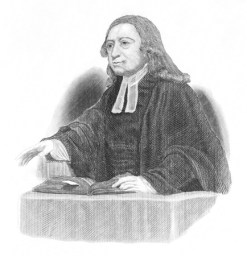
Evangelical has been a word of richness and diversity.  Many won’t understand, but Hillary Clinton, as a United Methodist, stands as much (or more) in the classical definition of Evangelicalism as do any of the Republican candidates.  As a United Methodist her heritage links her to the work of John Wesley and Martin Luther.  While both were men of their age — I think it is clear that neither would recognize what has been going on in these primaries as in any way “Evangelical” in its basic theological DNA structure.

John Wesley
John Wesley (1703-1791) Engraved after original artwork by J. Jackson

Having served as president of a school called “Garrett-Evangelical” I have sought to understand this word and place it in its historical and proper theological context.  The categorization that has been done in recent decades has resulted in a division that seems to allow no breadth of understanding.  I consider myself a “progressive-evangelical,” a place to stand that is, I believe, consistent with Luther or Wesley in their day or millions of Christians outside the U.S. today.

It is tragic that the word has been turned inside out, upside down and backwards in contemporary American thought.  Too long the word has been defined by Fox News and talk radio — too long certain preachers have used the word to divide rather than to heal.  Too long, well meaning pastors and bishops have remained quiet, allowed others to commit identity theft.  Too long, well meaning pastors have said, “It is in God’s hands, you don’t have to worry, it will all work out.” Perhaps it is their own fear that prevents them from speaking against the ugliness of this mean-spirited time.  And now, not surprisingly, “we have sown the wind and are reaping a whirlwind.”

Of course, all of this didn’t happen over night.  In his excellent column, The Governing Cancer of Our Time, David Brooks speaks of the distance we have traveled from our political and civic heritage and speaks of our current situation as “anti-politics” (Brooks, Governing Cancer).

In this column, Brooks notes that politics as a constructive art is in retreat and authoritarianism is on the rise world wide.  What might the church say in such a situation?  Where might Evangelicals seeking to be true to the deeper and richer meaning of the tradition find a constructive voice?  Stay tuned — more to follow.

Phil A


Upsidedowning: Inauguration 2017 Ups or Downs

Upsidedowning and January 20, 2017

One year from today — January 20, 2017 we will be watching the inauguration of the next President of the United States.  Trump? Clinton? Cruz? Sanders?  One of the others?  All flawed.  Some seem to threaten the very fabric of our democracy.   I am often asked by younger folks (you know, folks who are 40 or 50 are YOUNG to me) if I can remember a time when political conversation was this, well, nutty, this far off the rails, this unhinged from facts.

WhiteH8015375_sThe honest answer is NOAbsolutely not.  I remember well the campaigns of George Wallace, Gene McCarthy, Ross Perot, John Anderson, and I remember my high school infatuation with Barry Goldwater.  None of these are comparable.  This is a time when facts seem to matter little.  Anger, make that rage, is in vogue. 

It is as if our national identity, our political assumptions about integrity and well reasoned analysis of the national and world situation has gone down a rabbit hole.  We have entered a period of UPSIDEDOWNING.  What once was up is now down and…

whitehouse$20163804_s

Ridicule of others is now the currency to win votes. Wealth is either a measure of ones value or decadence.  No space is left for the virtues of thoughtful dialogue, learning, humility.  Intemperate statements are valued by the electorate.   Reasoned and careful action by the current president is seen as weakness.  No, I don’t recall a time like this in my memory when behavior like that of a junior high school bully is seen as a positive credential for a future president.

Of course there is a history as to how we got to this place.  Persons, it seemed on all sides, decided it was better to demonize others than find common ground.  You add the complexities of a modern world with 24/7 news coverage and throw in a large dose of racism, bank malfeasance (see or read THE BIG SHORT) and economic uncertainty and you come to the presidential race of 2016.

So, what’s a person to do?  Honestly I don’t know — I have no big idea.  I do remember the bumper sticker that read “If you think education is expensive, try ignorance!” 

Here is my small modest proposal.  You and I, good reader have one year, 366 days (its leap year) to engage persons at a local level with good caring but critically factual conversation.  My pledge is to every day speak to at least one person, preferably someone whose opinions differ from mine, and see what I can learn.  What do I need to know to be a better citizen? And, of course, what can I share that encourages another person, perhaps a stranger, to understand that we are neighbors – even when we disagree.  This might do a little bit to lower the temperature on the language that continues to boil over into vitriol. 

I will do other things, of course, to help the candidate I believe who can best move us out of these mean-spirited times and contribute to our being a place of honest and constructive disagreements.  It is what is called democracy.  Depending on how high the stakes may be, I may do a lot besides talking with my neighbor and stranger trying to bring more light than heat to the political dialogue of our time.  But for the next year (or until next November’s elections) I pledge to work toward honest, factual dialogue… that builds up rather than destroys.

My sense is that our nation can ill afford to elect a president who will encourage us to try ignorance.  The stakes are too high — the world is too complex.  We need cool wisdom and not hot revenge to make it through the challenges ahead.  Meanwhile, I tell my young friends, those under 50, that “NO, I have never seen a political season like this; and, it is time to seek factual information and to speak honestly and respectfully.” 

This is the stuff (honest dialogue and respectful disagreements) of a healthy democracy.  This is the way to RIGHTSIDEUP our national life.

The Great Identity Theft of 2015

The Great Christmas Identity Theft of 2015 

The devastating assaults in Paris have shattered our best hopes during this season.  I was traveling the day following this tragic time and couldn’t help but marvel at the way persons sitting in the airline terminal transfixed by the television images from Paris.  The usual noises of travelers hurrying through the terminal were muted.  We were all distracted.  Fear and anxiety overwhelmed any sense of normalcy.  Then, our worst fears about the future of terrorism seemed confirmed by the murders of innocents in San Bernardino.  Terrorists assault.  They kill and gravely wound unsuspecting civil servants at a holiday party. 

How do we respond to such evil.  What can we learn?  How will we find a way forward when there are appropriate fears about the future.  One healthy response is to seek to learn more, to understand more, to gain knowledge of the situation.

Who are these misguided murderers?  What motivates?  Why do they choose these suicidal theatrics.  We want to know who is doing this and what are their motives. This is all healthy and appropriate.  It is needed information.  And what can we learn about Islam and this radical apocalyptic cult — this ISIS or ISIL?  Important this is, all of it.

Still, isn’t it intriguing that during these days of terror, we hear volumes from the experts about Muslims — who they are and how they behave — while at the same time there is little or no consideration about who is a Christian or how Christians might act at this time.  The media are full of analysis about Islam.  Good.  knowledge is helpful; as one of my mentors would say “facts are our friends.”

It may be as important, make that more important, to consider what it means to be a Christian in this time.  In the seasons of Advent and Christmas 2015 we hear again the Jesus narratives.  His life and words are captured in carols and story and sermon.  What is there to be learned from this narrative about retaliation, revenge, exclusion, bigotry toward those who are different? 

It is interesting that on the same day that Pope Francis announced the beginning of Year of Jubilee as a time of mercy and reconciliation, Donald Trump is loudly and adamantly speaking words designed to stir up fear and set up new systems of discrimination.  Many people in this country seem to agree with him — in some places, places where there are strong “Christian” environments, there may even a majority who agree with The Donald.  

What has happened?  Most of those who seem to agree with Trump would be quick to say the United States is a Christian nation.  Really?  There is grave danger here.  If we are to choose the way of discrimination toward persons of a different faith, this is a danger I would label identity theft.  Someone is taking the basic elements of what it means to be a Christian and substituting a cheapened, debased form of shallow and self-serving religiosity.

It is not up to me to say whether Donald Trump is a Christian or not.  He says he is, “I attend church on Christmas, Easter and special occasions.”  He says that if he is elected president he will be “the greatest Christian representative ever to be in the White House.”  His faithfulness and the ways he acts on his beliefs are between him and God.  However, he doesn’t get a pass on his easy claims.  How do they match up with the story of Christmas?

9931687_sNo, it is not my call to determine whether Donald is a Christian… but we do know a great deal about who and what a Christian is expected to be from the scriptures and the great traditions of the church.  Racism, bigotry and calls for revenge displayed by too many just don’t square with the person and teachings of Jesus.  Right now — as we gain knowledge about others, equal care needs to be given to thinking clearly about what it means to be a Christian.  Certainly the calls to exclude persons from the United States based on a religious test is unconstitutional.  That is easy.  For me, however, it is more important to ask, is it Christlike?

We are warned at this time of year to guard our credit card information.  We are told to be careful giving out information about social security numbers or family background.  Someone might steal your identity and this would be disastrous.  I want to warn of an even greater identity theft that is underway — it is a theft of what it means to be a Christian.  Guard this closely.  The loss of this identity might be even more damaging than having one’s credit compromised.  The loss of this identity may close down important options that will be needed in the future if we are to find a way past this current wave of terror.

Fear is a powerful thing; so is knowledge.  It is critically important in these days to know more about Islam — what is true and what is false?  Let me suggest that it is even more essential, for those of us who make the faith claim that we are “Christian” to consider carefully what this means — what is true and what is false?