It was Alice Roosevelt Longworth, who in speaking of her father, Teddy, said he wanted to be the corpse at every funeral, the bride at every wedding and the baby at every christening. I first heard this from my friend Thomas Lane Butts, a remarkable United Methodist pastor from Monroeville, Alabama. Yes, that Monroeville! In fact, over the decades Tom would have breakfast every week, at Hardees fast food restaurant, with Harper Lee. Yes, that Harper Lee!
It took a while to discover that Tom, who would often speak of “a bride at every wedding and corpse at every funeral,” had borrowed and reshaped the quote to his purpose. I remember Tom’s sonorous southern cadence as he would identify some attention-starved politician, bishop, power hungry legislator, university administrator or professor, or pompous preacher or rabbi, as one who fit the category.
My prayers in recent months often have been that a narcissism-neutralizer could be invented. It could be marketed as a humility-pepper-spray and deodorize any power-hungry-stench. I have prayed that an election, a court verdict, a news editorial, an honest phone call from a friend, a speeding ticket, a failed speech, or a glance in some other “reality mirror” might burst all pomposity balloons. I’ve looked in a few such mirrors myself over the years. I recall the Sunday I thought I had preached a fine sermon, and a woman took my hand at the door and said, “Every sermon you preach is better than the next.” Great timing – a glance in the reality mirror. I was remembering the true meaning and joy of worship.
My dream of some ego-adjusting-comeuppance is likely not to happen… probably can’t happen given all that is at play in our day. Our national-body-politic, gerrymandered-legislatures, embattled-universities, overly-cautious-conflicted-churches, profit-only-driven-corporations, or ideologically-ensconced-media-enterprises are in their own protective enclosures.
In the meantime, sadly, attention is taken from those who genuinely deserve our honor, memorials, respect and shared joy. Here is an invitation to you to join in remembering and celebrating those who have died, those getting married and all those we name as children of God.
The Indiana Conference of the United Methodist Church Clergy Session had ended and a childhood memory played across my mind. Perhaps you recall the game often played at picnics, or at elementary school recess. Children would race walking backwards toward a finish line ahead.
I remember some falls and trips and stumbles as I rushed in the opposite direction with backward steps. We were facing where we had been, glancing over the shoulder to make certain we were moving forward, careful not to land on our behinds. Too often my movements proved to be sideways rather than toward my goal.
The Indiana UMC proceedings and language were familiar. Newly ordained clergy were asked to commit to moving forward toward perfection in love. A good thing – Methodism’s understanding of sanctification – being perfected in love.
There were a set of newly determined behavioral standards presented. Thirty-six (36) pages of them! In small print! Coming down to those gathered from some unidentified Mount Saini and without Moses presenting them, they seemed odd and half-baked. The point was made that these “guidelines” were not to be used to police one another, rather these were provided to be clear about “expected personal conduct.”
Later some of us chuckled at this effort to “guide” this group with a document and suggested that 36-pages weren’t enough. Perhaps a 200-page or 300-page document might get closer to capturing our human frailties and failings more fully. Or perhaps there is another way to proceed based more on the Biblical patterns of relationship, narrative, Gospel. This document carried no mention of repentance, restitution or forgiveness. Precious little spoke to communal failings. There was no mention of a failure to visit in the neighborhoods, to offer communion to those in prison or hospital. There was no call to public witness against greed, racism or systemic abuses.
I looked across the sanctuary at St. Luke’s church that was filled with colleagues. Good and fine people they are. I realized that they, like me, were sometimes strong and wise, and often, also, we are “broken people.” I thought of a song by the Cincinnati based folk music band Over-the-Rhine, “All My Favorite People are Broken.” This stanza came to mind:
All my friends are part saint and part sinner We lean on each other, try to rise above We are not afraid to admit we are all still beginners We are all late bloomers when it comes to love
The assembled leaders up on the chancel for this gathering are well intentioned folks and, if honest, they are broken as well. They congratulated one another for service. Okay – it was deserved. Still, old-timers like me recall this was formerly the session when retirees had a couple of minutes to speak. Their brief (and sometimes not so brief) reflections were worth 1,000 pages of behavioral standards. At this session a couple of dozen retiree’s names were read and placed on the screen. No stories from their service were shared. Only seven new elders or deacons were welcomed. Shouldn’t there be some conversation about welcoming more persons into ministry for the future?
Nor was there mention of ways those currently in ministry were seeking to address the gun violence in neighborhoods nearby. There was no mention of the continuing tragedy of an opioid epidemic raging in rural communities, nor a word about the ways the state legislature is engaged in practices that favor the wealthy and disadvantage the poor in education, healthcare, or taxation. There was nothing in the 36-page document calling for pastoral attention to these matters.
The few mentions of the recent decision by the General Conference of the United Methodist Church to remove harmful language excluding LGBTQI persons were offered in a defensive context like backward facing, careful steps! Is it truly a welcoming of ALL in membership and ministry if made only in a backward facing defensive mode? The point was made that “traditionalists” are welcome. That is important, crucial, understandable. Who might be left out in this affirmation? Are persons who are pushing the limits of our current understandings of church and ministry also welcome? What of those who want to do more than talk about justice? Those who challenge the status quo?
I understand the fear, the need to control. I know my temptations to “slow walk” a witness in times of controversy. Thank-you-gifts were shared among those up front who were completing a term of service. Glad. Good people they; they have been faithful and careful in clergy evaluation and ordination. Still, it is strange this is called a “conference” and no conferring is done. The agenda is top-down, pre-arranged, cautious, from some cookie-cutter paradigm designed for control. We left with no story told about ministry in our urban and rural settings. No new story to tell. Looking across the room I thought of the remarkable gifts shared by these pastoral leaders in their communities. There was so much to celebrate since last assembled. One can hardly move quickly or effectively to offer a transforming message of the Gospel while walking backwards, in the hope of forward motion.
A research psychologist friend told me about epigenetic trauma a couple of years ago. Can the traumas of one generation be genetically passed on to the next? Not just environmentally but biologically? Might there be some influence/alteration on the DNA of offspring following extreme stresses on the parent? I thought it improbable, fantastical even; then began to discover the scientific research and was amazed. Rachel Yehuda writes in the Scientific American (July 1, 2022) of “How Parents’ Trauma leaves Biological Traces in Children.” The article makes modest claims, even suggesting some potential benefits; still it is clear this phenomenon is rooted in a growing body of research. Some report significant inherited vulnerabilities among children, as gene functions are altered by violence and trauma to a parent.
My research friend notes that over the past seventy years, generation after generation have lived in a time when foreign wars never ceased for long. For decades now gun violence and mass shootings have become a staple in our information diet. He conjectures that well over 60% of our societies’ population lives with some degree of Post-Traumatic Stress Disorder or Depression. Significant increases in suicide rates and treatment for severe depression stand as evidence something has changed.
This has left me wondering about the United Methodist Church. What has been the impact of decades of disinformation and disagreement on the denomination and leaders? Following the decisions of the 2024 General Conference in Charlotte, removing the harmful language excluding LGBTQ persons from congregational care and leadership, the question of institutional epigenetic trauma weighs on my mind. Sociologists have long understood the phenomenon of “structural effects” or “institutional effects.” Persons are shaped, restricted, influenced, limited, or open based on the ecologies in which they reside and work. This has been evident in the responses of denominational leaders following General Conference. An ecology of abuse and division has prevailed in the denomination for decades. Much of it is carried out by well-funded advocacy groups like the so-called Institute for Religion and Democracy and Good News Movement.
The decisions in Charlotte, long overdue, offered a time of relief, celebration, joy. I was there – and found myself laughing and sobbing all at once. As some sang and hugged, there was a muted quality to the celebration. A good thing, I thought. It was not a time of gloating or retribution. As Steve Harper puts it, we need to be an “Un-reviling Methodist Church” to become, in truth and fullness a “United Methodist Church.” This spirit of forgiveness and opportunity was reflected in persons who spoke in favor of making space for congregations who had disaffiliated to return in the future.
Still, it seems, many denominational leaders were careful not to engage in too much celebration in Charlotte and upon returning home these “leaders” were more inclined toward defense. Many who quietly supported welcoming all into the church, returned home (to their local context – district or conference) with a more muted response. Their main theme became, “If you disagree with the decision in Charlotte, don’t worry, your local church doesn’t have to change. You can keep behaving the way you always have.” Meaning keep excluding as you will. This is to my understanding much more a PTSD response than imaginative leadership. The violence done by groups specifically organized to do damage has left its generational marks.
I can easily ask “Where is the courage? Where is the imagination for the future?” And I do. Even so, I am mindful that for decades groups organized to do damage on the UMC continue at their work. Even before we left Charlotte, there were forces publishing and on social media seeking to bully and diminish the joy that should otherwise accompany the new day of openness and welcome for United Methodists.
I don’t have an easy remedy to this institutional epigenetic trauma. My research friend recommends meditation, prayer, music, seeking calm, new collaborations, reaching out to others who have been wounded. In my experience imagination will require finding time for laughter and celebration. It will require an end to seeking to placate those who have been a part of the damage inflicted. Now is time for generational healing and for the imagination that will follow.
We are passing through a season of Ascension and Pentecost in the liturgical year. The fires of Pentecost continue to burn. Willie James Jennings of Yale Divinity School says of this season, “The revolution has begun.” Time to focus on the future. Time to admit our institutional PTSD and find care in one another and in our core and gracious identity as United Methodist.
Plastics are overwhelming our earth. Micro-plastic pollution is found in our drinking water, our food and even in our own blood streams. Every piece of plastic ever made is STILL in our environment. Amazing.
Today is also the beginning of Passover, Pesach. A time of remembering. A time to retell the story of what we are called to do and who we are to become as God’s people. It is a retelling of the escape from captivity. It is a time to reconsider where we have been and where we are going.Can we remember, turn around and move in another direction?
We have been living in a captivity to our hungers for extracted wealth from our earth, a tragic environmental Ponzi scheme, a plundering of nature — a using resources which should be set aside for our children and grand children. This over-exploitation has been increasing each year. We in the United States lead in extractive exploitation. If the entire world lived as we do it would take the resources of FIVE EARTHS to provide sufficiency.
We face the question today, how then shall we proceed?
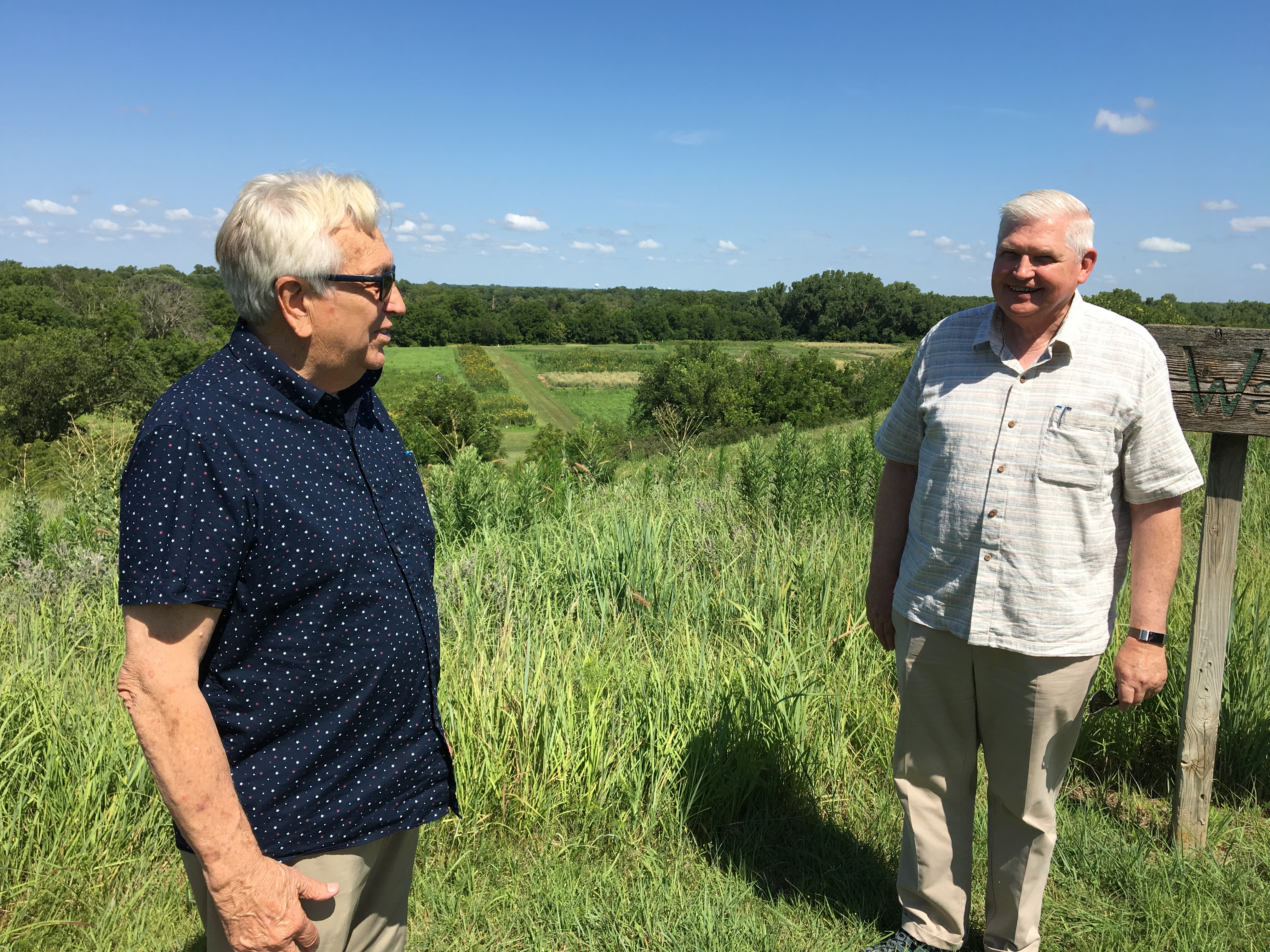
Enter Wes Jackson — someone who has been thinking about this dilemma for four decades. Jackson is co-founder of the Land Institute in Salinas Kansas. Elaine and I stopped to visit back in 2019. I had read his work. I knew of his friendship with Wendell Berry; and, I confess to being more than a little star struck. After all Wes was one of the early recipients of a MacArthur Fellowship. I expected our visit to last an hour and then be on my way.
Wes Jackson and his “computer” July 2019
We talked through the entire morning and toured the institute research facilities and farm research plots in Salinas. (Other research goes on around the world where institute scientists are working to discover new paths of regenerative agriculture.)
I found in Wes a friend… and mentor — someone with a deep concern, clarity about his vocation and a surprising light-heartedness. He confessed the dilemmas we all face. The human contradictions faced as we move from our extractive and fossil-fuel based systems. We laughed often; spoke of authors who had influenced us (Ivan Illich, Walter Brueggemann) and spoke of the need for a broader dialogue between science and religion. I loved it when Wes brought out his “computer” to take notes. It turned out to be his old Underwood typewriter!
Wes Jackson was more than a farmer and scientist. He is a person who has done his theological reflection about our creatureliness and relationship with the ecosphere. There were more than two dozen scientists and interns at The Land Institute seeking to establish perennial polycultures, developing perennial grains, legumes and oilseed varieties that can be grown together replicating the patterns evident in native ecosystems.
Wes Jackson at Land Institute, July 2019
We stopped on a hillside and Jackson pointed out the native prairie grasses and the cultivated fields below. “Modern agriculture” he argued has been moving in ever more destructive ways for the past 10,000 years. The Green Revolution, and the heavy use of nitrogen fertilizers, did produce more in the short term; however at the same time they were depleting the resources of our soil, water and fossil fuels ever more rapidly.
In late June, we will come to Earth Overshoot Day. The day we have used up the energy needed to see us through a year without extracting more. It is a day when we can admit our captivity to oil and gas — and their extract — plastics. Forgive my saying it, but it is about theology. It is about who we are and where we are headed as we live before a God and who asks us to continue in the co-creation of our planet.
I give thanks for the true “master theologians” of our time like Wes Jackson. He told me he had been “excommunicated” from his United Methodist Church in Kansas several years earlier by a pastor who considered him a heretic. On this Earth Day, I wish the church had more heretics like him. Maybe with time it will. Whatever your theology — or even if you have none — let’s work to make this happen sooner rather than later.
This is also the beginning of Passover 2024. Pesach — a time to remember who we are and what it means to live with responsibility for our actions.
Changes in our behaviors must come if our grandchildren are to receive the gifts of this wonderful planet with which we have been blessed. We are using up our natural resources 1.75 times faster than they can be replenished!
I work up this morning, birds chirping outside. Good thing. It “beats the options” as they say. Sorting through “news” of the day, I read a strange, recurring theme – one word repeated in many places. The word? WOKE. It has been used in disparaging ways for a few years. In government, education, religion, and more there are warnings of the dangers of “woke-ness.”
Dozens of arguments in recent months seem to begin and end with stressing the dangers of being “woke.” Nothing much more. Just a label, a four-letter word that carries a dumptruck load of fear and grievance. Here are a few examples from this past week:
Bill Barr, former U.S. Attorney General, warns of “wokeness” as a reason he would support the former president, that grievance-filled ghost of an administration-past. Mr. Barr earlier called him “a grotesque embarrassment” but one idea had tipped the scales, had caused him to reverse. It was a concern about being W-O-K-E!
After 92% of the Indiana University faculty voted “no confidence” in President Pamela Whitten, sadly, the response from many was the claim this was ALL about “woke-ism in the academy.”
Well documented and tragic reports of the destruction coral reefs around the globe are presented. Sure enough, there it is – responses calling it “woke science.”
Pope Francis is viewed favorably by 3/4ths of American Catholics, even so, there are disgruntled ones, some bishops and cardinals, who call him the “woke pope.”
The newly formed “Global Methodists” are issuing warnings that upcoming United Methodist General Conference will be overrun by persons with “woke theologies.”
There is, of course, a history of how this word has evolved in use. For some it is a verb, as in the past tense of “wake.” Here it means to be alert, aware, attentive. A decade or more ago scholars began to employ it as an adjective common in African-American vernacular speech, as in an awareness of racial discrimination and prejudice. This was the threat – and the opportunity – presented to many who didn’t want to be awakened to the racism in our society.
The word was repurposed, turned inside out and upside down. It became a quick way to avoid dealing with the realities of discrimination in our society. It is a way to flood the zone with smoke – to hide and obscure the need for conversion. It gained currency as a powerful “code word” allowing the user to avoid thought or conversation. It avoids the hopes for a civil society. Rather than being alert to a new day, experience or danger, it is turned into a verbal cudgel. It becomes an imprecise way to avoid facing our nation’s history and bigotry. An avoidance mechanism. Our nation’s original sin of racism is dodged by using a single word. Nice trick – avoid and redirect the word as a weapon.
Critiquing something as “woke” is lazy. It is a way to obscure, suppress, and avoid any call to rethink the old assumptions and categories. It demonstrates that change is always resisted; it is difficult. What’s the old saw? Only a baby with a wet diaper is comfortable with change.
For a fine reflection on a Biblical way of understanding the importance of “woke” as a spiritual activity, look to Dr. William Lawrence’s, “When the Church Woke.” Bill, former dean of the Perkins School of Theology, points to the Biblical call for wokeness – it is about conversion, metanoia, deep personal and social change.
Glad I woke up this morning. I am reminded of Lamentations 3:22-23, “The steadfast love of the Lord never ceases, his mercies never come to an end; they are new every morning; great is your faithfulness.”
As with many things, one can choose the lazy path of chirping out the fearful words, “woke, woke” and avoid an honest, healthy way forward. Instead, one can let the smoke clear and choose to be woke in “hope, hope” shaped by active care for others and for the healthy and honest ways forward.
Perhaps I was six or seven when the question first came. What is “good” about Good Friday? Our lives are full of questions; or at least mine is. These days most of my questions are about more mundane things, like “How did those spots get on my shirt or on my necktie?” Any man over seventy-five will understand.
After more than seven decades, the more profound and intellectually jarring theological question about the goodness of Good Friday still stirs in my spirit. I don’t have the one right, true answer as many of my conservative friends suggest they have. The soup stains on my necktie are so much more easily explained.
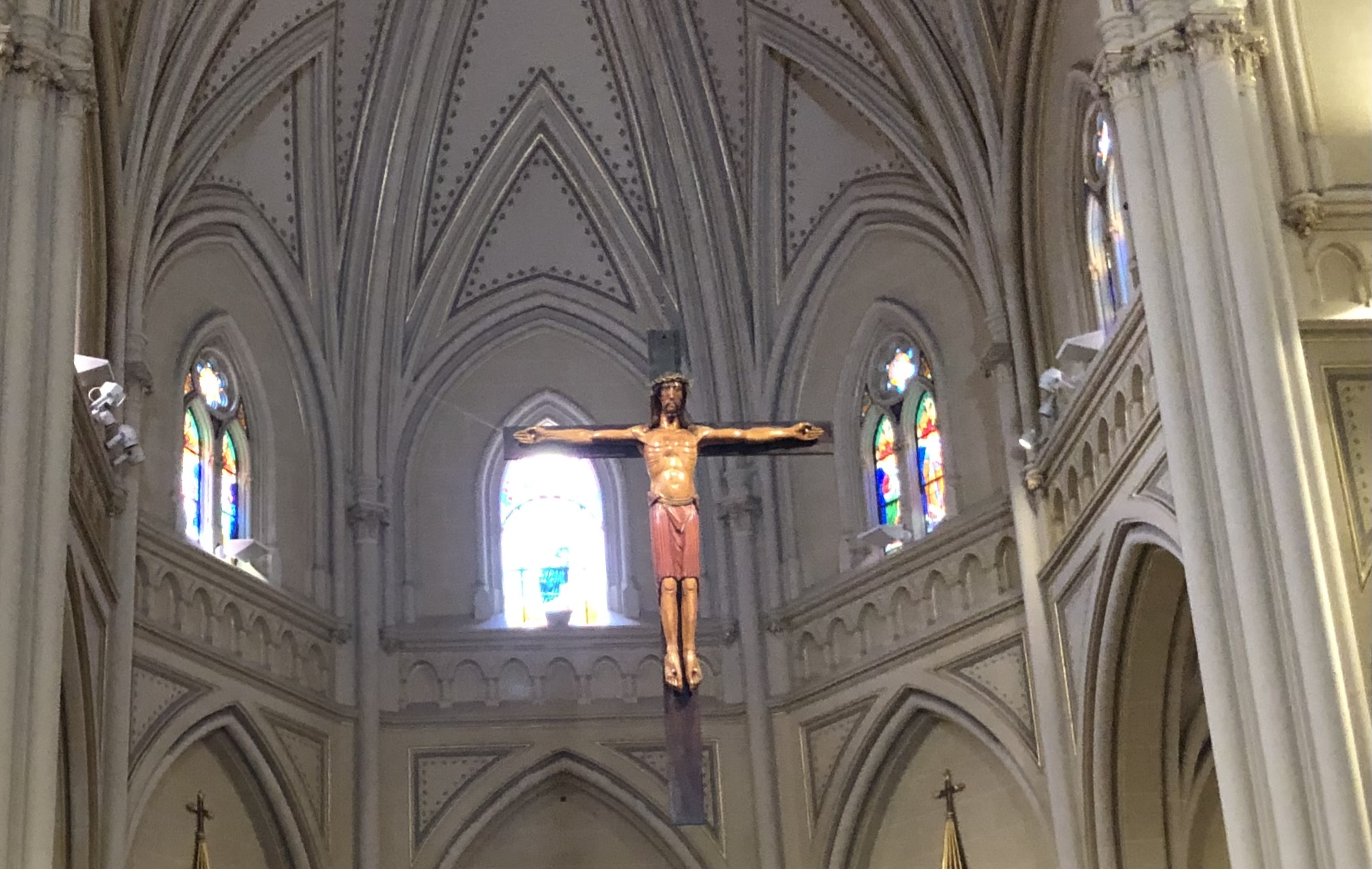
Other friends, more secular searchers, ask, “Why a focus on the cross? Isn’t there a better, less violent, symbol?” Without answering, I think of all the modern-day crosses people bare. I have been with families after a painful death, a murder, a rape, or a drowning. There are realities of starvation, war, captivity, and financial ruin. Abuse and discrimination are crosses of a different sort. Sin is woven within the human condition. Evil is present. No matter our desires for something less violent and more velvet — there is brutality and death.
Catehdral de San Isidore in Argentina
I recall the historic theories of the atonement. Jesus’s death is portrayed as Ransom, Substitute (suffers for), Penal (suffers instead), Example, and Victor. Each theory today is understood in decidedly individualistic ways. It is a quid pro quo formula as in Jesus did this and I get some reward. Such theology appears deeply embedded in St. Paul’s perspective (I Corinthians 15 or II Corinthians 5).
It was my beloved New Testament professor, Robert Lyon, who challenged me to think beyond this; to think more deeply and widely. The word study he assigned me was on the word λύτρον, meaning either redemption or ransom (Mark 10:45 and Matthew 20:28). I can still see the twinkle in Bob’s eye as he said, “And the context? Who is this ransom for and why? What is the larger Biblical frame?” These were the years of the Vietnam War and Civil Rights struggles over racism and sexism. Bob wasn’t dismissing classic atonement theories out of hand; he was asking for more – for a deeper grasp of the whole of the scriptural story. What does “ransom” have to do with justice? What if this is bigger than an individualistic transactional act? What if it is transformational for the entirety of God’s purposes? What if it is not primarily about one’s personal “free of sin” credit card? What if it is for ALL and for the entire Creation!
Walter Brueggemann suggests we speak of the execution of Jesus rather than his crucifixion. ALL THINGS are seen as potentially redeemed and redeemable: corrupt institutions, the violence of every empire, the despoiling of creation. Brueggeman speaks of God’s purposes as displayed in the life of Jesus as prophetic imagination. He speaks of “the alternative world that God has promised, and that God is birthing before our very eyes.
For me, even with food stains on my shirt, the questions in my spirit find greater meaning. This is the GOOD in Good Friday – God’s promise displayed for all persons and all creation. If we have eyes to see it and the will to live into it.
Headlines from Bloomington, Indiana – Ides of March, 2024
Local woman wears a hardhat when outside in her yard; permanent jewelry store opens; wheelchairs available in state parks; and, seven in ten (7 in 10) pregnant women test positive for toxin found in weed killers.
Story one: Angela Connor, 64, has been doing battle with a pair of red shouldered hawks in her back yard. For over a year, the protective raptors have dive bombed down attacking her from behind when she is gardening. After suffering several attacks and lacerations from their talons a friend offered a remedy of sorts. “For some reason they don’t attack the white DeWalt hard hat” when I wear it she said.
Story two: “Permanent Jewelry Store opens in the Mall.” Is it the jewelry that is permanent? or is the store? I suspect neither. Perhaps my epistemological understanding of “permanence” needs an update.
Story three: Motorized wheelchairs are now available for free in many Indiana state parks. Good news. Thanks to the ADA this may be a permanent option — for a while at least!
Story four: Speaking of permanence and mobility, recent research finds four times more amounts of the poison dicamba in the urine of pregnant woman than was present ten years ago. In Indiana, we value healthy corn and soybean crops, (5.4 and 5.5 million acres respectively) and our lovely lawns. Are we choosing healthy corn and weed-free-yards over healthy children? Weed killer residue is carried in wind and water miles away from where it was applied.
Summary: I’m glad (sorta) that raptors are protected by federal law; in the future my impermanent body may still see natural beauty via a motorized convenience; I pray we learn to value healthy soybeans less and healthy children more. And, amid this cavalcade of news, I failed to mention the governor authorizes carrying of firearms in State House. That’s the news that’s “printed to fit” the majority sentiments from Indiana today.
It happened again, recently. A public gathering, I prayed or presided in some fashion. A reception follows. All seems “normal” until one of the folks nearby starts to share a story and stops, “Woops, I forget, a preacher is here.” Often, I could anticipate what was going to be said. I have heard the story or off-color joke previously… I do not have “virgin ears”… but, somehow, I represent a purity zone. Clergy are thought to reside in the “Area 51” of polite conversation.
At times it is even worse. I am cornered as “an expert?” Some long-stored-up theological questions are brought forward. Many are just silly. Some would require a semester course in seminary, or perhaps the completion of a dissertation. Many are qustions that require attention throughout a lifetime. Some questions are asked as a “gotcha.” They are meant to make the preacher squirm.
Often, it begins with the words, “Pastor, I am not very religious, but I am spiritual and am troubled by some things; can you help me understand?” Here are a few I have encountered:
“What kind of fish swallowed Jonah?”
“Did Jesus really walk on water, or did he know where the rocks were?”
“If Jesus was alone when tempted in the desert, who knew to write about it?”
“Do you believe in Hell?”
“Do dogs go to heaven?”
“Did Adam and Eve have belly buttons?”
“In the Prodigal Son story, doesn’t the older brother get a bad rap? What did he do wrong?”
“Is everyone forgiven no matter what they do?
“Where did Cain find a wife? Isn’t marrying a sister incest?”
“Wasn’t Catholicism invented in 1054 so political leaders could break with the Eastern Church?”
“Does U.S. House of Representatives Speaker, Mike Johnson, have a Biblical Worldview?”
“Don’t you think Pope Francis is a Socialist?
Only a sample of the queries are here, some serious and knowledgeable, others an effort to be cute, too many with monistic (either/or) assumptions that miss the discovery and value of paradoxes within the theological task. (e.g., “If one would be master he/she must first be servant.”) I have learned the value of the rabbinic method of answering a question with a question. This is not the time for an overview of differing Biblical texts and literary scriptural devices. Much as I would like, there is little time to teach about the call to live in terms of the realm of God. (And there is certainly not time to speak of my preference for Kindom of God rather than Kingdom.) Often personal faith-journeys, current events or some family disputes are at the core of the seriously asked questions.
I find it a little like the “pick-up” basketball games played while growing up in Indiana. You call your own fouls and get to choose your team mates. The game unfolds “on the spot” but there are certain moves and shots that need to be tested against the other players. Could I make that hook shot now? Could I guard that more experienced player this time?
If possible, when these “questions for the pastor” spontaneous moments come my way, I invite folks to do their own study, later, and suggest a book or two to read. Then, I look for JOY. Is there a way to find in this moment the wide and wonder-filled sense of holiness carried within a smile or even a light chuckle? Perhaps thereby, faith is made more durable, understood with a richer complexity, and invitationally rather than a collecting up the right set of answers. So, when recently asked “Did Adam and Eve have a belly button?” I paused for a moment and said, “O yes, I think so, and I am certain God continues to have stretch marks from such births.” I was rewarded with a smile.
I am told that Thomas Langford, the former Duke Divinity School Dean, enjoyed driving a red pick-up truck around Durham and especially on the university campus. The license plate on the truck read “JOY N IT.” Folks who didn’t know Tom, might have mistakenly thought he was expressing his joy in driving that pickup. Others knew better. He was perhaps speaking of the joy of the truck, but I suspect he was also talking about the joy of a life of faith, of living and leaning forward into the questions, of imagining the joy of a life of gospel relevance… filled with gratitude and delight.
The poet John Keats wrote “Call the world, if you please, the Vale of Soul-making.” This task of “Soul-making” involves asking good questions and establishing habits of the heart. Habits of study, meditation, observation and being open to new imaginative insights, and yes, humor. It is the keeping of these patterns, until these patterns keep us.
So, I look forward to the next set of “questions for the pastor.” Maybe I can do better next time. Until then, I will remember the words from correspondence that is included in the Bible, James 1:2-5: My brothers and sisters, whenever you face trials of any kind, consider it nothing but joy, because you know that the testing of your faith produces endurance; and let endurance have its full effect, so that you may be mature and complete, lacking in nothing. If any of you is lacking in wisdom, ask God, who gives to all generously and ungrudgingly, and it will be given you. (NRSV).
Tears fall from her chin; she carries a never ending uneasiness. Ashamed she waits. In a nearby cell, he fidgets, knees bouncing uncontrollably, repentant without a path to forgiveness, he waits for a phone call. Both have made serious mistakes. Life-altering condemnation results, closing off future options. I do not know these two personally, but I can “see” them sitting alone, or with a cellmate, or standing in shackles in a courtroom. Such scenes continue across my state and our nation. Each person has a name, a history, a family, friends, and enemies waiting on the outside.
They have “done harm.” Some crimes are extremely serious, I understand. Much of the damage, however, has been done to themselves and their loved ones. This self-harm is often rooted in addiction or psychological illness. Some are dangerous to themselves and others. Sometimes, not always, these who sit and wait have journeyed through poverty, homelessness and/or abuse. We all lose. In Indiana alone the estimates are that opioid addictions cost the state between $4 billion and $5 billion in lost revenue, incarceration, and recovery expenses every year.
I write of “Rush County” jail more as metaphor than the actual place. There is a Rush County; Rushville, Indiana is the county seat. It is grand old town, where Wendell Willkie headquartered his 1940 campaign as the Republican candidate for the President. It is east and south of Indianapolis. Traveling south and east it is on the way to Cincinnati. With a population of roughly 6,200, it is like hundreds of towns dealing with the scourge of addiction and other illness. It is a symbol that across the board, once arrested, so many are rushed to vilification, only to languish in jail. It is quick judgement and slow justice. The wheels of our legal system grind ever more slowly as so many weep and wait for that phone call.
In Monroe County, my home, our jail is a disgrace – overcrowded, unhealthy, and understaffed. Monroe is regarded as one of the most progressive counties in Indiana, yet every month seems to find another incident reflecting the horrors of our jail. We have a fast train into jail and a slow walk to trial. This, despite a sheriff, judges and commissioners who diligently seek to change the situation and build a safer facility. It is already too late for so many.
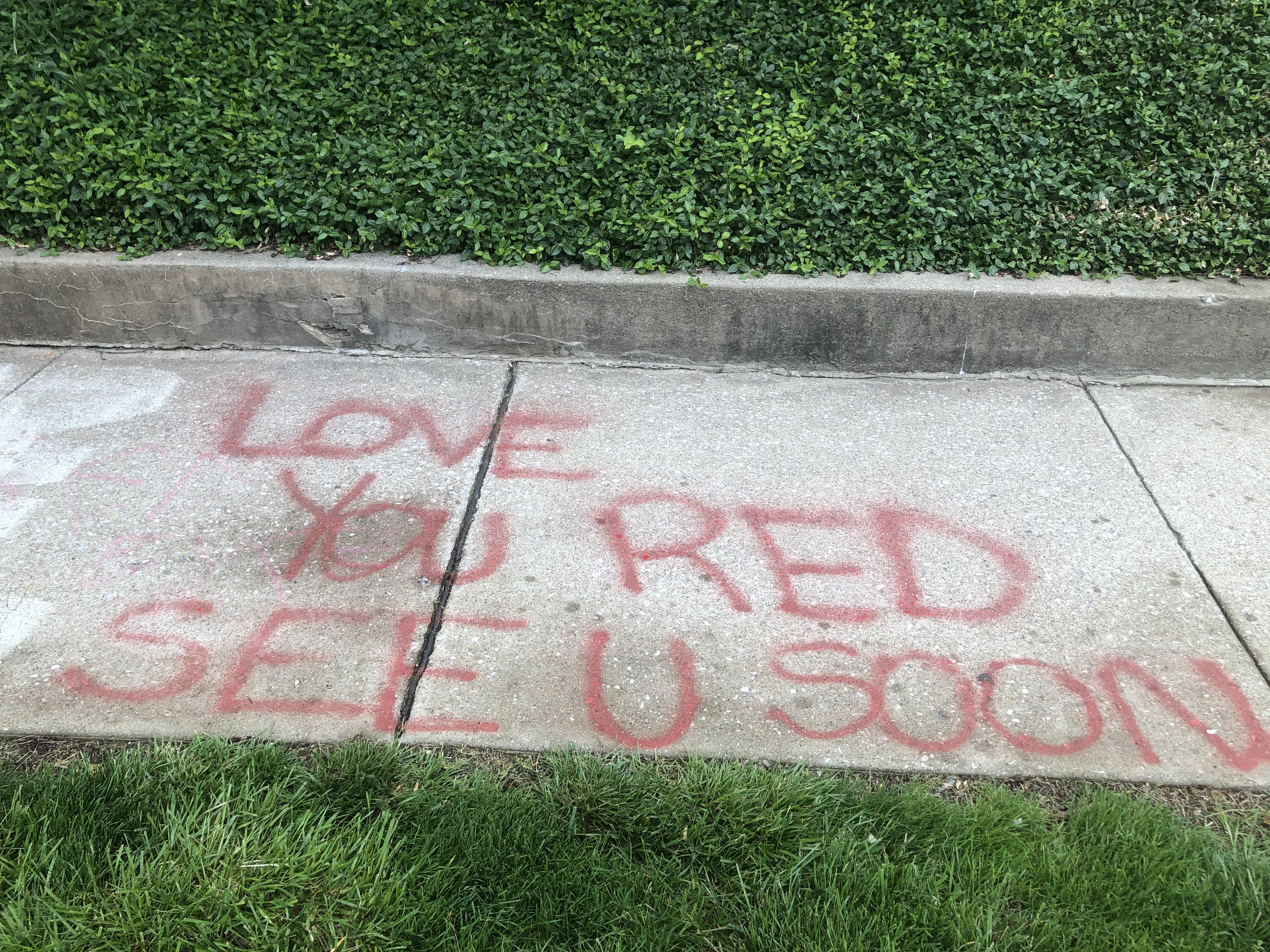
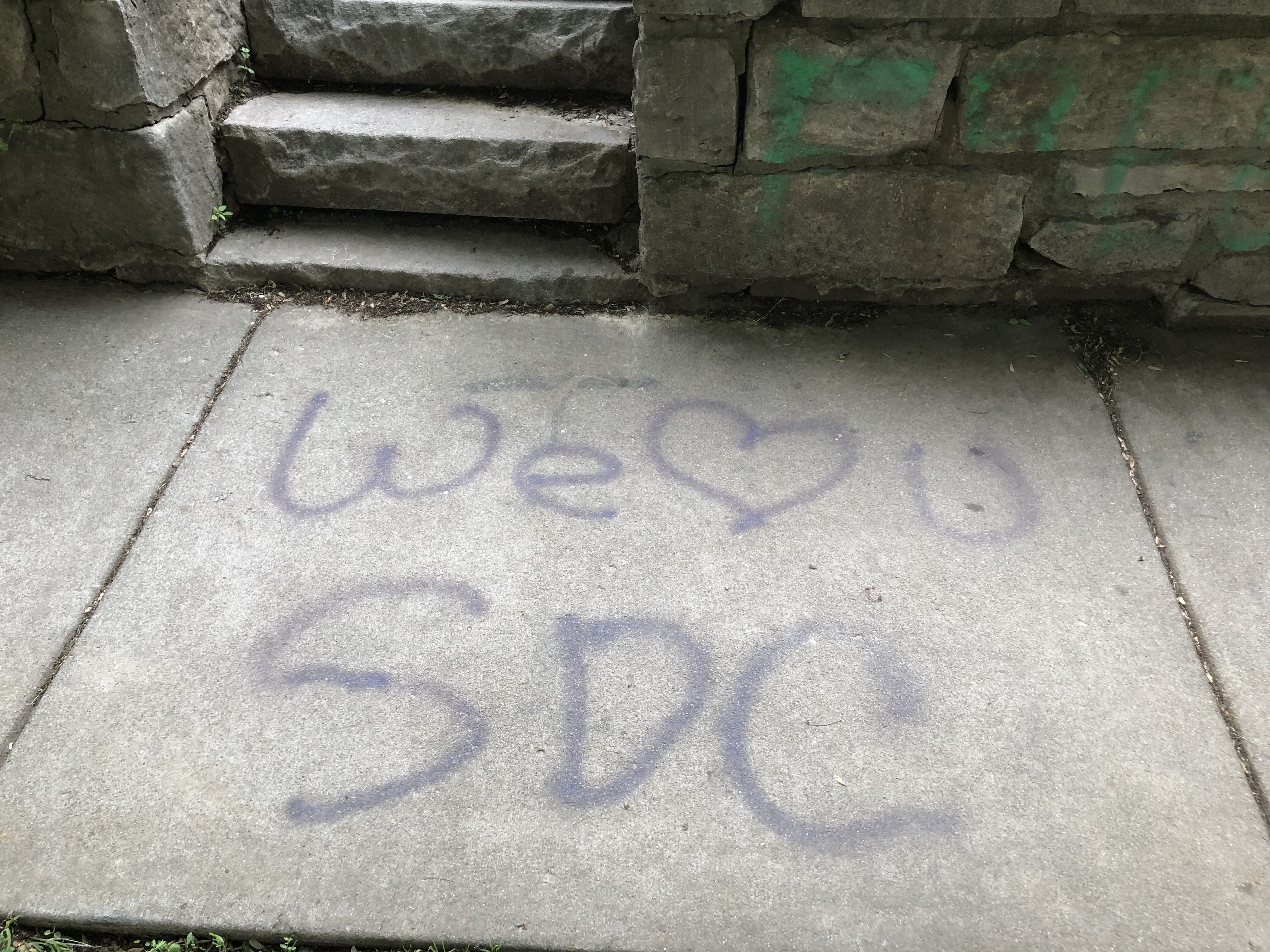
Our county jail is only a few blocks from where I live. Walking along the sidewalk paralleling the jail I see scrawled messages in chalk or paint. These are messages of hope, love and encouragement to prisoners who can look out and see what friends and family have written.
Over my decades as a pastor, I have met with, walked alongside, and known far too many who are like the two persons imagined in the opening paragraph. I do not know names of those currently in Rush – or Monroe – County facilities. I do know these are not only imaginary. These exist, just as surely as you do, good reader. I know parents and spouses, children today who have loved ones being held, awaiting trial.
I may not know or understand all the “crimes,” but I do know there are currently over a half-million such persons held in over 5,000 local jails and youth detention centers in the U.S. There are another 1.5 to 2 million persons held in state and federal prisons. Our nation consistently has the highest incarceration rates in the world. Our practices still have the mark of primitive and counterproductive logic. It is built on monistic, either-or understandings of human behavior and psychology. It is not far removed from shameful practices of shunning, exclusion, and projecting our fears on the most vulnerable among us. Are there evil actors? – yes, of course. Might our systematic response be greatly flawed? – yes, of course.
Frankly, much of what continues is often based on simplistic theologies of good and evil that are subject to manipulation and misuse by the wealthy and powerful. We have become experts at isolation and seem to know very little about restoration. Our young believe our systems are rigged in favor of the wealthy. Are they not? I find myself thinking of the families who see loved ones locked up for minor crimes of addiction, while at the same time watch a former President of the U.S. use his power and wealth to manipulate the current court systems to avoid trials and dodge accountability.
We spend more than $182 billion on incarceration each year in the United States. Increasingly this is built on “for profit” prisons, that turn incarceration into a profit-making venture with the inmates as customers-without-a-choice facing exorbitant expenses for phone calls or other prison “benefits.”
I am far from being an expert on how to best address these concerns. There are many acronyms for efforts underway, already proposed and practiced. Over the years I have seen us turn to more flexible sentencing, home confinement, halfway houses, drug courts, mental health courts, restorative justice and/or restitution options, community service, etc. It is a complex system, filled with obstacles and some more enlightened practices. My appreciation for conscientious judges, defense and prosecuting attorneys, sheriffs, jail and police officers is enormous. I am grateful for, and applaud, all those who are pushing for reform, for a better way. Still, too many languish behind bars, weeping alone and waiting for that phone call.
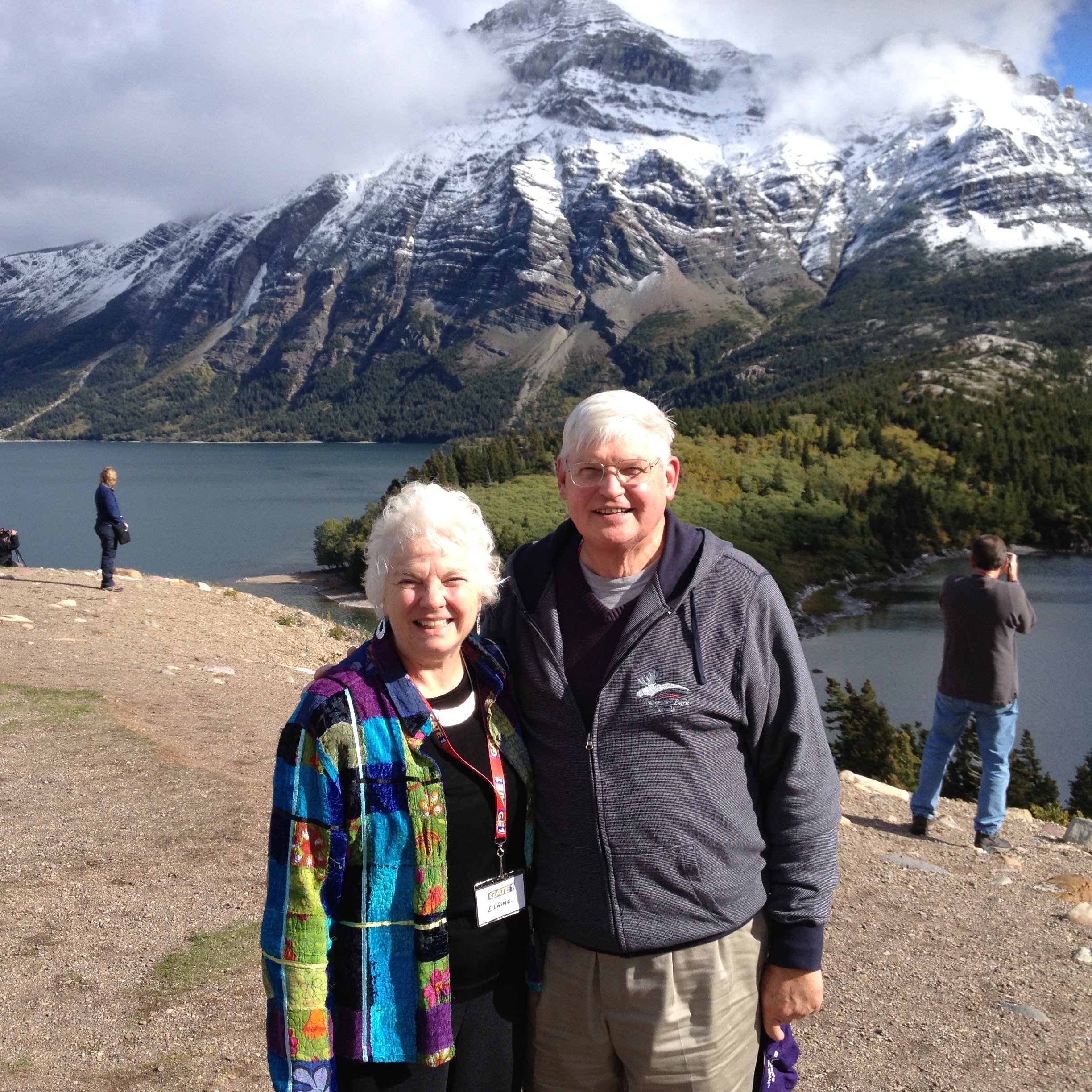
It was mid-September 2016. Elaine and I were traveling in the Canadian Rockies; part of our 50th years of marriage celebration. Walking in the lovely city of Banff, Alberta I spied a t-shirt in the tourist shop window. We laughed. I pointed it out to others who were on the trip. I shared my concerns about Donald Trump.
Two in our group were retired attorneys now living on Long Island. One was volunteering as a Catholic lay deacon who shared my concerns about “the Donald’s” mean-spiritedness, misogynistic behaviors, and racial bigotry. The other attorney laughed saying, “I worked in the prosecutor’s office in NYC for years. Everyone knew he liked to pretend to be something he was not. We all knew Trump was ‘mobbed up’ with the Russian mob.” “Don’t worry,” he said, “a guy like that will never be elected.” “Okay,” I thought, “if you say so. You have seen him up close.”
That was then. He was wrong about Mr. Trump’s possible election. Ever since, I have recalled the “mobbed up” comment. As president, Mr. Trump spoke fondly of Mr. Putin and his dictatorship in Russia. There were other troublesome moments like a phone call that appeared to be asking for a bribe from the Ukrainian president. In the intervening years as Mr. Trumps actions have become more bizarre. Now, he says the quiet part out loud about admiring dictators and hoping to be a totalitarian leader of the U.S. I keep thinking about that conversation in front of the shoppe window in Banff.
This past week (2/2024) at a rally in South Carolina, Trump, railed against NATO countries suggesting they didn’t pay enough in dues. He claimed, “one of the presidents of a big country asked whether the US would still defend that European country if they were invaded by Russia.” Astonishingly, Trump replied “No, I would not protect you. In fact, I would encourage them (Russia) to do whatever the hell they want. You got to pay. You got to pay your bills.”
The words “mobbed up” keep recurring, ever gaining more salience for me. I didn’t buy the t-shirt on that September day in 2016. I buy that he was unelectable. I was wrong. Our nation keeps living though what seems to be an unending nightmare. A nightmare that could endanger the future of our democracy and the freedoms of my grandchildren and the hope for freedom for children around the world.
There is much beauty in our world — in nature and in our flawed but essential institutions of democracy. Will truth and liberty and civility be easily combed over? Don’t fall into the trap I did — believing that IT CAN’T HAPPEN.








 Hands of the Strong