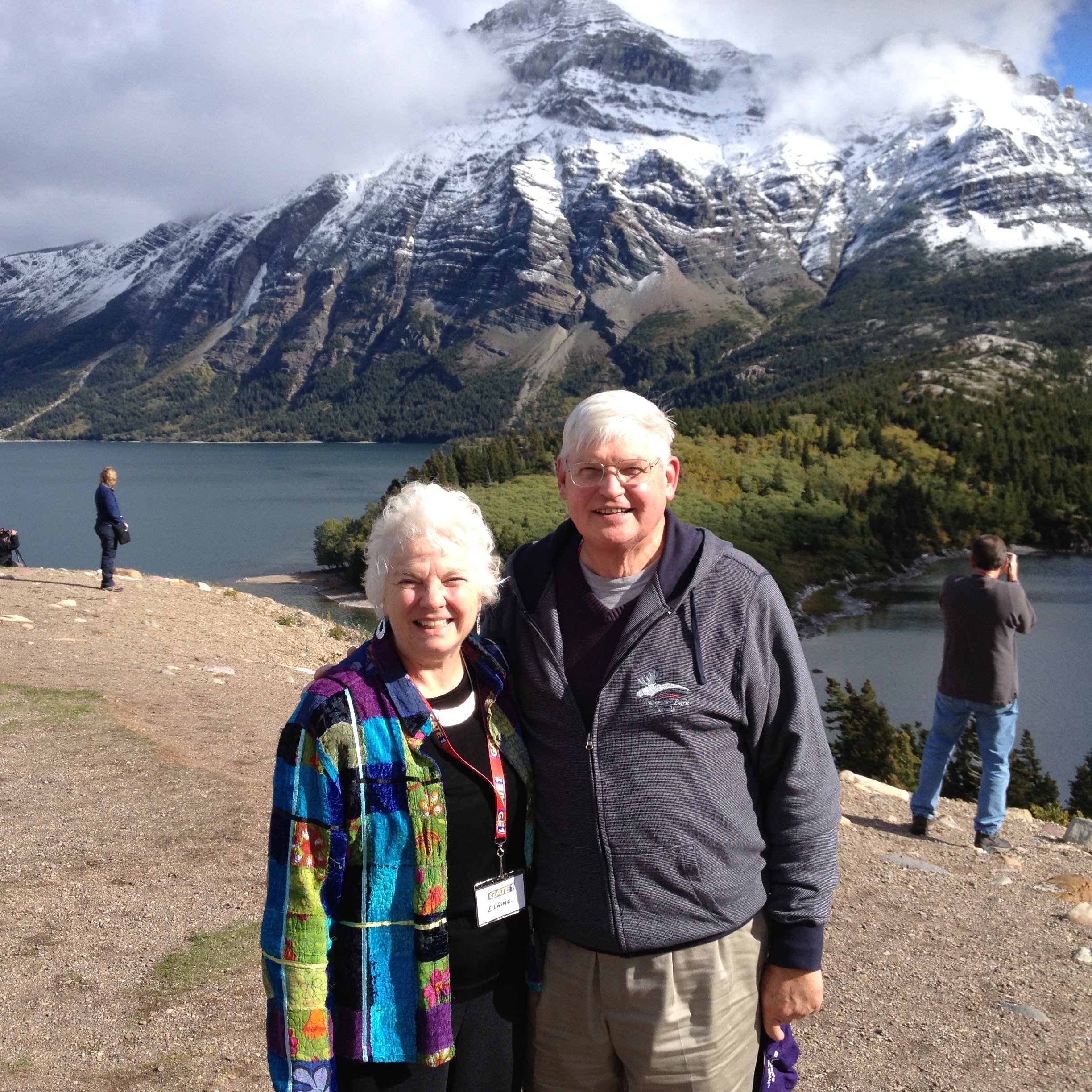
It was mid-September 2016. Elaine and I were traveling in the Canadian Rockies; part of our 50th years of marriage celebration. Walking in the lovely city of Banff, Alberta I spied a t-shirt in the tourist shop window. We laughed. I pointed it out to others who were on the trip. I shared my concerns about Donald Trump.
Two in our group were retired attorneys now living on Long Island. One was volunteering as a Catholic lay deacon who shared my concerns about “the Donald’s” mean-spiritedness, misogynistic behaviors, and racial bigotry. The other attorney laughed saying, “I worked in the prosecutor’s office in NYC for years. Everyone knew he liked to pretend to be something he was not. We all knew Trump was ‘mobbed up’ with the Russian mob.” “Don’t worry,” he said, “a guy like that will never be elected.” “Okay,” I thought, “if you say so. You have seen him up close.”
That was then. He was wrong about Mr. Trump’s possible election. Ever since, I have recalled the “mobbed up” comment. As president, Mr. Trump spoke fondly of Mr. Putin and his dictatorship in Russia. There were other troublesome moments like a phone call that appeared to be asking for a bribe from the Ukrainian president. In the intervening years as Mr. Trumps actions have become more bizarre. Now, he says the quiet part out loud about admiring dictators and hoping to be a totalitarian leader of the U.S. I keep thinking about that conversation in front of the shoppe window in Banff.
This past week (2/2024) at a rally in South Carolina, Trump, railed against NATO countries suggesting they didn’t pay enough in dues. He claimed, “one of the presidents of a big country asked whether the US would still defend that European country if they were invaded by Russia.” Astonishingly, Trump replied “No, I would not protect you. In fact, I would encourage them (Russia) to do whatever the hell they want. You got to pay. You got to pay your bills.”
The words “mobbed up” keep recurring, ever gaining more salience for me. I didn’t buy the t-shirt on that September day in 2016. I buy that he was unelectable. I was wrong. Our nation keeps living though what seems to be an unending nightmare. A nightmare that could endanger the future of our democracy and the freedoms of my grandchildren and the hope for freedom for children around the world.
There is much beauty in our world — in nature and in our flawed but essential institutions of democracy. Will truth and liberty and civility be easily combed over? Don’t fall into the trap I did — believing that IT CAN’T HAPPEN.
Full text of Bloomington Rotary Reflection Notes 2-7-24 (Parts were edited out at presentation for brevity.)
Mark Twain once said: “When I was a boy of 14, my father was so ignorant I could hardly stand to have the old man around. But when I got to be 21, I was astonished at how much the old man had learned in seven years.”
There is another side to this wisdom. For me, now that I am in my late 70s, I am often surprised by how little I know. Wendell Berry and Wes Jackson have written we need to often add an “Ignorance-based world view.” Philosophers call this the Principle of Clarity. The administration of Indiana University would benefit from a familiarity with this Principle of Clarity. Clearly the administration’s failure to support the Kinsey Institute and canceling of the exhibition of Palestinian artist Samia Halaby at the last minute after months of planning demonstrate an abandonment of Academic Freedom that is dependent on open conversation and dialogue.
I mention Wes Jackson in honor of our speaker today who, of course, offers much valued alternative perspectives on agriculture. Wes is a geneticist, farmer, winner of MacArthur Genius award for research on perennial polycultures at The Land Institute in Salina Kansas.
As we enter Black History month while facing continuing racism exhibited by candidates for the highest offices in our nation and in a world filled with violent problems that seem intractable, there is need for open-minded clarity. If you are like me, it is too easy to live in an information bubble, supported by confirmation biases. Without looking at events from multiple perspectives, it becomes easier to argue than to respectfully disagree. It leaves us in zero-sum worlds where an understanding the opposite person’s perspective and experiences are disregarded.
Last week, Traci Jovanovic offered a helpful word about knowledge of others related to the war in Gaza. It caused me to think of my second visit (of what I think are now six trips) to Israel/Palestine; this in the 1988. Mickey Mauer invited many civic, corporate, and religious leaders from Indianapolis. We met with Israeli and Palestinian leaders in political, economic, and educational arenas. Near the end of trip, several of the Indy leaders held an unscheduled meeting seeking to come up with a solution they could offer after hearing from a few of the many sides in the region. It was 40th anniversary of State of Israel and in the early years of First Intifada.
My friends, these leaders, were going to suggest ways to fix things. After a few minutes, feeling discouraged by the well-intentioned naivete of some, I left the meeting and sat in the bar with our Israeli tour guide and Palestinian bus driver. We chuckled together about the well-meaning effort to find easy solutions to struggles that had gone on for decades, centuries, well… millennia. Indiana Jones movies were popular in those years. I recall the Palestinian bus driver saying, with a wink to the Israeli tour guide, “Well, maybe these Indiana Joneses can solve things. I wonder have they fixed all the problems in Indiana?”
Humility is a virtue that is enhanced by honoring the Principle of Clarity. For those of us who are Christians, it is worth noting that the keys to the Church of the Holy Sepulcher in Jerusalem have been entrusted to Muslim families for hundreds of years because the various “Christian” denominations and sects struggle and disagree over who should have what spaces in the church. Alas.
One of my friends over the years was Palestinian Christian Rev. Alex Awad. He worked with United Methodists who visited the region, was pastor of the East Jerusalem Baptist Church and taught at the Bethlehem Bible College. Several years ago, Rev. Awad suggested that perhaps the future will need something more connected at the grass roots, something deeper than politics. He said, “People must start dreaming about Palestinian and Jewish children playing together without refugee camps, segregation walls and tanks. Then we can truly call it a Holy Land.”
Israeli peace activist Amos Oz has written “I believe that if one person is watching a huge calamity, let’s say a conflagration, a fire, there are always three options. 1. Run away; 2. Write a very angry letter or hold a demonstration; 3. Bring a bucket of water and throw it on the fire, and if you don’t have a bucket, bring a glass, and if you don’t have a glass, use a teaspoon, everyone has a teaspoon.” In his book “How to Change the World” Oz suggests everyone can join The Order of the Teaspoon.
I am glad there are some people in this room working to find BIG SOLUTIONS to war and violence. There are also small things we can do, right here, now, at home. Welcoming the immigrant, finding shelter for the unhoused, saying no to racial prejudice and discrimination, seeking to mitigate domestic violence and gun play on our streets.
Jon Paul Dilts heads our club’s peace building committee. He reminded me that February is Rotary’s “Peacebuilding and Conflict Prevention Month.” The February issue of Rotary Magazine offers several grass roots ways to seek clarity – to work across differences. Much of the brokenness in our world has been ongoing for centuries, millennia. Big steps and small ones toward peace are required.
I close with the wisdom of my friend Wes Jackson who said, “If your life’s work can be accomplished in your lifetime, you’re not thinking big enough.”
This morning (1/1/24) I wake at the beginning of my 78th orbit around the sun. What a journey! Earthbound all the while, I didn’t notice the spinning while traveling roughly 30 kilometers a second. Thankfully, gravity prevailed along with the persistent tugs of other gravities like tradition and creature comfort. As 2024 begins, I make no New Year’s Resolutions. Instead, I will look to the delights ahead; 366 days to enjoy (it’s a Leap Year). Here are eight “in-joy-ments” I anticipate, let’s call them Orbits of Delight drawn from life lessons thus far and based on emerging hunches in a journey toward hope. You can keep the change. I will:
Delight in laughter – remembering the foolish things I say and do, more than suffering over the nonsense of others (especially the U.S. Congress).
Delight in weaving community — looking more peripherally making fresh connections with friends, neighbors, and strangers.
Delight in the currency of the Spirit – spending and saving a different form of wealth; banking on common humanity through greetings, stories, smiles and hugs.
Delight in tables of fellowship — hosting picnics, parties, and meals to listen for laughter or reach out in care for fear or grief.
Delight in welcoming the poor and immigrant – as Rev. Murphy Davis put it, welcoming others “not as a problem to be solved but as a mystery to be loved.”
Delight in the achievements of friends – making a phone call or sending a note of celebration.
Delight in the beauty of nature – walking and marveling in the land, vegetation, animals, and the sky (including a near total solar eclipse on April 8th where I live).
Delight in being a member of the extended household of God – while patriotism, has it’s merit, it is a puny, second-rate, counterfeit to God’s intentions for me, for us all.
Republican Presidential Candidate Nikki Haley, campaigning in New Hampshire at the end of 2023, was asked a simple question “What caused the U.S. Civil War?” Haley’s response was word-salad. It was mumbo-jumbo talk about differing theories of governance. We hear you loudly and clearly Nikki Haley. One hundred and fifty-eight years after the end of the U.S. Civil War, she was unable to give the clear one-word answer to the question. It was SLAVERY.
If anyone believes racism isn’t deeply embedded in our national psyche, our politics and civic discourse these more than fifteen decades later, they are either ignorant of history and/or unwilling to confess a sin that continues to erode our best future. There is considerable irony, of course, that the question was asked in New Hampshire. New Hampshire is a state from which thousands of brave young men gave their lives to end slavery.
The answer Nikki Haley gives – or fails to give – underlines our need for national confession of sin, repentance, and reconciliation. It exemplifies our continuing Un-Civil Wars. If the Confederacy had prevailed in 1865, would someone like Haley be able to hold political office today? One wonders. Yes, there are several auxiliary causal factors to U.S. Civil War; however, why avoid the basic truth? It was, and is, wrong for human beings to be treated as property to be held and sold? This was the crux of the war — the evils of racism as evidenced in slavery.
On April 9th, 1865, General Robert E. Lee and the Confederate Army of Northern Virginia surrendered to General Ulysses S. Grant at Appomattox Courthouse, Virginia. Five days later President Abraham Lincoln was assassinated in Washington, D.C. A surface telling of the history misses that thousands of troops continued fighting after April 9th and April 14th.
It also misses the continuing Un-Civil Wars across these past fifteen decades (Reconstruction, Lynchings, Jim Crow Laws, Segregation, Red-lining in housing, Unequal school funding and dozens of other discriminatory acts). The UnCivil Wars continue today as is evidenced clearly in voter suppression efforts and racial gerrymandering. Racist impulses and ideologies continue to shape our political conversation and actions, national values, and self-understandings. If one believes otherwise, please explain why Haley’s answer could not have included one simple word?
Emptiness. Manger Square, Bethlehem, December 23, 2023, is abandoned. Most years, every square meter of the space would be filled, maneuvering among the crowd, difficult. Christian Palestinians in Bethlehem, in solidarity with those in Gaza, have canceled Christmas. The Lutheran pastor says, “if Jesus were born today, it would be under the rubble of Gaza.” And nearby, among Israelis, the horror and grief of October 6 when families were ripped apart, children murdered, women raped, and hostages taken, and who even now are being tortured persists and widens.
Israelis and Palestinians deserve better. Still, decades long pent-up anger and distrust has erupted in an unimagined violence. Slow boiling political chicanery, terrorism, and bigotries mostly built on lies and prejudices now rob the people on all sides of options. Emptiness. No room left for rational thought or basic humanity.
No room left for recognition of another as a human being. Robbed by millions of deceits, papercuts on the soul, there is no space for mutuality, companionship, or love. The prefrontal cortex is severed from the reptilian parts of the brain. A single option appears the only one — revenge, revenge, revenge. Empty of alternatives, life on all sides is reduced to terror.
For those of us, observers with broken hearts and conflicted loves, there is another kind of emptiness. Those who know, respect, and love both Jews and Palestinians, live in a wasteland of uninhabited hope. Our carefully crafted dreams and visions for humanity are shattered. And what of our own bigotries and behaviors? What of the ways we discount and exclude those we fear? What of our treatment of those without shelter, who struggle with addictions or who come to us as immigrant?
We suffer with a similar, yet a differing void. For so many Christians, the mangers of our souls will seem vacant, emptied places this Christmas.
The Christmas story speaks of a family without shelter. Mother, father and newborn child they are. The record says they found refuge in a stable, a barn. They were on a journey, seeking a place of safety and stability. In our cities and towns, along our borders and spread across our world are those who seek shelter still. There are many efforts to respond.
Attached is a podcast on homelessness. Our daughter, Lydia Murray, who is a Managing Director with Deloitte consulting is one of those interviewed. Apart from being proud of Lydia and eager to share her wisdom with others, I believe the listener will find a respectful, up-to-date overview of resources and some ancient wisdom in this resource. Perhaps you can take a moment during the Christmas season to listen and learn how to better respond with those on the edges.
I was tempted. This morning. Even in my late 70s, the seduction was strong. Autumn leaves. Raked in a mound. Go for it… jump up and in! I remembered the joy of such flight up and in a mound of crunchy crimson glory as a child.
Walking home from the barber shop, I spied the leaf-dome someone had piled together the day before. At age six or seven or ten, there would have been no doubt about it. Leaves might be designed for photosynthesis and then mulch but in the second week of November, banked high they were meant to be jumped upon, rolled in, and enjoyed! The colors, the smells and cushy landings are autumn’s gift and a child’s hankering. Don’t stop to worry about hidden objects — tree branches, or broken glass, or rocks or… well, a surprise gift from a passing pooch. Go for it?
“Nope,” thought I. Too old, already landed on too many hard realities over the years. I’ll wait until the grandkids arrival for Thanksgiving visits. See then if any autumn offerings are in the neighborhood. Perhaps still dry, piled high and ready for love. Wouldn’t want to miss that joy for my leaping into some foolish temptation now.
Would compassion please step forward and state your name? “We will swear you in. Is the testimony you are about to give the truth, the whole truth, and nothing but the truth?” One by one they came to the podium. It was the city’s Zoning Appeals Board. Eloquent supporters of a new, relocated homeless shelter they were. It would offer services for the thousands living at the ragged end of poverty. Beacon, Inc. (Shalom Community Center), is a frontline community service agency responding to homelessness, hunger, health issues, addiction and more.
One by one they came supporting a larger and better shelter: more beds, food service, health care, employment assistance and more. Supporters cited statistics. Staff offered early architectural plans, reported on meetings with neighborhood residents and shared stories and poems written by persons living-on-the-streets.
Only one couple spoke in opposition They lived nearby and shared concerns about potential dangers and possible loss of property value. Clearly the folks at Beacon, especially the center’s director, the Rev. Forrest Gilmore, were prepared. Gilmore had previously met with the couple who were opposed. He spoke of his commitment to continue to be in communication with them and others in the neighborhood. They were appreciative.
It was an impressive thing to see, this well-planned and open-hearted expression of compassion. Well done, Beacon! There are still more plans to be made and many dollars to be raised. Even so, this is a BIG STEP in the right direction that might open as soon as 2025.
Compassion stepped forward. Still, I left aware many voices were missing-in-action.
Where was the faith community? Yes, Rev. Gilmore is an ordained Unitarian pastor; but, apart from him, there were no other faith representatives speaking. Is this not a concern in our congregations? I might have said a word. After all, Beacon’s earliest manifestation began in the 1990s when I was pastor at First United Methodist Church. A day-center, Shalom, started in the fellowship hall. It grew and improved in outreach. It is a gift to see what has developed over these decades. Even so, there was a hollowness in my chest as I wondered about the absence of other voices of faith today.
Where were the voices of those who struggle with homelessness now? Like so much that goes on in our liberal social service worlds, the truly poor are too often turned into voiceless objects. Recently I asked leaders working on homelessness in our community how those who are currently on the streets, or who have recently found a residence, were given voice in meetings and in planning? I was told it was “difficult to do” and “being worked on.” Okay; but in other cities they have found a way to listen to folks at the margins. I have asked leaders at the hospitals a similar question. Our institutions are better designed to fix someone than to listen to them or know them. The good folks at Beacon listen and respond; they seek to include. Others, many of us, who “care” seem to take the “it’s not my job” approach when it comes to listening to and knowing those who are “being helped.”
Where were the university representatives? Some national experts on homelessness teach in our nationally ranked business and public policy schools. And what of the administration and student leaders? Will they swear to “tell the truth and the whole truth” regarding homelessness in our city? As in many college towns, our real-estate market is overwhelmed, and rents are soaring. Multiple new apartments and condos are occupied by persons who do not work here. The university has backed away from offering more residential space, in large measure because students are wealthier than in the past. They now expect more than a dormitory room. Can the university’s mission be wide enough to teach about justice and good citizenship even while in school? Apartment complexes have mushroomed with rents well beyond what many low-income and even working-class folks can afford. Does the university care about this consequence of their decisions?
Where were the leaders in the current city administration? Where was the mayor or his representative? We have watched as plans and promises for workforce and low-income housing languish and are often placed on the back burner. Meanwhile, out-of-town developers build quickly, take their profits, and have little else to do with this community. Thankfully the likely new mayor has made housing for each, and all, a top priority. She speaks of building coalitions with a vision for a more welcoming and just city.
Perhaps we ALL should have been sworn in and asked to speak “the truth, the whole truth and nothing but the truth.” I left the meeting wondering if there will be a demand for a larger facility twenty-five years from now. Or might we move toward new ways of thinking and acting. As we build this new homeless facility, might we explore more comprehensive and collaborative ways of being a community that welcomes, listens to and values all?
Compassion is a fine attribute and friend. However, this community is going to need more. In the short term, there is the need for financial support so that the new Beacon facility and its programming can become a reality as soon as possible.
Compassion is a good thing. Might the time arrive when we ask the sister of compassion, named “justice,” to come forward and testify on all our behalf?
Whether national politics or elementary school, we observe bullies and victims. It is not a new phenomenon. Seventy years ago, at West Spring Street School in New Albany, Indiana – I saw it – and felt it – on the playground. This ancient human reality goes all the way back to Cain and Abel, Joseph and his brothers, King David and Uriah, Pharoah and the Israelites, or King Herod or his wife murdering John the Baptizer. Bullies and victims are forged deeply into our emotional and moral foundations.
Literature is built on the anti-hero, victim, and hero motiff. It is a delicious formula that fits well in literature, movies, and television series. Still, this easy pattern is missing something critical and complex. It is the place of responsibility. It is the paradox of the cross. As H. Richard Niebuhr noted in his classic “The Responsible Self” (1963) ethical behavior requires sorting through the ambiguity and distortions of real life. Ethical behavior requires attention to a universal community and honest observation of the best intentions and failures brought by each and every actor.
A victim can often turn into the bully; the research is clear. The story of the man bullied at work who comes home to kick the dog is a familiar one. Most adult abusers were abused as children. Limiting our frame to either bully or victim is a gestalt that has gained a wide purchase in our society. It is the core “stuff” of the MAGA movement. It plays out in the courtroom, city halls and, even in the church. Politicians market in meanness. Tough talk and threats are confused as “strong leadership.” On the other side many can only see themselves as victim. So much of our social service efforts and congregational life assumes a primary task to rescue the victim from the bully – and, of course, we are to be cast as heroes rescuing the victim.
In the wake of the trial of United Methodist Bishop MinervaCarcaño there are persons on each side suggesting they have been victimized – and “the other” was a bully. What’s missing? I would argue it is responsibility to the larger community. Was it a struggle over power, gender, culture, money? Perhaps all of these, yes. How did we arrive at the point when good folks on each side are to be sorted into the “bully/victim” divide? Perhaps one party was unwilling to seek a responsible remedy before going to trial. Perhaps both parties were unwilling. But here we are… still living in the bully/victim wilderness.
There are many ways forward. (Many will point to Matthew 18 counsel on how handle a dispute. It is a good place to begin.) However, I will start by borrowing from Robert Greenleaf’s notion of Servant Leadership. He writes of a servant leader’s responsibility in this way: “The best test, and difficult to administer, is: do those served grow as persons; do they, while being served, become healthier, wiser, freer, more autonomous, more likely themselves to become servants? And, what is the effect on the least privileged in society; will he or she benefit, or at least, will he or she not be further deprived?” (The Servant Leader, p. 7)
Might it be that while dollars, publicity, trust and energy were put into a drama of victimhood or bullying, the opportunity to act on the behalf of the least privileged among us has been lost?
There he was. Comfortably situated on the front steps, he was. We will call him “Andy.” I thought I recognized him the first time I passed but didn’t speak.
It was a shady spot. Good place for a breather and a smoke. He wasn’t in anyone’s way. It was Friday and these steps wouldn’t be needed until Sunday. Doors were locked. All the doors locked, each entrance around that church building. Locked. It was Friday noon. I tried an entrance on the other side of the building. Locked. There was a phone number to call. No answer. Disappointed, as I wanted to introduce my friend De’Amon to some of the folks there, we retraced our steps. Andy was still resting on the front steps.
His gear was scattered around him on the steps – helmet, belt pack, notebook, lighter. In front of him, between us, a nice bicycle, a good barrier – just in case. De’Amon and I approached. I caught his eye and opened with “Don’t I know you? You seem so familiar to me.” His eyes sparkled and his handsome ebony features all seemed to join the fun. “No, don’t think so.” I took off my hat so he could catch a clearer view. “You kinda familiar, but I don’t recall. I used to work in a nursing home in town, perhaps you knew me there.”
“Yeh, I think that’s it,” I responded. “I think I knew you back when.” He smiled, “I worked there for almost twenty years – of course that was a while ago.” Laughing I said, “I think you nailed it; I remember you there.” “Good work it was,” he replied, “but I got tired of seeing my friends die.”
De’Amon is pictured with Michael Mather. longtime friend and colleague.
I could have walked by but didn’t. You see, I was with the original “Roving Listener,” De’Amon Harges. He has listened tens of thousands into friendship. He can discover human-buried-treasures. He finds a depth of resources so often overlooked. De’Amon has helped establish networks of mutuality where others saw only poverty, alienation, or separation. He has taught thousands of folks around the world, from all social strata, about the value of social capital, the value of “neighboring.”
What choice did I have? It was like a test, a gift, a challenge, and Andy was there right beside us. I broke the ice. Off we went. De’Amon asked Andy about his work, his history, where he grew up, what he does best, what he is hoping to do in the future. We found out Andy had his own business, cleaning buildings. Had enough work to hire some others as well. “But they better be willing to work. I mean, seriously, it is my name on the business.” We got Andy’s phone number and thanked him for the visit.
As we left, I whispered to De’Amon “There it is, abundance on the doorstep of the church.” We laughed and knew this story would one day be in a sermon. But would such gifts, such opportunities remain outside?