The Great Identity Theft of 2015

The Great Christmas Identity Theft of 2015 

The devastating assaults in Paris have shattered our best hopes during this season.  I was traveling the day following this tragic time and couldn’t help but marvel at the way persons sitting in the airline terminal transfixed by the television images from Paris.  The usual noises of travelers hurrying through the terminal were muted.  We were all distracted.  Fear and anxiety overwhelmed any sense of normalcy.  Then, our worst fears about the future of terrorism seemed confirmed by the murders of innocents in San Bernardino.  Terrorists assault.  They kill and gravely wound unsuspecting civil servants at a holiday party. 

How do we respond to such evil.  What can we learn?  How will we find a way forward when there are appropriate fears about the future.  One healthy response is to seek to learn more, to understand more, to gain knowledge of the situation.

Who are these misguided murderers?  What motivates?  Why do they choose these suicidal theatrics.  We want to know who is doing this and what are their motives. This is all healthy and appropriate.  It is needed information.  And what can we learn about Islam and this radical apocalyptic cult — this ISIS or ISIL?  Important this is, all of it.

Still, isn’t it intriguing that during these days of terror, we hear volumes from the experts about Muslims — who they are and how they behave — while at the same time there is little or no consideration about who is a Christian or how Christians might act at this time.  The media are full of analysis about Islam.  Good.  knowledge is helpful; as one of my mentors would say “facts are our friends.”

It may be as important, make that more important, to consider what it means to be a Christian in this time.  In the seasons of Advent and Christmas 2015 we hear again the Jesus narratives.  His life and words are captured in carols and story and sermon.  What is there to be learned from this narrative about retaliation, revenge, exclusion, bigotry toward those who are different? 

It is interesting that on the same day that Pope Francis announced the beginning of Year of Jubilee as a time of mercy and reconciliation, Donald Trump is loudly and adamantly speaking words designed to stir up fear and set up new systems of discrimination.  Many people in this country seem to agree with him — in some places, places where there are strong “Christian” environments, there may even a majority who agree with The Donald.  

What has happened?  Most of those who seem to agree with Trump would be quick to say the United States is a Christian nation.  Really?  There is grave danger here.  If we are to choose the way of discrimination toward persons of a different faith, this is a danger I would label identity theft.  Someone is taking the basic elements of what it means to be a Christian and substituting a cheapened, debased form of shallow and self-serving religiosity.

It is not up to me to say whether Donald Trump is a Christian or not.  He says he is, “I attend church on Christmas, Easter and special occasions.”  He says that if he is elected president he will be “the greatest Christian representative ever to be in the White House.”  His faithfulness and the ways he acts on his beliefs are between him and God.  However, he doesn’t get a pass on his easy claims.  How do they match up with the story of Christmas?

9931687_sNo, it is not my call to determine whether Donald is a Christian… but we do know a great deal about who and what a Christian is expected to be from the scriptures and the great traditions of the church.  Racism, bigotry and calls for revenge displayed by too many just don’t square with the person and teachings of Jesus.  Right now — as we gain knowledge about others, equal care needs to be given to thinking clearly about what it means to be a Christian.  Certainly the calls to exclude persons from the United States based on a religious test is unconstitutional.  That is easy.  For me, however, it is more important to ask, is it Christlike?

We are warned at this time of year to guard our credit card information.  We are told to be careful giving out information about social security numbers or family background.  Someone might steal your identity and this would be disastrous.  I want to warn of an even greater identity theft that is underway — it is a theft of what it means to be a Christian.  Guard this closely.  The loss of this identity might be even more damaging than having one’s credit compromised.  The loss of this identity may close down important options that will be needed in the future if we are to find a way past this current wave of terror.

Fear is a powerful thing; so is knowledge.  It is critically important in these days to know more about Islam — what is true and what is false?  Let me suggest that it is even more essential, for those of us who make the faith claim that we are “Christian” to consider carefully what this means — what is true and what is false? 


An Advent of Sustainability

A Sustainable Advent: Integral Ecology

Dateline – Paris, November 30, 2015:  It is the first day of Advent and the leaders of nations around the world gather to seek ways to address the dilemmas created by Climate Change.   While there are some who believe that concern for the climate is antithetical to economic prosperity, there is a slow and steady awareness among business leaders that an alternative to this old either/or model can emerge. 

Interestingly this environmental summit begins on the first day of Advent.  Advent is a season filled with of stories of exile and a longing for home.  It is a time of waiting and watching.  Paris, touched so recently by terror, knows something about the challenges of exile and the welcoming of strangers

For me, the question of Climate Change is a leading edge of growing faith understanding.  This issue is a way I continue to “learn to learn.”  Sustainability is another way of speaking of the human responsibility to provide enduring care for God’s creation.  So… Advent is a time to wait, think anew, and reconsider my beliefs in the light of new lessons from scripture and science.

On my desk is a copy of the encyclical “Laudato Si” offered this spring by Pope Francis. The subtitle of this fine document is “Care for Our Common Home.”  Drawing on the witness of the pope’s namesake, St. Francis Assisi, we are encouraged to seek an “integral ecology.”  Care for the earth, it’s creatures and all human beings is one, indivisible task — it cannot be separated into parts.  Our commitment to care for the poor and stranger among us is related to our care for the earth; they are one focus. [Link to Ladato Si: Care for Our Common Home]

For years I have pondered the power and beauty of scriptures related to the the creation.  The call for an integral ecology is another way of saying the deepest spiritual themes of scripture and faith are interconnected.

I think of Genesis 1, where we are told that God sees everything that has been made and announces “behold it is very good.”  I consider passages like the 24th Psalm (“the earth is the Lord’s and all that is within it”) or the majesty of Psalm 104 or 148 — or Isaiah 40.  All of these passages are linked speaking to how we are to relate to our neighbor — especially the widow, orphan and stranger.  Our Christian scriptures culminate with Revelation 21 which speaks of the fulfillment of creation as a new heaven and a new earth.  

For me, the most haunting passages comes in the eighth chapter of Romans, one section of which reads: “We know that the whole creation has been groaning in childbirth right up to the present time.”  It goes on, “Who hopes for what he already has?  But if we hope for what we do not have we wait patiently for it.”

Advent is a time of waiting… in hope… and then taking steps toward a more integrated way of living as people of faith.  This is a time to ask and answer some hard questions, no matter your stance on how to proceed.  [Link to: NY Times: Short Answers to Hard Questions about Climate Change]

Sadly, there are climate skeptics who deny both science and these compelling scriptural injunctions.   Many in the U.S. Congress are voting against the plans that will be offered by the current U.S. administration this week.  Sadly, these skeptics do not offer any alternative ideas.  They simply deny the science — and the scriptures.  Leaders in more than half of the states are suing the administration over this climate care agenda.  Okay, congress and governors, disagree if you will; however, offer some alternative.  Especially if you make claims about being persons of faith.  At least speak to the matter of stewardship and God’s desires for the care of the earth.

If one is an intelligent Christian, this season of Advent is a time to think carefully about God’s call for us to care for creation.  The science regarding the dangers of climate change is compelling.   Even if it were not, we persons of faith are to be good stewards of all we have been given.  If you are a person of faith and cannot support the Paris proposals, then speak clearly about alternatives as to how we should live with care and respect for creation.  Advent is the perfect season to think this through and then begin to offer alternatives in the new year.

If, like me, you are both a person of faith and trust the science, then we may have the greater task.  How can we help others understand?  How will we live?  What will we do to bring about change.

One encouraging sign comes from persons in the corporate world who are ready to help address the climate crises.  Microsoft co-founder Bill Gates will be announcing the creation of a multi-billion dollar clean energy fund, tomorrow, November 30th, at the opening of the Paris summit.  This announcement comes after and in addition to his announcement this summer that he was investing more than $2 billion in renewable energy that will encourage both “productivity and sustainability.” 

Early reports are that several others are joining Mr. Gates in the creation of the clean energy fund; however, many donors wish to remain anonymous because there is still a considerable lobby of persons who are climate change skeptics among corporate leaders. 

This skepticism and resistance is changing, and apparently quickly, Steve Schein, a former CEO and now professor in the business school at Southern Oregon University has recently written “A New Psychology for Sustainability Leadership.”  In it he suggests that more and more business executives are displaying an ecologically informed worldview — a worldview that for many of them has been nurtured since childhood.

IMG_1030
2015, Pines in Yellowwood Forest

Several years ago a friend took me on a hike that led to a grove of trees in Indiana’s Yellowwood State Forest.  It is a wonderful natural cathedral.  The white pine planted in the mid-to-late 1930s are now over 100 feet tall.   This grove is still a spiritual place for me.  It is an Advent place — my Advent wreath —  where I pray and think.

It is more than a place to think and pray.  You see, as lovely as these trees are they are dying too soon. 

Planted by the Civilian Conservation Corps, they are in an area that is often swampy and this forest lacks the necessary biodiversity of the wider forest and ground coverings all around.  Still, this grove of pines is far better than the land there previously; land that was eroding and abandoned due to the Great Depression that so scoured the region in the 1930s.  Something had to be done then… and it was.  These trees, now one of my favorite cathedrals, were planted over 80 years ago.  This was a temporary fix, perhaps only lasting 100 or 150 years.  It does, however, give space for further ways the natural world might, groaning as in childbirth, bring yet another season of beauty and hope.  Even if it is only a temporary fix, success at the Paris summit needs to be a part of our Advent prayers in 2015.


Unwrapping an Early Christmas Gift

Christmas 2015: A Pageant of Imagination

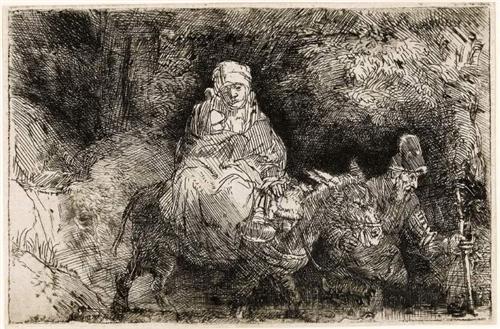
How will church nativity pageants be different in 2015?   Should we check the visas of Mary, Joseph and the baby Jesus before they process down the church aisle?   Or, should they be detained before they sit beside the manger scene in the chancel?  After all, these three family members were “outsiders” threatened by terror.  They were vetted by the authorities and found to be dangerous.  As a result, they became refugees.

You remember this part of the story, don’t you?  As a nation we in the United States seem to forget or perhaps simply say, “Well, that was then and this is now.”  Right?  Well, no, not really.

the-flight-into-egypt.jpg!Blog

Rembrandt’s rendering of “The Flight into Egypt”


The fears generated by tragic events in Paris this past week have resulted in U.S. political leaders loosing their ability to think clearly.  To call the response “knee-jerk” is disrespectful to knees everywhere!  The ignorance and intolerance displayed by folks like Donald Trump are not worthy of a great nation like ours.

Suddenly, our greatest fear is the 10,000 Syrian refugees who are being forced by terror to seek new homes?  While Jordan, Lebanon and Turkey are accepting millions of displaced refugees, we proud Americans, who are an ocean away, can’t welcome 10,000 who have been screened for nearly two years — and these are persons who are going to be placed with resettlement organizations most of which are religious groups with long histories of working with such refugees. 

Members of the House of Representatives quickly pass a bill that is designed to target persons based on their religion.  It is an astonishing nod to the bigotry and ignorance of the cheap seats in the American electorate.  It has been said by many and it is true — “we are better than this.”

However, rather than writing a screed on the small mindedness behind the statements and legislation that has been proposed, I choose to believe that these events just might be an early Christmas present, waiting to be unwrapped.  An early Christmas gift to be shared at our Thanksgiving dinner tables.  There is the opportunity here for imagination, for those who will be guided by thought, prayer, a clear-eyed view of our history to offer another version — not of who the Syrian refugees are, but who we are, especially if we are persons of faith.

I think of heroes like Colorado Governor Ralph Carr, who was faced with the demands of the Roosevelt administration to set up detention camps for Japanese Americans in his state.  Carr, a conservative Republican was shaped more by his Christian faith than political expediency.  He said, “No, not here, not on my watch” and he paid the price of losing an upcoming election to the U.S. Senate.  Today if you visit Denver you will see that the state judicial building is named for Ralph Carr in recognition an ethical clarity, drawn from  his faith, that allowed him to stand for justice against the popularity of bigotry on the march.

If you watch the news carefully, you will see politicians already coming to terms with their reactive bigotry.  News speak is that they are “walking back statements made about Syrian refugees.”  The mayor of Roanoke, Virginia is an example of one who had to change his suggestion that we go back to camps like those used to detain Japanese Americans during WW II.  Presidential candidate Ben Carson now says he regrets speaking of the refugees with a rabid dog analogy.  Fear is a powerful emotion mixed with self-interest in which human beings sometimes get lost in the worst of our impulses.

These events, put together, provide the occasion to think more holistically and imaginatively about how to proceed.  Should we accept Syrian refugees that are carefully screened.  Absolutely, YES… and I think we should welcome even more. 

HOWEVER, this is only a start — there are dozens of other things that might be done in the United States and in other parts of the world to humanely address this crises.  How do we assist those in Jordan and Lebanon and Turkey who have borne the brunt of the tragedy in Syria?  How do we assist those in Europe facing these challenges?  Now is not the time to play the tortoise by hiding inside our shell.   

The nations of the world no doubt will make increasing military responses to ISIS.  There are arguments to be made as to what might be done and how.  Again there will be dozens of ways to respond.  As for me, there will need to be a witness against war and violence — as our continuing “go to” solution to every dangerous and hostile situation.  Didn’t we get here by trusting too much in overusing the military as a solution to everything?

th

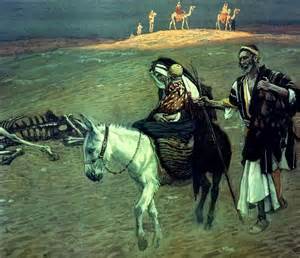
James J. Tissot’s “The Flight to Egypt”


This week, let’s join one another in unwrapping an early Christmas present at the Thanksgiving table.  Make this your early gift — encourage imagination.  Help others remember that our Christmas pageants are more than little parades of children in bathrobes and silly hats.   Laugh, play and retell the Christmas narrative in fullness, including the parts about a refugee family driven from their home. 


The Last Apple

THE LAST APPLE

November 2015

IMG_1073

Autumn sharpens one’s imagination.  Days are filled with transition.  The weather teases — do we chance leaving the tomatoes on the vine one more day?  Was it frost last night, or nearly frost? When will the leaves turn?  Will they be mostly golden or red or brown this year?  Day to day, transition comes, sometimes slowly and sometimes in a burst.  Some things end, some things anticipate a spring.  

This year, again, I have been planing bulbs (300 of them in the last week).  Tulips, daffodils, allium.  I know better, especially setting those tulips in bed for the winter, as the deer find them irresistible in the spring.  I foolishly calculate that if 100 bulbs are set this fall, maybe 50 will survive, especially if I spred some deer repellent nearby next spring.  Okay, so sign me up as an eternal optimist!  Still, there is something compelling about autumn.  A thinking person and/or a person of faith will see this as a time for hope… or, so I tell myself.

Each fall I think of the haunting passage written by E. B. White who described his wife Katherine, as she aged, still kneeling each fall to plant bulbs.  He wrote: “As the years went by and age overtook her, there was something comical in her bedraggled appearance… her studied absorption in the implausible notion that there would be another spring, oblivious to the ending of her own days, which she knew perfectly well was near at hand, sitting there with her detailed chart under those dark skies in the dying October, calmly plotting the resurrection.” [Forward in Katherine S. White, Onward and Upward in the Garden, Boston: Beacon Press, 2002.]

I’m with Kathrine White — calmly plotting the resurrection, indeed.  As I plant bulbs and trees I am aware that I may or may not be around to enjoy them 15 or 20 years hence — but my prayer is that someone will benefit and thereby be reminded of the beauty and promise found in these autumn days.

This year I also planted trees — decorative plum, pear and magnolia.  They stand all along the driveway.  And there were three apple and two cherry trees planted last spring.  I find I have to protect them all from the deer, who like to munch on the apple or cherry tree leaves or, in the case of the other trees, the bucks will come and scar the trunks during rutting season. 

IMG_1064 We lost the old apple tree in the front yard this fall.  A friend who knows about such things tells me the tree was approaching its 100th year… but we watched as it slowly faded in health over the past three years.  Someone, a century or so ago planted this apple tree; perhaps, like me, hoping it would be appreciated by another in a distant future.  This fall the time had come; we had to cut that tree down.  Sad, as the old apple tree in the front of the house was one of the features we loved when we bought the place three years ago.         

In  mid-September, walking past the tree, I noticed one last apple hanging up among the few branches still clinging to life.  (For those of you wondering, I took a cutting off that branch, in the hope I might plant it next spring — yes, my hope springs eternal!)    The tree is now down, the wood cleared and stump ground up.   That last apple — tart and memorable — has now been eaten and enjoyed.  In my imagination, that last apple lingers, remaining for me as an autumn metaphor.

IMG_1052As my seventieth birthday approaches on the cusp of a New Year, I still think of myself as young.  I do this even when I am sometimes offered the “senior discount.”  And this without my even asking!  More and more often, when speaking of friends, I add the words “of blessed memory” upon mentioning their names.  Time passes, life’s autumn season arrives.  Thankfully it does not mean that imagination disappears.

It is not only friends who have passed on.  I find institutions and organizational cultures are often “of blessed memory.”  Some gifts of courage and quality of thought I saw in the life of others seem to have evaporated in recent decades.  I confess to grieving the loss of courage and imagination among many who lead my denomination, the United Methodist Church. 

It is strange to go to denominational gatherings and realize that there is little appetite or awareness of the need to speak prophetically on matters of justice.  In this early autumn season of my life, when I look at Indiana United Methodism at least, it is easy to feel like I am one of the last apples. 

(Thankfully there are a few other ‘last apples’ around, but too few.  Hopefully we are not the “bad apples” as some now seeking to reform United Methodism seem prone to suggest.  Please know that I am all too aware of the inadequacies that were abundant in earlier generations.  I remember the bigotries and peevishness of some laity, clergy and denominational leaders — I remember these well.  I also remember courageous bishops and pastors who spoke prophetically about racism, war and peace, sexism and economic injustice.) 

Today, few wise and clarion voices are speaking.  The denomination is knotted up a homophobic dystrophy.   There is silence.  Or worse, we find a continuation of bigotry and exclusion toward gay and lesbian folks, lay and clergy.  There is more — there is too often silence regarding issues of economic injustice or environmental destruction.   In May 2016, the denomination will join in another General Conference — signs are not encouraging.  In Indiana, I find so-called United Methodists have little in common with those who provided a place for the prophetic tradition over the past century. 

Maybe the old tree has been removed, chopped down, and I missed the felling of it.  Maybe.  There is an old saying the “the apple doesn’t fall far from the tree.”   I wonder.   Sometimes I look around and think the whole orchard has been moved or chopped down.  What was once Methodism has become something wholly different.  Perhaps this new orchard is one of persimmons or crab apples.  I am surprised by the way a pathetic, poorly articulated and distorted Calvinism (dividing the world into the “saved and the fallen” with no hope for transformation or renewal) has replaced the Wesleyan vision of redemption and perfect love.

Even so, I can’t stop kneeling and planting the bulbs — and trees — of the future.  I will still try to take cuttings from the old tree and see if these can be brought to life — and perhaps appreciated by someone 100 years from now.  Maybe I am not among the last apples after all.

My One Question

My One Question

What would you ask?  If you could ask only one question of the candidates for the presidency of the United States what would it be? 

Tonight we will see the spectacle of the first presidential debates among the candidates of the Republican Party.  Several television and newspaper pundits are suggesting the questions that “must be asked by” the moderator.  For example, Tom Friedman suggests candidates be asked about an increase in the gasoline tax to pay for our crumbling highway infrastructure.  He notes this is something that Ronald Reagan supported upon his election and might help determine which candidates would be able to lead beyond narrow ideological constraints.  (See: http://www.nytimes.com/2015/08/05/opinion/thomas-friedman-my-question-for-the-republican-presidential-debate.html?src=me&_r=0).  Friedman also suggests questions on immigration and carbon tax credits.  Good questions — just not my question.

There is another group called Circle of Protection that would ask the candidates what they would do to end hunger and poverty in our nation.  Several of the candidates, in both parties, have posted video responses to this excellent question (see: circleofprotection.us).  This too is a marvelous question — a truly important question.  The video responses by candidates that have already been made are helpful — revealing of core beliefs.

However, most of the questions suggested by the pundits are designed to elicit a provocative response, something that will pit one candidate against another.  Most of the suggested questions have little to do with policy or vision and much to do with demeaning another candidate.  Clearly, the hope is to start a political food fight!   Most of the suggested quarries by the television talking-heads are designed to generate more heat than light.  These suggestions are a version of the old school yard taunt “Lets you and him fight!”  How interesting that on August 6th, Hiroshima Day, our nation’s attention turns to a forum where many are hoping to see a fight.

My one question would be this: WHO IS MY NEIGHBOR? 

It comes from my enduring preoccupation with the Gospel parable we often refer to as the story of the Good Samaritan.  I prefer to call it the Parable of the Unexpected Neighbor.  My preoccupation with this particular parable is shaped by the reading of the social philosopher Ivan Illich.  Illich returns to this story again and again as a theme in his analysis of modern institutions.  He notes our misguided efforts to provide professional solutions to problems that require, first and foremost, a neighborly community and a commitment to common conviviality.

Huntington Library Gardens
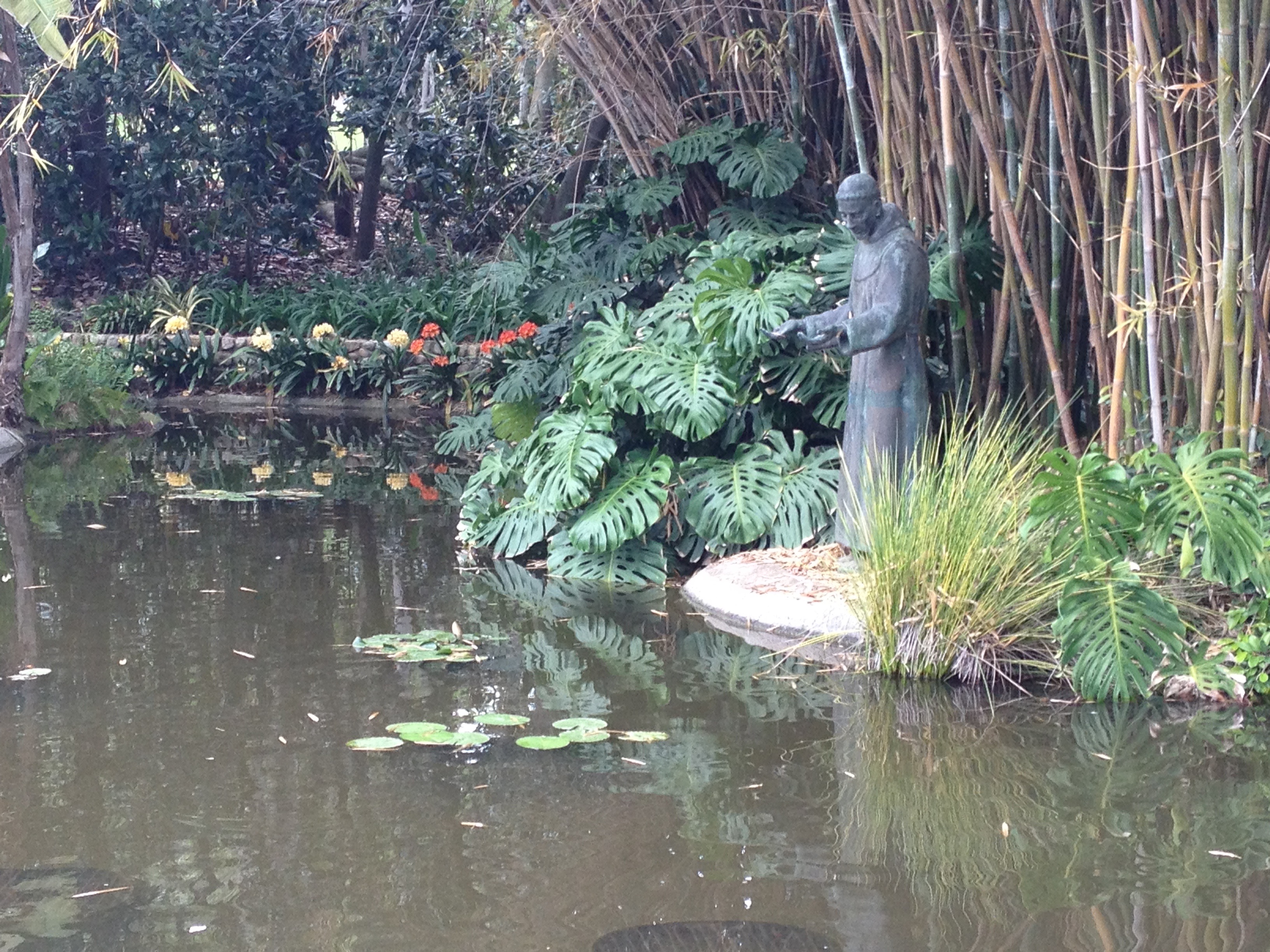
Huntington Library Gardens, Image of St. Francis

I believe the story of the Good Samaritan has been domesticated, romanticized and distorted in meaning.  I hold that in answering the question “Who is my neighbor?” one will hear from the respondent the core commitments of that person.  This is a “template narrative.”  It uncovers a human gestalt — points to the baseline of meaning. The answer to this question has shaped the lives of people throughout the ages, from St. Francis to Mother Teresa, from Ghandi to Thomas Merton.

Who is my neighbor?  The answer suggests so much — from a compassion for the stranger, to an openness to the foreigner, and a welcoming of the alien, alternative solutions to vexing problems.  It is a question that allows the responder to share ideas that might give us larger purpose and expanded hope.  Yes, the theme of care for the neighbor challenges our propensity to selfishness, bigotry and violence; I believe it offers us even more, when we grasp the dimensions of how this story and its context might shape our perspectives today.

Ivan Illich was once asked, “Given what you suggest about institutions, what is the best way to make change, violent revolution or gradual reform?” Illich answered, “Neither, the best way to bring change is to give an alternative story.” (in David Cayley’s, The Rivers North of the Future).

Over the next several postings I will expand on the wonder of this parable and the power of the question asked of Jesus by the young man in Luke 10:25-37.  I believe it opens us to a remarkably powerful, alternative story — maybe the most powerful alternative story available to humanity!

My plans this evening do not include watching “the debate.”  There will be plenty more where these came from.  I wonder what questions will be asked.  Were I given just one question, it would be — WHO?  WHO IS MY NEIGHBOR?

Bring Down that Banner — And More

Good Riddance to One Symbol

Hurray and Harumph — the Confederate Battle flags are coming down!  It has been marvelous seeing the emergence of a public conscience in South Carolina.  Let the symbol of hatred and racism come down!  Across the South the Confederate Battle Flag is being removed from State House grounds and other public spaces.  Walmart, Amazon and Sears have each said they will no longer sell this symbol of racism and exclusion.   Good riddance, I say.  It is long past time for this emblem of slavery and Jim Crow structures of oppression and injustice to disappear.  Place it in a museum where it belongs.th

Still, I am a little uneasy about my sense of triumph over this matter.  Born as I was just across the river from Kentucky and growing up in an era when “whites only” signs were above water fountains in Louisville, I know that progress has been made with regard to symbols.  I also know that as a “Yankee” (just barely by geography), there is too often a false pride and sense that the problems with racism are only in the south.  I think of the appeal George Wallace had in Michigan when he ran for president or the treatment Dr. King received in Cicero, Illinois.  We northerners too easily believe the problems of racism are located somewhere else.

So, as the Confederate battle flag is coming down in Charleston, I am thinking about those other, less obvious, banners of phony privilege and separation that fly in every corner of our nation.  The removal of the Confederate flag should have happened long ago.  And, the removal of these banners does not begin to compensate for the lives of the nine people who were Murdered at Mother Emmanuel AME Church in Charleston, South Carolina.

The nine persons who were assassinated deserve more than this important symbolic gesture.  The millions who have lived with the tyranny of racial discrimination and implicit threat to their well being deserve more.  At this time of repentance and reconciliation, the lowering of symbols of hatred is not enough.  

Bringing down this flag is easy compared with ending the almost limitless access to assault weapons across our land.  How many more gun deaths will it take for us to stop worshiping under the banner of a erroneous interpretation of the second amendment?  When will we take down the banners of the NRA that fly over the heads of our congress and members of our state legislatures?  Those murdered at Mother Emmanuel Church were not only the victims of racial hatred; to some degree their lives were taken by our inability to establish appropriate limits on the availability of weaponry on our streets.  We will never know if more reasonable gun laws might have reduced the dimensions of this tragedy.  Surely, our apparent blindness to the easy access to guns — the tool used in this tragedy — must be considered when we think about the Charleston assassinations.

What other less obvious banners do we fly without thinking of the ways they contribute to injustice?  Who are our friends?  How do we spend our money?  Where do we worship?  How have we benefited from racial privilege… often in ways we do not recognize?  I have mentioned in an earlier post the work of Richard Rothstein (see for example: http://prospect.org/article/making-ferguson-how-decades-hostile-policy-created-powder-keg) and his valuable research on the history of racial privilege in housing.  Often, even the diplomas hanging on our walls are symbols of the ways our educational systems were shaped by racial privilege.

NO, NO, NO, I am not asking you to feel guilty.  I am simply saying that there is no room for false pride as the legislature of South Carolina finally does the right thing.  Instead, this is a time to be grateful for the actions those in South Carolina are taking to remove one symbol AND for us all to consider the ways we, too often, live under the benefits of other less visible flags of privilege.


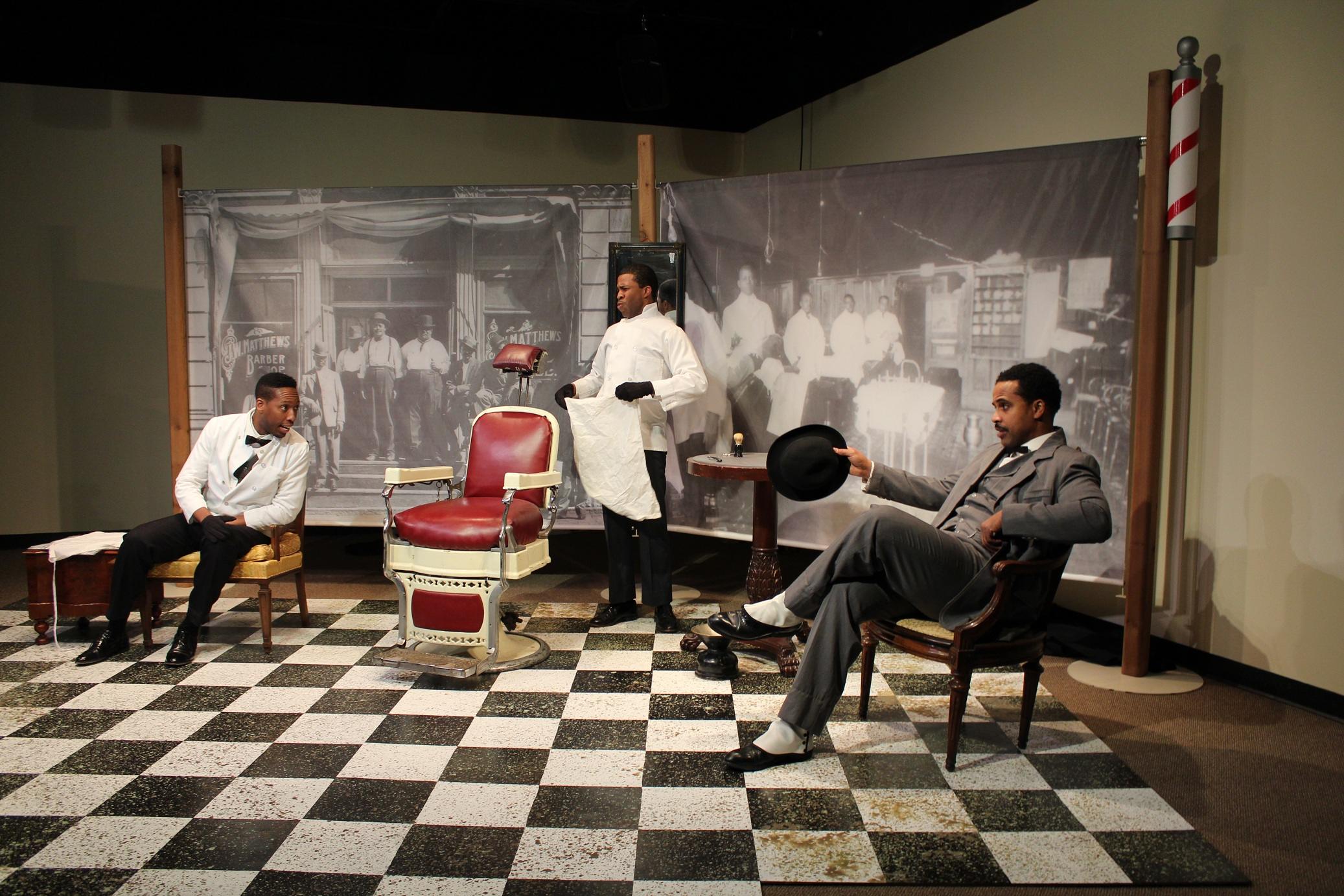
Lessons from the Barber Shop

Lessons from the Barber Shop

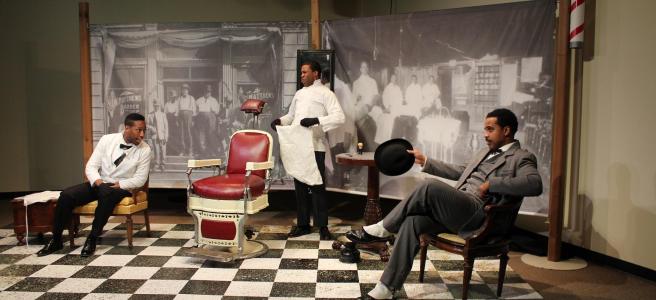
barbershop-1

One of the challenges of moving to a new community is finding a barber.  For nearly eight years I had been in the hands of Manny, my barber — or his father before him.  I knew about Manny’s family and where they vacationed — and he knew about mine.  In our new home, I discovered yet again that starting over on haircuts can be both a test and a teaching experience.

As my appearance no doubt shows — I have never sought a stylist or looked for any of the extras offered by upscale salons.  Nope, I liked the democratic air of the good ole, two or three chaired, small barber shop.  These are the places where opinions are uncensored even if sometimes overblown.  Here is where you hear the young ones brag and the older fellas complain.  Here I can see my gray hair drop to the floor and watch as it is swept up into a pile along with the darker shades of hair from younger customers. 

I’ve tried nearly half-a-dozen barbers since settling in northern Indiana last summer.  Each one was a teacher, as well as a barber.  This I found true from the tattooed fella who gave a fine haircut, but was so good, that he always had a long line of customers ahead of me, to the old-timer who opined that he had been cutting hair since “Nixon was telling lies in the White House and, that none of those crooks following him there got any better.”  So, in the past year I have experienced a range of clips and snips, views of the news and an open-sourced set of opinions about life, love, politics and religion.

The barber shop is a place to listen in on everyday perspectives on the world.  Of course, these male refuges remain (along with our Sunday morning worship services) among the most racially segregated places in our society.  I like to listen, especially if I can stay anonymous.  I learn a lot, about how some folks are thinking about everything from foreign trade to who’s been arrested and why.  I’ve heard opinions on how to save a marriage and what’s gone wrong with the county fair.  I was able to learn a lot, that is until someone, usually the barber, asked me what I do for a living.  I get some cover by simply saying I am retired… but the questions keep coming and the truth is squeezed, like Brylcreem from a tube, out of me. 

“You’re a preacher, I thought so!” someone says, and with that, I lose the advantage of hearing unvarnished and often quite colorful language about life and the world around.

One of the joys of retirement has been the advantage of not being “on” as a professional Christian.  And, until I was recently “outed” as a retired pastor, I was able to listen in on colorful language and ribald boasting of men in the barbershop of a small rust-belt community of the Midwest. 

I listened to talk about the economy, politics and sex, baseball and hockey, motorcycles, farming, golf and flying model planes.  The talk wasn’t as full of victimization, anger, fear or racism as some of our talk-radio hosts seem to encourage.  Instead, these were folks seeking company, a good laugh or maybe a story to re-tell. 

Talk about the church, before I was outed as a pastor, wasn’t very positive.  The church was seen as a place trying to get your money, to build another building or where a fella would have to work all weekend at a fish fry when he would rather be just fishing.  Honestly, the church was viewed as just another program or another project to be avoided.  Yes, I heard the word “hypocrites” more than once when talk turned to church.

Please don’t misunderstand, while I don’t confuse what happens in a barbershop for important and potentially transformative work of the church, there is a lot that goes on in barbershops that is more honest and helpful than in much of what happens in churches these days.  It is about relationships, first; a story, second; and, some honest talk about the real world, third.   Of course, if we let folks know that church life could be this simple and direct it would put all our church consultants and revitalization specialists out of business.  And, building such relationships wouldn’t cost as much as a shave and a haircut!

It’s as my barber said last week, “You know, most people are hungry for someone just to listen to them.  When I remember that, I am happiest in my job.”  Should I tell the barber he is involved in ministry, or would this spoil it for him?

Bee Cause — To Bee or Not to Bee?

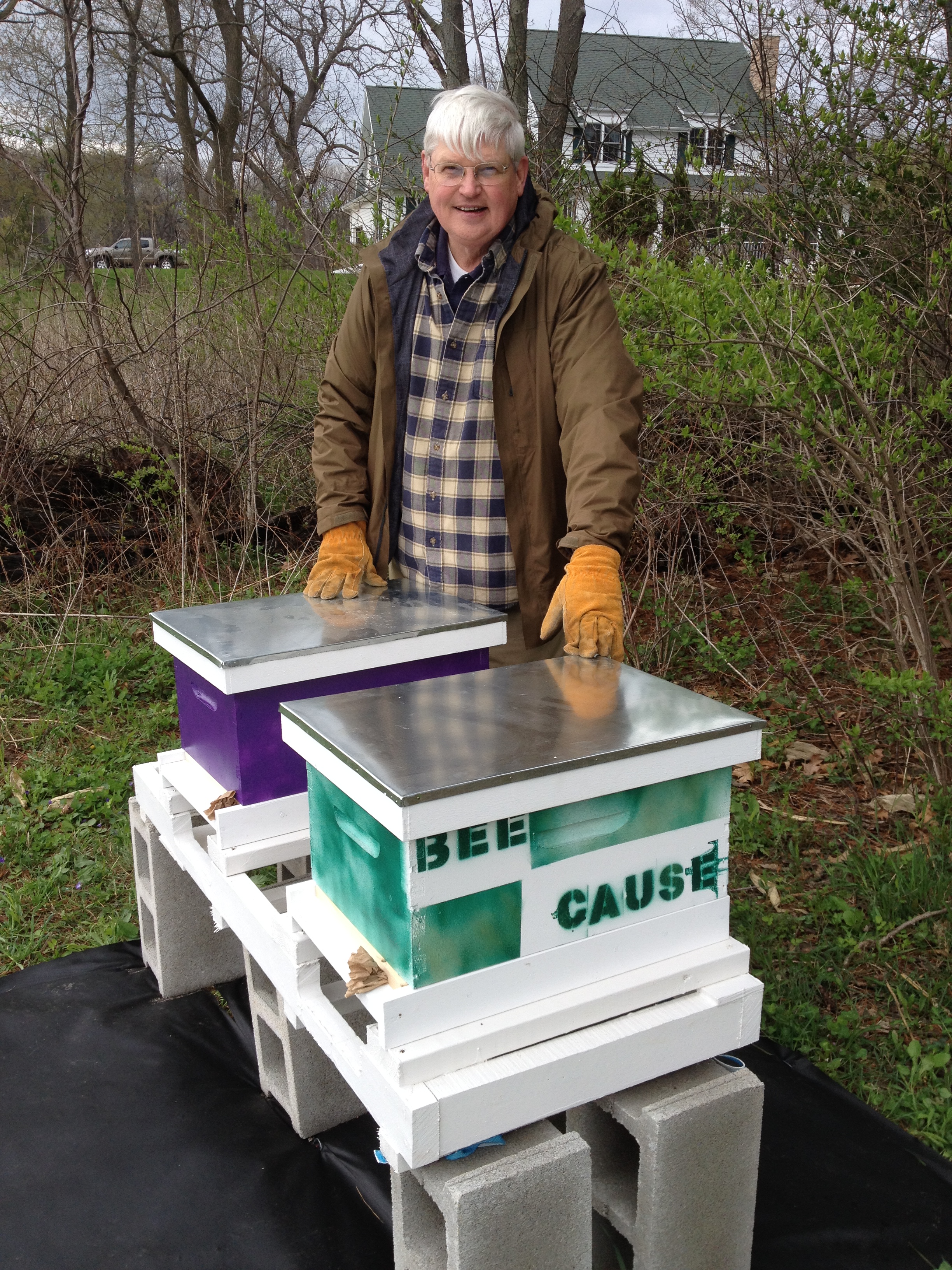
Bee Cause

“Slowly Learning?” — I scratch my head in wonderment.  Where did I read those words?   I have become aware that some slow learning is what I need at this juncture in life.  How about you?  This is a way we can slow down, be attentive to overlooked dimensions and gain knowledge we otherwise might miss?   Our culture is often better at fast-forgetting than slow learning.  To be labeled a “slow learner” in school is problematic  — it is a stigma, a barrier to future success.  In my search for abundant life, however, I have come to recognize this is a label to which I aspire.

New condos for the hives, just bee-cause.

I enrolled in a particularly challenging “slow-learning” curriculum this spring.  My teachers, all 14,000+ of them, arrived in late April.  They came in two small packages, 16x8x6 inch boxes with over 7,000 honey bees in each.   I prepared for their arrival by constructing two hives.  One hive was named “BEE WARE” and the other christened “BEE CAUSE.”  The bees arrived on April 21, the day before Earth Day.  At this point my learning curve went up in an almost perpendicular direction.  Can I learn from such a large faculty of over 7,000 in each hive?  I fret.  The weather is cold.  And, then I remember — slow learning may be my best option.

I kept bees before.  My first lessons in beekeeping came when I was in graduate school in Atlanta in the early 1970s.  It was a different time, before we heard of Africanized bees or the threat from a changing climate or the failure that results from an overuse of pesticides.  Having forgotten the little bit I once knew those many decades ago, I began again in the slow-learner class.  After attending the Indiana Bee School in March, I read and watched videos for beginning beekeepers.  It was clear much had changed.  Today bees are increasingly understood as critical, make that essential, to a healthy environment.

IMG_2161
Bee-ing attentive to the lessons at hand.

Upon retiring as a seminary administrator, a friend gave me Bill McKibben’s evocative book Oil and Honey: The Education of an Unlikely Activist.   (I had mentioned to my friend that I might return to bee keeping and he kindly sent me the book.) 

Oil and Honey speaks of the challenge before our civilization as we face the relentless and greedy forces determined to ignore the damage done by our heavily carbon-based economy.  There is an interesting counterbalance between the two commodities.  As oil production soars, honey production is in jeopardy.  McKibben, “an unlikely activist” he says, because his primary identity was as a college professor and United Methodist Sunday School Teacher.  McKibben’s research left him little choice but to do something more dramatic.  He began to organize against the growing overuse and dangerous distribution of petroleum products, especially the development of schemes like the Keystone Pipeline.  There are other things much more important than making profits — one is providing for a sustainable environment.  This is a much more worthy goal.   (These other lessons require a slower leaning.  They can be learned by staying home, listening and learning from the world around.)

Sadly, too many in our nation’s political leadership don’t seem to desire to learn these lessons at all.  Are they moving too fast?  Or, are they blinded by their attachments to wealth and power that actually encourages ignorance and denial?  It is, frankly, amazing that in the face of the dramatic changes in our environment, congress votes over-and-over on bills that deny any environmental changes are occurring.  And, how many absurd television commercials does it require to tell us that BP really cares about the environment or that fracking is a safe way to provide for our insatiable carbon appetites?

McKibben notes there are many ways to address the challenges we face.  One way is through activism — he is the leader of the 350.0rg environmental coalition.  McKibben also notes other ways we can continue to learn and make a difference — by staying at home and doing small things like keeping bees.  He speaks of his friend Kirk, the bee-keeper.  Kirk becomes a counterbalance to McKibben’s admittedly contradictory rushing around from protest to protest in petroleum fueled airplanes.  He notes some need to protest and others need to give primary attention to care for the earth before we lose much more of our environmental carrying capacity.  One small example of this earth care is by beekeeping.

Upon reading Oil and Honey I sent an email to McKibben including this message: “I chuckled when I read of your friend telling you that you were not a ‘mild mannered Methodist Sunday school teacher.’  You have perhaps proven her correct — at least regarding the ‘mild mannered’ part of your self description.  However, you stand high on the list of unlikely activists in my life, among them many great Methodist Sunday school teachers!” 

I mentioned that he would be in my prayers and that I was taking up bee-keeping again on our small acreage in northwest Indiana.  McKibben wrote back this response: “Dear Rev. Amerson–your words made me very happy, and even more so the thought of you donning the beekeeper’s veil again after those decades! all best, Bill.”

images-1

SLOWLY LEARNING — I remember now.  It comes from the last line in the poem “Thirst” by Mary Oliver. 

Thirst

Another morning and I wake with thirst
for the goodness I do not have. I walk
out to the pond and all the way God has
given us such beautiful lessons. Oh Lord,
I was never a quick scholar but sulked
and hunched over my books past the hour
and the bell; grant me, in your mercy,
a little more time. Love for the earth
and love for you are having such a long
conversation in my heart. Who knows what
will finally happen or where I will be sent,
yet already I have given a great many things
away, expecting to be told to pack nothing,
except the prayers which, with this thirst,
I am slowly learning.

— Mary Oliver, Thirst,
Beacon Press, Boston, 2006

This poem, this prayer, is my prayer during the spring of 2015.  “Love for the earth and love for you [God] is having a long conversation in my heart.”  So, I make this small act of learning from my bees… and perhaps they will give a little something extra in return.

We all can learn, we can move beyond intentional ignorance, we can agree that we can join in slowly learning a new way forward.

Grandsons Colin and Zack Murray get ready to help check on the hives.

Lamp Post Literalists

Hands of the Strong: Lamp Post Literalists. 

Amid the twists and turns of everyday life, I have been reflecting on the “recipes for a significant life” offered in our culture these days.  If you are like me, you long for certitude — for the right idea, the perfect politician, the road to true happiness.  And, if you are like me, you are tempted to believe there is a shortcut to such significance and joy.

Such hunger for certainty and clarity is, I have come to believe, the seedbed of fundamentalism.  Before your ask, yes, I believe fundamentalism is a shared human dilemma — make that a shared human flaw.  Fundamentalists can be clothed in many garbs.  Yes, there is “Islamic Fundamentalism” and also “Christian Fundamentalism,” “Jewish Fundamentalism,” “Hindu Fundamentalism,” or, even, “Atheistic Fundamentalism.”  We can too easily, in our search for the simple answer, turn to criticize persons of other faith traditions.  I have come to believe that we must first speak clearly to persons, tempted to fundamentalism, in our own tradition.

William Sloan Coffin, of blessed memory, put it this way: “Some Christians use the scriptures like a drunk uses a lamp post — more for support than for illumination.”  Bill Coffin was at the time pastor of Riverside Church in New York City.  He spoke of the human temptation to selectively use scriptures, or our faith, as a prop for our own shallowness, even our weaknesses.  Coffin suggested that we ALL are tempted to be “selective literalists,” — each of us eager to find the easy way forward, the simple formula, the one confirmation for what we already believe.

IMG_0972

This desire for the one formula, the simple rule, is too much at play in shaping our politics and our religious life.  It is astonishing, for example, that the mission of the United Methodist Church has been diverted, and in my view almost lost, by a focus on homosexuality.  This is based on 5 or 6 verses of scripture that are literally (and in my view wrongly) applied to our day.  How long will our mission and message be held captive to such sad smallness of vision?  In Indiana, we recently saw how this selective literalism of these scriptures was employed to pass legislation that would allow for discrimination against LGBT persons.

In our nation’s life, selective literalistic interpretation of the second amendment to the constitution has led us to a foolish worship of fire arms.  Such interpretations ignore any emphasis on “a well regulated militia.”  The “right to bear arms” is the predicate, not the subject, of this amendment.  As a result of this selective interpretation, we live in a nation where persons too easily trade in guns (even assault weapons) without background checks or any proof of competency.  This flawed literalism has lead to neighborhoods too often like war zones  — places where our children’s lives are under daily threat.

What then shall we do?  Columnist David Brooks’ new book The Road to Character is helpful.  Brooks suggests that the development of character requires humility, discipline, perspective and practice.  He notes that we too easily substitute our narcissistic desires for the gift of mature faith and the richness of the life well-lived.  He speaks of the dangers of smug superficiality — this, too frequently, reinforced by our fundamentalist instincts.  Finding strength and significance in our personal lives and in our national conversation will require a broader imagination and the admitting that we still have things to learn — that we are vulnerable to the siren songs of selfishness and narcissism.

The path to being spiritually healthy people, living emotionally substantial lives and sustaining healthy communities requires something more, something deeper.  Brooks speaks of dimensions of faith beyond our desire for personal validation or easy certainties.  He points to a better way forward offered by thousands, great and small.  He notes that in every community there are persons who are little recognized, yet seem to radiate the gift of faith as they relate to others.  And he notes several of the great thinkers and actors of faith.  Folks like St. Augustine offer a richer way forward, shaped by an understanding that we are all children of God, easily tempted to forget our place and to focus on our selective biases.

In my best moments, I am able to read the scriptures in a more holistic way and see there the deeper trend lines of God’s activity in human history.  There is a larger narrative at play than my self interest.  I see that for faith to be vibrant and meaning-filled will require attention to many dimensions and not my desire to exclude or simplify.  It will require head, heart and hands.  (See the sermon at https://www.youtube.com/watch?v=7SgvnUrT7tk.)

The poet Marianne Moore calls for us to live beyond the “insolence and triviality” around us and to become “literalists of the imagination.”  She suggests that we explore “imaginary gardens with real toads in them.”  So speaks the poet — and the columnist — and this pastor who seeks to keep learning.  I too often get focused on the real toads and miss the larger vision of the garden.  You?

Hands of the Strong: Get Off My Shoulders!

“Get Off My Shoulders!  There is Work to Be Done.”

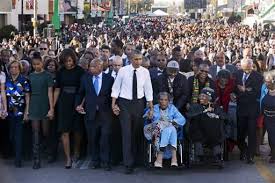
Amelia Boynton Robinson, 103, back in Selma with President Obama

No one said it better.  “Get off my shoulders!  There is work to be done.”  Amelia Boynton Robinson was responding to those who sought to honor her by saying they were “standing on her shoulders.”  In March 1965 she nearly lost her life on the Edmund Pettus Bridge in Selma, Alabama.  Severely beaten, unconscious, she was left for dead.  On March 7, 2015, at age 103, this time in a wheel chair and holding the hand of President Obama, she crossed the Edmund Pettus Bridge.


“Get off my shoulders” she says, “There is work to be done.”

images-5Work to be done?  In 2015?  Yes, there is.  Don’t we have an African American President?  Isn’t this a Post-Racial society?  Well, yes our president is African American… but NO this is not a post racial society.

Today, less than a week after the remembrance of Selma’s “Bloody Sunday,” we see video of members of the Sigma Alpha Epsilon fraternity at the University of Oklahoma singing a song full of racial vitriol and threat.  What is happening?  From Ferguson, Missouri there is the tragic shooting of two police officers at a rally outside the police station.  What is this about?

Yes, Ms. Boynton Robinson, THERE IS WORK TO BE DONE.

Racism continues to plague our society.  There are many causes, many reasons.  Racism remains because some view it too simplistically and some see it as overwhelmingly complex.  Some seem to imply that by simply cleaning up our language and no longer tolerating certain words (or by ending fraternity songs), we will eliminate racism.  I hear former congressman and television personality Joe Scarborough opining that the use of such language wasn’t a part of his experience growing up in the south or attending the University of Alabama.   There was racism around but he seemed to suggest he didn’t participate.  Really?  The implication seems to be that if we would all just clean up our language, we could end racism.  We might eliminate blatant, red-neck racist words but, while laudable, that would not be sufficient.  Language, while important, is one of the least essential elements contributing to the persistence of racism.

Language and behavior are not always aligned.  Prejudice and discrimination can be distinct realms.  Sociologists for decades have shown that what people say and how they act don’t always match.  It is possible for one to have pure language and only noble thoughts (good luck with that) and still act in ways that exclude, belittle and diminish another. 

Racism can also appear to be overwhelming as it is so complex.  Prejudice and discrimination are only two elements in this wicked brew.  There are also deeply embedded institutional and cultural patterns.    We could elect an African American president and still see the dismantling of voters rights in our nation.  This is the other side of our dilemma — we can treat racism as so complex that there is little we individually can do about it.  This is when the words “get off my shoulders” take on special meaning.  We are to keep moving ahead against the forces of injustice, despite the complexities.

For example, how will we now see the situation in Ferguson?  There is absolutely no justification for the shooting of two police officers simply because they are seeking to keep a demonstration peaceful.  My prayers are with those men who were shot — and their families.  It is also my hope that arrests are made soon.  The irony, of course, is that the rally on the evening of March 11, 2015 should have been one of celebration.  The U. S. Justice Department had documented the on-going patterns of discrimination and institutional damages against the black citizen in Ferguson over many years.  Changes were being made, judges and officials are being replaced by persons committed to making change.

And what happens now?  More violence.  This time directed toward the police — police there from other municipalities.  Is this what we have come to?  Are we really so caught up in an eye-for-an-eye sense of justice that anyone could think such a shooting is justified?  Faced with such patterns of revenge, I am astonished that the shooting of these officers in Ferguson did not result in greater violence.  The restraint of the police officials on the scene is, in my view, nothing short of remarkable — and is doubly worthy of praise. 

Now the question my friend — should the protests in Ferguson continue, even after these shootings?  It is not my call.  Others on the scene who are committed to nonviolence need to make this tough decision.  However, if there are citizens who still feel their voices have not been heard, then…  yes, the right to peaceful protest remains essential.  Such are the complexities of dealing with race in our time.  What is on display in Ferguson requires deeper thought and careful study.  The killing of Michael Brown this summer only tore the scab off of a wound that runs decades deep.  I commend to the reader the exceptional research done by Richard Rothstein on housing and job discrimination in St. Louis over the past century. These decades-old practices of racial discrimination helped established the template for the challenges we face today.  What is true of St. Louis is true of every city in our nation.  This report can be found at: http://s3.epi.org/files/2014/making-of-ferguson-final.pdf.

A video interview with Mr. Rothstein can be seen at: http://www.epi.org/event/the-making-of-ferguson-with-sherrilyn-ifill-and-richard-rothstein/

The mystery of why racism persists may lie in our temptation to view it too simply — or to become overwhelmed by the complexities of continuing institutional and cultural realities.  Most of us live our lives in places where we don’t easily see how we can make a difference.  We can be careful in our language and be nice to others but is there more?  We are more comfortable standing on the shoulders of others rather than seeing the work around us to be done.  This work may be as simple as greeting a friend, or as challenging as joining a protest march. 

Many of you make a difference every day, in your places of work or play.  Sometimes it is a smile, sometimes an appreciative or corrective word, sometimes it is making a donation, sometimes it is writing an elected official, sometimes it is joining a project that affirms racial justice.

This past fall a group of friends gathered in Chicago to celebrate my spouse Elaine’s birthday.  I watched and listened remembering the ways Elaine has learned and acted to seek racial justice.  Like Joe Scarborough, she grew up in north Florida.  She too was taught not to say ugly racist words.  However, she looks back with astonishment on the reality of discrimination, segregation and Jim Crow laws in Tallahassee where she grew up.  I have been privileged to watch as Elaine has journeyed ahead in her own ways, seeking to end discrimination and promote racial justice.  Her work over the years as teacher, school board member, advocate for justice and her life as friend to so many signals an abiding witness to the work that still is to be done. 

Recently I was surprised when Elaine said she had arranged to volunteer in a school nearby.  I was proud for her and I also chuckled to myself when thinking about the witness Elaine will be making.    

IMG_0778
Dr. Adrienne Mims and Dr. Elaine Amerson, September 28, 2014.

There is work that we all have to do.  Won’t you join?