For Learning, Loving or Loathing?

For Learning, Loving or Loathing?

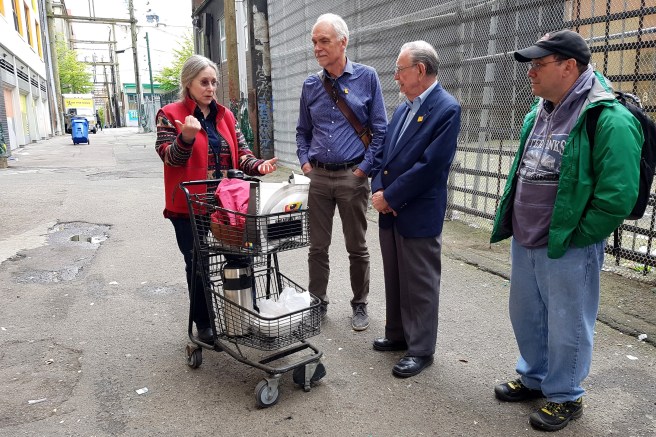
There she was in the alley.  Pushing a shopping cart.  She might have been mistaken as a homeless woman, except the cart was transporting a box of strawberries and a thermos of coffee.  Beside her along the route of sidewalk and alleyway, we walked.  She was recognized, and sometimes greeted, along the crowded path.  I looked on and saw scenes replaying over and again, as if she came from central casting.

20170517_152504s
Ann Livingston, Al Etmanski, John McKnight and Michael Mather (Photo by Travis Lupick, The Georgian Straight Magazine)

I was unprepared to meet Ann Livingston, founder of a group known as VANDU.  We were in the east end of Vancouver, B.C., Canada.  VANDU has been around for almost twenty-five years as an organization of drug users and former users.  They organize as peers, seeking action to better their neighborhood, their personal situation and that of others.  Ann is what I call a “divine irritant.”  She challenges the taken-for-granted worlds of Vancouver. 

Ann disrupts the “normal” activities of police officers, operators of cheap single room occupancy hotels, health professionals, social workers and drug dealers.  She is a convener of alternative visions, a truth-teller, a fierce organizer.  Her work — joined with dozens of others, especially drug users — rattles the tectonic plates of political, economic power.  She challenges the assumptions, programs and professional expectations of many on the east side of Vancouver. 

When I say Ann comes out of central casting, perhaps it is better to say she seems to emerge from the story of other women, women I never met, but have long regarded as saintly disturbers of the peace.  As I watched and listened, I thought of Francis Willard, Jane Addams or Lucy Ryder Meyer, from the 19th Century.  

With the arrival of fentanyl, deaths from drug overdoses in the neighborhood soared.  In the last six years over 1,800 persons died from overdoses. When public officials were slow to act, Ann and others decided to set up unsanctioned injection sites.  This strategy, along with clean needle exchanges, is based on the successful Four Pillars approach in Europe.  The four pillars are: Harm Reduction, Prevention, Treatment, and Enforcement.  To learn more see: Straight News, December 2016.

LEARNING

Now at the front end of my eighth decade, I am discovering how little I know and how much more there is to learn.  (And, I am learning of the many places I have been wrong in assessment or assumption.)  I am helped by new learning occasions.  Yes, these new insights can come from books and films — but I am advocating for putting ones self in new and uncomfortable places.  Places that challenge easy assumptions about life and how things really work.

20170517_142523s.jpg
photo by Travis Lupick

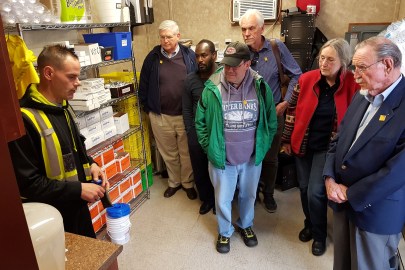
Visiting an unsanctioned safe injection site with Ann, I appreciated that we are not limited to the official, and agreed upon, responses to the social and institutional challenges we face.  When there was a need for a response to drug overdoses from fentanyl use, and the system failed, Ann pitched a tent and began to offer a place for safe injections.  There were safe needle exchanges and a responding to overdoses by offering naloxone,  Naloxone can counter the probable death from a fentanyl overdose.  When asked about the consequences of breaking the law, Ann simply replies, “I am pretty sure it is not against the law to save a person’s life.”

20170517_141118s.jpg
Ann Livingston and John McKnight, photo by Travis Lupick

My “learning journey” was with colleagues Mike Mather and DeAmon Harges of Indianapolis.  It was a gift to accompany friend and mentor, John McKnight.  John has advocated an Asset Based Community Development approach to community organizing.  It is about encouraging the recognizing of abundance within all communities.  This approach focuses on identifying the assets of people, rather than collecting up their deficits.  This approach, that focuses on gifts rather than needs, is widely known around the world, as ABCD community organizing.  Ann Livingston is a most remarkable practitioner of this approach, seeking out the abundance in her community, encouraging drug uses to be their own researchers, advocates and providers — and not being afraid to disrupt that which focuses only on neediness.

LOATHING

As I traveled I couldn’t help but think of our situation in the United States.  Our Attorney General, Jeff Sessions, is determined to return our nation to the expensive and failed “war on drugs” that focuses only on ENFORCEMENT and PUNISHMENT.  It simple doesn’t work.  Or, better said, it provides results that are exactly the opposite of what is believed. 

This effort misses all of the lessons that have been learned from around the world and across the years.  It comes from lousy morality constructs and even worse theology.   Incarceration only turns prisons into schools for future soldiers in the drug cartels and neighborhood pushers.  The time has long since passed for us to establish ways for the addicted to have access to methadone and medical heroin.  Only by ending the demand and offering a Four Pillars approach to drug use and addiction (harm reduction, prevention, treatment, enforcement) can we find a way forward that is not just a revolving door to continuing our past mistakes.  Mistakes that destroy lives, families and communities.

Conservative writer Andrew Sullivan has wisely said that much of the mean-spirited, anti-democratic and fear-based political efforts in the recent years is what he calls a “loathing of the present.”  It is a hunger to return to a world that never was — except in the minds of those who out of fear seek to divide, exclude and punish.  In this world those who suffer, who are different, are to be loathed because they represent a reality that cannot be accepted.

LOVING

Can there be a turn from loathing to loving?  Any faithful Christian expression would say “yes, of course.”  No need to cite chapter and verse — it is evident in the entire sweep of scripture — to move toward health, abundance and renewal… and to do so out of love and not exclusion.

By now, good reader, you have probably wondered, “Strawberries?  Why was Ann carrying strawberries?”  It seemed incongruous in the midst of all of the suffering and tragedy to bring strawberries to the unsanctioned safe injection site.  When asked why strawberries? Ann’s answer was simple, “Who doesn’t love a strawberry?”

“…seek an honorable exit”

After a life of service as pastor and/or denominational leader, some of our best are being pointed to the exit. Jack Harnish is one of the best among us. Sadly, some “colleagues” want to change the vision of the United Methodist Church from “Open Hearts, Open Minds, Open Doors” to “If you don’t agree with me there is the door. Exit politely please.” Here Jack speaks of the wonderment created by the idea that folks from the Wesleyan Covenant Association now say tens of thousands who have a differing view should seek “an honorable exit.”“…seek an honorable exit” And the worlds and work of the great spirits of our tradition like E. Stanley Jones, Leontine Kelly, Georgia Harkness, Albert Outler and James Thomas are turned upside down.

Jack Harnish's avatarMONDAY MEMO

I don’t think I have ever been invited to “seek an honorable exit” before, but it doesn’t feel very good.

Last week the Judicial Council of the United Methodist Church ruled against the consecration of a “self-avowed practicing homosexual” as a Bishop.  In it’s full context, it is a complex and somewhat convoluted decision, but the bottom line is that the Judicial Council did what they are supposed to do–they ruled on the constitutionality of such an election based on their understanding of the Discipline of the Church.  There is plenty of room for debate about their decision and there will be much conversation over the coming weeks about the implications.  Right now, I am not ready to step into that debate.  What struck me was the reaction of the “Wesleyan Covenant Association”, a conservative group for whom this issue is the bottom line, the red line, the litmus test…

View original post 448 more words

The Season of Splintering

The Season of Splintering

Somewhere in this nation there are probably folks who are celebrating the United Methodist Judicial Council’s decision #1341.  The body ruled that the consecration of Bishop Karen Oliveto in the Western Jurisdiction was a breaking of church law.  Somewhere.  Somewhere they must be slapping one another on the back, saying “we did it, we fixed it.”  Somewhere.

There was nothing fixed by this.  This whole kerfuffle just adds more fissures undermining the denomination’s ability to remain “united” Methodist.  Our energies, mission, identity and witness — all are predictably falling to pieces.  And somewhere there are folks who think they have won something. 

It is just one more indication that we are further removing ourselves from being a church for others, a church that shares the good news of the love of Christ for all people.  Busy with trials we miss finding ways forward that can acknowledge God’s call on many and diverse people — all being able to carry the name “United Methodist.”  This is placing ever more stress on the cracks in the earthen vessel we call the church.  And, somewhere there is celebration.

The Judicial Council’s decision ironically says that Karen Oliveto “remains in good standing as a clergy person” and now must be granted a “fair process” as to her ordination status.  A fair process based on whose assessment?  Is there one annual conference that has the perfect evaluation for clergy qualifications for all other conferences? Is the Judicial Council saying that the California-Nevada Conference got it wrong in assessing who might best serve in their area in ordaining Bishop Oliveto in the first place?  Should Bishop Oliveto have been judged by another better suited group?  Maybe a body in Texas, Mississippi, Indiana or Congo?

Somewhere there is joy.  Somewhere hearts are light.  It is the Western Jurisdiction that now has been named the “fall guy” in this travesty.  They are the one’s who failed when they consecrated Karen.  Is that it?

Oh yes, and why do we have Jurisdictional structures in the first place?  Is there any memory that back at the time when the Methodist Episcopal Church North and South came together that the south didn’t want to have any of those northern bishops overseeing their conferences?  Is there memory of the desire to keep segregation alive by setting up a separate “Central Jurisdiction” for blacks?  Not wanting to welcome persons without distinction or category, the southern church (aided and abetted by many in the north) “allowed” black Methodists to have a separate jurisdiction.

I know something of the south and value so much of what I know.  My college and seminary work were done in Wilmore, Kentucky at Asbury College and Seminary.  There are so many good things represented by these schools, especially the commitment that was once focused on mission.  At the same time this is were some of the seeds of perfectionism, and the proclivity to exclude and divide, are sown. 

Chapel was required at Asbury College.  My seat mate was Patty.  Patty was remarkable — talented and intelligent and had a nose for prejudice and discrimination.   If a sermon was racist or sexist or dismissive of those who were, dear God, liberals or Democrats, Patty would smile and whisper “Holiness Unto the Lord Has Nineteen Letters.”  She was saying to me “count the letters on at the front of the auditorium and ignore this simplistic drivel.”  Once after chapel she confided that “too many of these folks need an enemy to feel good about themselves.”  Patty didn’t acknowledge much else about her identity, her background or her pain — but I knew she carried a burden and a wisdom beyond my experience.

asburyholiness
Front of Hughes Auditorium, Asbury University

Fortunately, most of my experiences in chapel were uplifting and valued.  Still Patty had it right, I think.  She died a few years back — may eternal light be upon her.  Often these days I think of her and the code she was sending by whispering “Holiness Unto the Lord has nineteen letters.”  Many, many good folks attended Asbury and learned the lesson that Patty was teaching me.  Sadly, others from Wilmore, and ones who claim to be shaped by the “holiness tradition,” carry on the tendency toward exclusion and now sow the seeds for this splintering in the denomination.

In many respects the Civil War didn’t end one hundred and fifty years ago.  It simply has shape-shifted into new forms and battles.  Old style bigotrys turn into new ones and every generation struggles with permutations of false perfections that lead to such splintering and pain.

The splintering that has been a part of so many other denominations in recent years, is upon us in United Methodism.  It arrives now in real and troubling ways.  In truth, neither side, of the many sides in this tragedy, wins. 

I recently visited with a friend, a middle-aged father.  He was a cradle United Methodist coming from a family with deep links to the leadership and hierarchy of the denomination.  As we talked, he spoke with pride of his talented son, a young adult just beginning his higher education.  Then my friend said, “It was during the 2016 General Conference sessions that my son told me he was gay.  I have lost any pride in my United Methodist legacy since that day.”  It was heart wrenching. Here is the irony — the son still finds a home in a fine United Methodist congregation in the south.  I wonder for how long this will last, given the splintering at hand?

I am struck by how many of the “leaders” of the groups pushing for perfection have not served as pastors, or at least not pastors in places where there are diverse populations.  Perhaps this falls in the category of “enough said;” even so, I think back on the way God opened my eyes to the beauty of others who were different from me.  It has been in the relationships with others that I saw the greater gift of God’s realm on earth.  And I still think of Patty.

During this splintering season, I think of all the pastors who have children, or siblings, who are gay.  And, of course, I think of all the pastors (closeted and out) and lay leaders (closeted and out) who are gay.  Somewhere there is celebration.   Not among these good folks.  We have substituted rules for relationships and… I believe we have snuffed out the very essence of the gospel.

Somewhere there is celebration.  I know this — those who “celebrate” and will either take control or break away carry within their theology and world view the seeds for another splintering, and another, and another. This is the way perfectionism thrives until it is a majority of one.

Some may celebrate.  I weep, I grieve.  The church of Jesus Christ will go forward, even as we United Methodists splinter. 

Creation Care No Step in the Right Direction Too Small

Creation Care

No Step in the Right Direction is Too Small

Sunday last, I was asked to preach at St. Marks UMC in Bloomington, Indiana.  The topic assigned?  Christian responsibility regarding Creation Care.  What United

IMG_0958
Huntington Museum Gardens – St. Francis sculpture

Methodist Bishops have called “Environmental Holiness” has become of increasing interest and passion for me.  Perhaps this is especially the case as I am enjoying my years as a grandparent and considering the ways these children will experience the beauty and the destruction of the gift of the natural world.

Attached is the sermon that came for the day.  As any preacher knows — there is both more and less to say on any topic.  Sermons are shaped for particular occasions and specific audiences.  Still, I share this in the hope that no matter our particular perspective on the causes of the environmental changes that are now occurring, we can believe that we, each one of us has a responsibility to care for this “common home” that we share.

The sermon is here: ApologiesEaster – 4-23-17.

With thanks for the blessings of this good earth, I pray along with Christians everywhere — “Thy Kingdom come on earth.”

IMG_1800
Lake Louise – Canadian Rockies, 2016

My Easter Tie

My Easter Tie

Easter 2017 — my Easter necktie is missing.  In fact almost all of my neckties have disappeared.  Perhaps they didn’t make the move from LaPorte to Bloomington with us.  Perhaps they ended up in the items we sent to Goodwill. 

Every day I discover doodads, socks, books and photos that made the move to Bloomington.  In boxes or drawers, they appear.  So far, however, no neckties.  Most of the discoveries are items I didn’t know were missing.  Most are IMG_3878things I can do without.  I had thought we had given away so much — but not important things like Easter ties.

The time had come — I always wear a bright tie that symbolizes the joy of the day.  For more than four decades I have worn such a tie on Easter.  I think “Why would one go to an Easter service dressed otherwise?   My Easter ties were usually gold or yellow or a mix of other bright colors as part of my celebration the day of resurrection. 

I looked.  I pondered.  I looked again.  Nope, not there.  Not in the closet, the dresser, the storage room.  Not there.  I was left with only three ties packed for other more somber events.  These were ties to be worn for a lecture at a university, a funeral, an important business luncheon.  (I chuckled at the thought that maybe these three things are all alike!)

No more time to search.  The hour was on us — time to go to church — still no Easter tie.  Elaine was waiting for me!  This never happens.  Quickly I chose from the three ties remaining — a gray number, with muted white stripes.   It was a tie I had worn to a couple of funerals.  This would have to do.  Off to church. 

Driving I thought perhaps this is exactly the right tie to wear on Easter Day 2017.  How does one celebrate during these days of disorientation and discouragement?   What does one do when the world seems to be spinning toward more violence and deception.  Maybe, just maybe, it represents the idea that celebration this Easter involves getting ready for the new business at hand.  Maybe it is a time to for educating, not lecture, but serious thought and dialogue with others.  Maybe there are things too important, things to mourn this Easter, like the death of a dear friend, or the threats to truth.

Earlier that morning I sent the message:  One word counters a million Potus tweets: EASTER. Let it be our word, our verb. May hope & truth Easter in us as a witness beyond today.  I believe it.  Easter is to be understood as a verb… we are to practice resurrection as Wendell Berry suggests.

That was it!  We arrived at St. Marks UMC in time.  Jimmy Moore preached a marvelous Easter sermon.  He made it clear.  He was pastoral and warm and wise.  The sermon didn’t avoid the hard truths of a world where meanness and bigotry are on the rise. (I am so grateful to attend a church that speaks the truth in love and challenges parties of all ideological stances to consider the way the gospel calls for a bigger, more generous view of the neighbor and the stranger and the enemy.)

Jimmy’s sermon avoided bright shinny objects (and, I thought, he seemed to know I didn’t need a brightly colored Easter ties).  He offered examples of those who persist in seeking God’s kingdom even when faced with enormous difficulties.  He spoke of the ministry of Palestinian Elias Chacour.  He told of Chacour’s call for hope amid despair and his persistence in explaining that the man from Galilee will make appearances if only we can see them. 

So, for the time being at least, instead of looking for neckties, I will look for the Christ present in the world around.  I will speak against the phony uses of threat and bigotry.  This will be my Easter business for the year ahead.  It is to see the Christ alive today in places where I had missed this gift in the past. 


The Unexpected Neighbor

The Unexpected Neighbor

The remarkable social philosopher and Catholic priest Ivan Illich was once asked, “Given what you suggest about institutions, what is the best way to make change, violent revolution or gradual reform?” Illich answered, “Neither, the best way to bring change is to give an alternative story.” (in David Cayley’s, The Rivers North of the Future).

532984_f520
Ivan Illich, 1971, source: Wikipedia

Illich, was an iconoclast, a Christian visionary, a prolific writer — and widely read in the last decades of the Twentieth Century.  His brilliant critiques of our institutional practices, still provide a clear-eyed challenge and much valuable reforming wisdom, about our easy customs, traditions and ideologies.  Schools, hospitals, courts, governments and churches were all subjects of his analysis. 

He was more!  Each critique was not a call to anarchy, nor was it an invitation to some elaborate new strategy whereby those in power can better serve their “clients.”  He was about something much more basic — as basic as a table where all may share. 

His call is to reinvest in the original motivating principles behind our “helping” institutions.  He was about the nurturing of an underlying community spirit built on the essential importance of neighborliness.  He suggests there are ways of living into such community understandings as evidenced in his book Tools for Conviviality.

Illich spoke of “corruptio optimi pessima” or “the corruption of the best becoming the worst.” He writes, “Through the attempt to ensure, to guarantee, to regulate Revelation, the best becomes the worst.  And yet at any moment we still have opportunities to recognize, even when we are Palestinians, that there is a Jew lying in the ditch whom I can take in my arms and embrace.”  (David Cayley, Ivan Illich in Conversation, Toronto: Anansi Press, p. 242.)

As Illich would put it, there is a “sad historical progression in which God’s incarnation is turned topsy-turvy, inside out” (from David Cayley’s Rivers North of the Future, p. 29).  This corruption may be seen in our many efforts to serve, to control, to regulate, to manage and to turn our neighbors into categories or objects of our good intentions.  A simple illustration he gives is as follows: “In the early years of Christianity it was customary in a Christian household to have an extra mattress, a bit of candle and some dry bread in case the Lord Jesus, should knock at the door in the form of a stranger without a roof” (Cayley, Rivers North of the Future, p. 54.).  Over the centuries, hospitality was “improved upon.”  The work of each householder is transformed into the responsibility of our “serving institutions.”

If there is one alternative story which Ivan Illich cites more than others, it would, no doubt, be the one known as “the Good Samaritan Parable” in Luke 10. 

I have spent much of my adult life sifting through the human wisdom nuggets of truth in this story — AND BEING CONVERTED BY THIS WITNESS.  It is astonishing that in these few verses in Luke’s gospel, there are dozens upon dozens of insights into our institutions, our freedom, the incarnation story and the wider human reality — tragic and blessed.  I have written about this in other places — and will, no doubt, write more in the future about this upside down reality, this conspiracy, which is the core of Christianity (and that of many other great religious traditions).  Instead in this piece, I want to begin to share a few other alternative stories.  Today, there is the story from Wes Jackson, environmentalist and founder of The Land Institute in Salina, Kansas.

Alternative Story #1:

Wes Jackson shares a story of a visit E.F. Schumacher, author of the widely known work Small is Beautiful, made to his fledgling organization in Kansas in 1977.  Jackson says The Land Institute was “scarcely six months old and we were honored that Schumacher, the widely acclaimed author would visit and give a public lecture.”

“When Schumacher arrived, he did not dismiss this tiny organization that had recently experienced a devastating fire, destroying much of their early work. Instead, E. F. Schumacher listened patiently and insisted on being called ‘Fritz.’ On the evening of the lecture, the Salina Community Theater was filled with farmers, small business owners and the unemployed.”

images
Wes Jackson, from Cool Science News, 2009

Fritz began by telling of a trip he had made during the 1930s with some friends in an automobile across America. He and his compatriots had stopped at a service station in some small Kansas town at the height of the Great Depression. Fritz engaged a local man at the station by asking, “How are things?” “Fine,” the local replied. “What is it you do?” asked Fritz. “Oh, I work on that farm over there,” he said pointing in the direction of the farm. “I used to own that farm but I had no money to pay the hired hand, so I paid him in land.  Eventually he owned all of my farm and now I work for him.”

That is a very sad story,” replied Fritz.” “Well, not so sad,” countered the hired hand. “You see, now my friend has no money either and so he is paying me back in land.” (Jackson, Wes, The Land Institute, December 1999, see info@landinstitute.org).

What are your thoughts about such alternative narratives?  Let’s have a conversation.  Let’s keep listening for other stories that conspire to teach new lessons than might transform our view of the world — and perhaps even change the way we see ourselves.


An Ecology of Hope

Truth on the Scaffold and An Ecology of Hope

I find it difficult to be hopeful these days — about many things — especially our nation’s commitment to the care of God’s creation.  With Scott Pruitt confirmed as the head of the Environmental Protection Agency we quite literally have a case of “the fox guarding the hen-house.”  What might we do and where might we find hope?

I spoke to this yesterday at the University of Evansville Founder’s Day event.  In this address (attached below) I cited the comments made by environmentalist, entrepreneur and author Paul Hawken.

Harken gave a surprisingly hope-filled address at the University of Portland in 2009. It was titled You are Brilliant, and the Earth is Hiring.  When asked,” he says, “if I am pessimistic or optimistic about the future, my answer is always the same: If you look at the science about what is happening on earth and aren’t pessimistic, you don’t understand the data. But if you meet the people who are working to restore this earth and the lives of the poor, and you aren’t optimistic, you haven’t got a pulse… Inspiration is not garnered from the litanies of what may befall us; it resides in humanity’s willingness to restore, redress, reform, rebuild, recover, re-imagine, and reconsider.

Like Paul Harken, I am hopeful, despite the climate change deniers, skeptics and so-called “luke warmers.”  Still optimism does not come easily.  It requires that we join our voices in full-throated demands that we dare not continue to destroy the gift of God’s creation.

img_3771
Trains loading at Gibson County Coal Mine

In my address at the university I noted that “There are more toxic super polluting power plants around Evansville, Indiana than around any other large or midsized city in the nation.  Millions of pounds of toxic air-pollution are produced within a thirty-mile radius each year.  Of the twenty-one plants identified as super polluters in the United States, four of them are in this circle. (There are five super polluting plants in Indiana and four of them are within fifty miles of the campus.)” 

See full address at: ue-founders-day-2-19-17.

Dr. Stephen Jay of IUPUI’s School of Public Health notes “In Indiana industrial greenhouse-gas emissions are second only to Texas domestically, and exceed those from Israel, Greece and 185 other countries.”Emissions from coal-burning plants are not good for our health and they bring rapidly increasing destruction for our planet. A growing number of studies demonstrate this. Such pollution is correlated with higher incidences of heart disease, pulmonary problems and certain cancers.

img_3787
Cayuga coal power plant in Vermillion County

Way back in 1979, in an article for Sojourners Magazine, I quoted the Spencer County coroner who seeing the increasing incidence of serious health problems and death said, “If the people knew the truth, they’d panic.” Long time local activist and photographer John Blair puts it simply, “we’re subsidizing the coal industry big time with our health.”

James Russell Lowell’s poem spoke of times when “Truth was on the scaffold.” Today is such a time – regarding our environment – and so many other issues of morality, human respect and basic governance. 

Hollow Promises, Real Threats

Inauguration Day, January 20, 2017. 

Donald J. Trump takes the oath of office to be president of the United States with his hand on TWO Bibles!  (More on that later). 

He is now our president, my president.  Donald Trump?  How could this happen?  How, in this nation I love, could this occur?  I understand many of the dynamics, sociologically speaking: lost jobs, lost status, lost centers of cohesion.  Religious congregations and denominations have been narrowed into enclaves for the like-minded.  Patriotism has been turned into a category that is narrowly defined by a few talk radio hosts and Fox News.  But, am I not a patriot too, one who loves and will sacrifice for the country?

It was Bill Coffin who said “Good patriots carry on a lover’s quarrel with their country, a reflection of God’s lover’s quarrel with the world.”  Parker Palmer reminded me of this quote by Coffin in a recent interview with Krista Tippett (Parker Palmer on Patriotism and Trump).

Parker helped me better understand the emotional vertigo I was experiencing when he said, On January 20, 2017, the country I love will inaugurate a man who embodies many of our culture’s most soulless traits: adolescent impulsiveness, an unbridled drive for wealth and power, a taste for violence, nonstop narcissism, and massive arrogance. A man who has maligned women, Mexicans, Muslims, African Americans, immigrants, members of the LGBTQ community, people with disabilities, and Mother Earth — a man who’d sooner deny the obvious than apologize for the outrageous — will become President of the United States.

When time for the inauguration came I couldn’t watch — not in real-time.  I believe this is a day of tragedy for our nation. Actually, I pray fervently that I am wrong.  However, as one of my wise friends says, “There is no wrong way to do the right thing.”

Instead of watching the inauguration I read passages of scripture (Isaiah 43, Luke 4, Matthew 5-7, Psalm 30)  Psalm 30:5 reminds that “Weeping may linger for the night but joy comes with the morning.”   These passages offer a much more compelling inaugural — one that better fits the shape of our hope as human beings.

And I read passages from Rebecca Solnit’s book Hope in the Dark: Untold Histories, Wild Possibilities.   It was here I read “And when you face a politics that aspires to make you fearful, alienated, and isolated, joy is a fine initial act of insurrection.” 

th
President Trump’s Inaugural
In the end, I did look at video clips of Mr. Trump’s inauguration address — with the sound OFF.  Then I read it.  It was watching the address in silence that I noticed something for the first time.  Where had I seen these behaviors before?  These facial expressions, the gestures, the snarls, the gesticulation?  It was familiar, and threatening, apart from any words.  If I had never seen him before, this was clearly an angry man — diffuse anger.  Expressing disgust over something.    Something deep in my psyche said “don’t get near him.”

I searched my memory.  Why was this truculent image so compelling?  Then I recalled the places it had been seen —

  • Troubled parents yelling at their children from the sidelines of a baseball game or soccer match. 
  • Crowds caught up in so-called professional wrestling matches or soccer matches.
  • A certain angry basketball coach yelling at the refs — or worse, his players.
  • School board meetings or city council meetings where angry citizens want to “protect their children” or “protect their property” from others, unlike themselves, — usually the less fortunate.

image.jpg
Photo by Will Counts of Elizabeth Eckford on way to Little Rock High School, September 4, 1957
I was reminded of my own adolescence, of my anger and soul-sick past efforts to denigrate or belittle others, that I fell into.  Thankfully this mostly occurred in my preadolescent years… so I recognized the fear laden, petty impulses I saw in those images.

And, mostly, I was reminded of the famous photo taken by my friend Will Counts depicting the angry mob following Elizabeth Eckford of the Little Rock Nine as she was on her way to school.  One of the persons shouting at her is Hazel Massery.  (Forty years later Hazel sought forgiveness and reconciliation with Elizabeth.)

Angry words are easily spoken, especially by the immature, but typically they result in false promises and dangerous threats.  To fulfill the promises made will require some compromises, apologies, new alliances with perceived enemies.  It is the threats that are more easily made and laced in bigotry that are real. Threats indicate an inability to think beyond binary categories of good and evil or us and them.

The scripture passages I read tell of the power of anger to destroy others — and in the process one’s own self.  The scriptures speak of a need for forgiveness (no matter whether one thinks it is needed).  The scriptures speak of a God who loves ALL and calls us to love others as we are loved.  You can swear on two, or ten, or one hundred Bibles but the real importance of the Bible is to know the stories and truths it contains… and to incorporate those into a person’s living and behaviors. 

Hand on the Bible, Mr. Trump is now caught in a web of his own making.  He will be expected by us all — including those who voted for him — to do more than merely shout insults from the sidelines.  Either/or views of the world won’t do much good when the complexities of modern life and governance confront.  Can a seventy year old grow up emotionally?  The world watches and hopes.


Dr. King, Congressman Lewis and Other Creative Extremists

Dr. King, Congressman Lewis & Other Creative Extremists

I was up in the air on the 2017 Martin Luther King Jr. holiday. Flying somewhere over Iowa, between Clinton and Waterloo, our flight pattern took us over the Skunk River.  For some reason then my thoughts turned to the presidential inauguration this week.

What might Dr. King say about our nation’s current dilemma in leadership?  Only a few days ago Congressman John Lewis indicated he would not be attending the presidential inauguration of Donal Trump and said he considered the election of the president-elect to be illegitimate.  

What might Dr. King say?  Would he agree with Mr. Lewis?  No one can know for certain — however, let me respond as one who was around when Dr. King was active. If anything, Dr. King might say that John Lewis was too timid — that he should have said more about resisting the impending disregard for fair elections, truth and transparency on the part of anyone who would seek to serve as president.  

I remember well Dr. King’s courage.  I remember that at the time of his death most white folks in the United States thought he was too radical and disagreed with him.  I remember his commitment to the poor, the immigrant, the disenfranchised.  I remember his care for the U.S. Constitution and the need to stand against those who would seek to distort justice.  Dr. King, like Mr. Lewis today, was considered by many well-intentioned persons to be an extremist for justice.  

Writing from the Birmingham Jail in April 1963, Dr. King responds to eight clergymen who indicated that the activities in the struggle for civil rights in Birmingham were “unwise and untimely.”  Does this sound familiar?  Aren’t we hearing the same thing about Congressman Lewis’ comments.

Here is a passage from Dr. King’s letter to the clergy in Birmingham in 1963:

So the question is not whether we will be extremists, but what kind of extremists we will be. Will we be extremists for hate or for love? Will we be extremists for the preservation of injustice or for the extension of justice? In that dramatic scene on Calvary’s hill three men were crucified. We must never forget that all three were crucified for the same crime—the crime of extremism. Two were extremists for immorality, and thus fell below their environment. The other, Jesus Christ, was an extremist for love, truth and goodness, and thereby rose above his environment. Perhaps the South, the nation and the world are in dire need of creative extremists. [From “Letter from Birmingham Jail, April 16, 1963]

Prior to re-reading the text of Dr. King’s famous Letter From the Birmingham Jail while flying 32,000 feet in the air, my tendency was to think that perhaps Congressman Lewis had overstated — gone too far.  However, I now think Congressman Lewis’ statement was right, and was that of a courageous extremist.

For what might Mr. Lewis be called “an extremist?”  For asking us to “love the neighbor?”  For asking that our elections be fair and voter suppression to end?  For thinking foreign governments shouldn’t meddle in our democracy, nor be invited to do so by any candidate?  What about Donald Trump, where is he an extremist?  

Always before in my adult life, when I disagreed with the incoming president, I made the distinction between the person and the office.   However, what does it mean that most Americans today seem to respect the office of the presidency MORE than the man who was about to take the oath of office?  What does it mean that patterns of lies and deceptions have become normative?  What does it mean that this person will not be transparent with tax returns, seeks to find a dodge around potential conflicts of interest, challenges the intelligence experts of this nation, denies climate change, seeks to make alliances with known totalitarian practitioners and sees them as preferable to President Obama?

Reading an article by Ned Resnikoff in ThinkProgress (11/27/17) there was research that helped confirm my doubts and Congressmen Lewis’ concerns (see Ned Resnikoff, ThinkProgress, 11/27/16).  What we are facing is a constitutional crisis.  One that Dr. King would have recognized.  Resnikoff speaks of the coming administration’s style as “managed democracy.”  It is a perspective hostile to open, egalitarian standards of governance.  It is the preferred way suggested by Steve Bannon, now White House Chief Strategist, who famously said, “Darkness is good.  Dick Cheney, Darth Vader, Satan.  That’s power.”  Bannon hates a government based on compromise and consensus.  Borrowing from Putin’s crony Valdimir Serkoff, it is an approach that seeks to destabilize, distort, encourage contradictions and lies — always pointing to another as the true enemy or liar.

What happens when no news is to be trusted and all news is called “fake.”  What happens when press conferences turn into diversionary attacks on others or the media?  What happens when judges are accused of bias if you disagree?

The strategy is not new to our electoral process.  Karl Rove was a master at inversion or diversion whereby one’s own candidate’s weakness is projected on to the opponent preemptively.   Okay, that is politics, and as they say “it ain’t beanbag!”  

However, what is underway now, in our current experience, is so much more pernicious and dangerous.  It has been called inverted totalitarianism: All news media are said to be fake, so trust your prejudices over facts.  Who can know the truth? There are so many distortions and points of view… Or, all politicians are crooks and liars, our guy is so much more entertaining!  He is, so to speak, “a crook, but our crook.”  Reality television comes to Washington and truth is fractioned out of our institutions.  Schools, courts, churches, scientists, the press — all civic institutions are not to be trusted. 

When there is no truth to be trusted and when the people doubt their own moral compass with so many competing and confusing points of view — then those who can continue to distort and create confusion in a post-factual world, they can claim the power to keep their machinery going to their benefit.  It is no wonder that Mr. Trump admires Mr. Putin so fully.

I believe Mr. Lewis spoke and continues to speak a courageous word.  It is a word that is uncomfortable to hear.  John Lewis still has a strong moral compass.  He is still a creative extremist.  I stand with Congressman Lewis.

The New Non-Normal

The New NonNormal

Over the years one situation or another has been labeled the “New Normal.”   This was $3 a gallon gasoline in 2002 (something that is about to be true again), TSA personal searches prior to boarding an airline (this, sadly came true) or extreme weather events (something I fear is indeed truer month by month).

“New Normals” have included some positive things and some tragic.  We have witnessed on-line shopping, self driving cars, same day delivery by drones, gay marriage, uber transportation, school shootings, melting glaciers, electronic banking and social media of endless variety. 

There is, however, a “New NonNormal” that is afoot in our nation and patriotic Americans, especially people of faith, must resist it.  Any normalization in our culture and institutions that is not factual, thoughtful or ethical must be identified as outside the norms of our national identity.  Much has been said about the dangers of “normalization” within the presidency of Donald Trump.  Agreed.  There is much that must be identified as NonNormal and therefore opposed.  Let’s be specific.  We will not accept lies, programs based on prejudices rather than facts, or knee-jerk twitter-created public policies.

Good reader, lets join millions of others who will not accept the normalization of such things as torture, the denial of climate change, the practicing discrimination against religious or ethic minorities, preventative health care being taken away from millions of the poor, the demeaning or violation of women, the acceptance of gun violence or undermining the importance of quality journalism.

Yes, the list could go on and on and on.  Let’s make it simple.  Can we agree that truth is essential to our democracy and our way of life?  Can we agree that careful, factual information is vital to progress — whether this is information related to climate change, our news media or our national intelligence agencies?  Can we agree that national policies should be based on quality, iterative research — whether on tariffs, immigration or education reforms?

Simply this, it is NonNormal, if we don’t — tell the truth, gather our facts, and propose programs based on sound research.  To proceed otherwise is the “New NonNormal.”

  1. Tell the truth,
  2. Gather the facts,
  3. Act based on good research information. 

To do otherwise, must be understood as an unacceptable New NonNormal.