Little Donkey Sunday: this is what pastor Dan Caldwell at the Sacred Heart congregation in Bloomington, Indiana called it. Dan suggested this was a better name for the Sunday before Easter than Palm Sunday. I think he is right. Dan explained the waving of palms was mentioned only in John’s Gospel, but the picture of Jesus mounting a little donkey or colt is offered each of the gospels.
The parade for Jesus took place on the east side of Jerusalem, coming in from the Mount of Olives. The crowd gathered and shouted their hosannas. Jesus, feet dragging the ground, was riding a small donkey. What a picture! Is this a sign of conquest? On the other side of town, the Roman legions were riding their stallions and marching in columns to display their strength. The Romans were there to control any disturbances during Passover observances. One featured a man on a little donkey, a humble king as portrayed by the prophet Zechariah (Zechariah 9:9); the other was a spectacle of might, it was the military power of empire.
Over fifty years ago, my friend, Bill Wiley-Kellermann wrote of these two parades. Bill reminded us then – and now – of these two choices. People of faith face these today. Two divergent understandings of power, strength and right. Some like Secretary of Defense Pete Hegseth pray for “overwhelming violence” against the people of Iran. He marries the strength of empire with a half-baked-Christian-theology that suggests faith is defended by Patriot Missiles. Missiles that smash the homes and lives of innocent people, killing thousands, even children, what power do they display? On the other side of our nation there are the little donkey people. More humble, even silly, these people march in No Kings demonstrations.
Pastor Dan has it right. He helps me as I struggle with the many empires of my world. I struggle to place my faith in the love of neighbor demonstrated by Jesus, riding on a little donkey. I struggle with more than empires of national or world politics. There are the empires of the social service industry, of university leaders who succumb to racism and narrow ideology, of social-media-billionaires with algorithms that do harm, or of religious denominational authorities.
In our religious denominational empires, that come replete with bishops, general secretaries, synod execs, and superintendents there are too few who seem to remember the power of the little donkey. Instead, not all – but too many, march into town parading new structures and corporate plans that are detached from common sense and grass roots relationships. There is little or no listening to those members in the pew. With top-down stylings and business-shaped designs, they hunger to consolidate power. Frightened by a loss of market share, these religious leaders miss the glory all-around of little donkeys ridden by the faithful.
Let me close with Mary Oliver’s poem “The Poet Thinks of the Donkey”
On the outskirts of Jerusalem the donkey waited. Not especially brave, or filled with understanding, he stood and waited.
How horses, turned out into the meadow, leap with delight! How doves, released from their cages, clatter away, splashed with sunlight.
But the donkey, tied to a tree as usual, waited. Then he let himself be led away. Then he let the stranger mount.
Never had he seen such crowds! And I wonder if he at all imagined what was to happen. Still, he was what he had always been: small, dark, obedient.
I hope, finally, he felt brave. I hope, finally, he loved the man who rode so lightly upon him, as he lifted one dusty hoof and stepped, as he had to, forward. + Mary Oliver
+++++++
Too often, I am “tethered by the tree as usual.” That tree is named EMPIRE. I miss the little donkeys and their riders all around me. Might I be brave, along with the donkey.
Expertise and professionalism have shaped much of our social and economic world over the past century. Experts and professionals have their place – after all, my adult life has been spent playing one, or both, of these roles. Still, I chuckle at Mark Twain’s quip “an expert is an ordinary fellow from another town.” Later Geroge Bernard Shaw wrote the oft quoted line “Those who can do and those who can’t, teach.”
Now, at eighty, with nearly sixty years ordained as a pastor, administration and teaching behind me, I ponder the role of expertise and professionalism. I wonder if the role of “expert” and “professional” has been overvalued. A good consultant can be of great assistance. I know and have benefitted. Even so, much of professionalism and expertise is facing obsolesence. We are at the edge dramatically altered reality. Artificial intelligence is already radically shifting our assumptions and social stratifications.
Over my years of ministry, I have often been amazed by the authority and deference given to experts. Church experts on congregational life and pastoral ministry have brought their advice. It is often provided by consultants with minimal experience serving as pastor, or as one who has led a congregation.
These are good, well-meaning people, often talented and full of research that comes from arenas outside the life in a parish. However, as I have watched, I have been aware that they do not know, what they don’t know. They don’t know the reality of standing in the hospital room as the matriarch dies, the doctor not yet there, and the family looks for guidance and prayer. They have not been with parents whose child has been fatally shot, or who has committed a horrific crime, waiting for the sheriff or state trooper to confirm the tragic news. They have not faced a week in the parish when the boiler fails, there are three funerals to perform, a wedding coming on Saturday, a sermon to prepare and a church leader has been publicly accused of spousal abuse. They do not know what they do not know.
Experts function in a world of “let me help you analyze your situation and offer counsel with my preset categories.” These are often based on business, biological or cultural models. Meanwhile pastors live in ‘the overwhelming mix of emerging and overlapping situation(s).’
Often, I have appreciated the wisdom of a bishop with years of experience as a parish pastor. It makes a difference. I wonder, what if bishops served for a term and then returned to parish work? We could use this talent. This was a pattern in the former Evangelical United Brethren that merged with Methodists to become the United Methodist Church, where now bishops are elected for a lifetime. I watch as talented persons climb the ladders of leadership in the church, becoming experts on many things apart from leading a parish. Understandably something critical is being diminished, even lost. Often what is lost is the ability to value the talents of the members of a congregation. Often what is lost is a more democratic and community-building understanding of church.
This dilemma is not one faced by Mainline churches alone. A young couple I married a few years ago visited with me recently telling me of their experience in a large megachurch in a nearby city. They spoke of meeting the preaching pastor after a service and when they said, “We would like to welcome you to our home for a meal,” the preacher replied, “Oh, I am not that kind of pastor.”
Such specialization, such expertise, has limits and AI will expose these – sooner than most of us know. In the years ahead, when information about “situations” can be gained by, and speeded up by, using the powers of artificial intelligence, who will stand by the family in the hospital room? Or who will sit with the young woman in jail, or who will have gained understanding of the family dynamics often at play in weddings? Who will look in the eyes of other humans, hold their hands, pray the prayer that starts the healing? There won’t be time to login or call the consultant.
The future will require connectors, community builders. Leaders will need to convene and consecrate more than consult.
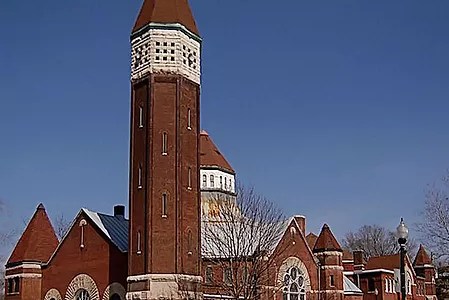
Indianapolis: early morning tv news, April 12, 2022. In the predawn shadows I recognize it. The tower of The Centrum, formerly Central Avenue United Methodist Church, greets the dawn. The Twelfth and Central intersection pictured is blocked off with yellow “crime scene” tape.
The story of Central Avenue Methodist Episcopal Church is a tale of great success, ending in a disappointing closure. It concerns the loss of a true center – for a community and a denomination. A familiar and oft repeated pattern across cities in the Rust Belt, this. A similar plotline has played out around the nation over the past century. At one-point, Central Avenue was a civic and cultural center and then, abandoned by the Methodists. “Redundant” as the Brits say. This is the tale of a faith group’s loss of clear identity, mission, and vision; a loss of “true north.” A building was “redeemed;” a parish was lost.[i]
Bill Cook, medical device inventor and visionary, from Bloomington came to the rescue in 2008. With Indiana Landmarks, restoration began on the grand old Romanesque-Revival structure. Good thing. Fine for the grand old facility, and the neighborhood. The Centrum is now a center of civic activities. The abandoned church captured Cook’s imagination — and dollars. Bill and Gayle Cook gave careful attention to preservation efforts in dozens of locations across the Midwest. Lovely this.
Central Avenue Methodist Episcopal Church was built in the horse and buggy era (1891) in one of Indianapolis’ first suburbs. It stood only a mile-and-a-quarter, twelve blocks, from city center – the Circle. Soon automobiles came to town. Following decades saw the Great Depression, two World Wars, and accompanying urbanization. Central Avenue prospered. An influential center of civic and social service efforts in the city and beyond, it offered much leadership and support for fledgling institutions. For example, the Methodist Hospital opened in 1908 a short distance to the west carrying with it the undergirding of several congregations, but Central Avenue was a leader. However, in the following decades, the prominence of the congregation changed.
Economic patterns shifted. Employment and housing ecologies were re-sorted. Newer neighborhoods in more distant suburbs were built. Depending on location, real estate values spiked or plummeted. The actual and perceived quality of various public schools was altered. Urban parishes, like Central Avenue, faced decline and redundancy. In the early decades of the 20th Century urbanization brought “improvements” and fresh investments, especially for those living further out from Center Township.
Thousands more workers were needed. While most in the working class lived on the south and west side of town the addition of even more hands and heft required finding additional living space. New migrants found this near the church. There was also an expanding racial diversity. Those leaving behind grand old homes and churches were moving on to newer, more prestigious addresses. It was the early-and-mid-century American Way; a prevailing residential and economic wave was playing out across the nation. Apartment buildings began to dot nearby streets and avenues. Folks moved into town from farms across the Midwest to find work; soon, to support “war efforts.” Others, from Appalachia (mostly Kentucky and Tennessee) and a greater number of African Americans (from the deep South) came to the city. Manufacturing, especially on the south and west side was booming and a robust pharmaceutical industry expanded.
The need for a low wage workforce of clerks, secretaries, cooks, janitors, and food service workers meant that many poor families were competing for a place. They arrived seeking shelter wherever it could be found. Near Central Avenue church, most single-family homes were slowly but steadily transformed into rental properties. Former one-family houses were sectored into three, four, five or even six apartment units. The carriage houses and garages, off the alleys nearby, were turned into one-room residences. Often, a family with several children might reside in these conversions. There would be a little coal-burning cookstove in one corner and a shallow loft for sleeping. By the early 1960s many of the graceful residences along Central, Park, Broadway, Alabama, College, Pennsylvania and Delaware Streets had fallen into disrepair. Apartment units, built to handle the migration during the World Wars, became roach and rat-infested, places of squalor.
Tree-lined neighborhood streets were widened into bustling three-and-four-lane, one-way thoroughfares. No longer was parking allowed along many of these byways. Commuters could speedily travel to and from work or entertainment downtown. Many who formerly resided in the neighborhood, now rushed through it, past it. This “transition” accelerated and expanded during the 1950s and 1960s.
The fabric of neighborhood relationships and human commitments, often overlooked or beneath the surface, suffered. Fear of the “stranger” shaped social and spiritual underpinnings. Like tectonic plates quaking beneath the earth’s crust, the Central Avenue parish was shaken, broken. By the early 1960s the neighborhood and congregation were seen as places of decline, even danger. This quaking left this congregation (and thousands of others like it across the nation), facing an existential crisis. Church members transferred to other congregations, primarily Methodist or another mainline denomination, mostly on the northside.
Some unethical real estate speculators, “slum lords” truly, invested little and extracted much. Like their cousins, still out on the farm, these real estate strip miners couldn’t resist the impulse to turn-a-quick-profit. There was an ignoring of the stewardship of a neighborhood’s fabric, just as farming malpractice fails to properly steward the land. The impulse, in too many cases, was to accrue ever larger profits, skip over best sustainable practices, ignore the long-term health and stability of the ecology of the farm or human residences in the city. Like the erosion of the soil of a farm, an erosion of the parish around Central Avenue was underway. It was the depletion of neighborhood institutions, shops and churches, community pride and a sense of commonweal.
Prevailing myths “explaining” why these neighborhood changes were occurring grew out of the individualistic notion that such patterns were the necessary, unfortunate, but unavoidable stages in urban progress.[ii] The resulting poverty surrounding the church was said to be “inevitable,” tragic perhaps, but essential to the larger success of the city. The poor would have to “make their way out” by individual hard-work and bootstrap initiative. These newly arriving poor ones, “the industrious unfortunate” could one day “escape” their plight through hard work – and perhaps a little luck.
Congregational assistance/charity programs to meet the needs of these new arrivals were commonplace and included a usual array of efforts – food pantry, a thrift shop, rummage sales, recovery groups, summer programs for children and youth, and emergency assistance. So it was, at Central Avenue Methodist in middle years of the century; so it was, in core city congregations across the nation.
The neighborhood ecology was believed to be rooted in a biological model, like the human life cycle: neighborhoods were born, grew up, then declined. Low wealth persons who lived around the church in the 1950s and 1960’s were understood to be “born to poverty,” or ones who suffered some misfortune, or were destined to their circumstances due to some individual human failing. If they had sufficient imagination, initiative, or opportunity they too could join the upwardly mobile path to the suburbs.
In some places, in other northern Rustbelt cities, the abandonment of lovely neighborhoods was even more dramatic. Banking practices of red-lining and racist government housing mortgage guidelines aided and abetted the decline. Lost, were opportunities for poor and minority persons to benefit from home ownership. Richard Rothstein’s excellent book the “The Color of Law: The Forgotten History of How Our Government Segregated America” documents the multiple ways local, state, and federal governments incentivized this deleterious turnover in neighborhoods, all the while limiting or outright blocking opportunities for homeownership for racial minorities and the poor.[iii]
By 1961, other voices, like Jane Jacobs and Gibson Winter offered alternative views of how urban neighborhoods might thrive[iv] and urban congregations might give witness.[v] Alternative urban parish models were emerging in the mid-century. Places like the East Harlem Protestant Parish in New York, the Church of the Savior in Washington D.C., and in Chicago, Woodlawn Mennonite Church, and the Ecumenical Institute were challenging old assumptions.
There were a few attempts at incorporating alternative approaches to the traditional congregational life emerging in Indianapolis. As one observer commented, “Indianapolis is a city that is long on charity and short on justice.”[vi] Mainline congregations confirmed a preference for charity as the primary hallmark and missional goal of urban parish life.
However, the story is more complex, isn’t it? It turns out to be more circular. Today a fuller view of the development cycle of economic, housing and neighborhood vibrancy is clearer. It is “wash, rinse and repeat.” Decline and decay were not inevitable. Indianapolis is more fortunate than many other cities where the loss of entire neighborhoods was and is more profound. It only took a few short decades, along with the vision and resources of folks known as Urban Pioneers for this cycle to be obvious.
Still, a blindness remains. Congregations and neighborhoods once benefitting from the population turnover and changes around Central Avenue now face their own demise. They now experience the loss of any sense of parish cohesiveness. False options offered by the prevailing view of inevitable development and/or decline persist and shape understandings. Today Indianapolis’ Old North Neighborhood has mostly been “gentrified.” There is good in this. There has also been harm. The Centrum, is a symbol of a neighborhood rediscovered and being “preserved.” One wonders for how long?
It is one thing to restore buildings and houses, quite another to re-establish (or perhaps rediscover) a parish.
This leaves one today (and hopefully future leaders of congregations and denominations) with three questions: why?what if? and why not? Future installments will seek to address these three queries. The hope is to better understand and offer suggestions as to alternative futures for faith-based communities. Might there be multiple ways to “re-parish” the urban landscape?
Endnotes.
[i] This story is one I know well, as I lived much of it. My father was pastor of Central Avenue, 1962-1966. He was a good and respected pastor. Prior to moving to Indianapolis, he had served growing congregations with predominantly working-class memberships. However, sixty years ago, Central Avenue was viewed as a “dying inner city congregation.” This work proved to be tough duty for my papa. He seemed to age too rapidly over those four years with speedily graying hair and the burdens of such a parish spiraling downward he seemed to stoop in his shoulders. He was one of five or six talented younger pastors across two decades of the 1950s and 1960s who were sent to “turn the place around.” It was not to be. ++There is more. As it turns out, just twenty years later I was appointed pastor to nearby Broadway United Methodist, just seventeen blocks to the north. The story of Broadway and the surrounding neighborhood was not unlike the story of Central Avenue. A once prominent congregation had fallen on hard times. In 1986 my family bought a home near the church, and I became one of those younger white professionals (urban pioneers) fortunate enough to own a home in a neighborhood that was beginning to regentrify.
[ii] Much of the work of the University of Chicago sociologists (e.g., Robert Park and Ernest Burgess) assumed that such patterns or variations thereof, known as the “Concentric Zone Model,” were predictable and normal in every city. Their book, The City, was published in 1925 and the model they offered, based largely on Chicago, shaped understandings of an inevitable pattern in all American urban ecologies.
[iii] Rothstein, Richard, The Color of Law: A Forgotten History of How Our Government Segregated America, Norton Publishing, 2018.
[iv] Jacobs, Jane, The Death and Life of Great American Cities, New York: Random House, 1961.
[v] Winter, Gibson, The Suburban Captivity of the Churches, An Analysis of Protestant Responsibility in the Expanding Metropolis, Doubleday, 1961.
[vi] This perspective, of Indianapolis being a city “long on charity and short on justice,” was discussed on several occasions by this author with Indianapolis Mayor William Hudnut III, mayor from 1976-1990. Hudnut had been pastor of the influential Second Presbyterian Church in the city. He was a graduate of Union Theological Seminary. Among his seminary classmates was his friend and mine, Dr. Carl Dudley, a leading observer, researcher, and proponent for new models of urban parish life. (Dudley was an urban pastor in St. Louis who later taught at McCormick Seminary in Chicago and Hartford Seminary.) “Mayor Bill” also knew the history of neighborhood decay and renewal set down in this piece. Hudnut knew the alternative approaches to urban parish life emerging in other cities. He did not disagree that individual charity was the preferred norm for the city and as such, the challenge for urban pastors was problematic. Even so, he offered cautionary counsel about “moving too quickly” to organize opposition that would confront underlying assumptions held by leaders in the city or denominational bodies.
The North Texas Annual Conference of the United Methodist Church is where I will be speaking on June 14-15, 2021. Originally the invitation was for June 2020, however, the COVID-19 pandemic changed those plans. I have been asked to make three presentations on the future of United Methodism in the United States. In preparing, it became clear the topic was larger than the future of one denomination. There is a loss of relevance for many institutions that has occurred over recent decades – United Methodism is but one example. Mainline Protestantism has lost its formerly dominant place in society.
It is my plan to post the presentations I am making here over several days, beginning on Monday, June 14. There are no easy solutions presented; although there are some examples of places where new imaginative ministry can be seen. We are at a time in the history of this nation and the church when there are no easy answers. I believe that for Christians today, “our work is one hundred year work.” As Wes Jackson of The Land Institute says, “If your life’s work can be accomplished in your lifetime, you’re not thinking big enough.”
The paragraphs below are from the introduction to these talks. My hope is to encourage some dialogue on this site and in various other venues.
+++++++++++++
INTRODUCTION: DOES UNITED METHODISM HAVE A FUTURE?
Recently, a friend on an early morning walk, asked if I believed United Methodism had a future? I have heard this question often over my ministry, especially recently. This time, however, I heard the question with surprising urgency.
Weaver Chapel United Methodist Church, Lafayette, Indiana
Does United Methodism have a future…or in highfalutin language, “Can United Methodism be Sustainable and Regenerative?” I don’t have a crystal ball. Still, I came all this way, so I am obliged to offer some perspective, some lessons from history and signs of hope. Mostly, I invite us to remember the invitation Jesus makes to the disciples in every age, simply this, “follow me.” Let’s walk together a bit, and consider the question of United Methodism’s future.
Our Context and Its Complications
As we consider our context, let me begin by sharing with you my answer to my friend. “Yes, I have no doubt that United Methodism has a future.” As to what our mission, witness or structure will be, here is a word of hope – we can choose the pathway forward. I believe our work is 100-year work. Or, as my friend Wes Jackson puts it, “If your life’s work can be accomplished in your lifetime, you’re not thinking big enough.”
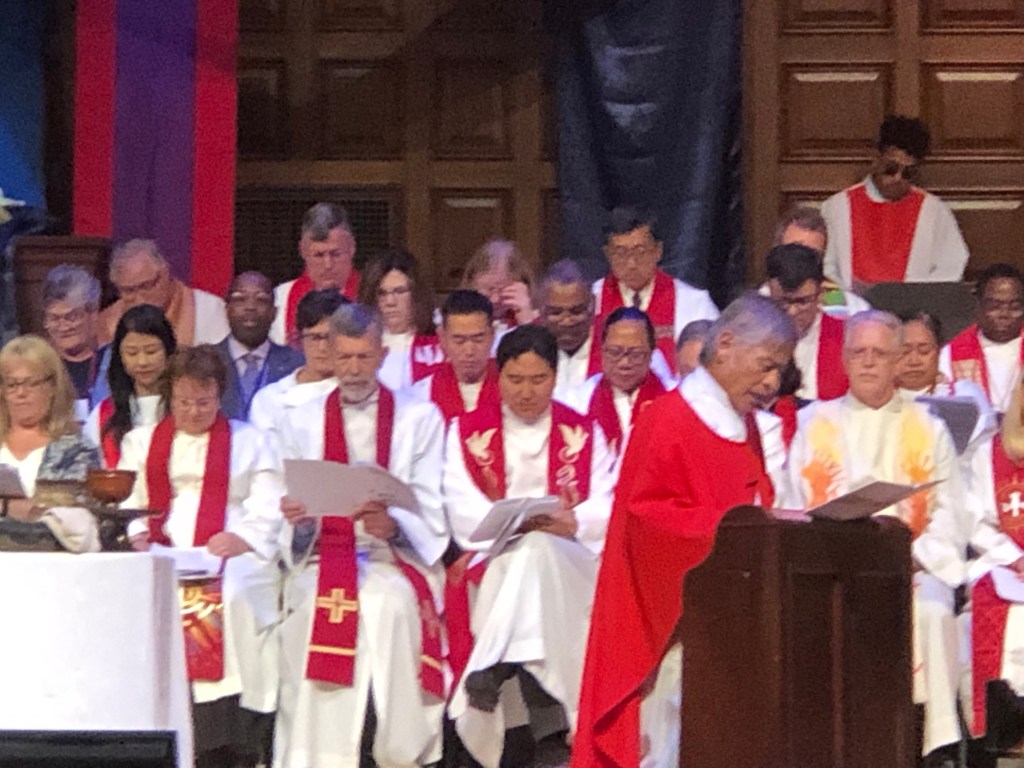
Bishop Grant Hagiya prays at California-Pacific Annual Conference worship, 2019
Researcher David W. Scott notes what is happening in the UMC is part of a larger cultural trend, shared by other denominations; a trend that cuts across race, class and theology. He writes: “U. S. Methodists (and U. S. Christians generally) are fooling themselves if they think that they can solve a cultural problem with organizational solutions.” Scott concludes, “I don’t know what the adaptive solution to the cultural problem of U. S. religious decline is. I wish I did. But I am sure that understanding the nature of the problem is the first step in finding the solution.”
Let me propose that our most hopeful options involve stepping away from long held assumptions about power and influence within the dominant culture. Douglass John Hall [Slide 5] speaking about Ecumenical Protestantism in North America, wrote: “Christianity has arrived at the end of its sojourn as the official, or established, religion in the Western world… The end of Christendom could be the beginning of something more nearly like the church – the disciple community described by the Scriptures and treasured throughout the ages by prophetic minorities.” By stepping away from the easy assumptions and practiced patterns of the dominant culture, a new beginning for Christianity and Methodism is possible. It can surprise, and perhaps, even delight us.
An overview for the three talks: 1) We consider what it means to be Rooted and Grounded in Love – our core identity as United Methodists. 2) We will consider being: “Connected to Bear Good Fruit,” and 3) “Communities of Restoration and Joy.” Our scripture focus will be on Ephesians 3 and John 15.
The text for these talks, including citations will be provided beginning on June 14th.
The final presidential debate of 2020 was held last evening. I didn’t watch. Couldn’t watch really. Not because I had already dropped my ballot in the box with the County Clerk. More than anything else, I suspected it would be a pretty joyless exchange. Wasn’t interested in more distraction, grievance, dreary argument, spin, grumbling or blaming others.
Joylessness — this is what I anticipated from the debate. I am fatigued by it all. If the follow-up analysis offered by pundits is accurate, I guessed right. Apparently Mr. Biden attempted to tease Mr. Trump about being Abraham Lincoln. The president missed the humor, as he does about many things, especially if his fragile ego is threatened. The reruns from the debate seemed to confirm that even though Mr. Trump seemed to use his “in door voice” more than in the past, he still seemed to offer more vinegar and acid than balm.
Thinking back over the years, to sermons I have preached or talks I have given, I often spoke of joy, laughter, or delight. Why? Well, I think joy, laughter and delight are recurring marks of faithful living. We all face suffering, pain, burdens and betrayals, but at the core of it all, God offers us JOY. Or, as C.S. Lewis puts it “Joy is the serious business of heaven” (Letters to Malcolm: Chiefly on Prayer, p. 93).
Serving as an interim pastor in a couple of congregations that had passed through some challenging times, it was clear that in the face of difficulty, humor can help. Laughter can offer an antidote to despairing. After one wise layperson observed “we have forgotten how to laugh in our parish,” we offered an entire series of sermons entitled “Count it all joy: Faith Crowned with Laughter.” I invited other friends to come and join me in the sermon series and we each shared stories of times joy made a difference in our work. As Steve Allen once put it, “Humor is the social lubricant that helps us get over some of the bad spots.”
I was not attempting to follow the current trend suggesting that worship should be a time of entertainment or avoiding challenging topics. Heaven forbid! Just the opposite, in fact. Humor often is a good way to approach difficult topics. More than three decades ago, in the late 1980s, when a congregation I served made the decision to fully welcome LGBTQ persons, it was the laughter and joy that helped us move forward. It was joy and an ability to delight in the gifts others might share and the abundance already present that offered us hope. We didn’t do it perfectly, but we did act with respect for the variety of beliefs in that church. Someone recently asked, “how did the people in that parish act in such a courageous way?” I didn’t reply, but I know they didn’t act out of courage so much as JOY.
Meister Eckhart, the 14th Century mystic said, “God laughs out of an abundance of life, energy and love. I believe in a pleasurable, joyful, laughing God.“
++++++++++++
A favorite reflection comes from Wendell Berry’s collection of Sabbath Poems (A Timbered Choir, p. 18).
Whatever is foreseen in joy
Must be lived out from day to day.
Vision held open in the dark
By our ten thousand days of work.
Harvest will fill the barn; for that
The hand must ache, the face must sweat.
And yet no leaf or grain is filled
By work of ours; the field is tilled
And left to grace. That we may reap,
Great work is done while we’re asleep.

When we work well, a Sabbath mood
Rests on our day, and finds it good.

+++++++++++
Whatever happens on November 3rd, we have work to do. Our joy must “be lived out from day to day.” It is a relief that there are no more presidential debates to avoid. Now, could someone do something about all of the email, television spots and fliers that seem to appear daily in the mail?
This is my goal for the remainder of this Fortnight of our Nation’s Soul. I will remember the JOY of living as a child of God. I will sing (not in a public choir of course), I will dance a little, I will laugh, read poetry, call friends, encourage persons to vote and give generously to good causes. I will choose to be joyful.
We are “two old white guys.” United Methodist pastors with over 90 years of parish experience between us. In the attached podcast we think about racism and anti-racist work. We laugh, we confess our failures and we acknowledge the joy of ministry in places of diversity. Over the years we have spoken of the romance of work in a parish and its surrounding community. Here is a taste of what we have discovered.
If you find something here that parallels your journey — or even if there is something helpful, or something with which you disagree — make a comment, share your story.
My experience is that much of our current United Methodist situation has been brought about by persistent and well-financed outside groups bent on reshaping Methodism away from our natural theological sensibilities and core understanding into a force field of division more to their liking (e.g., Institution for Religion and Democracy). What has happened to the Republican Party in the past two decades is an interesting parallel image. I encourage you to read Smith’s overview — it is a helpful analysis of where we currently stand and what might be possible.
Excellent overview, Jeremy. Excellent, thanks. The proposal has many flaws and potential cautions; however, it does seem to offer a direction if not a precise map to a way ahead. All of our categories and desires for perfection will be tested. That can be a good thing; if we are able to act and think in imaginative ways where the perfect is no longer the enemy of the good. Over the years I have been in three previous attempts at finding a space of compromise — of offering options beyond our ideological/theological entanglements. None made it this far… although a few came close.
Sadly a deep distrust will continue among many who carry decades-long wounds. Distrust will continue to percolate. Others more deeply tied to institutionalist roles will say silly things like bishops “have never stopped the pursuit for a more excellent way for the diversity of United Methodism to be freed from internal theological conflict so that love and respect can triumph over legislative votes that leave a divided church more wounded and less focused.” Poppycock. We need a more humble and repentant stance just now in my view.
What has happened is a tragedy… lost opportunity, broken promises, lost legacies, a tearing out at the root of centuries of witness, analysis that is shallow in anthropology and devoid of theological rigor.
Going forward we all could benefit from a larger dose of generosity, humility and repentance.
My Response: Well said, Jeremy. Your suggestions are good ones. I must say that I am surprised at how many seem to want to rush to the exits without giving more thought to what this means theologically. What is their biblical/theological understanding of the church? They rush without even considering unintended consequences. We live in a time, in our world, when the perfect becomes, for too many, the enemy of the good. Perhaps “big boat” is preferable to “big tent.” It is certainly an image with better theological symbolism (at least to my ears).
There are many contributors to our current dilemma. You identify ways General Boards and Agencies might better engage. Yes, good on the Women’s Division. And, yes our boards and agencies can improve — but it is not just in these places where more constructive initiatives are needed. A part of our challenge comes from the ecclesial and annual conference strategists over recent decades, who have through their various programs and emphases, encouraged the establishment of a flotilla of smaller vessels — that is exclusive attention to congregations.
This congregationalism was reinforced by “congregational development” where “specialists” took up many conference and general church resources (think Path One in the general church). Or look at many annual conferences where the lion’s share of program budget, for years, has been spent on experts who focus solely on starting new congregations or revitalizing older ones, and these modeled more on independent baptist theology and strategies. Congregations can and must be renewed and new ones started; still the strategies seem ignorant of historic Methodist resources. These “start ups” or “renewals” are done in ways that move us away from a sense of common mission and connection.
I recall one interview with a pastor of a strong congregation in my state who, when I asked about the participation of his congregation in UMCOR, GBGM or even annual conference efforts, said he thought his congregation would be better served by joining the mission efforts of one of the UM congregations in another city that did “really neat” mission trips. (His congregation had a long history of support for wider denominational initiatives). That “other UM congregation” with the “neat mission trips” has paid almost nothing in denominational askings over recent decades. It does a re-baptizing of members and is held up as an example for the conference of how “it should be done.” And one looks in vain on the website of this “other UM congregation” for any mention of United Methodist affiliation. This anxiety-over-decline-followed-up-by-congregationalist-strategies has gone on for decades with no accountability from conference leadership… no call for connection or even a basic Wesleyan theological basis. So, many other small boats have been launched that claim no United Methodist identity; however, now they stand in line asking for a share of the accumulated resources of the general church.
I watch in recent months as our colleges and universities (and seminaries) move to disaffiliate or distance themselves from the denomination and wonder why GBHEM, through the University Senate or another resource, isn’t moving to offer them alternative positive responses as part of the General Church’s educational efforts.
The fact that anyone would suggests there is little worth saving the general church only emphasizes how poorly the truth of who we have been/are/and/canbe is understood. It dismisses our broad, inclusive witness. I say “Sail On Ship of Zion.”
Steve Harper continues his reflections on Holy Love by looking to the life and teachings of Jesus. The Jesus Hermeneutic as offered by Richard Rohr captures the preference of “Christ Transforming Culture” rather than a “Christ of Culture” (as H. Richard Niebuhr suggested over fifty years ago).
The fourth vantage point for seeing the hermeneutic of holy love is Christ, the one who reveals the creator (“whoever has seen me has seen the Father,” John 14:9), the one who made the creation (“ everything came into being through the Word,” John 1:3), and the one who is the mediator of the covenant (Hebrews 8:6, 9:15, 12:24). So, everything we have said thus far comes together in Christ, and it does so through love (John 13:1).
One of the things I have heard people say about the relation between Christ and human sexuality is this, “I wish he had made it clear about sexual identities, orientations, same-sex marriage, etc. I have wished the same. I have thought, “If only I could spend five minutes with Jesus.” I have a list of questions. Human sexuality is one of them.
Scholars are correct in noting Jesus’ silence about homosexuality. And…
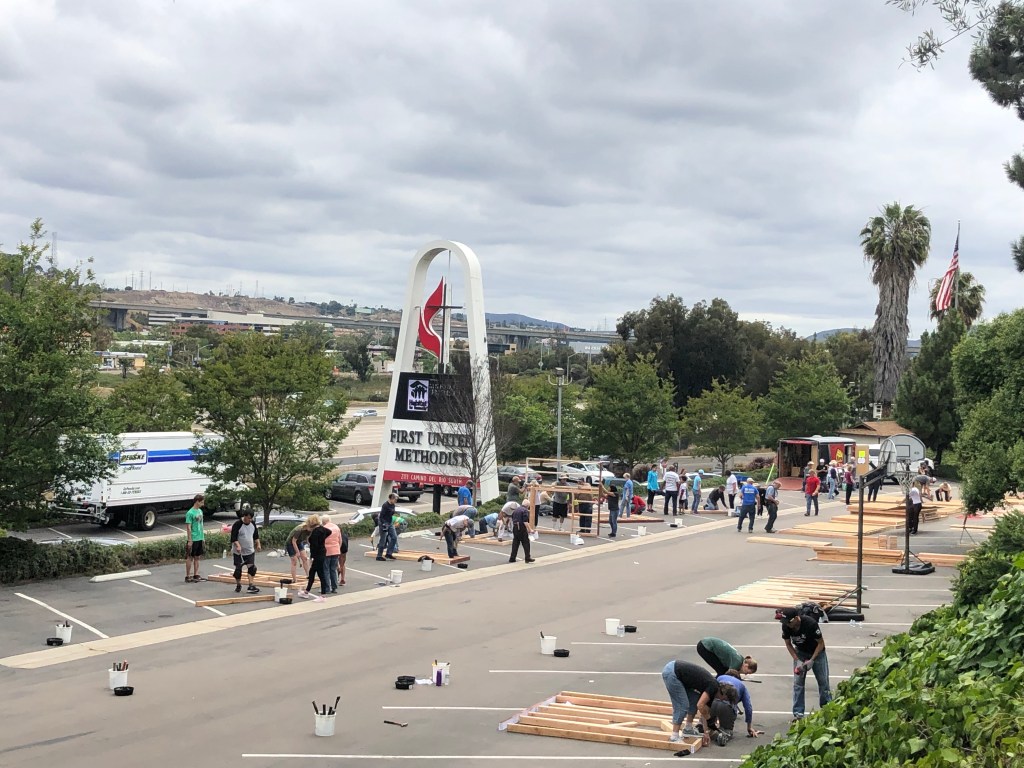
First United Methodist of San Diego — Habitat for Humanity Work Day
United Methodism’s Long Division Problem
My daily morning dyspepsia is, I believe, related to long division problems. I am awake in the early morning, unable to find rest amid puzzles I can’t seem to solve. At about age eight, a teacher taught me “to do long division.” The moment was delicious — I could solve big numbers that before seemed too large. In my early teens, I discovered algebraic long division. Another revelation, a gift, a tool.
Today, my morning dyspepsia, is not so simple. This problem requires an institutional calculus. It is not division I seek: rather, it is the seeking ways to avoid so much dividing — it is greater unity I would like to cipher. Every theological and social instinct within me calls out for linkage, for connection, for common ground rather than a land of separation. Am I simply foolish, nostalgic, tied to some ancient vision of St. Francis bargaining with the wolf or his meeting with the enemies during the Crusades to discover ways of peace?
Why is our nation so tribal, so insistent on becoming a splintering galaxy of spinning ideological enclaves? In ways I suspect most of us don’t fully see, the corollary exists in the divisions of the United Methodist Church. Both nation and church are pursuing long division problems. They are here now, in part because in both nation and church, we have been on a path too long-dividing. Many forces and fractions have brought us to this point: the rise of social media and loss of common language; new cultural and economic ecologies where unemployment and poor community resources persist; much focus on personal and social grievance; churches that avoid their prophetic voice as they fear the loss of market share and numerical decline — all these additives, and more, have brought us to this whirlpool of distrust.
Let’s focus on United Methodism. Maybe if we untangle this a bit, or at least untie some of these knots, it will assist with other riddles. Hardly a week goes by that someone doesn’t ask for a division solution. It often happens like this – I am walking through fellowship hall at church and someone says, “What are we going to do?” I know what is meant but can’t help myself, I reply, “About what?” The answers are: “About the church.” “About the harm being done to LGBTQI persons.” “About damage to the United Methodist brand. ” “About the loss of our children who already think the church is out of touch with their worlds.” Or, I am entering a store downtown, a friend greets me and says, “What do you think is going to happen?” I play out the scene again. “About what?” I respond and I hear the same list of concerns.
Or, I get phone calls from friends around the country. (And, yes, I sometimes call them.) “What’s the latest you have heard?” “Which plan should we support?”
Add this to the daily news about presidential impeachments or government conspiracy and the result is dyspepsia along with a certain emotional and spiritual vertigo — right?
United Methodism’s Long Division isn’t this easy!
So, here are some thoughts about our long division problem in the church — these are a collection of hunches, perceptions, experiences, frequent early morning musings based on my faith journey and desire to be a follower of Jesus. Please note, these are not a plan, nor the son of a plan — no long division solution here. In fact, the PLANS I have seen are, to my mind, part of the problem. I almost chuckle at the plan of the week unveiled from some official or unofficial grouping of problem-solvers and I weep at the theological vacuity often evidenced.
I wonder if there aren’t several million plans out there among United Methodists around the world — one plan for each of the members of the denomination. Individualism and self-centered privilege lead us to find our corner with the like minded. We can shape things along with our gang and the lines of our personal preference. I think of Thomas Jefferson who in a letter to Ezra Stiles Ely on June 25, 1819 wrote: “You say you are a Calvinist. I am not. I am of a sect by myself, as far as I know.” My memory is that on another occasion Jefferson opined that he “carried his religious denomination under his hat.“
Well-meaning people (and some not so well-meaning) offer up new plans weekly. Some would divide the church into two groups, some three, some four. I have even heard of a plan for seven new denominations. At the same time I hear little of how these plans correspond with the great ecumenical prayer of Jesus that “they would be one” (John 17) or the message from Paul about the church as a body with many members (I Corinthians 12).
Most of the proposals that are trumpeted seem unaware of the lessons of church history or from Christians of other denominational families who have struggled with divisions in recent years. What might we learn from the Cooperative Baptist Fellowship that still speaks, five decades later, of “Forming Together” after the splintering of Southern Baptists? What lessons might our Pan Methodist friends teach us as some large congregations have split off from their fellowships? Or, what of the Lutherans, the Seminex story from the Missouri Synod Church, or the merger resulting in the ELCA (Evangelical Lutheran Church in America) and the challenges they have faced? What lessons from the Assembly of God and splintering there? The Wesleyan Church? What might we learn from the United or Uniting Churches around the world (India, Canada, etc.) Or, what of lessons from our older sibling, the Episcopal Church.
Rather than a plan, I would offer some paradoxical thoughts, some ecclesiological assumptions, some prayerful hints for how we might proceed… with or without a plan. Paradoxical, yes, I propose them as cruciform. For they are. One clear assertion I will make is this: there will be no resurrection for us, no renewal apart from the cross. (In the gospels of Mark, Luke and Matthew there are the words like these “Those who try to gain their own life will lose it; but those who lose their life for my sake… you will find it..) Here are seven paradoxes to explore.
I pray that any reshaping or re-imagining of the United Methodist Church will be: Centered in the Christ of scripture and Christ alive in our world today; shaped by prayer and a humble mystic spirit; a seeking of unity among all believers even as we resist efforts to harm; focused locally as essential to a global witness; open to the long-haul of history in order to be relevant today; ready for sacrifice in order to find abundance in unexpected places; and, opening our hearts to the story of others within and beyond our daily routines so as to sharpen our Wesleyan distinctives.
Bishop Grant Hagiya, 2019
When have I seen us at our best? Not when we are arguing or devising our long division plans but rather when we are in mission with others. I see it when the gospel is shared and persons and communities are changed. I see it when bishops pray and invite all, especially those who disagree to a common table. When those who join that table represent the extraordinary array of those from multiple cultures and classes modeling together an invitation to live in our time and place in terms of God’s emerging kin-dom.
FUMC San Diego Acting as Witnesses
I see it in the thousands of places where our actions speak louder than our words. Where the “theology of the hammer” brings people together. I see it when the church works along the Mexican border and says in the name of Jesus, we will welcome these who are in need of sanctuary and we will not bear false witness against them. I see it when the church takes seriously its commitment to care for all creation.
A Blessing Indeed
I see it when I meet another United Methodist, from Africa, Zimbabwe. He tells me his name is “Blessing” and we laugh together when we talk about our mutual friends. Yes, he had taken some classes at Africa University. Yes, he was a student there when I visited that campus. We join in conversation about how we might heal a broken church, in order to set about healing a broken world. It is in surprises like this that my dyspepsia finds relief.




 Hands of the Strong