What you take into your Hands, You take into your heart

Via Hand and Heart: Part II
9364084_s
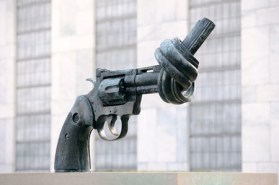
The Knotted Gun sculpture by Carl Fredrik Reutersward, United Nations, New York

 December 14th, 2012.  Sandy Hook Elementary School, Newtown, Connecticut.  It has been three years — such horror.  If there were ever evidence that we are following a misguided path regarding access to guns in our nation, Newtown is the evidence.

Twenty-seven murdered.  Children, teachers, a principal — all sacrificed to our nation’s inability to think or act rationally to protect the innocents.

In the early autumn of 2013, ten months after the tragedy, I was invited to preach in a congregation in downstate Illinois.  During the sermon on the text of “reaping and sowing,” I spoke of our inability to address the gun violence in our culture.  At that point, ten months after the Sandy Hook murders, Congress was still unable to offer even the slightest form of intelligent response of healing or hope for an alternative approach.

Following the worship service a well-spoken gentleman approached.  He didn’t appear angry but he did begin by saying he wanted to disagree with the sermon.  “Okay,” I said, “Please share; I am eager to learn.”  At this point he said that I should not have mentioned guns — “talk about violence, if you must, but when you make it ‘gun violence’ you make it political.  People can also hurt others with a knife.” He went on “if more people were armed the innocent could be protected from the crazies.” 

I was speechless, frightened really.   I didn’t want to have an argument right there in the fellowship hall.  A long pause followed.  I prayed.  He was obviously a sincere, intelligent man — one who had the courage to speak of his disagreement.  After what seemed like an eternity, I reached out and took his hand, still not knowing what to say.  Then, these words came, “How long have you worshiped fire arms?  Is it possible that you may have substituted trust in guns for trust in God?”  To my surprise he squeezed my hand and instead of taking up the argument he said, “I’ll have to think about that” and dropped his head.

Later I found out that this man was active in state politics… If he changed his perspective on the gun lobby his work would be in jeopardy.  He too was frightened.

The scripture lessons at Christmas tell the story of the birth of Jesus, yes.  There is more.  This story continues as it moves toward the story of the slaughter of the innocents and Jesus’ family becoming refugees to avoid his murder.  Herod sends out word that all the male infants should be killed.  I am reminded of the cover of the New York Post the day following the Sandy Hook tragedy.

tumblr_mf2xwj6iFj1rv4aqro1_1280Congress continues to give more protection to gun owners than to the innocent ones who face the terror of sick, troubled and misguided folks who find it easier to own a gun than have a license to drive a car.  We are not helpless… even in the face of difficult odds against change.  Let me suggest that you look to the work of the Brady Center at Brady Center to Prevent Gun Violence.

In Part I of this reflection I spoke of the movie Witness and the scene where the grandfather Eli is speaking with young Samuel about the gun he has found.  He says to the child “What we take into our hands we take into our hearts.”  This is one of two scenes I will always remember.

When the movie first came out in 1985, I was teaching an urban studies class for future pastors in Chicago.  One afternoon the class went to see the movie and then came back to discuss it together.  There were about twenty students in the class, approximately half of them were from the Mennonite or Brethren traditions.  The other students were a mix of Presbyterian, Baptist, Reformed and Methodist. 

The discussion turned to the second unforgettable scene for me from the movie.   It is near the end of the film.  Gunmen come to the Amish farm to track down and kill Detective Book and members of the Lapp family who witnessed a murder in Philadelphia.  What ensues is dramatic, haunting and amazing all rolled into one.  I won’t spoil you by giving you the ending of the movie, but I want to share the reactions from my class to one scene in particular.  The grandfather is facing an approaching gunman.  He looks into another room where Samuel can see him as he motions.  Grandfather Lapp’s hand is out at his side, clenched and moving slightly up and down.  The boy understands and runs to perform the unspoken task. 

In the debriefing of the movie Witness with that class in 1985, I asked how many thought the grandfather was signaling for Samuel to go ring the bell to gather the neighbors.  All of the Mennonite and Brethren students raised their hands.  I asked how many thought the signal was to go get the gun… almost all of the rest of us thought it was signal to get the gun.

The difference in what was seen by the two groups continues to haunt.  One group had grown up knowing the power of community when faced with danger; others of us had learned to prefer force and power.


What you take into your hands, you take into your heart.

Via Hand and Heart: Part I

9364084_s

The Knotted Gun sculpture by Carl Fredrik Reutersward, United Nations, New York


The movie Witness opens with eight year old Samuel Lapp (Lukas Hass) witnessing a murder.  Philadelphia detective John Book (Harrison Ford) questions the boy.  What did he see?  Detective Book is aware that young Samuel is now in danger.  As the plot unfolds, the detective is shot identifying a suspect; still he manages to drive the Amish boy and his mother to their farm. 

Upon arrival in Lancaster county, Detective Book collapses from his wounds.  He is now in the care of this Amish household/community.  Two scenes from this movie are particularly thought provoking for me.  The first scene is of Eli, the grandfather (Jan Rubes) talking with Samuel about the discovered gun.  Witness Youtube video: Eli and Samuel.  Eli says to the youngster “What we take into our hands, we take into our hearts.”  The scene is a too easy summary of one pacifist’s philosophy — still it carries power when thinking of the violence in our modern world.

In the wake of Paris, San Bernardino, Charleston, Colorado Springs, Newtown… [This list of the massacre of innocents can go on for pages] what will we take into our hands and hearts?  Thus far in 2015 there have been more than 40 mass murders in the U. S.  Of these, two involved persons claiming Islamic motivations.  Of over 12,500 gun deaths thus far this year, 19 were done by persons claiming a perverted radical Muslim identity.  We in the United States now have more guns than people.  To what end?

Congress is so controlled and manipulated by the gun lobby that all sensible legislation is blocked.  A majority of Americans are seeking restrictions on gun ownership and usage.  Does this change any thing?  No.  Background checks?  Nope.  This week there was a vote asking that those who are unable to fly, who are on a terrorist watch list, be restricted from purchasing guns.  One would think this is an easy “yes”, right?  No way!   Can we limit the purchase of guns designed for military style use?  Nope.  Limit the amount of ammunition in a cartridge?  Not a chance.  Have electronic finger print control allowing only the licensed owner to fire any new weapon?  Are you kidding?  Not in the U.S.!  We are suffering from a suicidal social addition.

In Indiana we have the added burden of being the major supplier for the armaments sold that are used in the murders on the south side of Chicago.  Will the Indiana legislature act to have universal background checks on gun purchases?  You know the answer — it is “No, no, no.”

At Liberty University this week, Jerry Falwell Jr. encouraged every student to have a handgun — this as part of what a Christian should be about in these days.  He praised the ability to have a concealed weapon and said this would take care of our “Muslim problem.”  Alas.

Two of my friends made cogent responses to Mr. Falwell.  Let me close this Part I of “What we take into our hands” by sharing links to these.   My friends Will Willimon and Sara Wenger-Shenk give us perspective on how we proceed.  They help us better understand what it means to respond to Falwell as a different brand of Christians.

See Willimon’s at: Pistol-Whipped Preacher

See Wenger-Shenk’s at:Practicing Reconciliation

 gun-166507_960_720


Hands of the Strong: Get Off My Shoulders!

“Get Off My Shoulders!  There is Work to Be Done.”

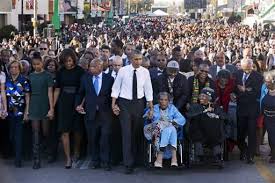
Amelia Boynton Robinson, 103, back in Selma with President Obama

No one said it better.  “Get off my shoulders!  There is work to be done.”  Amelia Boynton Robinson was responding to those who sought to honor her by saying they were “standing on her shoulders.”  In March 1965 she nearly lost her life on the Edmund Pettus Bridge in Selma, Alabama.  Severely beaten, unconscious, she was left for dead.  On March 7, 2015, at age 103, this time in a wheel chair and holding the hand of President Obama, she crossed the Edmund Pettus Bridge.


“Get off my shoulders” she says, “There is work to be done.”

images-5Work to be done?  In 2015?  Yes, there is.  Don’t we have an African American President?  Isn’t this a Post-Racial society?  Well, yes our president is African American… but NO this is not a post racial society.

Today, less than a week after the remembrance of Selma’s “Bloody Sunday,” we see video of members of the Sigma Alpha Epsilon fraternity at the University of Oklahoma singing a song full of racial vitriol and threat.  What is happening?  From Ferguson, Missouri there is the tragic shooting of two police officers at a rally outside the police station.  What is this about?

Yes, Ms. Boynton Robinson, THERE IS WORK TO BE DONE.

Racism continues to plague our society.  There are many causes, many reasons.  Racism remains because some view it too simplistically and some see it as overwhelmingly complex.  Some seem to imply that by simply cleaning up our language and no longer tolerating certain words (or by ending fraternity songs), we will eliminate racism.  I hear former congressman and television personality Joe Scarborough opining that the use of such language wasn’t a part of his experience growing up in the south or attending the University of Alabama.   There was racism around but he seemed to suggest he didn’t participate.  Really?  The implication seems to be that if we would all just clean up our language, we could end racism.  We might eliminate blatant, red-neck racist words but, while laudable, that would not be sufficient.  Language, while important, is one of the least essential elements contributing to the persistence of racism.

Language and behavior are not always aligned.  Prejudice and discrimination can be distinct realms.  Sociologists for decades have shown that what people say and how they act don’t always match.  It is possible for one to have pure language and only noble thoughts (good luck with that) and still act in ways that exclude, belittle and diminish another. 

Racism can also appear to be overwhelming as it is so complex.  Prejudice and discrimination are only two elements in this wicked brew.  There are also deeply embedded institutional and cultural patterns.    We could elect an African American president and still see the dismantling of voters rights in our nation.  This is the other side of our dilemma — we can treat racism as so complex that there is little we individually can do about it.  This is when the words “get off my shoulders” take on special meaning.  We are to keep moving ahead against the forces of injustice, despite the complexities.

For example, how will we now see the situation in Ferguson?  There is absolutely no justification for the shooting of two police officers simply because they are seeking to keep a demonstration peaceful.  My prayers are with those men who were shot — and their families.  It is also my hope that arrests are made soon.  The irony, of course, is that the rally on the evening of March 11, 2015 should have been one of celebration.  The U. S. Justice Department had documented the on-going patterns of discrimination and institutional damages against the black citizen in Ferguson over many years.  Changes were being made, judges and officials are being replaced by persons committed to making change.

And what happens now?  More violence.  This time directed toward the police — police there from other municipalities.  Is this what we have come to?  Are we really so caught up in an eye-for-an-eye sense of justice that anyone could think such a shooting is justified?  Faced with such patterns of revenge, I am astonished that the shooting of these officers in Ferguson did not result in greater violence.  The restraint of the police officials on the scene is, in my view, nothing short of remarkable — and is doubly worthy of praise. 

Now the question my friend — should the protests in Ferguson continue, even after these shootings?  It is not my call.  Others on the scene who are committed to nonviolence need to make this tough decision.  However, if there are citizens who still feel their voices have not been heard, then…  yes, the right to peaceful protest remains essential.  Such are the complexities of dealing with race in our time.  What is on display in Ferguson requires deeper thought and careful study.  The killing of Michael Brown this summer only tore the scab off of a wound that runs decades deep.  I commend to the reader the exceptional research done by Richard Rothstein on housing and job discrimination in St. Louis over the past century. These decades-old practices of racial discrimination helped established the template for the challenges we face today.  What is true of St. Louis is true of every city in our nation.  This report can be found at: http://s3.epi.org/files/2014/making-of-ferguson-final.pdf.

A video interview with Mr. Rothstein can be seen at: http://www.epi.org/event/the-making-of-ferguson-with-sherrilyn-ifill-and-richard-rothstein/

The mystery of why racism persists may lie in our temptation to view it too simply — or to become overwhelmed by the complexities of continuing institutional and cultural realities.  Most of us live our lives in places where we don’t easily see how we can make a difference.  We can be careful in our language and be nice to others but is there more?  We are more comfortable standing on the shoulders of others rather than seeing the work around us to be done.  This work may be as simple as greeting a friend, or as challenging as joining a protest march. 

Many of you make a difference every day, in your places of work or play.  Sometimes it is a smile, sometimes an appreciative or corrective word, sometimes it is making a donation, sometimes it is writing an elected official, sometimes it is joining a project that affirms racial justice.

This past fall a group of friends gathered in Chicago to celebrate my spouse Elaine’s birthday.  I watched and listened remembering the ways Elaine has learned and acted to seek racial justice.  Like Joe Scarborough, she grew up in north Florida.  She too was taught not to say ugly racist words.  However, she looks back with astonishment on the reality of discrimination, segregation and Jim Crow laws in Tallahassee where she grew up.  I have been privileged to watch as Elaine has journeyed ahead in her own ways, seeking to end discrimination and promote racial justice.  Her work over the years as teacher, school board member, advocate for justice and her life as friend to so many signals an abiding witness to the work that still is to be done. 

Recently I was surprised when Elaine said she had arranged to volunteer in a school nearby.  I was proud for her and I also chuckled to myself when thinking about the witness Elaine will be making.    

IMG_0778
Dr. Adrienne Mims and Dr. Elaine Amerson, September 28, 2014.

There is work that we all have to do.  Won’t you join?