Sunday last, I was asked to preach at St. Marks UMC in Bloomington, Indiana. The topic assigned? Christian responsibility regarding Creation Care. What United
Huntington Museum Gardens – St. Francis sculpture
Methodist Bishops have called “Environmental Holiness” has become of increasing interest and passion for me. Perhaps this is especially the case as I am enjoying my years as a grandparent and considering the ways these children will experience the beauty and the destruction of the gift of the natural world.
Attached is the sermon that came for the day. As any preacher knows — there is both more and less to say on any topic. Sermons are shaped for particular occasions and specific audiences. Still, I share this in the hope that no matter our particular perspective on the causes of the environmental changes that are now occurring, we can believe that we, each one of us has a responsibility to care for this “common home” that we share.
Chicago Cubs Vs. Cleveland’s Indigenous Peoples Demeaning Mascot
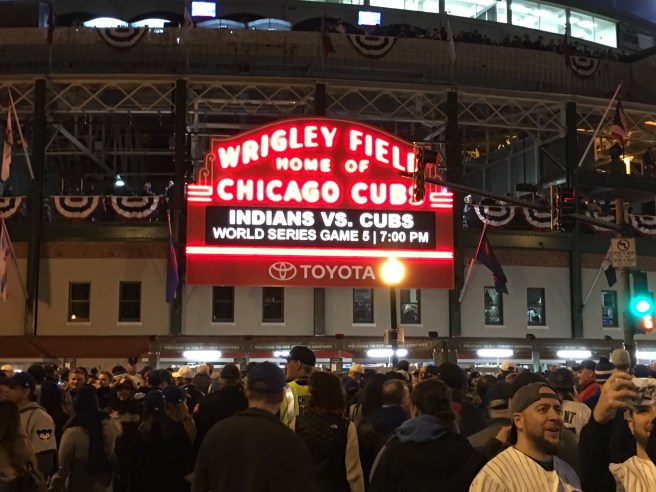
Okay, so that we are clear, I am a lifelong Chicago Cubs fan. There was a time when as a preadolescent I had a brief fling with the Cincinnati Reds and, I confess, I admired the St. Louis Cardinals for a brief period, but it was always, first and foremost, the CUBS! So you can imagine how marvelous it was to sit with my daughter at game five of this year’s world series with Cleveland and see my beloved team win a world series game there for the first time in seventy-eight years!
It was magical — nerve-wracking but magical. After the Cubs had a great year (the best in baseball with 103 wins) they are struggling against that Cleveland team. The Cubs are up against some extraordinary pitching, especially from a guy named Miller who is the best closer I have seen in, well, forever.
I will not mention the name of the Cleveland team because… well… because of… this:
Cleveland’s Chief Wahoo
Come on Cleveland, time to clean up this image of your mascot. I have often defended you as a fine city. You are not “a mistake by the lake.” In recent visits I have marveled at the vibrancy that has come to your downtown and the renewal taking place in many neighborhoods. You have had some good political leaders and some not so good (Stokes, Kucinich, Voinovich, Campbell, Jackson). I won’t mention which I think were the good ones. You have many fine educational and cultural institutions. Of course, there is also the Rock and Roll Hall of Fame!
I admit to being a Chicago partisan in this World Series but just a few months ago I was pulling for the Cavs to surprise everyone and come back from a 3 to 1 deficit to become the world champions in the NBA. THEY DID! So, now, a few hours before game six, I will be pulling for a similar comeback, this time for my dear Cubbies. I am pulling for the Cubs to beat the team I shall call the Cleveland Indigenous Peoples Impersonators.
Is the Chief Wahoo image racist? Of course it is! Don’t pretend differently. Ask the people who have the most right to be offended. The National Congress of American Indians published a poster recently that covers the situation all too well. Just imagine:
Anything more need to be said?
So, win or lose, Cleveland friends, please clean up this racist name and image. It’s an important step. Go to the website of the National Congress of American Indians to learn more (National Congress of American Indians).
Oh yes, and those of you NFL fans of a certain football team in Washington D.C. known as the R*dskins — you too can join in the fun of eliminating such demeaning symbols.
These may appear to some to be small matters; not significant. Some may say I am being “politically correct.” Others may say I should focus on matters of more substance like the Sioux Nation’s efforts to protect land and tribal rights at Standing Rock in North Dakota. I get that and I also think this is all a part of the same package — names of mascots, environmental threats, and small bigotries are all a reflection of our nation’s sinful acts against the First Peoples and our continuing discriminations. It is our enduring embarrassment and, yes, it will require more than just changing a mascot’s name.
As I write, game six of the Series is only a couple of hours away. So, Go Cubs, Beat the Cleveland Indigenous Peoples Impersonators!
These are days of discontent and disruption (even despair) in United Methodism in the United States. Earlier this week, my friend Professor Ted Campbell speaking to a gathering of World Methodists said the following about the United Methodist denomination: “The question at this point is not whether we divide or not,” said Campbell, standing under a “One” sign that signified the unity theme of the conference. “That I fear is a given now.”[United Methodist News, 9-1-16]
As a “cradle Methodist,” one who has lived and loved this Wesleyan expression of the church for more than seven decades, I have watched our common story as it is shattered apart. As it unfolds I watch with the horrid fascination of someone who fears she is seeing a train wreck about to occur. “A given?” So says my friend. I pray and hope Ted is WRONG. Really, are we to divide over this? This?
Still, Professor Campbell’s comment has caused me to do much thinking about our denomination. If we are going to speak of “givens,” I have a few to add. Here are a few “givens” that have been firmly in place for too long and I would suggest have led to my friend’s stark assessment of our situation.
In his fine book Beauty Will Save the World, Gregory Wolfe reflects on the cultural battles in our nation. He notes James Davison Hunter’s statement that culture wars consist of “competing utopian politics that will not rest until there is complete victory.” Wolfe continues regretfully, “The very metaphor of war ought to make us pause. The phrase ‘culture wars’ is an oxymoron: culture is about nourishment and cultivation, whereas war inevitably involves destruction and the abandonment of the creative impulse.”
Gregory Wolfe summarizes further: “Somewhere in our history we passed a divide where politics began to be more highly valued than culture.” Borrowing from Wolfe, I would adapt his statement to read that somewhere in our denomination’s history we passed a divide where politics began to be more highly valued than theology –especially our understanding of the church. We stopped caring for the health of our institution and began to seek total victory through our politics. Humility took a back seat to triumph. Years ago, it became a given — raw politics replaced more generous theological discourse. Outside forces played a role. If “culture wars” are an oxymoron, shouldn’t theological wars be equally onerous? (More on this in future.)
So, there is the previous “given” of politics being more salient than respectful theological discourse. I would suggest two other “givens” that underpin this.
It is increasingly scientifically clear that there are biological, hereditary contributors to a person’s sexual orientation. Year by year, the science keeps mounting — this research is a “given.” It is not that United Methodists have been unaware. In the 1980s and 1990s biological scientists like Sally Geiss were encouraging a more scientifically based view of human genetics. However, by narrow majorities, the General Conference chose to ignore this work. This, my friends, is another “given” that should be set along side the one Professor Campbell mentions. We have been MADE by our creator to have differing sexual proclivities and desires. I believe this is a “given” that should inform our theological reflection and transcend the political and the theological divisiveness we face. I fear on this issue our denomination continues to operate with the ignorance of those who once believed the earth was flat, even in the face of solid scientific evidence to the contrary.
Finally, I suggest it is a “given” that the true disagreement among us, the issue that divides, isn’t primarily human sexuality but how we interpret scripture. For years I have asked my friends, who wish to exclude homosexual persons from full participation in the church, to share with me their hermeneutic of scripture. I ask on what basis they interpret the five or six passages of all of scripture that MIGHT refer to what we understand today as homosexuality? How is it that my colleagues, with whom I disagree on this one matter, find more space to interpret scripture in less literal ways when it comes to divorce, the role of women in the church, support for slavery, polygamy, the eating of pork or even being left-handed? How is there this latitude in interpretation on some important matters like divorce, slavery, the role of women and at the same time a restrictive interpretation of passages on homosexuality?
I believe it is a “given” that until we can sit down respectfully and reason together about our interpretive approaches and differences, we will live more by political strategies than by theological respect. As one wag recently confided in me, “I wonder if this increasingly openness to schism, to the dividing of the body of Christ first rests in an openness to divorce, even though Jesus spoke against it? Perhaps once you accept divorce as normal, you are more open to a dividing of the church!” Interesting and troubling thought, this — even as I find it slightly off key.
Another friend has said that there can be grace-filled endings of marriages, but there seem never to be grace-filled divisions of a congregation or denomination. In this I fully agree. Over the years I have watched the damage done by the exclusionary practices, theologies and splintering activities of the Missouri Synod Lutheran and Southern Baptist denominations. It is clear that the seeking of some mythical purity has left both groups less focused on mission and imaginative ministry.
It is my belief that United Methodism has been shaped by too many “givens” already, without our easily accepting another, even if it is proposed by the good Professor Campbell. What if we worked on some other prior givens like: politics being more highly valued than theology, the scientific evidence we have at hand, or the inability to speak constructively about differing hermeneutical interpretations. What if folks in the emerging Wesley Covenant Association were to include all of these givens in their upcoming deliberations? What then?
[July 10, 2016 — First, an apology — many of you are not United Methodists and care little about the ecclesial wars underway in the denomination of my birth and my ordination. Forgive my need to offer this set of predictions at this time. More importantly, what is happening in our nation now, following the tragic murders and wounding of police officers in Dallas, along with the police shootings of African American men in Minneapolis and Baton Rouge (and beyond), only places in sharp relief the relative insignificant meanderings, bigoted and contradictory activities of United Methodism these days. We UM’s are in search of our true identity. Would that we might find again ways to speak to the nation of the power of love to overcome fear. So, I write this perspective, these predictions on United Methodism 2016. We are a denomination in search of our soul. Pray for us.]
Ten Predictions about United Methodism — summer of 2016:
United Methodism’s structure is akin to the old cosmological suggestion that the world rested on the back of a turtle. And what is beneath that turtle? The answer comes, of course, it is said, “it’s turtles all the way down!” In United Methodism it is conferences all the way down!
This spring and summer, in the United States, there are conferences on top of conferences (General Conference was in Portland in May), on top of this are Annual Conferences (56 in the U.S) and this week we will have five Jurisdictional Conferences where bishops will be elected. I will spare the reader my perspectives on each of these, except as they lead to the ten predictions outlined below:
Prediction #1. For the next decade at least, the word “omnishambled,” a new word to recent editions of the Oxford English Dictionary, will describe the denomination. There will be very little that can be said to be “United.” I recall the wedding bulletin nicely printed for a ceremony many years ago. It read that the wedding was being held at the First Untied Methodist Church. Spell check missed it — UNTIED rather than UNITED. Well, we are headed into a decade of Untied Methodism.
Prediction #2: More and more annual conferences will be acting independently. They will be rejecting the bigoted constraints adopted by the recent and future General Conferences. This is already well underway. This summer several annual conferences voted to act in ways that are contrary to the “official stances” of the church. These conferences will refuse to act against pastors performing same-sex weddings, they will support the ordination of GLBTQ persons, they will act in support of reproductive rights organizations and they will seek a more just way forward in the relationship between Israel and Palestine.
Prediction #3: The 2016 Jurisdictional Conferences held in five regions of the U.S. this week will be an “inflection point” for leadership change in the church. The theological and leadership commitments of the fifteen new bishops will shift the church to a more centrist and left-of-center place in the U.S. While the power of right-wing groups like the Institute for Religion and Democracy, the Good News Movement and the Confessing Movement were evident in Portland at General Conference, the reality is that such locked-down opposition to alternative perspectives will not carry over to these Jurisdictional gatherings. Look for several, perhaps a majority, of courageous centrists and progressives to be elected.
Predication #4: The Western Jurisdiction will elect the first openly gay bishop in the denomination. There are currently two strong candidates. This will produce widely spreading ripples across the denomination both of approval and dissent.
Predication #5: In reaction to these developments (annual conferences challenging the official stances of the church and the election of the first openly gay bishop), a small group of U.S. United Methodist bishops will seek to hold punitive church trials against pastors who perform same-sex ceremonies. One such trial is already underway in Kansas at the urging of Bishop Scott Jones.
Prediction #6: Increasingly these clergy trials will become more problematic and counterproductive for the traditionalists. They will be opposed and dismissed as foolish by a majority of folks in the pew, younger clergy and Christian friends outside the denomination. Instead, in most U.S. annual conferences, so-called “just resolutions” will be worked out with clergy who disobey the strictures of the church.
Prediction #7: There will be ever more organized efforts to hold the denomination together, with the hope of keeping as many at the table as possible. One such group is the United Methodist Centrist Movement that is growing in strength especially in the North Central Jurisdiction (see: UMCM). They speak clearly of the need to welcome a broader range of voices, against church trials and for support of local congregations.
Predication #8: The old and sadly familiar pattern of scapegoating the Western Jurisdiction as a place of rebellion will increase in many quarters. However, there will be growing appreciation of the way the Western Jurisdiction has remained steadfast in its witness to an alternative vision for the church. One compelling and insightful voice from the West is the Rev. Jeremy Smith. His recent reflections on the role of the Western Jurisdiction are, to my mind, prescient (see: Jeremy Smith’s Hacking Christianity)
Prediction #9: The cost of doing general church business for boards, agencies, council of bishops (travel, staff, meetings, programming) will become ever more burdensome, even overwhelming. Attempts to do institutional work out of the same ‘global church’ paradigm as in the past, will cause the 2020 General Conference to make dramatic cuts in budget, program design and staffing.
Prediction #10: Slowly, over the next decade, the United Methodist church in the U.S., at least the church that remains (there will no doubt be some splintering) will focus more on relationship and less on programs, more on conversation and less on spectacle, less on top down decision-making and more in the building of communities of support, and more on finding a third way forward.
Yes, these predictions do project an omnishambled future for United Methodism; still they are in the end hopeful. The move to a place where relationships are valued over program and conversations over spectacle will require new leaders — like those I pray will be elected bishops this next week. Conferences of the future will be less about performers on stage and more about those who gather around tables to share, listen and learn.
We have reached the limits of the strategies by those who would seek to impose corporate systems and lockstep programs for growth on the church and her clergy. There has been too much “talking down to” and too little listening to the genuine articles, the clergy and laity who carry out ministry in local settings. We will discover the value of what some social scientists call “positive deviance.” It will require a looking for and listening for different perspectives on the church and ministry.
At one recent annual conference as hundreds of the clergy gathered for what is called the “clergy session,” there came a need for conversation among those gathered. (Such conversation is, by the way, the basic idea behind a “conference.” It is, in United Methodist-speak, “watching over one another in love.”) However, as it became painfully clear, in this session clergy couldn’t converse — there were no microphones available in large hall of the convention center. Clergy colleagues wishing to raise a question or make a suggestion couldn’t hear one another. The bishop seemed surprised that there would be a question or a conversation needed. He simply said, “We didn’t anticipate this.”
We shall see which of these ten predictions come true — I would bet on most of them — but I am especially clear that conversation, genuine and respectful conversation, will make a return in the next decade if there is any hope for renewal.
Early June – daffodils and tulips have dropped their blooms. Now the purple allium flowers, gorgeous, stand proudly over the “weeds.”
Funny how I can miss the beauty by seeing only the weeds. Beauty — this year I saw it all around our home in the flower or vegetable beds. The allium amidst the weeds remind me of wisdom of a friend long ago — the Rev. Esther Angel.
I first met Esther in 1992 in Louisville. We were both clergy delegates to the United Methodist General Conference working in the same legislative group. That year Esther’s quiet and deeply spiritual presence made a difference. During a break in our legislative group, Esther, speaking softly, asked if she should say something to the entire group. Several of us encouraged her and then she said something that has lingered with me since. She simply and calmly said, “I fear the United Methodist Church is in a time of self-loathing. It is diminishing and replacing the joy of our work.” She went on “we are forgetting to celebrate the harvest, focusing too much on the weeds.”
That day, in the next hour, Esther rose and moved to the middle of the circle in which our legislative group was sitting. The topic was the denomination’s support for a woman’s right to have a choice when facing the tragedy of abortion. Up to this point, it was mainly men who had spoken. Raising her hand, moving to the center, turning and continuing to slowing circle, she began, “I would sing you my heart…”
She spoke of the women she had counseled facing difficult, almost impossible pregnancies and life situations. Saying she had never counseled a woman or her partner to proceed with an abortion — she could still understand how in some cases this would be a tragic yet appropriate choice. Esther spoke in a beautiful way of other ways we sought to be a denomination that brought healing and hope. She rehearsed the ways United Methodists had led over the years in civil rights struggles. She spoke on the behalf of a woman’s right to choose and wondering why none of the men, who had spoken with such strong views that week, had asked to hear from women in the room.
I thought of Esther this year when the 2016 General Conference voted to abandon our denomination’s long term support for the Religious Coalition for Reproductive Choice. In 1992, Esther spoke about the importance of welcoming gay and lesbian persons in our churches. She ended her solilloquy, her word-dance with the words, “Let’s stop harvesting the weeds.” In 1992, Esther’s quiet, yet prophetic, spirit made a difference. We missed her in 2016 — but her spirit remains.
The 2016 General Conference of the church “spent a lot of time harvesting weeds.” Esther, who died, too young several years ago, had a capacity for quiet communication. In 1992 Esther passed out a poem printed on a 4 X 6 note card. Here is a link to a copy:Re-Imagining — Esther Angel, 1992.
To my mind she captured something in speaking of our “denominational self-loathing.” She perceived then that we were forgetting to celebrate the good harvest related to who we are as Wesleyans as United Methodists. In too many places we forget our great legacy and are literally getting lost in the weeds.
Often when I hear of congreations who try to hide their United Methodist identity on signage or websites, I think of Esther. When I learn of congregations who ignore our theology of baptism or communion, who offer meager financial support to the denomination and prefer to identify themselves “post-denominational” or “community” churches rather than United Methodists, I think of Esther’s witness. When I see the stong waves of the so called New Room Calvinism seeking to capture the future theological direction of our denomination, I think of Esther.
In her poem Esther spoke of the energy expended on attacking and defending and then wrote: “Meanwhile, The poor hear bad news, Captives stay in prisons, The blind remain unsighted. Satan laughs. Wouldn’t you in his/her shoes? “Left”; “Right, both the same, in tactics and in what remains — Undone.”
At our house we are now harvesting vegetables. What joy! Still, it’s difficult not to focus on the weeds, no matter our best intentions. The same is true, I fear, in the church.
My own bishop writes compellingly that United Methodists are about so much more than dealing with issues of sexuality. Sadly, he then spends nearly every communication, every month, talking about the church and homosexuality. He may be trying to do penance for the years he has quietly aided and abetted our bigotry. Perhaps. Still, until we hear of the beauty of faithful, loving homosexual relationships or about the gift of the witness of congregations that are courageously focusing on welcome and reconciliation and rituals of support for all people, it all stays in the weeds.
We all have a responsibility. Will we speak of the beauty all around? Will we speak of the delights of the harvest? Will we speak about our denomination’s commitments to addressing poverty? Addressing racism? Our ongoing commitments to threatened immigrants in our nation and world? Will we have a constructive word about addressing the dilemmas of climate change? Will we hear about the ways the lives of persons in our communities are being changed through the love of Christ?
It is a clarifying moment… The x-rays are back from this laboratory. These hypothetical x-rays come from Super Tuesday of the 2016 presidential primaries. And what can be seen in these images? There it is — the often hidden, not-so-attractive, practices and support of racism. Surprisingly this racism comes from those who call themselves Evangelical Christians. It is painfully clear.Support for racial bigotry and discrimination is all too apparent in the way they vote and self-identify.
The voters have spoken: Donald Trump won seven of the twelve primary elections in states. He claimed the largest percentage of the so-called white Evangelical voters. Just hours before these elections Trump dodged questions about support he was receiving from the Ku Klux Klan and David Duke, a well known white supremacist. In what has become a typical media ploy, after he winked his appreciation for the racist support, Trump then changed his tune, saying that he had always opposed racism and, in typical form, he attacked the media saying that he was again being mistreated.
Can there be any doubt that behind the scenes and often breaking into the open racism has been employed to weaken the presidency of Barack Obama? Like many things, few people are as articulate in identifying such realities as is poet, novelist, conservationist Wendell Berry.
Wendell Berry**
Berry writes: “A good many people hoped and even believed that Barack Obama’s election to the presidency signified the end of racism in the United States. It seems arguable to me that the result has been virtually the opposite: Obama’s election has brought about a revival of racism. Like nothing since the Southern Strategy, it has solidified the racist vote as a political quantity recognizable to politicians and apparently large enough in some places to decide an election…
Nobody can doubt that virtually all of the President’s political enemies would vehemently defend themselves against a charge of racism. Virtually all of them observe the forms and taboos of political correctness. If any very visible one of their own should insult the President by a recognized racial slur, they would all join in the predictable outrage. But the paramount fact of this moment in the history of racism is that you don’t have to denominate the President by a recognized racial slur when his very name can be used as a synonym.”(Wendell Berry, Louisville Courier-Journal, September 15, 2015. See more at: Berry, Revival of Racism.
I was stuck by a recent report from the Southern Poverty Law Center that provided the recent history of active hate groups in the United States. During the first eight years of the twenty-first century there were roughly 150 groups such as the Ku Klux Klan, White Nationalist, Racist Skinhead, and Neo-Nazi. Their numbers changed very little in the period between 2000 and 2008. However, in 2009, following the election of our president, the number of hate groups rose to over 500 — and today there are nearly 1,000 such groups in the United States!
I am not saying that white Evangelicals are all racists. Still it is more than a little suspicious that there is not more resistance among these folks to Mr. Trump’s dog whistle to the racist fringe. I still remember visiting a family farm, shortly after the election of Mr. Obama. These were good people, church going folks, active in state politics. I have known them for years. As we talked my friends began to share email “jokes” about our president. The language was crude, ugly, bigoted and demeaning projections. It was raw, blatant racism in the depiction of our president. I was stunned — didn’t join in the laughter and spoke only a halting word of disagreement. In hindsight, I wish I had said more. In hindsight, I understand there are such “God fearing” folks and how they could vote for Mr. Trump.
In his insightful study One Nation Under God Kevin Kruse of Princeton University outlines the way the Christianity shifted in the twentieth century to become a public spiritual spectacle, useful to politicians and corporate leaders to pursue their goals of power and wealth. Kruse cites William Lee Miller of Yale Divinity School who spoke of the American people who followed their president, Eisenhower, and “had become fervent believers in a very vague religion.” (Kruse, p. 68) Or, as Robert Bellah put it, “Is this not just another indication that in America, religion is considered a good thing but people care so little about it that it has lost any content whatsoever?” (Kruse, p. 68) This vague religiosity has been filled with many things — and as Evangelicalism has gained ascendancy too much of the “vague” content has been long on self concern and short on self criticism.
The vague content of American Christianity — Evangelicalism in this case, has been filled with patterns of thought and behavior that have almost no connection with the message or life of Jesus the Christ. In fact, the vague content has been filled with shabby self indulgent understandings that are amazingly at odds with the Sermon on the Mount or the Lord’s Prayer.
What would a beliefs x-ray show about a person’s real commitments?***
I do not seek to salvage this word “Evangelical.” The damage, the identity theft, has been done. Such a project belongs to others. Thankfully, they are already at work and know it will take generations to correct what has gone amiss. As suggested in an earlier post, these elections provide an x-ray into the flawed theological and faith perspectives of such Evangelicals. Sadly, the x-ray comes back saying the illness is at a critical stage. This religiosity is shaped more by culture, history and prejudice than it is by the scriptures or sound theology. Honestly, it is more a folk religion than a coherent faith practice.
What are we to do? What is the church to do? In his column, “The Governing Cancer of Our Time, ” David Brooks speaks of the rise of authoritarianism (Brooks, Governing Cancer). Over forty years ago, I served as part of a national research project on the church and racism. In this work we discovered the connections between authoritarianism, status concern and racism in its various forms. The question became how should the church, the People of God, respond?
We learned three important things:
The church — especially the leaders in the church — must say NO to racism. That which is obvious and that which is more subtle. I wonder what difference it might have made if religious leaders and political leaders had stood up against Mr. Trump’s “birther” comments in 2008, or every year since? One can’t help but think that the current dilemma of the Republican Party was brought about by their own silence and disrespect all along the way.
Sermons and study groups alone have little effect on changing racist attitudes or behaviors. (Sorry about this preachers and teachers.) However, when sermons and education are combined with activities that engage parishoners with persons of a different race, especially activities that seek cooperatively to address racism, real change is possible. We saw it in Chicago, South Bend, Fresno, Dallas and Los Angeles.
Finally, a denomination’s commitment or congregation’s commitment to battle racism can be measured by the way budgets are made and expended. In 1974 we found that almost all congregations reported they spent more on toilet paper or light bulbs in a year than they did on efforts to address racism. Nothing much has changed over these four decades in this regard!
Silence. Vague content to our faith. Low commitment to change as evidenced in our practices and budgets. These things, good reader, may be among the reasons for our current embarrassment.
Only yesterday I was thinking of the three words spoken all too often these days — “Of Blessed Memory.” This is a phrase that typically follows the mention of the name of a friend who is now deceased. That list among my friends “of blessed memory,” sadly, continues to grow.
Little did I realize that today, less that 24 hours after this awareness, I would speak those words about two GREAT women — Harper Lee and LaVerta Terry. They were both 89 years old — they certainly experienced life over the same decades, yet in very different ways. I think they probably saw the world – its joys and challenges – in similar ways and would have been dear friends had they met. Both will remain among my greatest teachers.
Harper Lee
Harper Lee 1961 Monroeville Courthouse
Time Life Pictures/Getty Images
Although I met Harper Lee only through her writing and the occasional news stories about her, I felt she was a friend. We had a mutual friend, Thomas Lane Butts. Tom who for years would visit with Harper weekly would keep me updated about Ms. Lee. A treasured book on my shelf is a signed copy of To Kill a Mockingbird that he arranged for me during one of his weekly visits. I did meet Harper Lee’s older sister, Miss Alice Lee, at a church event over twenty years ago. Every United Methodist active in denomination-wide activities knew of Miss Alice. She was that remarkable lay leader and attorney from Monroeville, Alabama.
Harper Lee won a Pulitzer for To Kill a Mockingbird in 1960 which was an immediate success. I can still remember reading late into the night while a senior in high school, caught up in the drama surrounding the trial of Tom Robinson in the fictional town of Maycomb, Alabama. It was fictional but I knew it was about real life, real bigotry, real threats, real racism. I loved picturing Scout, Jem, Boo and and most of all Atticus Finch in my mind’s eye.
So, it was a quite a joy this past year to read Go Set a Watchman, a
Harper Lee 2006
novel that was written prior to Mockingbird. It was not as polished… and less idealistic. It was not published back then. Too bad. In Watchman, Good and evil are not as easily separated… and Atticus? Oh, sadly he turns out to be more true to real life as he buys into the racism of the town — for a larger “good.” Alas.
I must say, however, that I found Watchman to be a great read, full of humor and a clear-eyed view of life.
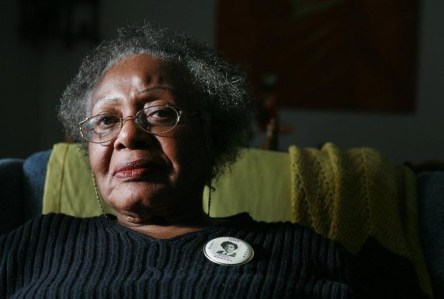
LaVerta Terry
Source: Bloomington, Indiana Herald Times
LaVerta Terry became my friend and mentor when I served as her pastor in Bloomington, Indiana. You can catch a glimpse of her dignity, intellect, her direct manner and memorable presence in this brief piece: https://www.youtube.com/watch?v=oRrZTKik8L8
Nothing was better for me than hearing LaVerta Terry laugh — and usually at my expense. She would tease and I would tease right back. She usually won. However, one evening when Elaine had other commitments, I asked LaVerta to accompany me to the opera at the Indiana University. (The opera is one of the great gifts of I.U. and LaVerta was a fine musician.) When we arrived at the auditorium, LaVerta looked at me and said “What will people think, the two of us out on a date.” I was ready for her and replied, “Don’t worry, they will think you are Elaine.” LaVerta was still laughing at the end of the first act.
In 1963, LaVerta Terry was the first African American hired by Public Schools in Monroe County. Twenty years earlier, in 1944 she had won a scholarship to the Indiana University School of Music. The remarkably sad story is that she had won first place in auditions with the Metropolitan Opera; however, when she arrived at I.U. with her luggage, she was denied a place in the dormitory because of her race.
Sadly, the persistent racial discrimination she found led her to complete her bachelors degree at Jarvis Christian College after some study at Tuskegee Institute. What a sad story and yet she was a great spirit. Later she became Assistant Director and Director of the Groups program at Indiana University. This program focused on encouraging and supporting racial ethnic minority students, most were the first generation from their family to attend college. Her students now are in places of leadership all around the world. When I was pastor in Bloomington, I would often meet them and hear of the way Mrs. Terry had been a “difference maker” in their succeeding at the university and in life.
My friend La Verta Terry taught me much. Mostly, she tried to teach me to speak the truth about difficult things with grace, elegance and style. I will never match her in this; but often I can hear her voice in my head cheering me on. And, like many of my dearest friends, she knew how to be a loving critic if I said or did something she thought might have been handled better. LaVerta, lived on the other side of the white-privilege Harper wrote about. They both knew the bitterness of racism and shaped beauty and meaning from the ugliness.

There are many, many others about whom I speak of with the words “Of Blessed Memory.” Mostly I speak these words about folks I knew, some very well, and folks who shaped me for the good. People like Daphne Mayorga Solis, Carl Dudley, Earl and Ethel Brewer, Stella Newhouse, Bob Greenleaf, Clarence Jordan, Scott Lawrence, Ernie and Polly Teagle, Ray Dean Davis, Bob Lyon, Gil James, Dow Kirkpatrick, Parker Pengilly, Liz Shindell, David Stewart, Jerry Hyde, Kenda Webb, Will Counts and Jane Tews… I am realizing this list could continue on and on. It does. Yes, the list goes on and on. It is called “the Community of the Saints.” Blessed are we who have known them, in person or otherwise; blessed are we indeed.
The Knotted Gun sculpture by Carl Fredrik Reutersward, United Nations, New York
December 14th, 2012. Sandy Hook Elementary School, Newtown, Connecticut. It has been three years — such horror. If there were ever evidence that we are following a misguided path regarding access to guns in our nation, Newtown is the evidence.
Twenty-seven murdered. Children, teachers, a principal — all sacrificed to our nation’s inability to think or act rationally to protect the innocents.
In the early autumn of 2013, ten months after the tragedy, I was invited to preach in a congregation in downstate Illinois. During the sermon on the text of “reaping and sowing,” I spoke of our inability to address the gun violence in our culture. At that point, ten months after the Sandy Hook murders, Congress was still unable to offer even the slightest form of intelligent response of healing or hope for an alternative approach.
Following the worship service a well-spoken gentleman approached. He didn’t appear angry but he did begin by saying he wanted to disagree with the sermon. “Okay,” I said, “Please share; I am eager to learn.” At this point he said that I should not have mentioned guns — “talk about violence, if you must, but when you make it ‘gun violence’ you make it political. People can also hurt others with a knife.” He went on “if more people were armed the innocent could be protected from the crazies.”
I was speechless, frightened really. I didn’t want to have an argument right there in the fellowship hall. A long pause followed. I prayed. He was obviously a sincere, intelligent man — one who had the courage to speak of his disagreement. After what seemed like an eternity, I reached out and took his hand, still not knowing what to say. Then, these words came, “How long have you worshiped fire arms? Is it possible that you may have substituted trust in guns for trust in God?” To my surprise he squeezed my hand and instead of taking up the argument he said, “I’ll have to think about that” and dropped his head.
Later I found out that this man was active in state politics… If he changed his perspective on the gun lobby his work would be in jeopardy. He too was frightened.
The scripture lessons at Christmas tell the story of the birth of Jesus, yes. There is more. This story continues as it moves toward the story of the slaughter of the innocents and Jesus’ family becoming refugees to avoid his murder. Herod sends out word that all the male infants should be killed. I am reminded of the cover of the New York Post the day following the Sandy Hook tragedy.
Congress continues to give more protection to gun owners than to the innocent ones who face the terror of sick, troubled and misguided folks who find it easier to own a gun than have a license to drive a car. We are not helpless… even in the face of difficult odds against change. Let me suggest that you look to the work of the Brady Center at Brady Center to Prevent Gun Violence.
In Part I of this reflection I spoke of the movie Witness and the scene where the grandfather Eli is speaking with young Samuel about the gun he has found. He says to the child “What we take into our hands we take into our hearts.” This is one of two scenes I will always remember.
When the movie first came out in 1985, I was teaching an urban studies class for future pastors in Chicago. One afternoon the class went to see the movie and then came back to discuss it together. There were about twenty students in the class, approximately half of them were from the Mennonite or Brethren traditions. The other students were a mix of Presbyterian, Baptist, Reformed and Methodist.
The discussion turned to the second unforgettable scene for me from the movie. It is near the end of the film. Gunmen come to the Amish farm to track down and kill Detective Book and members of the Lapp family who witnessed a murder in Philadelphia. What ensues is dramatic, haunting and amazing all rolled into one. I won’t spoil you by giving you the ending of the movie, but I want to share the reactions from my class to one scene in particular. The grandfather is facing an approaching gunman. He looks into another room where Samuel can see him as he motions. Grandfather Lapp’s hand is out at his side, clenched and moving slightly up and down. The boy understands and runs to perform the unspoken task.
In the debriefing of the movie Witness with that class in 1985, I asked how many thought the grandfather was signaling for Samuel to go ring the bell to gather the neighbors. All of the Mennonite and Brethren students raised their hands. I asked how many thought the signal was to go get the gun… almost all of the rest of us thought it was signal to get the gun.
The difference in what was seen by the two groups continues to haunt. One group had grown up knowing the power of community when faced with danger; others of us had learned to prefer force and power.
The Knotted Gun sculpture by Carl Fredrik Reutersward, United Nations, New York
The movie Witness opens with eight year old Samuel Lapp (Lukas Hass) witnessing a murder. Philadelphia detective John Book (Harrison Ford) questions the boy. What did he see? Detective Book is aware that young Samuel is now in danger. As the plot unfolds, the detective is shot identifying a suspect; still he manages to drive the Amish boy and his mother to their farm.
Upon arrival in Lancaster county, Detective Book collapses from his wounds. He is now in the care of this Amish household/community. Two scenes from this movie are particularly thought provoking for me. The first scene is of Eli, the grandfather (Jan Rubes) talking with Samuel about the discovered gun. Witness Youtube video: Eli and Samuel. Eli says to the youngster “What we take into our hands, we take into our hearts.” The scene is a too easy summary of one pacifist’s philosophy — still it carries power when thinking of the violence in our modern world.
In the wake of Paris, San Bernardino, Charleston, Colorado Springs, Newtown… [This list of the massacre of innocents can go on for pages] what will we take into our hands and hearts? Thus far in 2015 there have been more than 40 mass murders in the U. S. Of these, two involved persons claiming Islamic motivations. Of over 12,500 gun deaths thus far this year, 19 were done by persons claiming a perverted radical Muslim identity. We in the United States now have more guns than people. To what end?
Congress is so controlled and manipulated by the gun lobby that all sensible legislation is blocked. A majority of Americans are seeking restrictions on gun ownership and usage. Does this change any thing? No. Background checks? Nope. This week there was a vote asking that those who are unable to fly, who are on a terrorist watch list, be restricted from purchasing guns. One would think this is an easy “yes”, right? No way! Can we limit the purchase of guns designed for military style use? Nope. Limit the amount of ammunition in a cartridge? Not a chance. Have electronic finger print control allowing only the licensed owner to fire any new weapon? Are you kidding? Not in the U.S.! We are suffering from a suicidal social addition.
In Indiana we have the added burden of being the major supplier for the armaments sold that are used in the murders on the south side of Chicago. Will the Indiana legislature act to have universal background checks on gun purchases? You know the answer — it is “No, no, no.”
At Liberty University this week, Jerry Falwell Jr. encouraged every student to have a handgun — this as part of what a Christian should be about in these days. He praised the ability to have a concealed weapon and said this would take care of our “Muslim problem.” Alas.
Two of my friends made cogent responses to Mr. Falwell. Let me close this Part I of “What we take into our hands” by sharing links to these. My friends Will Willimon and Sara Wenger-Shenk give us perspective on how we proceed. They help us better understand what it means to respond to Falwell as a different brand of Christians.
Amelia Boynton Robinson, 103, back in Selma with President Obama
No one said it better. “Get off my shoulders! There is work to be done.” Amelia Boynton Robinson was responding to those who sought to honor her by saying they were “standing on her shoulders.” In March 1965 she nearly lost her life on the Edmund Pettus Bridge in Selma, Alabama. Severely beaten, unconscious, she was left for dead. On March 7, 2015, at age 103, this time in a wheel chair and holding the hand of President Obama, she crossed the Edmund Pettus Bridge.
“Get off my shoulders” she says, “There is work to be done.”
Work to be done? In 2015? Yes, there is. Don’t we have an African American President? Isn’t this a Post-Racial society? Well, yes our president is African American… but NO this is not a post racial society.
Today, less than a week after the remembrance of Selma’s “Bloody Sunday,” we see video of members of the Sigma Alpha Epsilon fraternity at the University of Oklahoma singing a song full of racial vitriol and threat. What is happening? From Ferguson, Missouri there is the tragic shooting of two police officers at a rally outside the police station. What is this about?
Yes, Ms. Boynton Robinson, THERE IS WORK TO BE DONE.
Racism continues to plague our society. There are many causes, many reasons. Racism remains because some view it too simplistically and some see it as overwhelmingly complex. Some seem to imply that by simply cleaning up our language and no longer tolerating certain words (or by ending fraternity songs), we will eliminate racism. I hear former congressman and television personality Joe Scarborough opining that the use of such language wasn’t a part of his experience growing up in the south or attending the University of Alabama. There was racism around but he seemed to suggest he didn’t participate. Really? The implication seems to be that if we would all just clean up our language, we could end racism. We might eliminate blatant, red-neck racist words but, while laudable, that would not be sufficient. Language, while important, is one of the least essential elements contributing to the persistence of racism.
Language and behavior are not always aligned. Prejudice and discrimination can be distinct realms. Sociologists for decades have shown that what people say and how they act don’t always match. It is possible for one to have pure language and only noble thoughts (good luck with that) and still act in ways that exclude, belittle and diminish another.
Racism can also appear to be overwhelming as it is so complex. Prejudice and discrimination are only two elements in this wicked brew. There are also deeply embedded institutional and cultural patterns. We could elect an African American president and still see the dismantling of voters rights in our nation. This is the other side of our dilemma — we can treat racism as so complex that there is little we individually can do about it. This is when the words “get off my shoulders” take on special meaning. We are to keep moving ahead against the forces of injustice, despite the complexities.
For example, how will we now see the situation in Ferguson? There is absolutely no justification for the shooting of two police officers simply because they are seeking to keep a demonstration peaceful. My prayers are with those men who were shot — and their families. It is also my hope that arrests are made soon. The irony, of course, is that the rally on the evening of March 11, 2015 should have been one of celebration. The U. S. Justice Department had documented the on-going patterns of discrimination and institutional damages against the black citizen in Ferguson over many years. Changes were being made, judges and officials are being replaced by persons committed to making change.
And what happens now? More violence. This time directed toward the police — police there from other municipalities. Is this what we have come to? Are we really so caught up in an eye-for-an-eye sense of justice that anyone could think such a shooting is justified? Faced with such patterns of revenge, I am astonished that the shooting of these officers in Ferguson did not result in greater violence. The restraint of the police officials on the scene is, in my view, nothing short of remarkable — and is doubly worthy of praise.
Now the question my friend — should the protests in Ferguson continue, even after these shootings? It is not my call. Others on the scene who are committed to nonviolence need to make this tough decision. However, if there are citizens who still feel their voices have not been heard, then… yes, the right to peaceful protest remains essential. Such are the complexities of dealing with race in our time. What is on display in Ferguson requires deeper thought and careful study. The killing of Michael Brown this summer only tore the scab off of a wound that runs decades deep. I commend to the reader the exceptional research done by Richard Rothstein on housing and job discrimination in St. Louis over the past century. These decades-old practices of racial discrimination helped established the template for the challenges we face today. What is true of St. Louis is true of every city in our nation. This report can be found at: http://s3.epi.org/files/2014/making-of-ferguson-final.pdf.
The mystery of why racism persists may lie in our temptation to view it too simply — or to become overwhelmed by the complexities of continuing institutional and cultural realities. Most of us live our lives in places where we don’t easily see how we can make a difference. We can be careful in our language and be nice to others but is there more? We are more comfortable standing on the shoulders of others rather than seeing the work around us to be done. This work may be as simple as greeting a friend, or as challenging as joining a protest march.
Many of you make a difference every day, in your places of work or play. Sometimes it is a smile, sometimes an appreciative or corrective word, sometimes it is making a donation, sometimes it is writing an elected official, sometimes it is joining a project that affirms racial justice.
This past fall a group of friends gathered in Chicago to celebrate my spouse Elaine’s birthday. I watched and listened remembering the ways Elaine has learned and acted to seek racial justice. Like Joe Scarborough, she grew up in north Florida. She too was taught not to say ugly racist words. However, she looks back with astonishment on the reality of discrimination, segregation and Jim Crow laws in Tallahassee where she grew up. I have been privileged to watch as Elaine has journeyed ahead in her own ways, seeking to end discrimination and promote racial justice. Her work over the years as teacher, school board member, advocate for justice and her life as friend to so many signals an abiding witness to the work that still is to be done.
Recently I was surprised when Elaine said she had arranged to volunteer in a school nearby. I was proud for her and I also chuckled to myself when thinking about the witness Elaine will be making.
Dr. Adrienne Mims and Dr. Elaine Amerson, September 28, 2014.
There is work that we all have to do. Won’t you join?
Ten Predictions – United Methodism Summer 2016
[July 10, 2016 — First, an apology — many of you are not United Methodists and care little about the ecclesial wars underway in the denomination of my birth and my ordination. Forgive my need to offer this set of predictions at this time. More importantly, what is happening in our nation now, following the tragic murders and wounding of police officers in Dallas, along with the police shootings of African American men in Minneapolis and Baton Rouge (and beyond), only places in sharp relief the relative insignificant meanderings, bigoted and contradictory activities of United Methodism these days. We UM’s are in search of our true identity. Would that we might find again ways to speak to the nation of the power of love to overcome fear. So, I write this perspective, these predictions on United Methodism 2016. We are a denomination in search of our soul. Pray for us.]
Ten Predictions about United Methodism — summer of 2016:
United Methodism’s structure is akin to the old cosmological suggestion that the world rested on the back of a turtle. And what is beneath that turtle? The answer comes, of course, it is said, “it’s turtles all the way down!” In United Methodism it is conferences all the way down!
This spring and summer, in the United States, there are conferences on top of conferences (General Conference was in Portland in May), on top of this are Annual Conferences (56 in the U.S) and this week we will have five Jurisdictional Conferences where bishops will be elected. I will spare the reader my perspectives on each of these, except as they lead to the ten predictions outlined below:
Prediction #1. For the next decade at least, the word “omnishambled,” a new word to recent editions of the Oxford English Dictionary, will describe the denomination. There will be very little that can be said to be “United.” I recall the wedding bulletin nicely printed for a ceremony many years ago. It read that the wedding was being held at the First Untied Methodist Church. Spell check missed it — UNTIED rather than UNITED. Well, we are headed into a decade of Untied Methodism.