
Harvesting Weeds

Harvesting Weeds


IMG_1423
Allium in Bloom, Walstead Farm 2016

Early June – daffodils and tulips have dropped their blooms.  Now the purple allium flowers, gorgeous, stand proudly over the “weeds.”

Funny how I can miss the beauty by seeing only the weeds.  Beauty — this year I saw it all around our home in the flower or vegetable beds.  The allium amidst the weeds remind me of wisdom of a friend long ago — the Rev. Esther Angel.

I first met Esther in 1992 in Louisville.  We were both clergy delegates to the United Methodist General Conference working in the same legislative group.  That year Esther’s quiet and deeply spiritual presence made a difference.  During a break in our legislative group, Esther, speaking softly, asked if she should say something to the entire group.  Several of us encouraged her and then she said something that has lingered with me since.  She simply and calmly said, “I fear the United Methodist Church is in a time of self-loathing.  It is diminishing and replacing the joy of our work.”  She went on “we are forgetting to celebrate the harvest, focusing too much on the weeds.

That day, in the next hour, Esther rose and moved to the middle of the circle in which our legislative group was sitting.  The topic was the denomination’s support for a woman’s right to have a choice when facing the tragedy of abortion.  Up to this point, it was mainly men who had spoken.  Raising her hand, moving to the center, turning and continuing to slowing circle, she began, “I would sing you my heart…” 

She spoke of the women she had counseled facing difficult, almost impossible pregnancies and life situations.  Saying she had never counseled a woman or her partner to proceed with an abortion — she could still understand how in some cases this would be a tragic yet appropriate choice.  Esther spoke in a beautiful way of other ways we sought to be a denomination that brought healing and hope.   She rehearsed the ways United Methodists had led over the years in civil rights struggles.  She spoke on the behalf of a woman’s right to choose and wondering why none of the men, who had spoken with such strong views that week, had asked to hear from women in the room. 

I thought of Esther this year when the 2016 General Conference voted to abandon our denomination’s long term support for the Religious Coalition for Reproductive Choice.   In 1992, Esther spoke about the importance of welcoming gay and lesbian persons in our churches.  She ended her solilloquy, her word-dance with the words, “Let’s stop harvesting the weeds.”  In 1992, Esther’s quiet, yet prophetic, spirit made a difference.  We missed her in 2016 — but her spirit remains.

The 2016 General Conference of the church “spent a lot of time harvesting weeds.”  Esther, who died, too young several years ago, had a capacity for quiet communication. In 1992 Esther passed out a poem printed on a 4 X 6 note card.  Here is a link to a copy: Re-Imagining — Esther Angel, 1992.

IMG_1457

To my mind she captured something in speaking of our “denominational self-loathing.” She perceived then that we were forgetting to celebrate the good harvest related to who we are as Wesleyans as United Methodists.  In too many places we forget our great legacy and are literally getting lost in the weeds. 

Often when I hear of congreations who try to hide their United Methodist identity on signage or websites, I think of Esther.  When I learn of congregations who ignore our theology of baptism or communion, who offer meager financial support to the denomination and prefer to identify themselves “post-denominational” or “community” churches rather than United Methodists, I think of Esther’s witness.  When I see the stong waves of the so called New Room Calvinism seeking to capture the future theological direction of our denomination, I think of Esther.

In her poem Esther spoke of the energy expended on attacking and defending and then wrote:  “Meanwhile, The poor hear bad news, Captives stay in prisons, The blind remain unsighted.  Satan laughs.  Wouldn’t you in his/her shoes?  “Left”; “Right, both the same, in tactics and in what remains — Undone.”

At our house we are now harvesting vegetables.  What joy!  Still, it’s difficult not to focus on the weeds, no matter our best intentions.  The same is true, I fear, in the church. 

My own bishop writes compellingly that United Methodists are about so much more than dealing with issues of sexuality.  Sadly, he then spends nearly every communication, every month, talking about the church and homosexuality.  He may be trying to do penance for the years he has quietly aided and abetted our bigotry.  Perhaps.  Still, until we hear of the beauty of faithful, loving homosexual relationships or about the gift of the witness of congregations that are courageously focusing on welcome and reconciliation and rituals of support for all people, it all stays in the weeds.

We all have a responsibility.  Will we speak of the beauty all around?  Will we speak of the delights of the harvest?  Will we speak about our denomination’s commitments to addressing poverty?  Addressing racism?  Our ongoing commitments to threatened immigrants in our nation and world?  Will we have a constructive word about addressing the dilemmas of climate change?  Will we hear about the ways the lives of persons in our communities are being changed through the love of Christ?

Esther had it right, let’s stop harvesting weeds!

Phil A

Count it All JOY!

Joy in It!

I am told that Thomas Langford when dean at Duke Divinity School had a license plate on his pick-up truck that read “JOY N IT.”  My suspicion is that folks who didn’t know Tom, might have mistakenly thought he was expressing his joy in driving that truck.  Others of us who knew Tom, knew better.  He was perhaps speaking of the joy of the truck, but suspect he was also talking about the joy of a life of faith, of living and leaning forward, of imagining the joy of a life of gospel relevance.

After writing about the current United Methodist General Conference an email came that challenged my call for repentance and accountability on the part of all of us, if we are to find a way forward.  The writer said he had no complicity in the current impasse and didn’t IMG_1003need to repent.  He said I offered no positive alternative.  Or, as he put it, “you call us to a whimper and a pout in our separate corners.”  Yikes, I thought.  Whimpering and pouting?  People who know me, know I like little more than a GOOD “conversation” — a solid and respectful debate often helps all sides come to fresh understanding, new truth.  There is, for me, Joy In It.  For me, a good learning experience is akin to my grandson Gus’ delight in cleaning up a bowl of chocolate cookie mix.

Conference gatherings for Methodists began in 1744.  The goal was to reason together about what should be taught, how it should be taught and how Methodists should live.  In recent decades our annual conferences leave little space for such conversations.

Annual Conferences are held in expensive (and expansive) convention centers where various interest groups and caucuses meet to plan on how to “win.”  Candidate slates are put together, text messages fly through the ether as partisans do their work.  Little time to listen to others here.  Worship becomes a show where some, up front, perform and we are to passively listen, or perhaps clap along.  I wonder when it was last suggested that we might sing together in harmony?

In my annual conference the expense of the big convention center means that we need to shorten the length of annual conference to avoid any extra expense.  Thereby we avoid more floor debate, time in small legislative gatherings and time for the inadvertent joy of making new friends.  “Come let us reason together” has been turned into “come-let-us-pass-the-budget, hear-reports, nominate-and-elect, have-performers-on-stage-and-avoid-lengthy-controversial-conversation.”  And then, a dear brother assigned to the role of speeding things up, comes to the microphone and moves to limit the number and length of speeches.  We are reminded of the expense of meeting in the convention center and we press onward and downward.

There is growing evidence of the health benefits associated with choral singing, the value of listening and harmonizing in song.  During our debates over human sexuality I have been aware that our Mennonite brothers and sisters are in the midst of a similar controversy.  Yet, they seem more able to hear those who differ, to make a welcoming space for diverse points of view.  Along with the Mennonite commitment to peacemaking, I can’t help but wonder if their practice of singing hymns in harmony (and not just having only performers on stage) might be of benefit to the health of the whole body gathered.

Today, J. Steven Harper wrote a hopeful piece regarding the decision made to support the U.M. bishops in hosting another meeting in a couple of years based on recommendations of a study commission on human sexuality (Steven Harper).  While I am more doubtful about a positive outcome, I join Steve in believing any positive way forward will require those who are involved to come with a humble and contrite spirit — a willingness to listen and set aside preconceived agendas.  If this could happen — what joy there might be.

Joy in it!  Hear the words from the epistle of James 1:2-5:  My brothers and sisters, whenever you face trials of any kind, consider it nothing but joy, because you know that the testing of your faith produces endurance; and let endurance have its full effect, so that you may be mature and complete, lacking in nothing.  If any of you is lacking in wisdom, ask God, who gives to all generously and ungrudgingly, and it will be given you. (NRSV)

Compass&BibleAt root, our differences will call for us to struggle with our interpretation of scripture and our various “captivities to local cultures” and step away from the worlds of narrow experience.  Folks like me will need to know how we can focus so narrowly on excluding gay folks based on a limited and questionable scriptural basis, and at the same time ignore other scripture “rules.” There are also “scriptural rules” on the role of women, divorce, the eating of pork, the wearing of synthetic clothing or the call to stone folks to death for many of our modern practices.


Fortunately there are good people who differ and yet who can joyfully engage in conversation with others who can provide us with helpful interpretive guidance.  Knowledge, reflection, empathy, relationship with those who differ can be helpful. I would like such a group to respond to questions about the dimensions of a scriptural hermaneutic behind the exclusionary paragraphs in our current Book of Discipline.

So… I offer to my friend ,who sent his email critique, more than a whimper or a pout.  My response might come with singing — learning again to sing in harmony.  It might come in talking and moving our annual conferences beyond being just about budgets, reports and votes.  It might change the ways we do charge conferences.   Might we sing and offer constructive conversations?  If we could, we just might be that we could again find JOY in being together.  If we could learn how to have annual conferences and charge conferences that offered space for relationship and for honest debate and conversation, we might lay the groundwork for more constructive general conference gatherings.  The burden is not just on the as yet unnamed study commission — it is on all of us.


1434 words

The Wrong Tool — General Conference

United Methodist General Conference Is A Lousy Tool

A friend who grew up in a Midwestern farm family speaks of the way his father would care for the farm implements.  After each use of a plow, a shovel or a hoe, the tool would be cleaned and sharpened.  It would be oiled, re-calibrated and made ready for the next chore, the next planting or cultivation. In this way, would the wise farmer care, year on year, for the tending of God’s good creation.

Recently I wrote of the value of having the right tool for work on my small remodeling project at home.  At the time, I was not just thinking about “the right tool” for carpentry and remodeling.  I was also thinking about institutions that are our tools as we seek to end homelessness and inadequate housing.  In my thoughts, there were other tools that are essential to our our common life, our health as a society and a church.

For example, our health care systems and our public education in the United States are examples of tools when properly cared for can be of benefit to all.  Instead of these tools being improved and used to assist, my sense is that in many places they have been cynically and actively undermined and misused.

This week, we have seen the dysfunction and inadequacy of the United Methodist General Conference as a helpful instrument.  General Conference is a dull and unwieldy tool that to my eyes destroys more than it builds up.  General Conference, built as it is on Roberts Rules of Order, could hardly be a more inappropriate tool for the tasks facing the contemporary church — especially a church that seeks to be global AND also inclusive.

Since the failed conference of 2012, I feared this would be another waste of the time, treasure and talents of many good people.  And so it appears to have been.  It has become more of a test of raw power and competing caucus groups seeking to win by any means available.  Hospitality has been replaced with tactics, legislative maneuvering and strategy wars.

This is not new to our denomination.  In fact, many of the wounds we now suffer go back to the racism and patriarchy of the past.  The whole notion of “jurisdictions” in the church in the U.S. goes back to a fundamental distrust rooted in differing views of racial segregation and fear of regional dominance.

Efforts to use a different tool, one identified at this conference as “Rule 44” were defeated by the body early in the conference.  It was perhaps not the best instrument — but it was an effort to try another approach for making difficult decisions.  It failed and no “better way” was offered.  So — now other ways to do our work are proposed.  A vague outline by the bishops — a call to prayer, a study commission and another gathering of the body in a couple of years.

Let me confess my doubts that this will bring success.  Not now, not in two years, not in four, not in ten years.  Why?  Because there are many different  tasks confronting the many constituencies and cultures of the church.  These each will require different instruments… not a one style fits all polity or theology.

However, there is another reason I have doubts about the efforts to use General Conference as a tool.  It is not the conference itself.  It is not Robert’s Rules. It is not Rule 44.  It is not the wisdom of our bishops or a study commission.  It is, the inability of us ALL to admit our sinfulness and culpability in contributing to the omnishambled morass we now experience.

Back in 1971, Elaine and I returned to the United States after an appointment as missionaries in the Republic of Panama.  The experience for was transformative.  We left as young idealistic Evangelicals.  Living among great people engaged in significant mission, we also saw the colonialism and paternalism of the church’s well intended efforts.  We saw the ways indigenous people would damage one another.  We saw the jealousies among missionaries and international aid workers.  We saw the ways governmental foreign aid was abused and misdirected toward benefiting U.S. corporations rather than truly assisting the needs of the people.

We were changed, and in this change we experienced something deeper than words or theology.  We were newly aware of our own complicity, our own sinfulness, our own addictions to the wealth and privilege.  And, we saw the lives of great people who likewise could acknowledge their failings and still keep seeking to live ever more responsibly even in confusing situations.  These were people who knew that the tools at their disposal (schools, churches, clinics, social service), might be small and dull, but they could be cared for, sharpened and re-calibrated.  They were also people who could argue well and respectfully and welcome persons who differed.

We saw great and good people (missionaries and indigenous leaders) whose lives modeled a way of integrity that was exemplary.  They were life-shaping models for us.  They were United Methodist missionaries, Catholic priests and lay people, Lutheran missionaries, Pentecostal fathers who would bring bags of nickels to school to pay a daughter’s tuition and mothers who would pray dawn to dusk for their children.  They knew a brokenness in their institutions, their nations and within themselves.  They modeled something deeper — something too rare in our world.  As the great leader, Bishop J. Waskom Pickett wrote from his missionary experience, “in the places where it was least expected the lives of believers became confirmations of the gospel.”  We watched with joy as Baptists, Catholics, United Methodists, Lutherans and Nazarenes worked together on evangelization teams.

In our first month back in the U.S. in 1971, I found myself speaking at an early gathering of the Good News organization.  In trying to tell of the integrity of people of faith (from many traditions) and of the pain of seeing our own personal complicity, I was struck by the response.  It was a dualism, the sense that no one wanted to hear such talk.  As it turned out, for many in the Good News movement, there were only two ways to view every matter — It was their way and the wrong way.

In one session that week, I listened to a leader who spoke of his visit to Panama and then critiqued United Methodist missionary efforts in Latin America.  I listened, astonished, as some of the persons we had come to love, were said to be communists and heretics because of their theologies or divergent political views.  It was all untrue, about being heretics or communists, but spoken with a certainty in these public gatherings.  I was amazed.  I was even more amazed when I spoke to one of the leaders of the Good News Movement about the misinformation being spread.  His response? “Sometimes things get a little overstated, but it is for a larger good.”  I asked what this good might be?  And was told it was the reformation of the church and to gain power in the denomination.  In other words,  it was about control.

Stunned, I simply muttered… “And, when you win, if you control the denomination as it is, what will you have?”

Today, May 18, 2016 it is clear that the Good News folks, forty-five years later, have WON.  The denomination is now in your hands.  I would ask, will you join in acknowledging the many ways good people have been harmed, truth has been shaved and repentance is required on all sides?   It is my view that the simplistic, either/or ways of proceeding have not changed over the decades.  And, yes, it is not just this one caucus that is shamefully one-sided and works with dull, broken and inappropriate instruments.

Today, I wrote my bishop and asked if he could join me in understanding that “complicity” is spelled with the letter “I” in it.  I acknowledge ways I have been complicit in the brokenness we now experience.  Can he?  I suspect not, because the spiritual muscle of dialogue with those who differ and disagree has atrophied.

How will we read scripture?

My reading of scripture and my theological study over the years brings me to the belief that until we ALL acknowledge our complicity and sin, the denomination will stay stuck.  And as long as we are stuck, my question from 1971 stands — “If you control the denomination as it is, what exactly will you have?”  Wesleyan “holiness,” you see, good Methodists, was always in the context of repentance and accountability.

It is how we kept our spiritual (and organizational) tools sharpened and in good working order.


Turning Bad News to Good

First, Confess The Sin of Racism

xrayview
Racism in Plain Sight*

It is a clarifying moment… The x-rays are back from this laboratory.  These hypothetical x-rays come from Super Tuesday of the 2016 presidential primaries.  And what can be seen in these images?  There it is — the often hidden, not-so-attractive, practices and support of racism.  Surprisingly this racism comes from those who call themselves Evangelical Christians.  It is painfully clear.  Support for racial bigotry and discrimination is all too apparent in the way they vote and self-identify. 

The voters have spoken: Donald Trump won seven of the twelve primary elections in states.  He claimed the largest percentage of the so-called white Evangelical voters.  Just hours before these elections Trump dodged questions about support he was receiving from the Ku Klux Klan and David Duke, a well known white supremacist.  In what has become a typical media ploy, after he winked his appreciation for the racist support, Trump then changed his tune, saying that he had always opposed racism and, in typical form, he attacked the media saying that he was again being mistreated.

Can there be any doubt that behind the scenes and often breaking into the open racism has been employed to weaken the presidency of Barack Obama?  Like many things, few people are as articulate in identifying such realities as is poet, novelist, conservationist Wendell Berry.

8972.jpg
Wendell Berry**

Berry writes: “A good many people hoped and even believed that Barack Obama’s election to the presidency signified the end of racism in the United States.  It seems arguable to me that the result has been virtually the opposite:  Obama’s election has brought about a revival of racism.  Like nothing since the Southern Strategy, it has solidified the racist vote as a political quantity recognizable to politicians and apparently large enough in some places to decide an election…

Nobody can doubt that virtually all of the President’s political enemies would vehemently defend themselves against a charge of racism.  Virtually all of them observe the forms and taboos of political correctness.  If any very visible one of their own should insult the President by a recognized racial slur, they would all join in the predictable outrage.  But the paramount fact of this moment in the history of racism is that you don’t have to denominate the President by a recognized racial slur when his very name can be used as a synonym.” (Wendell Berry, Louisville Courier-Journal, September 15, 2015.  See more at: Berry, Revival of Racism.

I was stuck by a recent report from the Southern Poverty Law Center that provided the recent history of active hate groups in the United States.  During the first eight years of the twenty-first century there were roughly 150 groups such as the Ku Klux Klan, White Nationalist, Racist Skinhead, and Neo-Nazi.  Their numbers changed very little in the period between 2000 and 2008.  However, in 2009, following the election of our president, the number of hate groups rose to over 500 — and today there are nearly 1,000 such groups in the United States!

I am not saying that white Evangelicals are all racists.  Still it is more than a little suspicious that there is not more resistance among these folks to Mr. Trump’s dog whistle to the racist fringe.  I still remember visiting a family farm, shortly after the election of Mr. Obama.  These were good people, church going folks, active in state politics.  I have known them for years.  As we talked my friends began to share email “jokes” about our president.  The language was crude, ugly, bigoted and demeaning projections.  It was raw, blatant racism in the depiction of our president. I was stunned — didn’t join in the laughter and spoke only a halting word of disagreement.  In hindsight, I wish I had said more.  In hindsight, I understand there are such “God fearing” folks and how they could vote for Mr. Trump.

In his insightful study One Nation Under God Kevin Kruse of Princeton University outlines the way the Christianity shifted in the twentieth century to become a public spiritual spectacle, useful to politicians and corporate leaders to pursue their goals of power and wealth.  Kruse cites William Lee Miller of Yale Divinity School who spoke of the American people who followed their president, Eisenhower, and “had become fervent believers in a very vague religion.”  (Kruse, p. 68)  Or, as Robert Bellah put it, “Is this not just another indication that in America, religion is considered a good thing but people care so little about it that it has lost any content whatsoever?” (Kruse, p. 68) This vague religiosity has been filled with many things — and as Evangelicalism has gained ascendancy too much of the “vague” content has been long on self concern and short on self criticism.

The vague content of American Christianity — Evangelicalism in this case, has been filled with patterns of thought and behavior that have almost no connection with the message or life of Jesus the Christ.  In fact, the vague content has been filled with shabby self indulgent understandings that are amazingly at odds with the Sermon on the Mount or the Lord’s Prayer

xraybrain

What would a beliefs x-ray show about a person’s real commitments?***

I do not seek to salvage this word “Evangelical.”  The damage, the identity theft, has been done.   Such a project belongs to others.  Thankfully, they are already at work and know it will take generations to correct what has gone amiss.  As suggested in an earlier post, these elections provide an x-ray into the flawed theological and faith perspectives of such Evangelicals. Sadly, the x-ray comes back saying the illness is at a critical stage.  This religiosity is shaped more by culture, history and prejudice than it is by the scriptures or sound theology.  Honestly, it is more a folk religion than a coherent faith practice.

What are we to do?  What is the church to do? In his column, “The Governing Cancer of Our Time, ” David Brooks speaks of the rise of authoritarianism (Brooks, Governing Cancer).  Over forty years ago, I served as part of a national research project on the church and racism.  In this work we discovered the connections between authoritarianism, status concern and racism in its various forms.  The question became how should the church, the People of God, respond?

We learned three important things:

  1. The church — especially the leaders in the church — must say NO to racism.  That which is obvious and that which is more subtle.  I wonder what difference it might have made if religious leaders and political leaders had stood up against Mr. Trump’s “birther” comments in 2008, or every year since?  One can’t help but think that the current dilemma of the Republican Party was brought about by their own silence and disrespect all along the way.
  2. Sermons and study groups alone have little effect on changing racist attitudes or behaviors.  (Sorry about this preachers and teachers.)  However, when sermons and education are combined with activities that engage parishoners with persons of a different race, especially activities that seek cooperatively to address racism, real change is possible.  We saw it in Chicago, South Bend, Fresno, Dallas and Los Angeles.
  3. Finally, a denomination’s commitment or congregation’s commitment to battle racism can be measured by the way budgets are made and expended.  In 1974 we found that almost all congregations reported they spent more on toilet paper or light bulbs in a year than they did on efforts to address racism.  Nothing much has changed over these four decades in this regard!

Silence.  Vague content to our faith.  Low commitment to change as evidenced in our practices and budgets.  These things, good reader, may be among the reasons for our current embarrassment.

Phil A

++++++++++++

Attributions:
  1. *Women viewing x-ray. Copyright: http://www.123rf.co/profile_rmarmion’>rmarmion / 123RF Stock Photo</a>.
  2. **Photo of Wendell Berry from newsinfo.iu.edu, (Indiana University media)
  3. ***Simulated x-ray of brain. Copyright: <a href=’http://www.123rf.com/profile_scottff72′>scottff72 / 123RF Stock Photo</a>
     

When Good News Becomes Bad News

The Evangelical Embarrassment

Evangelical

Agata Gladykowska, stock photo


The presidential primaries of 2016 are an embarrassment — to our nation, to thoughtful public discourse and, perhaps most tragically, to the witness of people of faith.  This trend has been underway for quite some time.  In an earlier post, I wrote of “Christian identity theft.”

Today is the so-called Super Tuesday, March 1, 2016.  Primary elections are being held in twelve states with hundreds of delegates in play for both political parties.

Over and again it is reported that the Evangelicals are a crucial and determining voting block.  The New York Times this morning says that “Donald Trump’s success with evangelicals is expected to help him dominate” in several of these elections.  REALLY?

The vileness and ugliness of this primary, especially on the Republican side, is so full of meanness and junior high potty mouth jokes as to make mud-wrestling look like a noble enterprise.  But most troubling for me is the use of that word “Evangelical.”

Sadly, this primary has proven to be a DNA test, or an x-ray image, showing the actual make-up and inner organs of many who claim to be Evangelicals.  Really?  Donald Trump represents the best hope for the future among people of faith, the desire to have a God-fearing nation?  Really?  Or, the juvenile, divisive and snarky comments of Mr. Rubio or Mr. Cruz — are these the marks of an “Evangelical?”  Thank God, there are Mr. Kasich and Carson who represent something better; but they seem to have little appeal to those who call themselves “Evangelicals.”

Compass&amp;Bible
For Evangelicals the whole of Scriptures was 0nce the guide
Wavebreak Media, stock photo

Evangelical at one time spoke of a person who believed the good news of God’s love for the world, each one and all.  An Evangelical once was a person who sought to follow Christian scripture, especially the major themes.  Today it has been distilled down to a test on two or three current cultural issues, abortion and gay marriage mostly. 

The x-ray machine which is the 2016 Republican Primary, shows that the core of the Biblical story is either ignored or little understood by this group, who claim the name Evangelical. Things like the care of God’s creation, the welcoming of strangers and refugees, sharing with the poor or living a life of service have dropped out of the body.  These organs critical for life have disappeared.  In its place, Mr. Trump and others have substituted fear, racism, xenophobia, distrust and envy.  Good news has become bad news.  This look inside those who call themselves Evangelicals suggests a perhaps incurable soul sickness, a brokenness.  I fear it is a sickness unto death.

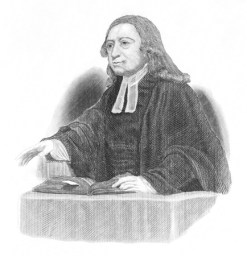
Evangelical has been a word of richness and diversity.  Many won’t understand, but Hillary Clinton, as a United Methodist, stands as much (or more) in the classical definition of Evangelicalism as do any of the Republican candidates.  As a United Methodist her heritage links her to the work of John Wesley and Martin Luther.  While both were men of their age — I think it is clear that neither would recognize what has been going on in these primaries as in any way “Evangelical” in its basic theological DNA structure.

John Wesley
John Wesley (1703-1791) Engraved after original artwork by J. Jackson

Having served as president of a school called “Garrett-Evangelical” I have sought to understand this word and place it in its historical and proper theological context.  The categorization that has been done in recent decades has resulted in a division that seems to allow no breadth of understanding.  I consider myself a “progressive-evangelical,” a place to stand that is, I believe, consistent with Luther or Wesley in their day or millions of Christians outside the U.S. today.

It is tragic that the word has been turned inside out, upside down and backwards in contemporary American thought.  Too long the word has been defined by Fox News and talk radio — too long certain preachers have used the word to divide rather than to heal.  Too long, well meaning pastors and bishops have remained quiet, allowed others to commit identity theft.  Too long, well meaning pastors have said, “It is in God’s hands, you don’t have to worry, it will all work out.” Perhaps it is their own fear that prevents them from speaking against the ugliness of this mean-spirited time.  And now, not surprisingly, “we have sown the wind and are reaping a whirlwind.”

Of course, all of this didn’t happen over night.  In his excellent column, The Governing Cancer of Our Time, David Brooks speaks of the distance we have traveled from our political and civic heritage and speaks of our current situation as “anti-politics” (Brooks, Governing Cancer).

In this column, Brooks notes that politics as a constructive art is in retreat and authoritarianism is on the rise world wide.  What might the church say in such a situation?  Where might Evangelicals seeking to be true to the deeper and richer meaning of the tradition find a constructive voice?  Stay tuned — more to follow.

Phil A


What you take into your hands, you take into your heart.

Via Hand and Heart: Part I

9364084_s

The Knotted Gun sculpture by Carl Fredrik Reutersward, United Nations, New York


The movie Witness opens with eight year old Samuel Lapp (Lukas Hass) witnessing a murder.  Philadelphia detective John Book (Harrison Ford) questions the boy.  What did he see?  Detective Book is aware that young Samuel is now in danger.  As the plot unfolds, the detective is shot identifying a suspect; still he manages to drive the Amish boy and his mother to their farm. 

Upon arrival in Lancaster county, Detective Book collapses from his wounds.  He is now in the care of this Amish household/community.  Two scenes from this movie are particularly thought provoking for me.  The first scene is of Eli, the grandfather (Jan Rubes) talking with Samuel about the discovered gun.  Witness Youtube video: Eli and Samuel.  Eli says to the youngster “What we take into our hands, we take into our hearts.”  The scene is a too easy summary of one pacifist’s philosophy — still it carries power when thinking of the violence in our modern world.

In the wake of Paris, San Bernardino, Charleston, Colorado Springs, Newtown… [This list of the massacre of innocents can go on for pages] what will we take into our hands and hearts?  Thus far in 2015 there have been more than 40 mass murders in the U. S.  Of these, two involved persons claiming Islamic motivations.  Of over 12,500 gun deaths thus far this year, 19 were done by persons claiming a perverted radical Muslim identity.  We in the United States now have more guns than people.  To what end?

Congress is so controlled and manipulated by the gun lobby that all sensible legislation is blocked.  A majority of Americans are seeking restrictions on gun ownership and usage.  Does this change any thing?  No.  Background checks?  Nope.  This week there was a vote asking that those who are unable to fly, who are on a terrorist watch list, be restricted from purchasing guns.  One would think this is an easy “yes”, right?  No way!   Can we limit the purchase of guns designed for military style use?  Nope.  Limit the amount of ammunition in a cartridge?  Not a chance.  Have electronic finger print control allowing only the licensed owner to fire any new weapon?  Are you kidding?  Not in the U.S.!  We are suffering from a suicidal social addition.

In Indiana we have the added burden of being the major supplier for the armaments sold that are used in the murders on the south side of Chicago.  Will the Indiana legislature act to have universal background checks on gun purchases?  You know the answer — it is “No, no, no.”

At Liberty University this week, Jerry Falwell Jr. encouraged every student to have a handgun — this as part of what a Christian should be about in these days.  He praised the ability to have a concealed weapon and said this would take care of our “Muslim problem.”  Alas.

Two of my friends made cogent responses to Mr. Falwell.  Let me close this Part I of “What we take into our hands” by sharing links to these.   My friends Will Willimon and Sara Wenger-Shenk give us perspective on how we proceed.  They help us better understand what it means to respond to Falwell as a different brand of Christians.

See Willimon’s at: Pistol-Whipped Preacher

See Wenger-Shenk’s at:Practicing Reconciliation

 gun-166507_960_720


The Great Identity Theft of 2015

The Great Christmas Identity Theft of 2015 

The devastating assaults in Paris have shattered our best hopes during this season.  I was traveling the day following this tragic time and couldn’t help but marvel at the way persons sitting in the airline terminal transfixed by the television images from Paris.  The usual noises of travelers hurrying through the terminal were muted.  We were all distracted.  Fear and anxiety overwhelmed any sense of normalcy.  Then, our worst fears about the future of terrorism seemed confirmed by the murders of innocents in San Bernardino.  Terrorists assault.  They kill and gravely wound unsuspecting civil servants at a holiday party. 

How do we respond to such evil.  What can we learn?  How will we find a way forward when there are appropriate fears about the future.  One healthy response is to seek to learn more, to understand more, to gain knowledge of the situation.

Who are these misguided murderers?  What motivates?  Why do they choose these suicidal theatrics.  We want to know who is doing this and what are their motives. This is all healthy and appropriate.  It is needed information.  And what can we learn about Islam and this radical apocalyptic cult — this ISIS or ISIL?  Important this is, all of it.

Still, isn’t it intriguing that during these days of terror, we hear volumes from the experts about Muslims — who they are and how they behave — while at the same time there is little or no consideration about who is a Christian or how Christians might act at this time.  The media are full of analysis about Islam.  Good.  knowledge is helpful; as one of my mentors would say “facts are our friends.”

It may be as important, make that more important, to consider what it means to be a Christian in this time.  In the seasons of Advent and Christmas 2015 we hear again the Jesus narratives.  His life and words are captured in carols and story and sermon.  What is there to be learned from this narrative about retaliation, revenge, exclusion, bigotry toward those who are different? 

It is interesting that on the same day that Pope Francis announced the beginning of Year of Jubilee as a time of mercy and reconciliation, Donald Trump is loudly and adamantly speaking words designed to stir up fear and set up new systems of discrimination.  Many people in this country seem to agree with him — in some places, places where there are strong “Christian” environments, there may even a majority who agree with The Donald.  

What has happened?  Most of those who seem to agree with Trump would be quick to say the United States is a Christian nation.  Really?  There is grave danger here.  If we are to choose the way of discrimination toward persons of a different faith, this is a danger I would label identity theft.  Someone is taking the basic elements of what it means to be a Christian and substituting a cheapened, debased form of shallow and self-serving religiosity.

It is not up to me to say whether Donald Trump is a Christian or not.  He says he is, “I attend church on Christmas, Easter and special occasions.”  He says that if he is elected president he will be “the greatest Christian representative ever to be in the White House.”  His faithfulness and the ways he acts on his beliefs are between him and God.  However, he doesn’t get a pass on his easy claims.  How do they match up with the story of Christmas?

9931687_sNo, it is not my call to determine whether Donald is a Christian… but we do know a great deal about who and what a Christian is expected to be from the scriptures and the great traditions of the church.  Racism, bigotry and calls for revenge displayed by too many just don’t square with the person and teachings of Jesus.  Right now — as we gain knowledge about others, equal care needs to be given to thinking clearly about what it means to be a Christian.  Certainly the calls to exclude persons from the United States based on a religious test is unconstitutional.  That is easy.  For me, however, it is more important to ask, is it Christlike?

We are warned at this time of year to guard our credit card information.  We are told to be careful giving out information about social security numbers or family background.  Someone might steal your identity and this would be disastrous.  I want to warn of an even greater identity theft that is underway — it is a theft of what it means to be a Christian.  Guard this closely.  The loss of this identity might be even more damaging than having one’s credit compromised.  The loss of this identity may close down important options that will be needed in the future if we are to find a way past this current wave of terror.

Fear is a powerful thing; so is knowledge.  It is critically important in these days to know more about Islam — what is true and what is false?  Let me suggest that it is even more essential, for those of us who make the faith claim that we are “Christian” to consider carefully what this means — what is true and what is false? 


My One Question

My One Question

What would you ask?  If you could ask only one question of the candidates for the presidency of the United States what would it be? 

Tonight we will see the spectacle of the first presidential debates among the candidates of the Republican Party.  Several television and newspaper pundits are suggesting the questions that “must be asked by” the moderator.  For example, Tom Friedman suggests candidates be asked about an increase in the gasoline tax to pay for our crumbling highway infrastructure.  He notes this is something that Ronald Reagan supported upon his election and might help determine which candidates would be able to lead beyond narrow ideological constraints.  (See: http://www.nytimes.com/2015/08/05/opinion/thomas-friedman-my-question-for-the-republican-presidential-debate.html?src=me&_r=0).  Friedman also suggests questions on immigration and carbon tax credits.  Good questions — just not my question.

There is another group called Circle of Protection that would ask the candidates what they would do to end hunger and poverty in our nation.  Several of the candidates, in both parties, have posted video responses to this excellent question (see: circleofprotection.us).  This too is a marvelous question — a truly important question.  The video responses by candidates that have already been made are helpful — revealing of core beliefs.

However, most of the questions suggested by the pundits are designed to elicit a provocative response, something that will pit one candidate against another.  Most of the suggested questions have little to do with policy or vision and much to do with demeaning another candidate.  Clearly, the hope is to start a political food fight!   Most of the suggested quarries by the television talking-heads are designed to generate more heat than light.  These suggestions are a version of the old school yard taunt “Lets you and him fight!”  How interesting that on August 6th, Hiroshima Day, our nation’s attention turns to a forum where many are hoping to see a fight.

My one question would be this: WHO IS MY NEIGHBOR? 

It comes from my enduring preoccupation with the Gospel parable we often refer to as the story of the Good Samaritan.  I prefer to call it the Parable of the Unexpected Neighbor.  My preoccupation with this particular parable is shaped by the reading of the social philosopher Ivan Illich.  Illich returns to this story again and again as a theme in his analysis of modern institutions.  He notes our misguided efforts to provide professional solutions to problems that require, first and foremost, a neighborly community and a commitment to common conviviality.

Huntington Library Gardens
Huntington Library Gardens, Image of St. Francis

I believe the story of the Good Samaritan has been domesticated, romanticized and distorted in meaning.  I hold that in answering the question “Who is my neighbor?” one will hear from the respondent the core commitments of that person.  This is a “template narrative.”  It uncovers a human gestalt — points to the baseline of meaning. The answer to this question has shaped the lives of people throughout the ages, from St. Francis to Mother Teresa, from Ghandi to Thomas Merton.

Who is my neighbor?  The answer suggests so much — from a compassion for the stranger, to an openness to the foreigner, and a welcoming of the alien, alternative solutions to vexing problems.  It is a question that allows the responder to share ideas that might give us larger purpose and expanded hope.  Yes, the theme of care for the neighbor challenges our propensity to selfishness, bigotry and violence; I believe it offers us even more, when we grasp the dimensions of how this story and its context might shape our perspectives today.

Ivan Illich was once asked, “Given what you suggest about institutions, what is the best way to make change, violent revolution or gradual reform?” Illich answered, “Neither, the best way to bring change is to give an alternative story.” (in David Cayley’s, The Rivers North of the Future).

Over the next several postings I will expand on the wonder of this parable and the power of the question asked of Jesus by the young man in Luke 10:25-37.  I believe it opens us to a remarkably powerful, alternative story — maybe the most powerful alternative story available to humanity!

My plans this evening do not include watching “the debate.”  There will be plenty more where these came from.  I wonder what questions will be asked.  Were I given just one question, it would be — WHO?  WHO IS MY NEIGHBOR?

Lamp Post Literalists

Hands of the Strong: Lamp Post Literalists. 

Amid the twists and turns of everyday life, I have been reflecting on the “recipes for a significant life” offered in our culture these days.  If you are like me, you long for certitude — for the right idea, the perfect politician, the road to true happiness.  And, if you are like me, you are tempted to believe there is a shortcut to such significance and joy.

Such hunger for certainty and clarity is, I have come to believe, the seedbed of fundamentalism.  Before your ask, yes, I believe fundamentalism is a shared human dilemma — make that a shared human flaw.  Fundamentalists can be clothed in many garbs.  Yes, there is “Islamic Fundamentalism” and also “Christian Fundamentalism,” “Jewish Fundamentalism,” “Hindu Fundamentalism,” or, even, “Atheistic Fundamentalism.”  We can too easily, in our search for the simple answer, turn to criticize persons of other faith traditions.  I have come to believe that we must first speak clearly to persons, tempted to fundamentalism, in our own tradition.

William Sloan Coffin, of blessed memory, put it this way: “Some Christians use the scriptures like a drunk uses a lamp post — more for support than for illumination.”  Bill Coffin was at the time pastor of Riverside Church in New York City.  He spoke of the human temptation to selectively use scriptures, or our faith, as a prop for our own shallowness, even our weaknesses.  Coffin suggested that we ALL are tempted to be “selective literalists,” — each of us eager to find the easy way forward, the simple formula, the one confirmation for what we already believe.

IMG_0972

This desire for the one formula, the simple rule, is too much at play in shaping our politics and our religious life.  It is astonishing, for example, that the mission of the United Methodist Church has been diverted, and in my view almost lost, by a focus on homosexuality.  This is based on 5 or 6 verses of scripture that are literally (and in my view wrongly) applied to our day.  How long will our mission and message be held captive to such sad smallness of vision?  In Indiana, we recently saw how this selective literalism of these scriptures was employed to pass legislation that would allow for discrimination against LGBT persons.

In our nation’s life, selective literalistic interpretation of the second amendment to the constitution has led us to a foolish worship of fire arms.  Such interpretations ignore any emphasis on “a well regulated militia.”  The “right to bear arms” is the predicate, not the subject, of this amendment.  As a result of this selective interpretation, we live in a nation where persons too easily trade in guns (even assault weapons) without background checks or any proof of competency.  This flawed literalism has lead to neighborhoods too often like war zones  — places where our children’s lives are under daily threat.

What then shall we do?  Columnist David Brooks’ new book The Road to Character is helpful.  Brooks suggests that the development of character requires humility, discipline, perspective and practice.  He notes that we too easily substitute our narcissistic desires for the gift of mature faith and the richness of the life well-lived.  He speaks of the dangers of smug superficiality — this, too frequently, reinforced by our fundamentalist instincts.  Finding strength and significance in our personal lives and in our national conversation will require a broader imagination and the admitting that we still have things to learn — that we are vulnerable to the siren songs of selfishness and narcissism.

The path to being spiritually healthy people, living emotionally substantial lives and sustaining healthy communities requires something more, something deeper.  Brooks speaks of dimensions of faith beyond our desire for personal validation or easy certainties.  He points to a better way forward offered by thousands, great and small.  He notes that in every community there are persons who are little recognized, yet seem to radiate the gift of faith as they relate to others.  And he notes several of the great thinkers and actors of faith.  Folks like St. Augustine offer a richer way forward, shaped by an understanding that we are all children of God, easily tempted to forget our place and to focus on our selective biases.

In my best moments, I am able to read the scriptures in a more holistic way and see there the deeper trend lines of God’s activity in human history.  There is a larger narrative at play than my self interest.  I see that for faith to be vibrant and meaning-filled will require attention to many dimensions and not my desire to exclude or simplify.  It will require head, heart and hands.  (See the sermon at https://www.youtube.com/watch?v=7SgvnUrT7tk.)

The poet Marianne Moore calls for us to live beyond the “insolence and triviality” around us and to become “literalists of the imagination.”  She suggests that we explore “imaginary gardens with real toads in them.”  So speaks the poet — and the columnist — and this pastor who seeks to keep learning.  I too often get focused on the real toads and miss the larger vision of the garden.  You?