Patchwork: Community of the Lost and Found

Patchwork: Lessons from a Community of the Lost and Found

Our difficulties start with the fact that we have lost each other. 

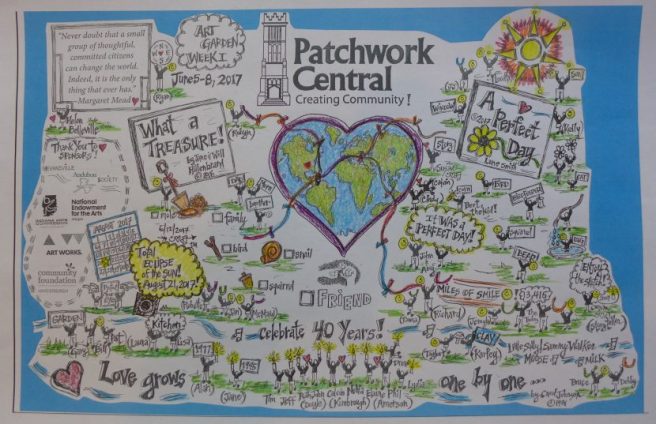
This weekend, July 15th, 2017 we will be joining others to celebrate the fortieth anniversary of Patchwork Central Ministries in Evansville Indiana.  It hardly seems possible that four decades have passed since the Amersons, Doyles and Kimbrough’s made a covenant to live in an “intentional community” in a core-city neighborhood.

IMG_3826
Alan Winslow, February 2017

We will also be celebrating the 95th birthday anniversary of Alan Winslow, a long-time member of the Patchwork Community.  Alan, along with Alice Serr, lead Patchwork’s Neighborhood Economic Development Center for many years.  This was a program of micro-lending before such efforts were widely undertaken.  Alan is one of the scores of incredible lay persons who have been a part of the Patchwork story over these four decades. 

Perhaps we were “foolish beyond our years” in 1977.
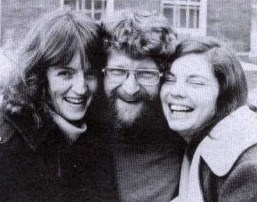
three-of-the-founders

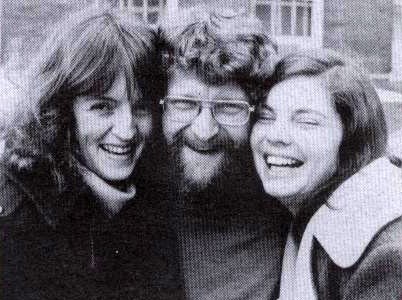
Nelia Kimbrough, John Doyle, Elaine Amerson, 1977

No doubt we were naive.  Perhaps we were just a part of our generation’s search for an “alternative lifestyle.”  No doubt we wanted to test some of theories learned in graduate school.  As we would have said at the time, we were seeking to find new ways to live as people of faith.  No doubt we were open to adventure, to odyssey, to new lessons about ourselves and others.

Whatever the case, we took the risk of leaving safe jobs and titles to join this experiment in covenantal living.  (I will avoid the easy jokes about making these changes due to eating some bad tacos or barbecue.)

safe_image

Judi Jacobson, Alan Winslow and Elaine Amerson, circa 1982.

We spoke of being an intentional community because this was the term used by others at the time.  There were other Christians, friends in Philadelphia, Cincinnati, Chicago and California who were experimenting as well.  It is safe to say we were trying to live out our personal vocations as Christians in ways that offered us the chance to explore new styles of worship, ministry and witness. Why Evansville?  Why this medium-sized community down on the Ohio River?  As we used to say, this only makes sense if it can “Play in Peoria.”

Over the years the Patchwork Central Community grew from the ten of us (six adults and four children) to dozens of folks.  We who would gather for worship, social service, educational and counseling programs, community organizing and protest rallies and so much more. We were “small but mighty in spirit” and our numbers seemed to increase in proportion to our commitment to try yet another mission.  Food panty, after school program, health care clinic, art education, photography, minority leadership development, micro-lending through Neighborhood Economic Development, Back Alley Bakery, tool lending, low-income housing, jobs program for ex-felons painting houses and more.  Our friend, Jim Wallis from the Sojourners Community, after a visit, jokingly said, “Patchwork is a place with more ministries than people!”

1983-photo-collage-sm-1024x689

Patchwork Gathering 1983


While many of us were United Methodist, ordained even, from the beginning we understood ourselves to also be ecumenical and interfaith in practice.  So, quickly, there were friends from the Roman Catholic, United Church of Christ, Lutheran, Presbyterian and Jewish communities.  Sunday evening worship grew.  Before long this little gathering turned into several dozen who worshiped, ate and laughed together on Sunday evenings.   The room was often overflowing with folks who found this to be a safe place and open place.

The three founding couples lived in separate homes, but shared many resources.  The joke among the men was about who got to “wear the community necktie.”  Truth is, we rarely wore ties.   We improved our turn of the century (1890 to 1910) homes.  Others joined.  Some lived in the neighborhood, but folks joined from around the city and the region.

We grew in numbers and influence in the city.  Soon we had the opportunity to purchase the Washington Avenue Synagogue nearby.  How could we afford it?  Our question became, “How could we not afford such a wonderful center for community activities and worship?”  We covered the down payment for the facility by selling a used car that was given to us by Drs. Polly and Ernie Teagle of Belleville, Illinois.  The rest of the mortgage we undertook “by faith.”  Hard to believe bankers would support this rag-tag group.  Such adventurism — but somehow it worked.

There are so many lessons from those years.  On this anniversary I think about what it means to be lost and found.  The 15th chapter of Luke’s Gospel is about finding and losing.  Here are parables of lost sheep, lost coins and a lost child — and the finding again of each.

What was lost and what did we find in those early years at Patchwork?  Who was lost and who found, at Patchwork?  Here are four lessons from those years — the list could be much longer (and, no doubt will be in future reflections).

First, we had lost our belief the institutional church could act in creative ways, especially outside the impulse impelling it toward focusing most ministry in suburban neighborhoods.  (There was a book published earlier written by Gibson Winter and entitled “The Suburban Captivity of the Church” named the dilemma we saw.) 

What we found was this.  If we took the risk of acting first, and asking permission later, some folks in the church would surprise us and support ministry within lower-income communities.  We decided to start Patchwork Central, and although some tried to dissuade us, others, some in leadership, said, “Well, you may be acting foolishly but we will do what we can to support you.”

I am not certain this would happen today.  I see a majority of leaders who are so risk-averse they seem stuck forever in the way things were always done.  For us, we have the gift of folks like Lloyd and Marie Wright and Sam and Marie Phillips.  Lloyd was the United Methodist District Superintendent in Evansville and while he often wanted us to “slow down” and “not try to fight city hall,” he none-the-less stood by our fledgling efforts at new forms of ministry.  Sam and Marie Phillips were the sort of progressive leaders we are lacking today.  Sam had been a D.S. as well and was working in the area of global mission.  The Phillips understood.  And, I could name many, many others, clergy and lay.  Suffice it to say — we found support and vision that we mistakenly thought had been lost to the entire church.

IMG_3828
Alan Winslow and Alice Serr, 2017

Second, speaking for myself, I thought the potential for ecumenical work in a core city neighborhood was a lost cause.  There were pundits in those days who said that a focus on social justice would drive people from the church.  Justice work was blamed for any decline in the church.  It seemed a world of “every denomination for itself” and the primary focus of churches was only on church growth. 

I was so very wrong.  There were clergy like Ed and Mariam Ouelette (UCC), Walt Wangerin (Lutheran), Joe Baus (Presbyterian), Jim Heady (UMC), Alice Serr (Catholic) and Michael Herzbrun (Jewish) to name a FEW. AND, many of the strong and growing congregations were ones that joined us in our ministry efforts.

Third, speaking again for myself, I thought there were few resources in my new neighborhood upon arrival.  I thought imagination and energy for change was lost to these new neighbors.

19894913_10154900004637725_395374373841488755_n

Darlene Bragg, Back Alley Bakery, circa 1983.


I remember, with embarrassment, saying that our work in those early years was to “bring resources to places where they don’t naturally occur.”  Such hubris!!  Such ignorance.   I believed the notion that we would “discover the needs of the people” and set up plans and strategies to fix these dysfunctions.  Instead, what we discovered were neighborhoods full of people with insights, talents, capacities and education beyond our imagination.  The poverty problem was my own — my poverty of vision.  I couldn’t see the potential resource that was all around.  In almost every new endeavor we found folks with gifts to share.  Where I had seen a desert of resource, there was more abundance than I could have imagined.  However, I needed to stop and listen.  If I did, I would discover that my role was more that of friend and coordinator than initiator.

Perhaps most significantly, I thought the basic ingredients of community were something I needed to bring because they were otherwise lost.  Somehow, I thought, I was to bring them to a community void.  Well, community by its very nature is about discovering relationships already available to us — if we can see them and risk finding.

We discovered that everyone can and does live in community.  The question becomes how intentional do you want it to be?  The choice is to risk living in new ways.  The choice is to see with new eyes what is possible.  It requires work.   bell hooks, in her book Teaching Community: A Pedagogy of Hope puts it this way: “To build community requires vigilant awareness of the work we must continually do to undermine all the socialization that leads us to behave in ways that perpetuate domination.”

In the parables we call the Prodigal Son in Luke 15 we too easily think of the son as the lost one.  However, a closer read shows that the father and older brother were also lost.  They had given the younger brother up for dead — and the parable suggests that when all seems lost, it is then a new relationship is possible, if it is accepted.

Ken Medema puts the lesson from scripture on finding and losing in a memorable verse:

Finding leads to losing, losing helps you find.

Living leads to dying but life leaves death behind.

Finding leads to losing, that’s all that I can say.

No one will find life another way.
P1520232-e1497901662155-830x537

There will, no doubt, be many memories this weekend about the early years at Patchwork Central.  Some will want to speak of what we gave — or contributed — to this ministry that still survives.  I will know the truth, for me Patchwork happened because of what I lost while there, and in so doing, what WE, together, found.


Restoring Broken Connections 

Restoring Broken Connections

Citizenship depends on connection.   Constructive membership in any group is rooted in the belief that there is space in the institutional ecology for a person’s engagement and contribution.  Novelist, poet, farmer and cultural critic Wendell Berry put it succinctly “Connection is health.”

quote-only-by-restoring-the-broken-connections-can-we-be-healed-connection-is-health-wendell-berry-87-40-31-1.jpgBerry says that it is “only by restoring the broken connections in our society that we will be healed.”  It is not just the edges of institutions that are frayed and fractured today; there is a disconnection at the very center.  Nor, is it only a brokenness between individuals.  Linkages between institutions and their members, and linkages among institutions are also broken.

  • Yesterday, thirteen United States Senators emerged from secret meetings to propose a heath care reform package.  Amazingly the proposal is opposed by the hospitals and/or university health research institutions in their home states. 
  • Polling shows that fewer than one-fourth of the citizens in these states support the proposed changes to the Affordable Care Act, still this proposal is moved forward.
  • A majority of American Roman Catholics in the United States do not support the church’s views on birth control, remarriage, having married priests or women priests (Pew Research on American Catholics) and yet change seems unlikely in the short-term.
  • There is growing evidence that human caused Climate Change is a dangerous emerging phenomenon. (This research has been done not only by independent university or industry based scientists but also by researchers at government-funded institutions like NASA or the U.S. military); yet, recent government policy actions move us away from healthy responses regarding environmental degradation.
  • The opioid epidemic, with increasing death and higher HIV-AIDS rates, is at crises levels.  Local police and healthcare providers now find their own health threatened by the powerful fentanyl powders being used and potentially inhaled by the persons providing care.  These service providers make specific recommendations to address this fentanyl problem; however, our political leaders respond by doubling down on the failed policies from the 1980s.  This disconnect is about life and death for our healthcare and law officers, our neighbors and the communities in which they reside.

The list could go on and on: there is a disconnect between many trade union leaders and their “members,” between the governor of Illinois and the legislative leaders, between the gentrifying neighborhoods in our cities and the people who are losing their residences and communities.

I have long been disheartened by the brokenness in my own denomination, the United Methodist Church.  Not just the divide between those with theological differences, or the young and older members, or the urban and rural ones, but also the divide among our institutions and between institutions and the people.  My work has led me for example to see the brokenness between our seminaries and the local churches they were designed to serve.

images.jpg

I recall the day when serving as a seminary president I spoke with a talented young woman, encouraging her to seek ordination as a pastor.  She paused a moment and said, “I don’t think I can trust the denomination with my vocation.” 

I mention this young woman because she represents, in my experience, a growing number of our younger folks.  Still we seem slow to reconnect with them.  The “disconnects” in the church among institutions, and between our institutions and individuals, some days seems insurmountable to me.  Having been both a pastor and seminary administrator, I understand.  And, I believe there is productive work to be done in healing such broken connections.

More recently, I joined a group of persons seeking to encourage the church to take seriously its commitments of care for God’s creation.  We proposed legislation to the annual meeting of my regional body, known as an annual conference.  There were persons eager to see the church begin to make a difference regarding our environmental actions.  To my sadness, this genuine enthusiasm was met by denominational leaders who sought to avoid any conflict by moving to table the proposals.  It was both astonishing and sad for the group, many of them younger folks, who saw these proposals as a way to seek healing in the divisions between our words and actions, between our local churches and the need for better care for creation.

When all of these signals are flashing danger, how might we respond? 

Well, this is for you to decide, dear reader.  It is also an opportunity to join with others, in existing institutions, and the creation of new ones, to offer places of citizenship and membership. 

For me, I will continue to challenge, and build new relationships, with the leaders of my regional body who seem so opposed to proposals regarding how our congregations might respond to climate change.  I will speak out on issues related to the opioid epidemic and get to know the persons on all sides of this challenge so that I might help make new connections.   I will challenge the efforts of my congressman and senator to strip medical coverage from more that twenty million persons in our nation, while giving large tax cuts to the rich.  I will challenge these congressmen to listen to hospital administrators and university researchers who may provide creative, alternative approaches to providing health care.

We are not alone.  Others are seeking to build connections as well.  Let me tell you about my friend.  A young pastor, serving in a small and conservative town in my state.  What is remarkable is that this young man would be considered by many to be too liberal, too concerned about the poor, too invested in environmental justice to fit in this small town parish.  So, when I asked how he was doing, I was prepared to hear about his difficulties, his disappointments.  Instead, I saw a broad smile and heard him say, “It’s great!  This is just where I am supposed to be!”  He acknowledged that he had his differences with some folks, but that he was enjoying learning from them and they from him. 

I have known this young man for many years now and seen him mature.  He completed his undergraduate and seminary work as an honors student — top of the class.  He becomes for me a sign of hope.  He understands Wendell Berry’s call to restore broken connections. 

How can I not strive to do the same?


The Season of Splintering

The Season of Splintering

Somewhere in this nation there are probably folks who are celebrating the United Methodist Judicial Council’s decision #1341.  The body ruled that the consecration of Bishop Karen Oliveto in the Western Jurisdiction was a breaking of church law.  Somewhere.  Somewhere they must be slapping one another on the back, saying “we did it, we fixed it.”  Somewhere.

There was nothing fixed by this.  This whole kerfuffle just adds more fissures undermining the denomination’s ability to remain “united” Methodist.  Our energies, mission, identity and witness — all are predictably falling to pieces.  And somewhere there are folks who think they have won something. 

It is just one more indication that we are further removing ourselves from being a church for others, a church that shares the good news of the love of Christ for all people.  Busy with trials we miss finding ways forward that can acknowledge God’s call on many and diverse people — all being able to carry the name “United Methodist.”  This is placing ever more stress on the cracks in the earthen vessel we call the church.  And, somewhere there is celebration.

The Judicial Council’s decision ironically says that Karen Oliveto “remains in good standing as a clergy person” and now must be granted a “fair process” as to her ordination status.  A fair process based on whose assessment?  Is there one annual conference that has the perfect evaluation for clergy qualifications for all other conferences? Is the Judicial Council saying that the California-Nevada Conference got it wrong in assessing who might best serve in their area in ordaining Bishop Oliveto in the first place?  Should Bishop Oliveto have been judged by another better suited group?  Maybe a body in Texas, Mississippi, Indiana or Congo?

Somewhere there is joy.  Somewhere hearts are light.  It is the Western Jurisdiction that now has been named the “fall guy” in this travesty.  They are the one’s who failed when they consecrated Karen.  Is that it?

Oh yes, and why do we have Jurisdictional structures in the first place?  Is there any memory that back at the time when the Methodist Episcopal Church North and South came together that the south didn’t want to have any of those northern bishops overseeing their conferences?  Is there memory of the desire to keep segregation alive by setting up a separate “Central Jurisdiction” for blacks?  Not wanting to welcome persons without distinction or category, the southern church (aided and abetted by many in the north) “allowed” black Methodists to have a separate jurisdiction.

I know something of the south and value so much of what I know.  My college and seminary work were done in Wilmore, Kentucky at Asbury College and Seminary.  There are so many good things represented by these schools, especially the commitment that was once focused on mission.  At the same time this is were some of the seeds of perfectionism, and the proclivity to exclude and divide, are sown. 

Chapel was required at Asbury College.  My seat mate was Patty.  Patty was remarkable — talented and intelligent and had a nose for prejudice and discrimination.   If a sermon was racist or sexist or dismissive of those who were, dear God, liberals or Democrats, Patty would smile and whisper “Holiness Unto the Lord Has Nineteen Letters.”  She was saying to me “count the letters on at the front of the auditorium and ignore this simplistic drivel.”  Once after chapel she confided that “too many of these folks need an enemy to feel good about themselves.”  Patty didn’t acknowledge much else about her identity, her background or her pain — but I knew she carried a burden and a wisdom beyond my experience.

asburyholiness
Front of Hughes Auditorium, Asbury University

Fortunately, most of my experiences in chapel were uplifting and valued.  Still Patty had it right, I think.  She died a few years back — may eternal light be upon her.  Often these days I think of her and the code she was sending by whispering “Holiness Unto the Lord has nineteen letters.”  Many, many good folks attended Asbury and learned the lesson that Patty was teaching me.  Sadly, others from Wilmore, and ones who claim to be shaped by the “holiness tradition,” carry on the tendency toward exclusion and now sow the seeds for this splintering in the denomination.

In many respects the Civil War didn’t end one hundred and fifty years ago.  It simply has shape-shifted into new forms and battles.  Old style bigotrys turn into new ones and every generation struggles with permutations of false perfections that lead to such splintering and pain.

The splintering that has been a part of so many other denominations in recent years, is upon us in United Methodism.  It arrives now in real and troubling ways.  In truth, neither side, of the many sides in this tragedy, wins. 

I recently visited with a friend, a middle-aged father.  He was a cradle United Methodist coming from a family with deep links to the leadership and hierarchy of the denomination.  As we talked, he spoke with pride of his talented son, a young adult just beginning his higher education.  Then my friend said, “It was during the 2016 General Conference sessions that my son told me he was gay.  I have lost any pride in my United Methodist legacy since that day.”  It was heart wrenching. Here is the irony — the son still finds a home in a fine United Methodist congregation in the south.  I wonder for how long this will last, given the splintering at hand?

I am struck by how many of the “leaders” of the groups pushing for perfection have not served as pastors, or at least not pastors in places where there are diverse populations.  Perhaps this falls in the category of “enough said;” even so, I think back on the way God opened my eyes to the beauty of others who were different from me.  It has been in the relationships with others that I saw the greater gift of God’s realm on earth.  And I still think of Patty.

During this splintering season, I think of all the pastors who have children, or siblings, who are gay.  And, of course, I think of all the pastors (closeted and out) and lay leaders (closeted and out) who are gay.  Somewhere there is celebration.   Not among these good folks.  We have substituted rules for relationships and… I believe we have snuffed out the very essence of the gospel.

Somewhere there is celebration.  I know this — those who “celebrate” and will either take control or break away carry within their theology and world view the seeds for another splintering, and another, and another. This is the way perfectionism thrives until it is a majority of one.

Some may celebrate.  I weep, I grieve.  The church of Jesus Christ will go forward, even as we United Methodists splinter. 

The Unexpected Neighbor

The Unexpected Neighbor

The remarkable social philosopher and Catholic priest Ivan Illich was once asked, “Given what you suggest about institutions, what is the best way to make change, violent revolution or gradual reform?” Illich answered, “Neither, the best way to bring change is to give an alternative story.” (in David Cayley’s, The Rivers North of the Future).

532984_f520
Ivan Illich, 1971, source: Wikipedia

Illich, was an iconoclast, a Christian visionary, a prolific writer — and widely read in the last decades of the Twentieth Century.  His brilliant critiques of our institutional practices, still provide a clear-eyed challenge and much valuable reforming wisdom, about our easy customs, traditions and ideologies.  Schools, hospitals, courts, governments and churches were all subjects of his analysis. 

He was more!  Each critique was not a call to anarchy, nor was it an invitation to some elaborate new strategy whereby those in power can better serve their “clients.”  He was about something much more basic — as basic as a table where all may share. 

His call is to reinvest in the original motivating principles behind our “helping” institutions.  He was about the nurturing of an underlying community spirit built on the essential importance of neighborliness.  He suggests there are ways of living into such community understandings as evidenced in his book Tools for Conviviality.

Illich spoke of “corruptio optimi pessima” or “the corruption of the best becoming the worst.” He writes, “Through the attempt to ensure, to guarantee, to regulate Revelation, the best becomes the worst.  And yet at any moment we still have opportunities to recognize, even when we are Palestinians, that there is a Jew lying in the ditch whom I can take in my arms and embrace.”  (David Cayley, Ivan Illich in Conversation, Toronto: Anansi Press, p. 242.)

As Illich would put it, there is a “sad historical progression in which God’s incarnation is turned topsy-turvy, inside out” (from David Cayley’s Rivers North of the Future, p. 29).  This corruption may be seen in our many efforts to serve, to control, to regulate, to manage and to turn our neighbors into categories or objects of our good intentions.  A simple illustration he gives is as follows: “In the early years of Christianity it was customary in a Christian household to have an extra mattress, a bit of candle and some dry bread in case the Lord Jesus, should knock at the door in the form of a stranger without a roof” (Cayley, Rivers North of the Future, p. 54.).  Over the centuries, hospitality was “improved upon.”  The work of each householder is transformed into the responsibility of our “serving institutions.”

If there is one alternative story which Ivan Illich cites more than others, it would, no doubt, be the one known as “the Good Samaritan Parable” in Luke 10. 

I have spent much of my adult life sifting through the human wisdom nuggets of truth in this story — AND BEING CONVERTED BY THIS WITNESS.  It is astonishing that in these few verses in Luke’s gospel, there are dozens upon dozens of insights into our institutions, our freedom, the incarnation story and the wider human reality — tragic and blessed.  I have written about this in other places — and will, no doubt, write more in the future about this upside down reality, this conspiracy, which is the core of Christianity (and that of many other great religious traditions).  Instead in this piece, I want to begin to share a few other alternative stories.  Today, there is the story from Wes Jackson, environmentalist and founder of The Land Institute in Salina, Kansas.

Alternative Story #1:

Wes Jackson shares a story of a visit E.F. Schumacher, author of the widely known work Small is Beautiful, made to his fledgling organization in Kansas in 1977.  Jackson says The Land Institute was “scarcely six months old and we were honored that Schumacher, the widely acclaimed author would visit and give a public lecture.”

“When Schumacher arrived, he did not dismiss this tiny organization that had recently experienced a devastating fire, destroying much of their early work. Instead, E. F. Schumacher listened patiently and insisted on being called ‘Fritz.’ On the evening of the lecture, the Salina Community Theater was filled with farmers, small business owners and the unemployed.”

images
Wes Jackson, from Cool Science News, 2009

Fritz began by telling of a trip he had made during the 1930s with some friends in an automobile across America. He and his compatriots had stopped at a service station in some small Kansas town at the height of the Great Depression. Fritz engaged a local man at the station by asking, “How are things?” “Fine,” the local replied. “What is it you do?” asked Fritz. “Oh, I work on that farm over there,” he said pointing in the direction of the farm. “I used to own that farm but I had no money to pay the hired hand, so I paid him in land.  Eventually he owned all of my farm and now I work for him.”

That is a very sad story,” replied Fritz.” “Well, not so sad,” countered the hired hand. “You see, now my friend has no money either and so he is paying me back in land.” (Jackson, Wes, The Land Institute, December 1999, see info@landinstitute.org).

What are your thoughts about such alternative narratives?  Let’s have a conversation.  Let’s keep listening for other stories that conspire to teach new lessons than might transform our view of the world — and perhaps even change the way we see ourselves.


An Ecology of Hope

Truth on the Scaffold and An Ecology of Hope

I find it difficult to be hopeful these days — about many things — especially our nation’s commitment to the care of God’s creation.  With Scott Pruitt confirmed as the head of the Environmental Protection Agency we quite literally have a case of “the fox guarding the hen-house.”  What might we do and where might we find hope?

I spoke to this yesterday at the University of Evansville Founder’s Day event.  In this address (attached below) I cited the comments made by environmentalist, entrepreneur and author Paul Hawken.

Harken gave a surprisingly hope-filled address at the University of Portland in 2009. It was titled You are Brilliant, and the Earth is Hiring.  When asked,” he says, “if I am pessimistic or optimistic about the future, my answer is always the same: If you look at the science about what is happening on earth and aren’t pessimistic, you don’t understand the data. But if you meet the people who are working to restore this earth and the lives of the poor, and you aren’t optimistic, you haven’t got a pulse… Inspiration is not garnered from the litanies of what may befall us; it resides in humanity’s willingness to restore, redress, reform, rebuild, recover, re-imagine, and reconsider.

Like Paul Harken, I am hopeful, despite the climate change deniers, skeptics and so-called “luke warmers.”  Still optimism does not come easily.  It requires that we join our voices in full-throated demands that we dare not continue to destroy the gift of God’s creation.

img_3771
Trains loading at Gibson County Coal Mine

In my address at the university I noted that “There are more toxic super polluting power plants around Evansville, Indiana than around any other large or midsized city in the nation.  Millions of pounds of toxic air-pollution are produced within a thirty-mile radius each year.  Of the twenty-one plants identified as super polluters in the United States, four of them are in this circle. (There are five super polluting plants in Indiana and four of them are within fifty miles of the campus.)” 

See full address at: ue-founders-day-2-19-17.

Dr. Stephen Jay of IUPUI’s School of Public Health notes “In Indiana industrial greenhouse-gas emissions are second only to Texas domestically, and exceed those from Israel, Greece and 185 other countries.”Emissions from coal-burning plants are not good for our health and they bring rapidly increasing destruction for our planet. A growing number of studies demonstrate this. Such pollution is correlated with higher incidences of heart disease, pulmonary problems and certain cancers.

img_3787
Cayuga coal power plant in Vermillion County

Way back in 1979, in an article for Sojourners Magazine, I quoted the Spencer County coroner who seeing the increasing incidence of serious health problems and death said, “If the people knew the truth, they’d panic.” Long time local activist and photographer John Blair puts it simply, “we’re subsidizing the coal industry big time with our health.”

James Russell Lowell’s poem spoke of times when “Truth was on the scaffold.” Today is such a time – regarding our environment – and so many other issues of morality, human respect and basic governance. 

Hollow Promises, Real Threats

Inauguration Day, January 20, 2017. 

Donald J. Trump takes the oath of office to be president of the United States with his hand on TWO Bibles!  (More on that later). 

He is now our president, my president.  Donald Trump?  How could this happen?  How, in this nation I love, could this occur?  I understand many of the dynamics, sociologically speaking: lost jobs, lost status, lost centers of cohesion.  Religious congregations and denominations have been narrowed into enclaves for the like-minded.  Patriotism has been turned into a category that is narrowly defined by a few talk radio hosts and Fox News.  But, am I not a patriot too, one who loves and will sacrifice for the country?

It was Bill Coffin who said “Good patriots carry on a lover’s quarrel with their country, a reflection of God’s lover’s quarrel with the world.”  Parker Palmer reminded me of this quote by Coffin in a recent interview with Krista Tippett (Parker Palmer on Patriotism and Trump).

Parker helped me better understand the emotional vertigo I was experiencing when he said, On January 20, 2017, the country I love will inaugurate a man who embodies many of our culture’s most soulless traits: adolescent impulsiveness, an unbridled drive for wealth and power, a taste for violence, nonstop narcissism, and massive arrogance. A man who has maligned women, Mexicans, Muslims, African Americans, immigrants, members of the LGBTQ community, people with disabilities, and Mother Earth — a man who’d sooner deny the obvious than apologize for the outrageous — will become President of the United States.

When time for the inauguration came I couldn’t watch — not in real-time.  I believe this is a day of tragedy for our nation. Actually, I pray fervently that I am wrong.  However, as one of my wise friends says, “There is no wrong way to do the right thing.”

Instead of watching the inauguration I read passages of scripture (Isaiah 43, Luke 4, Matthew 5-7, Psalm 30)  Psalm 30:5 reminds that “Weeping may linger for the night but joy comes with the morning.”   These passages offer a much more compelling inaugural — one that better fits the shape of our hope as human beings.

And I read passages from Rebecca Solnit’s book Hope in the Dark: Untold Histories, Wild Possibilities.   It was here I read “And when you face a politics that aspires to make you fearful, alienated, and isolated, joy is a fine initial act of insurrection.” 

th
President Trump’s Inaugural
In the end, I did look at video clips of Mr. Trump’s inauguration address — with the sound OFF.  Then I read it.  It was watching the address in silence that I noticed something for the first time.  Where had I seen these behaviors before?  These facial expressions, the gestures, the snarls, the gesticulation?  It was familiar, and threatening, apart from any words.  If I had never seen him before, this was clearly an angry man — diffuse anger.  Expressing disgust over something.    Something deep in my psyche said “don’t get near him.”

I searched my memory.  Why was this truculent image so compelling?  Then I recalled the places it had been seen —

  • Troubled parents yelling at their children from the sidelines of a baseball game or soccer match. 
  • Crowds caught up in so-called professional wrestling matches or soccer matches.
  • A certain angry basketball coach yelling at the refs — or worse, his players.
  • School board meetings or city council meetings where angry citizens want to “protect their children” or “protect their property” from others, unlike themselves, — usually the less fortunate.

image.jpg
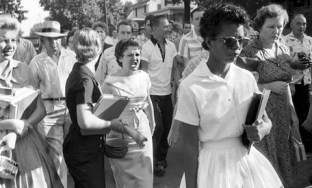
Photo by Will Counts of Elizabeth Eckford on way to Little Rock High School, September 4, 1957
I was reminded of my own adolescence, of my anger and soul-sick past efforts to denigrate or belittle others, that I fell into.  Thankfully this mostly occurred in my preadolescent years… so I recognized the fear laden, petty impulses I saw in those images.

And, mostly, I was reminded of the famous photo taken by my friend Will Counts depicting the angry mob following Elizabeth Eckford of the Little Rock Nine as she was on her way to school.  One of the persons shouting at her is Hazel Massery.  (Forty years later Hazel sought forgiveness and reconciliation with Elizabeth.)

Angry words are easily spoken, especially by the immature, but typically they result in false promises and dangerous threats.  To fulfill the promises made will require some compromises, apologies, new alliances with perceived enemies.  It is the threats that are more easily made and laced in bigotry that are real. Threats indicate an inability to think beyond binary categories of good and evil or us and them.

The scripture passages I read tell of the power of anger to destroy others — and in the process one’s own self.  The scriptures speak of a need for forgiveness (no matter whether one thinks it is needed).  The scriptures speak of a God who loves ALL and calls us to love others as we are loved.  You can swear on two, or ten, or one hundred Bibles but the real importance of the Bible is to know the stories and truths it contains… and to incorporate those into a person’s living and behaviors. 

Hand on the Bible, Mr. Trump is now caught in a web of his own making.  He will be expected by us all — including those who voted for him — to do more than merely shout insults from the sidelines.  Either/or views of the world won’t do much good when the complexities of modern life and governance confront.  Can a seventy year old grow up emotionally?  The world watches and hopes.


ReCentering Methodism: Open Letter to the Wesley “Covenant” Association

First — this apology to my non-United Methodist friends and readers.  We United Methodists are amid some “denominational challenges” just now.  I have written this letter as a way to encourage some of our more traditional and conservative leaders to answer five questions about their purposes and basic intentions.  You see, I fear this “new effort” known as the Wesleyan Covenant Association in North America is merely a building of a highway for schism among folks in our denomination divided by our views around homosexuality.  My prayer is that raising these questions may help identify some of the distortions often made by these, my friends, who claim to be more “Biblical, evangelical, and Wesleyan” than others of us.  Forgive this interlude in my blog entries — please check out the recent post on my  embarrassing moments as a pastor.  It is much more fun… and probably more enlightening.
 

+++++++++++++++++++++++++++

Dear Friends of the Wesley Covenant Association,
As I read the names of the founding sponsors of the Wesley Covenant Association, I know many of you — have known you for years.  You have been colleagues in our work as United Methodists.  You are committed pastors, known theological educators and activist organizers in the Confessing Movement and the Good News Movement in United Methodism.  Now you offer a new organization, a new association.  Hopefully your claim that the Wesley Covenant Association is a re-booting, a move toward re-discovery, a signal of readiness to traverse beyond the tread-worn battles of the past is true. 
I pray  you join me in the realization that the younger, rising generation of United Methodist seems rather disinterested in a rehearsal of the same old arguments, using the same labels and categories.  Our battles still may appear to be unresolved, but there is little doubt they are increasingly insignificant in the lives and faith of our grandchildren.  I would be helped if you could answer five questions.  They are ones asked before, at various times and places.  Not yet having received an answer I repeat them now – this time with a renewed sense of urgency as I fear the WCA may be simply a laying of the predicate for a schism in our denomination.
These questions of you are not rhetorical.  I sincerely would like to hear from you:
  • If “evangelical,” what is the “good news” you share? 
  • If “evangelical,” why so little attention to Christian experience, to personal conversion?  Why so little mention of the transforming love of Jesus Christ for persons and society?
  • If Wesleyan, why the silence about ministry with the poor?
  • If uniquely “Biblical Christian,” what is the basis of scriptural interpretation?  What is the hermeneutic employed?
  • If Wesleyan, what of John Wesley’s concern about schism and his clear guidance to learn from others who differ as expressed in “A Plain Account of Christian Perfection”?


Answers to these questions would help me know if I might be included in the “covenant” you seek to draw.  You see, I fear your appropriation of the word “covenant” is more of a way to exclude and narrow than it is a way to a hope-filled future.  It is a misdirection away from the more profound meaning of covenant that comes from scripture.  The covenant, I believe we share is much broader and more profoundly enduring than that which can be restricted by a few paragraphs in the ever-shifting-language of The United Methodist Book of Discipline.  Using the word “covenant” in this narrow way may be beneficial to an ecclesial political agenda.  It may serve to set folks like me outside of “the elect.”  I reject this use of covenant language in this way.  I will not be thus separated by your linguistic legerdemain.
It was after all, conservative theologian, Richard John Neuhaus, of blessed memory, who taught the essential difference between “contract” and “covenant.”  Our faith covenant binds us together by something deeper and more profound than contractual language can ever contain.
A contract is limited to the temporal, “quid pro quo” reality.  It is an effort to control and claim exclusive authority over things that are passing, temporal.  It seeks to hold us together, by our past rules, limited language and small understandings.  It is a way to count up grievances and deny our commonweal.  It suggests the interpretation of scripture is the exclusive possession of one party and only this view will be acceptable for all United Methodists.  A “contract” seeks to limit vision, thwart new expression, block new insights walling them in to past categories and perspectives.
Covenant is not contract.  Covenant is God’s gift for us ALL — something that draws us into the future, TOGETHER; it is the power of God’s Spirit at work in the world and it is beyond our ability to limit this.  Covenant continually ReCenters us in Christ.  Bonhoeffer wrote clearly of the church being centered in Christ where boundaries drawn by those who seek to limit the expansiveness of God’s activity in the world will not hold. 
Believing we all belong to Christ and this is our true covenant hope, I remain, your brother,
Philip Amerson

That Dumb Preacher and the Gift of Embarrassment

“That Dumb Preacher” and the Gift of Embarrassment

Fifty years ago this past summer I was provisionally ordained as a Methodist pastor.  Young and determined to change the world, I was “set aside” for ministry by Bishop Richard C. Raines in a pomp-filled ceremony in the Indiana University Auditorium.

th.jpg
I. U. Auditorium

I was ready to change the world — and I was so little aware of the way the world would change me.  Now there is time to look back, to reflect, to laugh and learn anew.

These past five decades as a clergy person have been filled joy and sadness.  All in all, it has been good ride, especially as I came to value the whimsy in life.  It has been good, in part, because of many moments of embarrassment.  Yes, I said embarrassment.   It keeps one humble.  One sees in these times both the stodgy excesses of organized religion and one’s own foolish efforts at vocational perfection.  Here is my top ten list — memories of times I played the role of “that dumb preacher.”

  1. One Saturday in June, presiding at the fourth wedding of the day, at the point of exchanging the vows, I heard myself say, “Will you Jennifer, take Mike, to be your husband.”  Even before I saw the confused and terrified look in the bride, Susan’s, eyes, I knew that she was not “Jennifer” and he was not a “Mike.”  And, I couldn’t remember their names.  I searched papers tucked in my Bible.  It took an eternity — probably 20 seconds before I could match the couple with their true identities.  I suspect that for years following, maybe even these decades later, Susan must have thought, “that poor, dumb preacher.”
  2. Rushing to complete my daily visits on another day, I decided to drop by the funeral home, speak words of condolence to members of my congregation who had lost a loved one.  I was not presiding at the funeral, but as pastor I wanted to support these folks.  I entered the visitation room, circulated, greeted several folks not recognizing anyone.  As I met the grieving widow and children it became clear that this was the wrong visitation — I was even at the wrong funeral home!  Turning to make a quick exit, the daughter asked, “How did you know my father?”  No words came for several seconds.  Then I muttered, “Oh, I knew of him.”  Blushing, I made my rapid exit.
  3. Oh, friends, this is an all too familiar experience for me.  More than once I have stopped by a hospital room to visit with a patient only to discover I was engaging the wrong person.  Often, in a shared room, I prayed with the roommate before learning he or she was not the person I had intended to visit.  I still smile thinking of the nice Jewish man who, after I had prayed, said he appreciated the prayer and knew his rabbi appreciated it too!
  4. Then, there are the multiple misadventures with cordless microphones.  On more than one occasion, I continued to “broadcast” when I should have turned the darn thing to “OFF.”  Let’s just say that needing some relief, I quickly slipped out of one service as a colleague was praying.  Moments later the congregation heard a great flushing sound.  These were not the rushing waters from Elijah.  These waters poured across the sound system drowning the prayer!
  5. Rarely was I more embarrassed than the time I received a call from a couple in a nearby state park who, with family and friends, waiting for me to officiate at their outdoor wedding.  We had visited earlier, done counseling together, and… yes, all was ready.  Except, I had the wrong date on my calendar!  Fortunately I was able to rush to the park (almost an hour away) in time to confirm what a non-ordained uncle had already done pronouncing them married.  I greeted everyone, heard the story of the improvised ceremony, asked the uncle to “say it again” and then confirmed it by shouting “yes, to what he said!”  I prayed a prayer, signed the wedding license and was the brunt of multiple jokes as we enjoyed slices of cake.
  6. We were celebrating the 70th wedding anniversary of a dear couple on a Sunday.  I broke my unwritten rule of never offering an open microphone to another.  This seemed safe enough.  Speaking to the couple in front of me I said, “It must be great to have 70 happy years together?”  The woman grabbed the mike and before I knew what was happening she said, “Well, actually, he ran around a lot on me during the first years of our marriage.”  The congregation roared with laughter.  Too late.  Nothing else would be remembered by any of us that Sunday.
  7. And, what could go wrong with wearing a new suit to worship?  Well… somehow the tailor didn’t tie off the knots along the leg seams.  As I greeted folks after the first service, I felt a breeze along my leg up to the crotch.  It was, so to speak, open territory.  What to do?  Fortunately we wore robes in the next two services.  Not many noticed my alabaster legs beneath the robe.  I wore a robe all the way home that day!
  8. I was a guest pastor, covering worship for a friend who served in a more liturgical tradition than my own.  On arrival, I was surprised to learn that I was not only to preach but also to preside at the eucharist — at all five services!  Let’s just say I wasn’t prepared.  At the first service, I realized too late I had consecrated an empty chalice.  More to the point at the end of the morning I learned that I didn’t need to empty the contents of the chalice after every worship service!  I don’t recall much of the sermon in service number five — I am certain it was brilliant, even if some words were slurred.
  9. Advice to young pastors — don’t attempt an infant baptism if your hands are already full.  As I recall there was a microphone, hymnal, the baptism certificate, a candle for the family, and… oh yes, the baby!  I thought it was all balanced and ready just as the baby’s pacifier fell out of her mouth.  Just above the baptismal font I reached to catch the pacifier.  The baby came down as well.  She was baptized on the wrong end!  The certificate, hymnal and microphone were also baptized that day.   I did catch the pacifier — after all, what is truly important?
  10. Sitting on the steps outside the door of our core-city congregation, I was waiting for a ride home.  Before I knew it three small children were beside me… then crawling over my lap and shoulders.  Snotty noses and grimy fingers were running through my hair.  The papers in folders on my lap were opened and explored.  I tried to engage the children, offering a pen to draw on my papers.  One little girl who had plopped beside me looked up and said, “You don’t know what to do with us, do you?”  Somewhere today that little girl, now an adult, must think back on “that dumb preacher.”
Wesley-United-Methodist-Church-Foundation-at-the-University-of-Illinois-360x676.jpg
Wesley UMC, University of Illinois

Much has changed over the past fifty years.  Mainline denominations, like my own, are regarded by many as more and more “sidelined” denominations.  We grow anxious, serious, more determined.  We focus on the latest organizational/leadership development programs designed to help us avoid decline.  Meanwhile we miss the larger movements of the Spirit that reach over decades.  We fail to see the basic demographics of our social settings and, mostly, we miss the joy and humanity all around, and within, us. 

Our institutions have much to be embarrassed about.  In fact, too often we seek to measure our value by the wrong metric.  Last winter I was fortunate enough to preach at one of the grand old churches of our denomination — Wesley UMC at the University of Illinois.  I had just attended an event where there was hand wringing about our need to be a global church and about worship attendance in the U.S. continuing to decline.  All of this is true.  Still, I couldn’t help but laugh out loud after the sermon in Champaign, Illinois, as dozens of international students came by to visit with me after that worship service.  I was aware that our global reach might be wider than our limited vision could see.  Too serious, too anxious, we should be embarrassed by our clumsy failures to hear the words, “you don’t know what to do with us, do you?”

I would not argue that we should not seek to be relevant.  I would, however, suggest a much lighter touch.  Some laughter might be good for the soul of the church — some acknowledgement of our embarrassing moments.  Maybe more humanity and a focus on awkward, surprising, relationships could help.   A little less certitude and a little more embarrassment is in order.  I have shared ten of my own embarrassing moments — there are dozens more I could offer.  This will do for now.  Enjoy… and consider what the little wiggly girl sitting on the church steps said.  I think she is right.   We just don’t know what to do with all the vibrant and bouncing protoplasm all around us.  I think we may miss our embarrassment of riches.

Five Queries on a Fine September Day

Five Queries on a Fine September Day

Autumn is in the air.  Just a touch in some places.   Still enough to know change is ahead.  So, change.  I awoke this morning with five questions about change on my mind.  As the leaves turn color and the fresh garden tomatoes dwindle, it seems right to wonder about the future. These are my provincial, idiosyncratic musings in mid-September.  Call these my “dancing with irony” questions.  Both autumn and anomaly are in the air.  So, here goes:

1.  Will it jinx the Chicago Cub’s chances for a world series victory, after waiting over a century, by talking about their great year with marvelous pitching and fine young players?  Woops, I may have just done it!

2. Should Simone Biles, the astonishing 19-year-old gymnast, be given an additional gold medal (or two or three more, and a lot more press coverage) for just being an extraordinary athlete and remarkable human being in a world where Ryan Lochte captures more headlines?

3.  Why are so many of the folks eager to protect the United Methodist Church from changing the Book of Discipline, the very same ones who take any mention of being United Methodists out of their congregation’s names and off their websites and church signage?

4.  Are the people who believe President Obama is a secret Muslim the same folks who believe Donald Trump is a practicing Christian?

5.  How is it that a recent CNN/ORC poll found 50% of respondents asserting that Donald Trump was “more honest and trustworthy” and only 35% thought Hillary Clinton was “more honest and trustworthy,” when careful analysis by PolitiFacts says that 53% of Trumps statements should be rated “false” or “pants on fire” and only 13% of Secretary Clinton’s statements should have this rating?

Might misogyny have something to do with it?   Forgive me, sorry, I promised only five questions. 

Surely things will improve tomorrow!

The Unexpected: Surprised by Joy

The Unexpected: Surprised by Joy

September 6, 2016

An unexpected gift came to my doorstep this week.  Unexpected.  And, actually, it wasn’t delivered to the mail box or, like an Amazon package, to my doorstep.  Rather it came when I was away from home; discovered while traveling in California.  Elaine and I were in Sacramento. 

54842954_s-2
The “Safe” — an empty pork and beans can

Early morning, out on my daily constitutional (the goal is to walk five miles a day), I was stepping along a stretch that looked promising.  It was a grassy and green stretch.  On one side was the I-5 interstate that runs the length of California.  Sounds of rushing traffic — good folks no doubt on their way to work in the city — perhaps in state government.  On the other side of the green way was a row of tall evergreen trees.  Beyond them an empty field.  The stretch, about four football fields long, ran between the Hilton and Marriott hotels.  No paths, little appearance of use, just the promise of a good place to walk alone, I thought.

About half way between the Hilton and Marriott, tucked away under the trees, sunlight streamed like a silver web on the grass.  It gyrated across my path.  The light beckoned me come.   I turned toward the trees and just a few steps away, hidden in underbrush, was a small encampment.  Clearly someone’s abode — plastic bags, a water jug and a couple of bedrolls — these were obvious.  Only the trees for cover.  I called, “hello,” then thought it foolish.  They likely wouldn’t welcome a visitor.  With no response, I looked more closely.  There were a couple of books including an old Bible and what, at first, appeared to be trash — four opened and empty tin cans.   Looking more closely, in a Pork and Beans empty “safe,” was a rosary and 47 cents.  Feeling guilty, embarrassed, about disturbing this hermitage, I quickly moved away.

Who lived here?  For how long?  Was this a “permanent” residence for a couple of homeless folks?  The irony of this camp between two upscale hotels did not escape me. I walked on pondering questions about our society and wondering about these residents on the edge of survival tucked away between the comfortable respite of travelers like me.   How had these homeless folks arrived at this situation?  Bad luck?  Addiction?  Mental illness?  How had our nation come to this point of ignoring the poor among us?  Our bad luck?  Our ideological addictions?  Our mental illness? 

A rosary and forty-seven cents – left in a pork and beans tin can.  Returning along the path, I couldn’t help it.  I returned.  Looking around carefully to make certain I would not intrude.  Still with no one “home,” I fished some cash from my wallet and added it to the modest stash in the pork and beans can. 

I left quickly, and then that first strand of light fell again across the path way.  I looked back to see an old broken mirror hinging from twine on a tree in the encampment that was reflecting the light.  I stopped and prayed, praying as earnestly as I have in years.  Yes, I prayed for these homeless folks.  Yes, I prayed for our nation and world.  More, I prayed for myself.  My intrusion into this purgatory (or was it a haven?), this place of meager shelter, hidden away in our brutal and too often numbing world was illuminating.  So many live on the edge.  It was a heartbreaking reminder of the work yet to do.  How many homeless in the U.S.?  Eleven million?  Or, as some say, thirty million? 

I was also aware that my intervention might not be of value.  Should I call a church or social workers?  NO!  Knowing all too well our systems of “helping,” I didn’t want to further endanger those who sought this place as sanctuary.  Even though I had left a little money behind, I was not a hero.  Nor were my motives heroic.  There is too much in our society that encourages us to believe that we are the heroes and others are the victims.  Our world is not as much of an either/or calculation as so many of our ideologies or theologies all too often communicate.

I wondered if this was a couple and if they had a child?  Might that child be undocumented?  Might that child be a refugee?  A refugee like that child Jesus so long ago?  Might it be a Joaquin, Jamal, Maria or Alice?

IMG_1645Returning to the hotel parking lot, there was another glimmer of light.   Down, and there on the asphalt, was a lost key.  My first thought was to carry it back to the camp.  Leave it there with the rosary in the can.  Then I realized the key might be for me.  I was to remember — that because God loved me so, I was to live in responsible ways, always remembering those tucked away, out of sight, living on the margins.  I was to live aware that because God loved those camped under the evergreen trees, I dare not stop speaking or working on the behalf of all.  Now — here is the real surprise for me.  In that moment there was JOY.  The joy of remembering my faith, of knowing my calling.  The JOY of having another key to my identity.  Lost and found — Joy.  Like an empty can, I had been provided so much by so many. I thought of those who had taught me so much — teachers, parents, friends, the homeless I had known over the years who “took me in.”  I checked with the hotel desk and no one reported losing a key, so I dropped it in my pocket as a reminder.

Yes, I was so privileged.  I had work to do.  In a world where our political candidates seem determined to forget the homeless, in a world where our refugees are a small fraction of the refugees all across the planet, there is work to do.

I recalled C. S. Lewis who wrote of these moments:  ” I call it Joy, which is here a technical term and must be sharply distinguished both from Happiness and Pleasure. Joy (in my sense) has indeed one characteristic, and one only, in common with them; the fact that anyone who has experienced it will want it again… I doubt whether anyone who has tasted it would ever, if both were in his power, exchange it for all the pleasures in the world. But then Joy is never in our power and Pleasure often is.”
C.S. Lewis, Surprised by Joy: The Shape of My Early Life

I brought the key home with me.