
Integrity & Jimmy Carter

Integrity & Jimmy Carter

Integrity and Jimmy Carter are synonymous. For one hundred years he offered his witness. There were ups and downs, missteps and the recognition of a Nobel prize. I see his life as a wonder-filled demonstration of human decency and generosity. A paradoxical mix of pride and humility, intelligence and determination, vision and myopia. This peanut farmer from Plains, Georgia offered a standard, a vision for a better way.

Friends disagree. Some call him naïve, too uncompromising, or too unwilling to make savvy political calls when necessary.  A ‘fluke,’ they say, ‘one who would never have been elected had not the nation become overburdened by the agony of wars in Southeast Asia and the deceptions of Nixon and Watergate.’ I disagree. Carter’s leadership emerges as an immeasurable gift for our nation and the world. Can we learn from, benefit from, the many positives of his life and perhaps, journey carefully around its pitfalls? 

I hold that President Carter, alongside countless others who have recently died, persons like my friends Ruth Duck, Jan Foster, Bill Pannell, John Cobb, and John McKnight, exemplified lives guided by an informed faith, a hunger for truth and a future established in hope rather than fear that our nation and world now desperately need. Their lives, along with millions of unknown or unnamed others, point toward the better path for humanity, a path taught in scripture.

Closing my eyes for a moment, I see Jimmy Carter standing before a Sunday School class at Maranatha Baptist Church in Plains, each Sunday. He had studied the lessons found in scripture, lessons that shaped his daily living and informed his efforts to lead. This image is in stark contrast to that of another president filled with guile, poising in front of a church building, sanctimoniously holding up a Bible as a prop, knowing little of the contents or gifts found in its pages.

One man, Carter, worked to build homes for the impoverished. The other, Trump, gained wealth by building hotels for the rich and casinos that served to impoverish the vulnerable. One worked to end the guinea worm disease and other illnesses in the world. The other used an epidemic to divide and undercut public health initiatives needed by a fearful nation. One worked to encourage care for our fragile earth, protecting more than 150 million acres of wild lands and rivers. The other continues to deny the reality of climate change and lives by the words “drill baby drill.” One was ridiculed as naïve for saying he had committed “adultery in his heart.” The other was convicted of sexual abuse and bragged of his sexual exploits.  One said, “I will not tell a lie.”  The other said, I will offer “alternate facts.” One spoke a hard truth about people torn apart by religion or culture, and scripted peace accords between nations. The other used culture wars to establish new enemy lines and employed exaggeration and falsehood about the immigrant, poor and vulnerable.

Sr. Joan Chittister writes: “At the end, three things measure both our integrity and the harmony of our own lives: self-control, respect, and freedom from self-deception.”  The true value of our living will ultimately surface like a submerged cork in the ocean.  Life comes and passes; nations rise and fall. I hold to the wisdom of scripture: “Whoever walks in integrity walks securely, but whoever takes crooked paths will be found out.” (Proverbs 10:9)
Fortnight – Day7: Curiosity

Fortnight – Day7: Curiosity

On this the seventh day of the fortnight prior to the 2020 presidential election in the United States, I recall the story Bob Greenleaf* enjoyed telling.  The first time I heard it we were sitting on his sun porch at a retirement community in Kennett Square, Pennsylvania.  It was the mid-1980s.  I have discovered he shared this anecdote in several places.

“There was an elderly couple who seldom ventured from their isolated home.  Although comfortable in their reclusive world, one day the man took a day trip into the city.  He returned carrying an old and battered cello with but one string.  The bow had only a few hairs.  That evening the fellow seated himself in a corner and began to saw away on the single open string.  He played only one note and that rather badly.  This went on day after day until one day his wife could stand it no longer and set out for the city to learn more about this object that had captivated her husband.

That evening, upon return, she confronted him. ‘See here, I have gone to the city and found other people playing instruments like yours.  It is called a cello.  Cellos are meant to have four strings and a bow with many strands.  What’s more, cello players move their fingers around playing many notes on each string.  And further, cellos often are played with other instruments, sometimes in small ensembles and sometimes in large orchestras.  Why do you sit here day after day playing that one raspy note?’

He gave his wife a cold look and replied, ‘I would expect that of you, a woman.  Those people you saw are still trying to find the right note, I have found it!'” 

Note the importance of curiosity and imagination; even more, there is the value of “seeing things whole” or “holistically.” There is benefit in other perspectives.  One can have more insight if listening to persons who have heard more notes played; they might have even heard a string quartet or an entire orchestra.  In selecting the one to sit in the White House during the next administration, will the American people select someone who can listen to and learn from others?

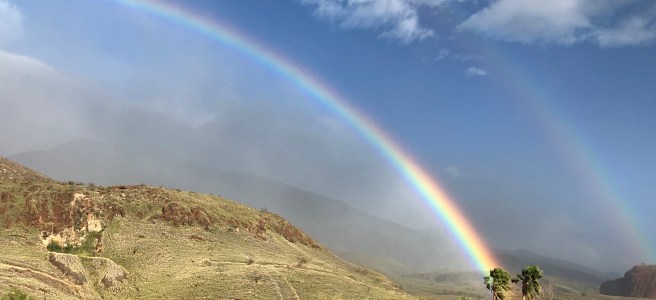
Curiosity in leadership will also lead to a valuing of paradox.  Paradox is the rather astonishing and beneficial awareness that in life and in institutions, two things, that appear to be opposites, can both be true at the same time.  There can be sunshine and rain together — and often this leads to a rainbow.

Robert K. GreenleafI still see Bob’s smile as he spoke of the mistake of institutions caught up in one narrow perspective or focus. Whether a corporation, church, or charity, the need for curiosity and seeing things in a wide frame was needed.
In politics, he spoke of the mistake of Prohibition in the 1920s and 30s.  Temperance was collapsed into abstinence. A broader conversation was needed about the cultural and economic realities that existed among impoverished folks during Prohibition.  More awareness of the medical realities surrounding addiction was needed. The irony, of course, is that many leaders then in the Women’s Christian Temperance Union (WCTU) understood this wider vision.  As part of their piety, they held progressive (even radical) views on economics, war, education and gender equality.  Today, these pious women would be dismissed as Socialists.  Their larger set of concerns were lost then, in an effort to do the impossible — legislate against the consumption of alcohol.  

Greenleaf suggested that one day, perhaps in the distant future, the mistake of using single issue, pressure politics to prohibit abortion would become evident.  (That day has not yet arrived.)

It was two decades later, Benedictine sister Joan Chittister observed, “I do not believe that just because you are opposed to abortion, that that makes you pro-life. In fact, I think in many cases, your morality is deeply lacking if all you want is a child born but not a child fed, a child educated, a child housed. And why would I think that you don’t? Because you don’t want any tax money to go there. That’s not pro-life. That’s pro-birth. We need a much broader conversation on what the morality of pro-life is.” (Interview with Bill Moyers, 2004)

++++++++++++

“When
I die
I’m sure
I will have a
Big Funeral.

Curiosity
seekers…
coming to see
if I
am really
Dead
or just
trying to make
Trouble.”

— Mari Evans

+++++++++++++

*Bob is known as the founder of the Servant Leadership movement.  For decades was an executive with American Telephone and Telegraph, involved in leadership development and research.  It was in his later years that he wrote on servant leadership and worked as a consultant with the Ford Foundation and the Lilly Endowment. 

Double rainbow, Maui, January 2020

Fortnight – Day6: Sabbath

Fortnight Day6: Sabbath

And we pray, not
for new earth or heaven, but to be
quiet in heart, and in eye,
clear. What we need is here.
(Wendell Berry)

If the presidential election, nine days hence, is to address the anxieties and despairing so many carry, it will require more than replacing one person with another. It will require more than changing the nameplates on office doors. It will require a transformation in us. It will require Sabbath. While many swamps may need to be drained, the primary swamp needing attention may be within the human heart.

Whatever the outcome of the vote, whether known in a few hours or several weeks, the temptation then will be to continue in the patterns and habits established out of anxiety, grievance and distrust. Sabbath will be required. Walter Brueggemann reminds: “Sabbath is the occasion to reimagine all of social life away from coercion and competition to compassionate solidarity.  Sabbath is not simply the pause that refreshes.  It is the pause that transforms.” (Brueggemann, Sabbath as Resistance, p. 44)

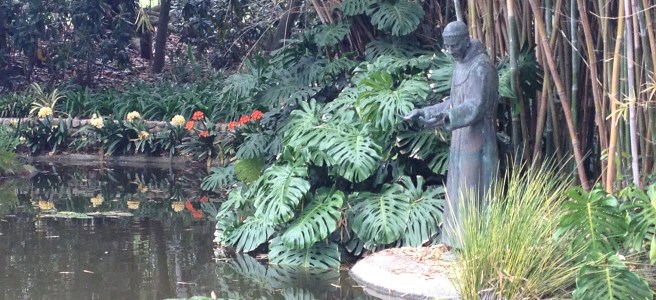
Lily Pond, The Huntington Gardens, 2015

I fear many things. I am anxious about much. Mostly, however, I desire to move from patterns of constant anxiety to another way of life. A way where I know the gifts of sabbath. The joy of rest, restoration, re-imagination and resistance. Joan Chittister wrote: “Sabbath is that period for holy leisure when I take time to look at life in fresh, new ways.” She encourages “contemplative leisure.”

Sabbath can serve as the great equalizer — it is a time when we are freed to set competition aside. As a great equalizer we are freed to recall that all share in creation; each other person is neighbor. Again Walter Brueggemann writes: The task is to SEVEN our lives. — On the Sabbath Day these vulnerable neighbors shall be like you.  Sabbath is not simply a pause, but the occasion to re-imagine all of society away from coercion and competition. (Sabbath as Resistance, p. 43)

++++++++++++++++

A Jewish Sabbath Prayer:  
Days pass, 
Years vanish,  
And we walk sightless among miracles.