Sickness Unto Death

Sickness Unto Death

Philip Amerson                                              May 1, 2025

Hope, when joined with mutual respect, becomes the oxygen supply for the lungs of a healthy democracy. In these troubled times, 19th Century Danish Philosopher Søren Kierkegaard offers perspective, a challenge, and a way beyond suffocating despair. In his classic “Sickness Unto Death,” this Christian theologian speaks of despair as a sin. Despair is, he suggests, a sin even worse than death. The reader is counseled to find the small pathways ahead, to persist, even when tempted to be captured in the clutches of fear and doubt – even when tempted to be held hostage to despair.  While anxiety may be unavoidable; Kierkegaard argues life calls us to continue forward, step by step, with whatever small light available.

Fear and disrespect are endemic in our nation. There is a tariff on HOPE. Many national and state officials are intent on destroying our “Commons” – the institutional trust established over the past two centuries. They act in ways to paralyze, to control, to tie us in contemporary knots of despair. Normality, civility, and decency are submerged in autocratic surges washing across our society.

This deluge is intended to overwhelm, to control, to undermine.  Such a “flooding the zone” strategy comes ceaselessly at us and from many tributaries: threats to the funding and governance of our universities: ending humanitarian aid to the poorest in our world; closing of scientific research necessary for public health; attacks on the judiciary and law firms; the deconstruction of a free and independent press; pressures on elected officials that leave one U.S. Senator saying “we are all afraid”; and, at base, there is the undoing of the personal constitutional rights for ordinary citizens and anxious refugees. These all coincide with what can be identified as practiced strategies from an autocratic playbook, one that has been tested and proven effective in other nations.

Alongside this national deluge of intolerance, the Indiana Legislature ended its recent session passing bills that can only be understood as a war on health care, on public education and on the poor. Indiana Senate Bill 289 was adopted as an “anti-DEI measure.” Touted as “bringing balance” to the teaching of history, civics and the social sciences, it instead is designed to censor, punish, place a chilling effect over public school districts or university curricula. It is a threat to any who dare depart from the ‘official truth’ presumed by those in power. It is an effort deny the tragic realities of racial, economic, religious, and sexual discrimination in our past and to end discussion of systemic economic disparities that continue.  Limits to funding Medicaid and public health resources will have devastating consequences on the poor in the state, delaying and denying needed care.

Persons without shelter in Indiana can now be placed in jail and/or face a $500 fine for “camping on the streets”! To add insult to injury, the final draft of the state’s budget contained a Trojan Horse, with the insertion, without public input, calling for “productivity reviews” of university faculty. It also included dramatically altered board governance structures for Indiana University giving the governor power to select all the university board members.

Apart from such legislation, other efforts to upend the truth and distort reality are astonishing. Indiana Lieutenant Governor, Micah Beckwith, posted a recent video celebrating what he misleadingly calls a “great compromise” made at the 1787 Constitutional Convention. Beckwith asserts the decision to count persons held as slaves as 3/5ths human (as property) was “a great move forward that led to the abolishment of slavery.” He turns history on its head, ignores the resulting decades of abuse, lynchings, and systemic discrimination. He quite literally whitewashes the dehumanization of slavery, the segregation that followed with Jim Crowe laws, mortgage redlining and the enduring systemic discrimination. Beckwith attempts to tell us that “what is up is down and what is true is false.” He ignores the tragic reality of more than a million men killed or severely wounded in the bloody U. S. Civil War and undercuts the Thirteenth, Fourteenth and Fifteenth Amendments to the constitution passed to assure the rights for all and designed to undergird equality. 

A good friend recently said, “For the first time in my adult life, I am embarrassed to be a Hoosier and related to Indiana University.”  Referring to the deluge of discriminatory initiatives taken by the governor and state legislature, he was also noting, with sadness, a compliant university administration, that has over and again failed to support academic freedom or stand against the bigotry of supercharged bullies. My friend spoke his sadness over the growing and blatant displays of racism and intolerance. Even so, despite such recent efforts, my friend said he was not giving up or dropping out.

Yes, these are unsettling times. The drift – make that the flood – toward intolerance, deception, and fascism is upon us.  We dare not hide or take cover in some false cocoon of isolation, thinking we can somehow choose to avoid the sin of despair.

During the recent Little 500 Weekend in Bloomington horrible, racist posts were placed on social media. They spoke of “the smell of welfare” and “turning Bloomington’s Kirkwood Avenue into Atlanta.”  There was more racist language, much worse than this, designed to encourage bigotry and foster white nationalism. These days such social media posts are likely generated by bots, foreign and domestic. They are designed to inflame passions and make false claims about marginalized others and are intentionally framed to spread fear and do harm.

Those of us who have the privileges accompanying “safe” racial identities, or our education, or other accidents of history dare not give in to despair.  As Dr. Martin Luther King Jr. put it “We are caught in an inescapable network of mutuality, tied in a single garment of destiny.” King was not simply suggesting all our histories and futures are connected and interdependent; he is also saying the struggles for civil rights for everyone must not end.  There continues to be work that needs to be done and injustices to be addressed.

Kirkegaard’s insights 175 years ago still ring true: despair that immobilizes is worse than death. Anxiety is a human given, but despair is a sin. Eleanor Roosevelt proposed “No one can make you feel inferior without your consent.” Social scientists W. I. and Dorothy Thomas offered that “What we perceive to be real becomes real in its consequences.”  How then shall we act?

Kirkegaard’s “Instead of Death” is based on the story of Lazarus as told in the eleventh chapter of the Gospel of John. On hearing the news of Lazarus’ passing, Jesus responds, “This sickness will not end in death.” Those captured in despair, will miss the potential for life. We have the power to choose how we react to horrible news, to deadly external influences.  Despair is a loss of perspective, a loss of agency, of self-worth.  It is a loss of hope.

What now are our choices?  What then can we do?  We begin by repudiating the climate of fear.  We can act and not be washed away in the fascist flood.  We can make a difference. 

Here are three areas to explore:

  1. When you see something, say something. An African American friend tells of being disrespected while shopping. In checking out, a clerk used clearly disrespectful and demeaning language. To my friend’s surprise, another customer, nearby, overhearing the exchange, gently but firmly in a quiet and clear voice said, “We are all better than this.”  Later, in the parking lot, the surprising voice offered support and friendship. We can welcome difference.  Maybe it is as simple as responding to a frown with a smile. A phone call, a visit that may help another. We can thank others for what they do. Ask how you might help. Encourage a teacher, a coach, a nurse, a therapist. Express appreciation to those who serve as police officers, fire fighters, local government officials.  Support public radio and television now are under attack.
  2. Reach out, make a new friend, and/or make a difference somewhere. Loneliness and fear are often the source of distrust and misunderstanding. This is a time to find ways to support the good work of programs like Exodus Immigration Refugee, NAACP, the Human Rights Commission. Host a dinner or picnic where persons from diverse backgrounds are welcomed and introduced. Perhaps make a new friend and together support our public schools in new ways, perhaps as a tutor or in support of a teacher. In Bloomington there are ways to support the healthcare for those with few resources through groups like HealthNet or by offering gratitude to our After-Hours Ambassadors working with the Community and Family Resource Department. We can write the university president asking why her administration does not better respond to attacks on academic freedom or to racist tweets that damage the sense of wellbeing among our students and other residents.  Ask the president why the university doesn’t join in efforts provide more for low-income housing, while it is the university driving up enrollments contributes to housing shortage and expense? Ask your banker, pastor, corporate leader how they might contribute to a more diverse racially community?  For some of us, who have the opportunity and occasion, we need to encourage broad representation from marginalized populations on boards and as candidates for leadership positions.
  3. Do one thing daily to challenge bigotry and discrimination.  Yes, I am going to say it – call or write your congressional or state representative challenging them to act against the flood of disinformation and intimidation. This is basic.  Write a letter to the editor.  Some days it may be as simple as being a friend to someone you know or a stranger you meet.

No need to be a crusader – some have that calling.  Others of us can do just one thing a day. Every day we can chose action and not fall into the sin of despair.

Integrity & Jimmy Carter

Integrity & Jimmy Carter

Integrity and Jimmy Carter are synonymous. For one hundred years he offered his witness. There were ups and downs, missteps and the recognition of a Nobel prize. I see his life as a wonder-filled demonstration of human decency and generosity. A paradoxical mix of pride and humility, intelligence and determination, vision and myopia. This peanut farmer from Plains, Georgia offered a standard, a vision for a better way.

Friends disagree. Some call him naïve, too uncompromising, or too unwilling to make savvy political calls when necessary.  A ‘fluke,’ they say, ‘one who would never have been elected had not the nation become overburdened by the agony of wars in Southeast Asia and the deceptions of Nixon and Watergate.’ I disagree. Carter’s leadership emerges as an immeasurable gift for our nation and the world. Can we learn from, benefit from, the many positives of his life and perhaps, journey carefully around its pitfalls? 

I hold that President Carter, alongside countless others who have recently died, persons like my friends Ruth Duck, Jan Foster, Bill Pannell, John Cobb, and John McKnight, exemplified lives guided by an informed faith, a hunger for truth and a future established in hope rather than fear that our nation and world now desperately need. Their lives, along with millions of unknown or unnamed others, point toward the better path for humanity, a path taught in scripture.

Closing my eyes for a moment, I see Jimmy Carter standing before a Sunday School class at Maranatha Baptist Church in Plains, each Sunday. He had studied the lessons found in scripture, lessons that shaped his daily living and informed his efforts to lead. This image is in stark contrast to that of another president filled with guile, poising in front of a church building, sanctimoniously holding up a Bible as a prop, knowing little of the contents or gifts found in its pages.

One man, Carter, worked to build homes for the impoverished. The other, Trump, gained wealth by building hotels for the rich and casinos that served to impoverish the vulnerable. One worked to end the guinea worm disease and other illnesses in the world. The other used an epidemic to divide and undercut public health initiatives needed by a fearful nation. One worked to encourage care for our fragile earth, protecting more than 150 million acres of wild lands and rivers. The other continues to deny the reality of climate change and lives by the words “drill baby drill.” One was ridiculed as naïve for saying he had committed “adultery in his heart.” The other was convicted of sexual abuse and bragged of his sexual exploits.  One said, “I will not tell a lie.”  The other said, I will offer “alternate facts.” One spoke a hard truth about people torn apart by religion or culture, and scripted peace accords between nations. The other used culture wars to establish new enemy lines and employed exaggeration and falsehood about the immigrant, poor and vulnerable.

Sr. Joan Chittister writes: “At the end, three things measure both our integrity and the harmony of our own lives: self-control, respect, and freedom from self-deception.”  The true value of our living will ultimately surface like a submerged cork in the ocean.  Life comes and passes; nations rise and fall. I hold to the wisdom of scripture: “Whoever walks in integrity walks securely, but whoever takes crooked paths will be found out.” (Proverbs 10:9)

Woke Smoke

Woke Smoke

I work up this morning, birds chirping outside.  Good thing.  It “beats the options” as they say.  Sorting through “news” of the day, I read a strange, recurring theme – one word repeated in many places.  The word?  WOKE.  It has been used in disparaging ways for a few years. In government, education, religion, and more there are warnings of the dangers of “woke-ness.”

Dozens of arguments in recent months seem to begin and end with stressing the dangers of being “woke.”  Nothing much more.  Just a label, a four-letter word that carries a dumptruck load of fear and grievance.   Here are a few examples from this past week:

  • Bill Barr, former U.S. Attorney General, warns of “wokeness” as a reason he would support the former president, that grievance-filled ghost of an administration-past. Mr. Barr earlier called him “a grotesque embarrassment” but one idea had tipped the scales, had caused him to reverse.  It was a concern about being W-O-K-E!
  • After 92% of the Indiana University faculty voted “no confidence” in President Pamela Whitten, sadly, the response from many was the claim this was ALL about “woke-ism in the academy.”
  • Well documented and tragic reports of the destruction coral reefs around the globe are presented.  Sure enough, there it is – responses calling it “woke science.”
  • Pope Francis is viewed favorably by 3/4ths of American Catholics, even so, there are disgruntled ones, some bishops and cardinals, who call him the “woke pope.” 
  • The newly formed “Global Methodists” are issuing warnings that upcoming United Methodist General Conference will be overrun by persons with “woke theologies.”

There is, of course, a history of how this word has evolved in use.  For some it is a verb, as in the past tense of “wake.”  Here it means to be alert, aware, attentive.  A decade or more ago scholars began to employ it as an adjective common in African-American vernacular speech, as in an awareness of racial discrimination and prejudice. This was the threat – and the opportunity – presented to many who didn’t want to be awakened to the racism in our society.

The word was repurposed, turned inside out and upside down.  It became a quick way to avoid dealing with the realities of discrimination in our society.  It is a way to flood the zone with smoke – to hide and obscure the need for conversion.  It gained currency as a powerful “code word” allowing the user to avoid thought or conversation.  It avoids the hopes for a civil society.  Rather than being alert to a new day, experience or danger, it is turned into a verbal cudgel.  It becomes an imprecise way to avoid facing our nation’s history and bigotry.  An avoidance mechanism.  Our nation’s original sin of racism is dodged by using a single word.  Nice trick – avoid and redirect the word as a weapon.

Critiquing something as “woke” is lazy.  It is a way to obscure, suppress, and avoid any call to rethink the old assumptions and categories. It demonstrates that change is always resisted; it is difficult. What’s the old saw?  Only a baby with a wet diaper is comfortable with change. 

For a fine reflection on a Biblical way of understanding the importance of “woke” as a spiritual activity, look to Dr. William Lawrence’s, “When the Church Woke.”  Bill, former dean of the Perkins School of Theology, points to the Biblical call for wokeness – it is about conversion, metanoia, deep personal and social change. 

https://www.umnews.org/en/news/methodism-overdue-for-becoming-woke-author-says

Glad I woke up this morning.  I am reminded of Lamentations 3:22-23, “The steadfast love of the Lord never ceases, his mercies never come to an end; they are new every morning; great is your faithfulness.” 

As with many things, one can choose the lazy path of chirping out the fearful words, “woke, woke” and avoid an honest, healthy way forward.  Instead, one can let the smoke clear and choose to be woke in “hope, hope” shaped by active care for others and for the healthy and honest ways forward.

Shall we Overcomb?

Shall we Overcomb?

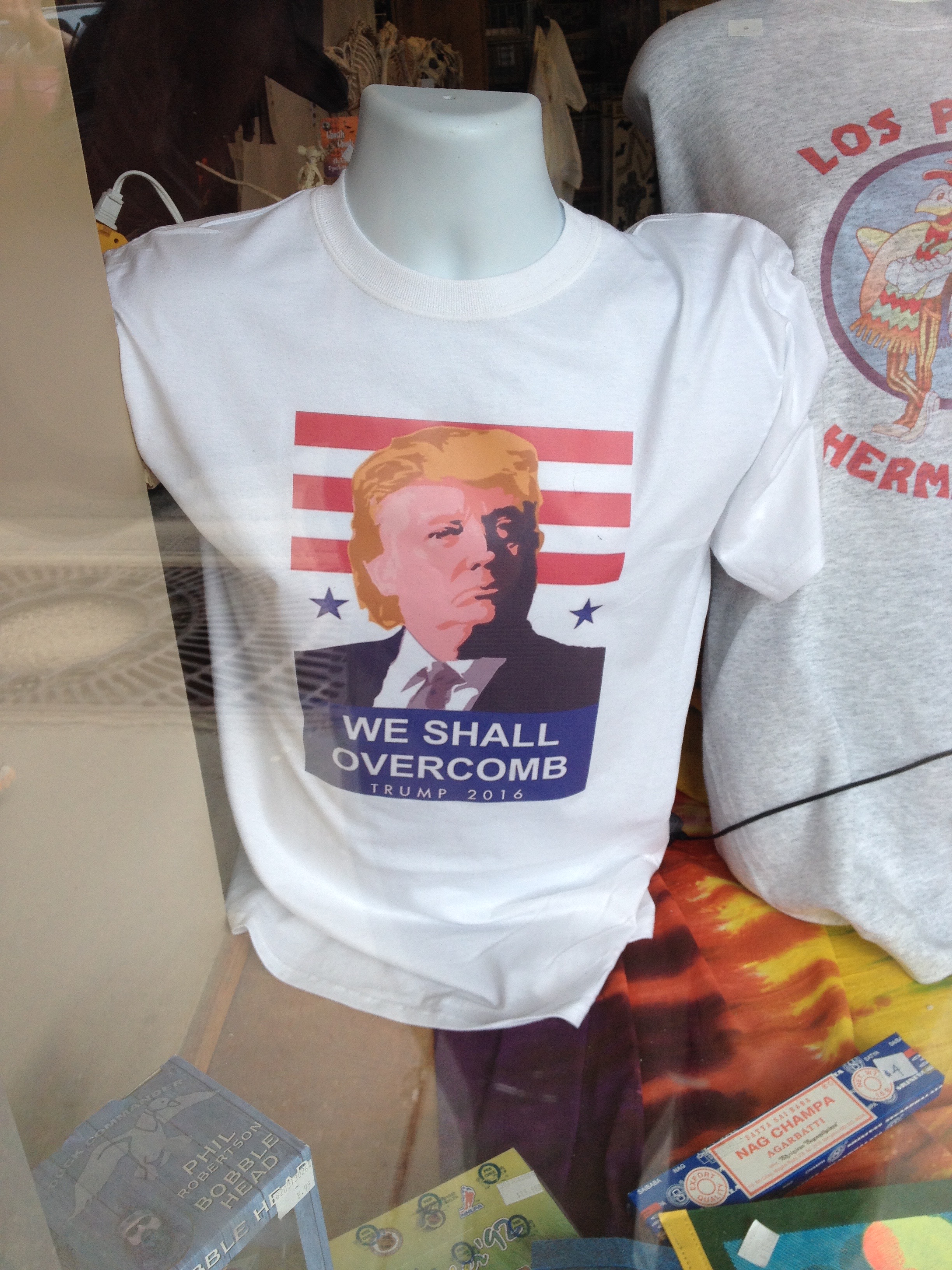
It was mid-September 2016.  Elaine and I were traveling in the Canadian Rockies; part of our 50th years of marriage celebration.  Walking in the lovely city of Banff, Alberta I spied a t-shirt in the tourist shop window. We laughed. I pointed it out to others who were on the trip.  I shared my concerns about Donald Trump. 

Two in our group were retired attorneys now living on Long Island. One was volunteering as a Catholic lay deacon who shared my concerns about “the Donald’s” mean-spiritedness, misogynistic behaviors, and racial bigotry.  The other attorney laughed saying, “I worked in the prosecutor’s office in NYC for years. Everyone knew he liked to pretend to be something he was not. We all knew Trump was ‘mobbed up’ with the Russian mob.”  “Don’t worry,” he said, “a guy like that will never be elected.”  “Okay,” I thought, “if you say so.  You have seen him up close.”

That was then.  He was wrong about Mr. Trump’s possible election.  Ever since, I have recalled the “mobbed up” comment.  As president, Mr. Trump spoke fondly of Mr. Putin and his dictatorship in Russia. There were other troublesome moments like a phone call that appeared to be asking for a bribe from the Ukrainian president.  In the intervening years as Mr. Trumps actions have become more bizarre. Now, he says the quiet part out loud about admiring dictators and hoping to be a totalitarian leader of the U.S.  I keep thinking about that conversation in front of the shoppe window in Banff.

This past week (2/2024) at a rally in South Carolina, Trump, railed against NATO countries suggesting they didn’t pay enough in dues.  He claimed, “one of the presidents of a big country asked whether the US would still defend that European country if they were invaded by Russia.”  Astonishingly, Trump replied “No, I would not protect you. In fact, I would encourage them (Russia) to do whatever the hell they want. You got to pay. You got to pay your bills.”

The words “mobbed up” keep recurring, ever gaining more salience for me.  I didn’t buy the t-shirt on that September day in 2016.  I buy that he was unelectable.  I was wrong.  Our nation keeps living though what seems to be an unending nightmare.  A nightmare that could endanger the future of our democracy and the freedoms of my grandchildren and the hope for freedom for children around the world.

There is much beauty in our world — in nature and in our flawed but essential institutions of democracy. Will truth and liberty and civility be easily combed over? Don’t fall into the trap I did — believing that IT CAN’T HAPPEN.

2-2-2-2uesday

2-2-2-2uesday

Today is a Twos-Day. This, the twenty-second (22) day, of the second (2) month, of the year twenty-twenty-two (2022), has me considering the things that might be “twinned” together. What are two places, two events, or two persons that share something in common.

Briefly then, I write of two persons who come to mind on this day of 2s. I join author John Green in not being a fan of heroizing individuals; even so, I risk it here. The belief that there is some hero in a white hat who will come along and save the day, is a deeply inculcated myth in our culture. It does much damage. One the one hand, some folks chose to wait for the hero to appear, not stepping forward to join others in seeking to address some injustice of shared dilemma. On the other hand some think they are called to act as hero and come up with “the great fix” that will solve whatever problem they perceive to be at hand. One doesn’t have to live long in low-wealth communities to see the damage done by the continuing cycle of “heros” who appear and believe they are going to fixt things, all the while ignoring the gifts of the persons or neighborhoods they were scheming to FIX.

Even so, on this day of twinning, there are some difference-makers who come to mind. They show up in our world to point us to noblier paths. On a day when tyrants, like Vladimir Putin, act as bullies on the international stage, there are other options. On a day when one can, in hindsight, see through the thinly veiled efforts of our former U.S. president to take us out of NATO, and undermine the democratically elected government of the Ukraine, I want to hold up two other persons. If Putin and Trump can be seen as twinned — at least in their preference for autocratic governance, there are two men who have shown a different path forward: Paul Farmer and Jim Wallis.

The news came yesterday that Paul Farmer had died. I only met Farmer once and briefly. Still his life, his writings, and his witness standout. He would not accept that healthcare should limited to only the wealty or privileged neighborhoods in our nation or world. He did his work encouraging the resources at hand — whether with the people by establishing neighborhood health worker corps or building clinics and hospitals using the natural resources and gifts of the communities where they were built. Read more about Paul Famer here: https://www.washingtonpost.com/opinions/2022/02/21/how-paul-farmer-saved-millions-of-lives/.

Farmer was clear and persistent. His calling was to act along with others, to make a difference, to give access to health care FOR ALL. A friend tells of a time Paul Farmer was asked to meet with executives of a large pharmaceutical company in the Midwest. In his presentation, he said he could make a difference in a nation in Africa if a donation of $3 million in specific medicines could be made available. At the close of this talk, the executives quickly huddled, then came back saying the best the company could do was $1 million of these medicines. Dr. Farmer responded that, then, he wouldn’t be able to accept their donation because it wasn’t sufficient to the challenge the people were facing. As he stood to leave, the executives asked for a moment to discuss the matter further. Upon their return to the room, they assured Paul Farmer he would receive ALL the medical supplies he requested. Clarity and Persistence. We grieve Paul Farmer’s early death and celebrate the gifts he shared.

The second man that comes to mind is Jim Wallis. Jim is still very much alive and I give thanks for this. My friendship with Jim has been a long one, beginning back in San Francisco in 1974 when we were both called Young Evangelicals. I was teaching in an urban studies progam and invited Jim to come speak at a conference on the role Christians might play to address discrimination and poverty in our cities. As the editor of a new magazine, The Post American, later to become Sojourners Magazine, Jim was one of several persons who were emerging as important Christian witnesses. Jim would be the first to say he is not a hero; and my years of friendship would confirm his assessment. Like every person I know, he has his blemishes. Still, I suspect, that when a list of the saints of our generation is written, his name will be on that list (or at least he will be in a place of honorable-mention!).

Currently, I give thanks that Jim Wallis’ voice and experience in making it clear that voting rignts for all in the U.S. today is a moral issue: https://www.washingtonpost.com/religion/2022/02/18/sojourners-jim-wallis-voting-rights-religious-left/. As Wallis puts it, “For me it’s the first book of the Bible. We were all made in God’s image and likeness. Voter suppression on the basis of skin color is a throwing away of Imago Dei.” Jim has spent more than fifty years giving witness to the ways the Gospel calls us to live beyond the prejudices and discrimination still so prevelant. Clarity and Persistence.

These two men are connected by Clarity and Persistance: 1) they believe every human being is made in the image of God; 2) No matter the evil patterns and powers and persons who seek to exclude and dominate, God’s way of love for all is the preferred way for humanity. Paul and Jim have demonstrated THE BETTER WAY on this Twos-Day.

Dr. King, Congressman Lewis and Other Creative Extremists

Dr. King, Congressman Lewis & Other Creative Extremists

I was up in the air on the 2017 Martin Luther King Jr. holiday. Flying somewhere over Iowa, between Clinton and Waterloo, our flight pattern took us over the Skunk River.  For some reason then my thoughts turned to the presidential inauguration this week.

What might Dr. King say about our nation’s current dilemma in leadership?  Only a few days ago Congressman John Lewis indicated he would not be attending the presidential inauguration of Donal Trump and said he considered the election of the president-elect to be illegitimate.  

What might Dr. King say?  Would he agree with Mr. Lewis?  No one can know for certain — however, let me respond as one who was around when Dr. King was active. If anything, Dr. King might say that John Lewis was too timid — that he should have said more about resisting the impending disregard for fair elections, truth and transparency on the part of anyone who would seek to serve as president.  

I remember well Dr. King’s courage.  I remember that at the time of his death most white folks in the United States thought he was too radical and disagreed with him.  I remember his commitment to the poor, the immigrant, the disenfranchised.  I remember his care for the U.S. Constitution and the need to stand against those who would seek to distort justice.  Dr. King, like Mr. Lewis today, was considered by many well-intentioned persons to be an extremist for justice.  

Writing from the Birmingham Jail in April 1963, Dr. King responds to eight clergymen who indicated that the activities in the struggle for civil rights in Birmingham were “unwise and untimely.”  Does this sound familiar?  Aren’t we hearing the same thing about Congressman Lewis’ comments.

Here is a passage from Dr. King’s letter to the clergy in Birmingham in 1963:

So the question is not whether we will be extremists, but what kind of extremists we will be. Will we be extremists for hate or for love? Will we be extremists for the preservation of injustice or for the extension of justice? In that dramatic scene on Calvary’s hill three men were crucified. We must never forget that all three were crucified for the same crime—the crime of extremism. Two were extremists for immorality, and thus fell below their environment. The other, Jesus Christ, was an extremist for love, truth and goodness, and thereby rose above his environment. Perhaps the South, the nation and the world are in dire need of creative extremists. [From “Letter from Birmingham Jail, April 16, 1963]

Prior to re-reading the text of Dr. King’s famous Letter From the Birmingham Jail while flying 32,000 feet in the air, my tendency was to think that perhaps Congressman Lewis had overstated — gone too far.  However, I now think Congressman Lewis’ statement was right, and was that of a courageous extremist.

For what might Mr. Lewis be called “an extremist?”  For asking us to “love the neighbor?”  For asking that our elections be fair and voter suppression to end?  For thinking foreign governments shouldn’t meddle in our democracy, nor be invited to do so by any candidate?  What about Donald Trump, where is he an extremist?  

Always before in my adult life, when I disagreed with the incoming president, I made the distinction between the person and the office.   However, what does it mean that most Americans today seem to respect the office of the presidency MORE than the man who was about to take the oath of office?  What does it mean that patterns of lies and deceptions have become normative?  What does it mean that this person will not be transparent with tax returns, seeks to find a dodge around potential conflicts of interest, challenges the intelligence experts of this nation, denies climate change, seeks to make alliances with known totalitarian practitioners and sees them as preferable to President Obama?

Reading an article by Ned Resnikoff in ThinkProgress (11/27/17) there was research that helped confirm my doubts and Congressmen Lewis’ concerns (see Ned Resnikoff, ThinkProgress, 11/27/16).  What we are facing is a constitutional crisis.  One that Dr. King would have recognized.  Resnikoff speaks of the coming administration’s style as “managed democracy.”  It is a perspective hostile to open, egalitarian standards of governance.  It is the preferred way suggested by Steve Bannon, now White House Chief Strategist, who famously said, “Darkness is good.  Dick Cheney, Darth Vader, Satan.  That’s power.”  Bannon hates a government based on compromise and consensus.  Borrowing from Putin’s crony Valdimir Serkoff, it is an approach that seeks to destabilize, distort, encourage contradictions and lies — always pointing to another as the true enemy or liar.

What happens when no news is to be trusted and all news is called “fake.”  What happens when press conferences turn into diversionary attacks on others or the media?  What happens when judges are accused of bias if you disagree?

The strategy is not new to our electoral process.  Karl Rove was a master at inversion or diversion whereby one’s own candidate’s weakness is projected on to the opponent preemptively.   Okay, that is politics, and as they say “it ain’t beanbag!”  

However, what is underway now, in our current experience, is so much more pernicious and dangerous.  It has been called inverted totalitarianism: All news media are said to be fake, so trust your prejudices over facts.  Who can know the truth? There are so many distortions and points of view… Or, all politicians are crooks and liars, our guy is so much more entertaining!  He is, so to speak, “a crook, but our crook.”  Reality television comes to Washington and truth is fractioned out of our institutions.  Schools, courts, churches, scientists, the press — all civic institutions are not to be trusted. 

When there is no truth to be trusted and when the people doubt their own moral compass with so many competing and confusing points of view — then those who can continue to distort and create confusion in a post-factual world, they can claim the power to keep their machinery going to their benefit.  It is no wonder that Mr. Trump admires Mr. Putin so fully.

I believe Mr. Lewis spoke and continues to speak a courageous word.  It is a word that is uncomfortable to hear.  John Lewis still has a strong moral compass.  He is still a creative extremist.  I stand with Congressman Lewis.

Our “Peak Crazy” Social Psyche

Our Peak Crazy Social Psyche

img_1847
Maligne Lake, Jasper National Park, Alberta Canada

Peak Crazy

Today’s New York Times (September 28, 2016) asks if our national psyche has reached a “peak craziness” with regard to our penchant for accepting conspiracy theories.  “Peak Craziness” was a new concept for me.  A search shows that it is not a widely used idea; however, I find it a helpful one.  It suggests a reaching of a distorted, foolish summit or high point in human experience and discourse.

Upon reading the NY Times commentary it was clear that while conspiracy theories aren’t a new phenomenon in our society, the changes in the way we receive our news and the power of social media, give a credence to conspiracy theories that is dense in saliency and reach.  Our “news” comes at us fast and furiously and these theories become an ordering mechanism for the hurried, anxious or fearful.

One couldn’t help but chuckle on Tuesday morning when Donald Trump complained that his microphone had malfunctioned during his recent debate with Hillary Clinton.  Trump went on to say that “he didn’t want to believe in conspiracy theories” and wondered why he had microphone problems and Mrs. Clinton did not.  It is no surprise, I guess, that the candidate who has been the most active in bringing our nation to a peak craziness around conspiracy theories would suggest that any failure on his part is the result of some conspiracy.   Truth is, that both Mr. Trump and Secretary Clinton have painted pictures of “vast conspiracies” as part of their election narrative. 

While I give more credence to Ms. Clinton’s concerns — whether about the crazed conjecturing about Benghazi, White Water, missing emails, etc. — it seems that she gives too much attention to some vast plot or “hidden hand” that determines present and future circumstance.  Of course, Mr. Trump’s conspiracy theories are more pernicious — filled with racism and xenophobia.  In fact, the record is clear, Trump’s “birther” conspiracy comments, freighted with bigoted attempts to undermine Barack Obama’s legitimacy as president, was a major factor in his staying in public consciousness.  We will no doubt hear of other “conspiracies” as Mr. Trump plays a kind of ideological bumper cars with the truth and our national psyche.

malignelakespiritisland
Spirit Island: Maligne Lake, Jasper National Park

Thinking about the idea of Peak Craziness reminds me of our recent visit to Maligne Lake in Jasper National Park.  Mary Schaffer is said to be the first person of European ancestry to “discover” Maligne Lake.  Using a map provided by Samson Beaver, a First Nations chief of the Stoney People, Mary Schaffer’s small party found this nonpareil site.  The glory of the lake and the surrounding peaks filled them with wonder.  An artist, Mary Schaffer, spoke of this as a place beyond ever fully capturing by words or brush.  Depending on where one stands there are peaks and glaciers in every direction surrounding the lake. 

Near the glacier-fed headwaters is Spirit Island.  The island is a sacred ground for the First Nations people who spoke of this as the temple of the gods.

One wonders if the humanly constructed “peaks of craziness” in our national psyche are blocking our view,  preventing us from seeing the genuine peaks of wonder all around.  Perhaps we need to spend more time on our own Spirit Islands to to see the true beauty of this election season.  There they are, towering beyond all our conspiracy theories, the peaks of shared humanity, the remarkable wonder of democracy — even when messy — and the towering responsibility of citizenship.

Let’s live as a Spirit island people, who work and vote in a world as free of conspiracy peaks as possible.


Five Queries on a Fine September Day

Five Queries on a Fine September Day

Autumn is in the air.  Just a touch in some places.   Still enough to know change is ahead.  So, change.  I awoke this morning with five questions about change on my mind.  As the leaves turn color and the fresh garden tomatoes dwindle, it seems right to wonder about the future. These are my provincial, idiosyncratic musings in mid-September.  Call these my “dancing with irony” questions.  Both autumn and anomaly are in the air.  So, here goes:

1.  Will it jinx the Chicago Cub’s chances for a world series victory, after waiting over a century, by talking about their great year with marvelous pitching and fine young players?  Woops, I may have just done it!

2. Should Simone Biles, the astonishing 19-year-old gymnast, be given an additional gold medal (or two or three more, and a lot more press coverage) for just being an extraordinary athlete and remarkable human being in a world where Ryan Lochte captures more headlines?

3.  Why are so many of the folks eager to protect the United Methodist Church from changing the Book of Discipline, the very same ones who take any mention of being United Methodists out of their congregation’s names and off their websites and church signage?

4.  Are the people who believe President Obama is a secret Muslim the same folks who believe Donald Trump is a practicing Christian?

5.  How is it that a recent CNN/ORC poll found 50% of respondents asserting that Donald Trump was “more honest and trustworthy” and only 35% thought Hillary Clinton was “more honest and trustworthy,” when careful analysis by PolitiFacts says that 53% of Trumps statements should be rated “false” or “pants on fire” and only 13% of Secretary Clinton’s statements should have this rating?

Might misogyny have something to do with it?   Forgive me, sorry, I promised only five questions. 

Surely things will improve tomorrow!

Mentors of Hope

Mentors of Hope

Visits with my best friends typically include the question, “what are you reading?”  Sometimes I am embarrassed and tongue-tied because I don’t want to admit that I can’t even remember the name of the author or the title of the book in that moment.  I know it is a good book and can even tell you the color of the cover or quote several passages from it.  But the name of the author? — Ah, the joys of being 70 keep coming!  Still, I am grateful for this question and for these friends as they are asking a deeper question, more fundamental question.  It is “who is teaching you these days?”

Good reader, who are your teachers?  This is not asking you who were your teachers? Rather what is informing you today?  No doubt lessons from the past are critical to shaping who we are.  I do remember elementary school teachers like Ms. Kerns, Ms. Schindler, Ms. Williams, Mr. Glass all offered lessons that still shape my living.  Occasionally I hear echoes of Ms. Schindler, third grade teacher saying “Philip, you are too good not to be better!”  What an enduring word — her legacy on my life.

Lessons from today are even more essential — essential to shaping who we will become.  Who teaches us now?  In a time when ignorance and falsehood is the trademark of one Donald Trump, the question “what are your reading?” is critical.  If you find Mrs. Clinton’s candidacy troubling, “what are you reading?”  What gives you perspective beyond the same ole talking heads on television?

So, here are a few folks who are shaping my thoughts today for the future:

  1. Sara Wenger Shenk is president of Anabaptist Mennonite Biblical Seminary.  In her blog “Practicing Restoration” Sara recently wrote of Beauty in the Borderlands (Wenger Shenk, Practicing Restoration).  Very nice — and full of wisdom like the importance of “caring for the institution you are trying to heal.”
  2. President Wenger Shenk mentions Gregory Wolfe’s Beauty Will Save the World and I am reminded of another wonderful teacher for these times.  I have only started the book but find it so compelling, I can even remember the name of the author!
  3. Then there is the work Connected by Nicholas Christakis and James H. Fowler that points to the power of our networks of friends and their friends who touch our lives in ways that shape our worlds for benefit or disease.
  4. I would mention the daily meditation pieces from Richard Rohr, at the Center for Action and Contemplation – see Richard Rohr meditations.  He has recently challenged my tendency to think too often in binary ways and reminded again of the powerful benefit of paradox for us if we are to find more hope-filled ways forward.
  5. Lastly, I would mention Malcolm Gladwell’s podcast Revisionist History at Revisionist History podcast.  He has just completed the first ten podcasts for this summer season.  They are richly rewarding and will make you think!

In a period of history when the temptation is to watch my favorite news channel (Fox or MSNBC or CNN or…. you name it) our communities and our body politic deserve our efforts to think more clearly and not find ourselves trapped in our limited cul de sacs of narrow analysis.  Read on good folks — think more broadly.  Our world deserves the best we can know, even if we can’t always remember the name of the author or the title of the work.  Where do you find hope?  Who mentors you in that direction?

It is all too easy to focus on some issue of discontent.  Okay, I hear your complaints.  What I want to know is where do you find hope — where do you see folks coming together?

I write trusting that in some small way I can act as a mentor of hope today.  I will have my issues of disagreement with others, of course.  I challenge you to join me to read more widely, think more broadly, our world needs you to do so.

Filet


Lessons from the House on Park Street

Lessons from the “Soon to Be” House on Park Street

logoHabitat

Some of you have asked about the house I am building this summer.  Well, not me exactly… but the house I am helping our local Habitat affiliate build as a way to celebrate my 70th year.  This, of course, is not “my house” or “my build.”  Soon, some deserving neighbor will call it home — after putting in hundreds of hours of “sweat equity,” they too will have the joy of a home with a manageable mortgage!  Still, I am grateful for those of you who have made a gift so that this work could go forward this summer.  Thank you!

IMG_1464

IT IS GOING WELL!  So much is happening so quickly.  The construction manager Keith Hite is a marvelous teacher.  (Keith teaches building trades at New Prairie High School.)  And thanks to groups like the folks from Alcoa Howmet Corporation in La Porte, the decking was in place and so much more was ready for those of us who were volunteering.  As a result, we are further along than we anticipated at this point.  We are ready for the dozens of volunteers coming over the next several weeks.  (Yes, you can come and help — just contact us at: LaPorte County Habitat website.)

It will surprise no one who has ever been a “Habitat Build” that there is always a great deal of laughter and lessons to be learned.  My great joy was to work with Bill, Jim, Sharon, Carter, Mike and Suzie.  Dozens more will help this summer.  It was Bill who offered me two lessons on my first day as a volunteer.

IMG_1461Lesson #1:  As we were beginning to put together the frames for windows in the walls, Bill looked over and asked “Did you pay for the whole hammer or just part of it?”  I immediately started to laugh because I knew the old joke.  I knew that it would be a good day.  My teacher had arrived.  “Hold the hammer lower and let it swing,” Bill said.  “Use it like you own the whole thing!”  That got us started talking and laughing.  Bill was a marvel to watch and joy with whom to work.

I discovered that Bill had been a volunteer on over TWO HUNDRED HABITAT FOR HUMANITY BUILDS!  He knew both Millard Fuller, the founder of Habitat for Humanity, and Clarence Jordan, Fuller’s co-conspirator at Koinonia Farm in Georgia.  As it turned out I had known both Millard and Clarence as well, and so the morning was filled with stories of how they taught that the gospel should be viewed as a radical document — especially when it comes to how we live our every day lives. We spoke of the “theology of the hammer,” and how Christian action spoke louder than all our words.

Bill told me of his church in Michigan.  He said Millard Fuller had challenged them to build ten houses in one of the early Habitat builds in Africa.  The churches in town were asked to stretch, dream big, and raise $15,000 so that ten (10) houses could be built in Africa.  It took a few months Bill said, but before long they did better than ten houses “We gave Habitat a check for $150,000 so that one hundred (100) houses might be built,” Bill said!  Yes, the gospel should challenge us to think radically and big about our resources and how we use them.

IMG_1468Lesson #2: As lunch time approached and we were expressing gratitude for the volunteers who were by this time raising the front wall together, Bill looked at me and said, “You know, there is only one time I have seen any volunteer asked to leave a build site.”  “When?” I asked.  He said, “there was once a fellow who when asked to clean up a small mistake in a wall being built responded with the words ‘Why? this will be good enough for the type folks who will be living in this house.'”  Bill said it didn’t take long for the construction manager to tell the fella to gather up his tools and not to return.

As to the fuller meaning of Lesson #2, I couldn’t help but consider the comparison with a leading political candidate who engages in racist statements, refuses to apologize and is still “on the scene” as a leader.  Why doesn’t Donald Trump’s political party have the courage to say, “Leave and don’t return until you are able to apologize.”   The morning paper today carries the powerful statement by Thomas Friedman entitled “Dump the G.O.P. for a Grand New Party.” (See: Thomas Friedman, June 8, 2016, NYTimes).  Here it is, the “Party of Lincoln” saying, “Well, yes, Trump is a racist but we will support him anyway.”  Amazing.  I want to ask, “Are you going to use all of the courage and moral legacy you claim or just a small part of it?”

Thanks to Bill — for his life given to gospel realities.  For me, these will always be treasured as my “Lessons from the ‘Soon to Be’ House on Park Street.”  Let’s keep Building!