Holding it Together: Being and Doing

Holding It Together: Being and Doing

Knowing of my friend’s health concerns, I asked “how are you doing?”  “I’m barely holding it together,” he responded. “It’s not the aches and pains; I’m not sleeping. I carry a dread for the future.” His insomnia was a fretting over our national trajectory and the deceits that appear to be a “new normal.” I understood. Divisive and demeaning language, dehumanizing others, greed and grifting, scapegoating, talk of retaliation and efforts to upend democratic institutions.  Mostly, my friend’s concerns were the loss of our nation’s moral center.

Women’s Park, Chicago: Jane Addams “Helping Hands” memorial.

“Barely holding it together” – honest, sharp-edged reality. Like the patient waiting to hear that dreaded diagnosis, or the father learning of an active shooter at his child’s school, or the undocumented mother who, after years working in a menial job and proudly sending her children off to college, who now fears deportations. After the 2024 election we live at the edges of hope and dread.

My first U.S. Presidential vote was in 1968. Fifteen elections later, my politics have changed, but not my trust in our future. That is, until now. Has our nation changed?  Will we hold it together?  Did the fear-saturated-campaign of 2024 and promises made with fascist overtones indicate a shift in our body politic?  Has racism, greed, misogyny and xenophobia reshaped our national identity or simply uncovered what was there?  Haven’t these dynamics always played a role? Of course, bigotry has been “background noise” but now, blatant discrimination and retribution are “baked-in” as a publicly endorsed strategy.

Is the seeking of truth sublimated to seeking revenge? Do computer algorithms prevent robust honest, dialogue among citizens?  Are “news” feeds turned into a diet of “ideologically-preprocessed-information-meals.”  Basic civic creeds that “all persons are created as equal,” or “the separation of church and state,” or “equal justice under the law” appear to be devalued, seen as outmoded and divorced from ethical political and civic practice.  As grievance becomes the coin of the realm, an inflation of conspiracy theories, dictatorial impulses, and a sense of helplessness emerges. Can we hold it together?

Pro Democracy Banner, Barcelona, 2019

We are heading into choppy national waters, bouncing along without a shared vision of common-wealth or personal responsibility. The Ship of State as conceived of by Jefferson, Hamilton, Adams and Madison, refined by Lincoln or Susan B Anthony and the wisdom of many more recent leaders is threatened. Our nation may founder on dangerous shoals of division, greed, and authoritarianism.  In his 1960 inaugural address John F. Kennedy challenged, “Ask not what your country can do for you but rather what can you do for your country.” 

My friend, the Rev. David G. Owen, now deceased, spoke of the importance of living a seamless life, where our actions (personal and social) are aligned with our core beliefs. These need to be “held together.”  How shall we live more fully, as if our nation’s creeds and our religious beliefs are reflected in our daily actions? 

Recently, prior to a meeting, a friend advised, “It is best if we leave Jesus in the parking lot.”  Perhaps he feared that as a clergy person I would divert our attention from the stated agenda.  I had heard this “leaving Jesus in the parking lot” talk before. I might have said, “O Jesus is already in that board room, don’t worry” but, instead, I was quiet.

“Holding it together” requires moral, judicial and behavioral consistency – being and doing.  This is not a call to Christian Nationalism, NO!  It is quite the opposite. It is a call to a patriotism linked to virtues taught across the centuries, religious and non-religious. It is a turning away from the threats and abuses commonly practiced by mob bosses toward treating each neighbor as we would choose to be treated. It is a move toward a seamless patriotism and away from the tyrannical. When the allegiances we pledge are not matched by our actions or by facts, trust is impossible, and a civic brokenness inevitable.  Historian Tim Snyder writes in “On Tyranny”: “A nationalist encourages us to be our worst, and then tells us that we are the best… A patriot has universal values, standards by which he judges his nation, always wishing it well—and wishing that it would do better.”

Philip Amerson, November 27, 2024

Shall we Overcomb?

Shall we Overcomb?

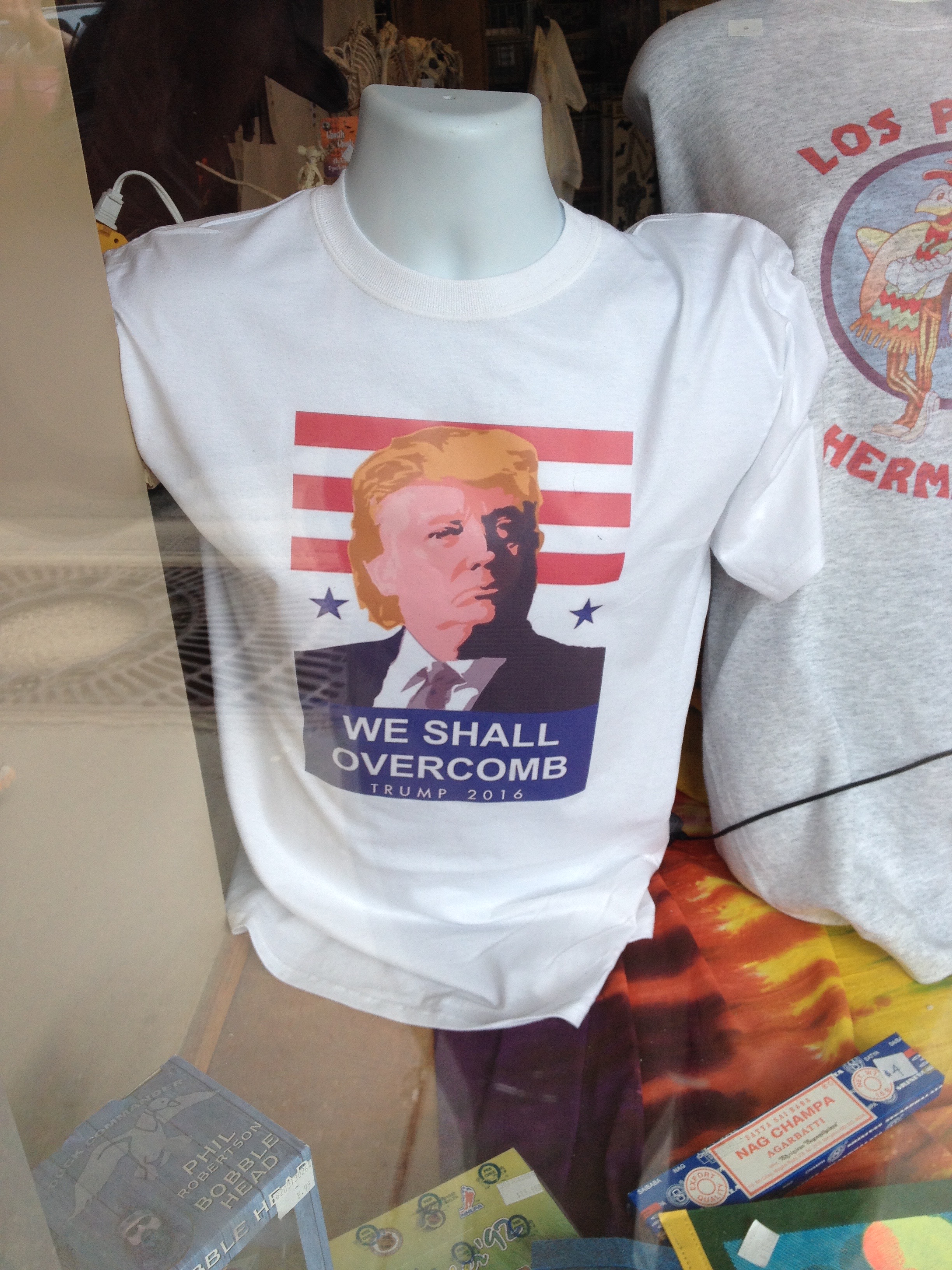
It was mid-September 2016.  Elaine and I were traveling in the Canadian Rockies; part of our 50th years of marriage celebration.  Walking in the lovely city of Banff, Alberta I spied a t-shirt in the tourist shop window. We laughed. I pointed it out to others who were on the trip.  I shared my concerns about Donald Trump. 

Two in our group were retired attorneys now living on Long Island. One was volunteering as a Catholic lay deacon who shared my concerns about “the Donald’s” mean-spiritedness, misogynistic behaviors, and racial bigotry.  The other attorney laughed saying, “I worked in the prosecutor’s office in NYC for years. Everyone knew he liked to pretend to be something he was not. We all knew Trump was ‘mobbed up’ with the Russian mob.”  “Don’t worry,” he said, “a guy like that will never be elected.”  “Okay,” I thought, “if you say so.  You have seen him up close.”

That was then.  He was wrong about Mr. Trump’s possible election.  Ever since, I have recalled the “mobbed up” comment.  As president, Mr. Trump spoke fondly of Mr. Putin and his dictatorship in Russia. There were other troublesome moments like a phone call that appeared to be asking for a bribe from the Ukrainian president.  In the intervening years as Mr. Trumps actions have become more bizarre. Now, he says the quiet part out loud about admiring dictators and hoping to be a totalitarian leader of the U.S.  I keep thinking about that conversation in front of the shoppe window in Banff.

This past week (2/2024) at a rally in South Carolina, Trump, railed against NATO countries suggesting they didn’t pay enough in dues.  He claimed, “one of the presidents of a big country asked whether the US would still defend that European country if they were invaded by Russia.”  Astonishingly, Trump replied “No, I would not protect you. In fact, I would encourage them (Russia) to do whatever the hell they want. You got to pay. You got to pay your bills.”

The words “mobbed up” keep recurring, ever gaining more salience for me.  I didn’t buy the t-shirt on that September day in 2016.  I buy that he was unelectable.  I was wrong.  Our nation keeps living though what seems to be an unending nightmare.  A nightmare that could endanger the future of our democracy and the freedoms of my grandchildren and the hope for freedom for children around the world.

There is much beauty in our world — in nature and in our flawed but essential institutions of democracy. Will truth and liberty and civility be easily combed over? Don’t fall into the trap I did — believing that IT CAN’T HAPPEN.

A Necessity of Democracy: Listening

Listening: This morning, having coffee with a friend, we reflected on the challenges faced by institutions in our nation just now. In government, education and religion — just to name three — old patterns of participation or civic engagement seem threatened. The former taken-for-granted connective tissues are frayed or seem to have disappeared. My friend reminded me of the comment made by television host Larry King who said, “I never learned anything while I was talking.”

It occurred to me then that I had done a lot of talking already on this morning — not to mention all the talking I had done over these seventy-five years. It is the occupational hazard of being a preacher, I guess. I remembered the time I preached a sermon during Holy Week on “Silence” that lasted for 25 minutes! However, I am not alone. Too much talking and too little listening is a national malady. Much of the talk these days seems to be done in “ideological bubbles of agreement” which are dangerous to our body politic.

Years ago I mused about the importance of parking lot conversations after church or meetings of the city council or school board. I don’t romanticize these, I have seen angry disagreements unfold among the pickup trucks and hybrid cars. On occasion, I have even seen small physical altercations — nothing serious, but troubling none-the-less. I guess this is better than such incidents occurring in the sanctuary or city council chambers. Mostly, parking lot conversations I have witnessed have been done in good humor — like the teasing between Indiana University and Purdue University supporters. Okay, that’s not a good illustration, but you know what I mean. What’s the old saw, “Can we disagree without being disagreeable?”

Our ability to listen, even when we disagree, is perhaps more important than our ability to speak — although the freedom of speech and legal protest is also essential. My point is that we seem to have lost an appreciation for all three; and more specifically, when we don’t listen our words and actions often miss the mark necessary for true communication. I recall with both sadness and a chuckle the denominational gathering of United Methodist clergy for what is referred to as a “clergy session” when a microphone was requested so that a concern could be expressed. The bishop and other leaders seemed surprised, nonplussed really, they had not planned on needing to listen to anyone in the gathering. Only a generation prior, in such gatherings it was normal to have dialogue and disagreements expressed at such gatherings. Something was lost over a period of a little more than a decade. That something was “listening.” Listening so that participation and faith in the institution might be stronger.

My spouse and I have participated on many boards, nonprofit and otherwise, over the years. We have noticed that in such meetings, there has been a loss in understanding some basic elements of healthy listening and decision making. While Roberts Rule of Order is not the only way, or perhaps the best way, fair-minded decision making can occur, it is often the case that today many meetings of boards occur without the basics of an agenda, knowledge of how to make a motion or call for a vote. Sadly, we are out of practice at the local level whether in civic board meetings, the church or in politics.

In our nation and world, listening seems undervalued, even ridiculed. Witness the criticism of President Biden for his willingness to take time to listen and try for a bipartisan approach to certain challenges we face. I admit, it has seemed like a fool’s errand, even naive, to think that Mitch McConnell who has made his reputation on blocking any and all things that he can’t control. I don’t deny that the filibuster in the Senate, as it is currently practiced, is harmful and I do think that, after listening, it is time for some tough votes to support voting rights or infrastructure improvements. The listening has been done and action needs to come… but it is important that listening was done!

So, two basic suggestions: 1) pick up the phone and call that person with whom you disagree and listen. Perhaps there is too much of a divide just now. Perhaps, if appropriate, you might still say something like “I appreciate you.” 2) Next meeting you attend where decisions are made, listen to see how you can in small ways improve the democratic process. It might be as simple as saying, “Could take a moment to set out an agenda, maybe set one now or plan on it next meeting?”

Retooling our listening abilities are a necessity if our democracy is to survive in any and all of our institutions, large and small.