The Ugliest Four Letter Word

The Ugliest of All the Four Letter Words?

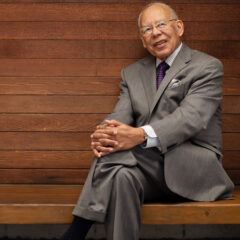
News came of the death of my dear friend Bill Pannell, evangelist, retired professor at Fuller Seminary. Our nation and the church have lost a great leader, a remarkable person. His clarity, his witness, helped hundreds-of-thousands of Christians follow the path of Jesus of Nazareth.

So many memories: I last spoke with Bill in the spring. We recalled a worship service at Goshen College Mennonite Church several years ago. Bill preached. The sermon was on “the ugliest four-letter word of them all. ” That word? “THEM.” Turning others into an enemy — separating one another from God’s purposes. “THEM.” This, Bill preached, was the ugliest of all words in the English language.

Bill offered another way, the Jesus way. He spoke of a nonviolent welcoming of the stranger. He called for an inviting all to our tables of conversation and care. Bill was not naive. He knew deeply and personally the pain of exclusion and bigotry. Even so, he understood that hate, revenge and retribution were only a road to human tragedy. Turning others into “them” contridictied the core of the Christian message.

His books “My Friend the Enemy” and “The Coming Race Wars” call for a discipleship that includes ALL. Today, Jemar Tisby carries on much of Bill’s witness.

Forgive me this prideful note, but I still remember that as Bill stood to preach in Goshen College Church that Sunday, he looked out and said, “Phil, is that you?” I was stunned. There were several hundred others there. It had been several years since we had last spoken. I nodded “yes.” He then said, “How good to fellowship with one another!” Neither of us were Mennonites; although we loved their faithful witness. I didn’t know Bill was going to be the preacher that morning. Elaine and I went to hear the glorious harmonies of Mennonite hymn singing. Bill, understood and expresed a note of the gift of the Anabaptist witness — “How good it is to be in fellowship with all.”

Today, I give thanks for the witness of William Pannell — Our nation needs his wisdom and faithful word today, perhaps more than ever. Jim Wallis captures this in his recent article about our mutural friend, Bill Pannell:

https://religionnews.com/2024/10/18/the-gospel-according-to-bill-pannell/?utm_source=RNS+Updates&utm_campaign=e19d65e382-EMAIL_CAMPAIGN_2024_10_20_06_10&utm_medium=email&utm_term=0_c5356cb657-e19d65e382-%5BLIST_EMAIL_ID%5D

UnFlagging Jesus

UnFLAGging Jesus

I once was joined for lunch by two friends. One was head of a theological school. Our conversation was amicable enough. Although the seminary president took up much of our visit promoting a wide array of initiatives focused on leadership. Future pastors, chaplains, counselors and social service providers were being trained to be leaders! It appeared an effort to impress the other friend at the table — John McKnight. 

John is one of the founders of the Asset Based Community Development approach to community organizing, (often abbreviated as ABCD).  A primary assumption of ABCD is that good leaders start by listening to others and discovering gifts, passions, assumptions and assets. After lunch as we were saying our “good-byes,” John took the hand of the seminary president and kindly offered, “Maybe we should focus a little more on connector-ship and a little less on leadership.” 

Connector-ship! That’s a missing ingredient in so much of human exchange. Universities, businesses, denominations and governments spend tens of millions of dollars and valuable personnel time training for leadership. This is not without merit and benefit. Still if one begins with a belief that energy and initiatives all flow from a top-down direction, a needed element for change is missing. Too often, there is the assumption that if the leader just has the right idea, program, language, skill set or practices, success will inevitably follow. McKnight, understands and teaches that human connection is a critical initial step in developing effective institutions and civil communities.

Don’t start identifying the needs of others you plan to fix without listening. First, listen to find the gifts, the capacities, the assets that folks already possess. Secondly, find that inner moral compass that must continually be developed throughout life by study, seeking fact-based reality, and interacting responsibly with others. This is a more enduring pathway forward.  

I know a remarkable corporate leader who upon arriving at a troubled firm, went to folks on the picket line, the hourly workers, not just upper management and he listened. A follower of Jesus, he continued in prayer, study and worship. Leadership meant connector-ship, listening, learning and finding a moral compass. Shortly thereafter, he gathered the employees in the parking lot. Taking a copy of the company’s unfair policies and procedures manual, he dropped it into the flames of a barrel used those standing in the cold. It was not a concession; it was a modeling of connection. Hard work followed.  He was saying, “We are listening, let’s talk.”

Recently I wrote a piece titled “Jesus Wrapped in a Flag.” Today’s Christian Nationalism promotes a fraudulent version of Christianity, and profoundly flawed revision of American History.  Lovett Weems offered a set of counter recommendations titled Leading Amidst Christian Nationalism.  While helpful, these are overly cautious words and appeared to assume there is only one paradigm for congregational life. It is a soft version of the very American Civil Religion that the author critiques. It is more of a starting point than a guide.

I thought of all the congregations and courageous religious leaders who are doing much more. They listen and share the hard truths discovered in their study and prayers about our responsibilities as Christians. They offer a more robust response to the profound dangers and misinformation widely dispensed by White Christian Nationalism and American Catholic Integralism.

The American church, Protestant and Catholic, needs to remove the American Flag from the shoulders of Jesus. It doesn’t belong there; never has. If U.S. policies and practices aren’t held under the judgement of the Gospel, why be a Christian at all?  Why not just pledge primary allegiance to anything our nation does and forget Jesus?  Just diminish our discipleship. 

Some U.S. “leaders” have done just that. Congresswoman Laureen Boebert said, “Jesus didn’t have enough AR-15 rifles to keep the government from killing him.”  What? Jesus is remolded into a grievance filled, revenge seeking and bully. What does the congresswoman do with the Sermon on the Mount, the words, “Love your enemies” or in the Garden of Gethsemane, “Nevertheless, thy will be done”?  The paradox, of course, as Reinhold Niebuhr argued, while international ethics are messy, they begin with morality in human expression.

The witness of Jesus of Nazareth, Jesus the Christ, isn’t limited to the foolish, mean-spirited and ill-informed theologies of some in congress these days. Jesus of scripture says “Come to me, all you who are weary and carrying heavy burdens, and I will give you rest.  Take my yoke upon you, and learn from me, for I am gentle and humble in heart, and you will find rest for your souls.[iv]” 

The witness of Jesus is UnFlagging!  It is persistent – enduring. It calls leaders to leave their C-Suite offices and learn from the folks in the parking lot.  It calls on congregations to speak with and learn from folks not in the pews on Sunday.

In the mid-1980s my family lived in a low-wealth neighborhood in Evansville, Indiana. One fall, fear gripped neighbors as vicious rapes were reported. The assailant was said to be African American in our multiracial community. Soon we learned the Ku Klux Klan was sending patrols to protect our white citizens, especially the women.  What should our small core-city ministry do? How might we offer a safe alternative to this violation and the hate-based response?

Someone suggested we talk with Will Campbell. Mississippi born, Baptist minister, graduate of Yale Divinity School, author, and Civil Rights advocate, Will was known for friendships with a wide range of people, including members of the Ku Klux Klan. Will took this dwelling together stuff seriously!

I called and left phone messages for Will. It took a few days, and he returned my call. Hearing of our situation, he said, “First thing you need to say to the Klan is “no, your activities are not welcome.'” That sounded good to me — We had already done that. Then, Will, stumped me, surprised me. He asked, “What are their names?” 

NAMES?  “What do you mean?” I responded, “Whose names? Our neighbors?”  “No.” Will said, thinking I would already know the Klansmen. Their names.  I confessed that I didn’t know any of those folks.  He said, “Well, then, what the hell you been doing?  Who are they?”  Interesting, our need to limit where repentance, reconciliation and renewal might occur. Perhaps some changes, some weaving of new relationships could happen in my own life, not only in the lives of Klan members. Might there be a bridging to new relationship, even there? A renewal larger than my imagining?

South African Methodist Bishop Peter Story noted that “America’s preachers have a task more difficult, perhaps, than those faced byus under apartheid. We had obvious evils to engage; you [on the other hand] have to unwrap your culture from years of red, white and blue myth, You have to expose and confront the great disconnect between the kindness, compassion and caring of most Americans and the ruthless way American power is experienced, directly and indirectly, by the poor of the earth. You have to help people see how they have let their institutions do their sinning for them.


@font-face
{font-family:”Cambria Math”;
panose-1:2 4 5 3 5 4 6 3 2 4;
mso-font-charset:0;
mso-generic-font-family:roman;
mso-font-pitch:variable;
mso-font-signature:-536870145 1107305727 0 0 415 0;}@font-face
{font-family:Aptos;
panose-1:2 11 0 4 2 2 2 2 2 4;
mso-font-charset:0;
mso-generic-font-family:swiss;
mso-font-pitch:variable;
mso-font-signature:536871559 3 0 0 415 0;}p.MsoNormal, li.MsoNormal, div.MsoNormal
{mso-style-unhide:no;
mso-style-qformat:yes;
mso-style-parent:””;
margin-top:0in;
margin-right:0in;
margin-bottom:0in;
margin-left:.5in;
mso-pagination:widow-orphan;
font-size:12.0pt;
font-family:”Aptos”,sans-serif;
mso-ascii-font-family:Aptos;
mso-ascii-theme-font:minor-latin;
mso-fareast-font-family:Aptos;
mso-fareast-theme-font:minor-latin;
mso-hansi-font-family:Aptos;
mso-hansi-theme-font:minor-latin;
mso-bidi-font-family:”Times New Roman”;
mso-bidi-theme-font:minor-bidi;
mso-font-kerning:1.0pt;
mso-ligatures:standardcontextual;}.MsoChpDefault
{mso-style-type:export-only;
mso-default-props:yes;
mso-ascii-font-family:Aptos;
mso-ascii-theme-font:minor-latin;
mso-fareast-font-family:Aptos;
mso-fareast-theme-font:minor-latin;
mso-hansi-font-family:Aptos;
mso-hansi-theme-font:minor-latin;
mso-bidi-font-family:”Times New Roman”;
mso-bidi-theme-font:minor-bidi;}div.WordSection1
{page:WordSection1;}


[i] Weems, Lovett H. Jr. Leading Amidst Christian Nationalism, LEADING IDEAS, Lewis Center for Church Leadership, June 25, 2024).

[ii] Matthew 5:43-48.

[iii] Luke 22:42

[iv] Matthew 11:28-30.

[v] Storey, Peter, Sojourners Magazine, Oct. 18, 2006.

Woke Smoke

Woke Smoke

I work up this morning, birds chirping outside.  Good thing.  It “beats the options” as they say.  Sorting through “news” of the day, I read a strange, recurring theme – one word repeated in many places.  The word?  WOKE.  It has been used in disparaging ways for a few years. In government, education, religion, and more there are warnings of the dangers of “woke-ness.”

Dozens of arguments in recent months seem to begin and end with stressing the dangers of being “woke.”  Nothing much more.  Just a label, a four-letter word that carries a dumptruck load of fear and grievance.   Here are a few examples from this past week:

  • Bill Barr, former U.S. Attorney General, warns of “wokeness” as a reason he would support the former president, that grievance-filled ghost of an administration-past. Mr. Barr earlier called him “a grotesque embarrassment” but one idea had tipped the scales, had caused him to reverse.  It was a concern about being W-O-K-E!
  • After 92% of the Indiana University faculty voted “no confidence” in President Pamela Whitten, sadly, the response from many was the claim this was ALL about “woke-ism in the academy.”
  • Well documented and tragic reports of the destruction coral reefs around the globe are presented.  Sure enough, there it is – responses calling it “woke science.”
  • Pope Francis is viewed favorably by 3/4ths of American Catholics, even so, there are disgruntled ones, some bishops and cardinals, who call him the “woke pope.” 
  • The newly formed “Global Methodists” are issuing warnings that upcoming United Methodist General Conference will be overrun by persons with “woke theologies.”

There is, of course, a history of how this word has evolved in use.  For some it is a verb, as in the past tense of “wake.”  Here it means to be alert, aware, attentive.  A decade or more ago scholars began to employ it as an adjective common in African-American vernacular speech, as in an awareness of racial discrimination and prejudice. This was the threat – and the opportunity – presented to many who didn’t want to be awakened to the racism in our society.

The word was repurposed, turned inside out and upside down.  It became a quick way to avoid dealing with the realities of discrimination in our society.  It is a way to flood the zone with smoke – to hide and obscure the need for conversion.  It gained currency as a powerful “code word” allowing the user to avoid thought or conversation.  It avoids the hopes for a civil society.  Rather than being alert to a new day, experience or danger, it is turned into a verbal cudgel.  It becomes an imprecise way to avoid facing our nation’s history and bigotry.  An avoidance mechanism.  Our nation’s original sin of racism is dodged by using a single word.  Nice trick – avoid and redirect the word as a weapon.

Critiquing something as “woke” is lazy.  It is a way to obscure, suppress, and avoid any call to rethink the old assumptions and categories. It demonstrates that change is always resisted; it is difficult. What’s the old saw?  Only a baby with a wet diaper is comfortable with change. 

For a fine reflection on a Biblical way of understanding the importance of “woke” as a spiritual activity, look to Dr. William Lawrence’s, “When the Church Woke.”  Bill, former dean of the Perkins School of Theology, points to the Biblical call for wokeness – it is about conversion, metanoia, deep personal and social change. 

https://www.umnews.org/en/news/methodism-overdue-for-becoming-woke-author-says

Glad I woke up this morning.  I am reminded of Lamentations 3:22-23, “The steadfast love of the Lord never ceases, his mercies never come to an end; they are new every morning; great is your faithfulness.” 

As with many things, one can choose the lazy path of chirping out the fearful words, “woke, woke” and avoid an honest, healthy way forward.  Instead, one can let the smoke clear and choose to be woke in “hope, hope” shaped by active care for others and for the healthy and honest ways forward.

Does Christianity Have a Future?

The North Texas Annual Conference of the United Methodist Church is where I will be speaking on June 14-15, 2021. Originally the invitation was for June 2020, however, the COVID-19 pandemic changed those plans. I have been asked to make three presentations on the future of United Methodism in the United States. In preparing, it became clear the topic was larger than the future of one denomination. There is a loss of relevance for many institutions that has occurred over recent decades – United Methodism is but one example. Mainline Protestantism has lost its formerly dominant place in society.

It is my plan to post the presentations I am making here over several days, beginning on Monday, June 14. There are no easy solutions presented; although there are some examples of places where new imaginative ministry can be seen. We are at a time in the history of this nation and the church when there are no easy answers. I believe that for Christians today, “our work is one hundred year work.” As Wes Jackson of The Land Institute says, “If your life’s work can be accomplished in your lifetime, you’re not thinking big enough.” 

The paragraphs below are from the introduction to these talks. My hope is to encourage some dialogue on this site and in various other venues.

+++++++++++++

INTRODUCTION: DOES UNITED METHODISM HAVE A FUTURE?

Recently, a friend on an early morning walk, asked if I believed United Methodism had a future?  I have heard this question often over my ministry, especially recently. This time, however, I heard the question with surprising urgency.

Weaver Chapel United Methodist Church, Lafayette, Indiana

Does United Methodism have a future…or in highfalutin language, “Can United Methodism be Sustainable and Regenerative?” I don’t have a crystal ball. Still, I came all this way, so I am obliged to offer some perspective, some lessons from history and signs of hope. Mostly, I invite us to remember the invitation Jesus makes to the disciples in every age, simply this, “follow me.”  Let’s walk together a bit, and consider the question of United Methodism’s future.

  1. Our Context and Its Complications

As we consider our context, let me begin by sharing with you my answer to my friend. “Yes, I have no doubt that United Methodism has a future.” As to what our mission, witness or structure will be, here is a word of hope – we can choose the pathway forward. I believe our work is 100-year work. Or, as my friend Wes Jackson puts it, “If your life’s work can be accomplished in your lifetime, you’re not thinking big enough.” 

Bishop Grant Hagiya prays at California-Pacific Annual Conference worship, 2019

Researcher David W. Scott notes what is happening in the UMC is part of a larger cultural trend, shared by other denominations; a trend that cuts across race, class and theology. He writes: “U. S. Methodists (and U. S. Christians generally) are fooling themselves if they think that they can solve a cultural problem with organizational solutions.” Scott concludes, “I don’t know what the adaptive solution to the cultural problem of U. S. religious decline is.  I wish I did.  But I am sure that understanding the nature of the problem is the first step in finding the solution.”

Let me propose that our most hopeful options involve stepping away from long held assumptions about power and influence within the dominant culture. Douglass John Hall [Slide 5] speaking about Ecumenical Protestantism in North America, wrote: “Christianity has arrived at the end of its sojourn as the official, or established, religion in the Western worldThe end of Christendom could be the beginning of something more nearly like the church – the disciple community described by the Scriptures and treasured throughout the ages by prophetic minorities.”  By stepping away from the easy assumptions and practiced patterns of the dominant culture, a new beginning for Christianity and Methodism is possible.  It can surprise, and perhaps, even delight us.

An overview for the three talks: 1) We consider what it means to be Rooted and Grounded in Love – our core identity as United Methodists. 2) We will consider being: “Connected to Bear Good Fruit,” and 3) “Communities of Restoration and Joy.”  Our scripture focus will be on Ephesians 3 and John 15.


The text for these talks, including citations will be provided beginning on June 14th.

Conjectures from This Guilty Bystander – Part I

Conjectures from This Guilty Bystander — Part I

A preliminary note: It is June, season of personal anniversaries, marriage (53 years) and ordination (51 years). 

For United Methodists, this is a time when regional gatherings called Annual Conferences meet and plan– or at least that is the theory.  After a fractious and harmful called Special General Conference in February, it appears that the denomination which I have served for over five decades is headed for a nervous breakdown – or an amputation of various body parts.  Who knows what will survive and in what form?

I find myself thinking there must be some way to think about this in a larger context than “my denomination” and “my years of ministry.”  I am reminded of the marvelous quote by Wes Jackson of the Land Institute, “If your life’s work can be accomplished in your lifetime, then you are not thinking big enough.”

So, I turn first to Thomas Merton for a larger frame on the world and the church — then over the next several postings (don’t know as yet how many) I will share some reflections from the view outside my window.

Thomas Merton’s Conjectures of a Guilty Bystander was published in 1965.  This wide-ranging collection of snippets from his notebooks is a rich resource.  Merton wrote, “We believe, not because we want to know, but because we want to beand spoke of the importance of “living fully in the condition of limited knowledge.

I recall the day a van load of us, young seminarians, were carted off to Gethsemani Abby near Bardstown, Kentucky. The Vietnam War was raging; I remember the compelling call from “Father Louis” to live fully into our Protestantism.  We should offer our delight in this struggle as “way-finders to the peaceable kingdom,” he said. Imagine my embarrassment upon learning later that this remarkable, robust monk, was in fact, Merton.
tmerton.jpg

When I read Merton I read a provocateur, a convivialist, whose insights push me forward.  My paltry, pale insights offered here are but wisps of smoke in comparison.  He writes as a “bystander” from the monastic life.  He shares “personal reflections, insights, metaphors, observations, judgements on readings and events.”  I write from the balcony of retirement — or at least my several recent attempts to retire.  I pray that while my thoughts will not match this master, I might have the vulnerability and a bit of the humility he displays in his work. Throughout Conjectures Merton reminds us of our vulnerability and that “We need not seek happiness, but, rather, discover that we are already happy.”

I will say more about near encounters with Merton and those who knew him in future posts. Before a few reflections on my denomination, United Methodism, and its current fracturing, this passage below from Conjuctures seems apt.

“I will be a better Catholic,” Merton writes, “not if I can refute every shade of Protestantism, but if I can affirm the truth in it and still go further. So, too, with the Muslims, the Hindus, the Buddhists, etc. This does not mean syncretism, indifferentism, the vapid and careless friendliness that accepts everything by thinking of nothing. There is much that one cannot affirm and accept, but first one must say “yes” where one can. If I affirm myself as a Catholic merely by denying all that is Muslim, Jewish, Protestant, Hindu, Buddhist, etc., in the end I will find that there is not much left for me to affirm as a Catholic: and certainly no breath of the Spirit with which to affirm it.” (Conjectures of a Guilty Bystander, p. 133)

++++++++++

I’m having that sinking feeling — “Help, help,” United Methodist’s cry, “we’re Melting!”  For me, these weeks of United Methodist Annual Conferences

IMG_1950

Disappearing Glacier on Columbia Ice field in Canadian Rockies

around the U.S. have been times of Despair and Delight.  United Methodism in  2019 feels like a glacier confronted with rapid climate change.  We are, as the Brits would put it, in omnishambles.  There are fissures all around.  I delight because each week in May and June from many Annual Conferences has come good news.  We are electing delegates to the next regular General Conference in the spring of 2020. Delight — a strong majority thus far, as represented by the delegates elected from Texas to Missouri to Florida to North Carolina want to turn away from the punitive past regarding our homosexual siblings.

Across the south and Midwest there is  change.  Trends strongly favor of Centrists and Progressives (as they have been labeled) picking up dozens of delegates.  Will it be enough to change things?  Well, probably not.  Legislation may change, but hearts and minds are less pliable.  It may be that we are stuck.  Many of these new delegates are folks who seek to reverse the harmful and mean-spirited actions take at the February 2019 Special General Conference —  reclaiming a more open stance for the church on issues of LGBTQI acceptance. The General Conference in February uncovered the ugly divisions that have been dividing the church for more that four decades.  The presenting issue is homosexuality but it is so much deeper than this. 

++++++++++++

Truth is the denomination in the U.S. has been melting for years and we have been seeking answers in all the wrong places.  Hearts and minds will never be changed so long as we see one another in categories, rather than as fellow children of God.

++++++++++++

I am told by friends I trust on all sides that there is no mending this shattered church.  “This broken family must now be dissolved,” they say.  Many families, kinship networks are already stressed and separated.  “Divorce is painful but it is not all bad,” I hear.  I am told “Methodists have done this before” — remember we divided over slavery in 1844!  I am told that United Methodism must be abandoned so that a new church can emerge.  To my ears some of this talk sounds a bit like the language from Vietnam when some foolishly said “We had to destroy the village to save it.”  Frankly, the talk of division comes too easily — Disaffiliation for what?  Toward what end?  It is the old metaphor of a glass half full and focusing on the empty part of the glass.  What is the value, the potential, of that which is already in place?  Yes, I will say it, there is a kind of naivete abroad when folks quickly say it is time to separate.

++++++++++

Nor does this talk of division ring true theologically for me.  I think of I Corinthians 12 and 13 or the message to the early church found in Galatians.  This month our Gospel lections were from John 14 and John 17.  Are these not calls for the followers of Jesus to stay together?   The prayer of Jesus presented in John 17 has been called the High Priestly prayer and the Great Ecumenical Prayer.  Of course, Richard Rohr reminds us that United in Christ is not the same as the unity of the church.  I know.  Even more, however, I am shaped by Dietrich Bonhoeffer who even in the face of the division of his Lutheran Evangelical home in Germany between the Confessing Church and State church called on the focus to be on “Christ the Center” and not on the boundary lines of time and place.” Shall we separate now so that we can re-affiliate in twenty or thirty years?  Have the so-called traditionalists listened to their adult children and grandchildren about this issue?  A majority of young persons who call themselves “Evangelicals” don’t buy the desire to exclude  others based on sexual orientation.

+++++++++++

What might we do?  This is the question many have pondered and most (including bishops and congregational leaders) have felt powerless to answer.   It is about agency.  By this, I mean, no one seems to have sufficient influence to make a difference.  I am told that there are folks working on solutions behind the scenes.  This is precisely my worry — how many groups are there?  Doing what?  Trading what for what? It feels very “in house” and based on old paradigms.  Still, I acknowledge my ‘guilt’ in this whole mess.  Even more, I grieve the pain caused by a church that for so long did such damage to persons based on the bigotry and discrimination of homophobia.  I struggle with the question of what more might I have done?

My sense is that we are thinking too small, we are talking too much to ourselves, we are working in the star chambers called the Caucus Groups, General Conference, Annual Conference and Boards and Agencies. 

Isn’t there a larger frame?  Can we admit that we are asking the wrong questions? I think of Roseanne Haggerty’s Community Solutions and her emphasis on Housing First.  She shows the need to “flip the script” on homelessness.  First, she argues, provide a place to live!  Stop believing persons much first earn safe shelter.  Then work on the other social and emotional needs.  In the wider economy and ecology, this is a better, more cost effective way of approaching things.  And it also happens to be Christian!

What if instead of dividing up the church we saw the great potential of having tens of thousands of communities where we worked in new ways to offer a witness?  What difference might be made regarding our ecological crises?  What if we used funds for community environmental renewal ministries and didn’t funnel everyone though some sausage-making congregational development matrix?  What might we learn from economists? Health Care specialists?  What new patterns of citizenry? — make that discipleship — might be modeled?  Might United Methodists seek to live more fully into our heritage and be way-finders to the peaceable kingdom?  Well that is a dream that certainly extends beyond my life time.


Balance, Imperfect but Balance

Balance, Imperfect but Balance

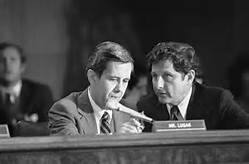
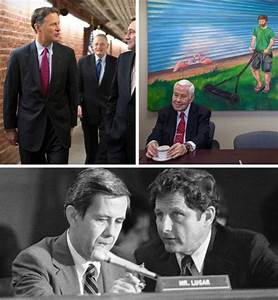
News of the death of Senator Richard Lugar arrives.  Not surprising, but saddening.  Coming two months after the death of Senator Birch Bayh it causes me to think about the gift of balance. 

Balance — that which allows us to stand  upright and walk forward.  Balance — that which keeps us from being overwhelmed by vertigo — whether physical or ethical.  Being Hoosiers, of a certain generation, for many years in the later half of the twentieth century, we United Methodists knew these two, one a Republican and the other a Democrat.  Each different, yet each shared our common Methodist heritage.  We United Methodists watched and lived with a balance displayed in our public/political lives — and in our churches.

th.jpg

Lugar and Bayh were different — yet they seemed to come as a matching set.  Lugar modeled modesty and graciousness; an intellect – a political and ethical realism; an openness to bipartisan solutions to complex national and world situations.  Bayh was passionate, a natural leader, and could light up a room with his rhetoric; he too was an informed realist, and when prepared, could debate with the best, and his drive to make a difference saw him take a lead in essential societal changes.

RUTGE_.jpg

Bayh’s leadership on Title 9 legislation guaranteeing equal rights for women in education, sports and commerce was a difference maker.  Lugar’s commitment to disarmament resulted in much of the nuclear arms control that emerged and his persuasion finally lead to the ending of South African Apartheid.  They both clearly understood that the “perfect could be the enemy of the good.”

Balance: it is missing from our body politic as a nation.  It is missing from United Methodism.  One cannot help but wonder as to how the nation and church moved to our current state of mean-spirited dysfunction.  As a clergy person, I can say that I have watched much of United Methodism in Indiana move away from the welcoming of difference, the welcoming balance, in our faith life and practice.  I have watched as we have had bishops and pastors who were too fearful of conflict to understand the gifts Lugar and Bayh modeled for us as a nation and a church. 

One recent bishop in Indiana now wonders what happened to the “Methodist Middle” and I chuckle.  I watched as honest debate was stifled and only one limited model for being church promoted.  Cautious theological conservatism and focus on seeking the magic formula for “congregational development” was promoted over emphasis on the denomination’s social witness and honest public debate or support for church ministries with the poor or marginalized persons.  We increasingly became a church in Indiana that placed our resources and commitments toward white, suburban, conservative enclaves.  Expressed differences, and openness to other views  — like those modeled by Lugar and Bayh — were discouraged. 

Why for example were certain “preferred,” certain “more conservative” congregations allowed to thumb their noses at the giving to larger denominational causes (something we call a tithe or an apportionment)?  This preference and lack of accountability didn’t go on for a year or two, no, but for decades. Meanwhile such giving was expected by ALL others.  Other congregations, progressives and moderates, were never offered this same “tolerance.” In other words — the progressives and moderate congregations carried the financial responsibilities for all — freeing up resources for those who were more exclusionary in their perspectives and practices to invest.

I watched as decisions were made that moved United Methodism in Indiana to a more fundamentalist and exclusionary stance — preferred over encouraging honest listening and learning from one another about our differences and a seeking of balance.   I am not naive enough to miss the fact that the nation as a whole was drifting toward more bitter language and divisive understandings.  Or, that some leaders do their best to avoid as much conflict as possible — meaning they give more space to the louder voices of “so-called-traditionalists” backed by the political and media sway of the Institute for Religion and Democracy or the so-called Good News or Confessing organizations.  So, it is understandable that leaders might surround themselves with persons who did not search for the balance valued by a Lugar or a Bayh — an ability to seek compromise while still moving ahead.

It required balance to move forward and not end up in a cul-de-sac of narrow-mindedness — something our denomination is seeking just now.  I fear it may be too late… but if there is a way forward, we do have the gift, the model, of two men, Lugar and Bayh, both United Methodists, who brought very different gifts and perspectives.  Yet both made our nation better for their service.  I give thanks for them — and pray for balance to be regained in our nation and our church.

th-1.jpg


Practicing Resurrection

How can it be?  Notre Dame Cathedral engulfed in flames?  And, early on Holy Week no less.  There are not words to capture the sense of our world’s spiritual and cultural loss.  Serge Schmemann, comes close when he writes “beauty and human genius lies gravely wounded” (New York Times, 4/16/19).

In response we hear brave words about rebuilding.  Good.  Yet, we know some things are forever gone.  Amidst the rubble and ashes lies an awareness that all our desires for permanence are ephemeral. Constancy and immutability are never fully within human grasp.  Great Cathedrals serve as pointers to something more eternal yet even they come with no guarantee-of-forever.  Small rural African-American churches, like those destroyed by fire in Louisiana recently, served as miniature cathedrals, for their faithful. They too now grieve irreplaceable loss.  Our call is not to believe we hold a final word or permanent design as to what God is about.  At our best we point the way, catch a glimpse of something better, and share what we have seen with others.  We offer our best, our highest aspirations, mixed in with our frailties, our vulnerabilities.  How then shall we proceed?  In the places we live and work?  In Louisiana? In Paris?

This Easter, with Notre Dame in view, I am reminded of a favorite poem by Wendell Berry, Manifesto: The Mad Farmer Liberation Front.”  Closing lines include these delicious words:

Ask the questions that have no answers.

Invest in the millennium.  Plant sequoias.

Say that your main crop is the forest

that you did not plant,

that you will not live to harvest…

Expect the end of the world.  Laugh.

Laughter is immeasurable.  Be joyful

though you have considered all the facts.

As soon as the generals and the politicos

can predict the motions of your mind,

lose it.  Leave it as a sign

to mark the false trail, the way

you didn’t go.  Be like the fox

who makes more tracks than necessary,

some in the wrong direction.

Practice Resurrection.

Practice Resurrection — My prayer is that you, that we, will practice our Easter prerogatives and that the practice of resurrection will become routine.  May it be our habit, our nod to that which is indeed eternal.

Philip Amerson

Forever Beginning

67.jpgForever Beginning

From T.S. Eliot’s poem Little Gidding:

We shall not cease from exploration
And the end of all our exploring
Will be to arrive where we started
And know the place for the first time.

Exploring, this time, lands me in the pulpit at First United Methodist Church in San Diego as Interim Pastor.  I have preached in this great church in the past; however, this time is different.  This time, I will have a weekly assignment.  To show up, listen, learn, study and then seek to share truths about the transforming love of God.

This is not an easy task in any season.  Yet, as I face the task now, it seems more challenging than any time in my 52 years of ministry.  Attached is the sermon entitled “Simply Beginning” preached on August 12, 2018. 

Prayers are appreciated for this fine congregation — and for the “weak reed” who will be giving his best in the year ahead.

Shalom,

Philip Amerson

++++++++++++++++++++++++++++++++

Sermon — Forever Beginning 8-12-18 PRINT


Whitsun Walks

Pieter_Brueghel_(II)_-_The_Whitsun_Bride_(Sotheby's_2013).jpg
Whitsun Bride, Pieter Brueghel the Younger

Whitsun Walks

Yesterday, I walked from meeting to meeting.  I had lunch with a Pentecostal minister; confided with a United Methodist pastor; participated in a planning meeting with a Baptist, a Jew, and a Buddhist; and completed the day conversing with a Roman Catholic layman.  It seemed right, this visiting with such a diverse group of folks.  My meetings were a “getting ready”… ready to move, to be led by the Spirit to new places of discovery.

Today we have arrived at the eve of Whitsunday (Pentecost Sunday), a celebration Christians call a moveable feast.  (Whitsunday is celebrated on the seventh Sunday following Easter.  Since the date of Easter changes from year to year so does the date of Whitsunday.)   I consider Pentecost a moveable feast for another reason – it is our call to new places, new understanding, new language.  Whitsun Walks occur in communities across the world, especially in Europe.  These walks, or parades, traditionally take place on almost any day in the week following Whitsunday — but Friday is a favorite.  The Whitsun Walks typically end with a community-wide party.  You see, Whitsuntide festival is a time of new beginnings — marriages are often are scheduled, crops are typically in the ground and graduation ceremonies abound.  Folks are in motion. 

Across Europe there are still vestiges of these Whitsun Walks in Italian, British and German towns.  Sadly, as commercialism, and its inevitable secular shadow, reach across these cultures, Whitsun Walks have diminished and in many places have disappeared.   In Great Britain, such festivities have largely been replaced by a fixed day, appropriately and ironically known as Bank Holiday, which is set on the last Monday in May.

Might we reclaim the week ahead (and the year ahead) as a time of Whitsun Walks?  Our world needs to remember the gifts of the Spirit set in motion at Pentecost.  We need a time to look around, all around, and see the gifts in the smiles of friends, to laugh, to hear the aria of the nightingale and thrush at dusk, to revel in the rich tapestry of music, language, art and to grow with the insights from multiple spiritual sources.

It was heart-breaking this past week, the week before Pentecost, to see the images in the Holy Land.  The celebration of the new U.S. Embassy in Jerusalem this week is a picture that is the very opposite, a reverse image, of the stories we read of the first Pentecost.  This week, folks of wealth and privilege gathered to congratulate one another on the opening of the new embassy in Jerusalem.  Only a few miles away, others who differ in culture, physical appearance and faith commitments were protesting.  There were more than fifty deaths and hundreds of injuries while the elites in power were giving one another high-fives. 

Both groups — those protesting in Gaza and those celebrating in Jerusalem are imprisoned.  Those in Gaza are trapped by unemployment and horrible living conditions.  They are trapped by a history many of their leaders helped create over decades of failed negotiations, broken promises and the heartless oppression from Israeli practices.  They are trapped by an inability to move past the physical and ideological fences and barriers that prevent migration to a place of greater security and opportunity.

Those who were celebrating the new embassy are trapped by arrogance and bigotry, horrible theologies and a foolish trust in economic and military power.  Some of this bigotry not only condemns all others to hell, now and in the future, but serves to daily undercut, ever more deeply, the prospect for a lasting peace.  This trap has become a never-ending cycle of fear, violence and retaliation, followed by new fears. 

Whereas the folks at the first Pentecost were able to communicate across divisions that separated peoples in the ancient world, the celebrants at the embassy opening seem to have lost any common language that speaks of hope, vision or the true source of human power.

It is amazing to see “Evangelical” pastors baptizing this embassy with their prayers and simultaneously condemning the rioters only a few miles away — persons they do not know.  Do they not know, for example, that there are tens of thousands of the Christian Palestinians in the Holy Land and there are hundreds of thousands of Palestinian Christians in diaspora? (See Richard Mouw’s To My Fellow Evangelicals, Richard Mouw.)

So we pray for peace; but we must also walk.  I do not oppose an embassy in Jerusalem — but at what price?   The decades of promises of a two state solution, of Jerusalem also being an international city, a capital city for both Jews and Palestinians, may have been permanently erased as a possibility.  We not only pray — we must walk — keep moving — keep learning from and about others.

If there was any movement in Jerusalem this week it was in the wrong direction.  Tomorrow across the world, Christians will read from the second chapter of Acts, the story that recounts how persons from diverse backgrounds were drawn forward by the Spirit into a new community.  These early followers of Jesus were known as People of the Way.  Too many of us today have become People of the Fence, or People of my Same-Ole-Stuck Place

It is a challenge for we humans, who have adapted to the power of fear, to act out of love for the stranger.  The early Jesus followers certainly had reason to hide, to protect themselves, to cluster in ever smaller worlds of kinship.  However, the hope of the Resurrection or the power loosed at Pentecost required risk.  Even when there is not clear path ahead, we walk — by faith more than sight.


James Cone, Gaye Hudson and Other Difference Makers

James Cone, Gaye Hudson and Other Difference Makers

I have come to understand that there is a rather simple human choice each of us can make.  It is this, will the generosity of a loving God be reflected in our lives?

In the past week two such difference makers for me, died.  Their names, James Cone – renown theologian, faculty member at Union Seminary in NYC and author of ground-breaking work on Black and Liberation theologies, and Gaye Hudson – elementary school teacher, musician and supporter/surrogate parent of students at Indiana University both passed away.

Gaye and James were in many ways different, and yet, in essential ways they were similar.  It is this — though both of them had reasons to live otherwise — they turned toward hope and healing as they lived their lives.

I remember the joy it was for me when James Cone would visit during my time in the administration at Garrett-Evangelical Theological Seminary or when we were attending various academic meetings together.  I would argue that more than any other writer in the last century, James Cone named the racism that constrained and corrupted the church in the United States.  James understood the way all of our institutions, including his own alma mater, Garrett-Evangelical, were diminished by the toxins of racial bigotry and discrimination. 

Still I knew him as a man of hope and… wait for it… JOY.  I can see that smile and loved the ease with which he shared a small laugh, a riddle, a pun, that betrayed an underlying sense of hope.  On more than one occasion, he expanded my ability to see past the fear-filled static and toxins of our society.  Even when his words began in anger, they found their way to the gift of transformation. John Robert McFarland writes meaningfully and beautifully of memories with his seminary  classmate James Cone — the difference maker (see: http://christinwinter.blogspot.com/).

Gaye Hudson was a member of First United Methodist Church in Bloomington, Indiana.  This is a church I served as pastor for almost a decade.  It was, and is, a congregation filled with remarkable folks — few more remarkable than Gaye.  For over thirty years she sang in the choir and for all of this time she was a friend to many.  Hundreds of students knew of Gaye’s care while in school.  She fed them, provided transportation, encouraged them, attended their recitals and on occasion slipped a little extra cash their way.  Some went on to teach; some became opera or recording stars; many were choral conductors, some wrote music and published books — ALL of them were in debt to their “dear friend Gaye.”

Gaye was the choir-mothercaring, challenging, sometimes lovingly disagreeing, anticipating the needs of others, and, yes, difference making.  At her funeral service on April 29th, the choir loft was overflowing with her “children.”  My, my, the music they made in her memory!  I suspect that nowhere in American — or the world for that matter — was music of praise and generosity more gloriously sung than yesterday in that sanctuary.

In a world too full of anger and blame, fear and shame, I give thanks for James Cone and Gaye Hudson, two folks who didn’t know one another, two who knew injustice and burdens, but they knew more, they knew the joy of living with generosity toward others.  I give thanks for these two who make a difference in my life.