
UnFLAGging Jesus
I once was joined for lunch by two friends. One was head of a theological school. Our conversation was amicable enough. Although the seminary president took up much of our visit promoting a wide array of initiatives focused on leadership. Future pastors, chaplains, counselors and social service providers were being trained to be leaders! It appeared an effort to impress the other friend at the table — John McKnight.
John is one of the founders of the Asset Based Community Development approach to community organizing, (often abbreviated as ABCD). A primary assumption of ABCD is that good leaders start by listening to others and discovering gifts, passions, assumptions and assets. After lunch as we were saying our “good-byes,” John took the hand of the seminary president and kindly offered, “Maybe we should focus a little more on connector-ship and a little less on leadership.”
Connector-ship! That’s a missing ingredient in so much of human exchange. Universities, businesses, denominations and governments spend tens of millions of dollars and valuable personnel time training for leadership. This is not without merit and benefit. Still if one begins with a belief that energy and initiatives all flow from a top-down direction, a needed element for change is missing. Too often, there is the assumption that if the leader just has the right idea, program, language, skill set or practices, success will inevitably follow. McKnight, understands and teaches that human connection is a critical initial step in developing effective institutions and civil communities.
Don’t start identifying the needs of others you plan to fix without listening. First, listen to find the gifts, the capacities, the assets that folks already possess. Secondly, find that inner moral compass that must continually be developed throughout life by study, seeking fact-based reality, and interacting responsibly with others. This is a more enduring pathway forward.
I know a remarkable corporate leader who upon arriving at a troubled firm, went to folks on the picket line, the hourly workers, not just upper management and he listened. A follower of Jesus, he continued in prayer, study and worship. Leadership meant connector-ship, listening, learning and finding a moral compass. Shortly thereafter, he gathered the employees in the parking lot. Taking a copy of the company’s unfair policies and procedures manual, he dropped it into the flames of a barrel used those standing in the cold. It was not a concession; it was a modeling of connection. Hard work followed. He was saying, “We are listening, let’s talk.”
Recently I wrote a piece titled “Jesus Wrapped in a Flag.” Today’s Christian Nationalism promotes a fraudulent version of Christianity, and profoundly flawed revision of American History. Lovett Weems offered a set of counter recommendations titled Leading Amidst Christian Nationalism. While helpful, these are overly cautious words and appeared to assume there is only one paradigm for congregational life. It is a soft version of the very American Civil Religion that the author critiques. It is more of a starting point than a guide.
I thought of all the congregations and courageous religious leaders who are doing much more. They listen and share the hard truths discovered in their study and prayers about our responsibilities as Christians. They offer a more robust response to the profound dangers and misinformation widely dispensed by White Christian Nationalism and American Catholic Integralism.
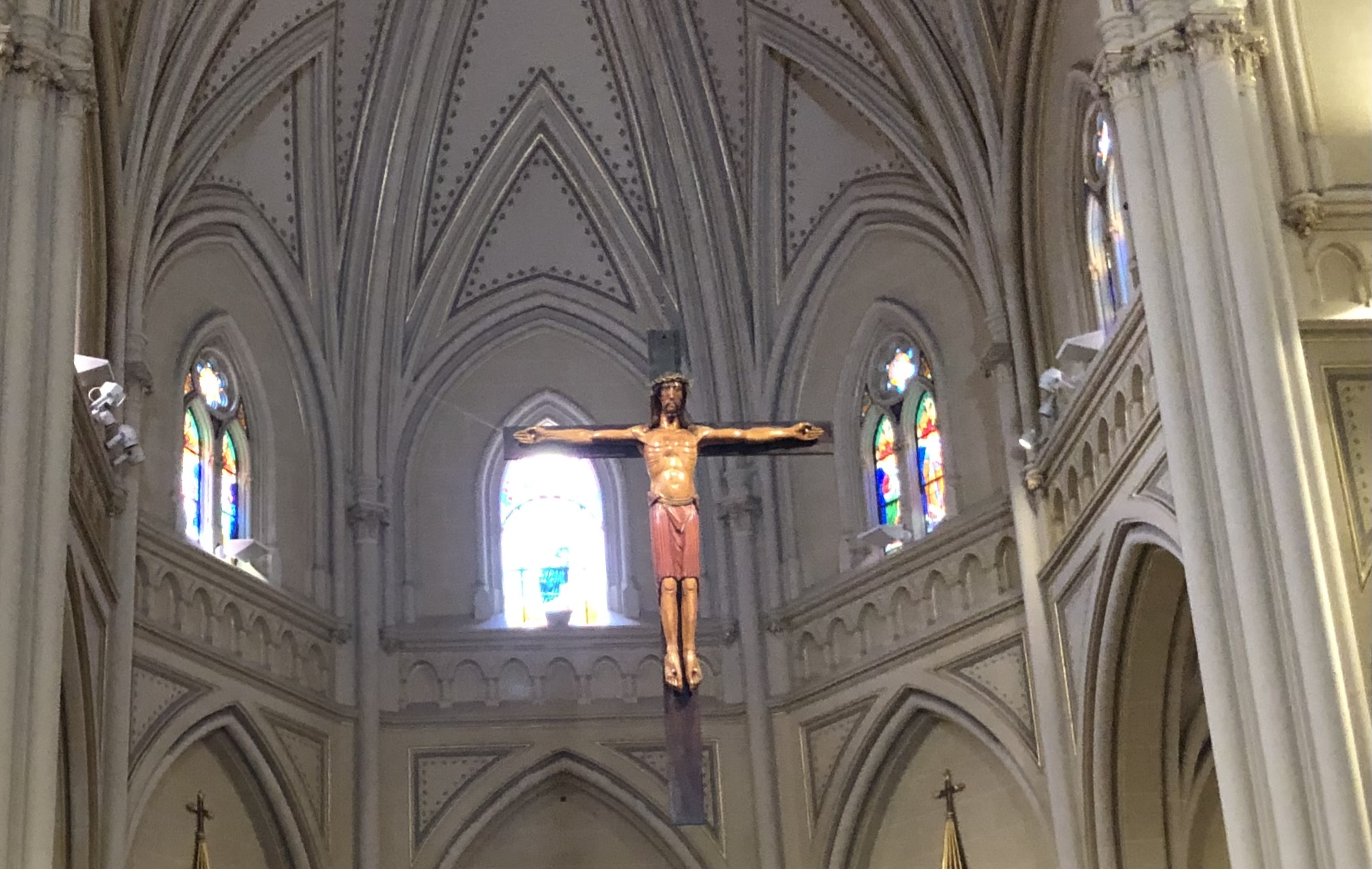
The American church, Protestant and Catholic, needs to remove the American Flag from the shoulders of Jesus. It doesn’t belong there; never has. If U.S. policies and practices aren’t held under the judgement of the Gospel, why be a Christian at all? Why not just pledge primary allegiance to anything our nation does and forget Jesus? Just diminish our discipleship.
Some U.S. “leaders” have done just that. Congresswoman Laureen Boebert said, “Jesus didn’t have enough AR-15 rifles to keep the government from killing him.” What? Jesus is remolded into a grievance filled, revenge seeking and bully. What does the congresswoman do with the Sermon on the Mount, the words, “Love your enemies” or in the Garden of Gethsemane, “Nevertheless, thy will be done”? The paradox, of course, as Reinhold Niebuhr argued, while international ethics are messy, they begin with morality in human expression.
The witness of Jesus of Nazareth, Jesus the Christ, isn’t limited to the foolish, mean-spirited and ill-informed theologies of some in congress these days. Jesus of scripture says “Come to me, all you who are weary and carrying heavy burdens, and I will give you rest. Take my yoke upon you, and learn from me, for I am gentle and humble in heart, and you will find rest for your souls.[iv]”
The witness of Jesus is UnFlagging! It is persistent – enduring. It calls leaders to leave their C-Suite offices and learn from the folks in the parking lot. It calls on congregations to speak with and learn from folks not in the pews on Sunday.
In the mid-1980s my family lived in a low-wealth neighborhood in Evansville, Indiana. One fall, fear gripped neighbors as vicious rapes were reported. The assailant was said to be African American in our multiracial community. Soon we learned the Ku Klux Klan was sending patrols to protect our white citizens, especially the women. What should our small core-city ministry do? How might we offer a safe alternative to this violation and the hate-based response?
Someone suggested we talk with Will Campbell. Mississippi born, Baptist minister, graduate of Yale Divinity School, author, and Civil Rights advocate, Will was known for friendships with a wide range of people, including members of the Ku Klux Klan. Will took this dwelling together stuff seriously!
I called and left phone messages for Will. It took a few days, and he returned my call. Hearing of our situation, he said, “First thing you need to say to the Klan is “no, your activities are not welcome.'” That sounded good to me — We had already done that. Then, Will, stumped me, surprised me. He asked, “What are their names?”
NAMES? “What do you mean?” I responded, “Whose names? Our neighbors?” “No.” Will said, thinking I would already know the Klansmen. Their names. I confessed that I didn’t know any of those folks. He said, “Well, then, what the hell you been doing? Who are they?” Interesting, our need to limit where repentance, reconciliation and renewal might occur. Perhaps some changes, some weaving of new relationships could happen in my own life, not only in the lives of Klan members. Might there be a bridging to new relationship, even there? A renewal larger than my imagining?
South African Methodist Bishop Peter Story noted that “America’s preachers have a task more difficult, perhaps, than those faced byus under apartheid. We had obvious evils to engage; you [on the other hand] have to unwrap your culture from years of red, white and blue myth, You have to expose and confront the great disconnect between the kindness, compassion and caring of most Americans and the ruthless way American power is experienced, directly and indirectly, by the poor of the earth. You have to help people see how they have let their institutions do their sinning for them.“
@font-face
{font-family:”Cambria Math”;
panose-1:2 4 5 3 5 4 6 3 2 4;
mso-font-charset:0;
mso-generic-font-family:roman;
mso-font-pitch:variable;
mso-font-signature:-536870145 1107305727 0 0 415 0;}@font-face
{font-family:Aptos;
panose-1:2 11 0 4 2 2 2 2 2 4;
mso-font-charset:0;
mso-generic-font-family:swiss;
mso-font-pitch:variable;
mso-font-signature:536871559 3 0 0 415 0;}p.MsoNormal, li.MsoNormal, div.MsoNormal
{mso-style-unhide:no;
mso-style-qformat:yes;
mso-style-parent:””;
margin-top:0in;
margin-right:0in;
margin-bottom:0in;
margin-left:.5in;
mso-pagination:widow-orphan;
font-size:12.0pt;
font-family:”Aptos”,sans-serif;
mso-ascii-font-family:Aptos;
mso-ascii-theme-font:minor-latin;
mso-fareast-font-family:Aptos;
mso-fareast-theme-font:minor-latin;
mso-hansi-font-family:Aptos;
mso-hansi-theme-font:minor-latin;
mso-bidi-font-family:”Times New Roman”;
mso-bidi-theme-font:minor-bidi;
mso-font-kerning:1.0pt;
mso-ligatures:standardcontextual;}.MsoChpDefault
{mso-style-type:export-only;
mso-default-props:yes;
mso-ascii-font-family:Aptos;
mso-ascii-theme-font:minor-latin;
mso-fareast-font-family:Aptos;
mso-fareast-theme-font:minor-latin;
mso-hansi-font-family:Aptos;
mso-hansi-theme-font:minor-latin;
mso-bidi-font-family:”Times New Roman”;
mso-bidi-theme-font:minor-bidi;}div.WordSection1
{page:WordSection1;}
[i] Weems, Lovett H. Jr. Leading Amidst Christian Nationalism, LEADING IDEAS, Lewis Center for Church Leadership, June 25, 2024).
[ii] Matthew 5:43-48.
[iii] Luke 22:42
[iv] Matthew 11:28-30.
[v] Storey, Peter, Sojourners Magazine, Oct. 18, 2006.
 Hands of the Strong