Corn-Bred

Corn-Bred

I’m a Hoosier, Indiana born and bred, on most July Sundays I can be found at church. On the best Sundays, the benediction ended, I then head for sweet corn at home from the farmer’s market.  Bought the day before from a young Amish teen in the City Hall parking lot.  Straw hat, gray shirt, grayer suspenders, blond curls and a sneaky, shiny smile. From down near Paoli most likely, I surmise – the corn and the smile.  “Picked this morning” he offers. “In the moonlight?” I tease, in return. We trade a chortle. The grin and banter worth the entire purchase price alone; but I win, as I carry off a half-dozen ears.  “He smiles with his eyes, he does.” I heard it growing up, like him I bet.

Early July, Indiana sweet corn is extra-scrumptious; I prescribe as it a necessary antidote to the extra-boneheaded politicians who now scour the state dressed in a toxic religious wardrobe. Deceptions attached to their bigotry like the sown-on-shadow of Peter Pan. This summer sweet corn is better. Much needed offset to the racism, so appreciated in the summer heat of ’25.  

Worship was delicious too this Sabbath. A needed cure offered, beginning with soaring music.  A fanfare for a refurbished organ followed by hymn texts full of ancient, hard-won truths. The anthem is fetched from the apothecary of faith. “It is well with my soul” lingers still. Take that, you many poisons of the soul, you dividers of a nation.

The stage is set by the liturgy – we are called to hope and not despair; and, then a sermon, chasing down our shared deeper story.  Listen again to Naaman’s healing. His trust in his own power, his military hardware, is insufficient to bring peace.  No, no, no, empathy is not “a bug in the system,” Mr. Musk.  Empathy marks true humanity.  A “healed femur is the sign of the beginning of civilization” Margaret Mead once noted.  The wonderful irony of the powerful finding healing and justice by finally heeding the counsel of a young girl.  She brings a four-star general to his knees and his senses… and more than an outer leprosy is healed.  She did it well, both the young girl and the preacher this Sunday.  We are reminded that interdependence is more to be valued than independence.

It’s corn-bred wisdom that hubris and arrogance will end in dust. True in Elisha’s time and a lesson to be relearned now. God’s preference is for the small and marginal ones. The narrative is told over and again.  Let those with ears-to-hear, listen.  Too bad uncle Donald was on the golf course and missed learning how his story will end.  The closing hymn offers again this poetry of hope. Then I head home to sweet corn and a nap.

O God of every nation, Of every race and land,

Redeem the whole creation With your almighty hand. 

Where hate and fear divide us  And bitter threats are hurled,

In love and mercy guide us  And heal our strife torn world.

Rain begins as we walk home… “good for the sweet corn,” I think...

Gospel Conspiracy Cycle

Gospel Conspiracy Cycle

Over the centuries, the followers of Jesus have lived within, and endured, many political regimes. Tyranny is often around the next turn of the calendar. From Herod or Ceasar, through Nero, up to King George or Hitler, the church has survived – sometimes it emerges misshapen or damaged. It has often failed to give clear witness to the priorities of the Gospel.  

Confronted with the current political realities in the United States, how might congregations and disciples offer a faithful response when racism rises, the poor suffer the loss of critical systems of food and healthcare, when the rich act as kleptocrats, autocracy threatens the very underpinnings of democracy? 

For followers of Jesus over the centuries, it is fair to say, this is not new.  We have seen this movie before… in fact, it is a story often rehearsed and replayed in nations.  Current challenges are not Christianity’s first brush with autocracy.  How then shall we respond?  Some of the suggestions below will surprise, as they are simple and personal, others are corporate.  They are based not only on personal experience; they also draw on observing what John Lewis called “good trouble.”  They are found in reading of the Christian Gospels, especially in what we call the Good Samaritan parable. I now prefer to call it the Good Conspirator parable. Below is what I offer as the “Gospel Conspiracy Cycle.”  Each element is best carried out as both a personal and communal activity.

Gospel Conspiracy Cycle: Pray/Meditate, Observe/Listen, Study/Learn, Repent/Reconcile, Join/Support/Praise, Sing/Dance/Laugh, Raise Your Voice, Direct Action/Resist  

Richard Lischer, retired professor at Duke Divinity School reminds us the wider lens of church history: “Older heads have thought through the issues we face today—and with us in mind. We have been to this precipice before, and we have discovered that it’s possible to practice our faith on the very edge of it. Which is where we are today. Christians have been anointed not to rule the world but to sanctify it. Not to dominate but to consecrate. Not to harvest but to sow. And to bless this poor, broken body with some soul.” (February 14, 2025, The Christian Century, “How Then Shall We Render.”)

At the heart of Christian Gospel is the Good Samaritan parable (Luke 10:25-35). It is widely known and often misunderstood. I prefer to call it the “Good Conspirator” story. Some believe Jesus is saying “we should help those in need.” That’s a part of it, but it is also about much more.  There is this, a Samaritan, considered an untrustworthy outsider, is the one who acts as the true neighbor.

Jewish scholar Amy-Jill Levine writes this story demonstrates a commandment to love all, no matter whether stranger or friend. This story was familiar to Jewish listeners. They have heard the plot before – a Priest, a Levite and an everyday Israelite travel past a situation. But wait, Jesus offers a new twist. The third person is not the everyday Israelite. Rather it is a foreigner, a Samaritan. Jesus thereby reframes the lawyer’s question of “who is my neighbor?” The unexpected, stranger, the Samaritan’s actions cut against the grain of expected and typical. The Samaritan is a conspirator for the good

The word “conspire” from the Latin is “conspiratio” which means to “breathe together with spirit.” From the beginning Christianity has valued an alternative perspective on what is normal. Jesus spoke of the paradoxes of the poor being the truly rich and the weakest ones also are the strongest.  Christianity offers an alternative to the “normal” and “expected.”

In my own life, (and I would be bold to say in the history of Christianity), there is a cycle I could call the Gospel conspiracy. This virtuous cycle is often interrupted, diverted for a while or even undercut by Christendom.  It is true in my own life as well. The cycle is this: 1) Pray and meditate; 2) Observe and Listen; 3) Study and Learn; 4) Repent and Reconcile; 5) Join, Support and Praise; 6) Sing, Dance and Laugh; 7) Raise Your Voice; and 8) take Direct Action and Resist – and always return to Prayer. One may move around in the cycle from one space to the next. All are essential.  A return to start, back to prayer is always an option.  The idea is to keep moving. These elements are meant to help followers of Jesus develop Tough Minds, Soft Hearts and Strong Hands.    

For regular updates, subscribe to: BelongingExchange.org

Faith Communities Could Boldly Lead

Faith Communities Could Boldly Lead

Attached below is a column sent to our local newspaper in Bloomington, Indiana, the Herald-Times

While it is local in focus, the situation is repeated in thousands of communities in the United States.  Perhaps there are some thoughts or themes here that could be helpful to you wherever you live and/or work. 

Our nation is amid a mental health crisis where our largest homeless shelters are the local jails.  Until the poor, ill and addicted have places of shelter and care, at minimum, no one should call this a “Christian nation.”

++++++++++++++++++

Faith Communities Could Boldly Lead

What makes Bloomington “BLOOM”? What offers vitality, hope, knowledge and hospitality? We have great institutions: centers of education, health science, manufacturing and culture. Innovation and technology are known to be essential. Still, Monroe County seems in the doldrums, waiting for a new gust of imagination and initiative. A community’s wellbeing in terms of jobs, housing, education, racial diversity and cultural amenities is a complex mix. Not thriving at a high level, we bump along.

Among our disquieting realities:

  • Declining population and lagging diversity. Since 2000, non-university related population is down 1.5%. Surprisingly, racial and ethnic diversity, lags peer communities.
  • Lower wages, productivity. At Futurecast 2025 in November, Philip Powell, director of Indiana Business Research Center noted core worker population (aged 18 to 44) continues to decline, below U.S. and Indiana average wages and productivity. Bloomington will “live and die by the talent that is here,” Professor Philip Powell concluded.[i]
  • Cost of living and housing expenses are among the highest in Indiana with too few homes on the market for demand. Many workers offering essential services must live outside the city.
  • The homeless. With little voice and few options hundreds seek shelter in a tent or doorway. Some live in an automobile. Some do “couch surfing,” others are in jail or healthcare facilities. Scores move every few days, from one unwelcoming location to another.

As I did research something strange happened: the same number, 143, popped up on two different topics. Mere coincidence? The Association of Religious Data Archives reported 143 faith congregations. Another topic showed 143 persons had no shelter at all, and 300 more persons were classified as homeless![ii]  

What if each faith group offered shelter for one person? Too simplistic and unlikely? I think not. Faith communities vary. Numbers vary over time; but not by much. Consider this, if Monroe County seeks more innovation, imagination, growth and productivity, is it solely the work of the corporate, government, service and education sectors? What roles for faith communities?

What if for the next five years, 2025 to 2030, congregations offered 143 additional safe places each year by building, renting or otherwise providing shelter for our poor?  What if each faith group reached out to know a person without shelter, not as a client but neighbor? In these frigid days of January 2025, two churches, First Christian and First United Methodist stepped up offering emergency shelter, a warm space, a small respite, a bite to eat. Beacon Inc. and Wheeler Mission do more as well. Might faith communities cooperate to end the need for such emergency spaces all together?  

Let’s not get carried away, here Phil! If this was a sermon, the Jewish or Christian scripture text could be Isaiah 58:7 or Matthew 25:35-40. (There are many other passages calling persons of faith to shelter the homeless.) In Matthew 25 the hungry, thirsty, or those without shelter are to be treated as if they were Jesus himself.

As some leaders in our community seek new vitality with technology, research and innovation hubs, might imagination also come from our faith communities? Congregations could assist the Housing Authority supporting Section-8 vouchers. They might offer additional volunteers and gifts for Heading Home, New Hope for Families, Habitat for Humanity, Wheeler Mission or Beacon Inc. Bloomington could become known as a place where faith communities offered one critical, stable baseline amenity, HOUSING for the poor along with wise, research-based care that could lead to recovery, employment and fuller citizenship.

A place to start now is with support for Beacon Inc., (https://beaconinc.org/).  The proposed new center will offer a more comprehensive approach: shelter, recovery, job training, space for prayer and meditation, care for physical and psychological difficulties. 

One-hundred-forty-three, 143!  The Rev. Forrest Gilmore, Director of Beacon, heard me speak of #143 and reminded me that it was the favorite number of Fred Rogers, the creator and television host of Mister Rogers’ Neighborhood. Rogers kept his weight at 143 pounds all his adult life!  More importantly, however, he said that 1-4-3 matched the number of letters in his favorite three words “I love you.”

One-hundred-forty-three, 143! Faith groups might join corporations, the city, the community foundation, university innovations and research, and social service groups in modeling a better way for Monroe County, our state and nation. Even if only half, or one third of our congregations, or if only a couple of dozen could boldly act together, they could make a difference so that Bloomington would be widely known as the city in bloom.


[i] Wright, Aubrey, Indiana Public Media, November 7, 2024 

[ii] Keener, Gentry, Indiana Daily Student, October 20, 2024. From the Indiana Housing and Community Development Corporation “point in time” count. 456 persons were homeless, with 143 living no shelter at all.

Crowd Size, Not So Much

Crowd Size, Not So Much

I know the tyranny of numbers. How many?  How much? In my work-life there were always such questions: What is the average in worship attendance, pastor?  How large is your enrollment, seminary administrator?

Counting is deeply embedded in our culture; math is essential for a strong citizenry. I recall my children delighting in Sesame Street’s Muppet Count Von Count. Even so, the oft overlooked and more critical understandings are based in asking “what should be counted and to what purpose?”  What are the essential measures for the health of a congregation, school, government program or social service agency? A hospital can report the number of beds, or the financial bottom line, but what of the morale of the staff, or trust patents have in a nurse or physician?

My dear colleague, Walter Wangerin, Jr., first alerted me to an overlooked theme in scripture. Reminding me that the fourth book of the Christian Bible is the “Book of Numbers” Walt noted that throughout the narratives, when the focus shifts from knowing the people to numbering them, danger is ahead.

In an astonishing fabrication, former President Donald Trump, claimed “No one has spoken to crowds bigger than me.” He said more people attended his January 6th, 2020 event prior to the attack on the capital building, than attended Dr. Martin Luther King, Jr.’s “I Have a Dream” speech.  Truth is 250,000 gathered on the Capital Mall on August 28, 1963. It was a crowd five times larger. Think on this: how do these two speeches differ in purpose? Crowds gathered to do what? Was it to enrich and extend our democracy or to upend it?

The Gospels are filled with stories of crowds following Jesus, anticipating his every move. Some first century census taker reported 4,000 and 5,000 at meals. One of these stories breaks open the myth that size matters, as a small boy gives his lunch of five barley loaves and two fish (John 6) toward the feeding of everyone.

There is no doubt that crowd size is seen as an indicator of popularity and power.  Adolf Hitler loved to brag about the size of his crowds in World War II Germany. However, there is another way to think of the gathering of people around a leader. Jesus of Nazareth, who often faced the press of crowds said: “For where two or three are gathered together in my name, there am I in the midst of them (Matthew 18:20 KJV).  As to power and authority, this Jesus said, “You’ve observed how godless rulers throw their weight around, how quickly a little power goes to their heads. It’s not going to be that way with you. Whoever wants to be great must become a servant” (Matthew 20:26, MSG). 

Those in our time who suggest Mr. Trump is God’s choice, have a problem bigger than his persistent lies; they have a Jesus problem. Jesus spoke of small gifts, shared in hope, as core indicators of God’s true purposes. God’s realm often was understood as yeast, seed, salt and light. Jesus looked out on the crowds with compassion and taught that love of God and neighbor was the highest good. Everyone counted. Bragging about crowd size and seeking division and fear for personal gain, not so much.

UnFlagging Jesus

UnFLAGging Jesus

I once was joined for lunch by two friends. One was head of a theological school. Our conversation was amicable enough. Although the seminary president took up much of our visit promoting a wide array of initiatives focused on leadership. Future pastors, chaplains, counselors and social service providers were being trained to be leaders! It appeared an effort to impress the other friend at the table — John McKnight. 

John is one of the founders of the Asset Based Community Development approach to community organizing, (often abbreviated as ABCD).  A primary assumption of ABCD is that good leaders start by listening to others and discovering gifts, passions, assumptions and assets. After lunch as we were saying our “good-byes,” John took the hand of the seminary president and kindly offered, “Maybe we should focus a little more on connector-ship and a little less on leadership.” 

Connector-ship! That’s a missing ingredient in so much of human exchange. Universities, businesses, denominations and governments spend tens of millions of dollars and valuable personnel time training for leadership. This is not without merit and benefit. Still if one begins with a belief that energy and initiatives all flow from a top-down direction, a needed element for change is missing. Too often, there is the assumption that if the leader just has the right idea, program, language, skill set or practices, success will inevitably follow. McKnight, understands and teaches that human connection is a critical initial step in developing effective institutions and civil communities.

Don’t start identifying the needs of others you plan to fix without listening. First, listen to find the gifts, the capacities, the assets that folks already possess. Secondly, find that inner moral compass that must continually be developed throughout life by study, seeking fact-based reality, and interacting responsibly with others. This is a more enduring pathway forward.  

I know a remarkable corporate leader who upon arriving at a troubled firm, went to folks on the picket line, the hourly workers, not just upper management and he listened. A follower of Jesus, he continued in prayer, study and worship. Leadership meant connector-ship, listening, learning and finding a moral compass. Shortly thereafter, he gathered the employees in the parking lot. Taking a copy of the company’s unfair policies and procedures manual, he dropped it into the flames of a barrel used those standing in the cold. It was not a concession; it was a modeling of connection. Hard work followed.  He was saying, “We are listening, let’s talk.”

Recently I wrote a piece titled “Jesus Wrapped in a Flag.” Today’s Christian Nationalism promotes a fraudulent version of Christianity, and profoundly flawed revision of American History.  Lovett Weems offered a set of counter recommendations titled Leading Amidst Christian Nationalism.  While helpful, these are overly cautious words and appeared to assume there is only one paradigm for congregational life. It is a soft version of the very American Civil Religion that the author critiques. It is more of a starting point than a guide.

I thought of all the congregations and courageous religious leaders who are doing much more. They listen and share the hard truths discovered in their study and prayers about our responsibilities as Christians. They offer a more robust response to the profound dangers and misinformation widely dispensed by White Christian Nationalism and American Catholic Integralism.

The American church, Protestant and Catholic, needs to remove the American Flag from the shoulders of Jesus. It doesn’t belong there; never has. If U.S. policies and practices aren’t held under the judgement of the Gospel, why be a Christian at all?  Why not just pledge primary allegiance to anything our nation does and forget Jesus?  Just diminish our discipleship. 

Some U.S. “leaders” have done just that. Congresswoman Laureen Boebert said, “Jesus didn’t have enough AR-15 rifles to keep the government from killing him.”  What? Jesus is remolded into a grievance filled, revenge seeking and bully. What does the congresswoman do with the Sermon on the Mount, the words, “Love your enemies” or in the Garden of Gethsemane, “Nevertheless, thy will be done”?  The paradox, of course, as Reinhold Niebuhr argued, while international ethics are messy, they begin with morality in human expression.

The witness of Jesus of Nazareth, Jesus the Christ, isn’t limited to the foolish, mean-spirited and ill-informed theologies of some in congress these days. Jesus of scripture says “Come to me, all you who are weary and carrying heavy burdens, and I will give you rest.  Take my yoke upon you, and learn from me, for I am gentle and humble in heart, and you will find rest for your souls.[iv]” 

The witness of Jesus is UnFlagging!  It is persistent – enduring. It calls leaders to leave their C-Suite offices and learn from the folks in the parking lot.  It calls on congregations to speak with and learn from folks not in the pews on Sunday.

In the mid-1980s my family lived in a low-wealth neighborhood in Evansville, Indiana. One fall, fear gripped neighbors as vicious rapes were reported. The assailant was said to be African American in our multiracial community. Soon we learned the Ku Klux Klan was sending patrols to protect our white citizens, especially the women.  What should our small core-city ministry do? How might we offer a safe alternative to this violation and the hate-based response?

Someone suggested we talk with Will Campbell. Mississippi born, Baptist minister, graduate of Yale Divinity School, author, and Civil Rights advocate, Will was known for friendships with a wide range of people, including members of the Ku Klux Klan. Will took this dwelling together stuff seriously!

I called and left phone messages for Will. It took a few days, and he returned my call. Hearing of our situation, he said, “First thing you need to say to the Klan is “no, your activities are not welcome.'” That sounded good to me — We had already done that. Then, Will, stumped me, surprised me. He asked, “What are their names?” 

NAMES?  “What do you mean?” I responded, “Whose names? Our neighbors?”  “No.” Will said, thinking I would already know the Klansmen. Their names.  I confessed that I didn’t know any of those folks.  He said, “Well, then, what the hell you been doing?  Who are they?”  Interesting, our need to limit where repentance, reconciliation and renewal might occur. Perhaps some changes, some weaving of new relationships could happen in my own life, not only in the lives of Klan members. Might there be a bridging to new relationship, even there? A renewal larger than my imagining?

South African Methodist Bishop Peter Story noted that “America’s preachers have a task more difficult, perhaps, than those faced byus under apartheid. We had obvious evils to engage; you [on the other hand] have to unwrap your culture from years of red, white and blue myth, You have to expose and confront the great disconnect between the kindness, compassion and caring of most Americans and the ruthless way American power is experienced, directly and indirectly, by the poor of the earth. You have to help people see how they have let their institutions do their sinning for them.


@font-face
{font-family:”Cambria Math”;
panose-1:2 4 5 3 5 4 6 3 2 4;
mso-font-charset:0;
mso-generic-font-family:roman;
mso-font-pitch:variable;
mso-font-signature:-536870145 1107305727 0 0 415 0;}@font-face
{font-family:Aptos;
panose-1:2 11 0 4 2 2 2 2 2 4;
mso-font-charset:0;
mso-generic-font-family:swiss;
mso-font-pitch:variable;
mso-font-signature:536871559 3 0 0 415 0;}p.MsoNormal, li.MsoNormal, div.MsoNormal
{mso-style-unhide:no;
mso-style-qformat:yes;
mso-style-parent:””;
margin-top:0in;
margin-right:0in;
margin-bottom:0in;
margin-left:.5in;
mso-pagination:widow-orphan;
font-size:12.0pt;
font-family:”Aptos”,sans-serif;
mso-ascii-font-family:Aptos;
mso-ascii-theme-font:minor-latin;
mso-fareast-font-family:Aptos;
mso-fareast-theme-font:minor-latin;
mso-hansi-font-family:Aptos;
mso-hansi-theme-font:minor-latin;
mso-bidi-font-family:”Times New Roman”;
mso-bidi-theme-font:minor-bidi;
mso-font-kerning:1.0pt;
mso-ligatures:standardcontextual;}.MsoChpDefault
{mso-style-type:export-only;
mso-default-props:yes;
mso-ascii-font-family:Aptos;
mso-ascii-theme-font:minor-latin;
mso-fareast-font-family:Aptos;
mso-fareast-theme-font:minor-latin;
mso-hansi-font-family:Aptos;
mso-hansi-theme-font:minor-latin;
mso-bidi-font-family:”Times New Roman”;
mso-bidi-theme-font:minor-bidi;}div.WordSection1
{page:WordSection1;}


[i] Weems, Lovett H. Jr. Leading Amidst Christian Nationalism, LEADING IDEAS, Lewis Center for Church Leadership, June 25, 2024).

[ii] Matthew 5:43-48.

[iii] Luke 22:42

[iv] Matthew 11:28-30.

[v] Storey, Peter, Sojourners Magazine, Oct. 18, 2006.

The “Good” in Good Friday

The “Good” in Good Friday

Perhaps I was six or seven when the question first came.  What is “good” about Good Friday?  Our lives are full of questions; or at least mine is.  These days most of my questions are about more mundane things, like “How did those spots get on my shirt or on my necktie?”  Any man over seventy-five will understand.

After more than seven decades, the more profound and intellectually jarring theological question about the goodness of Good Friday still stirs in my spirit. I don’t have the one right, true answer as many of my conservative friends suggest they have.  The soup stains on my necktie are so much more easily explained.

Other friends, more secular searchers, ask, “Why a focus on the cross? Isn’t there a better, less violent, symbol?”  Without answering, I think of all the modern-day crosses people bare. I have been with families after a painful death, a murder, a rape, or a drowning.  There are realities of starvation, war, captivity, and financial ruin. Abuse and discrimination are crosses of a different sort. Sin is woven within the human condition.  Evil is present. No matter our desires for something less violent and more velvet — there is brutality and death.

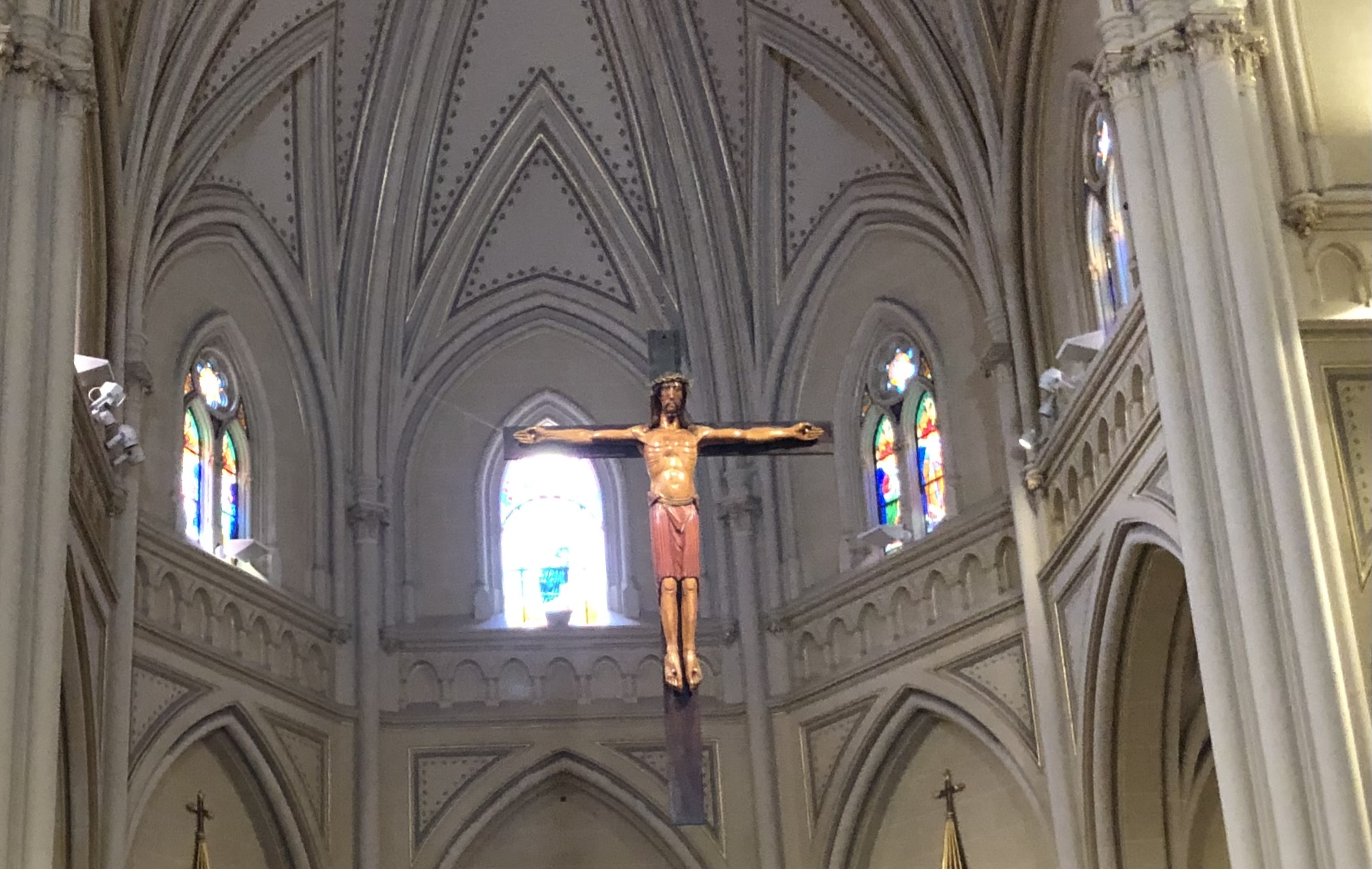
Catehdral de San Isidore in Argentina

I recall the historic theories of the atonement.  Jesus’s death is portrayed as Ransom, Substitute (suffers for), Penal (suffers instead), Example, and Victor. Each theory today is understood in decidedly individualistic ways.  It is a quid pro quo formula as in Jesus did this and I get some reward. Such theology appears deeply embedded in St. Paul’s perspective (I Corinthians 15 or II Corinthians 5).  

It was my beloved New Testament professor, Robert Lyon, who challenged me to think beyond this; to think more deeply and widely.  The word study he assigned me was on the word λύτρον, meaning either redemption or ransom (Mark 10:45 and Matthew 20:28).  I can still see the twinkle in Bob’s eye as he said, “And the context? Who is this ransom for and why?  What is the larger Biblical frame?”  These were the years of the Vietnam War and Civil Rights struggles over racism and sexism.  Bob wasn’t dismissing classic atonement theories out of hand; he was asking for more – for a deeper grasp of the whole of the scriptural story.  What does “ransom” have to do with justice?  What if this is bigger than an individualistic transactional act? What if it is transformational for the entirety of God’s purposes?  What if it is not primarily about one’s personal “free of sin” credit card?  What if it is for ALL and for the entire Creation!

Walter Brueggemann suggests we speak of the execution of Jesus rather than his crucifixion. ALL THINGS are seen as potentially redeemed and redeemable: corrupt institutions, the violence of every empire, the despoiling of creation.  Brueggeman speaks of God’s purposes as displayed in the life of Jesus as prophetic imagination.  He speaks of “the alternative world that God has promised, and that God is birthing before our very eyes.

For me, even with food stains on my shirt, the questions in my spirit find greater meaning. This is the GOOD in Good Friday – God’s promise displayed for all persons and all creation.  If we have eyes to see it and the will to live into it.