
Over the decades I have seen that excellent leaders sometimes need to manage and the best leaders do this only occasionally; on the other hand, too many called to lead, function exclusively as managers, unable to lead.
Holding it Together: Being and Doing
Holding It Together: Being and Doing
Knowing of my friend’s health concerns, I asked “how are you doing?” “I’m barely holding it together,” he responded. “It’s not the aches and pains; I’m not sleeping. I carry a dread for the future.” His insomnia was a fretting over our national trajectory and the deceits that appear to be a “new normal.” I understood. Divisive and demeaning language, dehumanizing others, greed and grifting, scapegoating, talk of retaliation and efforts to upend democratic institutions. Mostly, my friend’s concerns were the loss of our nation’s moral center.

“Barely holding it together” – honest, sharp-edged reality. Like the patient waiting to hear that dreaded diagnosis, or the father learning of an active shooter at his child’s school, or the undocumented mother who, after years working in a menial job and proudly sending her children off to college, who now fears deportations. After the 2024 election we live at the edges of hope and dread.
My first U.S. Presidential vote was in 1968. Fifteen elections later, my politics have changed, but not my trust in our future. That is, until now. Has our nation changed? Will we hold it together? Did the fear-saturated-campaign of 2024 and promises made with fascist overtones indicate a shift in our body politic? Has racism, greed, misogyny and xenophobia reshaped our national identity or simply uncovered what was there? Haven’t these dynamics always played a role? Of course, bigotry has been “background noise” but now, blatant discrimination and retribution are “baked-in” as a publicly endorsed strategy.
Is the seeking of truth sublimated to seeking revenge? Do computer algorithms prevent robust honest, dialogue among citizens? Are “news” feeds turned into a diet of “ideologically-preprocessed-information-meals.” Basic civic creeds that “all persons are created as equal,” or “the separation of church and state,” or “equal justice under the law” appear to be devalued, seen as outmoded and divorced from ethical political and civic practice. As grievance becomes the coin of the realm, an inflation of conspiracy theories, dictatorial impulses, and a sense of helplessness emerges. Can we hold it together?

We are heading into choppy national waters, bouncing along without a shared vision of common-wealth or personal responsibility. The Ship of State as conceived of by Jefferson, Hamilton, Adams and Madison, refined by Lincoln or Susan B Anthony and the wisdom of many more recent leaders is threatened. Our nation may founder on dangerous shoals of division, greed, and authoritarianism. In his 1960 inaugural address John F. Kennedy challenged, “Ask not what your country can do for you but rather what can you do for your country.”
My friend, the Rev. David G. Owen, now deceased, spoke of the importance of living a seamless life, where our actions (personal and social) are aligned with our core beliefs. These need to be “held together.” How shall we live more fully, as if our nation’s creeds and our religious beliefs are reflected in our daily actions?
Recently, prior to a meeting, a friend advised, “It is best if we leave Jesus in the parking lot.” Perhaps he feared that as a clergy person I would divert our attention from the stated agenda. I had heard this “leaving Jesus in the parking lot” talk before. I might have said, “O Jesus is already in that board room, don’t worry” but, instead, I was quiet.
“Holding it together” requires moral, judicial and behavioral consistency – being and doing. This is not a call to Christian Nationalism, NO! It is quite the opposite. It is a call to a patriotism linked to virtues taught across the centuries, religious and non-religious. It is a turning away from the threats and abuses commonly practiced by mob bosses toward treating each neighbor as we would choose to be treated. It is a move toward a seamless patriotism and away from the tyrannical. When the allegiances we pledge are not matched by our actions or by facts, trust is impossible, and a civic brokenness inevitable. Historian Tim Snyder writes in “On Tyranny”: “A nationalist encourages us to be our worst, and then tells us that we are the best… A patriot has universal values, standards by which he judges his nation, always wishing it well—and wishing that it would do better.”
Philip Amerson, November 27, 2024
John L. McKnight: A Tribute
John L. McKnight: Mentor, Friend and Spiritual Pumice Stone
All Saints Sunday, November 3, 2024
John L. McKnight died on Friday (11/1/24). I grieve… even as I celebrate a life given to striving after the best in human undertakings. Another loss, another bushel of memories gathered, another mixture of gratitude and grief stirred in my spirit. I had last spoken with John by phone two weeks before his death.
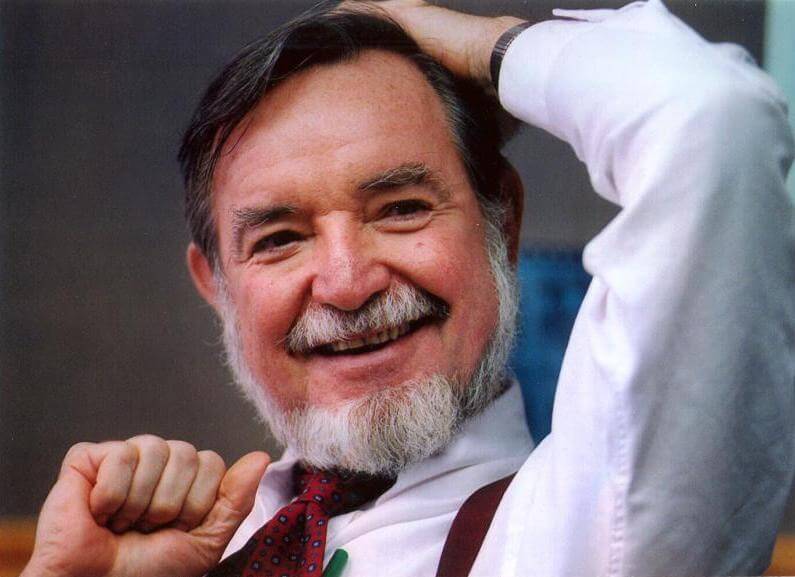
In the mid-1970s, I stood in the back of a conference room in the Bismark Hotel in Chicago as John spoke of changes in our national economy and institutional life over prior decades. Our society was transitioning from production of goods (agricultural, mining, manufacturing) toward a primary product of human services. People were objectified, turned into clients. Shared community being lost, relationships were turned into the “servers” and “the served.” Our economy needed “the needy.” We specialists could be the fixers of individuals; as the righteous we could offer service without knowing much about the other, beyond an assumption, a diagnosis, a project that meant they were different: poor or sick, addicted or uneducated, in trouble or in some other way needing our expertise, knowledge and assistance.
As I listened those fifty years ago, I was surprised to look down and see the front of my shirt was damp. Tears rolled off my chin. John named my arrogance and ignorance. My education was about needs surveys, prediction, best practice, control and the intervention of strategies to improve “their” lives. That day was one of my many conversion experiences. John named the sin of trying to fix others without relationship, without knowing the gifts and talents others bring, without looking for a caring community, without learning the assets and capacities my professionally trained eyes too often failed to see.

There is more to say about John. I have done so in the past and will again in the future. I recall times he gently challenged my thinking. Usually with a Socratic probing question. He was an intellectual and spiritual pumice stone removing the calluses of my professional and academic skin. I think of it now as cataract surgery for my soul.
As I have written in earlier reflections: John McKnight reminds that too often our institutional responses, well-meaning as they are meant to be, can become twisted and up-side-down in outcome. Self-understandings are molded by interactions with others like those I shared with John over the past fifty years. My mentors are too many to name; however, on this All Saints Day, I will mention Ms. Stella Newhouse, Gilbert James, Daphne Mayorga, Clarence Smart, Pat Davis, Earl Brewer, Walt Wangerin Jr., Bill Pannell and John McKnight.
When John and I talked two weeks ago he surprised me by saying he was worried about the coming national election. As I remember it, he said, “I fear the goodness assumed about the the American People is being undercut by the ugliness, fear and hatred in this presidential election.” I share these anxieties as we head into Tuesday’s election. Still, I know, whatever the outcome, John’s legacy can serve as a pumice stone on this democracy. We remember and honor all our saints, as the hymn “Rejoice in God’s Saints” lyric puts it “a world without saints forgets how to praise.”
We will remember and we will praise.

The Ugliest Four Letter Word
The Ugliest of All the Four Letter Words?
News came of the death of my dear friend Bill Pannell, evangelist, retired professor at Fuller Seminary. Our nation and the church have lost a great leader, a remarkable person. His clarity, his witness, helped hundreds-of-thousands of Christians follow the path of Jesus of Nazareth.
So many memories: I last spoke with Bill in the spring. We recalled a worship service at Goshen College Mennonite Church several years ago. Bill preached. The sermon was on “the ugliest four-letter word of them all. ” That word? “THEM.” Turning others into an enemy — separating one another from God’s purposes. “THEM.” This, Bill preached, was the ugliest of all words in the English language.
Bill offered another way, the Jesus way. He spoke of a nonviolent welcoming of the stranger. He called for an inviting all to our tables of conversation and care. Bill was not naive. He knew deeply and personally the pain of exclusion and bigotry. Even so, he understood that hate, revenge and retribution were only a road to human tragedy. Turning others into “them” contridictied the core of the Christian message.
His books “My Friend the Enemy” and “The Coming Race Wars” call for a discipleship that includes ALL. Today, Jemar Tisby carries on much of Bill’s witness.
Forgive me this prideful note, but I still remember that as Bill stood to preach in Goshen College Church that Sunday, he looked out and said, “Phil, is that you?” I was stunned. There were several hundred others there. It had been several years since we had last spoken. I nodded “yes.” He then said, “How good to fellowship with one another!” Neither of us were Mennonites; although we loved their faithful witness. I didn’t know Bill was going to be the preacher that morning. Elaine and I went to hear the glorious harmonies of Mennonite hymn singing. Bill, understood and expresed a note of the gift of the Anabaptist witness — “How good it is to be in fellowship with all.”
Today, I give thanks for the witness of William Pannell — Our nation needs his wisdom and faithful word today, perhaps more than ever. Jim Wallis captures this in his recent article about our mutural friend, Bill Pannell:
https://religionnews.com/2024/10/18/the-gospel-according-to-bill-pannell/?utm_source=RNS+Updates&utm_campaign=e19d65e382-EMAIL_CAMPAIGN_2024_10_20_06_10&utm_medium=email&utm_term=0_c5356cb657-e19d65e382-%5BLIST_EMAIL_ID%5D
And I Did Not Speak
And I Did Not Speak*
- First they came for the immigrants
- And I did not speak
- Because I was not an immigrant
- Then they came for election poll workers
- And I did not speak
- Because I was not an election worker
- Then they came for the journalists
- And I did not speak
- Because I was not a journalist
- Then they came for prosecutors and judges
- And I did not speak
- Because I was not a prosecutor or judge
- Then then came for teachers
- And I did not speak
- Because I was not a teacher
- Then they came for me
- And there was no one left
- To speak for me
*[In these perilous times for our nation I recall the words of Lutheran pastor Martin Niemöller on January 6, 1946. The “Then they came” poem speaks to the silence of the German church during the rise of Nazism. Below is a poetic rendering of the original.]
“First they came for the Communists
And I did not speak out
Because I was not a Communist
Then they came for the Socialists
And I did not speak out
Because I was not a Socialist
Then they came for the trade unionists
And I did not speak out
Because I was not a trade unionist
Then they came for the Jews
And I did not speak out
Because I was not a Jew
Then they came for me
And there was no one left
To speak out for me”
[German Lutheran pastor Martin Niemöller]
A Lovely Day at Wrigley, Spoiled

A Lovely Day at Wrigley, Spoiled
Saturday September 7th, 2024 the Chicago Cubs vs. the New York Yankees and it is a lovely day. Well mostly. My daughter Lydia, and her spouse Tom, have taken Elaine and me to the game. So many good memories at Wrigley.
A favorite Cub player is on the field at first base. It’s Anthony Rizzo. But wait, he’s in a Yankee uniform! Whoops. That 2016 World Series champion team (Contreras, Lester, Bryant, Fowler, Pena, Ross, Russell, Baez, Hendricks, Schwarber, Szczur, Almora, and more) have all been blown away to other teams – or retirement. That team was dispersed, suffering with a bad case of the “Ricketts” (family team owners). Okay, I know things didn’t go so well in 2017 when many of these champs were still in Chicago. Still, the Cubs are the Cubs. Why pass over a foolish trade when it is available?
Among the over 40,200 in attendance are Kerry Wood and Rick Sudcliffe! They were keepers, good to see on the big screen. When Rizzo comes to bat for the first time there is a prolonged ovation. NICE. Still, it is a bit unnerving to realize that many, maybe half of the crowd standing and cheering are wearing Yankees gear. Rizzo tips his hat several times. Nice – but so many Yankee fans?
One reason is because of another Yankee player, a little fella named Aaron Judge. He is a giant among other players, at a muscle bound 6’7”. His .321 batting average and 51 home runs also dwarf others. So, Yankee fans have come to see JUDGE and rizzo. I am prepared not to like Aaron Judge despite hearing all the stories speaking of him as a genuinely good guy. On the field and with the crowd he displays this good spirit and warm demeanor. I soften in my judgements about Judge. He is a nice guy.

In the sixth inning, Judge is walked. There are a series of other events I choose not to remember – a hit, stolen bases, and then a long fly ball to center field. The inning is ending! But no. The ball falls from the glove of a not to be named Cub and the Yankees take a 1-0 lead. The Yankee who hit that long fly, that should have been caught? You have already guessed. It was Antony Rizzo!
Is this what spoiled my otherwise wonderful afternoon at Wrigley? Well, no, I have suffered worse. (Insert your worst memory here.) In the fourth inning the four Yankee fans directly in front of us return from the concession stand. Like Aaron Judge, they seem nicer people than one would otherwise expect from Big Apple supporters. What spoiled it all was the desecration these Yankee fans brought on to Wrigley field. There they were with hotdogs (not even brats) and covering each of the dogs was, yes… it is tragic… large dollops of ketchup! Any respectable fan at Wrigley knows this is in bad form.
It is such inconsiderate etiquette! Ketchup at Wrigley? It is like me trying to speak French in a French restaurant or mentioning the Northern Illinois football win over the Irish on Saturday in South Bend. Just bad, inconsiderate form among decent folks
The game ended with the Yankees winning 2-0. There was some redemption. Cubs beat the Yankees the next day to prevent a sweep by a score of 2-1! Still, the image of ketchup on a hotdog at Wrigley can spoil a summer.
Crowd Size, Not So Much
Crowd Size, Not So Much
I know the tyranny of numbers. How many? How much? In my work-life there were always such questions: What is the average in worship attendance, pastor? How large is your enrollment, seminary administrator?
Counting is deeply embedded in our culture; math is essential for a strong citizenry. I recall my children delighting in Sesame Street’s Muppet Count Von Count. Even so, the oft overlooked and more critical understandings are based in asking “what should be counted and to what purpose?” What are the essential measures for the health of a congregation, school, government program or social service agency? A hospital can report the number of beds, or the financial bottom line, but what of the morale of the staff, or trust patents have in a nurse or physician?
My dear colleague, Walter Wangerin, Jr., first alerted me to an overlooked theme in scripture. Reminding me that the fourth book of the Christian Bible is the “Book of Numbers” Walt noted that throughout the narratives, when the focus shifts from knowing the people to numbering them, danger is ahead.
In an astonishing fabrication, former President Donald Trump, claimed “No one has spoken to crowds bigger than me.” He said more people attended his January 6th, 2020 event prior to the attack on the capital building, than attended Dr. Martin Luther King, Jr.’s “I Have a Dream” speech. Truth is 250,000 gathered on the Capital Mall on August 28, 1963. It was a crowd five times larger. Think on this: how do these two speeches differ in purpose? Crowds gathered to do what? Was it to enrich and extend our democracy or to upend it?
The Gospels are filled with stories of crowds following Jesus, anticipating his every move. Some first century census taker reported 4,000 and 5,000 at meals. One of these stories breaks open the myth that size matters, as a small boy gives his lunch of five barley loaves and two fish (John 6) toward the feeding of everyone.
There is no doubt that crowd size is seen as an indicator of popularity and power. Adolf Hitler loved to brag about the size of his crowds in World War II Germany. However, there is another way to think of the gathering of people around a leader. Jesus of Nazareth, who often faced the press of crowds said: “For where two or three are gathered together in my name, there am I in the midst of them (Matthew 18:20 KJV). As to power and authority, this Jesus said, “You’ve observed how godless rulers throw their weight around, how quickly a little power goes to their heads. It’s not going to be that way with you. Whoever wants to be great must become a servant” (Matthew 20:26, MSG).
Those in our time who suggest Mr. Trump is God’s choice, have a problem bigger than his persistent lies; they have a Jesus problem. Jesus spoke of small gifts, shared in hope, as core indicators of God’s true purposes. God’s realm often was understood as yeast, seed, salt and light. Jesus looked out on the crowds with compassion and taught that love of God and neighbor was the highest good. Everyone counted. Bragging about crowd size and seeking division and fear for personal gain, not so much.
Seeing The Unhoused: One City’s Proposal
Seeing the Unhoused: One City’s Proposal
Like hundreds of cities across the United States, Bloomington, Indiana, my home, is a place where we face the challenge of unhoused persons surviving on our streets. Because we are a generous and caring community, our town is seen as a place of welcome. Sadly, it is also a place where the number of persons facing chonic homelessness continues to grow and our resources fail to offer hopeful ways forward.
What follows is a column for our local newspaper, The Herald Times. Perhaps there are some ideas here that could be of value as you seek to offer responses in your communities. Perhaps you have some suggestions that you can share to be helpful to us. Here is the column:
Missing Ingredients in Housing Assistance Plans
On Tuesday evening August 6th the Bloomington City Council received a “comprehensive” Housing Action Plan. It was presented by Bloomington Mayor Kerry Thomson, Mary Morgan, the director of Heading Home of South Central Indiana, and advocates from several service groups. It is an ambitious six-year plan designed to make street homelessness “brief, rare and non-repeating.” It is indeed a dramatic and critical step in the right direction, but comprehensive?
The plan is bold. As The Herald Times reports, it proposes “significant” investments coming from “multiple” sources. It will require increased dollars, imagination and durable civic commitment. The report is found at: headinghomeindiana.org/news/housing-action-plan/. It deserves the community’s immediate endorsement and financial investment. Seeking 1,000 low-rent housing units by 2027, and 3,000 such units by 2030, is a HUGE challenge. Adding ten additional Healthnet street outreach staff and many more case workers at existing homeless services is appropriate. We need such a commitment.
The idea of a moratorium on helping unhoused persons from out of town for a period is strong and distasteful medicine. Even so, it may be what is required while other communities, and the State of Indiana, do not act in more caring ways for the vulnerable among us all. A temporary moratorium to regain a balance and offer sufficient safe housing, healthcare and see an end to persons living on the streets deserves exploration. Such a step, so long as the commitment to dramatically increase low-income housing is also accomplished, could serve as a model for other communities in Indiana and beyond.
STILL, this is not a “comprehensive” plan. It is good. It is bold. It includes parties that have stood too long on the sidelines, parties like Indiana University and I. U. Health. But is it “comprehensive”? Nope, don’t think so.
Three elements are noticeably missing:
- First, how will each of us, as citizens, in Bloomington, act in new and meaningful ways to support such a plan? More basically, how will we behave to understand that “these people” seen as “problems,” and “outsiders,” are part of us, our tribe, our social network, our family? As Kevin Adler and Don Burnes write in “When We Walk By: Broken Systems and the Role We Can Each Play in Ending Homeless in America,” the people we see as foreigners are persons with families – often they come from nearby biological families, and all are certainly a part of our larger human family. What reading, thinking, acting, praying might we do together as citizens to provide a witness as to a better way?
- Second, aren’t faith communities essential in providing motivation, resources, volunteers, leadership, imagination and even shelter space (emergency and longer-term)? Why are they not at the planning table? Yes, a few “religious groups” are mentioned as “providers;” but I would argue any comprehensive plan would include faith communities as essential “stake holders” and critical to the designing and implementing any sustainable plan. What if this is not simply an economic, addiction or heath care issue? What if it is a spiritual one as well? By this I do not mean to suggest a moral failing of those without shelter, but rather, a spiritual failure of our community and nation. The irony, of course, is that many, dare I say most, of homeless assistance resources in Bloomington were initiated and have been largely undergirded by faith-based vision, volunteers and financial support. A good case can be made that faith groups and leaders have been missing-in-action in recent years as we have been too focused on our own congregations with too little focus on being good neighbors. Oh, there are some fine individual congregational programs, but working with others in a coordinated way? Not so much.
- Finally, and perhaps most importantly, there is no mention of how persons identified as “homeless” will be engaged in envisioning and implementing a “comprehensive” plan. Many, many, who are currently living on the streets bring gifts, insights, connections and experience to assist in making homelessness “brief, rare and non-repeating.” These folks without shelter have names. Any plan needs to be imbued with an understanding that working with vulnerable persons is critically different from doing for “them.” Rather than clients, patients or “the needy,” what might we do to act in ways that find a space where all of us can act as fellow citizens?
UnFlagging Jesus
UnFLAGging Jesus
I once was joined for lunch by two friends. One was head of a theological school. Our conversation was amicable enough. Although the seminary president took up much of our visit promoting a wide array of initiatives focused on leadership. Future pastors, chaplains, counselors and social service providers were being trained to be leaders! It appeared an effort to impress the other friend at the table — John McKnight.
John is one of the founders of the Asset Based Community Development approach to community organizing, (often abbreviated as ABCD). A primary assumption of ABCD is that good leaders start by listening to others and discovering gifts, passions, assumptions and assets. After lunch as we were saying our “good-byes,” John took the hand of the seminary president and kindly offered, “Maybe we should focus a little more on connector-ship and a little less on leadership.”
Connector-ship! That’s a missing ingredient in so much of human exchange. Universities, businesses, denominations and governments spend tens of millions of dollars and valuable personnel time training for leadership. This is not without merit and benefit. Still if one begins with a belief that energy and initiatives all flow from a top-down direction, a needed element for change is missing. Too often, there is the assumption that if the leader just has the right idea, program, language, skill set or practices, success will inevitably follow. McKnight, understands and teaches that human connection is a critical initial step in developing effective institutions and civil communities.
Don’t start identifying the needs of others you plan to fix without listening. First, listen to find the gifts, the capacities, the assets that folks already possess. Secondly, find that inner moral compass that must continually be developed throughout life by study, seeking fact-based reality, and interacting responsibly with others. This is a more enduring pathway forward.
I know a remarkable corporate leader who upon arriving at a troubled firm, went to folks on the picket line, the hourly workers, not just upper management and he listened. A follower of Jesus, he continued in prayer, study and worship. Leadership meant connector-ship, listening, learning and finding a moral compass. Shortly thereafter, he gathered the employees in the parking lot. Taking a copy of the company’s unfair policies and procedures manual, he dropped it into the flames of a barrel used those standing in the cold. It was not a concession; it was a modeling of connection. Hard work followed. He was saying, “We are listening, let’s talk.”
Recently I wrote a piece titled “Jesus Wrapped in a Flag.” Today’s Christian Nationalism promotes a fraudulent version of Christianity, and profoundly flawed revision of American History. Lovett Weems offered a set of counter recommendations titled Leading Amidst Christian Nationalism. While helpful, these are overly cautious words and appeared to assume there is only one paradigm for congregational life. It is a soft version of the very American Civil Religion that the author critiques. It is more of a starting point than a guide.
I thought of all the congregations and courageous religious leaders who are doing much more. They listen and share the hard truths discovered in their study and prayers about our responsibilities as Christians. They offer a more robust response to the profound dangers and misinformation widely dispensed by White Christian Nationalism and American Catholic Integralism.
The American church, Protestant and Catholic, needs to remove the American Flag from the shoulders of Jesus. It doesn’t belong there; never has. If U.S. policies and practices aren’t held under the judgement of the Gospel, why be a Christian at all? Why not just pledge primary allegiance to anything our nation does and forget Jesus? Just diminish our discipleship.
Some U.S. “leaders” have done just that. Congresswoman Laureen Boebert said, “Jesus didn’t have enough AR-15 rifles to keep the government from killing him.” What? Jesus is remolded into a grievance filled, revenge seeking and bully. What does the congresswoman do with the Sermon on the Mount, the words, “Love your enemies” or in the Garden of Gethsemane, “Nevertheless, thy will be done”? The paradox, of course, as Reinhold Niebuhr argued, while international ethics are messy, they begin with morality in human expression.
The witness of Jesus of Nazareth, Jesus the Christ, isn’t limited to the foolish, mean-spirited and ill-informed theologies of some in congress these days. Jesus of scripture says “Come to me, all you who are weary and carrying heavy burdens, and I will give you rest. Take my yoke upon you, and learn from me, for I am gentle and humble in heart, and you will find rest for your souls.[iv]”
The witness of Jesus is UnFlagging! It is persistent – enduring. It calls leaders to leave their C-Suite offices and learn from the folks in the parking lot. It calls on congregations to speak with and learn from folks not in the pews on Sunday.
In the mid-1980s my family lived in a low-wealth neighborhood in Evansville, Indiana. One fall, fear gripped neighbors as vicious rapes were reported. The assailant was said to be African American in our multiracial community. Soon we learned the Ku Klux Klan was sending patrols to protect our white citizens, especially the women. What should our small core-city ministry do? How might we offer a safe alternative to this violation and the hate-based response?
Someone suggested we talk with Will Campbell. Mississippi born, Baptist minister, graduate of Yale Divinity School, author, and Civil Rights advocate, Will was known for friendships with a wide range of people, including members of the Ku Klux Klan. Will took this dwelling together stuff seriously!
I called and left phone messages for Will. It took a few days, and he returned my call. Hearing of our situation, he said, “First thing you need to say to the Klan is “no, your activities are not welcome.'” That sounded good to me — We had already done that. Then, Will, stumped me, surprised me. He asked, “What are their names?”
NAMES? “What do you mean?” I responded, “Whose names? Our neighbors?” “No.” Will said, thinking I would already know the Klansmen. Their names. I confessed that I didn’t know any of those folks. He said, “Well, then, what the hell you been doing? Who are they?” Interesting, our need to limit where repentance, reconciliation and renewal might occur. Perhaps some changes, some weaving of new relationships could happen in my own life, not only in the lives of Klan members. Might there be a bridging to new relationship, even there? A renewal larger than my imagining?
South African Methodist Bishop Peter Story noted that “America’s preachers have a task more difficult, perhaps, than those faced byus under apartheid. We had obvious evils to engage; you [on the other hand] have to unwrap your culture from years of red, white and blue myth, You have to expose and confront the great disconnect between the kindness, compassion and caring of most Americans and the ruthless way American power is experienced, directly and indirectly, by the poor of the earth. You have to help people see how they have let their institutions do their sinning for them.“
@font-face
{font-family:”Cambria Math”;
panose-1:2 4 5 3 5 4 6 3 2 4;
mso-font-charset:0;
mso-generic-font-family:roman;
mso-font-pitch:variable;
mso-font-signature:-536870145 1107305727 0 0 415 0;}@font-face
{font-family:Aptos;
panose-1:2 11 0 4 2 2 2 2 2 4;
mso-font-charset:0;
mso-generic-font-family:swiss;
mso-font-pitch:variable;
mso-font-signature:536871559 3 0 0 415 0;}p.MsoNormal, li.MsoNormal, div.MsoNormal
{mso-style-unhide:no;
mso-style-qformat:yes;
mso-style-parent:””;
margin-top:0in;
margin-right:0in;
margin-bottom:0in;
margin-left:.5in;
mso-pagination:widow-orphan;
font-size:12.0pt;
font-family:”Aptos”,sans-serif;
mso-ascii-font-family:Aptos;
mso-ascii-theme-font:minor-latin;
mso-fareast-font-family:Aptos;
mso-fareast-theme-font:minor-latin;
mso-hansi-font-family:Aptos;
mso-hansi-theme-font:minor-latin;
mso-bidi-font-family:”Times New Roman”;
mso-bidi-theme-font:minor-bidi;
mso-font-kerning:1.0pt;
mso-ligatures:standardcontextual;}.MsoChpDefault
{mso-style-type:export-only;
mso-default-props:yes;
mso-ascii-font-family:Aptos;
mso-ascii-theme-font:minor-latin;
mso-fareast-font-family:Aptos;
mso-fareast-theme-font:minor-latin;
mso-hansi-font-family:Aptos;
mso-hansi-theme-font:minor-latin;
mso-bidi-font-family:”Times New Roman”;
mso-bidi-theme-font:minor-bidi;}div.WordSection1
{page:WordSection1;}
[i] Weems, Lovett H. Jr. Leading Amidst Christian Nationalism, LEADING IDEAS, Lewis Center for Church Leadership, June 25, 2024).
[ii] Matthew 5:43-48.
[iii] Luke 22:42
[iv] Matthew 11:28-30.
[v] Storey, Peter, Sojourners Magazine, Oct. 18, 2006.
Jesus Wrapped in a Flag
Jesus Wrapped in a Flag
So-called Christian Nationalism appears to have mushroomed in our body politic. Books like Taking Back America for God (Andrew Whitehead and Samuel Perry) and The Kingdom, The Power and The Glory (Tim Alberta) document the spread and extent of this ideology across American faith communities. Is this new? Or is it reappearing after years buried in the subsoils of our common life?
Do your recall the l-o-n-g word Antidisestablishmentarianism? In elementary school I learned it was the longest word in the English language. Well, not quite. At only 28 letters, it now is said to be the fourth longest. I won’t try to spell or pronounce the top three. The folks at Merriam-Webster say it doesn’t qualify for a dictionary; it is so little used. Okay – but I have burned too many brain cells learning to spell it. Antidisestablishmentarianism arises from historic struggles in Britain over the role of religion in government. This word argues religion (the Church of England in this case) should receive special government benefits, support, patronage.
Increasingly unmerited claims that the United States was to be an exclusive Christian Nation are made. Stephen Wolfe’s book The Case for Christian Nationalism, widely read and oft cited, is a core effort in this “restorationist” project. This desire to return a simplistic narrative about our nation’s founding, our diverse communities of faith, and multiple cultural expressions is misleading, even antithetical to what Jefferson referred to as our “Great Experiment.” In fact, the First Amendment to the U.S. Constitution (known as the Establishment clause) opens with the words, “Congress shall make no law respecting an establishment of religion, or prohibiting the free exercise thereof.” Something fresh, never seen before, was being birthed with the American experiment. Something untethered to a monarch, or a single faith tradition was begun.
Evangelical scholar Kevin DeYoung acknowledges an understandable hunger among some Christians for something like Christian Nationalism; however, after reviewing Wolfe’s book, he concludes “Biblical instincts are better than nationalist ones, and the ethos of the Christian Nationalism project fails the biblical smell test.”
DeYoung offers a clear window on the rootage of Wolfe’s narrowly drawn and grievance informed “research” as he writes “The message—that ethnicities shouldn’t mix, that heretics can be killed, that violent revolution is already justified, and that what our nation needs is a charismatic Caesar-like leader to raise our consciousness and galvanize the will of the people—may bear resemblance to certain blood-and-soil nationalisms of the 19th and 20th centuries, but it’s not a nationalism that honors and represents the name of Christ.” He concludes“Christian Nationalism isn’t the answer the church or our nation needs.” (DeYoung, Kevin, “The Rise of Right-Wing Wokeism”, Christian Living, Nov. 28,2022)
As a teenager, in the early 1960s, I recall sermons warning if John Kennedy were elected, our first Roman Catholic President, he would receive orders directly from the Pope and the Vatican. Fortunately, a majority of U.S. voters didn’t buy that argument. Today, the benefits of Kennedy’s presidency and the tragedy of his assassination continues to shape and haunt our national self-understanding.
In my early adulthood (late 1960s and early 1970s), I heard the black evangelist Tom Skinner preach. He said “All the pictures of Christ were pictures of an Anglo-Saxon, middle-class, Protestant Republican. There is no way that I can relate to that kind of Christ.” (See Jamar Tisby, Footnotes, October 24, 2023.). Skinner painted the image of a white Jesus wrapped in an American flag. He was saying “the Jesus long marketed by the American church wasn’t a faithful representation of the Jesus of the Gospels.” Teaching in a United Methodist school in the Republic of Panama in these years further sharpened my awareness. Skinner was right.
Today’s Christian Nationalism continues to market a fraudulent version of the Christ. It is often linked to the “great replacement” theory that rests on the notion that immigrants and nonwhite, nonChristian persons (especially “Jewish elites”), are engaged in an international plot to take power away from those with birthright privilege in the United States. Do you remember the torchlight parade and the chant “Jews will not replace us” in Charlottesville, Virginia in 2017? Such entitlement beliefs are not only profoundly racist and antisemitic, but they are also neither faithful to U.S. history nor the Christian message.
Whether as Christians or patriotic Americans, or both, how shall we respond?
My friend, Lovett H. Weems, has outlined seven strategies “for responding to Christian Nationalism in measured and faithful ways.” (Leading Amidst Christian Nationalism, LEADING IDEAS, Lewis Center for Church Leadership, June 25, 2024). Weems offers a helpful overview especially reflecting on the church’s historic endorsement of a civil religion. He is clear about the dangerous ties to the racist agenda of many that Christian Nationalism brings. The strategies offered start with “Be Cautious” and conclude with advice to “Understand the broader social, historical and political landscape.” In between are calls to love of country, to be humble, to stay positive and focused, and to remind others that Christians are called to give witness. These are more a starting point than a guide.
Missed is an awareness of the multiple and diverse contexts and callings of Christian congregations. Few people understand this more than Weems. In many places a more robust response is appropriate. The cautious tone of these “strategies” reflects the tendency of many denominational leaders in recent years to avoid conflict. It reminds one of the crouching stances that have marked too many “leaders” in handling the recent divisions in United Methodism. Perhaps it is, as Weems admits, a “soft civil religion,” but it can none-the-less be misunderstood as a draping of the American flag across the shoulders of the cautious contemporary U.S. church. I suspect the author knows the suggestions offered focus more on what should be avoided and miss some options of what Can Be Done to faithfully respond to Christian Nationalism.
In future days I will offer what I believe may be more effectual responses. I close remembering the words of British Methodist leader Donald English when he said, “The world has enough salesmen of the Gospel. What we need is more free samples.”
 Hands of the Strong