Indiana University is in the midst of troubling acts of racist retrenchment. What is wrong with this picture? Yes, a backsliding into racism at that Indiana University, the one with a flagship campus in Bloomington, Indiana, and regional campuses around the state. Yes, the I.U. that has been shaped by commitments to diversity and inclusion. Tes, the one shaped by the likes of Herman B Wells and persons of academic excellence, integrity, faith and civic pride over the decades.
The great comprehensive university where notable Black alumni, students, faculty and staff are so multiple, it is too challenging to begin a list here. These are a few of the thousands of I.U. greats. In my personal experience, I have been blessed by friendships with folks like Joseph Taylor, LaVerta Terry, James Holland, David Baker, Vi Taliarerro, William McKinney, Camilla Williams, Charlie Nelms, and on and on the list goes.
It is unbelievable to those who know the historic commitments of this school. This racist retrenchments has resulted in the elimination of resources for students of underrepresented groups as well as critical support for faculty and staff. The actions challenge I.U.’s remarkable, historic legacy as a place where all are welcome and offered the opportunity to thrive. In recent months the following actions have taken place:
1. The awarding of scholarships designated for specific students based on ethnicity or sexual orientation have been “paused.”
2. Websites and campus materials have been scrubbed of words and phrases related to diversity or programs seeking racial understanding.
3. Posters around campus with the words “Build a Community Where All Belong” have been removed from bulletin boards and public spaces.
4. Names of programs or offices that provide services or support for underrepresented students are being removed or painted over or removed. The sign OVPDEI (Office of the Vice President for Diversity, Equity and Inclusion) has been painted over and left blank. Programs housed in this now unidentified building include Groups Scholars, FASE Mentoring, Twenty First Century Scholars and Hudson-Holland Scholars. Will all cultural centers face such identity-theft and censure, while programs that serve virtually all White programs and services go unchanged!
5. The essential core of academic freedom is being tested. Faculty face threats to their course materials over the use of language and/or ideas that call for the addressing of systemic or institutional racism.
We, the students, alumni, faculty and staff and friends of Indiana University, demand that on all its campuses, Indiana University STOP this retrenchment of White Racism being treated as normative. We demand that a commitment to the welcoming of ALL immediately be restored no matter race, class, creed or sexual orientation.
So-called Christian Nationalism appears to have mushroomed in our body politic. Books like Taking Back America for God (Andrew Whitehead and Samuel Perry) and The Kingdom, The Power and The Glory (Tim Alberta) document the spread and extent of this ideology across American faith communities. Is this new? Or is it reappearing after years buried in the subsoils of our common life?
Do your recall the l-o-n-g word Antidisestablishmentarianism? In elementary school I learned it was the longest word in the English language. Well, not quite. At only 28 letters, it now is said to be the fourth longest. I won’t try to spell or pronounce the top three. The folks at Merriam-Webster say it doesn’t qualify for a dictionary; it is so little used. Okay – but I have burned too many brain cells learning to spell it. Antidisestablishmentarianism arises from historic struggles in Britain over the role of religion in government. This word argues religion (the Church of England in this case) should receive special government benefits, support, patronage.
Increasingly unmerited claims that the United States was to be an exclusive Christian Nation are made. Stephen Wolfe’s book The Case for Christian Nationalism, widely read and oft cited, is a core effort in this “restorationist” project. This desire to return a simplistic narrative about our nation’s founding, our diverse communities of faith, and multiple cultural expressions is misleading, even antithetical to what Jefferson referred to as our “Great Experiment.” In fact, the First Amendment to the U.S. Constitution (known as the Establishment clause) opens with the words, “Congress shall make no law respecting an establishment of religion, or prohibiting the free exercise thereof.” Something fresh, never seen before, was being birthed with the American experiment. Something untethered to a monarch, or a single faith tradition was begun.
Evangelical scholar Kevin DeYoung acknowledges an understandable hunger among some Christians for something like Christian Nationalism; however, after reviewing Wolfe’s book, he concludes “Biblical instincts are better than nationalist ones, and the ethos of the Christian Nationalism project fails the biblical smell test.”
DeYoung offers a clear window on the rootage of Wolfe’s narrowly drawn and grievance informed “research” as he writes “The message—that ethnicities shouldn’t mix, that heretics can be killed, that violent revolution is already justified, and that what our nation needs is a charismatic Caesar-like leader to raise our consciousness and galvanize the will of the people—may bear resemblance to certain blood-and-soil nationalisms of the 19th and 20th centuries, but it’s not a nationalism that honors and represents the name of Christ.” He concludes“Christian Nationalism isn’t the answer the church or our nation needs.” (DeYoung, Kevin, “The Rise of Right-Wing Wokeism”, Christian Living, Nov. 28,2022)
As a teenager, in the early 1960s, I recall sermons warning if John Kennedy were elected, our first Roman Catholic President, he would receive orders directly from the Pope and the Vatican. Fortunately, a majority of U.S. voters didn’t buy that argument. Today, the benefits of Kennedy’s presidency and the tragedy of his assassination continues to shape and haunt our national self-understanding.
In my early adulthood (late 1960s and early 1970s), I heard the black evangelist Tom Skinner preach. He said “All the pictures of Christ were pictures of an Anglo-Saxon, middle-class, Protestant Republican. There is no way that I can relate to that kind of Christ.” (See Jamar Tisby, Footnotes, October 24, 2023.). Skinner painted the image of a white Jesus wrapped in an American flag. He was saying “the Jesus long marketed by the American church wasn’t a faithful representation of the Jesus of the Gospels.” Teaching in a United Methodist school in the Republic of Panama in these years further sharpened my awareness. Skinner was right.
Today’s Christian Nationalism continues to market a fraudulent version of the Christ. It is often linked to the “great replacement” theory that rests on the notion that immigrants and nonwhite, nonChristian persons (especially “Jewish elites”), are engaged in an international plot to take power away from those with birthright privilege in the United States. Do you remember the torchlight parade and the chant “Jews will not replace us” in Charlottesville, Virginia in 2017? Such entitlement beliefs are not only profoundly racist and antisemitic, but they are also neither faithful to U.S. history nor the Christian message.
Whether as Christians or patriotic Americans, or both, how shall we respond?
My friend, Lovett H. Weems, has outlined seven strategies “for responding to Christian Nationalism in measured and faithful ways.” (Leading Amidst Christian Nationalism, LEADING IDEAS, Lewis Center for Church Leadership, June 25, 2024). Weems offers a helpful overview especially reflecting on the church’s historic endorsement of a civil religion. He is clear about the dangerous ties to the racist agenda of many that Christian Nationalism brings. The strategies offered start with “Be Cautious” and conclude with advice to “Understand the broader social, historical and political landscape.” In between are calls to love of country, to be humble, to stay positive and focused, and to remind others that Christians are called to give witness. These are more a starting point than a guide.
Missed is an awareness of the multiple and diverse contexts and callings of Christian congregations. Few people understand this more than Weems. In many places a more robust response is appropriate. The cautious tone of these “strategies” reflects the tendency of many denominational leaders in recent years to avoid conflict. It reminds one of the crouching stances that have marked too many “leaders” in handling the recent divisions in United Methodism. Perhaps it is, as Weems admits, a “soft civil religion,” but it can none-the-less be misunderstood as a draping of the American flag across the shoulders of the cautious contemporary U.S. church. I suspect the author knows the suggestions offered focus more on what should be avoided and miss some options of what Can Be Done to faithfully respond to Christian Nationalism.
In future days I will offer what I believe may be more effectual responses. I close remembering the words of British Methodist leader Donald English when he said, “The world has enough salesmen of the Gospel. What we need is more free samples.”
“You can’t fight city hall.” my friend said. After I shared efforts to keep several inner-city schools open, he gave this response. My children attended one school on the docket to be closed – Culver Elementary, in Evansville, Indiana. It was the late 1970s. The Federal Court desegregation orders were being enforced. School busing was underway across the nation. In places like South Boston, there was angry, even violent, resistance. In Evansville folks were uneasy. My friend was also my supervisor.[i] His counsel was appreciated, well-intentioned. In fact, it was considered “progressive” as a support for desegregation efforts.
Public schools in the city were to “adjust” and “comply.” Our children’s school was naturally racially integrated. Along with others, all children could walk to school from home. No school bus needed, thank you. There was a natural racial mix. School desegregation orders, although imperfect, were a response to the prevailing patterns of separation and providing unequal resources based on race. The evil of systemic racism has plagued our nation from its founding, shaping the ecology of our cities. In the wake of this, white flight left thousands of formerly predominantly white urban congregations struggling to survive.[ii]
How to best respond to the effort to “desegregate” schools in my community? On the one hand, my children already attended a racially integrated school; on the other, there were deep systemic problems in cities across the land. In many places – no, in most places – the church lived by the notion “you can’t fight city hall.” It might be called a Go Along and Get Along theology. In earlier posts, I noted the multiplicity of ways congregational life was reshaped, distorted really, by racist activities, after WWII. Housing, transportation, education, and economics were woven together on a loom shaped by deeply racist social designs.
THAT WAS THEN. Alternative voices were also emerging. The Rev. Dr. Martin Luther King Jr. represented the best known of such an alternative vision.
In upcoming posts we will look at Dr. King’s prescription for change and how mainline denominations responded. We will also suggest some ideas for a more hopefilled furture. Perhaps Christendom as it has existed in recent generations in the United States is passing — and, perhaps, there are ways Christianity will flower in surprising new manifestations.
Next: Dr. M.L. King’s Nonconforming Transformationalism.
[i] Clergy supervisors in the Methodist tradition are known as district superintendents and bishops. My district superintendent was a good man and the urban ministry work we were doing at Patchwork Ministries in Evansville was made possible through his connectional support. This support was not primarily money; mostly it was permission for a group of young idealistic pastors to attempt something different in terms of urban ministry.
[ii] Tragically the current US Supreme Court is attacking legislation intended to secure voting rights, affirmative action and equal justice that accompanied these desegregation efforts.
“Preaching leads to changed lives,” I recall one of my seminary homiletics professor’s assertation. Another professor, a diminutive Scot, with a marvelous Scottish brogue (involving the trilling of ‘r’s in his speech), offered instead that “Ser-r-mons are r-r-eminder-rs of where God is al-r-r-eady active in the lives of the people.”
In my experience, sermons typically aren’t life-changing events for the hearer — or the preacher. Like workshops they can be helpful, but not often transformative. Now, after more than five decades, I have much appreciation for my Scottish professor’s understandings. A sermon may assist others in taking a step along faith’s journey. I don’t recall anyone greeting me after worship and saying, “that sermon was transformative.” On the other hand, years later a few have said, “You didn’t know it but that word came at a time in my life when I was ready to hear.” Amazingly, years or decades later, some have said, “I remember that sermon back in 19??. It came at a time when I was seeking another path, another vocation, or a new partner. Thanks.”
Recently, I wrote about well-intentioned but ineffectual Diversity, Equity and Inclusion workshops. Like sermons, such events rarely lead to substantial change in racialism and discrimination. But this is not written as a screed against workshops or sermons. Instead, it is the proposition that when these activities are accompanied by a clear invitation to join with others in witnessing and addressing racial discrimination, remarkable transformation is possible.
So, why this focus on preaching and racism? Well, put simply, addressing racism is about more than words or ideas. Racism is often distilled into the belief that it is only about personal attitudes or prejudice. For Whites — for all people – sermons are effective as they are joined to changes in the ways we live. Parker Palmer suggests “Changed thinking doesn’t lead to changed actions so much as changed actions lead to changes in the ways one thinks.” Sermons and workshops are insufficient, helpful perhaps, but in isolation they may serve as an inoculation avoiding fundamental change.
Several Open Housing campaigns in the 1960s carried the slogan: Your heart may be in the right place, but are you? As hundreds of thousands were moving to the suburbs avoiding racially integrated schools and neighborhoods, the church was… well, preaching a lot about racial justice. Meanwhile in only a few cities were churches at the center of racial justice and integration efforts. In 1961 Gibson Winter, theologian and social scientist, documented this in the book “The Suburban Captivity of the Churches.”
Dr. William Pannell
A cherished friend of mine, Professor William Pannell of Fuller Seminary, is now in his nineties. We met in the late 1960s when as a young seminarian his book “My Friend, the Enemy” spoke powerfully about racism being more than personal prejudice. As friends, he taught me that it was not enough to have a “changed heart.” I needed to acknowledge the enemy we both faced of white privilege, culture and discrimination.
Sermons, workshops, and conferences can be mechanisms of avoidance. Bill speaks of the 1966 World Congress on Evangelism. The theme for the 1966 gathering was One Race, One Gospel, One Task. Evangelical leaders invited more than 1,200 delegates from 100 countries to Berlin for this World Congress on Evangelism (an important precursor to the historic 1974 Lausanne Congress). Pannell speaks of a small group of African American Christians who discover that even though the theme was One Race, One Gospel, One Task, there was a silence about racial injustice. Imagine this in the middle of the Civil Rights struggles of those years. As Pannell tells it, (see: https://www.youtube.com/watch?v=AkpYIg8tpOI) those concerned about this omission confronted the conference leadership and, as is often the case, they were asked to write a document on racism to be approved by the Congress. Pannell then reports, these more than fifty years later, that document must be “sitting on a shelf somewhere.” You see, the passing of a nicely worded document, was not connected to concrete institutional and cultural change. Or as Pannell would have it, “Vital and Biblical evangelization.”
All around we have the opportunity to join in activities to address racial injustice and do more than attend workshop or preach sermons. However, those of us who are now, or have been, a part of Mainline Christian leadership need to learn to listen to and support others. There are some remarkable young persons ready to teach and lead us. Persons who come from different racial experiences. I will share more in future chapters. Urgently now, look for places where persons are addressing the evil of White Christian Nationalism. Check out the upcoming event: https://www.eventbrite.com/e/how-white-christian-nationalism-threatens-our-democracy-tickets-439763242697#search. Then do more. A true addressing of racism involves deep change in the ways our institutions understand, and act differently based on the structural, financial and cultural options pursued.
One of my other heroes was Thomas Broden on the faculty of Notre Dame Law School. Tom joined a team working on an initiative called Project Understanding, back in the early 1970s. It focused on city congregations across the country (Chicago, Los Angeles, Atlanta, Dallas, Indianapolis, Bay Area, South Bend). My work was to carry out research on ways racial attitudes might be changed and how racism in many forms might be addressed.
I recall the day we recommended to Broden that lay persons from many denominations be gathered to study and consider ways to address racial injustice. Tom’s response was “That’s okay as far as it goes.” He had my attention! He went on, “We will want to get them involved in some activity with persons who differ racially and in situations where discrimination can be clearly seen.” In South Bend, one of the activities he suggested was to have lay people sit in welfare offices and observe the cheating going on there. I was appalled – Tom laughed – “Oh, he said, cheaters will be found, but few of them will be those seeking assistance!” He was right, so very right. Today, in Indiana every welfare office must post “the rights of those who seek assistance.” That came directly from the work of lay people in Project Understanding. In Chicago and Dallas, change came from teams who sought to rent an apartment (some teams were White only, some Black only, some mixed racially). After visiting the same apartment and seeking to rent it, the teams would gather and learn about the ways discrimination was seen in the prospect of renting the same apartment. In California, there were engagements with persons seeking immigration or work documents. Sermons helped, workshops were okay, but the research showed that true and lasting changes in racial attitudes were rooted in real and concrete efforts to address discrimination and unjust institutions.
Or, as my seminary preaching professor would put It, “Serr-r-mons are r-r-eminder-rs of where God is al-r-r-eady active in the lives of the people.”
We pray the COVID pandemic is ending. Or, at least moving toward what might be called endemic where, like the flu virus, we can receive protection from a mutating disease with an annual vaccination. Looking back we can see the messy and confused ways our society lurched from stage to stage, denial to denial, and fear to fear in these months.
Our experience reminds me of an ancient rabbinic tale: A traveler attempting to reach a distant city approached a child playing at a crossroads. He asked directions to the city. The child answered, “do you want the short, long way or the long, short way?” The traveler replied, “Well, I wish the short, long way, of course” and the child pointed a direction. After an hour or two the traveler saw the city on the horizon; however, he was soon standing on the bank of a large swirling river separating him from the city.
Retracing his steps back to the child, he said, “Why did you send me to a place where I can see the city, but cannot not reach it without much time and danger?” The child replied, “You wanted the short, long way.” The traveler then took the other path and after several hours finally entered the city, crossing a bridge. (Talmud, Eruvin 53b, Rabbi Yehoshua be Chananiah)
For two years now, many have shought a shortcut bypassing the COVID pandemic, journeying the short, long way forward. One day, I pray we will re-learn, together, that the role of our national agencies, when guided by unfolding science, mutual respect and trust, offer the best “long, short way” ahead. As a child, I remember receiving the polio and small pox vaccines as part of such a national consensus. Millions since have been spared suffering and death. Vaccines, then and now, may serve as a bridge for the long, short journey.
There is another, more pernicious, pandemic that continually rages across our common life — it is the pandemic of racial bigotry and discrimination. It threatens our future, our being our best, and the hope of a just and moral way forward. Many people of good will want to act in ways that are anti-racist. Let me suggest that, here too, one discovers the option of a “short, long way” or a “longer, short way.”
Let me explain. In October 2020 when our nation was reeling form the many tragedies of racism laid bare, as symbolized by the murder of George Floyd, I was asked to offer some advice and teaching. How might we untangle the snares of racial injustice? How will we find a hopeful way forward and begin a journey toward more respectful and loving communities?
Based on earlier research on racism and my life experience, I was asked to lead several Zoom sessions (remember this was during the pandemic) on the seeking of racial justice. Looking back now, I recognize that my counsel was to travel the “long, short way.” There were no easy short cuts. I knew that establishing relationships with those unlike me was central; working together with persons of different racial backgrounds and experiences on addressing places of injustice was needed at a grass roots level as a way to seek racial justice. I said to preachers, “Don’t preach that sermon, until there is a way to build such relationships.” Many preached their finger-wagging sermons anyway. I encouraged persons to read a book on racism, hold conversations, but working together with neighbors who were unlike you was more essential for change. Many read the books and talked but did little else of real substance. As I watched the many efforts at “diversity training” and “book clubs reading about racism” unfold, I was hopeful but knew these might end up being a “short, long way.” We act our ways to new ways of thinking more often than we think our way to new ways of acting. Preachng, reading and talking are good — but insufficient in crossing this swirling river of division.
Since that time, I have watched “Critial Race Theory” and accusations about “defunding the police” or the “1619 Project” used to reinforce divisions by demagogues. Political and media actors make the building of relationships for the common good even more difficult. We are witnessing a pandemic of voter suppression as a way to avoid equal representation. A renewed use of the ‘Willie Horton strategy’ stiring up racial fear and animosity was evident in the hearings of Supreme Court nominee Ketanji Brown Jackson. Sadly, it will take more than churches doing diversity training and reading groups, to respond to the waves of racially-stoked fear in our body politic. It will take more than curricular changes in our schools. It will take even more than this for the church and our society to move beyond our racial brokenness.
There is hope. I see it. It is a Long, Short Way ahead — If you do your diversity training, read those books on racism, please DO MORE. BUILD NEW RELATIONSHIPS. Reach out to those you perceive to be ‘different.’ Listen to their stories, find some small ways to work together. Leave your top-down ideas at home. Be quiet and listen for the signals of how you can best walk beside others. Together discover the long, short journey ahead. Join John Lewis in ‘making good trouble’ by crossing over that bridge.
Lest, I be misunderstood, racial injustice, tribal and ethnic discrimination is a human problem… it is in China, Myrnmar, India, Russia, Latin America, Africa, the Middle East. White surpremacy is playing out during the trigic events in Ukraine just now. In each instance, there will be the temptation to deny or point to the sins of others… or to seek the short, long way forward. Hard questions await for us as to how our responses differ in Ukraine from Ethopia or Syria. For now, we can find a place in our hometowns to begin our own long, short journey.
The piece below as written last October. It is about a friend who helped teach me the long, short way toward racial justice. Her name was LaVerta Terry.
++++++++++++++++
How to NOT Cure an Illness
This week a note popped up on my calendar dated, October 1st, 2020. It was a reminder to do a little one-year analysis of progress made regarding racial justice in the U.S. It read: “Next year consider if any thing more than reading and talking about racism has been done in your networks over the past year. Let’s check annually.”
I chuckled to myself. Since writing that note I had sat in on a number of conversations. Back in the summer and fall of 2020, following the tragic murder of George Floyd, and several other murders, folks were ready — to talk. I preached a few times. There was much conversation and study. Many church folks joined reading groups. There are many fine, fine books and some good conversation that has taken place. I am encouraged and at the same time dubious that real progress was being made.
If one has a headache, and the doctor prescribes aspirin, is it enough for the patient to sit and read the aspirin bottle label and not take the medicine? If a person is diagnosed with cancer, should the patient only review the research on carcinogens and treatments? Racism is endemic in our nation. We seek to make a difference every generation or so, only to fall back into old patterns of bigotry, separation and discrimination. Ours is a repetitive cycle of two steps forward and then one back. Yes, we are making progress, but we have miles to go and we are only progressing a few yards each decade.
My dear friend, LaVerta Terry once told me that “It’s going to take a lot more than reading and talking for things to change.” She reminded me of the quote by Frederick Douglas, “I prayed for twenty years and received no answer until I prayed with my legs.”
Research done decades earlier, in the 1970s, part of a program named Project Understanding, taught me that church people like to sit and talk. Getting up and doing something is much more challenging. Many like hearing challenging sermons about justice — well, okay, some folks like them, not all. I laugh thinking of folks who would leave worship following a “prophetic” sermon seeming so grateful I had railed against racism or sexism or homophobia. One fella, many years ago, thanked me at the door following such a sermon saying, “That was good, we like it when you talk dirty to us.” Yikes, is that all some these sermons were? Just a scolding? Treating the congregation like a collection of bad adolescents? Are they just a public rehearsal of “oughts, musts and shoulds” that cause folks in the pew to squirm?
My friend, Laverta Terry
Since that research on racism now nearly fifty years ago, I have seen over and again that there is a better way to deal with racism than reading or preaching. In the 1970s we would challenge congregations by asking “Did your church spend more on light bulbs or toilet paper in the past year than on programs in the community supporting racial justice?” Maybe we should be asking that question again. There are ways to engage with persons across the racial lines that continue to separate and harm. There are ways to “walk our prayers into existence.” Whatever your race or ethnicity, we can do more than read — we can ACT, LEARN, BEFRIEND, TOUCH, LAUGH as we PRAY.
Yes, marches for justice are necessary. Yes, passing the voting rights act is essential. We also need to take account of how our institutions spend time and money. What will have changed for us when October 2022 comes around?
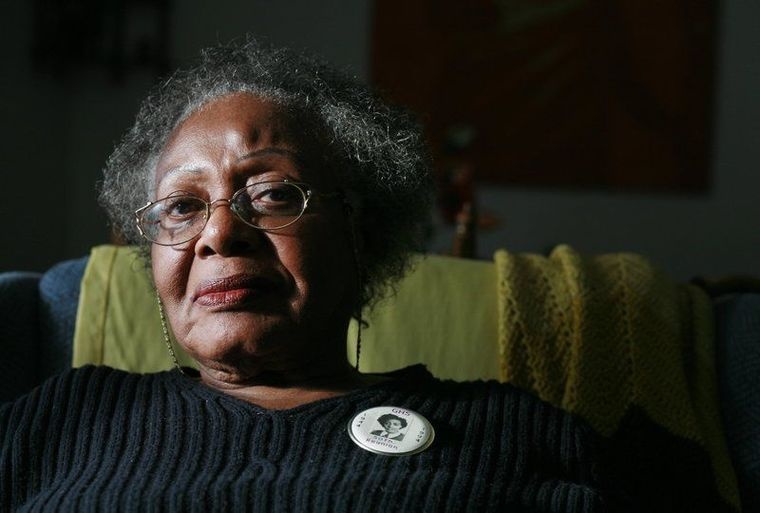
My friend LaVerta Terry, died five years ago. She worked with the Black Student programs at Indiana University. More importantly, I now realize that her best gift was as my friend. We laughed often and well. We went to the opera and marched to address racist behaviors or in support of a student who had been excluded or verbally wounded by hateful language. LaVerta would say “The more opposition I faced, the more I decided I could make a difference, but to do this I had to make some people uncomfortable.” We strategized as to how to make changes and not only talk about them. I can hear her still, saying “If all we are going to do at church is talk, talk, talk, I’ll be waiting outside the door to walk, walk, walk.” LaVerta taught me much — talking is good; walking is better; strategize to get up and make a change; make a new friend; and, laughing together can’t be beat.
How not to cure an illness? Just read the label? Okay, what are you planning for next year? Any new friendships in your future? Let’s check in again next October.
You don’t have to go to Pharoah to design a course on freedom, so says Professor Michael Eric Dyson, of Vanderbilt University. Per usual, Dyson puts the pith into pithy. We need his clarity as we enter Black History Month 2023. Right on time, Michael Eric Dyson nails the ugliness, the meanness and inappropriateness of Governor Florida Governor Ron DeSantis’ efforts to block the content of AP African American Studies curriculum.
This is but a contemporary example of a governor standing in the schoolhouse door. It is like George Wallace in 1963 who sought to block African American students Vivian Malone Jones, Dave McGlathery, and James Hood from enrolling in the University of Alabama. This time it is a governor seeking to block the free exchange of ideas and a shared knowledge of a painful history. It is an attempt to keep us from acting like respectful adults, as people open to the free expression of differing ideas.
But, what about us? It’s too easy to pick on a demagogue stirring up racial animosity as he prepares to run for the presidency. How might churches faithfully respond in this time? Let me speak for my group, the United Methodists. We, who are heirs to John Wesley’s legacy, have a ready response built into our theological DNA. Sadly, many of our congregations and denomination institutions have forgotten and often don’t display it. Early Methodists, in cities like London and Newcastle, formed a Strangers Friend Society. Wesley taught Christians “should meet strangers in their own habitation.” These societies designed “to visit and relieve the sick and distressed” were expressions of acceptance and inclusion. One such society still meets, weekly, in John Wesley’s New Room in Bristol near a clock identified as the Strangers’ Friend clock.
In the United States, the distressing illness of racism continues – sometimes it seems to overwhelm. Let me suggest it is time for United Methodists to turn STRANGERS INTO FRIENDS. What if United Methodist congregations across the nation and world offered classes in Critical Race Theory or on Being “Woke” to Racial Injustice? Okay, not realistic, you say. Well, what if… oh, let’s say 50%, or 25%, or even 10% of United Methodist congregations offered such courses? What if pastors and lay leaders in these places taught complementary classes based on Biblical sources and drawing on curriculum already developed by fine faculty in our seminaries?
In a time when all Christians, especially United Methodists, are too focused on much less relevant matters like institutional survival, or on how to handle our divisions, what if we called for healing of the disease of racism in our nation. What if we acted like we believed in a conversion (a wokeness). What if we called for the need of repentance and conversion from our chronic racism?
I can imagine certain politicians’ discomfort when they passed the church with the sign “Critical Race Theory Taught Here, Monday evening at 7:00 PM, Register NOW.” It’s about time!
What an interesting coincidence that the violent attempt to overturn the presidential election of 2020 occurred on the day Christians celebrate Epiphany! On the first anniversary of that ugly day and as another Epiphany arrives, it seems appropriate to reflect on the relationship between them.
Epiphany comes from a Greek word meaning “appearance,” “manifestation,” or “revelation” and is commonly linked with the visit of the Magi to the Christ child (Matthew 2:1-12). The Magi, from the region of what we know as Iraq and Iran, were foreigners who studied the stars for signs of divine presence and revelation.
An implication of Matthew’s story is that the God made known in Jesus the Christ reveals God’s self in multiple ways and to ALL people. God’s saving presence is not limited to our religion, our race, our nation, our culture, our political party. God is sovereign over ALL!
This week a note popped up on my calendar dated, October 1st, 2020. It was a reminder to do a little one-year analysis of progress made regarding racial justice in the U.S. It read: “Next year consider if any thing more than reading and talking about racism has been done in your networks over the past year. Let’s check annually.”
I chuckled to myself. Since writing that note I had sat in on a number of conversations. Back in the summer and fall of 2020, following the tragic murder of George Floyd, and several other murders, folks were ready — to talk. I preached a few times. There was much conversation and study. Many church folks joined reading groups. There are many fine, fine books and some good conversation that has taken place. I am encouraged and at the same time dubious that real progress was being made.
If one has a headache, and the doctor prescribes aspirin, is it enough for the patient to sit and read the aspirin bottle label and not take the medicine? If a person is diagnosed with cancer, should the patient only review the research on carcinogens and treatments? Racism is endemic in our nation. We seek to make a difference every generation or so, only to fall back into old patterns of bigotry, separation and discrimination. Ours is a repetitive cycle of two steps forward and then one back. Yes, we are making progress, but we have miles to go and we are only progressing a few yards each decade.
My dear friend, LaVerta Terry once told me that “It’s going to take a lot more than reading and talking for things to change.” She reminded me of the quote by Frederick Douglas, “I prayed for twenty years and received no answer until I prayed with my legs.”
Research done decades earlier, in the 1970s, part of a program named Project Understanding, taught me that church people like to sit and talk. Getting up and doing something is much more challenging. Many like hearing challenging sermons about justice — well, okay, some folks like them, not all. I laugh thinking of folks who would leave worship following a “prophetic” sermon seeming so grateful I had railed against racism or sexism or homophobia. One fella, many years ago, thanked me at the door following such a sermon saying, “That was good, we like it when you talk dirty to us.” Yikes, is that all some these sermons were? Just a scolding? Treating the congregation like a collection of bad adolescents? Are they just a public rehearsal of “oughts, musts and shoulds” that cause folks in the pew to squirm?
My friend, Laverta Terry
Since that research on racism now nearly fifty years ago, I have seen over and again that there is a better way to deal with racism than reading or preaching. In the 1970s we would challenge congregations by asking “Did your church spend more on light bulbs or toilet paper in the past year than on programs in the community supporting racial justice?” Maybe we should be asking that question again. There are ways to engage with persons across the racial lines that continue to separate and harm. There are ways to “walk our prayers into existence.” Whatever your race or ethnicity, we can do more than read — we can ACT, LEARN, BEFRIEND, TOUCH, LAUGH as we PRAY.
Yes, marches for justice are necessary. Yes, passing the voting rights act is essential. We also need to take account of how our institutions spend time and money. What will have changed for us when October 2022 comes around?
My friend LaVerta Terry, died five years ago. She worked with the Black Student programs at Indiana University. More importantly, I now realize that her best gift was as my friend. We laughed often and well. We went to the opera and marched to address racist behaviors or in support of a student who had been excluded or verbally wounded by hateful language. LaVerta would say “The more opposition I faced, the more I decided I could make a difference, but to do this I had to make some people uncomfortable.” We strategized as to how to make changes and not only talk about them. I can hear her still, saying “If all we are going to do at church is talk, talk, talk, I’ll be waiting outside the door to walk, walk, walk.” LaVerta taught me much — talking is good; walking is better; strategize to get up and make a change; make a new friend; and, laughing together can’t be beat.
How not to cure an illness? Just read the label? Okay, what are you planning for next year? Any new friendships in your future? Let’s check in again next October.
Juneteenth is officially a national holiday. Good. Great even! It is an annual remembrance of when news of the Emancipation Proclamation ending slavery finally reached Texas, 1865. It had taken two and a half years for the news to arrive from 1863. Today, it has taken 156 years for our nation to make Juneteenth a national holiday. Check out the poem by the Rev. James Forbes (https://www.youtube.com/watch?v=Aafi3a9-eS8).
Some say the Juneteenth holiday is only symbolic. The challenge of addressing racism requires more than a holiday, or two if you count ML King Jr. Day, every year. Each of us, each of our communities, must determine our responses to persistent racism. As an ole White guy who acknowledges my own struggles, who has worked to address racism and thought much about it, let me offer three suggestions for predominantly White folks to consider: 1) Being a friend; 2) Defining the problem; 3) Acting our way to new ways of thinking.
Dr. William Pannell
Friendship. Dr. William Pannell is a friend; a longtime friend with whom I have spent too little time. It was in the late 1960s when we first met. Bill’s book “My Friend, The Enemy” was published in 1972. Over the years while our paths have occasionally crossed; the message of his book has remained as a companion with me. Bill is Emeritus Professor at Fuller Theological Seminary for whom that seminary’s African American Church Studies Center is named. Bill wrote of our “Pigmentocracy” where “whiteness” was automatically, often unconsciously, given a higher status. He said if our national dilemma were given a color, that color would be white. Bill valued the paradoxes of racial engagement in the United States. He was an early teacher of the value of moving past easy dichotomies — one could at the same time be both friend and enemy when ensnared within the dominant culture. He noted that the challenges of racism aren’t going to be solved by simply changing the hearts of individuals, one at a time. Bill, who was a professor of Evangelism, believed in conversion and also noted that an individualistic proscription (changing hearts) was inadequate. Something deeper and more substantial was needed.
The friend might also be an enemy, or at least live and work behind enemy lines. Friendship, based on an honest knowing of the other and an honest awareness of the matrix of systemic brokenness, was critical, if racism was to begin to be addressed. Bill spoke of a gross ignorance of one another exhibited across racial lines — especially the ignorance folks like me have about persons of color in our society. Bill wrote “my White brother taught me to sing, ‘Take the World, But Give Me Jesus.’ I took Jesus. He took the world.”
Racism Defined. “There is not a racist bone in my body.” I heard these words again just last week. Typically, they are spoken by a person who would define racism around the single notion of prejudice or personal bigotry. Can one be racist and still believe that they view all persons equally, no matter the race? Well perhaps, but racism has a larger definition. For now, let’s simply begin by saying understanding racism needs to include both individual prejudice as well as systemic discrimination. There are cultural inequities as well. The person who said “there is not a racist bone in my body” also attended schools that were racially segregated. That person also benefited from national housing policies preventing Blacks from the mortgage support offered to whites, from educational and health advantages and from employment options over the years. Benefits offered to one generation accrue and are passed on to the next. The ways racism shapes our everyday lives, over the years, is wide and profound. If one thinks racism is only about individual attitudes, he or she, is ignoring the benefits accrued to and for them over generations.
Acting our way to new ways of thinking: Last Juneteenth, as our nation was reeling in the wake of the murders of Ahmaud Arbery, Brianna Taylor and George Floyd, I watched with some discomfort as well-meaning folks made plans to address the persistent racism in our nation and in my denomination. You see, almost fifty years earlier, I had been involved in research on racism and how it might be best addressed by the church. (My research drew on research of over 1,100 persons in six cities and over forty congregations, and also included studies that went back decades further.) I remember having some blow-back last year when I advised pastors “don’t preach that sermon on racism now.” If they did, it was probably too late; but certainly a sermon alone was inadequate. If you are going to preach it include some action as follow up.
We like clear and simple formulas for success. You know, the “five things that will make your life better” type of things. In the church this has been particularly true. I have often thought that church growth, or solving the dilemmas associated with the broad national move away from Christendom in our time, would better be labeled “the Church’s one fixation.”
So, when I suggested that there were better things to do than preach a sermon or hold a book study, I knew my counsel would not be heard or would be misunderstood. I kept saying it is more important to make friends with people who are of a different race. It is important to work together on some project to address racism than have a book study. At the time, I knew such counsel was futile. After all, a book study is so much easier to organize — and be counted. Don’t get me wrong, there are some very good books out there. Read them; even better, read these books in a racially diverse setting where the likelihood of some substantial change is much greater.
Last summer, within a few weeks, I watched as study programs on diversity and efforts to teach cultural competencies were offered. It is all well and good… but these efforts are insufficient and can even be counterproductive as folks think, “We’ll now I have the cure.” Again, this is about more than educating an individual or changing hearts and minds one at a time. Until we walk alongside persons living in a different racial reality, we will have difficulty understanding the breadth of white privilege. Until we establish lasting friendships we will miss the necessary struggle to establish meaningful, structural ways to address generational racial inequity. Go ahead, name your friends… or, make some new ones.
October 21, has been designated Global Ethics Day by the Carnegie Council for International Affairs. It’s a good and timely thing to give attention to virtue as we approach the selection of leaders in our nation. In this fortnight we reflect on virtue or ethics. What is “the best” way forward? What values, principles, intentions should be reflected in our personal and corporate actions? Where do we see evidence of the good, the true and the beautiful?
Virtue is born of our deepest beliefs, values, attitudes and desires. It finds expression and shape in our habits, our learned behaviors as these are repeated over and again until they are taken-for-granted as the “right” way. In this second fortnight post, we focus on the care that needs to be given in challenging what some believe is to be normative. I would ask, where is the virtue of immigrant children who have been separated from parents? What is valued in the denial of climate change? Should wearing a mask be a political statement when others may face harm by a neglect? Can any ethical person, let alone a Christian person, ignore the value of the health and well-being of another?
Aren’t these critical questions for all persons of faith — who is my neighbor? — how shall I therefore live my life? Will deception or lie be seen as normal? Will perpetual shading or spinning of the truth, or “gas lighting” (offering false stories) become appropriate for our leaders?
Aristotle offered four virtues: prudence, justice, temperance and fortitude. These have become known as the “cardinal virtues.” The church later added the three “theological virtues:” faith, hope and charity (from I Corinthians 13). These became “the seven virtues.” Others have said virtue is evidenced in that which is good, true and beautiful. Okay — nice overview — but how will we therefore live? And what is the test for these seven virtues or this this triad? How will we know the good, the true, the beautiful?
Few ethicists have shaped my thoughts more than Glen Stassen. He spoke of the guidance offered in the Sermon on the Mount where over and again Jesus points to the fruit borne in lives well-lived. In his work Living the Sermon on the Mount he writes: “I am suggesting that even though we do not know all there is to know, and we do not have the certitude of a universal viewpoint, we can see within our own history what kind of ethic comes through, which is truer because of the fruits it bears.” The theme throughout the Sermon on the Mount is “doing,” “producing,” “acting.” Here is joy and deliverance from deceit. (See Living the Sermon on the Mount, pp. 192-199).
Ivan Illich spoke of virtue as the “habitual facility of doing the good thing.” With a sharp and critical eye on our institutions (schools, hospitals, church and our politics), Illich notes a failure to accomplish primary stated purposes. Other values, he suggests, are given preferred over that which is truly the good. The love of neighbor is somewhere lost in the maze of social interaction. Some are excluded. “No category, neither law or custom, language or culture can define in advance who the neighbor might be.” (see David Cayley’s The Rivers North of the Future, p. 30). Illich often points to the parable in Luke’s Gospel spoken of as “The Good Samaritan.” It is the “expert in the law” who says he has kept all the customs and rules who challenges with “And who is my neighbor?” There is a rupturing of traditional categories in the answer Jesus gives. There is a call to conversion, to change.
Theologian Nancy Bedford calls on Christians “To Speak of God from More than One Place.” When leaders are reluctant to speak against White Supremacy or suggest that other nation’s and peoples are to be disrespected, there is an effort to link God’s purposes to my small, small world of my self interest… to my unwillingness to share. There is a signpost along a country road not far from my home. I chuckle each time I pass. It simply reads “Entering-Leaving Gatesville.” A single sign, same message, front and back, all on one post. For many, the reach of virtue, of ethical concern, begins and ends in one place.
The folks of Gatesville are lovely people I suspect. They clearly have a good sense of humor an perspective. This is important. Sadly, when awareness and care for the neighbor is lost, when our beginning and ending is at the edge of our own skin and ego, then we lose an ability to know the gifts we are offered in community, in diversity, in journeying to new understandings.
When thinking about practical virtues of in daily life, I am also helped by folks like Shirley Duncanson, a retired United Methodist pastor in Minnesota. Her posts in “A Pastor’s Heart: Thoughts on Life and Faith” offer clear and practical assistance. Writing on “Recovering Christian Ethics in an Age of COVID-19,” Rev. Duncanson offers cites the work of Barbara Brown Taylor’s pastoral experience in wise counsel: “The only way out of a pandemic is by all of us working together . . . Each of us doing our part . . . Each of us caring for people around us . . . Each of us using the means available to us to protect one another . . . Each of us holding tight, (in our hearts) to one another . . . And all the while, making sure that no one, but no one, is left behind.” (see: https://shirleyhobsonduncanson.com/tag/barbara-brown-taylor/).
+++++++++++
“Love does no wrong to it’s neighbor; therefore, love is the fulfillment of the law.” Romans 13:10.
++++++++++++
Poem by Linda Ori, 2004
The Time of Truth

The time is now
Let change begin,
Blend heaven and earth
In an endless spin,
Wherever you're going,
Wherever you've been
Now change your direction
And travel within;

The time is now
To take a good look
Examine your life
And the roads that you took,
From cover to cover
You've written your book
Did you swim in the river
Or sleep by the brook?

The time is now
Get your head on straight
No more indecision
To love or to hate,
Since you are the author
Don't blame it on Fate,
Take control of your future
Before it's too late.
Each autumn, as harvest-time nears, I re-live a surprise. Now, in early walks on crisp, chilled October mornings, I am reminded anew. I look to see if Jack Frost has spray-painted fresh abstract art on meadows. Recollections of other autumns come: hayrides, jack-o-lanterns, golden, maroon and salmon colored maple leaves gathered and pressed in the pages of an old encyclopedia. Or, I recall watching children “bob for apples” in an old wash tub or remember sweet, steaming cider served by a fireplace.
PublicDomainPictures.net
As I gaze to discover if hoarfrost has tinted a field in a crystalline hue, a rime-like shadow reaches across my consciousness. Perhaps the year was 2011; or thereabouts. A lovely autumn day and I am traveling across the nation’s farm-belt from of a distant meeting to my home, several hundred miles away. It promises to be a leisurely drive.
There being no urgency, I think of long-time friends. They work a large family farm. I will pass nearby. Hospitable folks, these. We exchange annual Christmas greetings. Every few years, some special event might bring us together. Each time — scribbled on a holiday card or spoken in a face-to-face visit — is the same gracious invitation: “Please, come visit; just drop by, anytime; no need to plan ahead.” I would nod, saying I would love to see their place; and, mean it. Still, years passed and the visit was never made. This would be a day I could stop. Surprise them.
PublicDomainPictures.net
This visit was the first of several unforeseen miscues that day! Readers familiar with the ebb and flow of agricultural life already know my error, my blunder. My surprise landed right in the middle of harvest. From sunup to sundown, and sometimes longer, combines whirled, rumbled and slashed. Farm trucks carried grain to the elevator cycling back and forth and back again unloading their bounty. This “surprise” visit was a first unforced error of the day.
When I greeted her on the phone, I should have picked up the overwhelm in her tentative voice. “Yes, so good to hear from you. Today? Well, yes, we would love to see you. The fellas will be gathering in the barn at noon. Can you make it by then? It is quicker if you take the county road over to our place. Come to the house first. You can help me carry over the lunch.”
Slow witted me! It was only as the call ended I realized I had bushwhacked them right in the middle of harvest! I was the city-slicker dropping by announced from the outskirts of hell.
I made it to the farm with a few minutes to spare and immediately offered my apologies. My friend only smiled and said, “It’s okay. You can help carry these things to the car.”
Arriving at the barn a half mile away, we pass the Pioneer Seed signs, the fuel pumps and grain storage elevator. Parking by an old John Deere we walk into a large structure with huge sliding doors at each end. It is full of implements: tractors, planters, harrows and several charts and computers along the western wall next to a small office. I am reminded that farming is an ever more sophisticated business.
We set out the lunch on a long table. Slowly others, family and farm hands, gathered. My friends introduce me as “a preacher friend who came by to pray for us today.” Okay, my turn to be surprised. So, I pray for a good harvest, for safety and well-being of all in our world during this harvest. I kept the prayer short knowing folks were eager to get back in the fields before rain might arrive.
Ample portions of chipped ham sandwiches, potato salad and iced tea are served. Some peanut butter cookies followed. There is teasing, talk about the weather, feeding the barn cats, and a few questions about mutual friends and grandchildren. Knowing the need to return to combines and trucks soon, I am amazed when my friend goes to his small office and returns handing me some papers. “Your going to enjoy this,” he chuckled.
It is a printout from an old dot matrix printer. Here before me were a collection of “jokes.” Reading the blue inked words, were some of the most offensive, racist jokes imaginable. They were about the President of the United States. Surprise hardly captures my emotions. It was closer to horror.
Still, I care for these people. My friend thought I would be amused, but this had burst across a divide in our worlds. I was confused, sad, disgusted, tongue-tied. I knew there was racial animus and bigotry toward Barack Obama, but surely not here. These were my friends, my good Christian friends.
I wish I could tell you of my courageous response, of my righteous witness. As I remember it now I didn’t say much, only mumbling “I don’t find this very funny.” A human hoarfrost was now stretching across our faces, our conversation, challenging the core of our friendship.
Soon, I was off, watching the dust of the combines in my rear view mirror. I was on my way home — back to another world, my natural habitat, an urban setting, on a university campus.
This surprising harvest occurred nearly a decade ago. Each autumn its memory returns and I realize it was a harbinger of much that has unfolded in our nation, especially in the last four years. Without any sense of irony, these are “good Christian folks,” at least in the way the see themselves and are seen by others. Even so they had burst open my easy assumptions.
They had reached out with hospitality to me — at least before I made my raid on their assumptions and routines. Racism is not the exclusive property of country folks. Many, many rural folks do not accept such bigotry; but many do. And yes, racism is alive and well in our cities and suburbs too. Still it seems to wait along the corridors of everyday activities to suddenly startle and divide us.
I have thought much about the culture that shapes these friends and their religious and political perspectives. Through study and conversations with many farmers, I know more of the stresses on those who today seek to make a living following a plow. I better understand the racial and cultural divides that can so easily be manpulated into fearful mistrust and misinformation.
I have learned that agriculture is changing dramatically, at an ever more rapid pace. Industrial-style agriculture is extraordinarily expensive and risky. Debt is high and weather is increasingly unpredictable. It is destined to change. It will ultimately be replaced by models more attune to sustaining the land, water and soils. Efforts to farm with perennial polycultures, like those being researched at The Land Institute in Salina, Kansas, will hopefully offer new options.
I am sad for my friends who carry the heavy load of racism and fear (and probably economic threat) that limits their ability to see the depths of racism that damage the soul of our nation. I pray they learn — in their church or social gatherings — of the ability to see others as persons of worth and dignity. I am saddened by the urban/rural and cosmopolitan/ localist divides in our nation and world.
I suspect my farm friends think me to be a “latte drinking urban elitist.” Even though, I don’t like latte! And, I am mindful of my own limited vision and fears that shape my understandings.
Richard Longworth’s fine book “Caught in the Middle: America’s Heartland in the Age of Globalism” offers compelling insights into the challenges of those who currently farm in America. He notes the phenomenon of vertical integration wherein every element of farm activity, from selecting seeds to spreading fertilizer to selling in a market is controlled by a large agribusiness — and not the farmer. As Longworth puts it, “Why own the farm when you can own the farmer?”
I don’t excuse the racism of my “friends.” Not at all. Nor do I miss the reality that a deep social/cultural divide was already emerging on the day I burst in on them. I fear such racism has only taken up greater residence in the minds of good people who now share their “jokes” on Instagram or Facebook rather than on a dot matrix printouts.
Something else was harvested on that October day a decade ago. My unacceptable silence was surfaced. It is the silence of too many of our churches, too many of our cultural and political leaders. What might I do better to express theology that valued all as Children of a loving God? How might I do better at harvesting respect, hope, love for the neighbor AND the stranger?
Perhaps I am overly optimistic, but it appears a harvest is underway in our society regarding racism. In the midst of the tragic deaths of folks like Breonna Taylor and George Floyd a new awareness seems to be possible. I suspect my farm friends don’t see anti-racism activities in the same hopeful light that I do. I see these as a sign of a potential harvest of hope — a sign that increasing racial justice might some day arrive… a time when the frozen assumptions and categories of our common life are thawed. It is not easy, not for my friends or for so many others caught up in the swirl of human distrust.
As I write a national election is only days away. I pray the current patterns of racism and ugly vitriol encouraged by the current national administration will be rejected and fresh sense of respect and the valuing of our common life can be harvested.
No matter the outcome, I will plan to make another visit to my farm friends — it has been too long since I saw them. Be assured I won’t bushwhack them again during harvest!










 Hands of the Strong