Planet or Plastic? Earth Day 2024

 Planet or Plastic?

Plastics are overwhelming our earth. Micro-plastic pollution is found in our drinking water, our food and even in our own blood streams. Every piece of plastic ever made is STILL in our environment. Amazing.

Today is also the beginning of Passover, Pesach. A time of remembering. A time to retell the story of what we are called to do and who we are to become as God’s people. It is a retelling of the escape from captivity. It is a time to reconsider where we have been and where we are going. Can we remember, turn around and move in another direction?

We have been living in a captivity to our hungers for extracted wealth from our earth, a tragic environmental Ponzi scheme, a plundering of nature — a using resources which should be set aside for our children and grand children. This over-exploitation has been increasing each year.  We in the United States lead in extractive exploitation.  If the entire world lived as we do it would take the resources of FIVE EARTHS to provide sufficiency.

We face the question today, how then shall we proceed?

Enter Wes Jackson — someone who has been thinking about this dilemma for four decades.  Jackson is co-founder of the Land Institute in Salinas Kansas.  Elaine and I stopped to visit back in 2019.  I had read his work.  I knew of his friendship with Wendell Berry; and, I confess to being more than a little star struck.  After all Wes was one of the early recipients of a MacArthur Fellowship.  I expected our visit to last an hour and then be on my way.  

IMG_0950
Wes Jackson and his “computer” July 2019

We talked through the entire morning and toured the institute research facilities and farm research plots in Salinas.  (Other research goes on around the world where institute scientists are working to discover new paths of regenerative agriculture.) 

I found in Wes a friend… and mentor — someone with a deep concern, clarity about his vocation and a surprising light-heartedness.  He confessed the dilemmas we all face.  The human contradictions faced as we move from our extractive and fossil-fuel based systems.  We laughed often; spoke of authors who had influenced us (Ivan Illich, Walter Brueggemann) and spoke of the need for a broader dialogue between science and religion.  I loved it when Wes brought out his “computer” to take notes. It turned out to be his old Underwood typewriter!

Wes Jackson was more than a farmer and scientist. He is a person who has done his theological reflection about our creatureliness and relationship with the ecosphere. There were more than two dozen scientists and interns at The Land Institute seeking to establish perennial polycultures, developing perennial grains, legumes and oilseed varieties that can be grown together replicating the patterns evident in native ecosystems.

IMG_0953
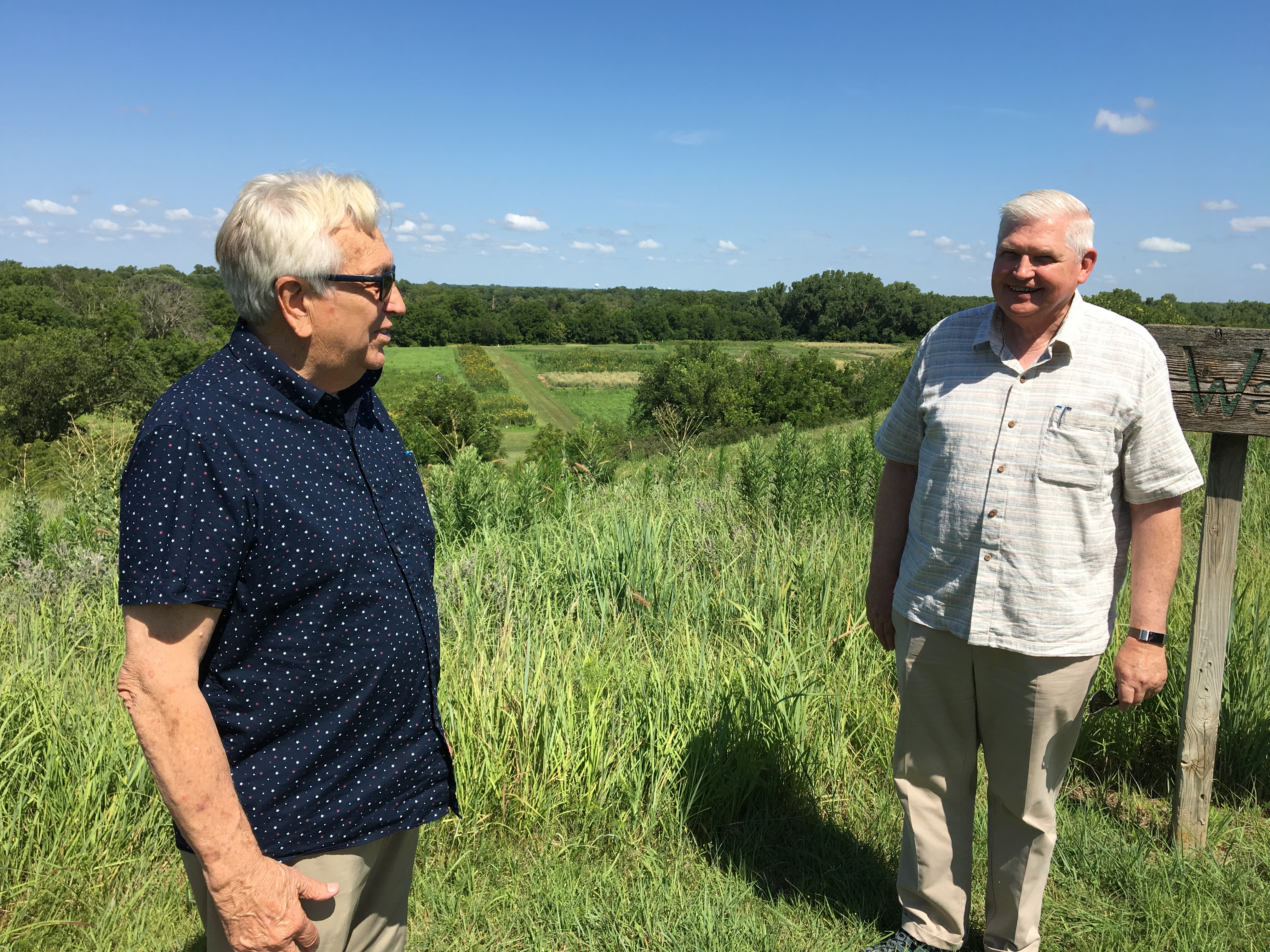
Wes Jackson at Land Institute, July 2019

We stopped on a hillside and Jackson pointed out the native prairie grasses and the cultivated fields below. “Modern agriculture” he argued has been moving in ever more destructive ways for the past 10,000 years. The Green Revolution, and the heavy use of nitrogen fertilizers, did produce more in the short term; however at the same time they were depleting the resources of our soil, water and fossil fuels ever more rapidly. 

In late June, we will come to Earth Overshoot Day. The day we have used up the energy needed to see us through a year without extracting more. It is a day when we can admit our captivity to oil and gas — and their extract — plastics. Forgive my saying it, but it is about theology. It is about who we are and where we are headed as we live before a God and who asks us to continue in the co-creation of our planet.

I give thanks for the true “master theologians” of our time like Wes Jackson.  He told me he had been “excommunicated” from his United Methodist Church in Kansas several years earlier by a pastor who considered him a heretic. On this Earth Day, I wish the church had more heretics like him.  Maybe with time it will.  Whatever your theology — or even if you have none — let’s work to make this happen sooner rather than later.

This is also the beginning of Passover 2024. Pesach — a time to remember who we are and what it means to live with responsibility for our actions.

Changes in our behaviors must come if our grandchildren are to receive the gifts of this wonderful planet with which we have been blessed. We are using up our natural resources 1.75 times faster than they can be replenished! 

Woke Smoke

Woke Smoke

I work up this morning, birds chirping outside.  Good thing.  It “beats the options” as they say.  Sorting through “news” of the day, I read a strange, recurring theme – one word repeated in many places.  The word?  WOKE.  It has been used in disparaging ways for a few years. In government, education, religion, and more there are warnings of the dangers of “woke-ness.”

Dozens of arguments in recent months seem to begin and end with stressing the dangers of being “woke.”  Nothing much more.  Just a label, a four-letter word that carries a dumptruck load of fear and grievance.   Here are a few examples from this past week:

  • Bill Barr, former U.S. Attorney General, warns of “wokeness” as a reason he would support the former president, that grievance-filled ghost of an administration-past. Mr. Barr earlier called him “a grotesque embarrassment” but one idea had tipped the scales, had caused him to reverse.  It was a concern about being W-O-K-E!
  • After 92% of the Indiana University faculty voted “no confidence” in President Pamela Whitten, sadly, the response from many was the claim this was ALL about “woke-ism in the academy.”
  • Well documented and tragic reports of the destruction coral reefs around the globe are presented.  Sure enough, there it is – responses calling it “woke science.”
  • Pope Francis is viewed favorably by 3/4ths of American Catholics, even so, there are disgruntled ones, some bishops and cardinals, who call him the “woke pope.” 
  • The newly formed “Global Methodists” are issuing warnings that upcoming United Methodist General Conference will be overrun by persons with “woke theologies.”

There is, of course, a history of how this word has evolved in use.  For some it is a verb, as in the past tense of “wake.”  Here it means to be alert, aware, attentive.  A decade or more ago scholars began to employ it as an adjective common in African-American vernacular speech, as in an awareness of racial discrimination and prejudice. This was the threat – and the opportunity – presented to many who didn’t want to be awakened to the racism in our society.

The word was repurposed, turned inside out and upside down.  It became a quick way to avoid dealing with the realities of discrimination in our society.  It is a way to flood the zone with smoke – to hide and obscure the need for conversion.  It gained currency as a powerful “code word” allowing the user to avoid thought or conversation.  It avoids the hopes for a civil society.  Rather than being alert to a new day, experience or danger, it is turned into a verbal cudgel.  It becomes an imprecise way to avoid facing our nation’s history and bigotry.  An avoidance mechanism.  Our nation’s original sin of racism is dodged by using a single word.  Nice trick – avoid and redirect the word as a weapon.

Critiquing something as “woke” is lazy.  It is a way to obscure, suppress, and avoid any call to rethink the old assumptions and categories. It demonstrates that change is always resisted; it is difficult. What’s the old saw?  Only a baby with a wet diaper is comfortable with change. 

For a fine reflection on a Biblical way of understanding the importance of “woke” as a spiritual activity, look to Dr. William Lawrence’s, “When the Church Woke.”  Bill, former dean of the Perkins School of Theology, points to the Biblical call for wokeness – it is about conversion, metanoia, deep personal and social change. 

https://www.umnews.org/en/news/methodism-overdue-for-becoming-woke-author-says

Glad I woke up this morning.  I am reminded of Lamentations 3:22-23, “The steadfast love of the Lord never ceases, his mercies never come to an end; they are new every morning; great is your faithfulness.” 

As with many things, one can choose the lazy path of chirping out the fearful words, “woke, woke” and avoid an honest, healthy way forward.  Instead, one can let the smoke clear and choose to be woke in “hope, hope” shaped by active care for others and for the healthy and honest ways forward.

The “Good” in Good Friday

The “Good” in Good Friday

Perhaps I was six or seven when the question first came.  What is “good” about Good Friday?  Our lives are full of questions; or at least mine is.  These days most of my questions are about more mundane things, like “How did those spots get on my shirt or on my necktie?”  Any man over seventy-five will understand.

After more than seven decades, the more profound and intellectually jarring theological question about the goodness of Good Friday still stirs in my spirit. I don’t have the one right, true answer as many of my conservative friends suggest they have.  The soup stains on my necktie are so much more easily explained.

Other friends, more secular searchers, ask, “Why a focus on the cross? Isn’t there a better, less violent, symbol?”  Without answering, I think of all the modern-day crosses people bare. I have been with families after a painful death, a murder, a rape, or a drowning.  There are realities of starvation, war, captivity, and financial ruin. Abuse and discrimination are crosses of a different sort. Sin is woven within the human condition.  Evil is present. No matter our desires for something less violent and more velvet — there is brutality and death.

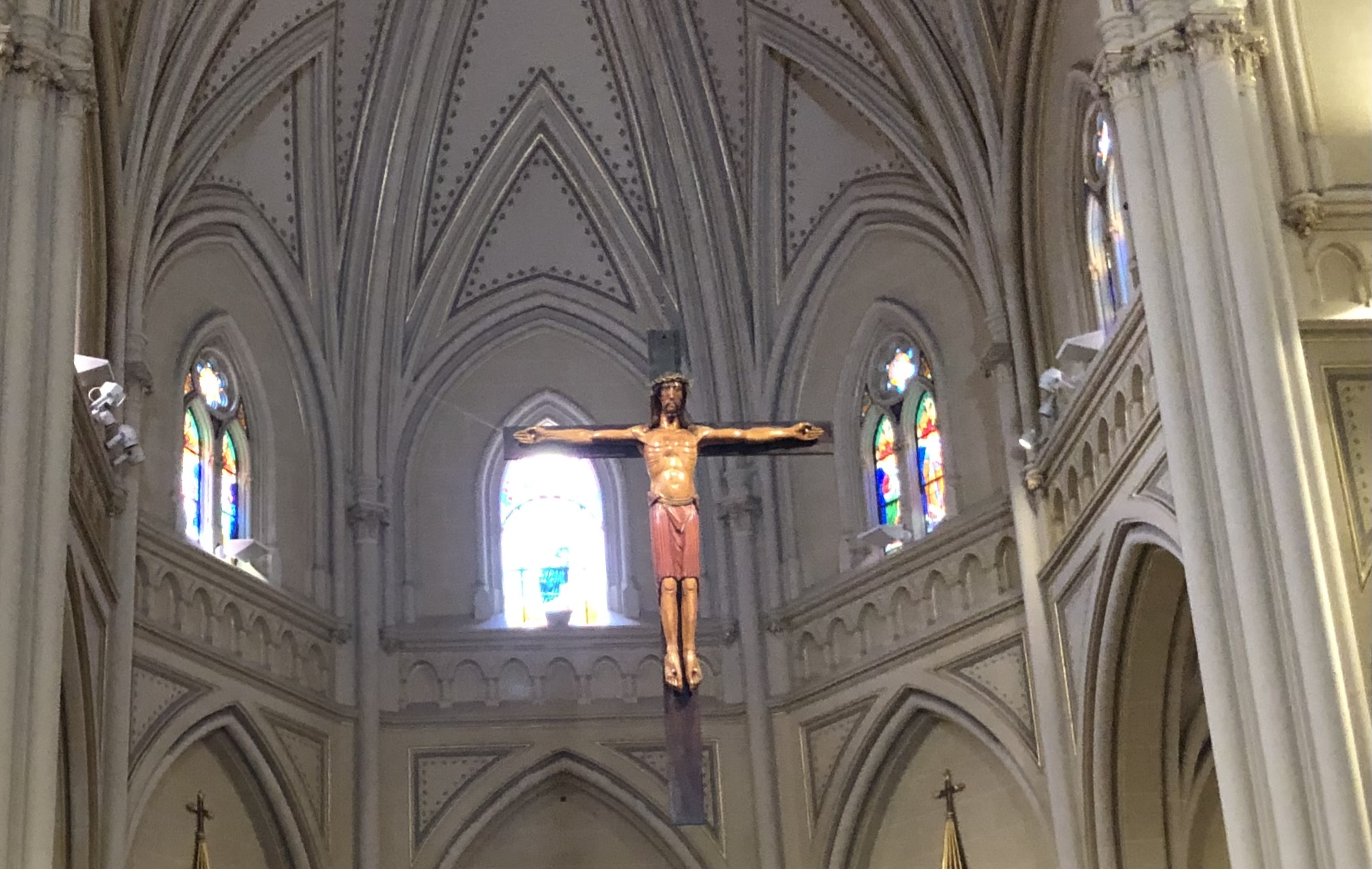
Catehdral de San Isidore in Argentina

I recall the historic theories of the atonement.  Jesus’s death is portrayed as Ransom, Substitute (suffers for), Penal (suffers instead), Example, and Victor. Each theory today is understood in decidedly individualistic ways.  It is a quid pro quo formula as in Jesus did this and I get some reward. Such theology appears deeply embedded in St. Paul’s perspective (I Corinthians 15 or II Corinthians 5).  

It was my beloved New Testament professor, Robert Lyon, who challenged me to think beyond this; to think more deeply and widely.  The word study he assigned me was on the word λύτρον, meaning either redemption or ransom (Mark 10:45 and Matthew 20:28).  I can still see the twinkle in Bob’s eye as he said, “And the context? Who is this ransom for and why?  What is the larger Biblical frame?”  These were the years of the Vietnam War and Civil Rights struggles over racism and sexism.  Bob wasn’t dismissing classic atonement theories out of hand; he was asking for more – for a deeper grasp of the whole of the scriptural story.  What does “ransom” have to do with justice?  What if this is bigger than an individualistic transactional act? What if it is transformational for the entirety of God’s purposes?  What if it is not primarily about one’s personal “free of sin” credit card?  What if it is for ALL and for the entire Creation!

Walter Brueggemann suggests we speak of the execution of Jesus rather than his crucifixion. ALL THINGS are seen as potentially redeemed and redeemable: corrupt institutions, the violence of every empire, the despoiling of creation.  Brueggeman speaks of God’s purposes as displayed in the life of Jesus as prophetic imagination.  He speaks of “the alternative world that God has promised, and that God is birthing before our very eyes.

For me, even with food stains on my shirt, the questions in my spirit find greater meaning. This is the GOOD in Good Friday – God’s promise displayed for all persons and all creation.  If we have eyes to see it and the will to live into it.

Ides of March 2024

Headlines from Bloomington, Indiana – Ides of March, 2024

Local woman wears a hardhat when outside in her yard; permanent jewelry store opens; wheelchairs available in state parks; and, seven in ten (7 in 10) pregnant women test positive for toxin found in weed killers. 

Story one: Angela Connor, 64, has been doing battle with a pair of red shouldered hawks in her back yard.  For over a year, the protective raptors have dive bombed down attacking her from behind when she is gardening.  After suffering several attacks and lacerations from their talons a friend offered a remedy of sorts.  “For some reason they don’t attack the white DeWalt hard hat” when I wear it she said.

Story two: “Permanent Jewelry Store opens in the Mall.”  Is it the jewelry that is permanent?  or is the store?  I suspect neither.  Perhaps my epistemological understanding of “permanence” needs an update.

Story three: Motorized wheelchairs are now available for free in many Indiana state parks.  Good news.  Thanks to the ADA this may be a permanent option — for a while at least!

Story four: Speaking of permanence and mobility, recent research finds four times more amounts of the poison dicamba in the urine of pregnant woman than was present ten years ago. In Indiana, we value healthy corn and soybean crops, (5.4 and 5.5 million acres respectively) and our lovely lawns.  Are we choosing healthy corn and weed-free-yards over healthy children?  Weed killer residue is carried in wind and water miles away from where it was applied.

Summary: I’m glad (sorta) that raptors are protected by federal law; in the future my impermanent body may still see natural beauty via a motorized convenience; I pray we learn to value healthy soybeans less and healthy children more.  And, amid this cavalcade of news, I failed to mention the governor authorizes carrying of firearms in State House. That’s the news that’s “printed to fit” the majority sentiments from Indiana today.

Locked up in the Rush County Jail

Locked Up in the Rush County Jail

Tears fall from her chin; she carries a never ending uneasiness. Ashamed she waits.  In a nearby cell, he fidgets, knees bouncing uncontrollably, repentant without a path to forgiveness, he waits for a phone call.  Both have made serious mistakes. Life-altering condemnation results, closing off future options. I do not know these two personally, but I can “see” them sitting alone, or with a cellmate, or standing in shackles in a courtroom.  Such scenes continue across my state and our nation.  Each person has a name, a history, a family, friends, and enemies waiting on the outside.

They have “done harm.”  Some crimes are extremely serious, I understand.  Much of the damage, however, has been done to themselves and their loved ones. This self-harm is often rooted in addiction or psychological illness. Some are dangerous to themselves and others.  Sometimes, not always, these who sit and wait have journeyed through poverty, homelessness and/or abuse. We all lose. In Indiana alone the estimates are that opioid addictions cost the state between $4 billion and $5 billion in lost revenue, incarceration, and recovery expenses every year.

I write of “Rush County” jail more as metaphor than the actual place. There is a Rush County; Rushville, Indiana is the county seat. It is grand old town, where Wendell Willkie headquartered his 1940 campaign as the Republican candidate for the President.  It is east and south of Indianapolis.  Traveling south and east it is on the way to Cincinnati. With a population of roughly 6,200, it is like hundreds of towns dealing with the scourge of addiction and other illness. It is a symbol that across the board, once arrested, so many are rushed to vilification, only to languish in jail.  It is quick judgement and slow justice. The wheels of our legal system grind ever more slowly as so many weep and wait for that phone call.

In Monroe County, my home, our jail is a disgrace – overcrowded, unhealthy, and understaffed. Monroe is regarded as one of the most progressive counties in Indiana, yet every month seems to find another incident reflecting the horrors of our jail. We have a fast train into jail and a slow walk to trial. This, despite a sheriff, judges and commissioners who diligently seek to change the situation and build a safer facility.  It is already too late for so many. 

Our county jail is only a few blocks from where I live.  Walking along the sidewalk paralleling the jail I see scrawled messages in chalk or paint.  These are messages of hope, love and encouragement to prisoners who can look out and see what friends and family have written.

Over my decades as a pastor, I have met with, walked alongside, and known far too many who are like the two persons imagined in the opening paragraph. I do not know names of those currently in Rush – or Monroe – County facilities.  I do know these are not only imaginary.  These exist, just as surely as you do, good reader.  I know parents and spouses, children today who have loved ones being held, awaiting trial.  

I may not know or understand all the “crimes,” but I do know there are currently over a half-million such persons held in over 5,000 local jails and youth detention centers in the U.S.  There are another 1.5 to 2 million persons held in state and federal prisons. Our nation consistently has the highest incarceration rates in the world.  Our practices still have the mark of primitive and counterproductive logic.  It is built on monistic, either-or understandings of human behavior and psychology.  It is not far removed from shameful practices of shunning, exclusion, and projecting our fears on the most vulnerable among us.  Are there evil actors? – yes, of course.  Might our systematic response be greatly flawed? – yes, of course.

Frankly, much of what continues is often based on simplistic theologies of good and evil that are subject to manipulation and misuse by the wealthy and powerful.  We have become experts at isolation and seem to know very little about restoration. Our young believe our systems are rigged in favor of the wealthy. Are they not? I find myself thinking of the families who see loved ones locked up for minor crimes of addiction, while at the same time watch a former President of the U.S. use his power and wealth to manipulate the current court systems to avoid trials and dodge accountability. 

We spend more than $182 billion on incarceration each year in the United States.  Increasingly this is built on “for profit” prisons, that turn incarceration into a profit-making venture with the inmates as customers-without-a-choice facing exorbitant expenses for phone calls or other prison “benefits.”

I am far from being an expert on how to best address these concerns.  There are many acronyms for efforts underway, already proposed and practiced. Over the years I have seen us turn to more flexible sentencing, home confinement, halfway houses, drug courts, mental health courts, restorative justice and/or restitution options, community service, etc.  It is a complex system, filled with obstacles and some more enlightened practices.  My appreciation for conscientious judges, defense and prosecuting attorneys, sheriffs, jail and police officers is enormous.  I am grateful for, and applaud, all those who are pushing for reform, for a better way.  Still, too many languish behind bars, weeping alone and waiting for that phone call.

The Principle of Clarity

Full text of Bloomington Rotary Reflection Notes 2-7-24 (Parts were edited out at presentation for brevity.)

Mark Twain once said: “When I was a boy of 14, my father was so ignorant I could hardly stand to have the old man around. But when I got to be 21, I was astonished at how much the old man had learned in seven years.”

There is another side to this wisdom.  For me, now that I am in my late 70s, I am often surprised by how little I know.  Wendell Berry and Wes Jackson have written we need to often add an “Ignorance-based world view.”  Philosophers call this the Principle of Clarity.  The administration of Indiana University would benefit from a familiarity with this Principle of Clarity.  Clearly the administration’s failure to support the Kinsey Institute and canceling of the exhibition of Palestinian artist Samia Halaby at the last minute after months of planning demonstrate an abandonment of Academic Freedom that is dependent on open conversation and dialogue.

I mention Wes Jackson in honor of our speaker today who, of course, offers much valued alternative perspectives on agriculture. Wes is a geneticist, farmer, winner of MacArthur Genius award for research on perennial polycultures at The Land Institute in Salina Kansas.

As we enter Black History month while facing continuing racism exhibited by candidates for the highest offices in our nation and in a world filled with violent problems that seem intractable, there is need for open-minded clarity.  If you are like me, it is too easy to live in an information bubble, supported by confirmation biases. Without looking at events from multiple perspectives, it becomes easier to argue than to respectfully disagree. It leaves us in zero-sum worlds where an understanding the opposite person’s perspective and experiences are disregarded.

Last week, Traci Jovanovic offered a helpful word about knowledge of others related to the war in Gaza.  It caused me to think of my second visit (of what I think are now six trips) to Israel/Palestine; this in the 1988.  Mickey Mauer invited many civic, corporate, and religious leaders from Indianapolis. We met with Israeli and Palestinian leaders in political, economic, and educational arenas.  Near the end of trip, several of the Indy leaders held an unscheduled meeting seeking to come up with a solution they could offer after hearing from a few of the many sides in the region.  It was 40th anniversary of State of Israel and in the early years of First Intifada.

My friends, these leaders, were going to suggest ways to fix things. After a few minutes, feeling discouraged by the well-intentioned naivete of some, I left the meeting and sat in the bar with our Israeli tour guide and Palestinian bus driver. We chuckled together about the well-meaning effort to find easy solutions to struggles that had gone on for decades, centuries, well… millennia.  Indiana Jones movies were popular in those years.  I recall the Palestinian bus driver saying, with a wink to the Israeli tour guide, “Well, maybe these Indiana Joneses can solve things.  I wonder have they fixed all the problems in Indiana?”

Humility is a virtue that is enhanced by honoring the Principle of Clarity. For those of us who are Christians, it is worth noting that the keys to the Church of the Holy Sepulcher in Jerusalem have been entrusted to Muslim families for hundreds of years because the various “Christian” denominations and sects struggle and disagree over who should have what spaces in the church.  Alas.

One of my friends over the years was Palestinian Christian Rev. Alex Awad.  He worked with United Methodists who visited the region, was pastor of the East Jerusalem Baptist Church and taught at the Bethlehem Bible College. Several years ago, Rev. Awad suggested that perhaps the future will need something more connected at the grass roots, something deeper than politics. He said, “People must start dreaming about Palestinian and Jewish children playing together without refugee camps, segregation walls and tanks.  Then we can truly call it a Holy Land.”

Israeli peace activist Amos Oz has written “I believe that if one person is watching a huge calamity, let’s say a conflagration, a fire, there are always three options. 1. Run away; 2. Write a very angry letter or hold a demonstration; 3. Bring a bucket of water and throw it on the fire, and if you don’t have a bucket, bring a glass, and if you don’t have a glass, use a teaspoon, everyone has a teaspoon.” In his book “How to Change the World” Oz suggests everyone can join The Order of the Teaspoon.

I am glad there are some people in this room working to find BIG SOLUTIONS to war and violence.  There are also small things we can do, right here, now, at home.  Welcoming the immigrant, finding shelter for the unhoused, saying no to racial prejudice and discrimination, seeking to mitigate domestic violence and gun play on our streets.

Jon Paul Dilts heads our club’s peace building committee.  He reminded me that February is Rotary’s “Peacebuilding and Conflict Prevention Month.” The February issue of Rotary Magazine offers several grass roots ways to seek clarity – to work across differences.  Much of the brokenness in our world has been ongoing for centuries, millennia.  Big steps and small ones toward peace are required.

I close with the wisdom of my friend Wes Jackson who said, “If your life’s work can be accomplished in your lifetime, you’re not thinking big enough.”

America’s UnCivil Wars

Republican Presidential Candidate Nikki Haley, campaigning in New Hampshire at the end of 2023, was asked a simple question “What caused the U.S. Civil War?” Haley’s response was word-salad. It was mumbo-jumbo talk about differing theories of governance. We hear you loudly and clearly Nikki Haley. One hundred and fifty-eight years after the end of the U.S. Civil War, she was unable to give the clear one-word answer to the question.  It was SLAVERY.

If anyone believes racism isn’t deeply embedded in our national psyche, our politics and civic discourse these more than fifteen decades later, they are either ignorant of history and/or unwilling to confess a sin that continues to erode our best future. There is considerable irony, of course, that the question was asked in New Hampshire.  New Hampshire is a state from which thousands of brave young men gave their lives to end slavery.

The answer Nikki Haley gives – or fails to give – underlines our need for national confession of sin, repentance, and reconciliation. It exemplifies our continuing Un-Civil Wars. If the Confederacy had prevailed in 1865, would someone like Haley be able to hold political office today?  One wonders. Yes, there are several auxiliary causal factors to U.S. Civil War; however, why avoid the basic truth?  It was, and is, wrong for human beings to be treated as property to be held and sold? This was the crux of the war — the evils of racism as evidenced in slavery.

On April 9th, 1865, General Robert E. Lee and the Confederate Army of Northern Virginia surrendered to General Ulysses S. Grant at Appomattox Courthouse, Virginia. Five days later President Abraham Lincoln was assassinated in Washington, D.C. A surface telling of the history misses that thousands of troops continued fighting after April 9th and April 14th

It also misses the continuing Un-Civil Wars across these past fifteen decades (Reconstruction, Lynchings, Jim Crow Laws, Segregation, Red-lining in housing, Unequal school funding and dozens of other discriminatory acts). The UnCivil Wars continue today as is evidenced clearly in voter suppression efforts and racial gerrymandering. Racist impulses and ideologies continue to shape our political conversation and actions, national values, and self-understandings. If one believes otherwise, please explain why Haley’s answer could not have included one simple word?

Christmas Emptiness

Christmas Emptiness

Emptiness. Manger Square, Bethlehem, December 23, 2023, is abandoned.  Most years, every square meter of the space would be filled, maneuvering among the crowd, difficult. Christian Palestinians in Bethlehem, in solidarity with those in Gaza, have canceled Christmas. The Lutheran pastor says, “if Jesus were born today, it would be under the rubble of Gaza.”  And nearby, among Israelis, the horror and grief of October 6 when families were ripped apart, children murdered, women raped, and hostages taken, and who even now are being tortured persists and widens.

Israelis and Palestinians deserve better. Still, decades long pent-up anger and distrust has erupted in an unimagined violence. Slow boiling political chicanery, terrorism, and bigotries mostly built on lies and prejudices now rob the people on all sides of options. Emptiness. No room left for rational thought or basic humanity.

No room left for recognition of another as a human being. Robbed by millions of deceits, papercuts on the soul, there is no space for mutuality, companionship, or love. The prefrontal cortex is severed from the reptilian parts of the brain. A single option appears the only one — revenge, revenge, revenge.  Empty of alternatives, life on all sides is reduced to terror. 

For those of us, observers with broken hearts and conflicted loves, there is another kind of emptiness. Those who know, respect, and love both Jews and Palestinians, live in a wasteland of uninhabited hope. Our carefully crafted dreams and visions for humanity are shattered. And what of our own bigotries and behaviors? What of the ways we discount and exclude those we fear? What of our treatment of those without shelter, who struggle with addictions or who come to us as immigrant?

We suffer with a similar, yet a differing void.  For so many Christians, the mangers of our souls will seem vacant, emptied places this Christmas.

Some Seek Shelter Still

Some Seek Shelter Still

The Christmas story speaks of a family without shelter. Mother, father and newborn child they are. The record says they found refuge in a stable, a barn. They were on a journey, seeking a place of safety and stability. In our cities and towns, along our borders and spread across our world are those who seek shelter still. There are many efforts to respond. 

Attached is a podcast on homelessness. Our daughter, Lydia Murray, who is a Managing Director with Deloitte consulting is one of those interviewed. Apart from being proud of Lydia and eager to share her wisdom with others, I believe the listener will find a respectful, up-to-date overview of resources and some ancient wisdom in this resource. Perhaps you can take a moment during the Christmas season to listen and learn how to better respond with those on the edges.

https://podcasts.apple.com/us/podcast/governments-future-frontiers/id1708237666?i=1000639030791

Remembering those who seek shelter still, Merry Christmas.

Autumn’s Sweet Temptation

Autumn’s Sweet Temptation

I was tempted.  This morning.  Even in my late 70s, the seduction was strong.  Autumn leaves. Raked in a mound. Go for it… jump up and in!  I remembered the joy of such flight up and in a mound of crunchy crimson glory as a child.

Walking home from the barber shop, I spied the leaf-dome someone had piled together the day before.  At age six or seven or ten, there would have been no doubt about it.  Leaves might be designed for photosynthesis and then mulch but in the second week of November, banked high they were meant to be jumped upon, rolled in, and enjoyed!  The colors, the smells and cushy landings are autumn’s gift and a child’s hankering.  Don’t stop to worry about hidden objects — tree branches, or broken glass, or rocks or… well, a surprise gift from a passing pooch. Go for it?

“Nope,” thought I. Too old, already landed on too many hard realities over the years.  I’ll wait until the grandkids arrival for Thanksgiving visits.  See then if any autumn offerings are in the neighborhood. Perhaps still dry, piled high and ready for love.  Wouldn’t want to miss that joy for my leaping into some foolish temptation now.