Ten Predictions – United Methodism Summer 2016

Ten Predictions – United Methodism Summer 2016

[July 10, 2016 — First, an apology — many of you are not United Methodists and care little about the ecclesial wars underway in the denomination of my birth and my ordination.  Forgive my need to offer this set of predictions at this time.  More importantly, what is happening in our nation now, following the tragic murders and wounding of police officers in Dallas, along with the police shootings of African American men in Minneapolis and Baton Rouge (and beyond), only places in sharp relief the relative insignificant meanderings, bigoted and contradictory activities of United Methodism these days. We UM’s are in search of our true identity.  Would that we might find again ways to speak to the nation of the power of love to overcome fear.  So, I write this perspective, these predictions on United Methodism 2016.  We are a denomination in search of our soul.  Pray for us.]

Ten Predictions about United Methodism — summer of 2016:

United Methodism’s structure is akin to the old cosmological suggestion that the world rested on the back of a turtle.  And what is beneath that turtle?  The answer comes, of course, it is said, “it’s turtles all the way down!”  In United Methodism it is conferences all the way down!

This spring and summer, in the United States, there are conferences on top of conferences (General Conference was in Portland in May), on top of this are Annual Conferences (56 in the U.S) and this week we will have five Jurisdictional Conferences where bishops will be elected.  I will spare the reader my perspectives on each of these, except as they lead to the ten predictions outlined below:

Prediction #1. For the next decade at least, the word “omnishambled,” a new word to recent editions of the Oxford English Dictionary, will describe the denomination.  There will be very little that can be said to be “United.”  I recall the wedding bulletin nicely printed for a ceremony many years ago.  It read that the wedding was being held at the First Untied Methodist Church.  Spell check missed it — UNTIED rather than UNITED.  Well, we are headed into a decade of Untied Methodism.


Prediction #2:  More and more annual conferences will be acting independently.  They will be rejecting the bigoted constraints adopted by the recent and future General Conferences.  This is already well underway.  This summer several annual conferences voted to act in ways that are contrary to the “official stances” of the church.  These conferences will refuse to act against pastors performing same-sex weddings, they will support the ordination of GLBTQ persons, they will act in support of reproductive rights organizations and they will seek a more just way forward in the relationship between Israel and Palestine.
Prediction #3: The 2016 Jurisdictional Conferences held in five regions of the U.S. this week will be an “inflection point” for leadership change in the church.  The theological and leadership commitments of the fifteen new bishops will shift the church to a more centrist and left-of-center place in the U.S.  While the power of right-wing groups like the Institute for Religion and Democracy, the Good News Movement and the Confessing Movement were evident in Portland at General Conference, the reality is that such locked-down opposition to alternative perspectives will not carry over to these Jurisdictional gatherings.  Look for several, perhaps a majority, of courageous centrists and progressives to be elected.
Predication #4:  The Western Jurisdiction will elect the first openly gay bishop in the denomination.  There are currently two strong candidates.  This will produce widely spreading ripples across the denomination both of approval and dissent.
Predication #5: In reaction to these developments (annual conferences challenging the official stances of the church and the election of the first openly gay bishop), a small group of U.S. United Methodist bishops will seek to hold punitive church trials against pastors who perform same-sex ceremonies.  One such trial is already underway in Kansas at the urging of Bishop Scott Jones. 
Prediction #6: Increasingly these clergy trials will become more problematic and counterproductive for the traditionalists.   They will be opposed and dismissed as foolish by a majority of folks in the pew, younger clergy and Christian friends outside the denomination.  Instead, in most U.S. annual conferences, so-called “just resolutions” will be worked out with clergy who disobey the strictures of the church.
Prediction #7:  There will be ever more organized efforts to hold the denomination together, with the hope of keeping as many at the table as possible.  One such group is the United Methodist Centrist Movement that is growing in strength especially in the North Central Jurisdiction (see: UMCM).  They speak clearly of the need to welcome a broader range of voices, against church trials and for support of local congregations.
Predication #8:  The old and sadly familiar pattern of scapegoating the Western Jurisdiction as a place of rebellion will increase in many quarters.  However, there will be growing appreciation of the way the Western Jurisdiction has remained steadfast in its witness to an alternative vision for the church.  One compelling and insightful voice from the West is the Rev. Jeremy Smith.  His recent reflections on the role of the Western Jurisdiction are, to my mind, prescient (see: Jeremy Smith’s Hacking Christianity)
Prediction #9: The cost of doing general church business for boards, agencies, council of bishops (travel, staff, meetings, programming) will become ever more burdensome, even overwhelming.  Attempts to do institutional work out of the same ‘global church’ paradigm as in the past, will cause the 2020 General Conference to make dramatic cuts in budget, program design and staffing.
Prediction #10:  Slowly, over the next decade, the United Methodist church in the U.S., at least the church that remains (there will no doubt be some splintering) will focus more on relationship and less on programs, more on conversation and less on spectacle, less on top down decision-making and more in the building of communities of support, and more on finding a third way forward.
Yes, these predictions do project an omnishambled future for United Methodism; still they are in the end hopeful.  The move to a place where relationships are valued over program and conversations over spectacle will require new leaders — like those I pray will be elected bishops this next week.  Conferences of the future will be less about performers on stage and more about those who gather around tables to share, listen and learn. 
We have reached the limits of the strategies by those who would seek to impose corporate systems and lockstep programs for growth on the church and her clergy.  There has been too much “talking down to” and too little listening to the genuine articles, the clergy and laity who carry out ministry in local settings. We will discover the value of what some social scientists call “positive deviance.”  It will require a looking for and listening for different perspectives on the church and ministry.
At one recent annual conference as hundreds of the clergy gathered for what is called the “clergy session,” there came a need for conversation among those gathered.  (Such conversation is, by the way, the basic idea behind a “conference.”  It is, in United Methodist-speak, “watching over one another in love.”)  However, as it became painfully clear, in this session clergy couldn’t converse — there were no microphones available in large hall of the convention center.  Clergy colleagues wishing to raise a question or make a suggestion couldn’t hear one another.  The bishop seemed surprised that there would be a question or a conversation needed.  He simply said, “We didn’t anticipate this.”
We shall see which of these ten predictions come true — I would bet on most of them — but I am especially clear that conversation, genuine and respectful conversation, will make a return in the next decade if there is any hope for renewal.


Lessons from the House on Park Street

Lessons from the “Soon to Be” House on Park Street

logoHabitat

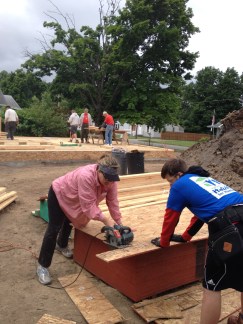
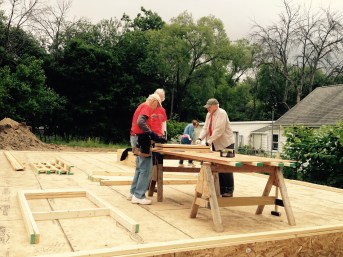
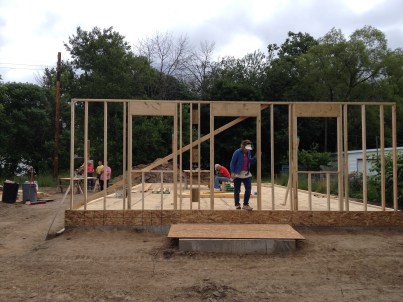
Some of you have asked about the house I am building this summer.  Well, not me exactly… but the house I am helping our local Habitat affiliate build as a way to celebrate my 70th year.  This, of course, is not “my house” or “my build.”  Soon, some deserving neighbor will call it home — after putting in hundreds of hours of “sweat equity,” they too will have the joy of a home with a manageable mortgage!  Still, I am grateful for those of you who have made a gift so that this work could go forward this summer.  Thank you!

IMG_1464

IT IS GOING WELL!  So much is happening so quickly.  The construction manager Keith Hite is a marvelous teacher.  (Keith teaches building trades at New Prairie High School.)  And thanks to groups like the folks from Alcoa Howmet Corporation in La Porte, the decking was in place and so much more was ready for those of us who were volunteering.  As a result, we are further along than we anticipated at this point.  We are ready for the dozens of volunteers coming over the next several weeks.  (Yes, you can come and help — just contact us at: LaPorte County Habitat website.)

It will surprise no one who has ever been a “Habitat Build” that there is always a great deal of laughter and lessons to be learned.  My great joy was to work with Bill, Jim, Sharon, Carter, Mike and Suzie.  Dozens more will help this summer.  It was Bill who offered me two lessons on my first day as a volunteer.

IMG_1461Lesson #1:  As we were beginning to put together the frames for windows in the walls, Bill looked over and asked “Did you pay for the whole hammer or just part of it?”  I immediately started to laugh because I knew the old joke.  I knew that it would be a good day.  My teacher had arrived.  “Hold the hammer lower and let it swing,” Bill said.  “Use it like you own the whole thing!”  That got us started talking and laughing.  Bill was a marvel to watch and joy with whom to work.

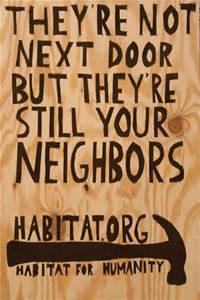
I discovered that Bill had been a volunteer on over TWO HUNDRED HABITAT FOR HUMANITY BUILDS!  He knew both Millard Fuller, the founder of Habitat for Humanity, and Clarence Jordan, Fuller’s co-conspirator at Koinonia Farm in Georgia.  As it turned out I had known both Millard and Clarence as well, and so the morning was filled with stories of how they taught that the gospel should be viewed as a radical document — especially when it comes to how we live our every day lives. We spoke of the “theology of the hammer,” and how Christian action spoke louder than all our words.

Bill told me of his church in Michigan.  He said Millard Fuller had challenged them to build ten houses in one of the early Habitat builds in Africa.  The churches in town were asked to stretch, dream big, and raise $15,000 so that ten (10) houses could be built in Africa.  It took a few months Bill said, but before long they did better than ten houses “We gave Habitat a check for $150,000 so that one hundred (100) houses might be built,” Bill said!  Yes, the gospel should challenge us to think radically and big about our resources and how we use them.

IMG_1468Lesson #2: As lunch time approached and we were expressing gratitude for the volunteers who were by this time raising the front wall together, Bill looked at me and said, “You know, there is only one time I have seen any volunteer asked to leave a build site.”  “When?” I asked.  He said, “there was once a fellow who when asked to clean up a small mistake in a wall being built responded with the words ‘Why? this will be good enough for the type folks who will be living in this house.'”  Bill said it didn’t take long for the construction manager to tell the fella to gather up his tools and not to return.

As to the fuller meaning of Lesson #2, I couldn’t help but consider the comparison with a leading political candidate who engages in racist statements, refuses to apologize and is still “on the scene” as a leader.  Why doesn’t Donald Trump’s political party have the courage to say, “Leave and don’t return until you are able to apologize.”   The morning paper today carries the powerful statement by Thomas Friedman entitled “Dump the G.O.P. for a Grand New Party.” (See: Thomas Friedman, June 8, 2016, NYTimes).  Here it is, the “Party of Lincoln” saying, “Well, yes, Trump is a racist but we will support him anyway.”  Amazing.  I want to ask, “Are you going to use all of the courage and moral legacy you claim or just a small part of it?”

Thanks to Bill — for his life given to gospel realities.  For me, these will always be treasured as my “Lessons from the ‘Soon to Be’ House on Park Street.”  Let’s keep Building!


Count it All JOY!

Joy in It!

I am told that Thomas Langford when dean at Duke Divinity School had a license plate on his pick-up truck that read “JOY N IT.”  My suspicion is that folks who didn’t know Tom, might have mistakenly thought he was expressing his joy in driving that truck.  Others of us who knew Tom, knew better.  He was perhaps speaking of the joy of the truck, but suspect he was also talking about the joy of a life of faith, of living and leaning forward, of imagining the joy of a life of gospel relevance.

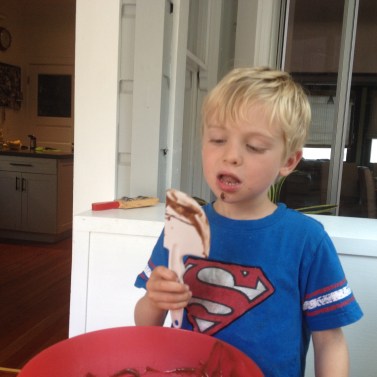
After writing about the current United Methodist General Conference an email came that challenged my call for repentance and accountability on the part of all of us, if we are to find a way forward.  The writer said he had no complicity in the current impasse and didn’t IMG_1003need to repent.  He said I offered no positive alternative.  Or, as he put it, “you call us to a whimper and a pout in our separate corners.”  Yikes, I thought.  Whimpering and pouting?  People who know me, know I like little more than a GOOD “conversation” — a solid and respectful debate often helps all sides come to fresh understanding, new truth.  There is, for me, Joy In It.  For me, a good learning experience is akin to my grandson Gus’ delight in cleaning up a bowl of chocolate cookie mix.

Conference gatherings for Methodists began in 1744.  The goal was to reason together about what should be taught, how it should be taught and how Methodists should live.  In recent decades our annual conferences leave little space for such conversations.

Annual Conferences are held in expensive (and expansive) convention centers where various interest groups and caucuses meet to plan on how to “win.”  Candidate slates are put together, text messages fly through the ether as partisans do their work.  Little time to listen to others here.  Worship becomes a show where some, up front, perform and we are to passively listen, or perhaps clap along.  I wonder when it was last suggested that we might sing together in harmony?

In my annual conference the expense of the big convention center means that we need to shorten the length of annual conference to avoid any extra expense.  Thereby we avoid more floor debate, time in small legislative gatherings and time for the inadvertent joy of making new friends.  “Come let us reason together” has been turned into “come-let-us-pass-the-budget, hear-reports, nominate-and-elect, have-performers-on-stage-and-avoid-lengthy-controversial-conversation.”  And then, a dear brother assigned to the role of speeding things up, comes to the microphone and moves to limit the number and length of speeches.  We are reminded of the expense of meeting in the convention center and we press onward and downward.

There is growing evidence of the health benefits associated with choral singing, the value of listening and harmonizing in song.  During our debates over human sexuality I have been aware that our Mennonite brothers and sisters are in the midst of a similar controversy.  Yet, they seem more able to hear those who differ, to make a welcoming space for diverse points of view.  Along with the Mennonite commitment to peacemaking, I can’t help but wonder if their practice of singing hymns in harmony (and not just having only performers on stage) might be of benefit to the health of the whole body gathered.

Today, J. Steven Harper wrote a hopeful piece regarding the decision made to support the U.M. bishops in hosting another meeting in a couple of years based on recommendations of a study commission on human sexuality (Steven Harper).  While I am more doubtful about a positive outcome, I join Steve in believing any positive way forward will require those who are involved to come with a humble and contrite spirit — a willingness to listen and set aside preconceived agendas.  If this could happen — what joy there might be.

Joy in it!  Hear the words from the epistle of James 1:2-5:  My brothers and sisters, whenever you face trials of any kind, consider it nothing but joy, because you know that the testing of your faith produces endurance; and let endurance have its full effect, so that you may be mature and complete, lacking in nothing.  If any of you is lacking in wisdom, ask God, who gives to all generously and ungrudgingly, and it will be given you. (NRSV)

Compass&BibleAt root, our differences will call for us to struggle with our interpretation of scripture and our various “captivities to local cultures” and step away from the worlds of narrow experience.  Folks like me will need to know how we can focus so narrowly on excluding gay folks based on a limited and questionable scriptural basis, and at the same time ignore other scripture “rules.” There are also “scriptural rules” on the role of women, divorce, the eating of pork, the wearing of synthetic clothing or the call to stone folks to death for many of our modern practices.


Fortunately there are good people who differ and yet who can joyfully engage in conversation with others who can provide us with helpful interpretive guidance.  Knowledge, reflection, empathy, relationship with those who differ can be helpful. I would like such a group to respond to questions about the dimensions of a scriptural hermaneutic behind the exclusionary paragraphs in our current Book of Discipline.

So… I offer to my friend ,who sent his email critique, more than a whimper or a pout.  My response might come with singing — learning again to sing in harmony.  It might come in talking and moving our annual conferences beyond being just about budgets, reports and votes.  It might change the ways we do charge conferences.   Might we sing and offer constructive conversations?  If we could, we just might be that we could again find JOY in being together.  If we could learn how to have annual conferences and charge conferences that offered space for relationship and for honest debate and conversation, we might lay the groundwork for more constructive general conference gatherings.  The burden is not just on the as yet unnamed study commission — it is on all of us.


1434 words

The Value of the Right Tool

The Value of the Right Tool

“If all you have is a hammer, everything looks like a nail.”  This idea is attributed to Abraham Maslow (and sometimes to Mark Twain).  It is variously known as “Maslow’s Hammer” or the Law of the Instrument. 

35198584_s

A variant version is “If all you have is a hammer, every challenge looks like a nail.”  I am learning again of the importance of having the right tool for the job at hand.

This past month I have been remodeling the basement of our home.  Don’t know what caused this lapse in my good judgement as I have only modest carpentry skills.  A true carpenter friend named me years ago, “just a TINK.”  I can tinker.  Still I have undertaken a rather major project of adding a bedroom and children’s play space downstairs. 

IMG_1380

Fortunately my friend, Jim Noseworthy, who has more experience “tinkering,” has been teaching and assisting me.  In the process I have leaned again the value of having the best tool for each task.  Things go much better if I have multiple tools and know which to use for each task.   Thanks Jim — and I have learned that hammers have little use in hanging sheet rock!  Squares and levels and cutting knives are a better choice!

In the process of learning, I have discovered again that I, too, am a tool.  There are things I have been designed to do, things I have learned, calling in my life where I am better able to make a difference.  While I am a “Tink” as a carpenter, there are other places where I add more value.

It is estimated that on any given evening more than one million folks are homeless in the U.S.  Another 12 to 15 million live in dramatically substandard and/or dangerous housing.  There are many tools out there one might use.  Some good ones.  Over the years I have a favorite — it is Habitat for Humanity.

thAs some of you know, it has been my goal in my 70th year to build a house through the good efforts of LaPorte County Habitat folks.  Last winter the local Habitat board was alerted to the fact that a matching gift of up to $35,000 was available.  Thus far, more than thirty (30) friends have given over $14,000 to this effort.  And, along with contributions from the donor so far (who has done more than matching these gifts) we have raised more than $32,000!  What a joy!!
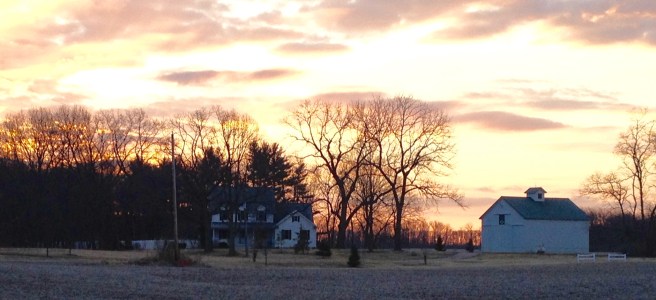

There are many good tools to address homelessness and inadequate housing… Finding the right one is critical. Thanks to all who are joining in this summers build in LaPorte.  The foundation is poured and “Tinks” will be needed this summer.  Any volunteers?  Come and join — make a gift — follow the progress online at Website for LaPorte, Indiana Habitat for Humanity.


An Ecological Dawning?

An Ecological Dawning

I am an early riser, one who enjoys watching the sun spread across the sky.  This morning I couldn’t help but consider it a metaphor for the new light I believe is on the horizon regarding our environment.  One reason for this is the reading I have been doing of late on this topic.  Yesterday, it was my honor to preach at Wesley United Methodist Church adjacent to the campus of the University of Illinois.  It was called a “teach in” as part of a national focus on faith and the environment.  I believe a new day is dawning in terms of public awareness and constructive action.

IMG_1327

It is not my intent to offer a reprise the sermon here.  Instead I have attached a link to a copy for those who are interested.  Here is my take away.  First, we face enormous challenges as a society, as a global community.  The damage has been severe, it will be difficult to reverse.  NASA now suggests that climate change is our nation’s most serious security risk.  Note the changes in the Arctic as our early warning system.  (The Petermann glacier in Greenland is receding more than twenty miles a year!)   Increasingly we are seeing a link with floods, wild fires and drought.  We will have more than fifty million environmental refugees by the year 2020.  This doubles the number of the estimates just twenty years ago. 

I know the dangers of climate change are very real — difficult (some say impossible) to reverse.   On the other hand, there are signs of hope, a dawning of awareness among nations, corporations and the general public.  It is my sincere hope that the U.S. Congress will one day soon catch up with the scientific evidence.  As the research is overwhelming clear, the Paris agreements are tentatively in process, and corporate and technological leaders are investing billions of dollars toward constructive change, it is our duty as citizens to press the case with Congress.  The cost of solar and wind energy continue to drop in price.  

It was a joy to be with a university community and see the commitments made by that congregation.  I spoke with several students who indicated a deep appreciation for the sermon — but more importantly a personal commitment as future engineers, chemists, business leaders and farmers to a different way of thinking about our economy and ecology.  Hooray for the gifts of great universities!  (Look for a post soon challenging the larger church to rethink our investments in and valuing of campus ministry.)

I know that change will be difficult.  Actually, it calls for a conversion — an ecological conversion, on the part of individuals, the culture and the economy.  The witness of people of faith is essential as part of any solution. All people of faith – especially the local church… these communities will need to find voice on these matters. As Pope Francis demonstrated with the issuance of the encyclical Laudato Si, Christians can bring a perspective, insight and inspiration for the future — for the dawning just ahead.

For the complete text of the  sermon, see: WesleySermon – Feb 14, 2016

The Last Apple

THE LAST APPLE

November 2015

IMG_1073

Autumn sharpens one’s imagination.  Days are filled with transition.  The weather teases — do we chance leaving the tomatoes on the vine one more day?  Was it frost last night, or nearly frost? When will the leaves turn?  Will they be mostly golden or red or brown this year?  Day to day, transition comes, sometimes slowly and sometimes in a burst.  Some things end, some things anticipate a spring.  

This year, again, I have been planing bulbs (300 of them in the last week).  Tulips, daffodils, allium.  I know better, especially setting those tulips in bed for the winter, as the deer find them irresistible in the spring.  I foolishly calculate that if 100 bulbs are set this fall, maybe 50 will survive, especially if I spred some deer repellent nearby next spring.  Okay, so sign me up as an eternal optimist!  Still, there is something compelling about autumn.  A thinking person and/or a person of faith will see this as a time for hope… or, so I tell myself.

Each fall I think of the haunting passage written by E. B. White who described his wife Katherine, as she aged, still kneeling each fall to plant bulbs.  He wrote: “As the years went by and age overtook her, there was something comical in her bedraggled appearance… her studied absorption in the implausible notion that there would be another spring, oblivious to the ending of her own days, which she knew perfectly well was near at hand, sitting there with her detailed chart under those dark skies in the dying October, calmly plotting the resurrection.” [Forward in Katherine S. White, Onward and Upward in the Garden, Boston: Beacon Press, 2002.]

I’m with Kathrine White — calmly plotting the resurrection, indeed.  As I plant bulbs and trees I am aware that I may or may not be around to enjoy them 15 or 20 years hence — but my prayer is that someone will benefit and thereby be reminded of the beauty and promise found in these autumn days.

This year I also planted trees — decorative plum, pear and magnolia.  They stand all along the driveway.  And there were three apple and two cherry trees planted last spring.  I find I have to protect them all from the deer, who like to munch on the apple or cherry tree leaves or, in the case of the other trees, the bucks will come and scar the trunks during rutting season. 

IMG_1064 We lost the old apple tree in the front yard this fall.  A friend who knows about such things tells me the tree was approaching its 100th year… but we watched as it slowly faded in health over the past three years.  Someone, a century or so ago planted this apple tree; perhaps, like me, hoping it would be appreciated by another in a distant future.  This fall the time had come; we had to cut that tree down.  Sad, as the old apple tree in the front of the house was one of the features we loved when we bought the place three years ago.         

In  mid-September, walking past the tree, I noticed one last apple hanging up among the few branches still clinging to life.  (For those of you wondering, I took a cutting off that branch, in the hope I might plant it next spring — yes, my hope springs eternal!)    The tree is now down, the wood cleared and stump ground up.   That last apple — tart and memorable — has now been eaten and enjoyed.  In my imagination, that last apple lingers, remaining for me as an autumn metaphor.

IMG_1052As my seventieth birthday approaches on the cusp of a New Year, I still think of myself as young.  I do this even when I am sometimes offered the “senior discount.”  And this without my even asking!  More and more often, when speaking of friends, I add the words “of blessed memory” upon mentioning their names.  Time passes, life’s autumn season arrives.  Thankfully it does not mean that imagination disappears.

It is not only friends who have passed on.  I find institutions and organizational cultures are often “of blessed memory.”  Some gifts of courage and quality of thought I saw in the life of others seem to have evaporated in recent decades.  I confess to grieving the loss of courage and imagination among many who lead my denomination, the United Methodist Church. 

It is strange to go to denominational gatherings and realize that there is little appetite or awareness of the need to speak prophetically on matters of justice.  In this early autumn season of my life, when I look at Indiana United Methodism at least, it is easy to feel like I am one of the last apples. 

(Thankfully there are a few other ‘last apples’ around, but too few.  Hopefully we are not the “bad apples” as some now seeking to reform United Methodism seem prone to suggest.  Please know that I am all too aware of the inadequacies that were abundant in earlier generations.  I remember the bigotries and peevishness of some laity, clergy and denominational leaders — I remember these well.  I also remember courageous bishops and pastors who spoke prophetically about racism, war and peace, sexism and economic injustice.) 

Today, few wise and clarion voices are speaking.  The denomination is knotted up a homophobic dystrophy.   There is silence.  Or worse, we find a continuation of bigotry and exclusion toward gay and lesbian folks, lay and clergy.  There is more — there is too often silence regarding issues of economic injustice or environmental destruction.   In May 2016, the denomination will join in another General Conference — signs are not encouraging.  In Indiana, I find so-called United Methodists have little in common with those who provided a place for the prophetic tradition over the past century. 

Maybe the old tree has been removed, chopped down, and I missed the felling of it.  Maybe.  There is an old saying the “the apple doesn’t fall far from the tree.”   I wonder.   Sometimes I look around and think the whole orchard has been moved or chopped down.  What was once Methodism has become something wholly different.  Perhaps this new orchard is one of persimmons or crab apples.  I am surprised by the way a pathetic, poorly articulated and distorted Calvinism (dividing the world into the “saved and the fallen” with no hope for transformation or renewal) has replaced the Wesleyan vision of redemption and perfect love.

Even so, I can’t stop kneeling and planting the bulbs — and trees — of the future.  I will still try to take cuttings from the old tree and see if these can be brought to life — and perhaps appreciated by someone 100 years from now.  Maybe I am not among the last apples after all.

Bring Down that Banner — And More

Good Riddance to One Symbol

Hurray and Harumph — the Confederate Battle flags are coming down!  It has been marvelous seeing the emergence of a public conscience in South Carolina.  Let the symbol of hatred and racism come down!  Across the South the Confederate Battle Flag is being removed from State House grounds and other public spaces.  Walmart, Amazon and Sears have each said they will no longer sell this symbol of racism and exclusion.   Good riddance, I say.  It is long past time for this emblem of slavery and Jim Crow structures of oppression and injustice to disappear.  Place it in a museum where it belongs.th

Still, I am a little uneasy about my sense of triumph over this matter.  Born as I was just across the river from Kentucky and growing up in an era when “whites only” signs were above water fountains in Louisville, I know that progress has been made with regard to symbols.  I also know that as a “Yankee” (just barely by geography), there is too often a false pride and sense that the problems with racism are only in the south.  I think of the appeal George Wallace had in Michigan when he ran for president or the treatment Dr. King received in Cicero, Illinois.  We northerners too easily believe the problems of racism are located somewhere else.

So, as the Confederate battle flag is coming down in Charleston, I am thinking about those other, less obvious, banners of phony privilege and separation that fly in every corner of our nation.  The removal of the Confederate flag should have happened long ago.  And, the removal of these banners does not begin to compensate for the lives of the nine people who were Murdered at Mother Emmanuel AME Church in Charleston, South Carolina.

The nine persons who were assassinated deserve more than this important symbolic gesture.  The millions who have lived with the tyranny of racial discrimination and implicit threat to their well being deserve more.  At this time of repentance and reconciliation, the lowering of symbols of hatred is not enough.  

Bringing down this flag is easy compared with ending the almost limitless access to assault weapons across our land.  How many more gun deaths will it take for us to stop worshiping under the banner of a erroneous interpretation of the second amendment?  When will we take down the banners of the NRA that fly over the heads of our congress and members of our state legislatures?  Those murdered at Mother Emmanuel Church were not only the victims of racial hatred; to some degree their lives were taken by our inability to establish appropriate limits on the availability of weaponry on our streets.  We will never know if more reasonable gun laws might have reduced the dimensions of this tragedy.  Surely, our apparent blindness to the easy access to guns — the tool used in this tragedy — must be considered when we think about the Charleston assassinations.

What other less obvious banners do we fly without thinking of the ways they contribute to injustice?  Who are our friends?  How do we spend our money?  Where do we worship?  How have we benefited from racial privilege… often in ways we do not recognize?  I have mentioned in an earlier post the work of Richard Rothstein (see for example: http://prospect.org/article/making-ferguson-how-decades-hostile-policy-created-powder-keg) and his valuable research on the history of racial privilege in housing.  Often, even the diplomas hanging on our walls are symbols of the ways our educational systems were shaped by racial privilege.

NO, NO, NO, I am not asking you to feel guilty.  I am simply saying that there is no room for false pride as the legislature of South Carolina finally does the right thing.  Instead, this is a time to be grateful for the actions those in South Carolina are taking to remove one symbol AND for us all to consider the ways we, too often, live under the benefits of other less visible flags of privilege.


Lessons from the Barber Shop

Lessons from the Barber Shop

barbershop-1

One of the challenges of moving to a new community is finding a barber.  For nearly eight years I had been in the hands of Manny, my barber — or his father before him.  I knew about Manny’s family and where they vacationed — and he knew about mine.  In our new home, I discovered yet again that starting over on haircuts can be both a test and a teaching experience.

As my appearance no doubt shows — I have never sought a stylist or looked for any of the extras offered by upscale salons.  Nope, I liked the democratic air of the good ole, two or three chaired, small barber shop.  These are the places where opinions are uncensored even if sometimes overblown.  Here is where you hear the young ones brag and the older fellas complain.  Here I can see my gray hair drop to the floor and watch as it is swept up into a pile along with the darker shades of hair from younger customers. 

I’ve tried nearly half-a-dozen barbers since settling in northern Indiana last summer.  Each one was a teacher, as well as a barber.  This I found true from the tattooed fella who gave a fine haircut, but was so good, that he always had a long line of customers ahead of me, to the old-timer who opined that he had been cutting hair since “Nixon was telling lies in the White House and, that none of those crooks following him there got any better.”  So, in the past year I have experienced a range of clips and snips, views of the news and an open-sourced set of opinions about life, love, politics and religion.

The barber shop is a place to listen in on everyday perspectives on the world.  Of course, these male refuges remain (along with our Sunday morning worship services) among the most racially segregated places in our society.  I like to listen, especially if I can stay anonymous.  I learn a lot, about how some folks are thinking about everything from foreign trade to who’s been arrested and why.  I’ve heard opinions on how to save a marriage and what’s gone wrong with the county fair.  I was able to learn a lot, that is until someone, usually the barber, asked me what I do for a living.  I get some cover by simply saying I am retired… but the questions keep coming and the truth is squeezed, like Brylcreem from a tube, out of me. 

“You’re a preacher, I thought so!” someone says, and with that, I lose the advantage of hearing unvarnished and often quite colorful language about life and the world around.

One of the joys of retirement has been the advantage of not being “on” as a professional Christian.  And, until I was recently “outed” as a retired pastor, I was able to listen in on colorful language and ribald boasting of men in the barbershop of a small rust-belt community of the Midwest. 

I listened to talk about the economy, politics and sex, baseball and hockey, motorcycles, farming, golf and flying model planes.  The talk wasn’t as full of victimization, anger, fear or racism as some of our talk-radio hosts seem to encourage.  Instead, these were folks seeking company, a good laugh or maybe a story to re-tell. 

Talk about the church, before I was outed as a pastor, wasn’t very positive.  The church was seen as a place trying to get your money, to build another building or where a fella would have to work all weekend at a fish fry when he would rather be just fishing.  Honestly, the church was viewed as just another program or another project to be avoided.  Yes, I heard the word “hypocrites” more than once when talk turned to church.

Please don’t misunderstand, while I don’t confuse what happens in a barbershop for important and potentially transformative work of the church, there is a lot that goes on in barbershops that is more honest and helpful than in much of what happens in churches these days.  It is about relationships, first; a story, second; and, some honest talk about the real world, third.   Of course, if we let folks know that church life could be this simple and direct it would put all our church consultants and revitalization specialists out of business.  And, building such relationships wouldn’t cost as much as a shave and a haircut!

It’s as my barber said last week, “You know, most people are hungry for someone just to listen to them.  When I remember that, I am happiest in my job.”  Should I tell the barber he is involved in ministry, or would this spoil it for him?

Hands of the Strong: The Order of the Teaspoon

The Order of the Teaspoon

The 2015 Lenten Season begins.  “From dust you have come and to dust you shall return” are the words we hear as millions of Christians receive the ashes.  They are daubed on our foreheads or hands in the shape of a cross.  Many enter Lent making plans for a specific “Lenten discipline” (something like giving up deserts, increasing prayer time or fasting at least one day a week).  And, with it goes the prayer that we will do better with our Lenten discipline that we did with that New Year’s resolution made just 45 days ago and already broken.

images

As we enter Lent, on the first two days, we are met with not one but two major speeches by President Obama.  He speaks on terrorism or as he would have it “violent extremism.”  He says that “we are not at war with Islam; rather we are at war with those who have perverted Islam.”  I agree.  In the background, the chattering classes have been quick to argue that he should use the language of “radical Islam” to talk about the the barbaric, inhumane and extreme actions against innocents by ISIS or ISIL in the Middle East.

I don’t pretend to be a foreign policy expert.  Even so, I remember the mistakes our nation made following the tragedy of 9/11.   In my view we were led into an extended war in Iraq and Afghanistan that was fueled too much by revenge and too little by knowledge.  We allowed understandable but blind retribution propel the U.S.A. into war.  We now can see the terrible price of the last fifteen years in terms of human casualties and wasted treasure.  Some at the time warned of an inevitable “blow-back” that would result.

As we rushed to war I was a part of a minority who felt engaging in Iraq was misguided.  My opposition was in large measure related to the failure to follow the long established ethical guidelines for a just war (proportionality of response, clarity of purpose, authority, prospect for winning, protecting noncombatants).  I remember being invited to speak at a seminar in San Diego on Ash Wednesday in 2002.  Nervous, I was even more on pins and needles when I discovered that the room was full of active and retired military brass.  Still I proceeded to speak about the ethical realities when considering military engagement.

I need not to have worried.  The folks in the room were way ahead of me.  You see, I learned that those who face the reality of warfare are more thoughtful and careful about these matters.  They not only took to my rather tepid presentation on Just War Theory.  They appreciated it.  They also spoke in private conversations about the challenges of fighting our perceived enemies on multiple fronts.  They also spoke of the differences between Sunni and Shiite sects in Islam and of our sloppy language and analysis.  We as a nation were long on emotion and short on facts.

I am not certain we have learned much in the intervening decade.  I have more Muslim friends and have been privileged to know several Imams who encourage their followers in practices that are decidedly open and respectful of persons from other faiths.  Still, in too many ways the current talk of war with ISIS seems strangely like the situation we faced in 2001.

One of the reasons I won’t be using the words “radical Islam” is that many of the people who are encouraging us to do so wouldn’t think of insisting that we speak of “radical Judaism” or “radical Christianity.”  These folks, often encouraged by Christian leaders like Franklin Graham, paint Islam as entirely evil and see us in a great battle of civilizations.  These “Fanatical, Apocalyptic Christians” believe these are the end times.  They suggest that we are facing an inevitable encounter with the evils of Islam.  This is the mirror image of the view of “Fanatical, Apocalyptic Muslims” ready to establish a caliphate.

What do those of us who are not fanatics and do not accept such apocalyptic notions of the future have to bring?  I remember a phone call to an Imam, a man I didn’t know, back in 2002.  “I hear that the children of your mosque are living in fear as they walk to school.  Might we help?”  It was the beginning of a remarkable friendship.

During this Lent, I will give up easy, sloppy language and foolish images about those who differ in their faith.  More I will commit to giving time to study.  Military engagement seems to be inevitable in the Middle East.  I reluctantly understand this.  The Israeli novelist Amos Oz has written a fine essay “How to Cure a Fanatic” (Princeton University Press, 2004).  He writes: “Fanaticism is older than Islam, older than Christianity, older than Judaism, older than any state or any government, or any political system, older than any ideology or faith in the world… Who would have thought that the twentieth century would be immediately followed by the eleventh century?”  (pp. 41-42).  Amos Oz speaks of the value of imagination and humor in the face of such evil.  The volume ends with an interview in which he speaks of the Order of a Teaspoon (pp. 93ff).

Faced with a calamity, say a conflagration, Oz says there are three responses we may have: 1) run away; 2) Get angry, march in protest, blame others and seek to remove leaders from office; or, 3) grab a bucket of water and throw it on the fire.  And if you don’t have a bucket?  Bring a glass of water.  And if you don’t have a glass?  Bring a teaspoon. The fire is huge but we can bring what we can.

Our teaspoons may be the language we select, the prayers we pray, the letters we write, the hands we reach out to greet, the knowledge we seek.

This Lenten season, my discipline will be to bring all of the teaspoons and glasses and buckets I can to put out the flames.  Others may have to fight against evil in far away places; they may sacrifice their lives. 

Remember, “from dust you have come and to dust you shall return.”  It is how you use the spirit-infused life in the here-and-now that is of eternal consequence.  Begin where you are.  Bring your teaspoons full of good will, your imagination and your good humor.  We people of dust will need this and more…

Hands of the Strong: Southern Exposure – People

Southern Exposure – People

 A new novel by Harper Lee.  Stunning news.  There she is, pictured on the front page of sections in today’s New York Times and USA Today.  Unbelievably, a previously written novel now has been discovered.  Written before To Kill a Mockingbird, and rumored to have existed for many years, it has been found.  The new novel, titled Go Set a Watchman, will be out in July 2015Only recently discovered among other documents, the news story suggests that even Miss Lee did not know this novel still existed.  It was written prior to, and with source material for, To Kill a Mockingbird.

What does this have to do with the Amerson’s 2015 tour through the south?  Well — everything and nothing — I guess.  We were able to visit with many wonderful friends along the way.  I will only mention one by name, Thomas Lane Butts.  Tom lives in a town in southern Alabama, Monroeville.  We stopped for a delightful visit with Hilda and Tom on January 12, 2015.  Monroeville, you puzzle?  Yes, some of you are already making the connection with Miss Harper Lee, she too lives in Monroeville.

IMG_0942

In fact, Dr. Butts and Harper Lee are longtime friends.  For years they would meet for breakfast every Thursday at the Hardees in town.  Harper Lee was known for her reclusive ways but among her most trusted friends are the Butts.  When you visit Monroeville you feel as if you have walked right into the fictional Maycomb County of the novel.

Thomas Lane Butts has been a remarkable friend to Elaine and me over the years.  He has been one of my mentors.  He is a great preacher — to my knowledge no other preacher’s sermons were more often featured on the national radio program The Protestant Hour.  His commitments to the civil rights struggles meant that he often took courageous stands during the early days of his ministry.  As a result was often overlooked, ridiculed and even punished by religious and denominational leaders.  Tom is, for me, a giant.  I chuckle when I say this.  He is great in spirit and in intellect although he is short in physical stature.  I write about him today because he represents so many exceptional southerners we have been privileged to know. 

I knew Tom long before I became president of Garrett-Evangelical Theological Seminary and was pleased to discover after my appointment to that post that Tom was a graduate.  In fact, he finished a masters degree in pastoral counseling in Evanston before returning to the south and many years of courageous sacrifice in the service of racial justice.  If you want to hear more of Tom’s remarkable story you can find the sermon he preached at Garrett-Evangelical in the fall of 2013 on the school’s website: (http://www.garrett.edu/gmedia/pdf/communications/Thomas_Lane_Butts_Sermon_Nov_2013.pdf).

The movie Selma was playing as we traveled across the southern states.  We took time to see it one evening along the way.  I was reminded of the many great folks who sought racial justice in the past — and who still act with courage and vision.  On our southern tour we visited so many of them. 

We visited with friends who work at the Open Door community, a ministry modeled in the Catholic Worker tradition that offers shelter and clothing for the homeless and gives witness against the death penalty in Atlanta.  There were university deans providing remarkable leadership and preparing a new generation of community, religious and academic leaders.  There was a bishop who is doing amazing work that opens new vistas for the church in Texas.  We spent time with a medical doctor who is extending the availability of health care to the poor across the southeastern U.S. and a psychiatric social worker who provides creative new ways for mental healing.  There were teachers, preachers, engineers and preschool teachers along the way.  There was the board chair of a Fortune 500 company and a retired school teacher who drives elderly friends to the grocery each week.

“Red State/Blue State” divisions have become a part of our national vocabulary.   We think we can predict how people will behave or think based on where they live.  Of course, we know it isn’t true — but we so easily can divide folks into false dichotomies.  Stereotypes are dangerous things.  We found remarkable people everywhere we went, even in the most out of the way places.  Miss Harper Lee demonstrated this in her writing first published fifty-five years ago.  Do you recall?  I especially remember two quotes from To Kill a Mockingbird — the book we thought would be the only book Harper Lee would publish.  She wrote “I think there’s just one kind of folks. Folks.”  And in another place she says, “The one thing that doesn’t abide by majority rule is a person’s conscience.”

+++++++++++

I started writing this blog wondering if it was something I would want to continue.  Now, I find I am thinking of more posts than I dreamed might be tucked away in the corners of my consciousness.  If you would like to hear more about any items mentioned today, just ask.  Here are some of the other things I plan to write about soon:

  • What Contemporary Atheists Get Right,
  • What We Learn from Bees,
  • The Sermon that Pushed Me Over the Edge,
  • Encouragement Even Helps a Rat!
  • Whining Bishops and Other Oddities,
  • Why I Won’t Plant Rutabagas
  • Racism and Other Modern Mysteries

As you can tell, there will be whimsy and challenge, critique and compliment in the postings ahead.  Perhaps you would like to follow this post regularly?  There is now a “tag” along the right edge allowing you to do this.  Perhaps you will share this with friends.

Just Folks — Phil A