Little Donkey Sunday: this is what pastor Dan Caldwell at the Sacred Heart congregation in Bloomington, Indiana called it. Dan suggested this was a better name for the Sunday before Easter than Palm Sunday. I think he is right. Dan explained the waving of palms was mentioned only in John’s Gospel, but the picture of Jesus mounting a little donkey or colt is offered each of the gospels.
The parade for Jesus took place on the east side of Jerusalem, coming in from the Mount of Olives. The crowd gathered and shouted their hosannas. Jesus, feet dragging the ground, was riding a small donkey. What a picture! Is this a sign of conquest? On the other side of town, the Roman legions were riding their stallions and marching in columns to display their strength. The Romans were there to control any disturbances during Passover observances. One featured a man on a little donkey, a humble king as portrayed by the prophet Zechariah (Zechariah 9:9); the other was a spectacle of might, it was the military power of empire.
Over fifty years ago, my friend, Bill Wiley-Kellermann wrote of these two parades. Bill reminded us then – and now – of these two choices. People of faith face these today. Two divergent understandings of power, strength and right. Some like Secretary of Defense Pete Hegseth pray for “overwhelming violence” against the people of Iran. He marries the strength of empire with a half-baked-Christian-theology that suggests faith is defended by Patriot Missiles. Missiles that smash the homes and lives of innocent people, killing thousands, even children, what power do they display? On the other side of our nation there are the little donkey people. More humble, even silly, these people march in No Kings demonstrations.
Pastor Dan has it right. He helps me as I struggle with the many empires of my world. I struggle to place my faith in the love of neighbor demonstrated by Jesus, riding on a little donkey. I struggle with more than empires of national or world politics. There are the empires of the social service industry, of university leaders who succumb to racism and narrow ideology, of social-media-billionaires with algorithms that do harm, or of religious denominational authorities.
In our religious denominational empires, that come replete with bishops, general secretaries, synod execs, and superintendents there are too few who seem to remember the power of the little donkey. Instead, not all – but too many, march into town parading new structures and corporate plans that are detached from common sense and grass roots relationships. There is little or no listening to those members in the pew. With top-down stylings and business-shaped designs, they hunger to consolidate power. Frightened by a loss of market share, these religious leaders miss the glory all-around of little donkeys ridden by the faithful.
Let me close with Mary Oliver’s poem “The Poet Thinks of the Donkey”
On the outskirts of Jerusalem the donkey waited. Not especially brave, or filled with understanding, he stood and waited.
How horses, turned out into the meadow, leap with delight! How doves, released from their cages, clatter away, splashed with sunlight.
But the donkey, tied to a tree as usual, waited. Then he let himself be led away. Then he let the stranger mount.
Never had he seen such crowds! And I wonder if he at all imagined what was to happen. Still, he was what he had always been: small, dark, obedient.
I hope, finally, he felt brave. I hope, finally, he loved the man who rode so lightly upon him, as he lifted one dusty hoof and stepped, as he had to, forward. + Mary Oliver
+++++++
Too often, I am “tethered by the tree as usual.” That tree is named EMPIRE. I miss the little donkeys and their riders all around me. Might I be brave, along with the donkey.
It happened again, recently. A public gathering, I prayed or presided in some fashion. A reception follows. All seems “normal” until one of the folks nearby starts to share a story and stops, “Woops, I forget, a preacher is here.” Often, I could anticipate what was going to be said. I have heard the story or off-color joke previously… I do not have “virgin ears”… but, somehow, I represent a purity zone. Clergy are thought to reside in the “Area 51” of polite conversation.
At times it is even worse. I am cornered as “an expert?” Some long-stored-up theological questions are brought forward. Many are just silly. Some would require a semester course in seminary, or perhaps the completion of a dissertation. Many are qustions that require attention throughout a lifetime. Some questions are asked as a “gotcha.” They are meant to make the preacher squirm.
Often, it begins with the words, “Pastor, I am not very religious, but I am spiritual and am troubled by some things; can you help me understand?” Here are a few I have encountered:
“What kind of fish swallowed Jonah?”
“Did Jesus really walk on water, or did he know where the rocks were?”
“If Jesus was alone when tempted in the desert, who knew to write about it?”
“Do you believe in Hell?”
“Do dogs go to heaven?”
“Did Adam and Eve have belly buttons?”
“In the Prodigal Son story, doesn’t the older brother get a bad rap? What did he do wrong?”
“Is everyone forgiven no matter what they do?
“Where did Cain find a wife? Isn’t marrying a sister incest?”
“Wasn’t Catholicism invented in 1054 so political leaders could break with the Eastern Church?”
“Does U.S. House of Representatives Speaker, Mike Johnson, have a Biblical Worldview?”
“Don’t you think Pope Francis is a Socialist?
Only a sample of the queries are here, some serious and knowledgeable, others an effort to be cute, too many with monistic (either/or) assumptions that miss the discovery and value of paradoxes within the theological task. (e.g., “If one would be master he/she must first be servant.”) I have learned the value of the rabbinic method of answering a question with a question. This is not the time for an overview of differing Biblical texts and literary scriptural devices. Much as I would like, there is little time to teach about the call to live in terms of the realm of God. (And there is certainly not time to speak of my preference for Kindom of God rather than Kingdom.) Often personal faith-journeys, current events or some family disputes are at the core of the seriously asked questions.
I find it a little like the “pick-up” basketball games played while growing up in Indiana. You call your own fouls and get to choose your team mates. The game unfolds “on the spot” but there are certain moves and shots that need to be tested against the other players. Could I make that hook shot now? Could I guard that more experienced player this time?
If possible, when these “questions for the pastor” spontaneous moments come my way, I invite folks to do their own study, later, and suggest a book or two to read. Then, I look for JOY. Is there a way to find in this moment the wide and wonder-filled sense of holiness carried within a smile or even a light chuckle? Perhaps thereby, faith is made more durable, understood with a richer complexity, and invitationally rather than a collecting up the right set of answers. So, when recently asked “Did Adam and Eve have a belly button?” I paused for a moment and said, “O yes, I think so, and I am certain God continues to have stretch marks from such births.” I was rewarded with a smile.
I am told that Thomas Langford, the former Duke Divinity School Dean, enjoyed driving a red pick-up truck around Durham and especially on the university campus. The license plate on the truck read “JOY N IT.” Folks who didn’t know Tom, might have mistakenly thought he was expressing his joy in driving that pickup. Others knew better. He was perhaps speaking of the joy of the truck, but I suspect he was also talking about the joy of a life of faith, of living and leaning forward into the questions, of imagining the joy of a life of gospel relevance… filled with gratitude and delight.
The poet John Keats wrote “Call the world, if you please, the Vale of Soul-making.” This task of “Soul-making” involves asking good questions and establishing habits of the heart. Habits of study, meditation, observation and being open to new imaginative insights, and yes, humor. It is the keeping of these patterns, until these patterns keep us.
So, I look forward to the next set of “questions for the pastor.” Maybe I can do better next time. Until then, I will remember the words from correspondence that is included in the Bible, James 1:2-5: My brothers and sisters, whenever you face trials of any kind, consider it nothing but joy, because you know that the testing of your faith produces endurance; and let endurance have its full effect, so that you may be mature and complete, lacking in nothing. If any of you is lacking in wisdom, ask God, who gives to all generously and ungrudgingly, and it will be given you. (NRSV).
Emptiness. Manger Square, Bethlehem, December 23, 2023, is abandoned. Most years, every square meter of the space would be filled, maneuvering among the crowd, difficult. Christian Palestinians in Bethlehem, in solidarity with those in Gaza, have canceled Christmas. The Lutheran pastor says, “if Jesus were born today, it would be under the rubble of Gaza.” And nearby, among Israelis, the horror and grief of October 6 when families were ripped apart, children murdered, women raped, and hostages taken, and who even now are being tortured persists and widens.
Israelis and Palestinians deserve better. Still, decades long pent-up anger and distrust has erupted in an unimagined violence. Slow boiling political chicanery, terrorism, and bigotries mostly built on lies and prejudices now rob the people on all sides of options. Emptiness. No room left for rational thought or basic humanity.
No room left for recognition of another as a human being. Robbed by millions of deceits, papercuts on the soul, there is no space for mutuality, companionship, or love. The prefrontal cortex is severed from the reptilian parts of the brain. A single option appears the only one — revenge, revenge, revenge. Empty of alternatives, life on all sides is reduced to terror.
For those of us, observers with broken hearts and conflicted loves, there is another kind of emptiness. Those who know, respect, and love both Jews and Palestinians, live in a wasteland of uninhabited hope. Our carefully crafted dreams and visions for humanity are shattered. And what of our own bigotries and behaviors? What of the ways we discount and exclude those we fear? What of our treatment of those without shelter, who struggle with addictions or who come to us as immigrant?
We suffer with a similar, yet a differing void. For so many Christians, the mangers of our souls will seem vacant, emptied places this Christmas.
Would compassion please step forward and state your name? “We will swear you in. Is the testimony you are about to give the truth, the whole truth, and nothing but the truth?” One by one they came to the podium. It was the city’s Zoning Appeals Board. Eloquent supporters of a new, relocated homeless shelter they were. It would offer services for the thousands living at the ragged end of poverty. Beacon, Inc. (Shalom Community Center), is a frontline community service agency responding to homelessness, hunger, health issues, addiction and more.
One by one they came supporting a larger and better shelter: more beds, food service, health care, employment assistance and more. Supporters cited statistics. Staff offered early architectural plans, reported on meetings with neighborhood residents and shared stories and poems written by persons living-on-the-streets.
Only one couple spoke in opposition They lived nearby and shared concerns about potential dangers and possible loss of property value. Clearly the folks at Beacon, especially the center’s director, the Rev. Forrest Gilmore, were prepared. Gilmore had previously met with the couple who were opposed. He spoke of his commitment to continue to be in communication with them and others in the neighborhood. They were appreciative.
It was an impressive thing to see, this well-planned and open-hearted expression of compassion. Well done, Beacon! There are still more plans to be made and many dollars to be raised. Even so, this is a BIG STEP in the right direction that might open as soon as 2025.
Compassion stepped forward. Still, I left aware many voices were missing-in-action.
Where was the faith community? Yes, Rev. Gilmore is an ordained Unitarian pastor; but, apart from him, there were no other faith representatives speaking. Is this not a concern in our congregations? I might have said a word. After all, Beacon’s earliest manifestation began in the 1990s when I was pastor at First United Methodist Church. A day-center, Shalom, started in the fellowship hall. It grew and improved in outreach. It is a gift to see what has developed over these decades. Even so, there was a hollowness in my chest as I wondered about the absence of other voices of faith today.
Where were the voices of those who struggle with homelessness now? Like so much that goes on in our liberal social service worlds, the truly poor are too often turned into voiceless objects. Recently I asked leaders working on homelessness in our community how those who are currently on the streets, or who have recently found a residence, were given voice in meetings and in planning? I was told it was “difficult to do” and “being worked on.” Okay; but in other cities they have found a way to listen to folks at the margins. I have asked leaders at the hospitals a similar question. Our institutions are better designed to fix someone than to listen to them or know them. The good folks at Beacon listen and respond; they seek to include. Others, many of us, who “care” seem to take the “it’s not my job” approach when it comes to listening to and knowing those who are “being helped.”
Where were the university representatives? Some national experts on homelessness teach in our nationally ranked business and public policy schools. And what of the administration and student leaders? Will they swear to “tell the truth and the whole truth” regarding homelessness in our city? As in many college towns, our real-estate market is overwhelmed, and rents are soaring. Multiple new apartments and condos are occupied by persons who do not work here. The university has backed away from offering more residential space, in large measure because students are wealthier than in the past. They now expect more than a dormitory room. Can the university’s mission be wide enough to teach about justice and good citizenship even while in school? Apartment complexes have mushroomed with rents well beyond what many low-income and even working-class folks can afford. Does the university care about this consequence of their decisions?
Where were the leaders in the current city administration? Where was the mayor or his representative? We have watched as plans and promises for workforce and low-income housing languish and are often placed on the back burner. Meanwhile, out-of-town developers build quickly, take their profits, and have little else to do with this community. Thankfully the likely new mayor has made housing for each, and all, a top priority. She speaks of building coalitions with a vision for a more welcoming and just city.
Perhaps we ALL should have been sworn in and asked to speak “the truth, the whole truth and nothing but the truth.” I left the meeting wondering if there will be a demand for a larger facility twenty-five years from now. Or might we move toward new ways of thinking and acting. As we build this new homeless facility, might we explore more comprehensive and collaborative ways of being a community that welcomes, listens to and values all?
Compassion is a fine attribute and friend. However, this community is going to need more. In the short term, there is the need for financial support so that the new Beacon facility and its programming can become a reality as soon as possible.
Compassion is a good thing. Might the time arrive when we ask the sister of compassion, named “justice,” to come forward and testify on all our behalf?
In November 1954, Dr. Martin Luther King Jr. preached his inaugural sermon at Dexter Avenue Baptist Church in Montgomery, Alabama. In retrospect, it was his future ministry’s thesis statement[i]. His text? Romans 12:2: “Do not be conformed to this world, but be transformed by the renewing of your minds, so that you may discern what is the will of God—what is good and acceptable and perfect” (NRSV). The sermon was titled “The Transformed Nonconformist.” He was proposing that Christians sometimes needed to act in ways that didn’t always “go along to get along.” Civil, nonviolent nonconformity, was a preferred option when democratic institutions failed, and discrimination continued unabated.[ii]
There were scores of other faith leaders, expressing such a witness, prior to and alongside of, Dr. King. The church had a rich history of persons acting as Transformed Nonconformists.[iii] Urban Training Centers were active across the nation in the mid-1960s, most notably in Chicago, Detroit, and Cleveland. There were many models unfolding ranging from the East Harlem Protestant Parish in New York to Church of the Savior in Washington D.C., to Operation Push in Chicago. In Boston, Cleveland, Nashville, Atlanta, and Los Angeles such efforts were institutionalized and often funded by mainline denominations. In the rural south there was the witness of the Koinonia Farm in Georgia and Voice of Calvary in Mississippi.[iv]
In Indiana the Rev. Luther Hicks in Indianapolis founded Dignity Unlimited. Hicks, a pastor, also set up work with youth in a storefront outreach effort near Shortridge High School at 34th and Meridian. Hicks was arrested on several occasions for leading nonviolent protests over racial injustices. Urban legend has it that the “Methodist” bishop would call the “Methodist” mayor to intervene. Hicks’ crime? Seeking to de-escalate possible violence and “promoting patience and reason.”[v]
In earlier decades, Gary (Indiana) Central Methodist Church championed racial justice efforts as the Reverend S. Walton Cole encouraged members to confront their own prejudices, welcome new members from diverse backgrounds and march in demonstrations for equal pay and education. At Trinity Church in Muncie, Indiana, Rev. J. C. Williams’ activities in Civil Rights struggles lead to his candidacy for Mayor of Muncie as “Poor People’s Party Candidate”[vi]
Back to Evansville, and to the topic the closing of desegregation and the closing of inner-city schools, the counsel “You cannot fight city hall” was heard, and it was reframed to a need the importance of speaking directly to school administrators.[vii] In the process, changes did come. Culver School was not closed, and a new building was constructed. Elaine Amerson was elected to the county-wide school board where she served for eight years, three of them as board president. Resources that had been heavily directed to suburban schools were shared more equally across the school system. And, yes, county-wide busing did occur, while at the same time several “naturally racially integrated” schools continued to serve a neighborhood.
Despite the range of these efforts, little research, or documentation of the import of such faith-initiated efforts at transformation has been produced. Dr. King’s legacy endures. It has been revived by persons like the Rev. William Barber II. Taking a longer view, while significant advances have occurred, perhaps a deeper and wider story has gone untold.[viii] There has been little reporting on the breadth of the many faith-based activities.[ix]
Denominations have turned inward. The slow and critical work of building up neighborhood parishes appears pushed to the sidelines. Examples of genuinely interracial and multicultural congregational life are little-known or valued only at the margins in Mainline Christianity. The death of Dr. King in 1968 dealt a severe blow to the call made to the church in his “Letter from Birmingham Jail.” The time of Non-conforming Transformationalism abated but it has not disappeared.
In the wider culture, since Dr. King’s death, change has come fast and hard, resulting in questions as to the relevance of the church and much handwringing among church leaders. A decline in attendance began in the late 1960s. Baby Boomers emerged as a new and different demographic. At colleges and congregations on university campuses interest in church attendance declined dramatically at the end of the 1960s. Many campus pastors and priests point to 1967, or thereabouts, as a critical juncture when students who had once filled the pews began to disappear in large numbers from worship. Meanwhile, in urban neighborhoods, those expanded church facilities that had been built in the decades following WWII for all the children, were emptying out.
The Vietnam War, the birth control pill, and the weak response by churches to support the civil rights exposed how insular, self-absorbed, and out of touch religious institutions were in the culture. Going along and Getting Along had taken a toll. We were said to be entering “a post-denominational era.” The call of Dr. King and the work of scores of faith-based initiatives designed to engage the church in seeking transformation in society was seen more as an artifact than a calling.
For denominations these realities accelerated the anxious casting about for ways to find or retain relevance. There was a willingness to try many things to stop the growing loss of membership. Ironically, efforts to value and benefit by affirming a core denominational identity and neighborhood parish locations was typically missed or overlooked. The megachurch movement was off and running. It has served as a central hoped-for-solution among denominational bodies.[x] Now, in hindsight, it appears exclusive focus on a megachurch model was destined to be insufficient to the changes that continue.
Less attention was given to taking seriously the need for in-depth lay theological education. Popular narrow cultural ideologies, “seeker-friendly” worship that avoided symbols of sacrifice like a cross, along with contemporary music, mixed with safe political perspectives were the tail that wagged the theological dogs of this era. As church historian Martin E. Marty put it: “To give the whole store away to match what this year’s market says the unchurched want is to have the people who know least about the faith determine most about its expression.”[xi]
Especially notable, in the 1980s through the 2010s, were the more agile, drive in, folk-based religious mega-church expressions. Willow Creek Community Church in the Chicago suburbs or Mars Hill Bible Church in Michigan are often-cited examples. These “independent community church” expressions are now in second or third generations of leadership and appear to be going through their own identity crises — and decline. The recent exclusion of Saddle Back Church from the Southern Baptist Convention is worth considering as persons consider what the future of the megachurch will be.
The story of the megachurch in United Methodism is more complex. At places like the Church of the Resurrection in Kansas, St. Andrew UMC in Colorado, or Ginghamsburg UMC in Ohio, there have been deliberate efforts to encourage thoughtful theological discourse and support for nearby neighborhood parishes. Typically, however, these types of megachurch congregations are the exceptions among the large church expressions.
Anxiety was the driver. There was a widely held belief, a self-fulfilling prophecy in fact, that we had entered a post-denominational era. This anxiety was a symptom of what might be diagnosed as“Church Growth fever.” Such fear-based views and flight to “safe places” continues. There have been few efforts to stop to consider what gifts may already be present in smaller and more local parish settings. Megachurch models were advocated that were too often independent from a denomination’s core identity.[xii]
The response over the past four decades has only reinforced the self-focus and self-concern in many settings. Denominations and philanthropic entities focused attention on leadership training and congregational development. These efforts, while not bad in and of themselves, turn attention toward inwardly directed programs. They also, inadvertently perhaps, set up a system where pastoral performance is measured against the “successes” of the booming megachurch in the suburbs. Looking inward, it was the pastor or the congregation that needed to change to be “more valued.” One might say the time of Non-transformational Conformity had arrived.
Sadly, in many places, the value of neighborhood congregations was lost; the importance churches as a local center of informal gathering and values-production among residents living nearby was sacrificed. Starbucks, neighborhood eateries and bars now filled the civic void left behind in urban neighborhoods.
BUT WAIT, THERE IS MORE!
In many urban neighborhoods, congregations have survived, even prospered. They have persisted despite often being undervalued and overlooked.[xiii] While thousands of neighborhood congregations have disappeared, thousands of others are being transformed. Not all continue as worshipping communities only, or primarily. It is often not the church as known it in the past. Some places are more traditional but in almost all, there is a willingness to be Nonconforming Transformationalists.
There is a remarkable phenomenon, for example, of church buildings being transformed into low-income residences.[xiv] In other places congregations are building tiny houses on church property and are forming communities of care where church members build fellowship with persons finding health and spiritual care for chronic difficulties. There are at the same time new models of faith life bubbling up that don’t require a building, as in coffee shop Bible studies and parenting fellowship groups. There are new forms of believers assembling to “be transformed together” working on immigration reform or providing shelter or health care for low wealth persons that have begun and are beginning. These are signs of hope and joy and celebration. They are places where diversity is celebrated, where multicultural expressions are honored, and where everyone, no matter race or sexual preference, is welcome.
COMING NEXT: Parish-based Renewal and Seeing Christ in the Neighbor and Neighborhood.
[i] McCullough, Marcus, “Go Along to Get Along,” The Graduate Journal of Harvard Divinity School, 2023.
[ii] Passages from Romans chapters 12-15 have been cited to undergird both conformity and nonconformity with government practices across the centuries. In Romans 13:1ff, Paul seems to argue that Christians should simply submit to civil authority. However, King and others suggested Romans 12 set the terms for any such submission. When faced with evil institutions, conformity is predicated on the ever continuing the call for transformation? Discrimination, Jim Crow laws, lynching, unequal economic, societal, employment and education systems could and should be transformed.
[iii] Too often forgotten or overlooked were the many others who were part of Urban Training Centers shaping urban ministry around the country. Gibson Winter’s book The Suburban Captivity of the Churches helped set the stage as did his work with the Urban Training Center in Chicago. There were the folks like Clarence and Florence Jordan at Koinonia Farm and Gordon and Mary Cosby at Church of the Savior in Washington D.C. There was the ministry of Father Jack Egan for the Chicago Catholic Diocese and Vincent Harding with the Mennonite communities in Chicago and Atlanta. Folks like Don Benedict, Archie Hargraves, Bill Webber, and Letty Russell at the East Harlem Protestant Parish New York.
[iv] I mention these few, of many, because much of this history has been overlooked. Dr. King’s work, and that of the Southern Christian Leadership Conference, was essential to the changes brought about by the civil rights struggle. At the same time there were dozens of localized ways people of faith were engaged in taking their faith to the streets.
[vii] We heard my supervisor’s admonition that one “can’t fight city hall” as a call “not to turn city leaders into the enemy.” This led to many lunches with school administrators and city officials. Some of the best allies in seeking more equity in public education came from teachers and administrators within the school system.
[viii] Examples come in many dimensions: In housing (Habitat for Humanity grew out of the witness of Koinonia Farm with Millard Fuller and Clarence Jordan in Georgia), with economic structures (e.g., Rev. Faith Fowler at Cass Community in Detroit provides a model, as does John Perkins with Christian Community Development Associations, or incubator businesses out of several congregations), and resources linking spirituality and social action continue (e.g., Fr. Richard Rohr’s at the Center for Action and Contemplation and Rev. Jim Wallis’ leadership at the Sojourners in Washington, D.C.).
[ix] Research waits to be done. In the early 1970s, for example, Project Understanding looked at the efficacy of programs designed to bring racial change through religious congregations – little has followed.
[x] Dr. Scott Thuma at Hartford Seminary has done considerable research on the rise (and decline) of the megachurch phenomena. See: mhttp://hirr.hartsem.edu/megachurch/research.html.
[xii] It is not surprising that many of the same folks who pushed a singular focus on tinkering with the patterns of congregational life warned we were entering “a post-denominational era.” From “Keys to Growth” and the “Habits of Successful Congregations” the remedies proposed included more parking, new member campaigns, management by objectives, leadership training, changing music or moving the location of the congregation to a “better place.” Long established denominational connections or linkages with other institutions in a community were not highlighted. Mostly, the unspoken assumption was that larger congregations of like-minded people were the answer. Seldom was there a focus on the parish surrounding the church – and when there was such a focus, the parish was seen as a place of scarcity, even danger. A place needing outside help rather than a resource for congregational vitality.
[xiii] Some researchers speak of these examples of heath where there is perceived poverty and decline as “positive deviance.” I choose to see it as the work of the Holy Spirit.
[xiv] A remarkable initiative is being carried out by the United Methodist Foundation in the New England Annual Conference where “redundant” church buildings are being evaluated as places for potential residences or for new ministry/mission sites.
In June 1979, the Indiana United Methodist Annual Conference met in the I.U. Auditorium. The presiding bishop, Leroy Hodapp,[i] set an agenda for the future “We must go to where the people are!” The subtext was clear, we must go to the suburbs and invest talent, time, and resources there. As pastor in a core-city neighborhood at the time, I leaned to a friend beside me and whispered, “What are the people in our neighborhoods? Chopped liver?
The post-WWII Baby Boom population surge was slowing. A “population shock wave[ii]” or “Agequake”[iii] disrupted assumed church practices. Denominational anxiety about the future was on the upswing. In 1970 Alvin Toffler, with his wife Adelaide, published the popular Future Shock.[iv] It spoke of the events of these years as “too much change in too short a period of time.”
Urban neighborhoods, perceived as dangerous and in inevitable decline, were changing rapidly. Homes were abandoned by families, mostly of European ancestry and sold to real estate speculators. The houses left behind were often subdivided into multiapartment residences. The new arrivals came mostly from non-Caucasian ancestry. Typically, they were families with lower wealth. Dramatic population and neighborhood changes continued, wavelike over the next decades, as residences and local businesses were turned into rental properties. Only a couple of decades later, change came again as younger folks who were given the rather ironic label of “urban pioneers”[v] arrived and refurbished the older houses again into single-family dwellings.
In an earlier post,[vi] I wrote of the demise of the Central Avenue United Methodist Church in Indianapolis. A version of Central Avenue’s story was replicated in thousands of churches in the U. S. during the middle-and-late Twentieth Century. The underpinnings of parish life were vanishing as linkages with surrounding neighborhoods diminished. This pattern, like rolling ocean waves, washed across city neighborhoods. Social connections withered, were then rebuilt, and again diminished, and then reestablished again.
Gentrification was only beginning. White flight had speeded changes.[vii] The none-to-subtle subtext of the bishop’s counsel in 1979 was that primary attention should be directed to those leaving the core-city and refocused on suburban church growth. Ironically, of course, the population density in core-city neighborhoods was growing to levels higher than ever.
The good bishop’s analysis and strategy failed to perceive the ways in which the “left behind” neighborhoods were becoming more global, more multicultural.[viii] There was also a failure to discern the gifts being brought by the new residents. Even as new Asian, Hispanic enclaves emerged, and African American communities were enlarged, at the same time many of these “re-establishing” neighborhoods became more multiethnic in composition.[ix]
A listening to, visiting with, and welcoming of the people of the neighborhoods near the church buildings by church leaders was rarely practiced. The focus was on who was leaving, following “our” people. There was a blindness. Importantly, and in truth determinatively, the financial base for many city congregations was diminishing as members left for the suburbs. In the Baby Boom years of the middle 1950s and early 1960s, many church buildings were expanded beyond what could be afforded by those left behind or newly arriving in the following decades.
The call to “go to where the people are” failed to consider options other than an exit strategy. Left behind were paternalistic responses welcoming the new arrivals. If there was an outreach to the newcomer, it was typically an effort to “fix” these new in-migrants. Rather than seeing these persons as resources, with gifts to share, they were thought of as “the needy” and as such, well-meaning ministries like food pantries, thrift shops, and tutoring programs became the primary mission of many inner-city churches.
As was noted in the previous post, “It is one thing to restore buildings and houses, quite another to re-establish (or perhaps rediscover) a parish.”[x] What lessons might we discover from this history? We ask: why?what if? and why not?
Why did these parishes evaporate or vanish? In the next two postings I will offer what I believe are the two primary reasons for this phenomenon: 1) the social and political ecology of embedded racism in the nation; and 2) Ineffectual denominational and congregational responses to these changes lacking in theological clarity.
Coming Next: 2-B, The Social and Political Ecology of Embedded Racism in the Nation.
Your thoughts? — Please enter these in the comment section.
ENDNOTES:
[i] Bishop Leroy Hodapp was a good and intelligent man and a good friend. Still, he was a product of the mid-twentieth century church culture that selected him and shaped him for leadership. He would be considered a Christian “progressive” and generally friendly to many urban ministry efforts at the time. However, the pressures of office and desire to balance competing expectations of over 1,100 congregations and 300,000 Hoosier United Methodists limited what he perceived to be the best way forward. There were dozens of urban congregations and pastors that might have helped widen his vision, but the dye was set by the prevailing myths of the inevitability of suburban growth and urban decay.
[ii] Rizvi, Abul, Population Shock, Monash University Publishing, 2022.
[iii] Wallace, Paul, Agequake: Riding the Demographic Rollercoaster, Shaking Business, Finance and Our World, UNKNO, 1999.
[iv] Toffler, Alvin and Adelaide, Future Shock, Random House, 1970. Society was said to move through the three stages: agrarian, industrial, and post-industrial and with each transition there was a period of societal disruption and stress. Toffler’s analysis followed in follow-up books, The Third Wave and Powershift.
[v] Hwang, Jackelyn, Pioneers of Gentrification: Transformation in Global Neighborhoods in Urban America in the Late Twentieth Century, Demography, February 2016, 189-213.
[vi] Amerson, Philip, Recentering the Parish – Part 1, see: https://wp.me/p5lzr1-3Kc. Upon reading the earlier piece on the decline of Central Avenue church a friend reminded me of other changes including the interstate highway system where Interstate Highways I-64 and I-70 sectored off neighborhoods from one another. He also noted the consolidation many city and county functions in a new structure known as Unigov in Indianapolis. He was right. There are multiple other contributors as noted in this essay and each one seems shaped by racial discrimination.
[vii] Semuels, Alana, White Flight Never Ended, THE ATLANTIC, July 30, 2015.
[viii] Buccitelli, Anthony, Bak, City of Neighborhoods: Memory, Folklore, and Ethnic Place in Boston, University of Wisconsin Press, 2016.
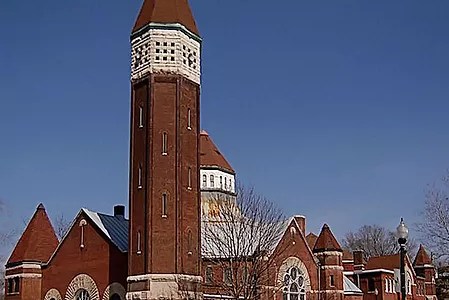
Indianapolis: early morning tv news, April 12, 2022. In the predawn shadows I recognize it. The tower of The Centrum, formerly Central Avenue United Methodist Church, greets the dawn. The Twelfth and Central intersection pictured is blocked off with yellow “crime scene” tape.
The story of Central Avenue Methodist Episcopal Church is a tale of great success, ending in a disappointing closure. It concerns the loss of a true center – for a community and a denomination. A familiar and oft repeated pattern across cities in the Rust Belt, this. A similar plotline has played out around the nation over the past century. At one-point, Central Avenue was a civic and cultural center and then, abandoned by the Methodists. “Redundant” as the Brits say. This is the tale of a faith group’s loss of clear identity, mission, and vision; a loss of “true north.” A building was “redeemed;” a parish was lost.[i]
Bill Cook, medical device inventor and visionary, from Bloomington came to the rescue in 2008. With Indiana Landmarks, restoration began on the grand old Romanesque-Revival structure. Good thing. Fine for the grand old facility, and the neighborhood. The Centrum is now a center of civic activities. The abandoned church captured Cook’s imagination — and dollars. Bill and Gayle Cook gave careful attention to preservation efforts in dozens of locations across the Midwest. Lovely this.
Central Avenue Methodist Episcopal Church was built in the horse and buggy era (1891) in one of Indianapolis’ first suburbs. It stood only a mile-and-a-quarter, twelve blocks, from city center – the Circle. Soon automobiles came to town. Following decades saw the Great Depression, two World Wars, and accompanying urbanization. Central Avenue prospered. An influential center of civic and social service efforts in the city and beyond, it offered much leadership and support for fledgling institutions. For example, the Methodist Hospital opened in 1908 a short distance to the west carrying with it the undergirding of several congregations, but Central Avenue was a leader. However, in the following decades, the prominence of the congregation changed.
Economic patterns shifted. Employment and housing ecologies were re-sorted. Newer neighborhoods in more distant suburbs were built. Depending on location, real estate values spiked or plummeted. The actual and perceived quality of various public schools was altered. Urban parishes, like Central Avenue, faced decline and redundancy. In the early decades of the 20th Century urbanization brought “improvements” and fresh investments, especially for those living further out from Center Township.
Thousands more workers were needed. While most in the working class lived on the south and west side of town the addition of even more hands and heft required finding additional living space. New migrants found this near the church. There was also an expanding racial diversity. Those leaving behind grand old homes and churches were moving on to newer, more prestigious addresses. It was the early-and-mid-century American Way; a prevailing residential and economic wave was playing out across the nation. Apartment buildings began to dot nearby streets and avenues. Folks moved into town from farms across the Midwest to find work; soon, to support “war efforts.” Others, from Appalachia (mostly Kentucky and Tennessee) and a greater number of African Americans (from the deep South) came to the city. Manufacturing, especially on the south and west side was booming and a robust pharmaceutical industry expanded.
The need for a low wage workforce of clerks, secretaries, cooks, janitors, and food service workers meant that many poor families were competing for a place. They arrived seeking shelter wherever it could be found. Near Central Avenue church, most single-family homes were slowly but steadily transformed into rental properties. Former one-family houses were sectored into three, four, five or even six apartment units. The carriage houses and garages, off the alleys nearby, were turned into one-room residences. Often, a family with several children might reside in these conversions. There would be a little coal-burning cookstove in one corner and a shallow loft for sleeping. By the early 1960s many of the graceful residences along Central, Park, Broadway, Alabama, College, Pennsylvania and Delaware Streets had fallen into disrepair. Apartment units, built to handle the migration during the World Wars, became roach and rat-infested, places of squalor.
Tree-lined neighborhood streets were widened into bustling three-and-four-lane, one-way thoroughfares. No longer was parking allowed along many of these byways. Commuters could speedily travel to and from work or entertainment downtown. Many who formerly resided in the neighborhood, now rushed through it, past it. This “transition” accelerated and expanded during the 1950s and 1960s.
The fabric of neighborhood relationships and human commitments, often overlooked or beneath the surface, suffered. Fear of the “stranger” shaped social and spiritual underpinnings. Like tectonic plates quaking beneath the earth’s crust, the Central Avenue parish was shaken, broken. By the early 1960s the neighborhood and congregation were seen as places of decline, even danger. This quaking left this congregation (and thousands of others like it across the nation), facing an existential crisis. Church members transferred to other congregations, primarily Methodist or another mainline denomination, mostly on the northside.
Some unethical real estate speculators, “slum lords” truly, invested little and extracted much. Like their cousins, still out on the farm, these real estate strip miners couldn’t resist the impulse to turn-a-quick-profit. There was an ignoring of the stewardship of a neighborhood’s fabric, just as farming malpractice fails to properly steward the land. The impulse, in too many cases, was to accrue ever larger profits, skip over best sustainable practices, ignore the long-term health and stability of the ecology of the farm or human residences in the city. Like the erosion of the soil of a farm, an erosion of the parish around Central Avenue was underway. It was the depletion of neighborhood institutions, shops and churches, community pride and a sense of commonweal.
Prevailing myths “explaining” why these neighborhood changes were occurring grew out of the individualistic notion that such patterns were the necessary, unfortunate, but unavoidable stages in urban progress.[ii] The resulting poverty surrounding the church was said to be “inevitable,” tragic perhaps, but essential to the larger success of the city. The poor would have to “make their way out” by individual hard-work and bootstrap initiative. These newly arriving poor ones, “the industrious unfortunate” could one day “escape” their plight through hard work – and perhaps a little luck.
Congregational assistance/charity programs to meet the needs of these new arrivals were commonplace and included a usual array of efforts – food pantry, a thrift shop, rummage sales, recovery groups, summer programs for children and youth, and emergency assistance. So it was, at Central Avenue Methodist in middle years of the century; so it was, in core city congregations across the nation.
The neighborhood ecology was believed to be rooted in a biological model, like the human life cycle: neighborhoods were born, grew up, then declined. Low wealth persons who lived around the church in the 1950s and 1960’s were understood to be “born to poverty,” or ones who suffered some misfortune, or were destined to their circumstances due to some individual human failing. If they had sufficient imagination, initiative, or opportunity they too could join the upwardly mobile path to the suburbs.
In some places, in other northern Rustbelt cities, the abandonment of lovely neighborhoods was even more dramatic. Banking practices of red-lining and racist government housing mortgage guidelines aided and abetted the decline. Lost, were opportunities for poor and minority persons to benefit from home ownership. Richard Rothstein’s excellent book the “The Color of Law: The Forgotten History of How Our Government Segregated America” documents the multiple ways local, state, and federal governments incentivized this deleterious turnover in neighborhoods, all the while limiting or outright blocking opportunities for homeownership for racial minorities and the poor.[iii]
By 1961, other voices, like Jane Jacobs and Gibson Winter offered alternative views of how urban neighborhoods might thrive[iv] and urban congregations might give witness.[v] Alternative urban parish models were emerging in the mid-century. Places like the East Harlem Protestant Parish in New York, the Church of the Savior in Washington D.C., and in Chicago, Woodlawn Mennonite Church, and the Ecumenical Institute were challenging old assumptions.
There were a few attempts at incorporating alternative approaches to the traditional congregational life emerging in Indianapolis. As one observer commented, “Indianapolis is a city that is long on charity and short on justice.”[vi] Mainline congregations confirmed a preference for charity as the primary hallmark and missional goal of urban parish life.
However, the story is more complex, isn’t it? It turns out to be more circular. Today a fuller view of the development cycle of economic, housing and neighborhood vibrancy is clearer. It is “wash, rinse and repeat.” Decline and decay were not inevitable. Indianapolis is more fortunate than many other cities where the loss of entire neighborhoods was and is more profound. It only took a few short decades, along with the vision and resources of folks known as Urban Pioneers for this cycle to be obvious.
Still, a blindness remains. Congregations and neighborhoods once benefitting from the population turnover and changes around Central Avenue now face their own demise. They now experience the loss of any sense of parish cohesiveness. False options offered by the prevailing view of inevitable development and/or decline persist and shape understandings. Today Indianapolis’ Old North Neighborhood has mostly been “gentrified.” There is good in this. There has also been harm. The Centrum, is a symbol of a neighborhood rediscovered and being “preserved.” One wonders for how long?
It is one thing to restore buildings and houses, quite another to re-establish (or perhaps rediscover) a parish.
This leaves one today (and hopefully future leaders of congregations and denominations) with three questions: why?what if? and why not? Future installments will seek to address these three queries. The hope is to better understand and offer suggestions as to alternative futures for faith-based communities. Might there be multiple ways to “re-parish” the urban landscape?
Endnotes.
[i] This story is one I know well, as I lived much of it. My father was pastor of Central Avenue, 1962-1966. He was a good and respected pastor. Prior to moving to Indianapolis, he had served growing congregations with predominantly working-class memberships. However, sixty years ago, Central Avenue was viewed as a “dying inner city congregation.” This work proved to be tough duty for my papa. He seemed to age too rapidly over those four years with speedily graying hair and the burdens of such a parish spiraling downward he seemed to stoop in his shoulders. He was one of five or six talented younger pastors across two decades of the 1950s and 1960s who were sent to “turn the place around.” It was not to be. ++There is more. As it turns out, just twenty years later I was appointed pastor to nearby Broadway United Methodist, just seventeen blocks to the north. The story of Broadway and the surrounding neighborhood was not unlike the story of Central Avenue. A once prominent congregation had fallen on hard times. In 1986 my family bought a home near the church, and I became one of those younger white professionals (urban pioneers) fortunate enough to own a home in a neighborhood that was beginning to regentrify.
[ii] Much of the work of the University of Chicago sociologists (e.g., Robert Park and Ernest Burgess) assumed that such patterns or variations thereof, known as the “Concentric Zone Model,” were predictable and normal in every city. Their book, The City, was published in 1925 and the model they offered, based largely on Chicago, shaped understandings of an inevitable pattern in all American urban ecologies.
[iii] Rothstein, Richard, The Color of Law: A Forgotten History of How Our Government Segregated America, Norton Publishing, 2018.
[iv] Jacobs, Jane, The Death and Life of Great American Cities, New York: Random House, 1961.
[v] Winter, Gibson, The Suburban Captivity of the Churches, An Analysis of Protestant Responsibility in the Expanding Metropolis, Doubleday, 1961.
[vi] This perspective, of Indianapolis being a city “long on charity and short on justice,” was discussed on several occasions by this author with Indianapolis Mayor William Hudnut III, mayor from 1976-1990. Hudnut had been pastor of the influential Second Presbyterian Church in the city. He was a graduate of Union Theological Seminary. Among his seminary classmates was his friend and mine, Dr. Carl Dudley, a leading observer, researcher, and proponent for new models of urban parish life. (Dudley was an urban pastor in St. Louis who later taught at McCormick Seminary in Chicago and Hartford Seminary.) “Mayor Bill” also knew the history of neighborhood decay and renewal set down in this piece. Hudnut knew the alternative approaches to urban parish life emerging in other cities. He did not disagree that individual charity was the preferred norm for the city and as such, the challenge for urban pastors was problematic. Even so, he offered cautionary counsel about “moving too quickly” to organize opposition that would confront underlying assumptions held by leaders in the city or denominational bodies.
Do you recall looking at your image in one of those fun house mirrors, concave and convex and otherwise bent, in an amusement park? It can illustrate the way we might miss-image ourselves based on an out-of-whack, taken-for-granted, reality. It is a distortion, a skewed reflection of what is real. What if our spiritual quests and faith understandings are vulnerable to the concave and convex bends in our worlds taken-for-granted.
In contemporary North American society, frames of reference are constrained by the dominant role individualism plays. It distorts. Societal understandings, economics, politics, culture, even language are limited. Cormac Russell and John McKnight compare this with the African notion of Ubuntu and write: “Individualism is a superhighway to a sick, depressed, and dissatisfied life and a fragmented society. Ubuntu, by contrast, says we are not self-reliant, we are other reliant: that life is not about self-fulfillment and leaning into work and money. Instead, a satisfying life is largely about leaning into our relationships and investing in our communities; it is about interdependence, not independence, (The Connected Community, Berrett-Koehler Publishers, 2022, p. xiv).
I would suggest our views of prayer have been focused too narrowly as an individualistic practice, to be personal prayer or meditation, primarily. There is Corporate Prayer, typically in a worship service or as the Invocation or Benediction in religious or civic gatherings.
Recently I wrote that the focus on Centering Prayer has gained much acceptance in religious life. While of value; still, I ask if it might be balanced by what I would call Othering Prayer.
To my mind, Othering Prayer is rooted in the prayer Jesus taught the disciples (Luke 11 and Matthew 6). What we refer to as The Lord’s Prayer draws on elements from multiple earlier Hebrew prayers. In English translations the opening word “Our” says a great deal. It begins with an awareness that we are part of a community.
I do not write this to suggest Centering Prayer, or deep personal religious experience is not of equal or often greater value. Rather, it is to suggest that there is reflection to be done on how Othering Prayer might carry benefits in acting toward God’s purposes in our world.
It was Trappist Abbot Thomas Keating, St. Joseph’s Abbey Trappist Monastery who played a significant role in opening awareness to the value of Centering Prayer more than fifty years ago. For Keating, Christian Centering Prayer was in continuity with the practices of other religious traditions.
I am assisted by the insights of Richard Rohr and the good folks at the Center for Action and Contemplation. Since 1987 this Center has sought to integrate contemplation and action with Rohr arguing they are inseparable. In fact, Rohr emphasizes this when he says the most important word in the Center’s name is neither Action or Contemplation but the small word “and.”
Recently a friend commented that her experience is that when she practices quiet, contemplative, centering prayer, it seems richer when done as part of a community. Hmmn.
Bob Greenleaf shared the story of an elderly, reclusive couple living in a small village who seldom ventured from their home. However, one day the elderly man set out alone on an adventure. He traveled to a nearby city and after some exploring he returned with a battered cello he had found on a trash heap. The damaged cello had but one string. The twisted bow stick had only a few remaining hairs. That evening and for weeks following, he seated himself in a front room corner and sawed away on the one single open string. Over and over he played one scratchy, repeated note. Day after day he played — his playing droned on increasing his wife’s unhappiness. Finally, able to stand it no longer, she decided to travel herself to the city.
Upon her return, she confronted her husband. “See here,” she said, “I have gone to the city and found people playing instruments very much like yours. The instrument is called a ‘cello’ and should have four strings. What’s more, those who play them move their fingers all along the neck of the cello and play many notes on each string.” “Even more,” she continued, “people often play these cellos along with many others instruments. The sound is beautiful and powerful when they all play together. I am told such a group is called a symphony. Why do you sit here day after day playing that one raspy note?”
The old fella gave his spouse a cold look and responded, “I would expect that of you. Those people you saw are still trying to find the one right note, I have found it!”
Robert K. Greenleaf, was a mentor to scores of folks; I was privleged to visit with him several times. His writings on Servant Leadership were widely read and practiced. Even in this, Bob knew that there would be the tendancy to turn his ideas into a distortion — a limited understanding — a one-note perspective. Too often it would be focused on “fixing” and “doing” rather than on “listening to others” and “reframing life with wider understandings.” Bob would chuckle at those who used Servant Leadership as a formula and say, “Leadership is a little like playing the cello. If you can’t hear the music maybe you shouldn’t try.” Or, Bob once opined “if you can’t share your playing with others, in a call and response way, then you will likely miss the beauty of the whole.
As I listen to the singular issues expounded in much of today’s social and religious discourse, I think of Bob and the story of the man and his broken cello. One note, one idea, one conviction (or two or three) can capture and predominate. Such behavior is like playing with too few strings on an instrument or giving too little attention to seeing things whole, seeing life and our challenges more comprehensively.
Perhaps you have seen the video of Johnny Mathis who holds one note, loudly, for almost a minute-and-a-half. It is amazing. Mathis is singing Johnny One Note, a song from the Broadway Musical “Babes in Arms” from 1937. (The movie version of this show starred Judy Garland and Mickey Rooney.)
The Free Dictionary identifies the idiom “Johnny-One-Note” as “Someone who repeatedly expresses or maintains a strong opinion on a single or a few particular subjects.” The song Johnny-One-Note and the idiom display the reality that when one person holds one note long and loudly, it is difficult to hear anything else.
Robert K. Greenleaf
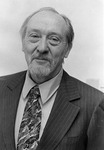
Bob Greenleaf died on September 29, 1990, at the age of 86. Some of the wisdom Bob shared seems even more relevant today. He called himself an “institution watcher.” His experiences within large institutions like AT&T and the Ford Foundation led to his insights, his consulting and writing. In answering the question how does one best lead in humane, constructive and effective ways? He wrote “The best test, and difficult to administer, is: do those served grow as persons; do they, while being served, become healthier, wiser, freer, more autonomous, more likely themselves to become servants? And, what is the effect on the least privileged in society; will he benefit, or at least, will he not be further deprived?” (From The Servant Leader, p. 7)
Bob is buried in his hometown of Terre Haute, Indiana after spending much of his working life in corporate headquarters on the East Coast. His head stone captures his sense of humor, and the whimsy of life, with an epitaph he wrote for himself: “Potentially a good plumber, spoiled by a sophisticated education.“
One of his many insights that comes today was his statement that “Whether we get a better society in the future will be determined by how well older people nurture the spirit of younger people.”
Bob Greenleaf encouraged folks to “see things whole;” maybe this is why he liked telling the story of the man and his battered cello.
When the student is ready, the teacher will appear. So goes the aphorism. Another version of this idea, attributed to Buddha Siddhartha Guatama, is: “Teachers are like enzymes. Nature’s go-to facilitators of change.” Even if only partially true, there is much wisdom here — at least in my experience.
Dr. Gilbert James, Used Courtesy of the Archives and Special Collections of Asbury Theological Seminary.
By the late 1960s, my generation in the U.S. were “teacher-ready.” We watched as young men, many of them friends, were being shipped off to an inexplicable war in Vietnam. Too many returning in body bags. State governors stood in univeristy doorways blocking entrance to African American students. We witnessed the assinations of M. L. King, Jr. and the Kennedy brothers. Riots were breaking out in many cities and the emerging “counter culture” saw a growing interest in drug use. Given the availability of “the pill,” a sexual revolution was afoot.
Like other young men, my name was placed in the military lottery; I was one of the lucky ones with a high number, so after college I headed to Asbury Seminary in Kentucky. There I met Gilbert James. He was teaching courses on The Church in Society, Race Relations and Sociology of Religion. The teacher appeared and I was “ready.”
Gilbert James: Free Methodist pastor, sawdust revival preacher, boxer, university professor, union organizer, poet, brilliant social researcher, friend of the poor, worker for racial justice, comfortable in a corporate board room and on skid row. Great “teachers” are not limited to the classroom. Fortunately, for many of us, Gilbert offered graduate-level insights wherever you found him. He challenged us to learn, whether in a classroom, on a Chicago “L” train, in a Congressional office, or, on a street corner in Harlem. Socratic in approach, he would ask probing questions, frame a situation so that those within earshot began to teach and learn from one another. How does one cipher the complexities of this man?
Not far beneath the surface was Gilbert James’ commitment to an historic Wesleyanism that encouraged vital piety, valued knowledge and sought social justice. He was one of several teachers at Asbury Seminary in those years who found ready students. I think of Bob Lyon who helped us explore serious Biblical interpretation and modeled a faith that included deep commitments to nonviolent action.
Gil James spoke easily of personal conversion and Christian experience; after all, he had come to faith by such a personal spiritual journey. However, he was critical of an individualism that ignored the Biblical mandates to love God and the neighbor. He spoke of a church that might live in terms of a “Jubilee sharing” of resources with the poor. He was suspicious of fanaticism and cautioned against the abuses of those seeking power for power’s sake – especially in the church. He had seen enough chicanery in the church and beyond. He knew the dangers of fanaticism when mixed uncritically into the religious life.
Gilbert encouraged us to be “both faithful and forward leaning.” At the same time he wanted us to know our ancestry. James reminded us of the insights of Eighteenth Century Methodists (including Free Methodists, Wesleyans and others). Our legacy included those who opposed pew rentals privileging the wealthy, who supported abolitionist struggles against slavery, who welcomed women in leadership, who encouraged ecumenism and unity, and who practiced peacemaking — often as pacifists.
Gilbert knew of the dangers of individualistic theology and the drift away from a balancing of personal conversion with social justice. In my next blog, I will share a letter from Gilbert written 52 years ago in the midst of an extended revival at Asbury College (a neighboring undergraduate institution to the seminary, seperate in curriculum and faculty).
James knew of the marginalization experienced by religious conservatives and foresaw a time when greivance would spill over and could lead to a insatiable hunger for power and status unmoored from Biblical ethics. He noted the transformation of Fundamentalism into Evangelicalism — that brought a sophistication in the use of political power. It might result, he suggested, in danger for our nation and the ruin of our churches. I remember thinking, as we were reflecting on the writings of Reinhold Neibuhr, that James was being overly grandiouse. Today, I see how on target he was about this threat that faith could to be compromised by a lust for approval and blind acquisition of institutional power these fifty years later.
Over coffee in the seminary cafeteriaI, I recall many informal “debates” with other faculty and students. Such exchanges were common and truly a gift. Students might be asked to “grab a cup and join the conversation.” I recall, one well-known faculty member offering up a common trope used at the time. Assuming the notion that there were two camps in American Protestant Christianity, this faculty member said that “Evangelicals were always rooted in ultimate authorithy of scripture, but Liberals always let the dominant culture set the agenda for their theology.” I recall Gilbert wriley smiling and responding, “Your culture does not set the agenda for how you read the scripture?”
Other exceptional teachers followed (Jackson Carroll, Earl Brewer, Gwen Neville) at Emory University. I then went on to my days of university teaching and Gilbert stayed in touch. In Atlanta, at Candler School of Theology, I helped him bring a group of Asbury students to that city, just as he had brought me as a student to Chicgo, Detroit and New York a decade earlier. He was still learning, teaching, making connections and demonstrating to students the ways a life of faith might be practiced among the institutions of the powerful and the gifts in low-wealth communities that were often hidden.
Gilbert James touched many lives and shaped the work of pastors and laity in diverse places. We found him to be a READY teacher and friend. Still, his concerns about the corruption of Evangelicalism ring true; and, are more applicable than ever. At his funeral in 1982 the great African American pastor and theologian James Earl Massey stood to speak of Gilbert and his influence. Massey summerized my teacher’s greatness in these simple words: He was a “practitioner of intelligent love.” It is my sense that we have a whole new generation of students ready to find such teachers today. May it be so.








 Hands of the Strong