“Racial Prejudice is a sin.” So reads the lead sentence in an ad from a well meaning Christian institution. Yes, it is! “Good,” I thought. “Not sufficient,” was my second thought.
The ad was announcing a new educational program. Daily I read of a new degree program, or certificate, or workshop on racism. There are programs featuring inclusion and diversity; some offering cultural awareness. Good — many in our nation have been woke to our nation’s prevailing racism. Then, again I think, not sufficient.
Anti-racism work involves more than addressing individual prejudice, or practicing inclusion, or graduating from diversity training. The deeply embedded racist practices, white privilege and enduring structures of our society require more than changing bad attitudes or reorienting mental categories. I am helped by Isabel Wilkerson’s recent argument that our society is, in reality, a caste system.
In my tradition, the prayer for each day begins “New every morning is your love, great God of light, and all day long you are working for good in the world. Stir up in us desire to serve you, to live peacefully with our neighbors, and to devote each day to your Son, Our Savior, Jesus Christ the Lord.” Once woke, there is the need to keep awakening.
Setting aside my unpleasant thoughts about the marketing and commercialization of programs to address racism, it is clear that antiracism work will require more than a new curriculum, or a certificate or registration for a webinar. If we are to continue movement toward the Beloved Community we will be required to do some major overhauls, yes personally, but also in our institutions and economies.
As I have come to realize, over and again, my personal confession and repentance is only the prelude to a life-long reorientation. Recently I was asked if I was suggesting there is need for a “continual conversion.” In short, YES. As one friend suggests, this is “one-hundred-year-work.” It is as Eugene Peterson reminds us “A long obedience in the same direction.” Antiracism requires sustained commitment to institutional and cultural change. If you thought differently, I want to disabuse you of belief in any easy path. This is to say those eight week or eight month programs are… well, a small, good beginning, but only that.
In ways too numerous to list, we will always be learning, confessing, repenting, and re-imagining our common life and its institutions. In our podcast/videocast, Mike Mather and I suggest this lifelong commitment will involve Remembering Community — remembering our common Beloved Community.
While we don’t offer a certificate, a degree program, or a $135 workshop or webinar, Mike Mather and I invite folks to listen in and join the conversation. We are reflecting on our own racism and the deep caste-like patterns with which we have struggled in our ministries — personal, institutional and cultural. In the weeks ahead we will be looking at this along with the many stories from parish and community ministry.
In this weeks episode we speak of institutional racism, and of how two remarkable African American women, Hertha Taylor and Sadie Flowers, each acted in creative and joy-filled ways. Our call is to remember folks like these and to venture beyond the comfortable formats of small projects in “helping others,” that so many assume to be best. You can watch the video at: https://www.youtube.com/watch?v=sbFkguEMsSw.
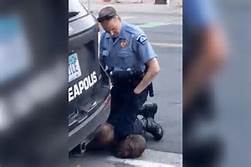
As I watched the tragic scenes unfold across our nation in the wake of the murder of George Floyd, I remembered the phrase scratched on a napkin and slid toward me: “Words, words, words: Hamlet.” This writer of the quote in 1992 was Bill Hudnut, former long-time mayor of Indianapolis. Bill was a friend. I was pastor at Broadway United Methodist Church. We often had to agree to disagree. In considering the wounds to our nation’s soul just now, I think of Bill.
Officer Derek Chauvin on neck of George Floyd from Daily Guide Network, May 28, 2020
There have been too many words. I believe this is a message the rioters are tying to communicate — in imperfect ways, yes, but there have been too many words… words of promise, words to placate, words to delay. And, there have been too many words from the highest office in the land that harm and destroy. More, even worse, there have been words designed to incite violence. There are words tweeted in short attacks or enshrined in policies that reinforce the systemic racism of a nation that has never recovered from slavery, segregation and centuries of discrimination and shame.
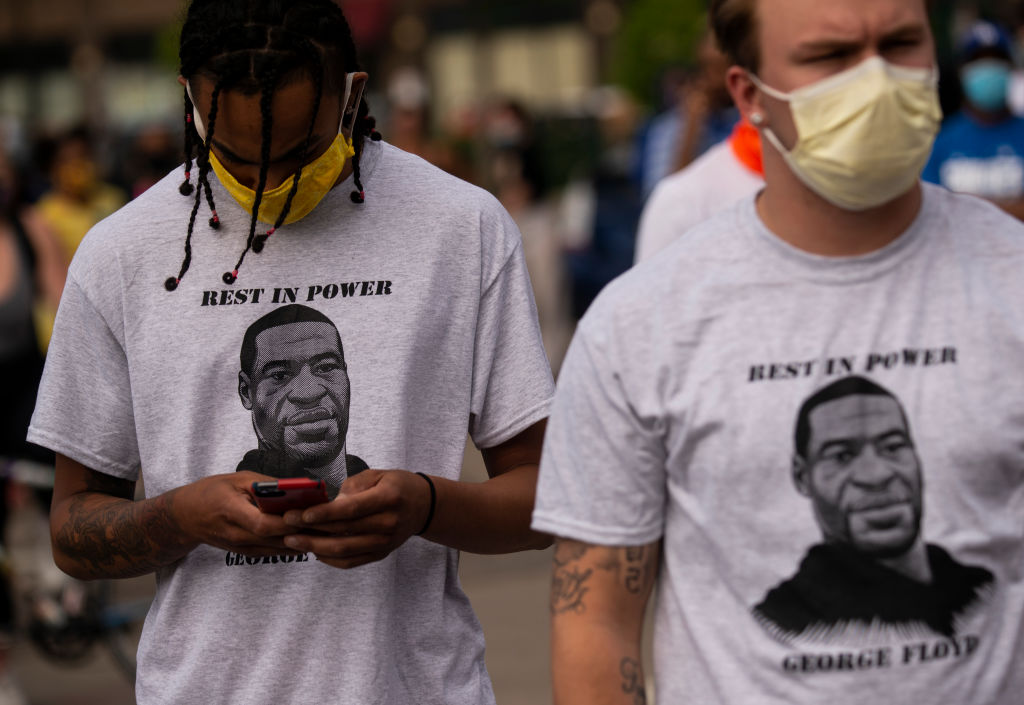
MINNEAPOLIS, MN – MAY 27: Two men wear shirts stating “Rest in Power George Floyd” outside the Third Police Precinct on May 27, 2020 in Minneapolis, Minnesota. (Photo by Stephen Maturen/Getty Images as shared in United Methodist Insight, May 28, 2020)
Hudnut wrote the note “words, words, words” as we listened to the remarks of a popular young governor. The speaker was his opponent in 1992, as Bill challenged the young governor for his seat. Hudnut lost that race. The governor went on to another term; then was elected senator, like his father before him. As I recall all these years later, Hudnut was reacting to the governor’s word-salad related to a question about law enforcement and tragedies like the death of Michael Taylor. How might we better address police abuse? In 1987, Michael Taylor, a 16 year old, was handcuffed and in the custody of Indianapolis police officers when he was shot and killed. The officers claimed Taylor had somehow, with hands in cuffs, behind his back, grabbed one of their weapons. — So, they said, “they had to kill him.”
Michael Taylor’s murder remains an open sore for many in Indianapolis, myself included. George Floyd’s murder and the national response only displays that we have a pervasive and longtime pattern of such abuse. We have only formalized the “lynching culture” prevalent a century ago. In 1987 Bill Hudnut and I publicly disagreed about Indianapolis’ response in the Michael Taylor case.
William Hudnut GreatLakesMetros.wordpress.com
Don’t get me wrong — Hudnut was a wise voice, took a lot of heat for not being tough enough on crime and too friendly with the minority community. At the time, Bill challenged some prevalent police practices. Still, he was the mayor and thought his primary job was to keep the peace and the support of his party. In private, we talked on several occasions, we prayed together and he shared his profound sadness. Behind the scenes Bill took actions to improve police practices, including better public review — something that is still not sufficiently dealt with today.
“Words, words, words: Hamlet” is remembered now. At the time they were first shared with me, neither of us knew how much “the Rev. Bill Hudnut,” graduate of Princeton University and Union Theological Seminary, was a part of a dying breed. He was a Republican committed to racial justice and civil rights in word and DEED. A part of his story is told in Indiana History, “William Hudnut III versus the Reagan Administration” (https://indianahistory.org/stories/william-hudnut-iii-versus-the-reagan-administration/).
Hudnut with Oscar Robertson Indianapolis Star
The Republican Party lost its way. How can they claim to be the party of Lincoln or Grant? How? I wish it was this easy. If one can just blame someone else, it is too easy. Our nation has lost its way as well. Bill Hudnut was a practical politician — yes, he made compromises. He was right to have a jaundiced view of the language of the Democrats.
We have all lost our way. We somehow think that there is some easy way to undo the massive damage of racial injustice that is four centuries old in our land. “Words, words, words” Bill Hudnut rightly quoted from Shakespeare’s Hamlet. In every arena related to racial justice we have talked too much and accomplished too little. The deceit was implicit in the opening words to our constitution, written by a slave owner, who knew better but never emancipated his own slaves. “We hold these truths to be self evident, that all men (and women) all are created equal…” Perhaps our generation can do some bold things to make these sentiments more than words.
When I hear politicians say “we must get back to normal,” I can barely contain my laughter — or my tears. Good reader, would you suggest that what we were experiencing as a nation, as a world, in 2019 was “normal?” If so, we may need to have a little chat about faith, science, reason and being a society of constitutional law. We would need to talk about the meaning of “life, liberty and the pursuit of happiness.”
This question about normalcy is the second of three questions we are considering in this time of pandemic. Here they are again: 1) What livelihoods will we love or treasure? 2) What shall we consider to be normal? 3) What shall we truly love and treasure in the future?
Blizzard, Long Winter or New Mini Ice Age?
In early March I began to see newsletters and opinion pieces that offered a metaphor regarding the changes the COVID-19 pandemic would bring. By now, dozens have used these images. Here is how it is framed: Is this pandemic going to be more like a blizzard, a long winter or a new mini ice age? In other words, How long will it last? How bad will it get? How much will we be changed?
Award winning journalist Laurie Garrett, a highly respected scientist and author of The Coming Plague has been warning of the possibility of a world pandemic for more than three decades. Garrett has emerged as someone who can offer us clues as to what may be ahead. In an interview with Frank Bruni in the New York Times on May 2, 2020 Garrett was asked: So, is “back to normal,” a phrase that so many people cling to, a fantasy?
Her answer: “This is history right in front of us,” Garrett said. “Did we go ‘back to normal’ after 9/11? No. We created a whole new normal. We scrutinized the United States. We turned into an anti-terror state. And it affected everything. We couldn’t go into a building without showing ID and walking through a metal detector, and couldn’t get on airplanes the same way ever again. That’s what’s going to happen with this.”
When asked in a CNN interview on May 7th if this situation is worse than she had predicted and feared, Garrett’s response was clear. She warned that things will not be the same and that five years from now we would still be dealing with the changes across all of our society brought by this pandemic. She noted that in every other viral outbreak over recent years, the CDC (Center for Disease Control) was a scientific center of good information and strategic thinking. However, now they have been reduced in scope, their guidelines are being set aside and this will only lead to a wider spread of the virus and deeper damage to our society and other societies around the world.
So… what shall we consider normal? Sadly, I believe that even with a change at the top of our government, the damage has been done and over the next year will continue with a result that…. well, at least a long winter of discontent is ahead, or, I hate to write this, but we may be entering another mild ice age like our world experienced from roughly 1300 to 1900 AD. As one writer has put it: For 600 years the earth was colder than average. This affected farming practices, house designs, and pushed Europeans to search for warmer areas and more fertile lands to farm, such as in North America. This was a multi-generational event that shaped the history of the world. People lived their entire lives in this ice age (Jeff Clark, “Blizzards, Winters and Ice Ages,”Rural Matters Institute, April 14, 2020).
Is Normal Our Best?
My sixteen year old grandson and I recently talked about societal norms in our weekly zoom chat. (“A weekly zoom chat with a 16 year old?” you say. Okay, I guess this is a new normal — at least for a while.) In our conversation, I rehearsed the sociological categories of social norms: folkways, mores, taboos and laws. He politely listened and then with appropriate doubt to the sufficiency of these categories, observed, “But none of those things can measure what is truly ‘normal,’ right? Don’t we need to also think about what things are ethical, I mean like moral?” Of course… such a smart grandson I have!
Guided by Too Much Grace
In the mid-1980s, I faced some powerful questions about norms and ethics. It was during the HIV-AIDS epidemic. I was pastor of Broadway United Methodist Church in Indianapolis. Suddenly there were many young men in that congregation and community who were getting very sick. They were dying from this strange new disease. First a few, then dozens. Our congregation had welcomed many gay and lesbian persons into membership. Actually, it may be better said that many LGBTQ folks were generous enough to welcome us. We were connected, the phony barriers and bigotries of religious tradition and being closeted were set aside for a new normal of common humanity. It was a marvelous time as I grew in understanding and faith. I learned many things about my own ignorance and unrecognized biases; and, it was a painful time as well when many of my superiors in the denomination were upset that we were breaking with what was their “normal.”
In the midst of this, a phone call came from the father of one of the young men who had been worshiping with us. He started by introducing himself as the young man’s father and then said, “I am a pastor in Ohio and I want you to know that I don’t agree with your theology or my son’s choices.” There was a long pause… I was expecting a theological harangue. Still, I could tell this might be different. Even over the phone from hundreds of miles away I knew the man was holding back tears. With a breaking voice this father went on. “I guess part of me thinks your church offers too much grace, but another part of me is so grateful you have found each other. I am glad he is connected even if it is not normal.”
As a pastor, I was grateful that that congregation had decided it would be normal to live in terms of too much grace… grace for all. John Wesley, Methodism’s founder often pointed to Psalm 145:9 which reads, “The Lord is good to all and his compassion is over all he has made” (NRSV), or from another source it is translated “God is good to one and all; everything he does is suffused with grace” (The Message).
Surely, my denomination is still very broken over how we align our ethics and our norms. I often ponder what John Wesley would think of our quarrels these days. For me, at least, I make the choice to come down on the side of Too Much Grace — for me and for all.
I have been warned by my psychologist and psychoanalyst friends to take care when speaking of any thing as “normal.” One of them was bold enough to say, “Well, I may be normal but you look pretty sketchy to me!” I replied, “this is what keeps folks like you employed.” Anyone who has read E.B. White’s delightful short story “The Second Tree From the Corner” will appreciate that, like beauty, normal is in the eye of the beholder.
If a healthy way forward, beyond this pandemic is to be discovered, it will require honesty about the scientific data, more good research, testing and tracking… and perhaps a vaccine. It will require more, I believe. It will require that we see that God’s compassion extends over all and to all.
Or, we can pretend that we can “go back” to a fantasy world, where science is diminished, bigotries are encouraged as normal, and God’s care for all is ignored.
Such a move backwards from the fact that we are all connected one to another and to creation is a possibility. Let’s choose another option. Wendell Berry wrote: “Only by restoring broken connections can we be healed. Connection is health.” (Berry, Wendell, Essays: 1969 to 1990). (See also https://wordpress.com/block-editor/post/philipamerson.com/6682)
So choose your metaphor: blizzard, long winter or ice age? What will be a compass and a guide as we seek to better align the normal with the ethical? I fear we are in a long winter at least; probably a mild ice age. John Wesley offered this overarching way of proceeding: “Do no harm, Do Good, Stay in Love with God.” I will look, in these ways, to restoring broken connections — to getting to a new normal or a “daily harmony” as one therapist friend suggests — and to living with others in terms of our common humanity and the sufficiency of God’s grace as we journey together.
Even if we could go “back to normal,” I would work and pray that we could do better than that.
Late in 2019, prior to the COVID-19 pandemic, I came across a surprising passage from an economics text. Edmund Phelps, winner of the Nobel Prize in economics, and professor at both Columbia and MIT, edited a book back in 1975 (Altruism, Morality, and Economic Theory). In his introduction he writes, “When Sir Dennis Robertson lectured at the bicentennial celebrations for Columbia University, it was therefore expected that he would address a question of grandeur: What Do Economists Economize?” His unexpected answer: We economize on love.”
We economize on love. How apparent this has become in recent weeks. What or who do we love most truly? What or who do we treasure most dearly? It is an ancient religious question that has been raised to the highest levels of our consciousness by this pandemic.
Life or Livelihood? The debate ramps up. Will we preference saving lives or saving livelihoods? My congressman, Trey Hollingsworth, was an early voice (April 14) proposing we should “put on our big boy pants” and accept some loss of life to secure the ‘American way of life.’ The genie was out of the bottle — there would soon be a wider call to sacrifice some people to the benefit of others. We shouldn’t let the “cure be worse than the disease,” meaning, of course, that a national effort to shelter-at-home shouldn’t get in the way of quickly returning to “business as usual.”
Since that time, in a rising crescendo, the American people have been called on by folks like Larry Kudlow, Chris Christie, Donald Trump, and the governors of Texas, Georgia, Florida and other states, to “wage a war” on COVID-19 by… you guessed it — restarting the economy. It is that simple? Really? These folks admit such actions will threaten the lives of many, especially the most vulnerable, still they persist. Why? The true purpose, in far too many cases, is the protection of wealth, property and businesses of those who are at the top of our economic system. I am not unaware of the damage that is being done to small businesses — what I do argue is that we can find a better way.
How far we have come from early American leaders like William Penn who wrote: “A good end cannot sanctify evil means: nor must we ever do evil that good may come of it… let us then try what love will do.” What might love do differently? What might faithful people seek in this time. As a Christian, I ask myself, “isn’t there a better way to proceed?”
Life or livelihood is, of course, a false choice. Why are we not approaching this with a third option? Why are we not asking how can we save as many lives as possible and at the same time do as much to stabilize economic interests as well? The answer may be that what we truly love, what we most deeply cherish, is exposed by this pandemic.
What do we treasure?
Like so many of the choices offered, things are being boiled down to simplistic dichotomies – either/or – either the wealth some have accumulated or the life of many others. In some places (New York, New Jersey, Massachusetts, California), after the tragic loss of life, there seems to be a slowing of new infections. Yet, even this is at risk, if we are not prudent.
In other places where the COVID-19 virus is only now appearing, governors and mayors are being urged “open up the economy and immediately get back to normal.” My fear, based on considerable experience and research, is that we will see, not only many persons in poor and/or rural and/or isolated communities succumb to this virus, and in the process we will see the destruction of the economic life of these poor and already weakened communities, their businesses, hospitals, social services and safety personnel. All of this will be due to this false choice that has been unevenly conceived with a preemptive “restart” and “return normal.”
A few days ago Donald Trump projected that “tragic as it is” we will “ONLY” lose about 60,000 lives, then a few days later it was “ONLY” 75,000, and as I write, he suggests “tragic as it is” we will “ONLY” see perhaps 125,000 die but, he argues “we must all fight the war and restart our economy.” One wonders what will be the “tragic as it is” number of lives that will be counted among the dead from this virus by mid-summer? One wonders what is most loved and most treasured?
All of this begs several questions for people of faith, and especially for those of us who are Christians. Here are three that come to mind today; questions we will consider in the days ahead:
1) Which livelihoods are to be preferred and saved?
Dr. Martin Luther King, Jr. holiday arrives. Another year. Another invitation to dream, to conceive a different world. Memories cascade:
Dr. King’s funeral, standing with other seminarians outside Ebenezer Church, then, marching/weeping along the route;
Harlem, a year later, discovering my profound ignorance of the white problem in our nation;
Two years later, substitute teaching in Atlanta and realizing that the young shy boy named Marty, who seemed so lonely, had the last name of “King;”
Graduate research on Racism and Suburban Congregations opened new vistas on the complexity of white racism.
Then, I was honored to pastor a predominantly Black church.
These memories and many more remind me of the Whiteness Problem our nation faces. I am white; and have been shaped by hidden and obvious advantages of being placed in this racial category. Even though there is more than a hint of Native American ancestry, my whiteness still shapes how I navigate the world and the social structures in which I live. In the end I believe that all of our racial categories are only social constructs, they are none-the-less real and filled with the potential to do continuing harm to persons and groups.
White racism is the most negative of the templates shaping our nation’s core identity. There is slavery, reconstruction, lynchings, Jim Crow, federal policies restricting loans for African Americans leading to widespread housing segregation, the practices of red lining that continue, the courage of Rosa Parks and the Civil Rights movement. The Whiteness Problem is embedded in the warp and woof of our core. Years ago Toni Morrison said that “Every American novel is about race.” Her novel “Beloved,” for me captures a way of seeing who we are and seeing a more hope-filled future.
Sixty-five years ago the U.S. Supreme Court ruled in the Brown vs. Board of Education of Topeka that racial segregation was illegal. Desegregation of public schools was to be undertaken with “all deliberate speed.” In a majority of our cities little has changed since then.
Sixty-two years ago, as I was preparing to enter the seventh grade, there were nine young African American persons in Little Rock, Arkansas who would risk personal safety to enroll in Little Rock Central High School. President Eisenhower faced with the threats of violence responded by sending troops to protect those young persons.
[Elizabeth Eckford on her way to class at Little Rock Central High School. Photo by Will Counts.]Fifty-two years ago, February 1968, the National Advisory Commission on Civil Rights, otherwise known as The Kerner Commission released their extensive and clear analysis of the White Problem: “What white Americans have never fully understood but what the Negro can never forget — is that white society is deeply implicated in the ghetto. White institutions created it, white institutions maintain it, and white society condones it.”
At the time, Dr. Martin Luther King, Jr. said of the report that it was a “physicians warning of approaching death, with a prescription for life.” Two months later, Dr. King was assassinated in Memphis. Even so, President Johnson and Congress ignored the recommendations from The Kerner Commission Report. Johnson was leaving office as his Vietnam War policies were an evident failure. Richard Nixon would assume office in January of the next year.
In 1975, forty-five years ago, I completed my graduate work. My dissertation title was simple, “Racism and Suburban Congregations: Strategies for Change.” The research was part of a national effort entitled Project Understanding. We measured changes brought about through a variety of interventions. More than 1,100 persons were surveyed from more than seventy congregations in six cities. We learned much; at the core of our learning was that the extent and pervasiveness of the Whiteness Problem waited to be addressed.
Any enduring change would require more than sermons, teaching, pulpit exchanges or even legislation. Change required relationship. It required those of us who are categorized as “White” to see with new eyes. It would require people lumped in each and all racial categories working together to uncover and end discrimination and prejudice.
Being “non-racist” is not sufficient. This myth of neutrality in vogue at the highest levels of our government seeks to paper over the deep wounds and sins that beset us. It is the notion of “good people on all sides.” Astonishingly, the racism that fueled the murders in El Paso is dismissed. Defenders of the current administration say, “It’s not us, the White Nationalist are the true racists!”
This is the challenge — how to name the evil, the oppression and remain clear. Amazingly, many leaders dismiss, confuse and obfuscate even as racist language, behaviors and institutional practices are on the ascendancy. Senate Majority leader, Mitch McConnell stood before T.V. cameras and said “President Trump is not a racist.” Really, Senator McConnell? You say this with a straight face.
There are few who write about race and racism today as astutely as Tressie McMillan Cottom. Her collection of essays “Thick” is a tour-de-force as it looks at the challenges and opportunities we face as a people seeking to live together with honesty and care. One of the sharp essays in this collection is entitled, “(Black is Over) Or, Special Black.” She writes of the way some seek to dismiss our deeply embedded racism by suggesting that the acceptance of academics like herself proves that we have entered a new era where the gifted, special Blacks prove we have moved on.
She writes: “Black is not over… There is no post-black race theory or race work or racial justice or activism that can thrive by avoiding this truth. Whether at the dinner table or in grand theories, the false choice between black-black and worthy black is a trap. It poses that ending blackness was the goal of anti-racist work when the real goal has always been and should always be ending whiteness.” [Thick, p. 152]
My experience is that much of our current United Methodist situation has been brought about by persistent and well-financed outside groups bent on reshaping Methodism away from our natural theological sensibilities and core understanding into a force field of division more to their liking (e.g., Institution for Religion and Democracy). What has happened to the Republican Party in the past two decades is an interesting parallel image. I encourage you to read Smith’s overview — it is a helpful analysis of where we currently stand and what might be possible.
Excellent overview, Jeremy. Excellent, thanks. The proposal has many flaws and potential cautions; however, it does seem to offer a direction if not a precise map to a way ahead. All of our categories and desires for perfection will be tested. That can be a good thing; if we are able to act and think in imaginative ways where the perfect is no longer the enemy of the good. Over the years I have been in three previous attempts at finding a space of compromise — of offering options beyond our ideological/theological entanglements. None made it this far… although a few came close.
Sadly a deep distrust will continue among many who carry decades-long wounds. Distrust will continue to percolate. Others more deeply tied to institutionalist roles will say silly things like bishops “have never stopped the pursuit for a more excellent way for the diversity of United Methodism to be freed from internal theological conflict so that love and respect can triumph over legislative votes that leave a divided church more wounded and less focused.” Poppycock. We need a more humble and repentant stance just now in my view.
What has happened is a tragedy… lost opportunity, broken promises, lost legacies, a tearing out at the root of centuries of witness, analysis that is shallow in anthropology and devoid of theological rigor.
Going forward we all could benefit from a larger dose of generosity, humility and repentance.
Steve Harper continues his reflections on Holy Love by looking to the life and teachings of Jesus. The Jesus Hermeneutic as offered by Richard Rohr captures the preference of “Christ Transforming Culture” rather than a “Christ of Culture” (as H. Richard Niebuhr suggested over fifty years ago).
The fourth vantage point for seeing the hermeneutic of holy love is Christ, the one who reveals the creator (“whoever has seen me has seen the Father,” John 14:9), the one who made the creation (“ everything came into being through the Word,” John 1:3), and the one who is the mediator of the covenant (Hebrews 8:6, 9:15, 12:24). So, everything we have said thus far comes together in Christ, and it does so through love (John 13:1).
One of the things I have heard people say about the relation between Christ and human sexuality is this, “I wish he had made it clear about sexual identities, orientations, same-sex marriage, etc. I have wished the same. I have thought, “If only I could spend five minutes with Jesus.” I have a list of questions. Human sexuality is one of them.
Scholars are correct in noting Jesus’ silence about homosexuality. And…
So many memories, joyful ones, of Bishop Judith Craig. That laugh — so often laughing at herself. Those hands on your shoulder as she teased or counseled or intermingled the two and you didn’t realize you had been “schooled” until the next afternoon. Those eyes — that voice. That wisdom — cutting through the antics of clergy or lay person who would seek to damage the whole.
I think of her as one always open to delight — she lived with an expectancy of something better. And could she preach and pray — yes, my Lord, she could! Losing dear Judy in this hour in the life of our United Methodist Church is heartrending. I salute you, dear sister and beloved friend. May perpetual light shine on you.
I remember how moved I was when Judy was the first woman to give the episcopal address for the denomination back in 1996. She called for a church that could be bigger than the narrow bigotry that entrapped us. She was unashamedly a champion of full inclusion of our LGBTQ siblings.
At the time (1996), I thought the church would make a transition to a more accepting and courageous witness quickly. I was wrong. It has now been over twenty years of regressive movement. Twenty years of narrow interest caucus groups using the scriptures and our guiding documents as a blunt instrument of exclusion and harm. How can the good news of Jesus have been so disfigured into another kind of news? What hermeneutic can justify this push to separate and move away from one another in a time when the gospel is so relevant to a hurting world?
We seem to have been “trading down” as a denomination for these two decades. Giving away our legacy, our commitment to loving acceptance for all. Open hearts, minds and doors of welcome has been replaced by a move for the withering of the church by exclusion. It is fostered by those who build fences of fear and use the very resources and structures of the church against it. The church has lost a great visionary leader. She was mentored in East Ohio by another great, Bishop James Thomas. They were of an uncommon kind. I see them together — one testimony to our church at its very best. Both were able to stand tall for justice and piety. Neither would sell out for a false sense of peace. I saw both of them stand tall in difficult circumstances. Each possessed a wisdom that would not accept the ill-considered proposal, the seeking of unfair advantage of others, or the mean-spirited tactics of a caucus group.
Mary Oliver
Judy’s death comes within hours of poet Mary Oliver. Two women, two singular voices. I wonder if they ever met? Let me suggest that Judy offered us the poetry of a life-well-lived and of poetry-in-action. Or, as Mary Oliver might say, Judy “didn’t end up simply visiting the world.” She was indeed “a bride married to amazement.”
I give thanks for the witness, the joy, the friendship of Judith Craig… I now laugh through my tears. I have been touched by greatness and I know her expansive witness will endure and thrive in places we do not yet see, no matter the petty politics of the current United Methodist Church.
In a recent piece in the New York Times, Katherine Stewart writes of what she has been discovering among many right wing, Christian Nationalist groups. [See Katherine Stewart, NY Times.] Having read her thought-provoking report, I can’t help but wonder why Christians would seek the re-emergence of a King Cyrus when we have the far more appropriate witness in life, death and resurrection of King Jesus, as our guide?
I also stop and consider what recent socio-cultural trends mean for the church. While United Methodism has been distracted by folks seeking a heretofore undesired “doctrinal purity” on issues like “homosexuality,” our core message of multiple ways for faithful disciples to “Know God in Christ” has languished… and in some places nearly disappeared. All the while, our distractions have kept our attentions from the deeper cultural realities. Basic assumptions about liberty and faith provided by folks like the Niebuhrs, ML King, Jr., E. Stanley Jones, Georgia Harkness and Dietrich Bonhoeffer have been undercut. A profound shift in understanding of the nature of Christian citizenship has eroded beneath our feet.
This, I believe, was (and continues to be) a well-planned, well-funded and well-executed effort by persons who have little or no interest in encouraging a Wesleyan spirit. I don’t believe many of my sisters and brothers caught up in the so-called “Good News” movement or the so-called “Wesleyan Covenant Association” intended this. Even so, they are in my view the seminal actors in this tragedy. I do also wonder, at the same time, if they (and we) haven’t “been played” by nationalistic and anti-democratic forces over the past several decades. Have we unwittingly made space for some to suggest that POTUS is a modern “King Cyrus?” Alas.
I believe our foolish warfare over welcoming our gay brothers and sisters has contributed, in some significant measure, to the current season of intolerance and authoritarianism that passes for Christianity. Can United Methodism recover it’s voice? Can we move back to a focus on living lives based on the teachings of Jesus? Can we again practice basic democratic, respectful and honorable civic dialogue? This was once a part of Methodist annual conference sessions — in many places in recent years it has been lost. Can we mend the soul and witness of our church? The soul of our nation may stand in the balance.
We are arriving at the Reign of Christ Sunday (Christ the King). It is the conclusion of the seasons known as Kingdomtide and Pentecost. 2018 is one of the unusual years when the Reign of Christ Sunday comes after Thanksgiving.
The scripture lesson is from John’s Gospel, the 18th chapter. The lesson tells of Jesus’ encounter with Pilate — the Roman Governor who questions Jesus and has yet to be answered verbally for two millenia. Pilate asks “What is truth?” Jesus is SILENT — He just stands there. He has already given the answer by how he has lived. Truth is discovered in right relationships rather more than in right answers.
Parker Palmer in To Know As We Are Known writes “In prayer I begin to realize that I not only know but am known.” Palmer says “Truth is in relationship… “The hallmark of a community of truth is in its claim that reality is a web of communal relationships, and we can know reality only by being in community with it.”
So the sermon tomorrow will focus on the mirrors of truth I have known over the years — those who included me in the conversation toward truth. [You can find it on the church’s webpage at http://www.fumcsd.org.] I will be speaking of Olive and Sidney Anderson. We knew them in Atlanta when in graduate school and teaching at Emory. They worshiped, as did we, at Trinity UMC in downtown Atlanta. Here is a part of the story that unfolded slowly as we knew them: Anderson, Sidney (An Disheng) (1889 ~ 1978) – Methodist Mission Bicentennial.
Their amazing lives – the lives of these two were mirrors into the Reign of Christ which came into view as we were blessed to know folks like these and call them friends.
Folks like Sid and Olive Anderson and the Bob Wilson, each in their own special way, leave behind a legacy that answers the question “What is truth?” They answer through their lives, each in his/her own unique way.
Yeats speaks of the truth of legacy-making through relationships in this poem.
Though leaves are many, the root is one;
Through all the lying days of my youth
I swayed my leaves and flowers in the sun,
Now may I wither into the truth.
William Butler Yeats, The Coming of Wisdom With Time