Shoveling alone. It is the story in almost all our communities in the United States. The poorest of the poor are shuffled to the edges of our economy and end up living on the streets — or in jail!
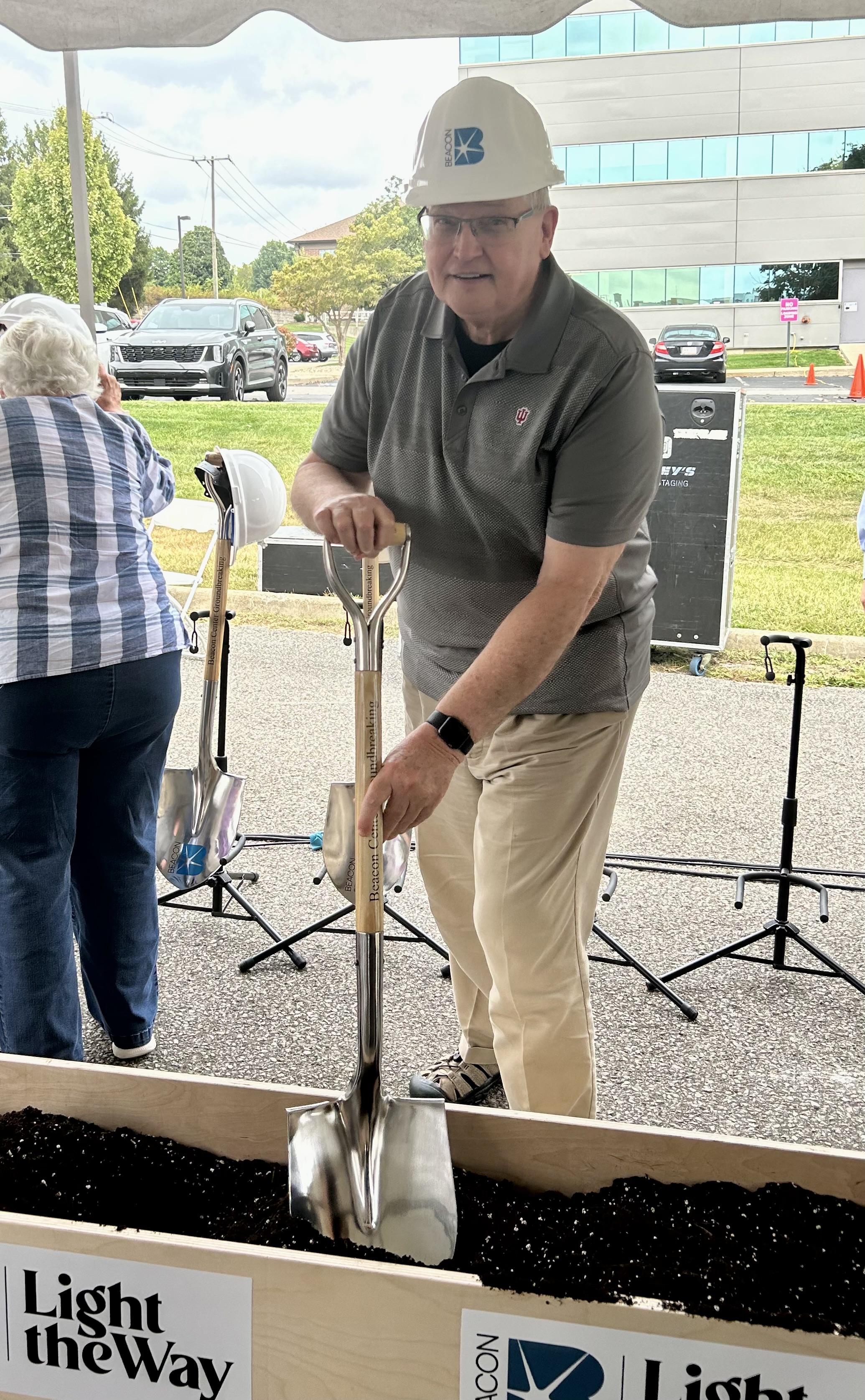
As I turned the shovel in Bloomington on a recent Wednesday, at the groundbreaking for our new Beacon center, I realized I was alone in that moment… no one on either side… but so many had gone ahead, and others would follow. Is it true in your community as well?
Not just on a given afternoon but across the years, I knew others in the faith community and beyond, who didn’t attend this groundbreaking… but who had ‘turned the soil’ of change in many places. They have been at this turning the soil, and turning our souls, in the past and will be in the future. In the process our souls are returned to an original place of hope and sharing among all.
I believe our local faith community, and others whereever you live, will do more in the months ahead, not just for places like Beacon. We must do this because our challenges cannot be fully handled by any one social service agency. Beacon, and similar agencies are a good, but insufficient response.
Bloomington Mayor Thomson is right, a comprehensive response to the challenge of persons without shelter is needed. Rise up now, faith communities and others, show more muscle, join in to assist the Emergency Winter Shelters, programs like Heading Home, the Recovery Alliance, New Leaf/New Life. Offer more mutual respect and support for all! The massive cuts to Medicaid will touch us all and especially the poor. Emergency rooms will be more crowded, retirement homes and clinics will close, healthcare will be rationed and delayed. Time for more to pick up the shovel and turn the soil toward the planting of new seeds of hope.
“When did we see you…?” the scriptures ask. “When you did it to the least among you” comes the answer. I live with the firm knowledge this shelter, even with a “better” setting where healthcare, employment assistance, public safety, addiction recovery and other resources, are provided is but a small beginning. It is not THE answer. Still, it is a needed step. Many can and will raise needed funds, offer to volunteer, and challenge public policy to do better… in God’s name.
The road is long and filled with twists and turns, social detours, myths about addiction, mental health and blindness to our own complicity in the “social welfare” practices in this country, and the misdirected, cruel political impulses and assault of so many in power in this time. Our culture lives with the myth of hero and victim. It is the “Hero Journey” story that Jung and Campbell identified as embedded in all we perceive as possible. It is so fully ingrained in our psyche and social systems that, sadly, we turn others into “clients” rather than “neighbors” and are more comfortable in speaking of THEY rather than with US.
It will take time — this turning the soil. Still as a Christian I recall the hymn refrain “We are not alone, for God is with us.” ‘Naive’ you say, of course it appears that way, of course. Others are using their constructions of false gods to continue cruelty. I know. That is why those who have theologies more tied to the larger, historic faith story must now speak the truth, afresh. Until some have seen a life changed, a person healed from addiction and communities moving away from cruel patterns of greed and domination, we are stuck. And, until a community is seen pulling together to solve such challenges, many will call me naive. I prefer to call it our shared hopes, foundational for the future — that we can care for one another. Check it out. This is a core teaching of Christianity and other great faith traditions. Interdependence is more essential to humanity’s long-term survival than independence.
Paul Farmer, remarkable physician and founder of Partners in Health (PIH) understood his life’s work as “The Long Defeat.” He said, “I have fought the long defeat and brought other people on to fight the long defeat, and I’m not going to stop because we keep losing. Now I actually think sometimes we may win. I don’t dislike victory. … You know, people from our background-like you, like most PIH-ers, like me-we’re used to being on a victory team, and actually what we’re really trying to do in PIH is to make common cause with the losers. Those are two very different things. We want to be on the winning team, but at the risk of turning our backs on the losers, no, it’s not worth it. So you fight the long defeat.” [From Tracy Kidder, “Mountains Beyond Mountains: The Quest of Dr. Paul Farmer, a Man Who Would Cure the World.”]
So, pick up a shovel, write a check, welcome the stranger, say ‘hello’, ask the stranger her/his name, smile… and keep doing it in your community, whereever you are. Keep at it, even when times are tough. My friend Wes Jackson put it this way, “If you think your life’s work can be accomplished in your lifetime, you are not thinking big enough!”
Like hundreds of cities across the United States, Bloomington, Indiana, my home, is a place where we face the challenge of unhoused persons surviving on our streets. Because we are a generous and caring community, our town is seen as a place of welcome. Sadly, it is also a place where the number of persons facing chonic homelessness continues to grow and our resources fail to offer hopeful ways forward.
What follows is a column for our local newspaper, The Herald Times. Perhaps there are some ideas here that could be of value as you seek to offer responses in your communities. Perhaps you have some suggestions that you can share to be helpful to us. Here is the column:
Missing Ingredients in Housing Assistance Plans
On Tuesday evening August 6th the Bloomington City Council received a “comprehensive” Housing Action Plan. It was presented by Bloomington Mayor Kerry Thomson, Mary Morgan, the director of Heading Home of South Central Indiana, and advocates from several service groups. It is an ambitious six-year plan designed to make street homelessness “brief, rare and non-repeating.” It is indeed a dramatic and critical step in the right direction, but comprehensive?
The plan is bold. As The Herald Times reports, it proposes “significant” investments coming from “multiple” sources. It will require increased dollars, imagination and durable civic commitment. The report is found at: headinghomeindiana.org/news/housing-action-plan/. It deserves the community’s immediate endorsement and financial investment. Seeking 1,000 low-rent housing units by 2027, and 3,000 such units by 2030, is a HUGE challenge. Adding ten additional Healthnet street outreach staff and many more case workers at existing homeless services is appropriate. We need such a commitment.
The idea of a moratorium on helping unhoused persons from out of town for a period is strong and distasteful medicine. Even so, it may be what is required while other communities, and the State of Indiana, do not act in more caring ways for the vulnerable among us all. A temporary moratorium to regain a balance and offer sufficient safe housing, healthcare and see an end to persons living on the streets deserves exploration. Such a step, so long as the commitment to dramatically increase low-income housing is also accomplished, could serve as a model for other communities in Indiana and beyond.
STILL, this is not a “comprehensive” plan. It is good. It is bold. It includes parties that have stood too long on the sidelines, parties like Indiana University and I. U. Health. But is it “comprehensive”? Nope, don’t think so.
Three elements are noticeably missing:
First, how will each of us, as citizens, in Bloomington, act in new and meaningful ways to support such a plan? More basically, how will we behave to understand that “these people” seen as “problems,” and “outsiders,” are part of us, our tribe, our social network, our family? As Kevin Adler and Don Burnes write in “When We Walk By: Broken Systems and the Role We Can Each Play in Ending Homeless in America,” the people we see as foreigners are persons with families – often they come from nearby biological families, and all are certainly a part of our larger human family. What reading, thinking, acting, praying might we do together as citizens to provide a witness as to a better way?
Second, aren’t faith communities essential in providing motivation, resources, volunteers, leadership, imagination and even shelter space (emergency and longer-term)? Why are they not at the planning table? Yes, a few “religious groups” are mentioned as “providers;” but I would argue any comprehensive plan would include faith communities as essential “stake holders” and critical to the designing and implementing any sustainable plan. What if this is not simply an economic, addiction or heath care issue? What if it is a spiritual one as well? By this I do not mean to suggest a moral failing of those without shelter, but rather, a spiritual failure of our community and nation. The irony, of course, is that many, dare I say most, of homeless assistance resources in Bloomington were initiated and have been largely undergirded by faith-based vision, volunteers and financial support. A good case can be made that faith groups and leaders have been missing-in-action in recent years as we have been too focused on our own congregations with too little focus on being good neighbors. Oh, there are some fine individual congregational programs, but working with others in a coordinated way? Not so much.
Finally, and perhaps most importantly, there is no mention of how persons identified as “homeless” will be engaged in envisioning and implementing a “comprehensive” plan. Many, many, who are currently living on the streets bring gifts, insights, connections and experience to assist in making homelessness “brief, rare and non-repeating.” These folks without shelter have names. Any plan needs to be imbued with an understanding that working with vulnerable persons is critically different from doing for “them.” Rather than clients, patients or “the needy,” what might we do to act in ways that find a space where all of us can act as fellow citizens?
Dateline: September 30, 2021, Bloomington, Indiana.
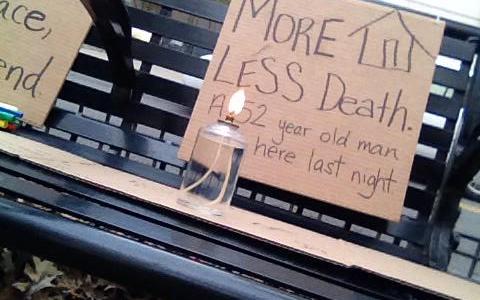
There is an old adage “success has many parents, while failure is an orphan.” Last evening folks gathered on the lawn of the county courthouse in our town to remember the thirty-two persons who had died without adequate shelter over the past year. No doubt others threatened by poverty, addiction, or hunger had also passed away. They were not known. This likelihood was mentioned; homelessness cycles for millions continually in our society. Where is there hope?
Joe Emerson and Sylvia McNair at the Service of Remembrance, September 29, 2021
Candles were lit and small placards with the names of the known deceased were placed on the courthouse lawn. There were prayers, poetry and singing as several dozen folks lifted their candles in remembrance. The Rev. Forrest Gilmore, Director of Beacon Inc in Bloomington (an antipoverty program that grew out of, and includes, the Shalom Center Shelter) lead the service. Politicians spoke and a family member shared the important words, “We miss her. A hole is left in our hearts. Forgive yourself and others.”
It was an inspiring evening. The Rev. Joe Emerson, now approaching his 90th birthday, opened in prayer. He had first suggested such a service of remembrance back in 2004. Joe prayed. My thoughts went back to the United Methodist General Conference in 1992 in Louisville, to the beginnings of what became known as Shalom Zones. The 1992 Louisville Conference occurred as the trial of four police officers involved in the tragic arrest and beating of Rodney King was concluding. As the “not guilty” verdict was read, rioting broke out in Los Angeles. It was April 29th, midway into the two-week denominational conference, held every four years. How should the church respond? Those gathered in Louisville took their cue from the Rev. Joe Hyun-Seung Yang, a pastor in Los Angeles’ Koreatown, near the riots. Yang had set up a “relief center” that became known as the Shalom Community Center. Shalom, a word from the Hebrew Scriptures meaning peace, wholeness, safety, health.
In Louisville that week the Rev. Joseph Sprague from Columbus, Ohio (later a bishop serving in Chicago) proposed a Shalom Initiative. Civil rights leader the Rev. James Lawson and his brother the Rev. Philip Lawson, both delegates, rose to speak in support. The vote was overwhelmingly in favor. Within hours a denomination-wide program calling for “Shalom Zones” was adopted and funded. Shalom Zones were to be established around the world as places where persons in poverty could find safe space to build communities of hope and restoration.
In Bloomington, later that year and in years following, we began to pray, confess our failings, study and hold conversations on the biblical notion of Shalom. We challenged one another to address the broken places in our society, in our city. How might we respond? Make a difference? Many initiatives followed. Financial offerings were taken and shared; the church kitchen was used to provide meals for the hungry, clothing was collected and shared. In 1999 the church provided funds for one of the early Habitat for Humanity houses built in the city.
A day center for the homeless was up and running in First United Methodist Church’s fellowship hall by 1999. Here, persons could get mail, use a phone, have a meal and simply stay safe and warm. The need for more overnight shelter remained. Many incredible lay people in the congregation, and beyond, struggled to make a difference for those on the streets. Change, enduring change, needed a persistence practiced by the actions of lay persons. This was much more crucial than sermons or study times led by the pastor. The day center was given a name — it would be the, naturally, the “Shalom Center.” Lay persons, like Indiana University Economics professor Philip Saunders, joined dozens of others who began to widen the vision for what might be possible. In fact, the feeding program at the Shalom Shelter, in 2021, twenty-four year’s later, is known as Phil’s Kitchen.
At the service last night, a fellow approached and surprisingly called my name. It had been more than twenty years since we met in the late 1990s. Having overcome the challenges of addiction he had faced earlier, this man was now helping others. We laughed as he reminded me that many on the streets didn’t adopt the name “Shalom Center.” Instead they slurred the words, using street humor, they teasingly called the fellowship hall arrangement the “Slum Center.” These folks knew, and we knew, we could do better. Thankfully as the years passed many others joined together to do better. They persisted. Something much better has emerged.
I hear other origin stories about these beginnings of the Shalom Center in Bloomington. Each narrative holds its own truth… there have been many sources of action and investment. The sacrifices and generosity of so many since 1992 have made a difference. Prior to the 1990s there were already many fine service organizations (e.g., Monroe County United Ministries and Community Kitchen) assisting persons facing the brutal results of relentless poverty and non-available shelter. Today, even more organized resources are offered in the community through social service groups and government programs.
Yes, success has many parents. One must ask, has this truly been a success? Well, yes… and no. No doubt many lives have been saved and new beginnings discovered. Still, at least thirty-two of God’s children died on the streets in our town over the last year. That’s not the mark of success. Such an assessment is true in almost every city in the nation. Last night, I heard the politicians speak of aid that has been offered and I often read annual reports of the organizations in our city like Habitat for Humanity, New Hope for Families, Wheeler Mission and the Bloomington Housing Authority. Good, good and very good on them all. Still, still, still, there is yet a shadow over us. Thirty-two died without housing last year — this we know. Shalom Zone activities begun in Louisville in 1992 continue around the world. Scores of places have benefited through dozens of projects in the U.S., Asia, Africa, Europe and Latin America.
Rev. Ingrid McIntyre, Glenncliff Village, Nashville
Even so, in this nation and in my community, homelessness persists. We seem stuck, forever overshadowed by the tragedy of persons without safe housing. Many in our nation seem forever caught up in ignorance, bad theology and lousy public policy, devoid of humane responses to addiction and poor mental health. We must not fall into the trap of believing homelessness is about an individual’s moral failings, as so many seem to think; rather, these without shelter are evidence of our society’s moral failings, failings of our community, our economic and political choices.
How to move beyond the shadow? There is, as the scriptures say, a “great cloud of witnesses” showing us pathways forward. There are persons with a broader vision, a better response. In my city there is a “Heading Home” proposal that offers the better linkage of resources, more housing and earlier, more appropriate, and sustainable, interventions to persons in such crisis.
Across the nation, others point the way, typically these days initiatives are ecumenical and/or interfaith in nature. For example, note the work of folks like Ingrid McIntyre in Nashville, the Rev. Ingrid McIntyre, co-founder of Open Table Nashville, which seeks to “break the mold of what people call the church.” Rev. McIntyre led in the building of twenty-two micro homes in a Nashville neighborhood known as The Village at Glencliff. These are shelters for “medically vulnerable neighbors who are chronically homeless” as they wait for permanent housing. The homes form a sacred halo around Glencliff United Methodist Church. I can’t help but think about other churches, scores of them, where tiny houses might be built and homeless persons having interim shelter and linking the gifts of the congregation with those who need shelter.
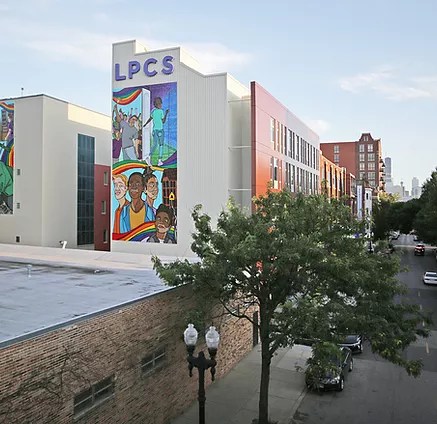
Lincoln Park Community Services, 2020
In Dallas, an ecumenical initiative known as CitySquare has over these past twenty-five years grown from a food pantry into offerings of legal aid, to job development, housing rehab and the building more fifty tiny houses for those needing short-term housing while persons deal with addictions and other health issues.
In Chicago a group of churches joined together to build a new facility for Lincoln Park Community Service offering interim housing and job counseling for more than 120 residents.
This is a tiny window into the work of persons who are working to end homelessness. Each one is essential to ultimately addressing the challenge.
Finding room for the unsheltered can seem overwhelming, I understand. Even so, I join the Israeli novelist Amos Oz who suggests that when confronted by huge, seemingly intractable problems (like the fanaticism and hatred held by many Palestinians and many Jews in Israel), a productive option is to join The Order of the Teaspoon.
Oz writes that when facing an enormous, tragic situation, like a conflagration, a fire burning out of control, there are three options: 1) Run away; 2) Write an angry letter to the editor; 3) “Bring a bucket of water and throw it on the fire.” He goes on, “and if you don’t have a bucket, bring a glass, and if you don’t have a glass, use a teaspoon — almost everyone has a teaspoon.” Oz Amos [“how to cure a fanatic,” Princeton University Press, 2006, pp. 93-95] asserts that if millions who have a teaspoon form the Order of the Teaspoon to join in taking on enormous challenges, dramatic change is possible. [Homelessness is an enormous problem but small when compared with others like the Jewish/Palestinian divide which is the conflagration to which Oz Amos is pointing.]
Too many will sleep unhoused tonight on the streets of my city or town, and yours. Might we continue the vision of Shalom Zones begun thirty years ago — and, actually, centuries before that — [insert your own scripture here — there are dozens from which to chose]. What if we each brought our teaspoon to dose the fires that leave us in the shadow of the unhoused? So, please, find a place near seeking to make a difference. Persist, you and your a bucket of difference-making support, or add glassful or a teaspoon of support toward ending homelessness.
Hope and Freedom are inextricably linked — twin sisters of the great experiment in democracy known as the United States of America. Both are best defined and lived out in the future tense. Mark Twain put it this way, “Lord save us all from old age and broken health and a hope-tree that has lost the faculty of putting out blossoms.” In three days, I pray a tidal wave of voters in the United States will choose Hope and Freedom. It is a critical moment for the nation to move forward and step away from the politics of division, despair and fear.
I miss the easy sense of hope and freedom I knew before the COVID-19 pandemic savaged our nation. Still I am most fortunate; I know this. I have benefited fully from HOPE and FREEDOM. So my struggles in this time of pandemic are minimal, modest. My challenges center in a missing touch with family and friends, mask wearing, safe grocery shopping or the absence of gatherings like Sunday worship.
In a strange way, pandemic offered opportunity to join others in online worship. On a typical Sunday, I check in on my home congregation and then roam across the internet. Sometimes checking out three or four other congregations. Okay, I know this is atypical — make that downright strange! Call it an occupational hazard of a retired preacher. Better, know it is the joy of discovering gifts other women and men offer as they lead worship. From New York to Colorado to California I watch. There is the exceptional pipe organ offerings of Jaebon Hwang in San Diego or the profound words of my friend Michael Mather in Boulder.
Most Sundays since the pandemic began, I drop in on music and preaching at St. Andrew in Highlands Ranch, Colorado. This past Sunday, October 27, I sat straight up in my chair as Mark Feldmeir quoted from Toni Morrison: “The function of freedom is to make someone else free.” “Yes,” I thought. That is what makes this election so important! Freedom should never be quarantined to self absorbed, individualistic, personal freedom — or, even to the idea that freedom should be restricted to the boundaries of one nation. Freedom is to be shared. Hope is to be shared. So, borrowing from Morrison, let’s say that the function of hope is to offer others hope!
Barbara Brown Taylor reflects on the two disciples walking along the Emmaus road having just left Jerusalem. They are heart-broken by the crucifixion of Jesus. A stranger joins them who asks why they are so downcast and defeated. According to Taylor they reply: “We had hoped he was the one to redeem Israel.” She then notes: “We had hoped. Hope in the past tense, one of the saddest sounds a human being can make. We had hoped he was the one. We believed things might really change, but we were wrong. He died. It is over now. NO more fairy tales. No more illusions. Back to business as usual.” (Gospel Medicine, p. 21)
++++++++++++
Hope is a thing with feathers,That perches in the soul,And sings the tune without the wordsAnd never stops at all. - Emily Dickinson
Prayer: Remind us, O God, that the warp and woof of creation are hope and freedom. It is in these we discover joy. In these we are called to delight and praise. May we know the tremors of bliss, the winks of heaven, the whispers of hope, the pathways of freedom that signal the grand consummation of all things. Amen. (adapted by P. Amerson from Thomas a’Becket) +++++





 Hands of the Strong