Our “Peak Crazy” Social Psyche

Our Peak Crazy Social Psyche

img_1847
Maligne Lake, Jasper National Park, Alberta Canada

Peak Crazy

Today’s New York Times (September 28, 2016) asks if our national psyche has reached a “peak craziness” with regard to our penchant for accepting conspiracy theories.  “Peak Craziness” was a new concept for me.  A search shows that it is not a widely used idea; however, I find it a helpful one.  It suggests a reaching of a distorted, foolish summit or high point in human experience and discourse.

Upon reading the NY Times commentary it was clear that while conspiracy theories aren’t a new phenomenon in our society, the changes in the way we receive our news and the power of social media, give a credence to conspiracy theories that is dense in saliency and reach.  Our “news” comes at us fast and furiously and these theories become an ordering mechanism for the hurried, anxious or fearful.

One couldn’t help but chuckle on Tuesday morning when Donald Trump complained that his microphone had malfunctioned during his recent debate with Hillary Clinton.  Trump went on to say that “he didn’t want to believe in conspiracy theories” and wondered why he had microphone problems and Mrs. Clinton did not.  It is no surprise, I guess, that the candidate who has been the most active in bringing our nation to a peak craziness around conspiracy theories would suggest that any failure on his part is the result of some conspiracy.   Truth is, that both Mr. Trump and Secretary Clinton have painted pictures of “vast conspiracies” as part of their election narrative. 

While I give more credence to Ms. Clinton’s concerns — whether about the crazed conjecturing about Benghazi, White Water, missing emails, etc. — it seems that she gives too much attention to some vast plot or “hidden hand” that determines present and future circumstance.  Of course, Mr. Trump’s conspiracy theories are more pernicious — filled with racism and xenophobia.  In fact, the record is clear, Trump’s “birther” conspiracy comments, freighted with bigoted attempts to undermine Barack Obama’s legitimacy as president, was a major factor in his staying in public consciousness.  We will no doubt hear of other “conspiracies” as Mr. Trump plays a kind of ideological bumper cars with the truth and our national psyche.

malignelakespiritisland
Spirit Island: Maligne Lake, Jasper National Park

Thinking about the idea of Peak Craziness reminds me of our recent visit to Maligne Lake in Jasper National Park.  Mary Schaffer is said to be the first person of European ancestry to “discover” Maligne Lake.  Using a map provided by Samson Beaver, a First Nations chief of the Stoney People, Mary Schaffer’s small party found this nonpareil site.  The glory of the lake and the surrounding peaks filled them with wonder.  An artist, Mary Schaffer, spoke of this as a place beyond ever fully capturing by words or brush.  Depending on where one stands there are peaks and glaciers in every direction surrounding the lake. 

Near the glacier-fed headwaters is Spirit Island.  The island is a sacred ground for the First Nations people who spoke of this as the temple of the gods.

One wonders if the humanly constructed “peaks of craziness” in our national psyche are blocking our view,  preventing us from seeing the genuine peaks of wonder all around.  Perhaps we need to spend more time on our own Spirit Islands to to see the true beauty of this election season.  There they are, towering beyond all our conspiracy theories, the peaks of shared humanity, the remarkable wonder of democracy — even when messy — and the towering responsibility of citizenship.

Let’s live as a Spirit island people, who work and vote in a world as free of conspiracy peaks as possible.


The Unexpected: Surprised by Joy

The Unexpected: Surprised by Joy

September 6, 2016

An unexpected gift came to my doorstep this week.  Unexpected.  And, actually, it wasn’t delivered to the mail box or, like an Amazon package, to my doorstep.  Rather it came when I was away from home; discovered while traveling in California.  Elaine and I were in Sacramento. 

54842954_s-2
The “Safe” — an empty pork and beans can

Early morning, out on my daily constitutional (the goal is to walk five miles a day), I was stepping along a stretch that looked promising.  It was a grassy and green stretch.  On one side was the I-5 interstate that runs the length of California.  Sounds of rushing traffic — good folks no doubt on their way to work in the city — perhaps in state government.  On the other side of the green way was a row of tall evergreen trees.  Beyond them an empty field.  The stretch, about four football fields long, ran between the Hilton and Marriott hotels.  No paths, little appearance of use, just the promise of a good place to walk alone, I thought.

About half way between the Hilton and Marriott, tucked away under the trees, sunlight streamed like a silver web on the grass.  It gyrated across my path.  The light beckoned me come.   I turned toward the trees and just a few steps away, hidden in underbrush, was a small encampment.  Clearly someone’s abode — plastic bags, a water jug and a couple of bedrolls — these were obvious.  Only the trees for cover.  I called, “hello,” then thought it foolish.  They likely wouldn’t welcome a visitor.  With no response, I looked more closely.  There were a couple of books including an old Bible and what, at first, appeared to be trash — four opened and empty tin cans.   Looking more closely, in a Pork and Beans empty “safe,” was a rosary and 47 cents.  Feeling guilty, embarrassed, about disturbing this hermitage, I quickly moved away.

Who lived here?  For how long?  Was this a “permanent” residence for a couple of homeless folks?  The irony of this camp between two upscale hotels did not escape me. I walked on pondering questions about our society and wondering about these residents on the edge of survival tucked away between the comfortable respite of travelers like me.   How had these homeless folks arrived at this situation?  Bad luck?  Addiction?  Mental illness?  How had our nation come to this point of ignoring the poor among us?  Our bad luck?  Our ideological addictions?  Our mental illness? 

A rosary and forty-seven cents – left in a pork and beans tin can.  Returning along the path, I couldn’t help it.  I returned.  Looking around carefully to make certain I would not intrude.  Still with no one “home,” I fished some cash from my wallet and added it to the modest stash in the pork and beans can. 

I left quickly, and then that first strand of light fell again across the path way.  I looked back to see an old broken mirror hinging from twine on a tree in the encampment that was reflecting the light.  I stopped and prayed, praying as earnestly as I have in years.  Yes, I prayed for these homeless folks.  Yes, I prayed for our nation and world.  More, I prayed for myself.  My intrusion into this purgatory (or was it a haven?), this place of meager shelter, hidden away in our brutal and too often numbing world was illuminating.  So many live on the edge.  It was a heartbreaking reminder of the work yet to do.  How many homeless in the U.S.?  Eleven million?  Or, as some say, thirty million? 

I was also aware that my intervention might not be of value.  Should I call a church or social workers?  NO!  Knowing all too well our systems of “helping,” I didn’t want to further endanger those who sought this place as sanctuary.  Even though I had left a little money behind, I was not a hero.  Nor were my motives heroic.  There is too much in our society that encourages us to believe that we are the heroes and others are the victims.  Our world is not as much of an either/or calculation as so many of our ideologies or theologies all too often communicate.

I wondered if this was a couple and if they had a child?  Might that child be undocumented?  Might that child be a refugee?  A refugee like that child Jesus so long ago?  Might it be a Joaquin, Jamal, Maria or Alice?

IMG_1645Returning to the hotel parking lot, there was another glimmer of light.   Down, and there on the asphalt, was a lost key.  My first thought was to carry it back to the camp.  Leave it there with the rosary in the can.  Then I realized the key might be for me.  I was to remember — that because God loved me so, I was to live in responsible ways, always remembering those tucked away, out of sight, living on the margins.  I was to live aware that because God loved those camped under the evergreen trees, I dare not stop speaking or working on the behalf of all.  Now — here is the real surprise for me.  In that moment there was JOY.  The joy of remembering my faith, of knowing my calling.  The JOY of having another key to my identity.  Lost and found — Joy.  Like an empty can, I had been provided so much by so many. I thought of those who had taught me so much — teachers, parents, friends, the homeless I had known over the years who “took me in.”  I checked with the hotel desk and no one reported losing a key, so I dropped it in my pocket as a reminder.

Yes, I was so privileged.  I had work to do.  In a world where our political candidates seem determined to forget the homeless, in a world where our refugees are a small fraction of the refugees all across the planet, there is work to do.

I recalled C. S. Lewis who wrote of these moments:  ” I call it Joy, which is here a technical term and must be sharply distinguished both from Happiness and Pleasure. Joy (in my sense) has indeed one characteristic, and one only, in common with them; the fact that anyone who has experienced it will want it again… I doubt whether anyone who has tasted it would ever, if both were in his power, exchange it for all the pleasures in the world. But then Joy is never in our power and Pleasure often is.”
C.S. Lewis, Surprised by Joy: The Shape of My Early Life

I brought the key home with me.


Mentors of Hope

Mentors of Hope

Visits with my best friends typically include the question, “what are you reading?”  Sometimes I am embarrassed and tongue-tied because I don’t want to admit that I can’t even remember the name of the author or the title of the book in that moment.  I know it is a good book and can even tell you the color of the cover or quote several passages from it.  But the name of the author? — Ah, the joys of being 70 keep coming!  Still, I am grateful for this question and for these friends as they are asking a deeper question, more fundamental question.  It is “who is teaching you these days?”

Good reader, who are your teachers?  This is not asking you who were your teachers? Rather what is informing you today?  No doubt lessons from the past are critical to shaping who we are.  I do remember elementary school teachers like Ms. Kerns, Ms. Schindler, Ms. Williams, Mr. Glass all offered lessons that still shape my living.  Occasionally I hear echoes of Ms. Schindler, third grade teacher saying “Philip, you are too good not to be better!”  What an enduring word — her legacy on my life.

Lessons from today are even more essential — essential to shaping who we will become.  Who teaches us now?  In a time when ignorance and falsehood is the trademark of one Donald Trump, the question “what are your reading?” is critical.  If you find Mrs. Clinton’s candidacy troubling, “what are you reading?”  What gives you perspective beyond the same ole talking heads on television?

So, here are a few folks who are shaping my thoughts today for the future:

  1. Sara Wenger Shenk is president of Anabaptist Mennonite Biblical Seminary.  In her blog “Practicing Restoration” Sara recently wrote of Beauty in the Borderlands (Wenger Shenk, Practicing Restoration).  Very nice — and full of wisdom like the importance of “caring for the institution you are trying to heal.”
  2. President Wenger Shenk mentions Gregory Wolfe’s Beauty Will Save the World and I am reminded of another wonderful teacher for these times.  I have only started the book but find it so compelling, I can even remember the name of the author!
  3. Then there is the work Connected by Nicholas Christakis and James H. Fowler that points to the power of our networks of friends and their friends who touch our lives in ways that shape our worlds for benefit or disease.
  4. I would mention the daily meditation pieces from Richard Rohr, at the Center for Action and Contemplation – see Richard Rohr meditations.  He has recently challenged my tendency to think too often in binary ways and reminded again of the powerful benefit of paradox for us if we are to find more hope-filled ways forward.
  5. Lastly, I would mention Malcolm Gladwell’s podcast Revisionist History at Revisionist History podcast.  He has just completed the first ten podcasts for this summer season.  They are richly rewarding and will make you think!

In a period of history when the temptation is to watch my favorite news channel (Fox or MSNBC or CNN or…. you name it) our communities and our body politic deserve our efforts to think more clearly and not find ourselves trapped in our limited cul de sacs of narrow analysis.  Read on good folks — think more broadly.  Our world deserves the best we can know, even if we can’t always remember the name of the author or the title of the work.  Where do you find hope?  Who mentors you in that direction?

It is all too easy to focus on some issue of discontent.  Okay, I hear your complaints.  What I want to know is where do you find hope — where do you see folks coming together?

I write trusting that in some small way I can act as a mentor of hope today.  I will have my issues of disagreement with others, of course.  I challenge you to join me to read more widely, think more broadly, our world needs you to do so.

Filet


Harvesting Weeds

Harvesting Weeds


IMG_1423
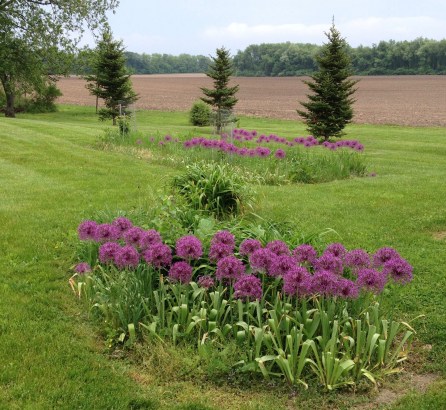
Allium in Bloom, Walstead Farm 2016

Early June – daffodils and tulips have dropped their blooms.  Now the purple allium flowers, gorgeous, stand proudly over the “weeds.”

Funny how I can miss the beauty by seeing only the weeds.  Beauty — this year I saw it all around our home in the flower or vegetable beds.  The allium amidst the weeds remind me of wisdom of a friend long ago — the Rev. Esther Angel.

I first met Esther in 1992 in Louisville.  We were both clergy delegates to the United Methodist General Conference working in the same legislative group.  That year Esther’s quiet and deeply spiritual presence made a difference.  During a break in our legislative group, Esther, speaking softly, asked if she should say something to the entire group.  Several of us encouraged her and then she said something that has lingered with me since.  She simply and calmly said, “I fear the United Methodist Church is in a time of self-loathing.  It is diminishing and replacing the joy of our work.”  She went on “we are forgetting to celebrate the harvest, focusing too much on the weeds.

That day, in the next hour, Esther rose and moved to the middle of the circle in which our legislative group was sitting.  The topic was the denomination’s support for a woman’s right to have a choice when facing the tragedy of abortion.  Up to this point, it was mainly men who had spoken.  Raising her hand, moving to the center, turning and continuing to slowing circle, she began, “I would sing you my heart…” 

She spoke of the women she had counseled facing difficult, almost impossible pregnancies and life situations.  Saying she had never counseled a woman or her partner to proceed with an abortion — she could still understand how in some cases this would be a tragic yet appropriate choice.  Esther spoke in a beautiful way of other ways we sought to be a denomination that brought healing and hope.   She rehearsed the ways United Methodists had led over the years in civil rights struggles.  She spoke on the behalf of a woman’s right to choose and wondering why none of the men, who had spoken with such strong views that week, had asked to hear from women in the room. 

I thought of Esther this year when the 2016 General Conference voted to abandon our denomination’s long term support for the Religious Coalition for Reproductive Choice.   In 1992, Esther spoke about the importance of welcoming gay and lesbian persons in our churches.  She ended her solilloquy, her word-dance with the words, “Let’s stop harvesting the weeds.”  In 1992, Esther’s quiet, yet prophetic, spirit made a difference.  We missed her in 2016 — but her spirit remains.

The 2016 General Conference of the church “spent a lot of time harvesting weeds.”  Esther, who died, too young several years ago, had a capacity for quiet communication. In 1992 Esther passed out a poem printed on a 4 X 6 note card.  Here is a link to a copy: Re-Imagining — Esther Angel, 1992.

IMG_1457

To my mind she captured something in speaking of our “denominational self-loathing.” She perceived then that we were forgetting to celebrate the good harvest related to who we are as Wesleyans as United Methodists.  In too many places we forget our great legacy and are literally getting lost in the weeds. 

Often when I hear of congreations who try to hide their United Methodist identity on signage or websites, I think of Esther.  When I learn of congregations who ignore our theology of baptism or communion, who offer meager financial support to the denomination and prefer to identify themselves “post-denominational” or “community” churches rather than United Methodists, I think of Esther’s witness.  When I see the stong waves of the so called New Room Calvinism seeking to capture the future theological direction of our denomination, I think of Esther.

In her poem Esther spoke of the energy expended on attacking and defending and then wrote:  “Meanwhile, The poor hear bad news, Captives stay in prisons, The blind remain unsighted.  Satan laughs.  Wouldn’t you in his/her shoes?  “Left”; “Right, both the same, in tactics and in what remains — Undone.”

At our house we are now harvesting vegetables.  What joy!  Still, it’s difficult not to focus on the weeds, no matter our best intentions.  The same is true, I fear, in the church. 

My own bishop writes compellingly that United Methodists are about so much more than dealing with issues of sexuality.  Sadly, he then spends nearly every communication, every month, talking about the church and homosexuality.  He may be trying to do penance for the years he has quietly aided and abetted our bigotry.  Perhaps.  Still, until we hear of the beauty of faithful, loving homosexual relationships or about the gift of the witness of congregations that are courageously focusing on welcome and reconciliation and rituals of support for all people, it all stays in the weeds.

We all have a responsibility.  Will we speak of the beauty all around?  Will we speak of the delights of the harvest?  Will we speak about our denomination’s commitments to addressing poverty?  Addressing racism?  Our ongoing commitments to threatened immigrants in our nation and world?  Will we have a constructive word about addressing the dilemmas of climate change?  Will we hear about the ways the lives of persons in our communities are being changed through the love of Christ?

Esther had it right, let’s stop harvesting weeds!

Phil A

Upsidedowning: Inauguration 2017 Ups or Downs

Upsidedowning and January 20, 2017

One year from today — January 20, 2017 we will be watching the inauguration of the next President of the United States.  Trump? Clinton? Cruz? Sanders?  One of the others?  All flawed.  Some seem to threaten the very fabric of our democracy.   I am often asked by younger folks (you know, folks who are 40 or 50 are YOUNG to me) if I can remember a time when political conversation was this, well, nutty, this far off the rails, this unhinged from facts.

WhiteH8015375_sThe honest answer is NOAbsolutely not.  I remember well the campaigns of George Wallace, Gene McCarthy, Ross Perot, John Anderson, and I remember my high school infatuation with Barry Goldwater.  None of these are comparable.  This is a time when facts seem to matter little.  Anger, make that rage, is in vogue. 

It is as if our national identity, our political assumptions about integrity and well reasoned analysis of the national and world situation has gone down a rabbit hole.  We have entered a period of UPSIDEDOWNING.  What once was up is now down and…

whitehouse$20163804_s

Ridicule of others is now the currency to win votes. Wealth is either a measure of ones value or decadence.  No space is left for the virtues of thoughtful dialogue, learning, humility.  Intemperate statements are valued by the electorate.   Reasoned and careful action by the current president is seen as weakness.  No, I don’t recall a time like this in my memory when behavior like that of a junior high school bully is seen as a positive credential for a future president.

Of course there is a history as to how we got to this place.  Persons, it seemed on all sides, decided it was better to demonize others than find common ground.  You add the complexities of a modern world with 24/7 news coverage and throw in a large dose of racism, bank malfeasance (see or read THE BIG SHORT) and economic uncertainty and you come to the presidential race of 2016.

So, what’s a person to do?  Honestly I don’t know — I have no big idea.  I do remember the bumper sticker that read “If you think education is expensive, try ignorance!” 

Here is my small modest proposal.  You and I, good reader have one year, 366 days (its leap year) to engage persons at a local level with good caring but critically factual conversation.  My pledge is to every day speak to at least one person, preferably someone whose opinions differ from mine, and see what I can learn.  What do I need to know to be a better citizen? And, of course, what can I share that encourages another person, perhaps a stranger, to understand that we are neighbors – even when we disagree.  This might do a little bit to lower the temperature on the language that continues to boil over into vitriol. 

I will do other things, of course, to help the candidate I believe who can best move us out of these mean-spirited times and contribute to our being a place of honest and constructive disagreements.  It is what is called democracy.  Depending on how high the stakes may be, I may do a lot besides talking with my neighbor and stranger trying to bring more light than heat to the political dialogue of our time.  But for the next year (or until next November’s elections) I pledge to work toward honest, factual dialogue… that builds up rather than destroys.

My sense is that our nation can ill afford to elect a president who will encourage us to try ignorance.  The stakes are too high — the world is too complex.  We need cool wisdom and not hot revenge to make it through the challenges ahead.  Meanwhile, I tell my young friends, those under 50, that “NO, I have never seen a political season like this; and, it is time to seek factual information and to speak honestly and respectfully.” 

This is the stuff (honest dialogue and respectful disagreements) of a healthy democracy.  This is the way to RIGHTSIDEUP our national life.

What you take into your Hands, You take into your heart

Via Hand and Heart: Part II

9364084_s
The Knotted Gun sculpture by Carl Fredrik Reutersward, United Nations, New York

 December 14th, 2012.  Sandy Hook Elementary School, Newtown, Connecticut.  It has been three years — such horror.  If there were ever evidence that we are following a misguided path regarding access to guns in our nation, Newtown is the evidence.

Twenty-seven murdered.  Children, teachers, a principal — all sacrificed to our nation’s inability to think or act rationally to protect the innocents.

In the early autumn of 2013, ten months after the tragedy, I was invited to preach in a congregation in downstate Illinois.  During the sermon on the text of “reaping and sowing,” I spoke of our inability to address the gun violence in our culture.  At that point, ten months after the Sandy Hook murders, Congress was still unable to offer even the slightest form of intelligent response of healing or hope for an alternative approach.

Following the worship service a well-spoken gentleman approached.  He didn’t appear angry but he did begin by saying he wanted to disagree with the sermon.  “Okay,” I said, “Please share; I am eager to learn.”  At this point he said that I should not have mentioned guns — “talk about violence, if you must, but when you make it ‘gun violence’ you make it political.  People can also hurt others with a knife.” He went on “if more people were armed the innocent could be protected from the crazies.” 

I was speechless, frightened really.   I didn’t want to have an argument right there in the fellowship hall.  A long pause followed.  I prayed.  He was obviously a sincere, intelligent man — one who had the courage to speak of his disagreement.  After what seemed like an eternity, I reached out and took his hand, still not knowing what to say.  Then, these words came, “How long have you worshiped fire arms?  Is it possible that you may have substituted trust in guns for trust in God?”  To my surprise he squeezed my hand and instead of taking up the argument he said, “I’ll have to think about that” and dropped his head.

Later I found out that this man was active in state politics… If he changed his perspective on the gun lobby his work would be in jeopardy.  He too was frightened.

The scripture lessons at Christmas tell the story of the birth of Jesus, yes.  There is more.  This story continues as it moves toward the story of the slaughter of the innocents and Jesus’ family becoming refugees to avoid his murder.  Herod sends out word that all the male infants should be killed.  I am reminded of the cover of the New York Post the day following the Sandy Hook tragedy.

tumblr_mf2xwj6iFj1rv4aqro1_1280Congress continues to give more protection to gun owners than to the innocent ones who face the terror of sick, troubled and misguided folks who find it easier to own a gun than have a license to drive a car.  We are not helpless… even in the face of difficult odds against change.  Let me suggest that you look to the work of the Brady Center at Brady Center to Prevent Gun Violence.

In Part I of this reflection I spoke of the movie Witness and the scene where the grandfather Eli is speaking with young Samuel about the gun he has found.  He says to the child “What we take into our hands we take into our hearts.”  This is one of two scenes I will always remember.

When the movie first came out in 1985, I was teaching an urban studies class for future pastors in Chicago.  One afternoon the class went to see the movie and then came back to discuss it together.  There were about twenty students in the class, approximately half of them were from the Mennonite or Brethren traditions.  The other students were a mix of Presbyterian, Baptist, Reformed and Methodist. 

The discussion turned to the second unforgettable scene for me from the movie.   It is near the end of the film.  Gunmen come to the Amish farm to track down and kill Detective Book and members of the Lapp family who witnessed a murder in Philadelphia.  What ensues is dramatic, haunting and amazing all rolled into one.  I won’t spoil you by giving you the ending of the movie, but I want to share the reactions from my class to one scene in particular.  The grandfather is facing an approaching gunman.  He looks into another room where Samuel can see him as he motions.  Grandfather Lapp’s hand is out at his side, clenched and moving slightly up and down.  The boy understands and runs to perform the unspoken task. 

In the debriefing of the movie Witness with that class in 1985, I asked how many thought the grandfather was signaling for Samuel to go ring the bell to gather the neighbors.  All of the Mennonite and Brethren students raised their hands.  I asked how many thought the signal was to go get the gun… almost all of the rest of us thought it was signal to get the gun.

The difference in what was seen by the two groups continues to haunt.  One group had grown up knowing the power of community when faced with danger; others of us had learned to prefer force and power.


My One Question

My One Question

What would you ask?  If you could ask only one question of the candidates for the presidency of the United States what would it be? 

Tonight we will see the spectacle of the first presidential debates among the candidates of the Republican Party.  Several television and newspaper pundits are suggesting the questions that “must be asked by” the moderator.  For example, Tom Friedman suggests candidates be asked about an increase in the gasoline tax to pay for our crumbling highway infrastructure.  He notes this is something that Ronald Reagan supported upon his election and might help determine which candidates would be able to lead beyond narrow ideological constraints.  (See: http://www.nytimes.com/2015/08/05/opinion/thomas-friedman-my-question-for-the-republican-presidential-debate.html?src=me&_r=0).  Friedman also suggests questions on immigration and carbon tax credits.  Good questions — just not my question.

There is another group called Circle of Protection that would ask the candidates what they would do to end hunger and poverty in our nation.  Several of the candidates, in both parties, have posted video responses to this excellent question (see: circleofprotection.us).  This too is a marvelous question — a truly important question.  The video responses by candidates that have already been made are helpful — revealing of core beliefs.

However, most of the questions suggested by the pundits are designed to elicit a provocative response, something that will pit one candidate against another.  Most of the suggested questions have little to do with policy or vision and much to do with demeaning another candidate.  Clearly, the hope is to start a political food fight!   Most of the suggested quarries by the television talking-heads are designed to generate more heat than light.  These suggestions are a version of the old school yard taunt “Lets you and him fight!”  How interesting that on August 6th, Hiroshima Day, our nation’s attention turns to a forum where many are hoping to see a fight.

My one question would be this: WHO IS MY NEIGHBOR? 

It comes from my enduring preoccupation with the Gospel parable we often refer to as the story of the Good Samaritan.  I prefer to call it the Parable of the Unexpected Neighbor.  My preoccupation with this particular parable is shaped by the reading of the social philosopher Ivan Illich.  Illich returns to this story again and again as a theme in his analysis of modern institutions.  He notes our misguided efforts to provide professional solutions to problems that require, first and foremost, a neighborly community and a commitment to common conviviality.

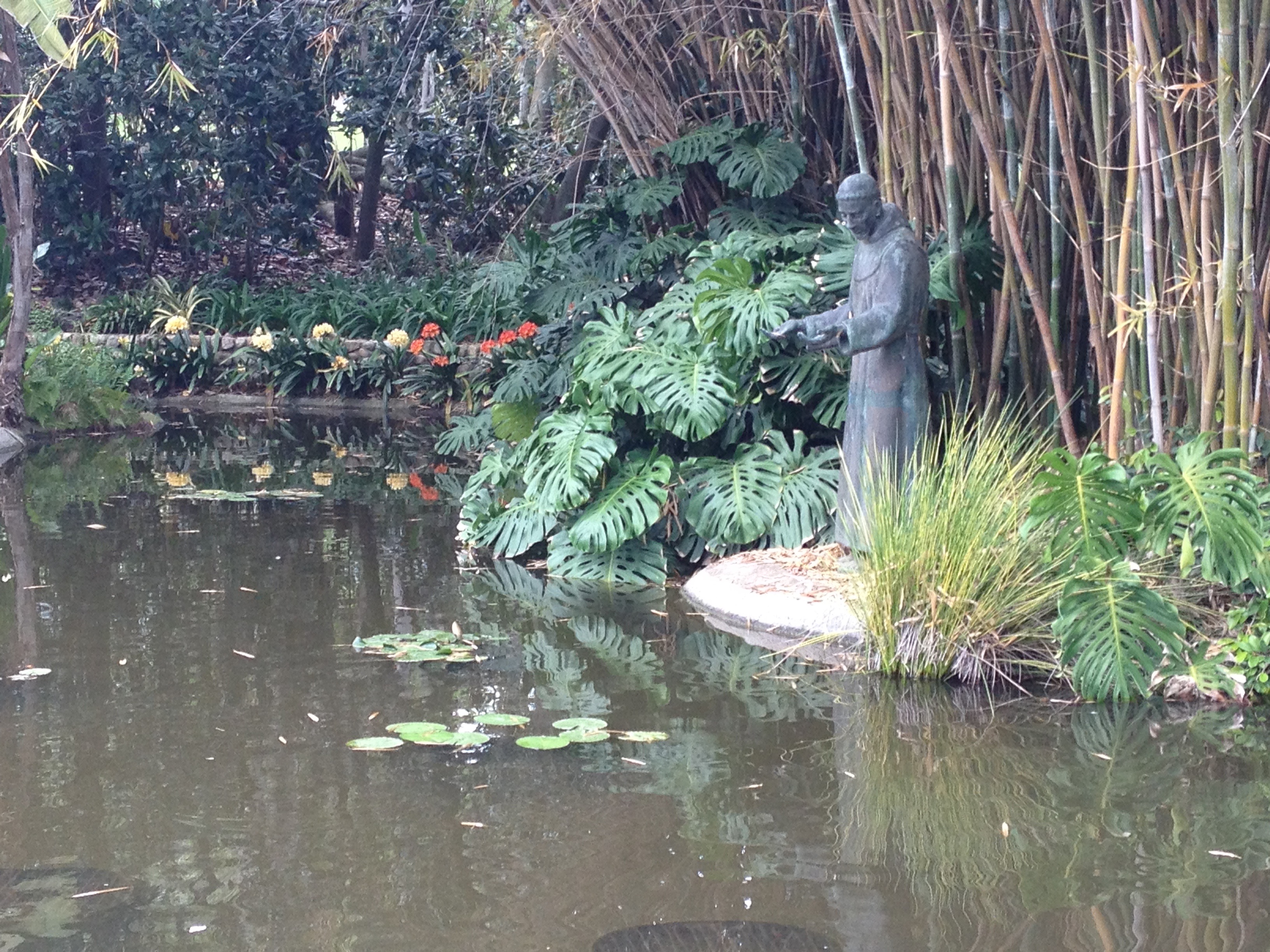
Huntington Library Gardens
Huntington Library Gardens, Image of St. Francis

I believe the story of the Good Samaritan has been domesticated, romanticized and distorted in meaning.  I hold that in answering the question “Who is my neighbor?” one will hear from the respondent the core commitments of that person.  This is a “template narrative.”  It uncovers a human gestalt — points to the baseline of meaning. The answer to this question has shaped the lives of people throughout the ages, from St. Francis to Mother Teresa, from Ghandi to Thomas Merton.

Who is my neighbor?  The answer suggests so much — from a compassion for the stranger, to an openness to the foreigner, and a welcoming of the alien, alternative solutions to vexing problems.  It is a question that allows the responder to share ideas that might give us larger purpose and expanded hope.  Yes, the theme of care for the neighbor challenges our propensity to selfishness, bigotry and violence; I believe it offers us even more, when we grasp the dimensions of how this story and its context might shape our perspectives today.

Ivan Illich was once asked, “Given what you suggest about institutions, what is the best way to make change, violent revolution or gradual reform?” Illich answered, “Neither, the best way to bring change is to give an alternative story.” (in David Cayley’s, The Rivers North of the Future).
Over the next several postings I will expand on the wonder of this parable and the power of the question asked of Jesus by the young man in Luke 10:25-37.  I believe it opens us to a remarkably powerful, alternative story — maybe the most powerful alternative story available to humanity!

My plans this evening do not include watching “the debate.”  There will be plenty more where these came from.  I wonder what questions will be asked.  Were I given just one question, it would be — WHO?  WHO IS MY NEIGHBOR?