Lent — What Fast Might Be Required?

Lent Arrives — What Fast Might Be Required?

I write this post on Shrove Tuesday, Fat Tuesday, the day known for Madi Gras or Carnival in many parts of the world. It is a time for play, for “letting go,” for silliness… and preparation.

Years ago, when teaching in the Republic of Panama, I discovered that in that culture at least, Carnaval lasted for days – make that weeks – with music and dancing till dawn every night and tricksters roaming the streets by day ready to smear the unsuspecting passerby with makeup or face paint.  This frolicking was a counterpoint to what followed, the Lenten season.  These forty days of Lent (excluding Sundays) were the days prior to Easter and were to be a season of fasting, mediation and self-denial.

As an adult, I have come to value the remarkable gift of the alternating seasons of the liturgical year, and alternating opportunities to live more fully, more deeply, into the dimensions of human experience.  Over the course of every liturgical year there are seasons of celebration and times of preparation, reflection and penitence.  This rotation captures the human reality — no fake news here — we humans live with the complications of joy and sorrow, sickness and health, solitude and community.  At best, at our most whole and holy center, appropriate belief and value systems will reflect this alternating dynamic.

Shrove Tuesday, for our family at least, usually means pancakes and perhaps a silly mask or costume… not much more.   No dancing all night or smearing with face paint.  We typically eat pancakes with lots or syrup, fruit and maybe even whipped cream on top.  We do this knowing that the next season will include some times of sacrifice, discipline and prayer.  Tomorrow, Ash Wednesday, begins a time of meditation and, perhaps, fasting and self-denial.

images-2


Some traditions speak of “giving something up for Lent.”  Perhaps it is sweets that are “given up,” or not going to the movies, or giving up attending a sports event (well, not basketball in Indiana!)  Perhaps some change in diet or giving up some other pleasure is practiced. 

In recent years I have appreciated those who suggest that perhaps we should think about what we might ADD to our daily life patterns during Lent.  Perhaps we should add some acts of kindness, charity or justice.  I like it.  Our pastor, Jimmy Moore, suggests this idea of adding something at Lent.  Then, jokingly, he says that when growing up, he had already given up all the pleasures and excesses of life, because at the time he was a Southern Baptist and had already given up all such temptations.  I laughed, and understand, because growing up in a strict conservative Methodist home, we had already given up dancing, movies, rock and roll music and, of course, smoking, alcohol and playing cards!

As Lent 2018 begins, two realities collide. 

There is scripture that speaks of God’s desire for humanity and there is the proposed national budget presented today in Washington, D.C.   From scriptures, think especially of Isaiah 58:1-11, where the prophet asks what sort of fast does God require of the faithful?  Hear these words written hundreds of years before Jesus of Nazareth, and referenced by him in his ministry.  They still carry a force for shaping the lives of believers today.

Isaiah 58:6 “Is not this the kind of fasting I have chosen:
to loose the chains of injustice
and untie the cords of the yoke,
to set the oppressed free
and break every yoke?
7 Is it not to share your food with the hungry
and to provide the poor wanderer with shelter—
when you see the naked, to clothe them,
and not to turn away from your own flesh and blood?
8 Then your light will break forth like the dawn,
and your healing will quickly appear;
Then the righteousness of the Lord will go before you;
and the glory of the Lord will be your rear guard.
 9 Then you will call, and the Lord will answer;
you will cry for help, and he will say: Here am I. 
“If you do away with the yoke of oppression,
with the pointing finger and malicious talk,
10 and if you spend yourselves in behalf of the hungry
and satisfy the needs of the oppressed,
then your light will rise in the darkness,
and your night will become like the noonday.
11 The Lord will guide you always;
he will satisfy your needs in a sun-scorched land
and will strengthen your frame.
You will be like a well-watered garden,
like a spring whose waters never fail.
12 Your people will rebuild the ancient ruins
and will raise up the age-old foundations;
you will be called Repairer of Broken Walls,
Restorer of Streets with Dwellings.
[New International Version]


Ironically, tragically, these words of guidance and reminder to the faithful, read during this 2018 Lenten season, COLLIDE HEAD ON with the national budget from the White House presented TODAY!  There are deep budget cuts proposed to efforts that provide food, housing and health care for the poorest among our people in the U.S.  [Less than a month ago, deep tax cuts were made that benefited the richest among us.]  Instead of building up our foundations, instead of seeking to strengthen our COMMONwealth here is a focus on walls, on further depleting our environment and the exclusion of those who differ.

So, what fast is required of us?  We shall pray and reflect; however, this is not a season for quietism or passivity.   We will need to find alternating patterns of action and prayer during Lent this year.  Richard Rohr appropriately calls his ministry a “Center for Action and Contemplation.”  These two emphases seem right this Lent.  Perhaps this is one of the sacrifices required this Lent — to do both — act and pray.  Some time normally given to meditation, may be time that will go to writing a congress person.  Maybe the money saved from having no desert should go more directly to offer food to the hungry.

This Lenten season I invite you to add some act of kindness and justice to your normal routine.  I invite you to daily prayer and meditation.  If this is not a part of your routine — this is your opportunity. 

There are many fine resources.  You might subscribe to the insightful reflections of Richard Rohr at the Center for Action and Contemplation CAC Daily Meditation; or, look to the Upper Room Upper Room for the daily devotionals there.

Perhaps you would wish to join some in New Harmony, Indiana on March 23 and 24 for a “Finding New Harmony” retreat (check out: www.mycalmcard.com ).

How will you observe this Lenten Season?  What might you give up?  What might you add?


An Untamed Pastor’s Fifty-Year Window

A Leaf from the Notebook of an Untamed Pastor: A Fifty Year Window

2018 marks my fiftieth year as an ordained pastor.  Five decades!  Many fine memories, good friends and much learning.  Wonderful, loving people have been teachers for me at every stop.  As former Indiana University President Herman B Wells once told me, “One sees things more clearly when viewed in fifty year blocks.”  Dr. Wells then laughed — he was 93 years old at the time. 

So, what do I see more clearly in 2018?  What might I share from a fifty-year window into this vocation?

IMG_4376
Five pastors of Broadway UMC regather in 2016: left to right -Phil Amerson, Rachel Metheny, Michael Mather, Mary Ann Moman and S. Baik.

A year has passed and I have shared strong words about Mr. Trump as a citizen; this year, 2018, I speak as pastorIt’s time to speak as a person of faith in an untamed fashion.  What we face in our nation is SIN — a clear and present danger to the spiritual health of our society and believers.   I have been too cautious in not speaking in terms of faith and in scriptural language.  I have not clearly called for repentance — from DJT.  Nor repentance for myself and so many in our nation. 

Clearly, ideology and grasping for power have replaced decency shaped by biblical and faith understandings.  Have we had other presidents who were sinful? — Of course — in fact, this is a character flaw, sin, we all are challenged by.  More to the point — it is the acknowledgement of sinfulness that marks movement to maturity and spiritual health.

In DJT we are witnessing an assault on truth, on the poor, on the immigrant, on God’s creation.  It is sinful.  This is a daily assault — sometimes hourly assault.  Our judicial and legislative systems, designed to align with highest religious values, are continually being threatened and undermined. Name-calling has become more normative than honest dialogue.  Those who disagree with the president are threatened with verbal abuse, even jail.  This is wrong.  Accepting it is a partnership with evil.  Sadly some support comes from those brothers and sisters who claim to be Christian — yet, little of what they argue appears to be established on scriptural basis or on principles of disciples.

On July 15, 2016, when Mr. Trump announced he was seeking the presidency, I was almost immediately troubled.  My pastoral radar sounded an alarm.  Bluntly, the fears unleashed, the thinly veiled racism and factual distortions, layered higher and higher, were anti-Christian.  My experienced eyes saw a person who was clearly a troubled, angry and manipulative man.  He belittled others so easily and thought far too highly of himself.  Over the months that have passed these initial indicators of the man’s soul-sickness have only become more tragically and dramatically evidenced by sinful decisions and impulses. 

I have decided to become an unleashed pastor because what we are witnessing is dangerous to our future and that of our grandchildren.  What we see unfolding comes straight out of Stalin’s play book — it is a pattern of disinformation, demonization and displacement.  (See Anne Applebaum’s fine book Red Famine.)

Let me offer a pastor’s call for repentance.  My own confession first.  I have been too timid to speak of the sinfulness of Mr. Trump’s words and actions.   I have been too quick to allow those who argue a false equivalency, his defenders, suggesting that the 2016 presidential election was between two equally flawed candidates. No. This is simply NOT TRUE, based on any fair-minded look at the options.  Was Secretary Clinton plagued by her own failings? — of course.  However, I am bold to claim we have journeyed in the ways of the devil after this election far more than had there been a different outcome. What we face now scriptures speak of as the evil of principalities and powers.  The spiritual well-being of our nation is at risk.

As a pastor, every year I would meet with the church’s nominating committee.  Our task?  To propose leaders the upcoming year.   Honestly, if Donald Trump were a member and his name proposed for any leadership task, I would quickly speak against him in almost any role.  I would speak about his not being a “good fit.”  No place for such a man as an assistant usher or a parking lot attendant, until there was evidence of more spiritual health.  And I certainly wouldn’t want him anywhere near the finance committee, youth work or buildings and grounds committees.  His evident narcissism and duplicity would be my guide — based on experience.

Fifty years have sharpened my radar about people.  Yes, I have made mistakes in this judgement — and keep learning from them.  And, yes, I know people can change — I have witnessed this.  However, my experience has taught that change comes with personal awareness of brokenness and the knowledge of the need to accept God’s transforming gifts in one’s life.  None of which are evident in this man.  If any role were offered, it would be the opportunity to spend a year working (silently) alongside the poor and studying scripture with a good teacher.  That would be an appropriate place for DJT – a place to begin a journey to healing and renewal… It would be an invitation to conversion.  I do not know the wounds contributing to his arrogance, masked low-self-confidence and sinful actions — but they are not helped by the enabling going on by many politicians and alleged religious leaders.

We are a nation struggling under the spell of a narcissistic, sin-burdened, con-artist.  A man who lies so frequently that truth and falsehood are continually blurred.  Can anyone account for a need to claim to be a “stable genius.”  Such hubris, such arrogance!  Can you imagine Abraham Lincoln or Ronald Reagan making such a claim — with a straight face? My dear Republican friends, what have you endured… and so many of you accepted as normal?  We have a self designated “stable genius” who doesn’t read, has almost no understanding of geopolitical historical realities and bases our nation’s future on own self-aggrandizement.  I do give thanks for Republicans like Steve Schmidt, Jeff Flake, David Jolly and Mitt Romney.  Perhaps they will help the party and our nation — save it’s soul.  However, they may not be enough.  More is required of us all.

Wesley_United_Methodist_Church_Urbana_Illinois
Wesley UMC, Urbana, Illinois — One of the many great centers of campus ministry for the denomination.

The United Methodist church once claimed a mission to “Reform the nation and spread scriptural holiness.”  Sadly, our recent response to the assault on our nation’s highest values, and Christianity itself, has been muted at best.  We do speak a word on behalf of the immigrant and the poor — but we say nothing about the sinfulness of our nation’s leaders at this critical time. So much for reforming the nation and spreading scriptural holiness. 

We have known greatness.  Our work in education and mission offer remarkable hope.  There have also been times when we have been an embarrassment to ourselves and our nation.  Now, as we are silent, I believe is a time when we should be embarrassed.

We have failed before — Methodists back-tracked from our early impulses against slavery or took too long to support our courageous women seeking suffrage and equality.  Still, like Legion in scriptures, upon being confronted by the Christ, we somehow turned around and came to our senses on these matters and many others.  This is the way sinful persons and institutions change.  But there is also potential for movement in another direction — it is this sinful downward movement I fear for our nation (and church) just now.   I speak as an untamed pastor, shaped by this denominational tradition and filled with awareness of many of my own shortcomings. 

Still I speak as one with experience — experience in recognizing sin-sickness and the need for repentance.  One sees things more clearly when viewed in fifty year blocks.


Hoosiers Finding Voice

Hoosier United Methodists Finding Our Voice: A Call and Confession of United Methodists in Indiana

IMG_4455
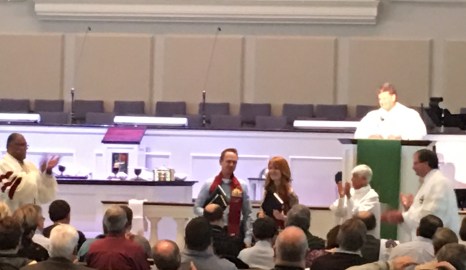
Revs. Maureen Knudsen Langdoc and Bryan Langdoc recognized as new ordinands, Clergy Covenant Day, 10/25/17.

I awoke this morning with an all too familiar thought about the church in the United States.  It is this: The United Methodist Church (and other denominations like it) still act as if we are the Mainline church when, in fact, we have been moved to the sidelines.  Must we remain silent in the false hope that we might regain our power position in society?  NO!

With a sense of lost status, we employ business models and church growth strategies as if we still haven’t learned that our best hope is to once again be the church based on the leading of the Holy Spirit and the gifts of believers in each local setting.  In the process, seeking not to rock the boat, we have remained silent to the realities all around.  We have become cowardly in acting to address the national fevers of fear and division that threaten our future and undermine our best selves. 

Where is there hope?  In many places — mostly not recognized by the “church development experts.”  I see hope in our young clergy, folks like Maureen and Bryan Langdoc.  I see hope in the faithful folks sitting in the pews of our local churches that are so easily overlooked because they are in the “wrong neighborhood” or are “congregations too small to make a difference.”  I see hope in the older clergy, many now retired, but who continue to offer their gifts.  You GO — Maureen and Bryan; You GO — younger clergy across our nation; You Go — faithful lay persons in local churches; You GO — older clergy often ready to serve but overlooked; YOU GO — HOLY SPIRIT.

If we are true to our faith and not simply believing in some set of misguided techniques and strategies, we would be saying something about the challenges to our civil society.  We would let God be God and stop trying to be soft-pedalling mediators.  Admitting that the Gospel calls us to give witness against fear and division, whether we are mainline or sideline, we would seek to speak Gospel truth to the meanness and irrationality perpetrated on our people.  So, I asked friends to join in putting together a petition. See: Hoosier United Methodists Speak Out.

IMG_4376.JPG
Pastors at Broadway UMC in the 1980s re-gathered at memorial for Rev. Frank Sablan, 9/7/17.

There was a memorial service for one of those good retired pastors, Rev. Frank Sablan at Broadway UMC, one of the places Frank served.  At this memorial service were several of the lay and clergy persons who had joined in ministry at Broadway.  We gathered for a photo and I realized the treasure that is all around but often overlooked.  Good people, still sharing their gifts.  Mainline or sideline it doesn’t matter. 

We call on Hoosier Untied Methodists to speak out.  Our church needs this witness, even more than our nation.  If you are not in Indiana, we encourage you to join with others in giving voice to our true hope.

A copy of the petition by Indiana United Methodists is here: Hoosier United Methodists Speak Out.

++++++++++++++++++++++++++++++++++++++++++++++

A Call and Confession of United Methodists in Indiana.

We the undersigned United Methodists speak a word of concern for our nation; and we confess that we have been silent for too long.

In our nation’s body-politic we are witnessing behaviors that are fundamentally at odds with our most basic faith expressions and creeds. A culture of fear, personal attacks, disregard for the truth and denial of scientific research now undermines our most cherished covenants as a nation and people of faith. Daily there is an assault on our deepest values of respect and human equality through administrative language, policies and practices. This language and these practices undermine our commitments to honest dialogue, equal justice, decent speech, fairness toward our neighbor and care for our earth. In the process, our nation is losing its critical role as the most important actor in favor of basic human rights around the world.

The bullying, bigotry and exclusion which seek to overwhelm our better angels, run counter to the Gospel of Jesus Christ. Our children and grandchildren are watching, and sadly, learning. How will we give Christian witness? We cannot remain silent any longer. We join Senator Jeff Flake and other men and women of courage and good will in saying “ENOUGH” of this course and destructive behavior.

We call on all of our congressional leaders, especially those in Indiana, to move toward greater civility, respect and desire for practices of justice for all upon which our nation’s greatness rests.

Rim Walking to the Eternal

Rim Walking to the Eternal

Almost autumn; rouge-tinged leaves hint that a soon-to-arrive-change is near.  Rotund tomatoes have captured a summer filled with both promise and tragedy.  It is time… to remember, to move on.

Saturday morning and a visit to our hometown Farmers’ Market.  A much-needed respite, today’s early gifts.

IMG_3494
Farmers Market, Bloomington, September 16, 2017

Our overripe national drama could cause one to despair, to wonder if a return to normal can be gained, or regained. 

From near and far are images of tragedy… a nursing home in Hollywood Hills, Florida, opioid overdoses down the street, a denuded Virgin Island paradise, mud, posturing politicians, mold, South Texas languishing, St. Louis marching in step with decades of accumulated grievance.  Politicians preen, speak sly words and pose for photo-op-displays-of-compassion.  These televised images vie for attention alongside heartless racist-tinged rhetoric.

Will our national identity be reduced to cheap reality television episodes?  Are we prisoners to shallow, disjointed actions and pathetic promises? “Everyone will be happy”!?  Is this reality?  Fake becomes real, while the real, the true, is declared fake.  Don’t lose your balance fellow pilgrims-of-hope.

Even here, especially here, there is truth… there is music, poetry and beauty.   So much fine produce at the market, stacked high, even okra (mostly for my spouse) and summers-end sweet corn (mostly for me).  The community band plays sweet summers-end music.  Abide With Me as it tunes up for the morning.  Tune to the “A.”  Some things do remind one of stability.  Abide…


Sweet corn, ripe tomatoes, sweet music and poetry abide.  Justice will prevail.  Our belief in respect and decency will survive this cruel passage.  It is clear in the acts of human compassion evidenced in the places of unimaginable destruction.  From St. Johns, a family shares space under their tarpaulin.  One visits a nearby hospital — just a brief word, a smile and a prayer.  We applaud as early response teams arrive in Texas and Florida, and ahead of them are thousands-upon-thousands of cleaning kits, (flood buckets), arriving along with a piece of our hearts.

How will we know the way?  What direction and pace shall we travel?  Poetry directs us beyond the limits of here and now.  Friend Walter Wangerin, Jr. calls our name:

The Wanderer*

I am the World-Rim-Walker.

I tread the sheer crags

Where night and daylight

Contour one other.

So we journey ahead as Rim Walkers toward the Eternal.  Between the tragedy and treat offered in the daily news cycles and our truest hope found in the dignity of human beings at their best.  Here and there… we move forward.

IMG_3498
Bloomington Farmers Market

These are our compass points.  Smiles and greetings.  New friends met and old friends greeted.  Fresh eggs, ripe tomatoes, kale and spinach now join honey, music and poetry to point to our pathway ahead.  We journey together fellow Rim Walkers

May your late summer be filled with laughter, joy and the reminders of taken-for-granted beauty all around.  Together let us continue to walk in ways that rebut and rebuke the vapid efforts to divert us from the ways of our truest hope.

++++++++++++++

*Poem The Wanderer is from “The Absolute, Relatively Inaccessible” by Walter Wangerin, Jr., Eugene, Oregon, Cascade Books, 2017.


Standing Behind the President?

Standing Behind the President?

8-15Trumptower

Our pugilistic president has once more sought to bully his way past the moral and legal heritage we together claim as a nation.  Much has already been said about his pathetic performance in Trump Tower on Tuesday, 8-15-17.  He spoke his mind.  In the process truth, his presidency and our nation’s standing in the world were diminished.  It was a shameful moment that will, I suspect, become a central moment identified as the end any prospect to provide ethical leadership.

Increasingly, however, my concern is not primarily about Mr. Trump’s bigotry and failings.  He is clearly not up to the job, intellectually or morally.  His ignorance and intolerance are, sadly, no longer astonishing.  My concern is now with those folks who continue to stand behind him. 

It was rather graphically portrayed on Tuesday.  There, in the lobby of Trump Tower in New York were several Cabinet Secretaries standing behind as he spoke — each one of whom would be on the enemies list of the hate groups marching in Charlottesville.

The question before us all now is where do we stand?  Political leaders — Republican, Democrat and Independent — have spoken out against the moral equivalency arguments misused by the president yesterday.  However, this still begs the question about WHERE THEY WILL STAND GOING FORWARD?

636227733576218929-EPA-USA-TRUMP-ABE-PRESS-CONFERENCE.jpg
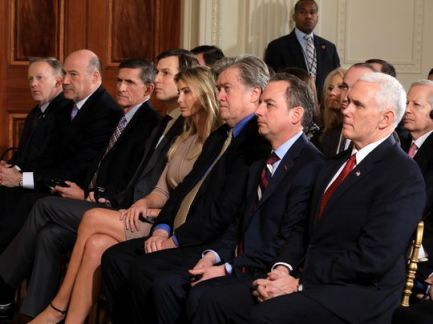
White House “leaders” playing Musical Chairs — Who will be left?    Photo by USA Today,
February 17, 2017

We watch as one by one, folks leave their posts in the White House.  Increasingly, many of these folks, fine people they, leave this administration with their reputations in tatters.  They have, as the old joke goes, “Tried to teach a pig to sing.”  The futility of this effort is identified as follows, “it only wastes your time and it annoys the pig.”  As we have already seen there is a pathetic kind of musical chairs being played out in an administration that has no guiding set of principles other than the hope of returning us to a world that never existed — to the mythical land of “Make America Great Again.”

Romans 12:21 commends the faithful as follows: “Do not be overcome by evil, but overcome evil with good.”  How then shall we live?

Is Mr. Trump redeemable?  Yes, of course, as a person.  I am a Christian pastor, after all, and I do believe in conversion.  However, there is another question which we must consider: “Is this presidency redeemable?”  To that I would answer “NO.”  We have now passed the point of no-return for this administration.   I speak for myself, and I regret to say, I suspect this is now the sentiment of a majority of others in our nation.

What then to do?  Yes, you guessed it — we begin with ourselves — let’s start there.  If we are not going to stand behind this fatally flawed president what will we do? 

Years ago there was an Open Housing campaign that ran ads in national newspapers with the headline “Your Heart May Be in the Right Place But Are You?”  As I suggested earlier this week on this blog, we need to reach across the many divides in our society (there are more than two, Mr. President) and build and rebuild what Dr. King called the Beloved Community.

(I am avoiding the question of what wasn’t done that allowed us to get to this place.  I look around my denomination — United Methodism — and see our failures.  We were so busy trying to grow our congregations that we missed what was happening in our communities.  We allowed racist perceptions, fears of the undocumented and discrimination against gay persons to distort our Christian witness.  We sought to “grow” our congregations by filling them up with people like ourselves.)

We need to be honest about the ways economic exclusion and racism have denied opportunities and allowed our nation to value crony capitalism and violence as our tools of choice when facing complex problems.  For those of us who are perceived to be “white” and have thereby benefited from this underlying racial advantage, we need to rethink how we spend our time and resources.  We may need to rethink our paternalistic styles of “helping the poor” as these often do more damage than good.

And, yes, we must support corporate, civic and political leaders who will no longer stand behind this president’s misguided set of words and actions. 

We saw some corporate leaders take that step away in recent days, leaving the president’s manufacturing council.  In every place now possible, I am prepared to argue that folks need to step away.  Find a political leader who has a clear moral compass.  Encourage and support him or her. 

Send words of support to those corporate and political leaders who do step away and say, “Thank you for modeling true patriotism and the best of our citizenship by no longer following this misguided, confused man.”  I believe our democracy is up to it.  I pray our democracy is up to it.

++++++++++++++++++++++++++++++

Post Script — Why My Strong Words:

I have wondered if I should respond to the president’s words yesterday.  After all, I don’t have much in the way of authority or agency.  My words might only do damage or cause pain… perhaps even be painful to persons I love and respect.  However,  I haven’t exactly been a wilting violet in the past — and, there is a sense that each one of us needs to now join in seeking to be a bit more bold and honest if we are to seek a peaceful and healthy nation and world.  I also decided to write after seeing the video attached below.  It is chilling to see the intentions of hatred from the inside white supremacists.  So, I have added my small voice — more, I pledge my actions on the behalf of reconciliation and stronger communities.

Perhaps Mr. Trump mistakes loud verbal fisticuffs with moral strength.  Sad.  He stepped off script and spoken his mind yesterday.  Among the many utterly foolish things said a the press conference in Trump Tower yesterday (8-15-17) were these words: “I only tell you this, there are two sides to a story.”  No, Mr. President, you are wrong. There are many sides.

As persons from MANY sides are saying today, there is no moral equivalency between Neo-Nazis, KKK and other supremacists with those who were counter protesters.  The president says he took time to gather the evidence before he spoke.  Really? Has this been our experience over the months of this twitter presidency?  I wonder if he took the time to see the images in the video on White supremacists on Vice News video on HBO.  This remarkable coverage, from inside the hate group, gives a clear picture of the violence intended leading to the tragic events.  Surely Mr. Trump could and should have this information — AND MORE.  He is, after all, the president of the United States.

There are multiple sides to our nation’s story.  Perhaps Mr. Trump is only able to work in a binary world of either this / or that.  However, this is a nation that continues to benefit when our leaders have a moral center and when they seek to unify rather than divide.

Some have recently suggested to me that I should be equally concerned about the hatred and violence expressed by groups on the left.  All such hatred and violence must stop — I am concerned, yes, but not equally.  The reality is that the actual criminality, on the streets, is not comparable in threat or in our response to it.  White supremacists represent more than 90% of the violence visited on us by terrorists-made-in-America in recent years.  Most tragically, these supremacist groups have been validated and sustained by the beliefs and actions of staff persons currently serving on the White House.  When David Duke praises the courage of Donald Trump for his words yesterday, there is no clearer witness needed to the danger that is at hand.


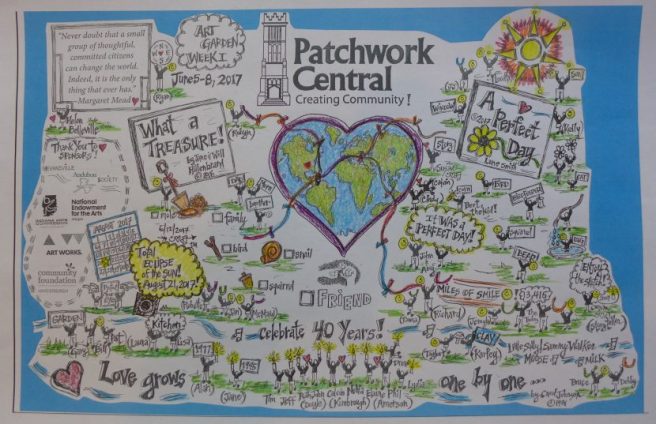
Patchwork: Community of the Lost and Found

Patchwork: Lessons from a Community of the Lost and Found

Our difficulties start with the fact that we have lost each other. 

This weekend, July 15th, 2017 we will be joining others to celebrate the fortieth anniversary of Patchwork Central Ministries in Evansville Indiana.  It hardly seems possible that four decades have passed since the Amersons, Doyles and Kimbrough’s made a covenant to live in an “intentional community” in a core-city neighborhood.

IMG_3826
Alan Winslow, February 2017

We will also be celebrating the 95th birthday anniversary of Alan Winslow, a long-time member of the Patchwork Community.  Alan, along with Alice Serr, lead Patchwork’s Neighborhood Economic Development Center for many years.  This was a program of micro-lending before such efforts were widely undertaken.  Alan is one of the scores of incredible lay persons who have been a part of the Patchwork story over these four decades. 

Perhaps we were “foolish beyond our years” in 1977.

three-of-the-founders

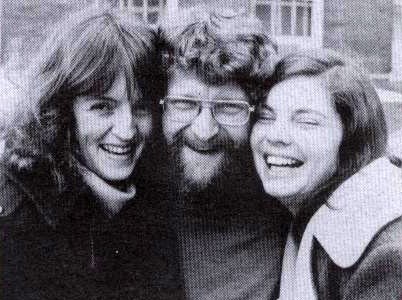
Nelia Kimbrough, John Doyle, Elaine Amerson, 1977

No doubt we were naive.  Perhaps we were just a part of our generation’s search for an “alternative lifestyle.”  No doubt we wanted to test some of theories learned in graduate school.  As we would have said at the time, we were seeking to find new ways to live as people of faith.  No doubt we were open to adventure, to odyssey, to new lessons about ourselves and others.

Whatever the case, we took the risk of leaving safe jobs and titles to join this experiment in covenantal living.  (I will avoid the easy jokes about making these changes due to eating some bad tacos or barbecue.)

safe_image

Judi Jacobson, Alan Winslow and Elaine Amerson, circa 1982.

We spoke of being an intentional community because this was the term used by others at the time.  There were other Christians, friends in Philadelphia, Cincinnati, Chicago and California who were experimenting as well.  It is safe to say we were trying to live out our personal vocations as Christians in ways that offered us the chance to explore new styles of worship, ministry and witness. Why Evansville?  Why this medium-sized community down on the Ohio River?  As we used to say, this only makes sense if it can “Play in Peoria.”

Over the years the Patchwork Central Community grew from the ten of us (six adults and four children) to dozens of folks.  We who would gather for worship, social service, educational and counseling programs, community organizing and protest rallies and so much more. We were “small but mighty in spirit” and our numbers seemed to increase in proportion to our commitment to try yet another mission.  Food panty, after school program, health care clinic, art education, photography, minority leadership development, micro-lending through Neighborhood Economic Development, Back Alley Bakery, tool lending, low-income housing, jobs program for ex-felons painting houses and more.  Our friend, Jim Wallis from the Sojourners Community, after a visit, jokingly said, “Patchwork is a place with more ministries than people!”

1983-photo-collage-sm-1024x689

Patchwork Gathering 1983


While many of us were United Methodist, ordained even, from the beginning we understood ourselves to also be ecumenical and interfaith in practice.  So, quickly, there were friends from the Roman Catholic, United Church of Christ, Lutheran, Presbyterian and Jewish communities.  Sunday evening worship grew.  Before long this little gathering turned into several dozen who worshiped, ate and laughed together on Sunday evenings.   The room was often overflowing with folks who found this to be a safe place and open place.

The three founding couples lived in separate homes, but shared many resources.  The joke among the men was about who got to “wear the community necktie.”  Truth is, we rarely wore ties.   We improved our turn of the century (1890 to 1910) homes.  Others joined.  Some lived in the neighborhood, but folks joined from around the city and the region.

We grew in numbers and influence in the city.  Soon we had the opportunity to purchase the Washington Avenue Synagogue nearby.  How could we afford it?  Our question became, “How could we not afford such a wonderful center for community activities and worship?”  We covered the down payment for the facility by selling a used car that was given to us by Drs. Polly and Ernie Teagle of Belleville, Illinois.  The rest of the mortgage we undertook “by faith.”  Hard to believe bankers would support this rag-tag group.  Such adventurism — but somehow it worked.

There are so many lessons from those years.  On this anniversary I think about what it means to be lost and found.  The 15th chapter of Luke’s Gospel is about finding and losing.  Here are parables of lost sheep, lost coins and a lost child — and the finding again of each.

What was lost and what did we find in those early years at Patchwork?  Who was lost and who found, at Patchwork?  Here are four lessons from those years — the list could be much longer (and, no doubt will be in future reflections).

First, we had lost our belief the institutional church could act in creative ways, especially outside the impulse impelling it toward focusing most ministry in suburban neighborhoods.  (There was a book published earlier written by Gibson Winter and entitled “The Suburban Captivity of the Church” named the dilemma we saw.) 

What we found was this.  If we took the risk of acting first, and asking permission later, some folks in the church would surprise us and support ministry within lower-income communities.  We decided to start Patchwork Central, and although some tried to dissuade us, others, some in leadership, said, “Well, you may be acting foolishly but we will do what we can to support you.”

I am not certain this would happen today.  I see a majority of leaders who are so risk-averse they seem stuck forever in the way things were always done.  For us, we have the gift of folks like Lloyd and Marie Wright and Sam and Marie Phillips.  Lloyd was the United Methodist District Superintendent in Evansville and while he often wanted us to “slow down” and “not try to fight city hall,” he none-the-less stood by our fledgling efforts at new forms of ministry.  Sam and Marie Phillips were the sort of progressive leaders we are lacking today.  Sam had been a D.S. as well and was working in the area of global mission.  The Phillips understood.  And, I could name many, many others, clergy and lay.  Suffice it to say — we found support and vision that we mistakenly thought had been lost to the entire church.

IMG_3828
Alan Winslow and Alice Serr, 2017

Second, speaking for myself, I thought the potential for ecumenical work in a core city neighborhood was a lost cause.  There were pundits in those days who said that a focus on social justice would drive people from the church.  Justice work was blamed for any decline in the church.  It seemed a world of “every denomination for itself” and the primary focus of churches was only on church growth. 

I was so very wrong.  There were clergy like Ed and Mariam Ouelette (UCC), Walt Wangerin (Lutheran), Joe Baus (Presbyterian), Jim Heady (UMC), Alice Serr (Catholic) and Michael Herzbrun (Jewish) to name a FEW. AND, many of the strong and growing congregations were ones that joined us in our ministry efforts.

Third, speaking again for myself, I thought there were few resources in my new neighborhood upon arrival.  I thought imagination and energy for change was lost to these new neighbors.

19894913_10154900004637725_395374373841488755_n

Darlene Bragg, Back Alley Bakery, circa 1983.


I remember, with embarrassment, saying that our work in those early years was to “bring resources to places where they don’t naturally occur.”  Such hubris!!  Such ignorance.   I believed the notion that we would “discover the needs of the people” and set up plans and strategies to fix these dysfunctions.  Instead, what we discovered were neighborhoods full of people with insights, talents, capacities and education beyond our imagination.  The poverty problem was my own — my poverty of vision.  I couldn’t see the potential resource that was all around.  In almost every new endeavor we found folks with gifts to share.  Where I had seen a desert of resource, there was more abundance than I could have imagined.  However, I needed to stop and listen.  If I did, I would discover that my role was more that of friend and coordinator than initiator.

Perhaps most significantly, I thought the basic ingredients of community were something I needed to bring because they were otherwise lost.  Somehow, I thought, I was to bring them to a community void.  Well, community by its very nature is about discovering relationships already available to us — if we can see them and risk finding.

We discovered that everyone can and does live in community.  The question becomes how intentional do you want it to be?  The choice is to risk living in new ways.  The choice is to see with new eyes what is possible.  It requires work.   bell hooks, in her book Teaching Community: A Pedagogy of Hope puts it this way: “To build community requires vigilant awareness of the work we must continually do to undermine all the socialization that leads us to behave in ways that perpetuate domination.”

In the parables we call the Prodigal Son in Luke 15 we too easily think of the son as the lost one.  However, a closer read shows that the father and older brother were also lost.  They had given the younger brother up for dead — and the parable suggests that when all seems lost, it is then a new relationship is possible, if it is accepted.

Ken Medema puts the lesson from scripture on finding and losing in a memorable verse:

Finding leads to losing, losing helps you find.

Living leads to dying but life leaves death behind.

Finding leads to losing, that’s all that I can say.

No one will find life another way.

P1520232-e1497901662155-830x537

There will, no doubt, be many memories this weekend about the early years at Patchwork Central.  Some will want to speak of what we gave — or contributed — to this ministry that still survives.  I will know the truth, for me Patchwork happened because of what I lost while there, and in so doing, what WE, together, found.


Mirror Images

Mirror Images

Independence Day Reflections

July 2nd is Independence Day for the United States!  So insisted John Adams, always the contrarian.  You see, Adams and others believed the festivities should be celebrated on the date the thirteen colonies officially voted to separate from Britain.images.jpg

There are many parts of our nation’s birth story that are subject to question, even revision.  The musical “Hamilton,” for example is a recasting of our nation’s earliest years.  Hamilton gives new focus to the significance of Alexander Hamilton and Aaron Burr.  (And the musical provides a delightful reconsideration of our ideas about folks like Washington and Jefferson.) 

I have been thinking about the mirror images (and differences) between the United States and Canada.  Canada celebrated its 150th Birthday on July 1st.  We have so much in common.  Two nations, so similar in cultural traditions and yet so different.  We are, and we are not, mirror images.   We both reflect the quest for democracy and freedom in North America… and have much to learn from one another.

Web searches on the topic of “Myths about U.S. Independence” or “Misconceptions surrounding the Revolutionary War” will uncover lists of the fallacies regarding our easily held stories of the nation’s birth.  It is helpful to be reminded that our knowledge can always be advanced; our own self-identity is much more complex than our fifth grade history lessons portrayed.  An engagement with the story of Canada, for example, makes these myths even more fascinating.

SamSullivan.jpg
Sullivan reelected, May 9. 2017, Straight.com

In May I had the privilege of meeting Sam Sullivan, recently elected to a second term as a member of the British Columbia legislature in Canada.  Sullivan, former mayor of Vancouver, B.C., was left paraplegic following a skiing accident at age 19.  A civic reformer, inventor, leader in rethinking urban landscapes and how we might live in more environmentally sensitive ways in the future.  Sam is a delight to be around.  He loves challenging the taken-for-granted worlds which too often confine us. 

20170517_125303s
Lunch with Sam Sullivan, July 17, 2017, photo by Travis Lupick

Sullivan is a student of history, especially the founding of our two nations.  In our visit he enjoyed retelling the U.S.’s founding story, from a Canadian perspective.  He reminded us that had there been no so-called “revolutionary war,” slavery would have been outlawed in the colonies decades earlier, women would have had the right to vote sooner and the taxes over which we have been told were the basis for the Boston Tea Party were, in fact, rescinded before the revolution began.  He suggested we take a closer look at the ways France played a critical role in our founding as an “independent” nation.

If my perceptions surrounding Independence Day are distorted, what might I need to reconsider about the current social, cultural and political realities?

It is too easy for me to speak of the narcissism of the current occupant of the White House.  He is indeed a troubled soul, so hungry for adulation that he surrounds himself with people who agree to only see the world through his lenses of reality.  There is, no doubt, plenty to criticize.  (I have given much space in this blog over recent months to doing so.)  He seems to forever be looking for validation and praise, seeking self-worth by looking in the mirrors of the media for images that portray him as hero and victor.  If he doesn’t like the reflection, it is “false.” The myth of Narcissus is, in fact, the story of one so hungry for adulation that he dies beside the stream admiring his own image.

But this critique is too easy for this Independence Day.  How many times did I preach of the importance of seeing oneself clearly in the world in which we live and work?   Drawing on the thoughts of great theologians like Reinhold Niebuhr or Dietrich Bonhoeffer, I encouraged myself and others to be aware of the “Little Hitler” that exists in every human breast.

IMG_4166Now for those of you who don’t like this theological assumption of original sin, I confess that I don’t like it much either.

I would prefer to speak of human beings as being originally blessed, avoiding anything to do with original sin.  Honesty, however, compels me to believe that both make up the human condition.  Our nation’s history and our personal ones argue that we are subject to less than noble self-understandings and actions.  The temptation to move to binary thinking (one is all good and another is all bad) leads us to places where we can easily condemn the other and remain immature and unfulfilled ourselves.  Let me recommend the teaching of Fr. Richard Rohr at the Center for Action and Contemplation on the limits of such binary theologies.  [See Richard Rohr].

Please do not read this as suggesting an equivalency between the current occupant of the White House and Adolf Hitler.  That is NOT the point.  My suggestion is about the rest of us — that we all need to be freed from our tendency to divide the world too easily and believe our understandings are the only way to proceed. We, the people of the United States, need some honest looking in the mirror around our history, our bigotry and our potential.

The call is toward renewal, personal and social.  The call to be freed from distortions in our self-perceptions and idealized views of our being somehow more special than others.  This, I would suggest, is a true way to celebrate Independence, on July 2, July 4 and every day of the year.

I leave you with the words from the song of that great philosopher, Michael Jackson:

I’m starting with the man in the mirror
I’m asking him to change his ways
And no message could have been any clearer
If  you want to make the world a better place
Take a look at yourself and then make a change

[Performed by Michael Jackson, written by Glen Ballard and Siedah Garrett]


Restoring Broken Connections 

Restoring Broken Connections

Citizenship depends on connection.   Constructive membership in any group is rooted in the belief that there is space in the institutional ecology for a person’s engagement and contribution.  Novelist, poet, farmer and cultural critic Wendell Berry put it succinctly “Connection is health.”

quote-only-by-restoring-the-broken-connections-can-we-be-healed-connection-is-health-wendell-berry-87-40-31-1.jpgBerry says that it is “only by restoring the broken connections in our society that we will be healed.”  It is not just the edges of institutions that are frayed and fractured today; there is a disconnection at the very center.  Nor, is it only a brokenness between individuals.  Linkages between institutions and their members, and linkages among institutions are also broken.

  • Yesterday, thirteen United States Senators emerged from secret meetings to propose a heath care reform package.  Amazingly the proposal is opposed by the hospitals and/or university health research institutions in their home states. 
  • Polling shows that fewer than one-fourth of the citizens in these states support the proposed changes to the Affordable Care Act, still this proposal is moved forward.
  • A majority of American Roman Catholics in the United States do not support the church’s views on birth control, remarriage, having married priests or women priests (Pew Research on American Catholics) and yet change seems unlikely in the short-term.
  • There is growing evidence that human caused Climate Change is a dangerous emerging phenomenon. (This research has been done not only by independent university or industry based scientists but also by researchers at government-funded institutions like NASA or the U.S. military); yet, recent government policy actions move us away from healthy responses regarding environmental degradation.
  • The opioid epidemic, with increasing death and higher HIV-AIDS rates, is at crises levels.  Local police and healthcare providers now find their own health threatened by the powerful fentanyl powders being used and potentially inhaled by the persons providing care.  These service providers make specific recommendations to address this fentanyl problem; however, our political leaders respond by doubling down on the failed policies from the 1980s.  This disconnect is about life and death for our healthcare and law officers, our neighbors and the communities in which they reside.

The list could go on and on: there is a disconnect between many trade union leaders and their “members,” between the governor of Illinois and the legislative leaders, between the gentrifying neighborhoods in our cities and the people who are losing their residences and communities.

I have long been disheartened by the brokenness in my own denomination, the United Methodist Church.  Not just the divide between those with theological differences, or the young and older members, or the urban and rural ones, but also the divide among our institutions and between institutions and the people.  My work has led me for example to see the brokenness between our seminaries and the local churches they were designed to serve.

images.jpg

I recall the day when serving as a seminary president I spoke with a talented young woman, encouraging her to seek ordination as a pastor.  She paused a moment and said, “I don’t think I can trust the denomination with my vocation.” 

I mention this young woman because she represents, in my experience, a growing number of our younger folks.  Still we seem slow to reconnect with them.  The “disconnects” in the church among institutions, and between our institutions and individuals, some days seems insurmountable to me.  Having been both a pastor and seminary administrator, I understand.  And, I believe there is productive work to be done in healing such broken connections.

More recently, I joined a group of persons seeking to encourage the church to take seriously its commitments of care for God’s creation.  We proposed legislation to the annual meeting of my regional body, known as an annual conference.  There were persons eager to see the church begin to make a difference regarding our environmental actions.  To my sadness, this genuine enthusiasm was met by denominational leaders who sought to avoid any conflict by moving to table the proposals.  It was both astonishing and sad for the group, many of them younger folks, who saw these proposals as a way to seek healing in the divisions between our words and actions, between our local churches and the need for better care for creation.

When all of these signals are flashing danger, how might we respond? 

Well, this is for you to decide, dear reader.  It is also an opportunity to join with others, in existing institutions, and the creation of new ones, to offer places of citizenship and membership. 

For me, I will continue to challenge, and build new relationships, with the leaders of my regional body who seem so opposed to proposals regarding how our congregations might respond to climate change.  I will speak out on issues related to the opioid epidemic and get to know the persons on all sides of this challenge so that I might help make new connections.   I will challenge the efforts of my congressman and senator to strip medical coverage from more that twenty million persons in our nation, while giving large tax cuts to the rich.  I will challenge these congressmen to listen to hospital administrators and university researchers who may provide creative, alternative approaches to providing health care.

We are not alone.  Others are seeking to build connections as well.  Let me tell you about my friend.  A young pastor, serving in a small and conservative town in my state.  What is remarkable is that this young man would be considered by many to be too liberal, too concerned about the poor, too invested in environmental justice to fit in this small town parish.  So, when I asked how he was doing, I was prepared to hear about his difficulties, his disappointments.  Instead, I saw a broad smile and heard him say, “It’s great!  This is just where I am supposed to be!”  He acknowledged that he had his differences with some folks, but that he was enjoying learning from them and they from him. 

I have known this young man for many years now and seen him mature.  He completed his undergraduate and seminary work as an honors student — top of the class.  He becomes for me a sign of hope.  He understands Wendell Berry’s call to restore broken connections. 

How can I not strive to do the same?


For Learning, Loving or Loathing?

For Learning, Loving or Loathing?

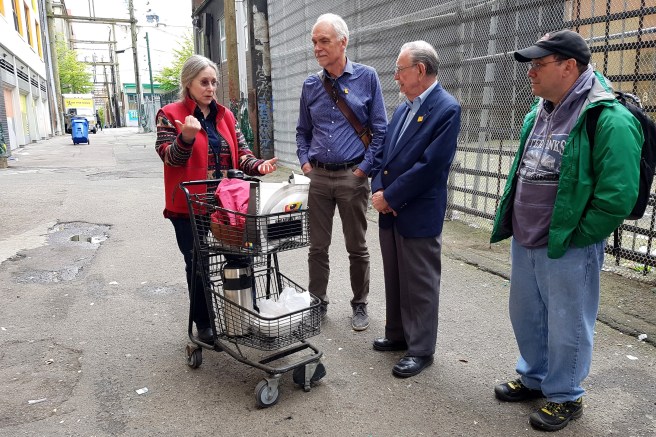
There she was in the alley.  Pushing a shopping cart.  She might have been mistaken as a homeless woman, except the cart was transporting a box of strawberries and a thermos of coffee.  Beside her along the route of sidewalk and alleyway, we walked.  She was recognized, and sometimes greeted, along the crowded path.  I looked on and saw scenes replaying over and again, as if she came from central casting.

20170517_152504s
Ann Livingston, Al Etmanski, John McKnight and Michael Mather (Photo by Travis Lupick, The Georgian Straight Magazine)

I was unprepared to meet Ann Livingston, founder of a group known as VANDU.  We were in the east end of Vancouver, B.C., Canada.  VANDU has been around for almost twenty-five years as an organization of drug users and former users.  They organize as peers, seeking action to better their neighborhood, their personal situation and that of others.  Ann is what I call a “divine irritant.”  She challenges the taken-for-granted worlds of Vancouver. 

Ann disrupts the “normal” activities of police officers, operators of cheap single room occupancy hotels, health professionals, social workers and drug dealers.  She is a convener of alternative visions, a truth-teller, a fierce organizer.  Her work — joined with dozens of others, especially drug users — rattles the tectonic plates of political, economic power.  She challenges the assumptions, programs and professional expectations of many on the east side of Vancouver. 

When I say Ann comes out of central casting, perhaps it is better to say she seems to emerge from the story of other women, women I never met, but have long regarded as saintly disturbers of the peace.  As I watched and listened, I thought of Francis Willard, Jane Addams or Lucy Ryder Meyer, from the 19th Century.  

With the arrival of fentanyl, deaths from drug overdoses in the neighborhood soared.  In the last six years over 1,800 persons died from overdoses. When public officials were slow to act, Ann and others decided to set up unsanctioned injection sites.  This strategy, along with clean needle exchanges, is based on the successful Four Pillars approach in Europe.  The four pillars are: Harm Reduction, Prevention, Treatment, and Enforcement.  To learn more see: Straight News, December 2016.

LEARNING

Now at the front end of my eighth decade, I am discovering how little I know and how much more there is to learn.  (And, I am learning of the many places I have been wrong in assessment or assumption.)  I am helped by new learning occasions.  Yes, these new insights can come from books and films — but I am advocating for putting ones self in new and uncomfortable places.  Places that challenge easy assumptions about life and how things really work.

20170517_142523s.jpg
photo by Travis Lupick

Visiting an unsanctioned safe injection site with Ann, I appreciated that we are not limited to the official, and agreed upon, responses to the social and institutional challenges we face.  When there was a need for a response to drug overdoses from fentanyl use, and the system failed, Ann pitched a tent and began to offer a place for safe injections.  There were safe needle exchanges and a responding to overdoses by offering naloxone,  Naloxone can counter the probable death from a fentanyl overdose.  When asked about the consequences of breaking the law, Ann simply replies, “I am pretty sure it is not against the law to save a person’s life.”

20170517_141118s.jpg
Ann Livingston and John McKnight, photo by Travis Lupick

My “learning journey” was with colleagues Mike Mather and DeAmon Harges of Indianapolis.  It was a gift to accompany friend and mentor, John McKnight.  John has advocated an Asset Based Community Development approach to community organizing.  It is about encouraging the recognizing of abundance within all communities.  This approach focuses on identifying the assets of people, rather than collecting up their deficits.  This approach, that focuses on gifts rather than needs, is widely known around the world, as ABCD community organizing.  Ann Livingston is a most remarkable practitioner of this approach, seeking out the abundance in her community, encouraging drug uses to be their own researchers, advocates and providers — and not being afraid to disrupt that which focuses only on neediness.

LOATHING

As I traveled I couldn’t help but think of our situation in the United States.  Our Attorney General, Jeff Sessions, is determined to return our nation to the expensive and failed “war on drugs” that focuses only on ENFORCEMENT and PUNISHMENT.  It simple doesn’t work.  Or, better said, it provides results that are exactly the opposite of what is believed. 

This effort misses all of the lessons that have been learned from around the world and across the years.  It comes from lousy morality constructs and even worse theology.   Incarceration only turns prisons into schools for future soldiers in the drug cartels and neighborhood pushers.  The time has long since passed for us to establish ways for the addicted to have access to methadone and medical heroin.  Only by ending the demand and offering a Four Pillars approach to drug use and addiction (harm reduction, prevention, treatment, enforcement) can we find a way forward that is not just a revolving door to continuing our past mistakes.  Mistakes that destroy lives, families and communities.

Conservative writer Andrew Sullivan has wisely said that much of the mean-spirited, anti-democratic and fear-based political efforts in the recent years is what he calls a “loathing of the present.”  It is a hunger to return to a world that never was — except in the minds of those who out of fear seek to divide, exclude and punish.  In this world those who suffer, who are different, are to be loathed because they represent a reality that cannot be accepted.

LOVING

Can there be a turn from loathing to loving?  Any faithful Christian expression would say “yes, of course.”  No need to cite chapter and verse — it is evident in the entire sweep of scripture — to move toward health, abundance and renewal… and to do so out of love and not exclusion.

By now, good reader, you have probably wondered, “Strawberries?  Why was Ann carrying strawberries?”  It seemed incongruous in the midst of all of the suffering and tragedy to bring strawberries to the unsanctioned safe injection site.  When asked why strawberries? Ann’s answer was simple, “Who doesn’t love a strawberry?”

The Unexpected Neighbor

The Unexpected Neighbor

The remarkable social philosopher and Catholic priest Ivan Illich was once asked, “Given what you suggest about institutions, what is the best way to make change, violent revolution or gradual reform?” Illich answered, “Neither, the best way to bring change is to give an alternative story.” (in David Cayley’s, The Rivers North of the Future).

532984_f520
Ivan Illich, 1971, source: Wikipedia

Illich, was an iconoclast, a Christian visionary, a prolific writer — and widely read in the last decades of the Twentieth Century.  His brilliant critiques of our institutional practices, still provide a clear-eyed challenge and much valuable reforming wisdom, about our easy customs, traditions and ideologies.  Schools, hospitals, courts, governments and churches were all subjects of his analysis. 

He was more!  Each critique was not a call to anarchy, nor was it an invitation to some elaborate new strategy whereby those in power can better serve their “clients.”  He was about something much more basic — as basic as a table where all may share. 

His call is to reinvest in the original motivating principles behind our “helping” institutions.  He was about the nurturing of an underlying community spirit built on the essential importance of neighborliness.  He suggests there are ways of living into such community understandings as evidenced in his book Tools for Conviviality.

Illich spoke of “corruptio optimi pessima” or “the corruption of the best becoming the worst.” He writes, “Through the attempt to ensure, to guarantee, to regulate Revelation, the best becomes the worst.  And yet at any moment we still have opportunities to recognize, even when we are Palestinians, that there is a Jew lying in the ditch whom I can take in my arms and embrace.”  (David Cayley, Ivan Illich in Conversation, Toronto: Anansi Press, p. 242.)

As Illich would put it, there is a “sad historical progression in which God’s incarnation is turned topsy-turvy, inside out” (from David Cayley’s Rivers North of the Future, p. 29).  This corruption may be seen in our many efforts to serve, to control, to regulate, to manage and to turn our neighbors into categories or objects of our good intentions.  A simple illustration he gives is as follows: “In the early years of Christianity it was customary in a Christian household to have an extra mattress, a bit of candle and some dry bread in case the Lord Jesus, should knock at the door in the form of a stranger without a roof” (Cayley, Rivers North of the Future, p. 54.).  Over the centuries, hospitality was “improved upon.”  The work of each householder is transformed into the responsibility of our “serving institutions.”

If there is one alternative story which Ivan Illich cites more than others, it would, no doubt, be the one known as “the Good Samaritan Parable” in Luke 10. 

I have spent much of my adult life sifting through the human wisdom nuggets of truth in this story — AND BEING CONVERTED BY THIS WITNESS.  It is astonishing that in these few verses in Luke’s gospel, there are dozens upon dozens of insights into our institutions, our freedom, the incarnation story and the wider human reality — tragic and blessed.  I have written about this in other places — and will, no doubt, write more in the future about this upside down reality, this conspiracy, which is the core of Christianity (and that of many other great religious traditions).  Instead in this piece, I want to begin to share a few other alternative stories.  Today, there is the story from Wes Jackson, environmentalist and founder of The Land Institute in Salina, Kansas.

Alternative Story #1:

Wes Jackson shares a story of a visit E.F. Schumacher, author of the widely known work Small is Beautiful, made to his fledgling organization in Kansas in 1977.  Jackson says The Land Institute was “scarcely six months old and we were honored that Schumacher, the widely acclaimed author would visit and give a public lecture.”

“When Schumacher arrived, he did not dismiss this tiny organization that had recently experienced a devastating fire, destroying much of their early work. Instead, E. F. Schumacher listened patiently and insisted on being called ‘Fritz.’ On the evening of the lecture, the Salina Community Theater was filled with farmers, small business owners and the unemployed.”

images
Wes Jackson, from Cool Science News, 2009

Fritz began by telling of a trip he had made during the 1930s with some friends in an automobile across America. He and his compatriots had stopped at a service station in some small Kansas town at the height of the Great Depression. Fritz engaged a local man at the station by asking, “How are things?” “Fine,” the local replied. “What is it you do?” asked Fritz. “Oh, I work on that farm over there,” he said pointing in the direction of the farm. “I used to own that farm but I had no money to pay the hired hand, so I paid him in land.  Eventually he owned all of my farm and now I work for him.”

That is a very sad story,” replied Fritz.” “Well, not so sad,” countered the hired hand. “You see, now my friend has no money either and so he is paying me back in land.” (Jackson, Wes, The Land Institute, December 1999, see info@landinstitute.org).

What are your thoughts about such alternative narratives?  Let’s have a conversation.  Let’s keep listening for other stories that conspire to teach new lessons than might transform our view of the world — and perhaps even change the way we see ourselves.