Shoveling Alone

Shoveling Alone

Shoveling alone. It is the story in almost all our communities in the United States. The poorest of the poor are shuffled to the edges of our economy and end up living on the streets — or in jail!

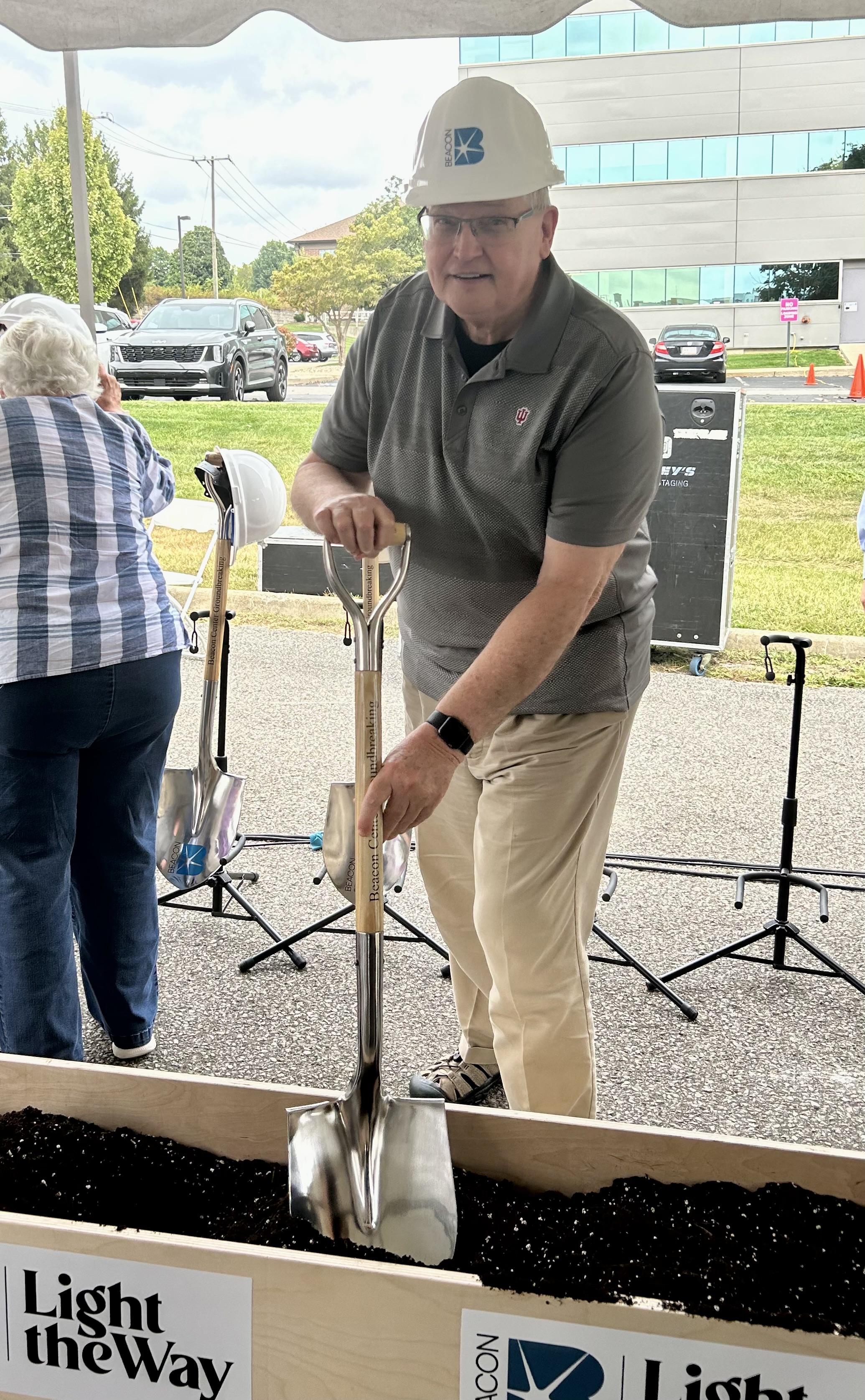
As I turned the shovel in Bloomington on a recent Wednesday, at the groundbreaking for our new Beacon center, I realized I was alone in that moment… no one on either side… but so many had gone ahead, and others would follow. Is it true in your community as well?

Not just on a given afternoon but across the years, I knew others in the faith community and beyond, who didn’t attend this groundbreaking… but who had ‘turned the soil’ of change in many places. They have been at this turning the soil, and turning our souls, in the past and will be in the future. In the process our souls are returned to an original place of hope and sharing among all.

I believe our local faith community, and others whereever you live, will do more in the months ahead, not just for places like Beacon. We must do this because our challenges cannot be fully handled by any one social service agency. Beacon, and similar agencies are a good, but insufficient response.

Bloomington Mayor Thomson is right, a comprehensive response to the challenge of persons without shelter is needed. Rise up now, faith communities and others, show more muscle, join in to assist the Emergency Winter Shelters, programs like Heading Home, the Recovery Alliance, New Leaf/New Life. Offer more mutual respect and support for all! The massive cuts to Medicaid will touch us all and especially the poor. Emergency rooms will be more crowded, retirement homes and clinics will close, healthcare will be rationed and delayed. Time for more to pick up the shovel and turn the soil toward the planting of new seeds of hope.

“When did we see you…?” the scriptures ask. “When you did it to the least among you” comes the answer. I live with the firm knowledge this shelter, even with a “better” setting where healthcare, employment assistance, public safety, addiction recovery and other resources, are provided is but a small beginning. It is not THE answer. Still, it is a needed step. Many can and will raise needed funds, offer to volunteer, and challenge public policy to do better… in God’s name.

The road is long and filled with twists and turns, social detours, myths about addiction, mental health and blindness to our own complicity in the “social welfare” practices in this country, and the misdirected, cruel political impulses and assault of so many in power in this time. Our culture lives with the myth of hero and victim. It is the “Hero Journey” story that Jung and Campbell identified as embedded in all we perceive as possible. It is so fully ingrained in our psyche and social systems that, sadly, we turn others into “clients” rather than “neighbors” and are more comfortable in speaking of THEY rather than with US.

It will take time — this turning the soil. Still as a Christian I recall the hymn refrain “We are not alone, for God is with us.” ‘Naive’ you say, of course it appears that way, of course. Others are using their constructions of false gods to continue cruelty. I know. That is why those who have theologies more tied to the larger, historic faith story must now speak the truth, afresh. Until some have seen a life changed, a person healed from addiction and communities moving away from cruel patterns of greed and domination, we are stuck. And, until a community is seen pulling together to solve such challenges, many will call me naive. I prefer to call it our shared hopes, foundational for the future — that we can care for one another. Check it out. This is a core teaching of Christianity and other great faith traditions. Interdependence is more essential to humanity’s long-term survival than independence.

Paul Farmer, remarkable physician and founder of Partners in Health (PIH) understood his life’s work as “The Long Defeat.” He said, “I have fought the long defeat and brought other people on to fight the long defeat, and I’m not going to stop because we keep losing. Now I actually think sometimes we may win. I don’t dislike victory. … You know, people from our background-like you, like most PIH-ers, like me-we’re used to being on a victory team, and actually what we’re really trying to do in PIH is to make common cause with the losers. Those are two very different things. We want to be on the winning team, but at the risk of turning our backs on the losers, no, it’s not worth it. So you fight the long defeat.” [From Tracy Kidder, “Mountains Beyond Mountains: The Quest of Dr. Paul Farmer, a Man Who Would Cure the World.”]

So, pick up a shovel, write a check, welcome the stranger, say ‘hello’, ask the stranger her/his name, smile… and keep doing it in your community, whereever you are. Keep at it, even when times are tough. My friend Wes Jackson put it this way, “If you think your life’s work can be accomplished in your lifetime, you are not thinking big enough!”

Racism at Indiana University

Racism and Indiana University

Indiana University is in the midst of troubling acts of racist retrenchment. What is wrong with this picture? Yes, a backsliding into racism at that Indiana University, the one with a flagship campus in Bloomington, Indiana, and regional campuses around the state. Yes, the I.U. that has been shaped by commitments to diversity and inclusion. Tes, the one shaped by the likes of Herman B Wells and persons of academic excellence, integrity, faith and civic pride over the decades.

The great comprehensive university where notable Black alumni, students, faculty and staff are so multiple, it is too challenging to begin a list here. These are a few of the thousands of I.U. greats. In my personal experience, I have been blessed by friendships with folks like Joseph Taylor, LaVerta Terry, James Holland, David Baker, Vi Taliarerro, William McKinney, Camilla Williams, Charlie Nelms, and on and on the list goes.

It is unbelievable to those who know the historic commitments of this school. This racist retrenchments has resulted in the elimination of resources for students of underrepresented groups as well as critical support for faculty and staff. The actions challenge I.U.’s remarkable, historic legacy as a place where all are welcome and offered the opportunity to thrive. In recent months the following actions have taken place:

1. The awarding of scholarships designated for specific students based on ethnicity or sexual orientation have been “paused.”

2. Websites and campus materials have been scrubbed of words and phrases related to diversity or programs seeking racial understanding.

3. Posters around campus with the words “Build a Community Where All Belong” have been removed from bulletin boards and public spaces.

4. Names of programs or offices that provide services or support for underrepresented students are being removed or painted over or removed.  The sign OVPDEI (Office of the Vice President for Diversity, Equity and Inclusion) has been painted over and left blank. Programs housed in this now unidentified building include Groups Scholars, FASE Mentoring, Twenty First Century Scholars and Hudson-Holland Scholars. Will all cultural centers face such identity-theft and censure, while programs that serve virtually all White programs and services go unchanged!

5. The essential core of academic freedom is being tested.  Faculty face threats to their course materials over the use of language and/or ideas that call for the addressing of systemic or institutional racism.

We, the students, alumni, faculty and staff and friends of Indiana University, demand that on all its campuses, Indiana University STOP this retrenchment of White Racism being treated as normative.  We demand that a commitment to the welcoming of ALL immediately be restored no matter race, class, creed or sexual orientation.

Corn-Bred

Corn-Bred

I’m a Hoosier, Indiana born and bred, on most July Sundays I can be found at church. On the best Sundays, the benediction ended, I then head for sweet corn at home from the farmer’s market.  Bought the day before from a young Amish teen in the City Hall parking lot.  Straw hat, gray shirt, grayer suspenders, blond curls and a sneaky, shiny smile. From down near Paoli most likely, I surmise – the corn and the smile.  “Picked this morning” he offers. “In the moonlight?” I tease, in return. We trade a chortle. The grin and banter worth the entire purchase price alone; but I win, as I carry off a half-dozen ears.  “He smiles with his eyes, he does.” I heard it growing up, like him I bet.

Early July, Indiana sweet corn is extra-scrumptious; I prescribe as it a necessary antidote to the extra-boneheaded politicians who now scour the state dressed in a toxic religious wardrobe. Deceptions attached to their bigotry like the sown-on-shadow of Peter Pan. This summer sweet corn is better. Much needed offset to the racism, so appreciated in the summer heat of ’25.  

Worship was delicious too this Sabbath. A needed cure offered, beginning with soaring music.  A fanfare for a refurbished organ followed by hymn texts full of ancient, hard-won truths. The anthem is fetched from the apothecary of faith. “It is well with my soul” lingers still. Take that, you many poisons of the soul, you dividers of a nation.

The stage is set by the liturgy – we are called to hope and not despair; and, then a sermon, chasing down our shared deeper story.  Listen again to Naaman’s healing. His trust in his own power, his military hardware, is insufficient to bring peace.  No, no, no, empathy is not “a bug in the system,” Mr. Musk.  Empathy marks true humanity.  A “healed femur is the sign of the beginning of civilization” Margaret Mead once noted.  The wonderful irony of the powerful finding healing and justice by finally heeding the counsel of a young girl.  She brings a four-star general to his knees and his senses… and more than an outer leprosy is healed.  She did it well, both the young girl and the preacher this Sunday.  We are reminded that interdependence is more to be valued than independence.

It’s corn-bred wisdom that hubris and arrogance will end in dust. True in Elisha’s time and a lesson to be relearned now. God’s preference is for the small and marginal ones. The narrative is told over and again.  Let those with ears-to-hear, listen.  Too bad uncle Donald was on the golf course and missed learning how his story will end.  The closing hymn offers again this poetry of hope. Then I head home to sweet corn and a nap.

O God of every nation, Of every race and land,

Redeem the whole creation With your almighty hand. 

Where hate and fear divide us  And bitter threats are hurled,

In love and mercy guide us  And heal our strife torn world.

Rain begins as we walk home… “good for the sweet corn,” I think...

Corn-Bred

Corn-Bred

I’m a Hoosier, Indiana born and bred, on most July Sundays I can be found at church. On the best Sundays, the benediction ended, I then find sweet corn from the farmer’s market.  Bought the day before from a young Amish teen in the City Hall parking lot.  Straw hat, gray shirt, grayer suspenders, blond curls and a sneaky, shiny smile. From down near Paoli most likely, I surmise – the corn and the smile.  “Picked this morning” he offers. “In the moonlight?” I tease, in return. We trade a chortle. The grin and banter worth the entire purchase price alone; but I win, as I carry off a half-dozen ears.  “He smiles with his eyes, he does.” I heard growing up, like him I bet.

Early July, Indiana sweet corn is extra-scrumptious; I prescribe as it a necessary antidote to the extra-boneheaded politicians who now scour the state dressed in a toxic religious wardrobe, attached to their bigotry like the sown-on-shadow of Peter Pan. This summer sweet corn is better. Much needed offset the racism, appreciated in the heat of ’25.  

Worship was delicious too this Sabbath. A needed cure offered, beginning with soaring music.  A fanfare from refurbished organ followed by hymn texts full of ancient, hard-won truths. The anthem is fetched from the apothecary of faith. “It is well with my soul” lingers still. Take that, you many poisons of the soul, you dividers of a nation.

The stage is set by the liturgy – we are called to hope and not despair; and, then a sermon, chasing down our shared deeper story.  Listen again to Naaman’s healing. His trust in his own power, his military hardware, is insufficient to bring peace.  No, no, no, empathy is not “a bug in the system,” Mr. Musk.  Empathy marks true humanity.  A “healed femur is the sign of the beginning of civilization” Margaret Mead noted.  The wonderful irony of the powerful finding healing and justice by finally heeding the counsel of a young girl.  She brings a four-star general to his senses… and more than an outer leprosy is healed.  She did it well, both the young girl and the preacher.  We are reminded that interdependence is more to be valued than independence.

It’s corn-bred wisdom that hubris and arrogance will end in dust.  True in Elisha’s time and a lesson to be relearned now. God’s preference for the small and marginal ones. The narrative is told over and again.  Let those with ears-to-hear, listen.  Too bad uncle Donald was on the golf course and missed learning how his story will end.  The closing hymn offers again this poetry of hope. Then I head home to sweet corn and a nap.

O God of every nation, Of every race and land,

Redeem the whole creation With your almighty hand. 

Where hate and fear divide us  And bitter treats are hurled,

In love and mercy guide us  And heal our strife torn world.

Rain begins as we walk home… “good for the sweet corn,” I think...

Sickness Unto Death

Sickness Unto Death

Philip Amerson                                              May 1, 2025

Hope, when joined with mutual respect, becomes the oxygen supply for the lungs of a healthy democracy. In these troubled times, 19th Century Danish Philosopher Søren Kierkegaard offers perspective, a challenge, and a way beyond suffocating despair. In his classic “Sickness Unto Death,” this Christian theologian speaks of despair as a sin. Despair is, he suggests, a sin even worse than death. The reader is counseled to find the small pathways ahead, to persist, even when tempted to be captured in the clutches of fear and doubt – even when tempted to be held hostage to despair.  While anxiety may be unavoidable; Kierkegaard argues life calls us to continue forward, step by step, with whatever small light available.

Fear and disrespect are endemic in our nation. There is a tariff on HOPE. Many national and state officials are intent on destroying our “Commons” – the institutional trust established over the past two centuries. They act in ways to paralyze, to control, to tie us in contemporary knots of despair. Normality, civility, and decency are submerged in autocratic surges washing across our society.

This deluge is intended to overwhelm, to control, to undermine.  Such a “flooding the zone” strategy comes ceaselessly at us and from many tributaries: threats to the funding and governance of our universities: ending humanitarian aid to the poorest in our world; closing of scientific research necessary for public health; attacks on the judiciary and law firms; the deconstruction of a free and independent press; pressures on elected officials that leave one U.S. Senator saying “we are all afraid”; and, at base, there is the undoing of the personal constitutional rights for ordinary citizens and anxious refugees. These all coincide with what can be identified as practiced strategies from an autocratic playbook, one that has been tested and proven effective in other nations.

Alongside this national deluge of intolerance, the Indiana Legislature ended its recent session passing bills that can only be understood as a war on health care, on public education and on the poor. Indiana Senate Bill 289 was adopted as an “anti-DEI measure.” Touted as “bringing balance” to the teaching of history, civics and the social sciences, it instead is designed to censor, punish, place a chilling effect over public school districts or university curricula. It is a threat to any who dare depart from the ‘official truth’ presumed by those in power. It is an effort deny the tragic realities of racial, economic, religious, and sexual discrimination in our past and to end discussion of systemic economic disparities that continue.  Limits to funding Medicaid and public health resources will have devastating consequences on the poor in the state, delaying and denying needed care.

Persons without shelter in Indiana can now be placed in jail and/or face a $500 fine for “camping on the streets”! To add insult to injury, the final draft of the state’s budget contained a Trojan Horse, with the insertion, without public input, calling for “productivity reviews” of university faculty. It also included dramatically altered board governance structures for Indiana University giving the governor power to select all the university board members.

Apart from such legislation, other efforts to upend the truth and distort reality are astonishing. Indiana Lieutenant Governor, Micah Beckwith, posted a recent video celebrating what he misleadingly calls a “great compromise” made at the 1787 Constitutional Convention. Beckwith asserts the decision to count persons held as slaves as 3/5ths human (as property) was “a great move forward that led to the abolishment of slavery.” He turns history on its head, ignores the resulting decades of abuse, lynchings, and systemic discrimination. He quite literally whitewashes the dehumanization of slavery, the segregation that followed with Jim Crowe laws, mortgage redlining and the enduring systemic discrimination. Beckwith attempts to tell us that “what is up is down and what is true is false.” He ignores the tragic reality of more than a million men killed or severely wounded in the bloody U. S. Civil War and undercuts the Thirteenth, Fourteenth and Fifteenth Amendments to the constitution passed to assure the rights for all and designed to undergird equality. 

A good friend recently said, “For the first time in my adult life, I am embarrassed to be a Hoosier and related to Indiana University.”  Referring to the deluge of discriminatory initiatives taken by the governor and state legislature, he was also noting, with sadness, a compliant university administration, that has over and again failed to support academic freedom or stand against the bigotry of supercharged bullies. My friend spoke his sadness over the growing and blatant displays of racism and intolerance. Even so, despite such recent efforts, my friend said he was not giving up or dropping out.

Yes, these are unsettling times. The drift – make that the flood – toward intolerance, deception, and fascism is upon us.  We dare not hide or take cover in some false cocoon of isolation, thinking we can somehow choose to avoid the sin of despair.

During the recent Little 500 Weekend in Bloomington horrible, racist posts were placed on social media. They spoke of “the smell of welfare” and “turning Bloomington’s Kirkwood Avenue into Atlanta.”  There was more racist language, much worse than this, designed to encourage bigotry and foster white nationalism. These days such social media posts are likely generated by bots, foreign and domestic. They are designed to inflame passions and make false claims about marginalized others and are intentionally framed to spread fear and do harm.

Those of us who have the privileges accompanying “safe” racial identities, or our education, or other accidents of history dare not give in to despair.  As Dr. Martin Luther King Jr. put it “We are caught in an inescapable network of mutuality, tied in a single garment of destiny.” King was not simply suggesting all our histories and futures are connected and interdependent; he is also saying the struggles for civil rights for everyone must not end.  There continues to be work that needs to be done and injustices to be addressed.

Kirkegaard’s insights 175 years ago still ring true: despair that immobilizes is worse than death. Anxiety is a human given, but despair is a sin. Eleanor Roosevelt proposed “No one can make you feel inferior without your consent.” Social scientists W. I. and Dorothy Thomas offered that “What we perceive to be real becomes real in its consequences.”  How then shall we act?

Kirkegaard’s “Instead of Death” is based on the story of Lazarus as told in the eleventh chapter of the Gospel of John. On hearing the news of Lazarus’ passing, Jesus responds, “This sickness will not end in death.” Those captured in despair, will miss the potential for life. We have the power to choose how we react to horrible news, to deadly external influences.  Despair is a loss of perspective, a loss of agency, of self-worth.  It is a loss of hope.

What now are our choices?  What then can we do?  We begin by repudiating the climate of fear.  We can act and not be washed away in the fascist flood.  We can make a difference. 

Here are three areas to explore:

  1. When you see something, say something. An African American friend tells of being disrespected while shopping. In checking out, a clerk used clearly disrespectful and demeaning language. To my friend’s surprise, another customer, nearby, overhearing the exchange, gently but firmly in a quiet and clear voice said, “We are all better than this.”  Later, in the parking lot, the surprising voice offered support and friendship. We can welcome difference.  Maybe it is as simple as responding to a frown with a smile. A phone call, a visit that may help another. We can thank others for what they do. Ask how you might help. Encourage a teacher, a coach, a nurse, a therapist. Express appreciation to those who serve as police officers, fire fighters, local government officials.  Support public radio and television now are under attack.
  2. Reach out, make a new friend, and/or make a difference somewhere. Loneliness and fear are often the source of distrust and misunderstanding. This is a time to find ways to support the good work of programs like Exodus Immigration Refugee, NAACP, the Human Rights Commission. Host a dinner or picnic where persons from diverse backgrounds are welcomed and introduced. Perhaps make a new friend and together support our public schools in new ways, perhaps as a tutor or in support of a teacher. In Bloomington there are ways to support the healthcare for those with few resources through groups like HealthNet or by offering gratitude to our After-Hours Ambassadors working with the Community and Family Resource Department. We can write the university president asking why her administration does not better respond to attacks on academic freedom or to racist tweets that damage the sense of wellbeing among our students and other residents.  Ask the president why the university doesn’t join in efforts provide more for low-income housing, while it is the university driving up enrollments contributes to housing shortage and expense? Ask your banker, pastor, corporate leader how they might contribute to a more diverse racially community?  For some of us, who have the opportunity and occasion, we need to encourage broad representation from marginalized populations on boards and as candidates for leadership positions.
  3. Do one thing daily to challenge bigotry and discrimination.  Yes, I am going to say it – call or write your congressional or state representative challenging them to act against the flood of disinformation and intimidation. This is basic.  Write a letter to the editor.  Some days it may be as simple as being a friend to someone you know or a stranger you meet.

No need to be a crusader – some have that calling.  Others of us can do just one thing a day. Every day we can chose action and not fall into the sin of despair.

I Will Call Her ‘Elizabeth’

I Will Name Her ‘Elizabeth’

A block ahead of me, she slowly trod. She wears a blanket falling from her shoulders like a train dragging behind as if a royal gown. She turns at the corner, and I notice her bare feet. No crown, just matted hair from a rough night on the streets. Late March, evening temps were cool, but tolerable, I guess.  Still a blanket helped warm from to the chilly breeze.  Her gait made me think of her as “royalty on these mean streets” and I decided to name her ‘Elizabeth Rex.’

Another block, I have caught up and pass as we cross the street together.  At the corner of Kirkwood and Walnut, she stops and slowly turns. The grimy blanket end has gathered sidewalk debris.  Across from the Courthouse, near a restaurant I frequent, Elizabeth looked my way. Our eyes met and she quietly asks, “Do you know where I can get some shoes?”  I asked her name and where she was staying. She said she lives on the streets.  Had for nine years.  I doubted that, but I didn’t want to argue. 

Then from nowhere she says, “I’m an addict… a drug addict.”  I nod and ask what she was using.  “Meth, and some other stuff.”  “It can be dangerous,” I say.  I tell her that I have lost some friends to addiction.  She nods.  “What size shoes do you need? She stares into space for a long moment, then answers “nine-and-a-half.”  I doubt this as well.  Then, catching her eye again, I say there is a place nearby that can help.  Have you heard of Beacon? She stares off in the distance and nods “no.”

Calling her name, which was not Elizabeth, I said I would ask someone to bring some shoes if she wished.  She nod “yes.”  I call Elaine and ask if she could find something in our closet.  Elaine agrees and heads our way in her car.

I tell ‘Elizabeth’ that shoes and socks were on the way.  I then said again, “We can take you to a place that can offer more help.”  There was no sign of recognition, just that distant stare. We sat quietly for a few minutes near the crosswalk. Shortly a horn was sounding nearby.  It was Elaine.  I asked my new friend “Elizabeth,” if we could give her a ride to a place where she could have more help.  Over and again, I pointed and told her about Beacon, a place only a few blocks away that could help.  I opened the front door of Elaine’s Prius and invited her to take a seat.  “No, no,” she said, “God doesn’t want me to ride in cars, NO!”

Taking the bag from Elaine the woman and I sat on a nearby bench. I gave her the bag with socks and shoes and a few other healthcare aids.  She slowing pulled on the socks.  The shoes were TOO LARGE but the best we had to offer. She put them on.  I smiled, and feeling very Christian, I handed her a $20 bill.  She walked away – and I, experiencing an all too familiar voyeur’s guilt, took a photo.

Then, to my surprise she turned and walked back.  “Will you pray for me?” she asks. “Yes, yes,” I reply, “How about now?” We stood in the middle of the sidewalk and with my hand touching the royal blanket over her shoulder, I pray.  I prayed for her as a beloved child of God.  I pray that she would be delivered from her addiction.  I pray that she would know health and the love of others and discover places where she would not be harmed. “Amen” we said together.

Then to my surprise she said, “I cannot take this, none of it.”.  Handing me the $20, she sat down and removed shoes and socks. Putting them back in the small sack, she stood replacing the blanket over her shoulder she started away.  I tried to persuade, “Please keep them, the socks and shoes.” There was that glazed stare, birthed from addiction, abuse, fear, illness, poverty, or all-of-the-above… and more.  I tried again.  “Why don’t I sit the bag over there?” pointing to a nearby site.  “You can have it when I go away.”

“That would work,” she mumbled, repeating it over. I was pleased and sat the full bag on a step about 10 feet away.  I left.  Or I pretended to leave.  I crossed to the other side of the street and hurried down the block. Using the corner of the old Ladyman’s Restaurant as a shield, I watched.  I saw her pick up the sack.  She stood a long time at the corner, then crossed to my side of the street.  “Yes!” I whispered as I saw her carrying the bag.  When she turned and headed my way I quickly retreated, out of sight. 

I hustled past a church where I once served as the pastor, a quarter of a century ago, where we had begun a day center for persons without shelter. Turning east at the next corner, Fourth Street. I was out of sight, but “Elizabeth” and the millions of others like her, was not out of my thoughts.

What does it mean that our society cannot do better to aid persons without shelter, persons who struggle with addictions or mental illness?  What does it say about effectiveness of congregations, like this good one, that there are more persons on the streets without shelter than there were twenty-five years ago?  What does it say about me? My city? This university town filled with all our so-called experts? Why am I still so clumsy in honoring the humanity, the divinity, the royalty, of persons like Elizabeth?

Brokenhearted, Yet a Wholehearted Hope

Brokenhearted, Yet a Wholehearted Hope

Brokenhearted. In prayer for those suffering the wildfires in Los Angeles area. So many friends there, great folks in wonderful neighborhoods now destroyed or threatened.

Sad to learn the lovely Altadena United Methodist Church building was destroyed. I think of friends in, and nearby, who must be suffering and facing great uncertainty. Altadena UMC is a place where my dear friends, Rev. Mark Trotter and Rev. Yvonne Boyd served in different eras over the years. They built and sustained a strong and welcoming congregation.

In Altadena, the Jet Propulsion Lab and many graceful parks, museums, and educational centers are nearby. It was a place where racial exclusion and redlining was exposed in the 1960s and for many decades has been rich in racially diverse neighborhoods. You see, this fire may be destroying more than homes — also lost is the experience of neighbors who shared gifts brought by differing cultures and life experiences.

Of course, Pasadena is close by – we think of friends there. At Huntington Library and Gardens, Fuller Seminary, several other congregations. There also is the California Pacific UMC conference headquarters.  Dear ones, we treasure, are facing threat in Pasadena… some have been put on alert to prepare to evacuate. We pray for them.

So many, now vulnerable areas, and friends at risk — Glendale, Hollywood, Santa Clarita and, of course, the Palisades. We commit to share our small financial support that can go for ALL those who suffer today.  We are proud to know that United Methodists have offered shelter and outreach to those facing this tragedy.  See: https://www.calpacumc.org/news/cal-pac-fire-updates-january-8-2025/

Other denominations, churches, mosques and synagogues also now offer spaces of refuge and care. In the midst of ongoing infernos, there is a broader and deeper expression of common humanity. Some reports of looters, but these pale in comparison to the expansive acts of neighborly care.

++++++
And one other word… what can be said of the moral depravity of the incoming president? Isn’t he a looter of our commonweal? Aren’t his words robbing us of the chance to honor others and practice neighbor-love in a time of need, absent of ugly incrimination. I say “yes.” He is a looter of the common good.

He, who always presents himself as the greatest of victims, shows little or no empathy for those who are truly suffering. He blames, distorts, creates division and uses this tragedy to score political points. Why this perpetual need to harm? What inferno has burned across his soul and left this abyss that lacks humanity or humility? Is it that he is afraid of a tragedy taking away his place on center stage?

Surely there are many reasons for this tragedy… too little water storage? But there was also too much rain in recent years contributing to increased vegetation. Vegetation that turned into fuel over months of draught. Of course, there are questions of building such large communities in desert areas and diverting water away from natural flow. Ask the folks in Mexico about the trickle of the Colorado River that was once a wide and potent source of life and beauty. There are also profound questions about our national and international dependance on petroleum that contributes to changes in our climate.

In recent years, taking a cue from folks like Wendell Berry and Wes Jackson, I have sought to follow “a way of ignorance.” By this, they mean admitting there is so much we do not know, and MUCH to learn, as we journey ahead. We start with an awareness of much yet to be discovered. It keeps one honest and appropriately humble. Admitting, first, there is much to learn and to love. There is so much that is unknown about persons, communities and the natural world – and it also offers space for growth and discovery – space for delight. 

Sadly, I also see that some chose a differing “way of ignorance.” This one is rooted in fear, arrogance and denial. This is an ignorance based in fear and the need to control. It blocks new insights, transformation, unity and joy.  It persists in brokenness and grievance.  I pray for the incoming president today, that he might be healed of this way of acting and behaving.

Brokenhearted, yet I also will wholeheartedly give my energies, in the limited years I have remaining, to joining the good work of others, like my United Methodist friends, in encouraging our nation and world toward a better way. I will name the “looters of the common good,” persons like Donald Trump, as I give thanks to the millions of witnesses who offer care, hope and new discovery, even in the face of tragedy.

John L. McKnight: A Tribute

John L. McKnight: Mentor, Friend and Spiritual Pumice Stone

All Saints Sunday, November 3, 2024

John L. McKnight died on Friday (11/1/24).  I grieve… even as I celebrate a life given to striving after the best in human undertakings.  Another loss, another bushel of memories gathered, another mixture of gratitude and grief stirred in my spirit.  I had last spoken with John by phone two weeks before his death.

In the mid-1970s, I stood in the back of a conference room in the Bismark Hotel in Chicago as John spoke of changes in our national economy and institutional life over prior decades.  Our society was transitioning from production of goods (agricultural, mining, manufacturing) toward a primary product of human services.  People were objectified, turned into clients.  Shared community being lost, relationships were turned into the “servers” and “the served.” Our economy needed “the needy.”  We specialists could be the fixers of individuals; as the righteous we could offer service without knowing much about the other, beyond an assumption, a diagnosis, a project that meant they were different: poor or sick, addicted or uneducated, in trouble or in some other way needing our expertise, knowledge and assistance.

As I listened those fifty years ago, I was surprised to look down and see the front of my shirt was damp.  Tears rolled off my chin.  John named my arrogance and ignorance.  My education was about needs surveys, prediction, best practice, control and the intervention of strategies to improve “their” lives. That day was one of my many conversion experiences.  John named the sin of trying to fix others without relationship, without knowing the gifts and talents others bring, without looking for a caring community, without learning the assets and capacities my professionally trained eyes too often failed to see.

John and Ann Livingston, Vancouver, B.C. 2017

There is more to say about John.  I have done so in the past and will again in the future.  I recall times he gently challenged my thinking.  Usually with a Socratic probing question. He was an intellectual and spiritual pumice stone removing the calluses of my professional and academic skin.  I think of it now as cataract surgery for my soul.

As I have written in earlier reflections: John McKnight reminds that too often our institutional responses, well-meaning as they are meant to be, can become twisted and up-side-down in outcome.  Self-understandings are molded by interactions with others like those I shared with John over the past fifty years.  My mentors are too many to name; however, on this All Saints Day, I will mention Ms. Stella Newhouse, Gilbert James, Daphne Mayorga, Clarence Smart, Pat Davis, Earl Brewer, Walt Wangerin Jr., Bill Pannell and John McKnight.

When John and I talked two weeks ago he surprised me by saying he was worried about the coming national election.  As I remember it, he said, “I fear the goodness assumed about the the American People is being undercut by the ugliness, fear and hatred in this presidential election.”  I share these anxieties as we head into Tuesday’s election.  Still, I know, whatever the outcome, John’s legacy can serve as a pumice stone on this democracy.  We remember and honor all our saints, as the hymn “Rejoice in God’s Saints” lyric puts it “a world without saints forgets how to praise.” 

We will remember and we will praise.

UnFlagging Jesus

UnFLAGging Jesus

I once was joined for lunch by two friends. One was head of a theological school. Our conversation was amicable enough. Although the seminary president took up much of our visit promoting a wide array of initiatives focused on leadership. Future pastors, chaplains, counselors and social service providers were being trained to be leaders! It appeared an effort to impress the other friend at the table — John McKnight. 

John is one of the founders of the Asset Based Community Development approach to community organizing, (often abbreviated as ABCD).  A primary assumption of ABCD is that good leaders start by listening to others and discovering gifts, passions, assumptions and assets. After lunch as we were saying our “good-byes,” John took the hand of the seminary president and kindly offered, “Maybe we should focus a little more on connector-ship and a little less on leadership.” 

Connector-ship! That’s a missing ingredient in so much of human exchange. Universities, businesses, denominations and governments spend tens of millions of dollars and valuable personnel time training for leadership. This is not without merit and benefit. Still if one begins with a belief that energy and initiatives all flow from a top-down direction, a needed element for change is missing. Too often, there is the assumption that if the leader just has the right idea, program, language, skill set or practices, success will inevitably follow. McKnight, understands and teaches that human connection is a critical initial step in developing effective institutions and civil communities.

Don’t start identifying the needs of others you plan to fix without listening. First, listen to find the gifts, the capacities, the assets that folks already possess. Secondly, find that inner moral compass that must continually be developed throughout life by study, seeking fact-based reality, and interacting responsibly with others. This is a more enduring pathway forward.  

I know a remarkable corporate leader who upon arriving at a troubled firm, went to folks on the picket line, the hourly workers, not just upper management and he listened. A follower of Jesus, he continued in prayer, study and worship. Leadership meant connector-ship, listening, learning and finding a moral compass. Shortly thereafter, he gathered the employees in the parking lot. Taking a copy of the company’s unfair policies and procedures manual, he dropped it into the flames of a barrel used those standing in the cold. It was not a concession; it was a modeling of connection. Hard work followed.  He was saying, “We are listening, let’s talk.”

Recently I wrote a piece titled “Jesus Wrapped in a Flag.” Today’s Christian Nationalism promotes a fraudulent version of Christianity, and profoundly flawed revision of American History.  Lovett Weems offered a set of counter recommendations titled Leading Amidst Christian Nationalism.  While helpful, these are overly cautious words and appeared to assume there is only one paradigm for congregational life. It is a soft version of the very American Civil Religion that the author critiques. It is more of a starting point than a guide.

I thought of all the congregations and courageous religious leaders who are doing much more. They listen and share the hard truths discovered in their study and prayers about our responsibilities as Christians. They offer a more robust response to the profound dangers and misinformation widely dispensed by White Christian Nationalism and American Catholic Integralism.

The American church, Protestant and Catholic, needs to remove the American Flag from the shoulders of Jesus. It doesn’t belong there; never has. If U.S. policies and practices aren’t held under the judgement of the Gospel, why be a Christian at all?  Why not just pledge primary allegiance to anything our nation does and forget Jesus?  Just diminish our discipleship. 

Some U.S. “leaders” have done just that. Congresswoman Laureen Boebert said, “Jesus didn’t have enough AR-15 rifles to keep the government from killing him.”  What? Jesus is remolded into a grievance filled, revenge seeking and bully. What does the congresswoman do with the Sermon on the Mount, the words, “Love your enemies” or in the Garden of Gethsemane, “Nevertheless, thy will be done”?  The paradox, of course, as Reinhold Niebuhr argued, while international ethics are messy, they begin with morality in human expression.

The witness of Jesus of Nazareth, Jesus the Christ, isn’t limited to the foolish, mean-spirited and ill-informed theologies of some in congress these days. Jesus of scripture says “Come to me, all you who are weary and carrying heavy burdens, and I will give you rest.  Take my yoke upon you, and learn from me, for I am gentle and humble in heart, and you will find rest for your souls.[iv]” 

The witness of Jesus is UnFlagging!  It is persistent – enduring. It calls leaders to leave their C-Suite offices and learn from the folks in the parking lot.  It calls on congregations to speak with and learn from folks not in the pews on Sunday.

In the mid-1980s my family lived in a low-wealth neighborhood in Evansville, Indiana. One fall, fear gripped neighbors as vicious rapes were reported. The assailant was said to be African American in our multiracial community. Soon we learned the Ku Klux Klan was sending patrols to protect our white citizens, especially the women.  What should our small core-city ministry do? How might we offer a safe alternative to this violation and the hate-based response?

Someone suggested we talk with Will Campbell. Mississippi born, Baptist minister, graduate of Yale Divinity School, author, and Civil Rights advocate, Will was known for friendships with a wide range of people, including members of the Ku Klux Klan. Will took this dwelling together stuff seriously!

I called and left phone messages for Will. It took a few days, and he returned my call. Hearing of our situation, he said, “First thing you need to say to the Klan is “no, your activities are not welcome.'” That sounded good to me — We had already done that. Then, Will, stumped me, surprised me. He asked, “What are their names?” 

NAMES?  “What do you mean?” I responded, “Whose names? Our neighbors?”  “No.” Will said, thinking I would already know the Klansmen. Their names.  I confessed that I didn’t know any of those folks.  He said, “Well, then, what the hell you been doing?  Who are they?”  Interesting, our need to limit where repentance, reconciliation and renewal might occur. Perhaps some changes, some weaving of new relationships could happen in my own life, not only in the lives of Klan members. Might there be a bridging to new relationship, even there? A renewal larger than my imagining?

South African Methodist Bishop Peter Story noted that “America’s preachers have a task more difficult, perhaps, than those faced byus under apartheid. We had obvious evils to engage; you [on the other hand] have to unwrap your culture from years of red, white and blue myth, You have to expose and confront the great disconnect between the kindness, compassion and caring of most Americans and the ruthless way American power is experienced, directly and indirectly, by the poor of the earth. You have to help people see how they have let their institutions do their sinning for them.


@font-face
{font-family:”Cambria Math”;
panose-1:2 4 5 3 5 4 6 3 2 4;
mso-font-charset:0;
mso-generic-font-family:roman;
mso-font-pitch:variable;
mso-font-signature:-536870145 1107305727 0 0 415 0;}@font-face
{font-family:Aptos;
panose-1:2 11 0 4 2 2 2 2 2 4;
mso-font-charset:0;
mso-generic-font-family:swiss;
mso-font-pitch:variable;
mso-font-signature:536871559 3 0 0 415 0;}p.MsoNormal, li.MsoNormal, div.MsoNormal
{mso-style-unhide:no;
mso-style-qformat:yes;
mso-style-parent:””;
margin-top:0in;
margin-right:0in;
margin-bottom:0in;
margin-left:.5in;
mso-pagination:widow-orphan;
font-size:12.0pt;
font-family:”Aptos”,sans-serif;
mso-ascii-font-family:Aptos;
mso-ascii-theme-font:minor-latin;
mso-fareast-font-family:Aptos;
mso-fareast-theme-font:minor-latin;
mso-hansi-font-family:Aptos;
mso-hansi-theme-font:minor-latin;
mso-bidi-font-family:”Times New Roman”;
mso-bidi-theme-font:minor-bidi;
mso-font-kerning:1.0pt;
mso-ligatures:standardcontextual;}.MsoChpDefault
{mso-style-type:export-only;
mso-default-props:yes;
mso-ascii-font-family:Aptos;
mso-ascii-theme-font:minor-latin;
mso-fareast-font-family:Aptos;
mso-fareast-theme-font:minor-latin;
mso-hansi-font-family:Aptos;
mso-hansi-theme-font:minor-latin;
mso-bidi-font-family:”Times New Roman”;
mso-bidi-theme-font:minor-bidi;}div.WordSection1
{page:WordSection1;}


[i] Weems, Lovett H. Jr. Leading Amidst Christian Nationalism, LEADING IDEAS, Lewis Center for Church Leadership, June 25, 2024).

[ii] Matthew 5:43-48.

[iii] Luke 22:42

[iv] Matthew 11:28-30.

[v] Storey, Peter, Sojourners Magazine, Oct. 18, 2006.

A Corpse at Every Funeral…

The Corpse at Every Funeral…

It was Alice Roosevelt Longworth, who in speaking of her father, Teddy, said he wanted to be the corpse at every funeral, the bride at every wedding and the baby at every christening. I first heard this from my friend Thomas Lane Butts, a remarkable United Methodist pastor from Monroeville, Alabama.  Yes, that Monroeville! In fact, over the decades Tom would have breakfast every week, at Hardees fast food restaurant, with Harper Lee.  Yes, that Harper Lee!

It took a while to discover that Tom, who would often speak of “a bride at every wedding and corpse at every funeral,” had borrowed and reshaped the quote to his purpose. I remember Tom’s sonorous southern cadence as he would identify some attention-starved politician, bishop, power hungry legislator, university administrator or professor, or pompous preacher or rabbi, as one who fit the category.

My prayers in recent months often have been that a narcissism-neutralizer could be invented. It could be marketed as a humility-pepper-spray and deodorize any power-hungry-stench. I have prayed that an election, a court verdict, a news editorial, an honest phone call from a friend, a speeding ticket, a failed speech, or a glance in some other “reality mirror” might burst all pomposity balloons. I’ve looked in a few such mirrors myself over the years. I recall the Sunday I thought I had preached a fine sermon, and a woman took my hand at the door and said, “Every sermon you preach is better than the next.”  Great timing – a glance in the reality mirror.  I was remembering the true meaning and joy of worship.

My dream of some ego-adjusting-comeuppance is likely not to happen… probably can’t happen given all that is at play in our day.  Our national-body-politic, gerrymandered-legislatures, embattled-universities, overly-cautious-conflicted-churches, profit-only-driven-corporations, or ideologically-ensconced-media-enterprises are in their own protective enclosures. 

In the meantime, sadly, attention is taken from those who genuinely deserve our honor, memorials, respect and shared joy.  Here is an invitation to you to join in remembering and celebrating those who have died, those getting married and all those we name as children of God.