Avoiding Deep Change: Racism and the Ineffectual Church, Chapter 2

Racism and the Ineffectual Church, Chapter 2

Racism and the Ineffectual Church, Chapter 2

“Preaching leads to changed lives,” I recall one of my seminary homiletics professor’s assertation. Another professor, a diminutive Scot, with a marvelous Scottish brogue (involving the trilling of ‘r’s in his speech), offered instead that “Ser-r-mons are r-r-eminder-rs of where God is al-r-r-eady active in the lives of the people.”

In my experience, sermons typically aren’t life-changing events for the hearer — or the preacher. Like workshops they can be helpful, but not often transformative.  Now, after more than five decades, I have much appreciation for my Scottish professor’s understandings. A sermon may assist others in taking a step along faith’s journey.  I don’t recall anyone greeting me after worship and saying, “that sermon was transformative.” On the other hand, years later a few have said, “You didn’t know it but that word came at a time in my life when I was ready to hear.” Amazingly, years or decades later, some have said, “I remember that sermon back in 19??.  It came at a time when I was seeking another path, another vocation, or a new partner. Thanks.”

Recently, I wrote about well-intentioned but ineffectual Diversity, Equity and Inclusion workshops. Like sermons, such events rarely lead to substantial change in racialism and discrimination. But this is not written as a screed against workshops or sermons. Instead, it is the proposition that when these activities are accompanied by a clear invitation to join with others in witnessing and addressing racial discrimination, remarkable transformation is possible.

So, why this focus on preaching and racism? Well, put simply, addressing racism is about more than words or ideas. Racism is often distilled into the belief that it is only about personal attitudes or prejudice. For Whites — for all people – sermons are effective as they are joined to changes in the ways we live. Parker Palmer suggests “Changed thinking doesn’t lead to changed actions so much as changed actions lead to changes in the ways one thinks.”  Sermons and workshops are insufficient, helpful perhaps, but in isolation they may serve as an inoculation avoiding fundamental change.

Several Open Housing campaigns in the 1960s carried the slogan: Your heart may be in the right place, but are you? As hundreds of thousands were moving to the suburbs avoiding racially integrated schools and neighborhoods, the church was… well, preaching a lot about racial justice.  Meanwhile in only a few cities were churches at the center of racial justice and integration efforts.  In 1961 Gibson Winter, theologian and social scientist, documented this in the book “The Suburban Captivity of the Churches.”

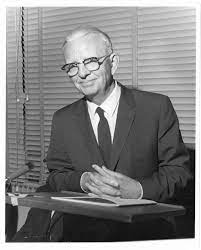
Dr. William Pannell

A cherished friend of mine, Professor William Pannell of Fuller Seminary, is now in his nineties. We met in the late 1960s when as a young seminarian his book “My Friend, the Enemy” spoke powerfully about racism being more than personal prejudice. As friends, he taught me that it was not enough to have a “changed heart.”  I needed to acknowledge the enemy we both faced of white privilege, culture and discrimination. 

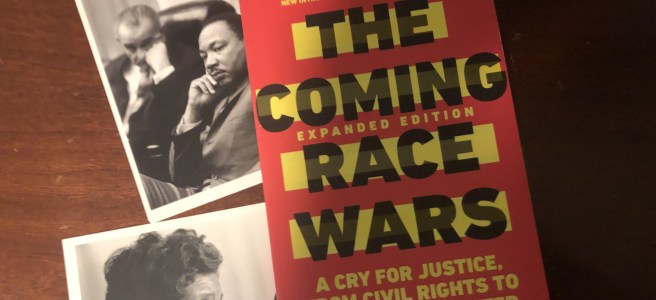
Sermons, workshops, and conferences can be mechanisms of avoidance. Bill speaks of the 1966 World Congress on Evangelism. The theme for the 1966 gathering was One Race, One Gospel, One Task.  Evangelical leaders invited more than 1,200 delegates from 100 countries to Berlin for this World Congress on Evangelism (an important precursor to the historic 1974 Lausanne Congress). Pannell speaks of a small group of African American Christians who discover that even though the theme was One Race, One Gospel, One Task, there was a silence about racial injustice.  Imagine this in the middle of the Civil Rights struggles of those years. As Pannell tells it, (see:  https://www.youtube.com/watch?v=AkpYIg8tpOI) those concerned about this omission confronted the conference leadership and, as is often the case, they were asked to write a document on racism to be approved by the Congress.  Pannell then reports, these more than fifty years later, that document must be “sitting on a shelf somewhere.”  You see, the passing of a nicely worded document, was not connected to concrete institutional and cultural change.  Or as Pannell would have it, “Vital and Biblical evangelization.”

All around we have the opportunity to join in activities to address racial injustice and do more than attend workshop or preach sermons.  However, those of us who are now, or have been, a part of Mainline Christian leadership need to learn to listen to and support others.  There are some remarkable young persons ready to teach and lead us. Persons who come from different racial experiences.  I will share more in future chapters. Urgently now, look for places where persons are addressing the evil of White Christian Nationalism. Check out the upcoming event: https://www.eventbrite.com/e/how-white-christian-nationalism-threatens-our-democracy-tickets-439763242697#search.  Then do more.  A true addressing of racism involves deep change in the ways our institutions understand, and act differently based on the structural, financial and cultural options pursued.

One of my other heroes was Thomas Broden on the faculty of Notre Dame Law School. Tom joined a team working on an initiative called Project Understanding, back in the early 1970s. It focused on city congregations across the country (Chicago, Los Angeles, Atlanta, Dallas, Indianapolis, Bay Area, South Bend). My work was to carry out research on ways racial attitudes might be changed and how racism in many forms might be addressed.

I recall the day we recommended to Broden that lay persons from many denominations be gathered to study and consider ways to address racial injustice. Tom’s response was “That’s okay as far as it goes.” He had my attention! He went on, “We will want to get them involved in some activity with persons who differ racially and in situations where discrimination can be clearly seen.”  In South Bend, one of the activities he suggested was to have lay people sit in welfare offices and observe the cheating going on there.  I was appalled – Tom laughed – “Oh, he said, cheaters will be found, but few of them will be those seeking assistance!”  He was right, so very right.  Today, in Indiana every welfare office must post “the rights of those who seek assistance.”  That came directly from the work of lay people in Project Understanding.  In Chicago and Dallas, change came from teams who sought to rent an apartment (some teams were White only, some Black only, some mixed racially). After visiting the same apartment and seeking to rent it, the teams would gather and learn about the ways discrimination was seen in the prospect of renting the same apartment. In California, there were engagements with persons seeking immigration or work documents.  Sermons helped, workshops were okay, but the research showed that true and lasting changes in racial attitudes were rooted in real and concrete efforts to address discrimination and unjust institutions.

Or, as my seminary preaching professor would put It, “Serr-r-mons are r-r-eminder-rs of where God is al-r-r-eady active in the lives of the people.”
Avoiding Deep Change: Racism and the Ineffectual Church, Chapter 1

Avoiding Deep Change: Racism and the Ineffectual Church, Chapter 1

A year ago, October 1, 2021, I made a calendar note, “Write about this next year!” A year ago today, I had just read of another “Diversity, Equity and Inclusion” workshop planned by a denominational group. My heart sank. One could find dozens of such events planned — and, no doubt, there were consultants who were happy to have the work!

Please understand. I am not against “Diversity, Equity and Inclusion” commitments. A good thing this. I’m not as enthusiastic about workshops, training events, webinars, etc. that are unhinged from engagement in the communities nearby where undiscovered neighbors, real people, live and work. Workshops can become tools of avoidance, especially as stand alone, one-off, efforts. Without a deeper look at institutional and cultural strata shaped by racism over decades there are well intentioned but shallow responses. Tragically, they sometimes result in representational leadership (a minority person promoted to a leadership role) without addressing the deeply embedded patterns upon which institutions function.

Let me confess that I delayed a year in writing this because I didn’t want to be reactive. Perhaps, if I waited, something would emerge to assuage my doubts. Or, I could give a more measured response than simply concluding most church leaders would prefer to avoid, delay and placate all the while appearing to make progress by offering training sessions. Perhaps I would see real, deep and sustainable change. As of a year — I still wait for something substantial to address the racial injustice in which we are mired. Even worse, in this year it appears white nationalism sentiments have grown, sadly often within congregations.

A year ago, following the murders of George Floyd and Breanna Taylor I had been involved in several conversations, web seminars, zoom meetings and the like, where I attempted to share research that showed education and sermons were not sufficient to bring enduring change. I attempted to argue that DEI workshops would not be enough — they would be ineffectual. I even warned pastors “Don’t preach that sermon” until you have in place a way to work with neighbors on antiracism measures in your setting. This advice was not based on a hunch, but on research on addressing racism that had been done decades earlier as part of a program called Project Understanding. That research made it clear that real and enduring change to address racism at a root level involved action with others who brought their differences, as well as education.

A true addressing of racism involves deep change in the ways our institutions understand, and act differently based on their financial and cultural options. There are instruments designed to address institutional racism. These were not requested. There was work to be done beyond training sessions — work to support minority owned banks, address racial discrimination in housing, business, and real estate. Any true addressing of racism in the church would take more than sermons, minority clergy serving as pastors in predominantly white settings or pulpit exchanges once a year with a racial ethnic congregation down the street. There were concrete, measurable ways congregants could be deeply involved, spiritually alive and committed to take common action with persons of different racial and religious groups — action for fundamental change.

An early Inventory of Institutional Racism, from 1973

The year has past… Surely some good has resulted. Please share this in the comments section. Even so, I don’t hear much being reported that is substantial and sustainable. I write a year later of my concern and will in the next few postings offer again insights regarding other approaches. I will share insights from saints who are nearing the end of life or have now passed on — persons like William Pannell at Fuller Seminary, Thomas Broden at Notre Dame, Joseph Taylor and LaVerta Terry at Indiana University, Gilbert James at Asbury Seminary and Jicelyn Thomas who was a gifted preacher and theologian taken from our earthly fellowship too soon, too soon.

A North American Distortion of the Lord’s Prayer

A North American Adaptation of the Lord’s Prayer – for too many Christians

A “Distortion” of The Lord’s Prayer as understood by too many North American Christians

(With interpretive notes)

Matthew 6:9-15

Pray then in this way:
Our* MY Father in heaven,
hallowed be MY UNDERSTANDING OF your name.
Your SPIRITUALIZED kingdom come,
Your SPIRITUALIZED will be done,
On earth** AMONG MY TRIBE as it is in heaven.
Give us ME this day our daily MORE EXCESS bread,
And forgive us our ME MY debts,
as we I also have forgiven our MY debtor FRIENDs WHO DESERVE IT.
And do not bring us ME to the time of trial,
but rescue us ME from the evil ones WHO DISAGREE WITH ME.
For if you forgive*** CONDEMN others of their trespasses,

your heavenly Father will also ESPECIALLY forgive you;

but if you do not forgive others,

neither will your Father WILL forgive your trespasses ANYWAY.
–Matthew 6:9-15

Interpretive Aids:

*This prayer is distorted to fit “modern” North American individualistic sensibilities held by many Christians.  Toby Keith’s song “I Want to Talk About Me” can be sung after the prayer.  It is based on the message preached and believed that all the followeres of Jesus are to focus on is individual salvation. This view forgets any mention of love of neighbor, the Year of Jubilee, Gospel stories about welcoming the outsider and stranger, Paul’s mention of each having gifts needed to be a part of whole community, historic practices of social-justice or ideas of covenant and commonweal.

** Faith in this view is all about heaven and the hereafter. It has little reference to daily life on earth. My current life is to get me ready for the “sweet by-and-by.” God’s will is meant only for those who think like me and believe the same theology and creeds that I hold.  In other words, “on earth” is about how I treat those who are part of my tribe.  This means, climate change is a myth, any government aid the poor is “evil socialism,” the earth’s resources are to be dominated and used up for my benefit and those who are like me. The earth is not our “Common Home” as Pope Francis proclaims. The United Methodist bishops calling for “environmental holiness” was wrong.

*** Forgiveness in this view is a sign of weakness… unless it is asking for a pardon for crimes.  The individual praying the prayer doesn’t need forgiveness because he or she has the right answer on two or three critical issues (e.g., against homosexuality and all abortions) and all else is “up to God.” I don’t really need to ask for forgiveness as my way is the only way to salvation. The story about the prodigal returning home is always about “them” and never about “me.”

Summer Reading Bouquet

A Summer Reading Bouquet

Among my summer bouquet of reading — or re-reading, I have put two in my backpack to carry along with others. These are meant to be devotional books. I plan to carry them as devotional resources to be read and re-read as gifts in these challenging days. These are valuable starting points for reflection and meditation… a stopping to smell spiritual flowers.

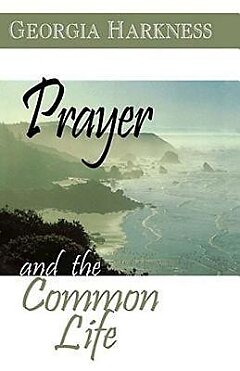
For persons of faith, or those interested in exploring Christianity, I recommend these two theologian/prophets from the mid-twentieth Century as among the best of the witnesses of their time. First, take a look at a book about E. Stanley Jones and second, a book penned by Georgia Harkness. Both were essential Christian figures writing during our nation’s troubled times of war, depression, racial injustice and rapid social change.

Dr. Georgia Harkness

In the recently publishedThirty Days with E. Stanley Jones Jack Harnish offers a fresh look into the life of Jones – the mystic, prophet, missionary, peace activist, evangelist, ecumenist and global ambassador. Georgia Harkness’ Prayer and the Common Life is written for folks in that mid-Twentieth Century, socially moble, economically bubbling and globally expanding culture. Professor Harkness, theologian and philosopher, authored more than thirty books, some scholarly and many others, like Prayer and the Common Life, are meant to be accessible to the lay audience. I believe both have much to teach us, today.

By reading these two together one can see the hoped for seeds of renewal and unity anticipated in the church and society in those years, and at the same time, they point to the troubles ahead for Christendom caught up in narrow cultural understandings. For Christians inclined to devotional reading that comes from an earlier time and yet speaks with profundity to our current dilemmas, I lift these two remarkable people of faith for our personal and common benefit.

For believers, doubters or just plan folks interested, I share these two suggestions as remarkable additions to a good summer reading boquet.

Johnny (and Jill) One-Notes

Johnny (and Jill) One-Notes

Bob Greenleaf shared the story of an elderly, reclusive couple living in a small village who seldom ventured from their home.  However, one day the elderly man set out alone on an adventure. He traveled to a nearby city and after some exploring he returned with a battered cello he had found on a trash heap. The damaged cello had but one string. The twisted bow stick had only a few remaining hairs.  That evening and for weeks following, he seated himself in a front room corner and sawed away on the one single open string. Over and over he played one scratchy, repeated note. Day after day he played — his playing droned on increasing his wife’s unhappiness. Finally, able to stand it no longer, she decided to travel herself to the city.

Upon her return, she confronted her husband. “See here,” she said, “I have gone to the city and found people playing instruments very much like yours. The instrument is called a ‘cello’ and should have four strings. What’s more, those who play them move their fingers all along the neck of the cello and play many notes on each string.”  “Even more,” she continued, “people often play these cellos along with many others instruments. The sound is beautiful and powerful when they all play together. I am told such a group is called a symphony.  Why do you sit here day after day playing that one raspy note?”

The old fella gave his spouse a cold look and responded, “I would expect that of you.  Those people you saw are still trying to find the one right note, I have found it!” 

Robert K. Greenleaf, was a mentor to scores of folks; I was privleged to visit with him several times. His writings on Servant Leadership were widely read and practiced. Even in this, Bob knew that there would be the tendancy to turn his ideas into a distortion — a limited understanding — a one-note perspective. Too often it would be focused on “fixing” and “doing” rather than on “listening to others” and “reframing life with wider understandings.” Bob would chuckle at those who used Servant Leadership as a formula and say, “Leadership is a little like playing the cello. If you can’t hear the music maybe you shouldn’t try.” Or, Bob once opined “if you can’t share your playing with others, in a call and response way, then you will likely miss the beauty of the whole.

As I listen to the singular issues expounded in much of today’s social and religious discourse, I think of Bob and the story of the man and his broken cello. One note, one idea, one conviction (or two or three) can capture and predominate. Such behavior is like playing with too few strings on an instrument or giving too little attention to seeing things whole, seeing life and our challenges more comprehensively.

Perhaps you have seen the video of Johnny Mathis who holds one note, loudly, for almost a minute-and-a-half. It is amazing. Mathis is singing Johnny One Note, a song from the Broadway Musical “Babes in Arms” from 1937. (The movie version of this show starred Judy Garland and Mickey Rooney.)

The Free Dictionary identifies the idiom “Johnny-One-Note” as “Someone who repeatedly expresses or maintains a strong opinion on a single or a few particular subjects.” The song Johnny-One-Note and the idiom display the reality that when one person holds one note long and loudly, it is difficult to hear anything else.

Bob Greenleaf died on September 29, 1990, at the age of 86. Some of the wisdom Bob shared seems even more relevant today. He called himself an “institution watcher.” His experiences within large institutions like AT&T and the Ford Foundation led to his insights, his consulting and writing. In answering the question how does one best lead in humane, constructive and effective ways? He wrote “The best test, and difficult to administer, is: do those served grow as persons; do they, while being served, become healthier, wiser, freer, more autonomous, more likely themselves to become servants?  And, what is the effect on the least privileged in society;  will he benefit, or at least, will he not be further deprived?” (From The Servant Leader, p. 7)

Bob is buried in his hometown of Terre Haute, Indiana after spending much of his working life in corporate headquarters on the East Coast. His head stone captures his sense of humor, and the whimsy of life, with an epitaph he wrote for himself: “Potentially a good plumber, spoiled by a sophisticated education.

One of his many insights that comes today was his statement that “Whether we get a better society in the future will be determined by how well older people nurture the spirit of younger people.”

Bob Greenleaf encouraged folks to “see things whole;” maybe this is why he liked telling the story of the man and his battered cello.

Sunday School and Poker

Sunday School and Poker

Recently I visited an adult Sunday School class in a nearby town. It was, well – unusual, surprising, and helpful to my understanding of some of our current culutural divides. In this class leadership is shared among the members.  Folks volunteer and can schedule their time as “teacher.” Greet Idea with lots of benefits.  You can learn about musical instruments, Buddhism, jogging, or one of the Biblical Prophets.  The class is filled with thoughtful and faithful people. It is in my mind one good model of excellence in congregational life.  It is a place of sharing and care.  One quickly can tell that there is much mutual affection in the group as there is an abundance of teasing and laughter. As John Wesley put it, there is a generous dollop of “watching over one another in love” stirred into the weekly fellowship. All to the good.

It is also a place where the divisions and distortions of our current political situation are offered. Among the many points of view, the many topics covered, sometimes a heavy dose of MAGA partisanship is brought to the lectern by the volunteer teacher.  I visited one Sunday morning when the Gospel-linked understandings of faith got more than a little garbled by Fox News “truths.”

That’s okay, good even.  I knew that there would be open conversation and a range of perspectives in this class.  Here is an opportunity for dialogue and the gentle corrections possible through friendship.  I have often thought that Sunday School classes and post-church-parking-lot-conversations serve as a seedbed for improved democracy.  I saw some of that in the class that day. I also witnessed the ways strongly held beliefs or ideological frameworks can disfigure the core message of Jesus of Nazareth.

I knew that members of the Sunday School class cared for this good man, filled with worrisome opinions and muddled prejudices. They knew of his real-life challenges. They were neighbors to one another. They offered each a place of respect. We all face challenges, whether betrayal, addiction, loss of health or loss of a spouse. We all know the dilemmas of fractures with friends or family. We all face loss of health or opportunity.

The volunteer teacher that morning proclaimed that from his studies, there was no guarantee the scriptures were the authoritative word of God, or that Jesus ever told the Good Samaritan story.  He then offered that the best framework for life is found in a poker game. “Each person at the table is dealt a hand at birth; that is the hand we play in life.” The cards one is dealt limit options, but he said this “will also offer some opportunities. The idea is to play the hand you are dealt as best you can when sitting at the poker-table-of-life.  Trying to help people can only hurt them if they haven’t been dealt the right cards.”

Wow!! Quite a framework. Quite a set of assumptions, all wrapped at the edges in the class-warfare encouraged by the Trumpian politics of our time.  In A Farewell to Arms Ernest Hemmingway writes: “The world breaks everyone and afterward many are strong at the broken places.”  I prefer the answer Jesus gives to the question “And who is my neighbor?”  It begins, “There was a certain man…”

Pondering this in recent weeks, I come to two conclusions: 

  1. There is no coherence to the MAGA movement. It is polyform, a muddle of prejudice, half-truths, wishful thinking, grievance and a struggle for self-esteem. As much as it may claim Christianity as source, it is often (mostly?) untethered from the Gospels.  It is also thickly covered over, cocooned, if you will, by the belief that others are cheating, getting something they don’t deserve. Interestingly, it is a modern Gnosticism, – a belief in a special knowledge each individual may garner by watching the correct rightwing television or a scouring of questionable internet sites.
  2.  Such gatherings at this Sunday School class, and other venues where diversity is welcomed and where all are respected, are all too rare.  These places are a most needed antidote to our current social/cultural/religious divides.

I will plan to return to this class – in part because all the other Sunday School classes I know of near me are filled with folks who all think alike.  I guess this is the poker hand I have been dealt.

Dream This Dream

The lion and the lamb shall lie down together;
The kid and the panther shall play in the sun;
No one shall know the strange word "soldier";
And war shall be a shameful deed that long ago was done.

And rest for the weary, and food for the hungry,
And peace for the comfortless shall not be far to seek;
And beauty in labor, and beauty in laughter,
And beauty in loving shall come to the meek.

Mountain calls to mountain top -
Sinai unto Calvary;
Whispers rise from ancient fields -
They push up through the sod;
        
       "Tell all the children
           To tell their children's children
                To dream this dream for God."

Ernest Cadman "Pomp" Colwell
President, Claremont School of Theology (1957 - 1968)
Dr. Calwell, ca. 1960

‘Untied’ Methodism: Ten Turnings

‘Untied’ Methodism: Ten Turnings

The wedding was to be an oppulent affair. No detail overlooked. Expensive floral boquets adorned every corner of the sanctuary. The string quartet rehearsing, women attendents doning gorgeous gowns and men were in tuxedos, all in anticipation as a stretch limo waited at the door to parade the bride and groom to a reception for hundreds following the wedding. As pastor, I observed it all with embarrassment. These were fine young people; I liked and prayed for them. This event was detailed in bridal magazines as one costing hundreds-of-thousands-of-dollars! This, at a time when our congregation was giving considerable attention, energy and resources to aid the homeless and hungry around us. What witness did this extravagence offer?

Preparing to preside, heavy hearted, I put the robe over my shoulders and picked up the order of service. Immediately, my sadness melted; I began to laugh. This perfectly planned wedding would be remembered, not so much for the wealth displayed but for a typo atop the custom-printed bulletin. There it was on the second line, the church was identified as “The First Untied Methodist Church.” Amid all the preparations, the printer and spell-check had missed it. The church was not named the “First United Methodist,” but rather indellibly printed were the words “First Untied Methodist.” We were UNTIED, and at a wedding!

Steve Harper recently wrote that the “The Future of the United Methodist Church is Now.” The denomination’s 2020 General Conference (an event scheduled for every four years) has now been delayed for the third time due to the COVID pandemic. It will now be convened in 2024. In response, a break-away group, identifying itself as “traditionalist,” indicated they can “wait no longer.” They are forming a new and seperate denomination, the Global Methodist Church to be initiated in May 2022. Our denominational un-tiedness is on full display. Dr. Harper advises that for the large majority who do not exit, the phrase “United Methodist” should be understood as a verb. He suggests to be about intentionally and actively forging a renewed identity. To be passive, he writes, is for “congregations to be impotent and irrelevant.”

It is time to move from being “untied” to being “united” again. Earlier Methodists and Evangelical United Brethren, shaped by the likes of the Wesley brothers, Philip Otterbien, Jacob Albright, Barbara Heck, E. Stanley Jones and Georgia Harkness, James Thomas, Leontyne Kelly each pointed to God’s redemptive work as resource. Even so; the doors opening to the future require new eyes to see the ways forward. Isaiah 43 comes to mind — behold, God is doing a new thing. The New Testament is filled with the call to “turn around” (metanoia) and walk a renewed and ever-renewing path.

Emerging from my observations as pastor and seminary administrator, and thinking of United Methodism as a verb, I offer here ten turnings for a renewal of identity and mission for United Methodists:

  1. Repentance, not Reactivity: Let us repent of the damage done to the “other.” Our healthiest future will involve repentence. I do not suggest this is easy, or obvious, or perfectly done, or that we should give up core beliefs/commitments/actions, or our welcome of LGBTQ+ persons throughout our church. However, we can give up the practice of “talking about” rather than “talking with” one another. We have been too quick to react and too slow to repent. Repentance takes a lifetime, reactivity is a quick fix, that in my experience doesn’t work and damages more than it heals. My dear friend, Walter Wangerin, Jr., died last summer. Watching the warfare inside of our Untied Methodist Church these days, I recall what Walt shared with me on more than one occassion. Walt left his beloved Missouri Synod Lutheran ancestry, the denomination of his birth, early in his pastoral career to join another Lutheran body. He would remind me that “schism in the body of Christ was a mark of sinfulness on all sides.”
  2. Resurrection, not Rebuilding: This is God’s work. We are privileged to join. Jesus spoke of those who lose their life “for my sake” might find it. Much energy has been spent and is being spent on trying to “save the denominaton.” As a wise pastor-friend of mine once observed, “People don’t get burned out, It’s mostly that they were committed to the wrong thing in the first place.” Saving a denomination has left us in a place where the melodrama obscures God’s first purpose — bringing life and hope to the world. It is time to let the many assumptions about power, place and authority die and trust our future in God’s hands. Prayer more than plan, laughter more than grievance, humility shaped by community and friendship more than caucus will be signs of resurrection. In these years it may be more important to “give up” rather than “gain up” in restructuring. At the center of our story is death and resurrection. Yet, it is the thing that scares us most of all.  We seem not to believe that resurrection doesn’t come without a death.
  3. Welcome, not Exclusion: Let us unite in acting as a loving community with the poor, the immigrant, the disenfranchised. Our denominational squabbles have turned us inward, unable to accept the interruptions of the Spirit at work at our doorsteps. Let us turn to know the names of our neighbors and their stories, not as those who we seek to fix but rather the others with whom we share, together, the transforming love of Christ.
  4. Heart Religion, not Statute: At our best we are a people who value Christian Experience, a people who practice a faith that is confirmed by a tranformed heart and mind (a metanoia) that is sustained and flourishes by living in loving relationship with other believers. Rather than more rules to keep things as they were, we might look to less standing still and more turning to live in loving relationships with other believers. The Shaker hymn “Tis a Gift to Be Simple” speaks of “turning, turning, till we come round right.”
  5. Ecumenical, not Faith Enclave: Let us turn to truly be a global and ecumenical church, not in words but in practice. Let us see the beauty all around in the practice of grass-roots ecumenism and interfaith sharing. Let’s do this, moving past the often thinly veiled paternalism and colonialism that has shaped much of our talk and action about “mission.” This will involve the essential task of learning from those in other places and who seek to follow Christ in different ways.
  6. Economy of Love, not the Marketing of Scarcity: Let us turn from, and give up, the “business facade and facination” that has distorted our core Christian identity and purpose. Too much time, energy, and resources have been directed to “best practice” models from business or from scarcity models designed to hoard resources. There are certainly lessons to draw from business and commerce, but where is our witness to “faith, hope and charity?” Strategies and designs that turn congregations into branch offices have done real damage. Rather than seeing God’s people gathered in unique communities, with distinctive gifts, expensive programs have been established that, while well-meaning, in too many places are counter-productive. Pastors are bombarded with the message that unless they do it like corporate America, or a megachurch somewhere, they are failing. They are told by some authority unfamilar with the ministry context, or the gifts of the people they know, how to “be fruitful.” (There are important parallel lessons coming from well-intended but ultimately destructive models in modern agriculture whose full damage to our environment and food resources is only now becoming apparent.)
  7. Encourage Positive Deviance, not Scaleable Formulas: Let us celebrate the overlooked places, sometimes small or nontraditonal, where ministry results in changed lives, new ways of being church, and witness that is otherwise overlooked. Such places of “positive deviance” offer dozens of exciting examples of witness in finding community with homeless persons, in caring for God’s creation, in welcoming the immigrant, in giving witness in the corporate board room, in demonstrating our opposition to war and violence in all forms. Let these be the ministries we seek to replicate, more than a mega-church or a drive-in restaurant chain.
  8. Watching Over in Love, not with Sanction: Let us turn to focus again on building and sustaining small group relationships and the practice of “watching over one another in love.” As my friend Michael Mather puts it, “If we watched over one another in love, we would not keep missing the abundant acts of grace, charity, and encouragement that happen in all of our churches and that would pull our heart and attention to somewhere that would certainly please God.” Whether called “class meeting” or “covenant discipleship” or any other name, we United Methodists have a remarkable tradition here.
  9. Horizontal, rather than Vertical: Let the connection be rewoven — horizontally. This could model for the world a different way of being community, a way that has been lost. This will involve discovering again and turning toward the value of circuits, of districts, subdistricts, relationships with and among our schools, colleges, seminaries, hospitals and other institutions. It would change what we counted and valued. General Boards and Agencies (whichever ones remain) should turn toward acting as weavers and reweavers of connections, turning from perceiving themselves as the center of action and returning to the earlier practice of assisting others in flourishing and being sustainable. The models await development and our moving from the heavily top-down and bureaucratic approaches of the past generation. Too many laypersons were placed on the sidelines as conferences merged, institutions drifted away from positive connections with the wider church. More attention to our colleges and universities is overdue. Our seminaries too need to think horizontally. Some will need to merge, some should close or discover another mission. All should become more cooperative. In preparing pastors, United Methodist theological students should spend at least one year in a United Methodist seminary as a part of this reweaving and building relationships for mission.
  10. Democratic doorkeepers, not Border Guards. Perhaps we need to stop merging conferences and allow for core polity and mission structures that are smaller, more agile and more adaptable. Perhaps these units might be the size of a couple of districts today with an elected presiding elder or table of leadership. Focus could be on the social and cultural ecology of each place – urban, suburban or rural. Perhaps there would be no bishops or superintendents at all, as is the case in other Methodist bodies. Or, if we continue in the episcopal format, explore a term limited episcopacy rather than life-episcopacy. Perhaps all appointments beyond the local church should also be expected to serve in a local congregation as well as in a non-congregational setting.

These, then, are Ten Turnings that might be considered as we move from being the Un-tied church. They are, in the Protestant tradition, a call to be a people who are Forever Reforming (Semper Reformanda), or as the Methodist Bicentennial motto in the United States put it “Forever Beginning.”

In recent days there has been much talk about a conspiracy around the postponing of the General Conference, yet again. It is charged that General Conference 2020 is being further delayed for some political advantage and suggested that those “moderates” and “progressives” who plan to stay in the United Methodist church, have successfully plotted to postpone any the General Conference until 2024, as a way to undercut the plans of the “traditionalists.” I laugh at such notions. Having spent much of my life around the corridors of authority in the denomination, I know that our church leaders have problems organizing a three float parade! Something as dramatic as a power play to change the General Conference dates three times, for a power advantage, is as likely as a Southern Baptist giving up immersion. Further, the COVID pandemic that shut down the gathering of persons from around the world, leving a singnificant minority unable to obtain visas, is not a conspiracy of anyone’s planning.

Let’s face it, we live and serve in an anacronistic institution. It is one we don’t know how to handle. We need let go of the foolish conspiracy thinking that has marked too much of our brokenness, and for too long, and which is, let me say it again – sinful.

My friend Noah was a Trappist monk who two decades after the changes in the Roman Catholic Church from Vatican II, shared with me an insight about his disappointment that there was not more renewal in denominational practices, structure and mission. Speaking of his sadness that positive changes were painfully slow to come, Noah said, “At the monestary, we changed our dress, our leadership patterns, and the arrangement of our furniture in the chapel. We changed our music, our liturgy, and our educational curriculum.” He paused and smiling said, “We tried changing everything… but our hearts.”

California-Pacific Annual Conference worship, June 2019

There is much in our United Methodist tradition(s) that is of great value… and much that need be changed. I look and chuckle to see the multiple ways folks are trying to arrive at perfection, like the effort at that wedding service where I presided so many years ago. In remembering, I begin to laugh out loud. We who call United Methodism home are indeed more UN-TIED than we are UNITED. There are now, and will be, many plans as to how the future should be approached. We are indeed a verb — but too often in the passive tense. And knowing this, and knowing human nature, I chuckle. As God’s church, perhaps we can find ways whereby our hearts might be changed and not just our structures and ways of sanctioning. Perhaps these “Ten Turnings” offer a few ideas, hunches really, as to where we can discover the God already at work among us.

Free Ukraine, Free Joey

Free Ukraine, Free Joey

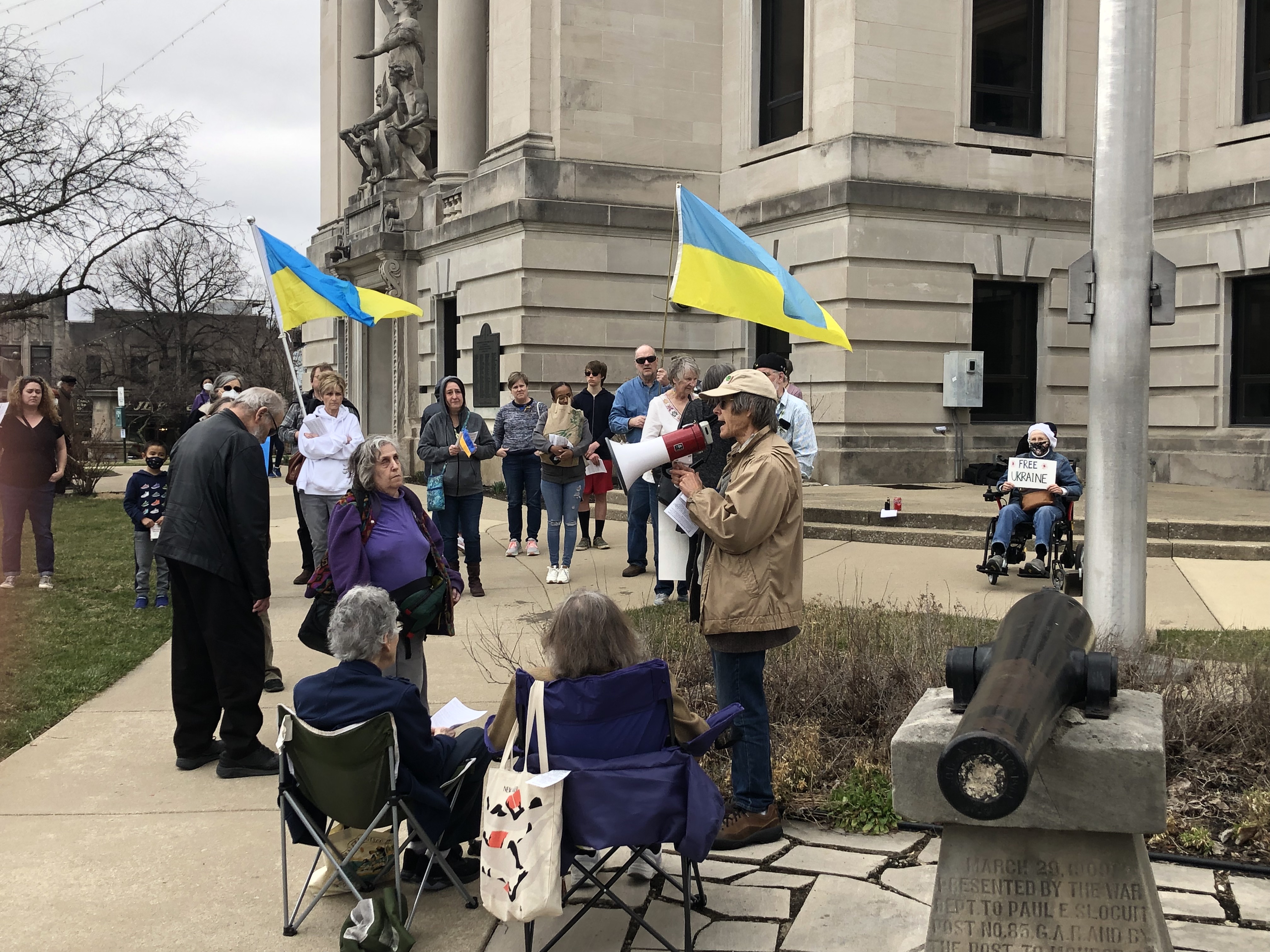
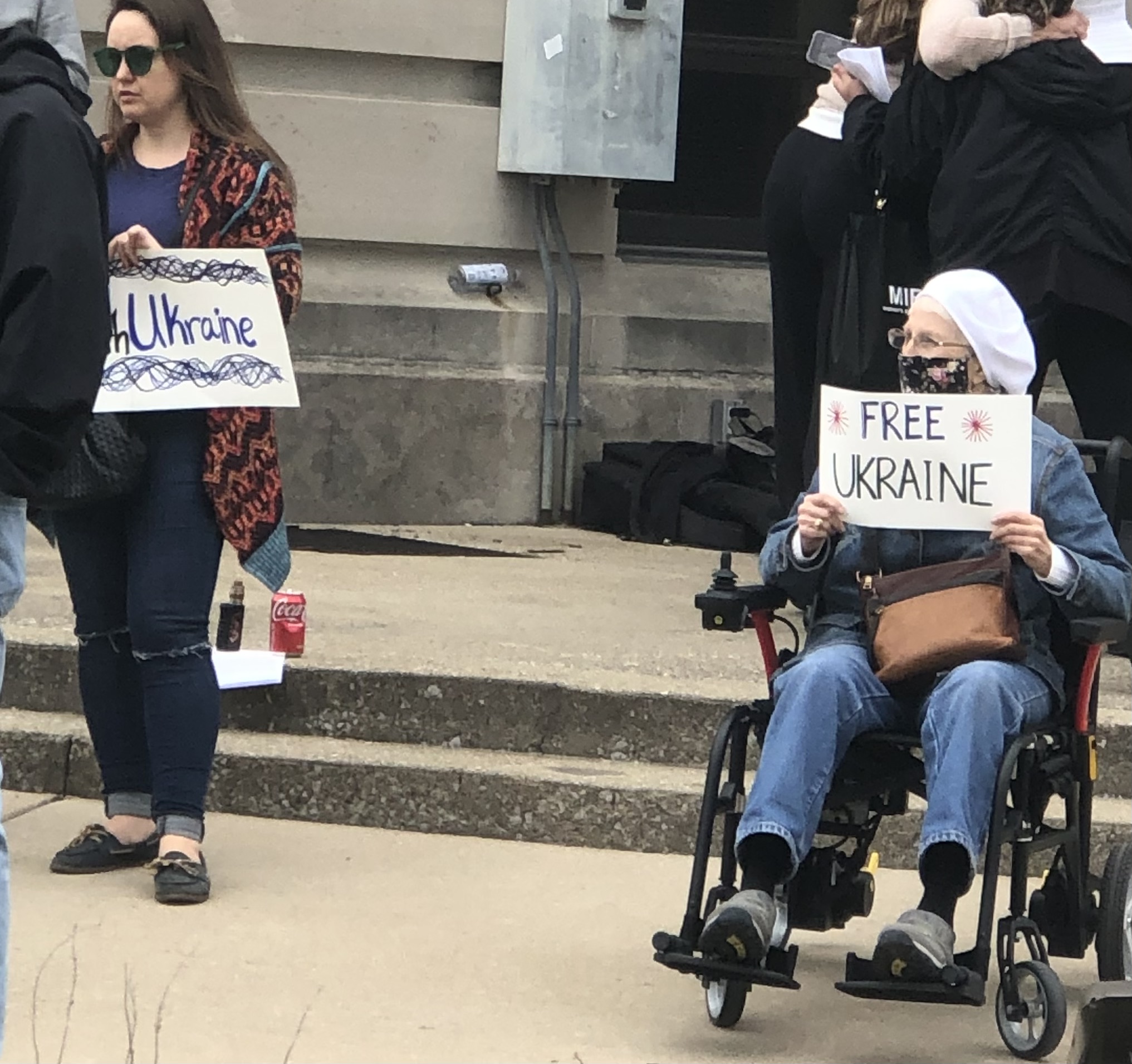
He showed up after most of the group had gathered. Speeches were being made against the war in Ukraine. There was also a clear accounting of the continuing threat of nuclear conflagration in our world. The group started small, perhaps two dozen. I recognized some from demonstrations thirty years earlier. It was an interfaith gathering. Truth is, it was mostly folks from the Quaker, Unitarian and Jewish traditions. There were a few Methodist types attending — but not many. Here we were, gathered again, persistant voices against violence and war. I had shown up early to join “my people,” and I also came to observe and to learn. As the speeches began, others joined, the crowd slowly grew. Some had brought Ukranian flags. Others carried signs calling for the end of war and stopping the aggression by Mr. Putin.

Demonstration supporting Ukraine Freedom

As the crowd grew, by my count, to just over one hundred, others passed by enjoying the warm March weather. We were on the south lawn of the County Courthouse in Bloomington, Indiana. One woman wove her way through the crowd distributing packets of Sun Flower seeds, a sign of peace in Ukraine. A few passing motorists blew horns in support. Mostly, people on the sidewalks barely noticed, on their way to the coffee or ice cream shops nearby. A speaker, standing beside an old Civil War canon, finished his reflections by saying “I don’t have any easy answers, but we must stay vigilant. In these difficult days we must do all we can to stop such tyrrany.”

From the back of the crowd a man shouted “Bomb Ukraine.” He scolded the speaker, “What do you mean you don’t have any answers?” We turned to see him, swaying behind us, clearly under the influence of alcohol or drugs. He erupted again, “That’s no good. We need to bomb the hell outta somebody.” As the inebriated shouts continued, someone begain to sing “I ain’t gonna study war no more.”

I joined in for a verse or two and watched as the man uncertain on his feet swaying and occasionally shouting. It is not surprising that this too was ridiculed by the drunken man. “Singing ain’t going to do any good against bullets and bombs. This is stupid.” He weaved and stumbled before shouting again, “Bomb Ukraine. Get Poland to join the fight, they are mean SOBs.” Folks moved away — others began to disburse — still others sang louder.

Slowly approaching him, I asked, “How are you do’in? Anything I can do to help?” Our eyes met and we both understood. He knew my modus operandi as much as I knew his. Laughing, he slurred, “You a preacher or someting?” Caught. I chuckled and said, “My name is Phil.” “Phil the pill,” he responded. He had me pegged, preacher, social worker, or a physician or counselor, or someone experienced around addiction. I asked his name, “It’s Joey, showy Joey.” We talked on for a few minutes. Not arguing but speaking out of our deepest hopes. Joey said he had recently lost his job, was from Texas. When he asked again if I was trying to “save him,” I replied, “God is already working on you… and on me too. You are about to be caught. God bless you, showy Joey,” I said. He stuck out his hand to shake. I touched his shoulder. Our eyes met again. Two children of God recoginizing each other.

Turning for home, this all seemed to me to be an apt metaphor. Joey, shouting for attention. Others like me who only know to sing the songs of Zion from our past while in this wilderness, while many of our politicians, drunk on narcissism, grievance, or thirst for power speak as foolishly as Joey about bombing and killing. The greed and drunkeness for power in our nation has contributed to our dilemma. The senior senator from South Carolina publicly calls for an assination of the Russian leader. Violence is the only tool he seems to know. While the senior senator from West Virginia, so drunk on his addictions to fossil fuels, calls for increased drilling and mining in the U.S., not wanting to miss the opportunity to supplant the Russian production of petroleum and turn a profit for himself and his friends. Will this violence, greed and hunger end without an enormous expenditure of life and treasure? I fear not; even as the violence spirals across Ukranian communities? We grope for a way forward amid the darkness and grieve the suffering of the innocents.

As the sun set, I journeyed to prayers at a local church. On a different liturgical calendar, this year the Lenten Season in Eastern Christianity begins a week after ours. Lent starts with “clean Monday” or “pure Monday” and prayers are held on the Sunday evening prior with a time of forgiveness. At the service in Bloomington there were prayers for Ukraine and for Russia… and for Europe and for Ethopia and for Syria and for the U.S. There were prayers for our leaders – the wise and the foolish. And there were prayers for all the people of Ukraine. And there were prayers for Joey — and the Joey that resides in each and every one of us.

2-2-2-2uesday

2-2-2-2uesday

Today is a Twos-Day. This, the twenty-second (22) day, of the second (2) month, of the year twenty-twenty-two (2022), has me considering the things that might be “twinned” together. What are two places, two events, or two persons that share something in common.

Briefly then, I write of two persons who come to mind on this day of 2s. I join author John Green in not being a fan of heroizing individuals; even so, I risk it here. The belief that there is some hero in a white hat who will come along and save the day, is a deeply inculcated myth in our culture. It does much damage. One the one hand, some folks chose to wait for the hero to appear, not stepping forward to join others in seeking to address some injustice of shared dilemma. On the other hand some think they are called to act as hero and come up with “the great fix” that will solve whatever problem they perceive to be at hand. One doesn’t have to live long in low-wealth communities to see the damage done by the continuing cycle of “heros” who appear and believe they are going to fixt things, all the while ignoring the gifts of the persons or neighborhoods they were scheming to FIX.

Even so, on this day of twinning, there are some difference-makers who come to mind. They show up in our world to point us to noblier paths. On a day when tyrants, like Vladimir Putin, act as bullies on the international stage, there are other options. On a day when one can, in hindsight, see through the thinly veiled efforts of our former U.S. president to take us out of NATO, and undermine the democratically elected government of the Ukraine, I want to hold up two other persons. If Putin and Trump can be seen as twinned — at least in their preference for autocratic governance, there are two men who have shown a different path forward: Paul Farmer and Jim Wallis.

The news came yesterday that Paul Farmer had died. I only met Farmer once and briefly. Still his life, his writings, and his witness standout. He would not accept that healthcare should limited to only the wealty or privileged neighborhoods in our nation or world. He did his work encouraging the resources at hand — whether with the people by establishing neighborhood health worker corps or building clinics and hospitals using the natural resources and gifts of the communities where they were built. Read more about Paul Famer here: https://www.washingtonpost.com/opinions/2022/02/21/how-paul-farmer-saved-millions-of-lives/.

Farmer was clear and persistent. His calling was to act along with others, to make a difference, to give access to health care FOR ALL. A friend tells of a time Paul Farmer was asked to meet with executives of a large pharmaceutical company in the Midwest. In his presentation, he said he could make a difference in a nation in Africa if a donation of $3 million in specific medicines could be made available. At the close of this talk, the executives quickly huddled, then came back saying the best the company could do was $1 million of these medicines. Dr. Farmer responded that, then, he wouldn’t be able to accept their donation because it wasn’t sufficient to the challenge the people were facing. As he stood to leave, the executives asked for a moment to discuss the matter further. Upon their return to the room, they assured Paul Farmer he would receive ALL the medical supplies he requested. Clarity and Persistence. We grieve Paul Farmer’s early death and celebrate the gifts he shared.

The second man that comes to mind is Jim Wallis. Jim is still very much alive and I give thanks for this. My friendship with Jim has been a long one, beginning back in San Francisco in 1974 when we were both called Young Evangelicals. I was teaching in an urban studies progam and invited Jim to come speak at a conference on the role Christians might play to address discrimination and poverty in our cities. As the editor of a new magazine, The Post American, later to become Sojourners Magazine, Jim was one of several persons who were emerging as important Christian witnesses. Jim would be the first to say he is not a hero; and my years of friendship would confirm his assessment. Like every person I know, he has his blemishes. Still, I suspect, that when a list of the saints of our generation is written, his name will be on that list (or at least he will be in a place of honorable-mention!).

Currently, I give thanks that Jim Wallis’ voice and experience in making it clear that voting rignts for all in the U.S. today is a moral issue: https://www.washingtonpost.com/religion/2022/02/18/sojourners-jim-wallis-voting-rights-religious-left/. As Wallis puts it, “For me it’s the first book of the Bible. We were all made in God’s image and likeness. Voter suppression on the basis of skin color is a throwing away of Imago Dei.” Jim has spent more than fifty years giving witness to the ways the Gospel calls us to live beyond the prejudices and discrimination still so prevelant. Clarity and Persistence.

These two men are connected by Clarity and Persistance: 1) they believe every human being is made in the image of God; 2) No matter the evil patterns and powers and persons who seek to exclude and dominate, God’s way of love for all is the preferred way for humanity. Paul and Jim have demonstrated THE BETTER WAY on this Twos-Day.