UnFlagging Jesus

UnFLAGging Jesus

I once was joined for lunch by two friends. One was head of a theological school. Our conversation was amicable enough. Although the seminary president took up much of our visit promoting a wide array of initiatives focused on leadership. Future pastors, chaplains, counselors and social service providers were being trained to be leaders! It appeared an effort to impress the other friend at the table — John McKnight. 

John is one of the founders of the Asset Based Community Development approach to community organizing, (often abbreviated as ABCD).  A primary assumption of ABCD is that good leaders start by listening to others and discovering gifts, passions, assumptions and assets. After lunch as we were saying our “good-byes,” John took the hand of the seminary president and kindly offered, “Maybe we should focus a little more on connector-ship and a little less on leadership.” 

Connector-ship! That’s a missing ingredient in so much of human exchange. Universities, businesses, denominations and governments spend tens of millions of dollars and valuable personnel time training for leadership. This is not without merit and benefit. Still if one begins with a belief that energy and initiatives all flow from a top-down direction, a needed element for change is missing. Too often, there is the assumption that if the leader just has the right idea, program, language, skill set or practices, success will inevitably follow. McKnight, understands and teaches that human connection is a critical initial step in developing effective institutions and civil communities.

Don’t start identifying the needs of others you plan to fix without listening. First, listen to find the gifts, the capacities, the assets that folks already possess. Secondly, find that inner moral compass that must continually be developed throughout life by study, seeking fact-based reality, and interacting responsibly with others. This is a more enduring pathway forward.  

I know a remarkable corporate leader who upon arriving at a troubled firm, went to folks on the picket line, the hourly workers, not just upper management and he listened. A follower of Jesus, he continued in prayer, study and worship. Leadership meant connector-ship, listening, learning and finding a moral compass. Shortly thereafter, he gathered the employees in the parking lot. Taking a copy of the company’s unfair policies and procedures manual, he dropped it into the flames of a barrel used those standing in the cold. It was not a concession; it was a modeling of connection. Hard work followed.  He was saying, “We are listening, let’s talk.”

Recently I wrote a piece titled “Jesus Wrapped in a Flag.” Today’s Christian Nationalism promotes a fraudulent version of Christianity, and profoundly flawed revision of American History.  Lovett Weems offered a set of counter recommendations titled Leading Amidst Christian Nationalism.  While helpful, these are overly cautious words and appeared to assume there is only one paradigm for congregational life. It is a soft version of the very American Civil Religion that the author critiques. It is more of a starting point than a guide.

I thought of all the congregations and courageous religious leaders who are doing much more. They listen and share the hard truths discovered in their study and prayers about our responsibilities as Christians. They offer a more robust response to the profound dangers and misinformation widely dispensed by White Christian Nationalism and American Catholic Integralism.

The American church, Protestant and Catholic, needs to remove the American Flag from the shoulders of Jesus. It doesn’t belong there; never has. If U.S. policies and practices aren’t held under the judgement of the Gospel, why be a Christian at all?  Why not just pledge primary allegiance to anything our nation does and forget Jesus?  Just diminish our discipleship. 

Some U.S. “leaders” have done just that. Congresswoman Laureen Boebert said, “Jesus didn’t have enough AR-15 rifles to keep the government from killing him.”  What? Jesus is remolded into a grievance filled, revenge seeking and bully. What does the congresswoman do with the Sermon on the Mount, the words, “Love your enemies” or in the Garden of Gethsemane, “Nevertheless, thy will be done”?  The paradox, of course, as Reinhold Niebuhr argued, while international ethics are messy, they begin with morality in human expression.

The witness of Jesus of Nazareth, Jesus the Christ, isn’t limited to the foolish, mean-spirited and ill-informed theologies of some in congress these days. Jesus of scripture says “Come to me, all you who are weary and carrying heavy burdens, and I will give you rest.  Take my yoke upon you, and learn from me, for I am gentle and humble in heart, and you will find rest for your souls.[iv]” 

The witness of Jesus is UnFlagging!  It is persistent – enduring. It calls leaders to leave their C-Suite offices and learn from the folks in the parking lot.  It calls on congregations to speak with and learn from folks not in the pews on Sunday.

In the mid-1980s my family lived in a low-wealth neighborhood in Evansville, Indiana. One fall, fear gripped neighbors as vicious rapes were reported. The assailant was said to be African American in our multiracial community. Soon we learned the Ku Klux Klan was sending patrols to protect our white citizens, especially the women.  What should our small core-city ministry do? How might we offer a safe alternative to this violation and the hate-based response?

Someone suggested we talk with Will Campbell. Mississippi born, Baptist minister, graduate of Yale Divinity School, author, and Civil Rights advocate, Will was known for friendships with a wide range of people, including members of the Ku Klux Klan. Will took this dwelling together stuff seriously!

I called and left phone messages for Will. It took a few days, and he returned my call. Hearing of our situation, he said, “First thing you need to say to the Klan is “no, your activities are not welcome.'” That sounded good to me — We had already done that. Then, Will, stumped me, surprised me. He asked, “What are their names?” 

NAMES?  “What do you mean?” I responded, “Whose names? Our neighbors?”  “No.” Will said, thinking I would already know the Klansmen. Their names.  I confessed that I didn’t know any of those folks.  He said, “Well, then, what the hell you been doing?  Who are they?”  Interesting, our need to limit where repentance, reconciliation and renewal might occur. Perhaps some changes, some weaving of new relationships could happen in my own life, not only in the lives of Klan members. Might there be a bridging to new relationship, even there? A renewal larger than my imagining?

South African Methodist Bishop Peter Story noted that “America’s preachers have a task more difficult, perhaps, than those faced byus under apartheid. We had obvious evils to engage; you [on the other hand] have to unwrap your culture from years of red, white and blue myth, You have to expose and confront the great disconnect between the kindness, compassion and caring of most Americans and the ruthless way American power is experienced, directly and indirectly, by the poor of the earth. You have to help people see how they have let their institutions do their sinning for them.


@font-face
{font-family:”Cambria Math”;
panose-1:2 4 5 3 5 4 6 3 2 4;
mso-font-charset:0;
mso-generic-font-family:roman;
mso-font-pitch:variable;
mso-font-signature:-536870145 1107305727 0 0 415 0;}@font-face
{font-family:Aptos;
panose-1:2 11 0 4 2 2 2 2 2 4;
mso-font-charset:0;
mso-generic-font-family:swiss;
mso-font-pitch:variable;
mso-font-signature:536871559 3 0 0 415 0;}p.MsoNormal, li.MsoNormal, div.MsoNormal
{mso-style-unhide:no;
mso-style-qformat:yes;
mso-style-parent:””;
margin-top:0in;
margin-right:0in;
margin-bottom:0in;
margin-left:.5in;
mso-pagination:widow-orphan;
font-size:12.0pt;
font-family:”Aptos”,sans-serif;
mso-ascii-font-family:Aptos;
mso-ascii-theme-font:minor-latin;
mso-fareast-font-family:Aptos;
mso-fareast-theme-font:minor-latin;
mso-hansi-font-family:Aptos;
mso-hansi-theme-font:minor-latin;
mso-bidi-font-family:”Times New Roman”;
mso-bidi-theme-font:minor-bidi;
mso-font-kerning:1.0pt;
mso-ligatures:standardcontextual;}.MsoChpDefault
{mso-style-type:export-only;
mso-default-props:yes;
mso-ascii-font-family:Aptos;
mso-ascii-theme-font:minor-latin;
mso-fareast-font-family:Aptos;
mso-fareast-theme-font:minor-latin;
mso-hansi-font-family:Aptos;
mso-hansi-theme-font:minor-latin;
mso-bidi-font-family:”Times New Roman”;
mso-bidi-theme-font:minor-bidi;}div.WordSection1
{page:WordSection1;}


[i] Weems, Lovett H. Jr. Leading Amidst Christian Nationalism, LEADING IDEAS, Lewis Center for Church Leadership, June 25, 2024).

[ii] Matthew 5:43-48.

[iii] Luke 22:42

[iv] Matthew 11:28-30.

[v] Storey, Peter, Sojourners Magazine, Oct. 18, 2006.

Jesus Wrapped in a Flag

Jesus Wrapped in a Flag

So-called Christian Nationalism appears to have mushroomed in our body politic. Books like Taking Back America for God (Andrew Whitehead and Samuel Perry) and The Kingdom, The Power and The Glory (Tim Alberta) document the spread and extent of this ideology across American faith communities. Is this new? Or is it reappearing after years buried in the subsoils of our common life?

Do your recall the l-o-n-g word Antidisestablishmentarianism? In elementary school I learned it was the longest word in the English language. Well, not quite. At only 28 letters, it now is said to be the fourth longest. I won’t try to spell or pronounce the top three. The folks at Merriam-Webster say it doesn’t qualify for a dictionary; it is so little used. Okay – but I have burned too many brain cells learning to spell it. Antidisestablishmentarianism arises from historic struggles in Britain over the role of religion in government. This word argues religion (the Church of England in this case) should receive special government benefits, support, patronage.

Increasingly unmerited claims that the United States was to be an exclusive Christian Nation are made. Stephen Wolfe’s book The Case for Christian Nationalism, widely read and oft cited, is a core effort in this “restorationist” project. This desire to return a simplistic narrative about our nation’s founding, our diverse communities of faith, and multiple cultural expressions is misleading, even antithetical to what Jefferson referred to as our “Great Experiment.” In fact, the First Amendment to the U.S. Constitution (known as the Establishment clause) opens with the words, “Congress shall make no law respecting an establishment of religion, or prohibiting the free exercise thereof.” Something fresh, never seen before, was being birthed with the American experiment. Something untethered to a monarch, or a single faith tradition was begun.

Evangelical scholar Kevin DeYoung acknowledges an understandable hunger among some Christians for something like Christian Nationalism; however, after reviewing Wolfe’s book, he concludes “Biblical instincts are better than nationalist ones, and the ethos of the Christian Nationalism project fails the biblical smell test.”

DeYoung offers a clear window on the rootage of Wolfe’s narrowly drawn and grievance informed “research” as he writes “The message—that ethnicities shouldn’t mix, that heretics can be killed, that violent revolution is already justified, and that what our nation needs is a charismatic Caesar-like leader to raise our consciousness and galvanize the will of the people—may bear resemblance to certain blood-and-soil nationalisms of the 19th and 20th centuries, but it’s not a nationalism that honors and represents the name of Christ.” He concludes“Christian Nationalism isn’t the answer the church or our nation needs.” (DeYoung, Kevin, “The Rise of Right-Wing Wokeism”, Christian Living, Nov. 28,2022)

As a teenager, in the early 1960s, I recall sermons warning if John Kennedy were elected, our first Roman Catholic President, he would receive orders directly from the Pope and the Vatican. Fortunately, a majority of U.S. voters didn’t buy that argument. Today, the benefits of Kennedy’s presidency and the tragedy of his assassination continues to shape and haunt our national self-understanding.

In my early adulthood (late 1960s and early 1970s), I heard the black evangelist Tom Skinner preach. He said “All the pictures of Christ were pictures of an Anglo-Saxon, middle-class, Protestant Republican. There is no way that I can relate to that kind of Christ.” (See Jamar Tisby, Footnotes, October 24, 2023.). Skinner painted the image of a white Jesus wrapped in an American flag. He was saying “the Jesus long marketed by the American church wasn’t a faithful representation of the Jesus of the Gospels.” Teaching in a United Methodist school in the Republic of Panama in these years further sharpened my awareness. Skinner was right.

Today’s Christian Nationalism continues to market a fraudulent version of the Christ. It is often linked to the “great replacement” theory that rests on the notion that immigrants and nonwhite, nonChristian persons (especially “Jewish elites”), are engaged in an international plot to take power away from those with birthright privilege in the United States. Do you remember the torchlight parade and the chant “Jews will not replace us” in Charlottesville, Virginia in 2017? Such entitlement beliefs are not only profoundly racist and antisemitic, but they are also neither faithful to U.S. history nor the Christian message.

Whether as Christians or patriotic Americans, or both, how shall we respond?

My friend, Lovett H. Weems, has outlined seven strategies “for responding to Christian Nationalism in measured and faithful ways.” (Leading Amidst Christian Nationalism, LEADING IDEAS, Lewis Center for Church Leadership, June 25, 2024).  Weems offers a helpful overview especially reflecting on the church’s historic endorsement of a civil religion. He is clear about the dangerous ties to the racist agenda of many that Christian Nationalism brings. The strategies offered start with “Be Cautious” and conclude with advice to “Understand the broader social, historical and political landscape.” In between are calls to love of country, to be humble, to stay positive and focused, and to remind others that Christians are called to give witness. These are more a starting point than a guide.

Missed is an awareness of the multiple and diverse contexts and callings of Christian congregations. Few people understand this more than Weems. In many places a more robust response is appropriate. The cautious tone of these “strategies” reflects the tendency of many denominational leaders in recent years to avoid conflict. It reminds one of the crouching stances that have marked too many “leaders” in handling the recent divisions in United Methodism. Perhaps it is, as Weems admits, a “soft civil religion,” but it can none-the-less be misunderstood as a draping of the American flag across the shoulders of the cautious contemporary U.S. church. I suspect the author knows the suggestions offered focus more on what should be avoided and miss some options of what Can Be Done to faithfully respond to Christian Nationalism.

In future days I will offer what I believe may be more effectual responses. I close remembering the words of British Methodist leader Donald English when he said, “The world has enough salesmen of the Gospel.  What we need is more free samples.

Backward Facing, Careful Steps

Backward Facing, Careful Steps

The Indiana Conference of the United Methodist Church Clergy Session had ended and a childhood memory played across my mind.  Perhaps you recall the game often played at picnics, or at elementary school recess.  Children would race walking backwards toward a finish line ahead.

I remember some falls and trips and stumbles as I rushed in the opposite direction with backward steps.  We were facing where we had been, glancing over the shoulder to make certain we were moving forward, careful not to land on our behinds. Too often my movements proved to be sideways rather than toward my goal.

The Indiana UMC proceedings and language were familiar. Newly ordained clergy were asked to commit to moving forward toward perfection in love.  A good thing – Methodism’s understanding of sanctification – being perfected in love

There were a set of newly determined behavioral standards presented.  Thirty-six (36) pages of them!  In small print! Coming down to those gathered from some unidentified Mount Saini and without Moses presenting them, they seemed odd and half-baked. The point was made that these “guidelines” were not to be used to police one another, rather these were provided to be clear about “expected personal conduct.” 

Later some of us chuckled at this effort to “guide” this group with a document and suggested that 36-pages weren’t enough.  Perhaps a 200-page or 300-page document might get closer to capturing our human frailties and failings more fully. Or perhaps there is another way to proceed based more on the Biblical patterns of relationship, narrative, Gospel. This document carried no mention of repentance, restitution or forgiveness.  Precious little spoke to communal failings. There was no mention of a failure to visit in the neighborhoods, to offer communion to those in prison or hospital. There was no call to public witness against greed, racism or systemic abuses.

I looked across the sanctuary at St. Luke’s church that was filled with colleagues. Good and fine people they are. I realized that they, like me, were sometimes strong and wise, and often, also, we are “broken people.”  I thought of a song by the Cincinnati based folk music band Over-the-Rhine, “All My Favorite People are Broken.” This stanza came to mind:

All my friends are part saint and part sinner
We lean on each other, try to rise above
We are not afraid to admit we are all still beginners
We are all late bloomers when it comes to love

The assembled leaders up on the chancel for this gathering are well intentioned folks and, if honest, they are broken as well. They congratulated one another for service.  Okay – it was deserved.  Still, old-timers like me recall this was formerly the session when retirees had a couple of minutes to speak.  Their brief (and sometimes not so brief) reflections were worth 1,000 pages of behavioral standards. At this session a couple of dozen retiree’s names were read and placed on the screen.  No stories from their service were shared. Only seven new elders or deacons were welcomed. Shouldn’t there be some conversation about welcoming more persons into ministry for the future?

Nor was there mention of ways those currently in ministry were seeking to address the gun violence in neighborhoods nearby. There was no mention of the continuing tragedy of an opioid epidemic raging in rural communities, nor a word about the ways the state legislature is engaged in practices that favor the wealthy and disadvantage the poor in education, healthcare, or taxation.  There was nothing in the 36-page document calling for pastoral attention to these matters.

The few mentions of the recent decision by the General Conference of the United Methodist Church to remove harmful language excluding LGBTQI persons were offered in a defensive context like backward facing, careful steps!  Is it truly a welcoming of ALL in membership and ministry if made only in a backward facing defensive mode? The point was made that “traditionalists” are welcome. That is important, crucial, understandable.  Who might be left out in this affirmation? Are persons who are pushing the limits of our current understandings of church and ministry also welcome? What of those who want to do more than talk about justice? Those who challenge the status quo?

I understand the fear, the need to control. I know my temptations to “slow walk” a witness in times of controversy. Thank-you-gifts were shared among those up front who were completing a term of service.  Glad. Good people they; they have been faithful and careful in clergy evaluation and ordination. Still, it is strange this is called a “conference” and no conferring is done.  The agenda is top-down, pre-arranged, cautious, from some cookie-cutter paradigm designed for control. We left with no story told about ministry in our urban and rural settings. No new story to tell. Looking across the room I thought of the remarkable gifts shared by these pastoral leaders in their communities.  There was so much to celebrate since last assembled. One can hardly move quickly or effectively to offer a transforming message of the Gospel while walking backwards, in the hope of forward motion.

UMC and PTSD

UMC & PTSD

A research psychologist friend told me about epigenetic trauma a couple of years ago. Can the traumas of one generation be genetically passed on to the next? Not just environmentally but biologically? Might there be some influence/alteration on the DNA of offspring following extreme stresses on the parent?  I thought it improbable, fantastical even; then began to discover the scientific research and was amazed. Rachel Yehuda writes in the Scientific American (July 1, 2022) of “How Parents’ Trauma leaves Biological Traces in Children.” The article makes modest claims, even suggesting some potential benefits; still it is clear this phenomenon is rooted in a growing body of research. Some report significant inherited vulnerabilities among children, as gene functions are altered by violence and trauma to a parent. 

My research friend notes that over the past seventy years, generation after generation have lived in a time when foreign wars never ceased for long. For decades now gun violence and mass shootings have become a staple in our information diet.  He conjectures that well over 60% of our societies’ population lives with some degree of Post-Traumatic Stress Disorder or Depression.  Significant increases in suicide rates and treatment for severe depression stand as evidence something has changed.

This has left me wondering about the United Methodist Church. What has been the impact of decades of disinformation and disagreement on the denomination and leaders?  Following the decisions of the 2024 General Conference in Charlotte, removing the harmful language excluding LGBTQ persons from congregational care and leadership, the question of institutional epigenetic trauma weighs on my mind. Sociologists have long understood the phenomenon of “structural effects” or “institutional effects.”  Persons are shaped, restricted, influenced, limited, or open based on the ecologies in which they reside and work. This has been evident in the responses of denominational leaders following General Conference. An ecology of abuse and division has prevailed in the denomination for decades. Much of it is carried out by well-funded advocacy groups like the so-called Institute for Religion and Democracy and Good News Movement.

The decisions in Charlotte, long overdue, offered a time of relief, celebration, joy.  I was there – and found myself laughing and sobbing all at once. As some sang and hugged, there was a muted quality to the celebration. A good thing, I thought. It was not a time of gloating or retribution. As Steve Harper puts it, we need to be an “Un-reviling Methodist Church” to become, in truth and fullness a “United Methodist Church.” This spirit of forgiveness and opportunity was reflected in persons who spoke in favor of making space for congregations who had disaffiliated to return in the future. 

Still, it seems, many denominational leaders were careful not to engage in too much celebration in Charlotte and upon returning home these “leaders” were more inclined toward defense. Many who quietly supported welcoming all into the church, returned home (to their local context – district or conference) with a more muted response. Their main theme became, “If you disagree with the decision in Charlotte, don’t worry, your local church doesn’t have to change. You can keep behaving the way you always have.” Meaning keep excluding as you will.  This is to my understanding much more a PTSD response than imaginative leadership.  The violence done by groups specifically organized to do damage has left its generational marks.

I can easily ask “Where is the courage?  Where is the imagination for the future?” And I do. Even so, I am mindful that for decades groups organized to do damage on the UMC continue at their work. Even before we left Charlotte, there were forces publishing and on social media seeking to bully and diminish the joy that should otherwise accompany the new day of openness and welcome for United Methodists.  

I don’t have an easy remedy to this institutional epigenetic trauma.  My research friend recommends meditation, prayer, music, seeking calm, new collaborations, reaching out to others who have been wounded. In my experience imagination will require finding time for laughter and celebration. It will require an end to seeking to placate those who have been a part of the damage inflicted. Now is time for generational healing and for the imagination that will follow. 

We are passing through a season of Ascension and Pentecost in the liturgical year.  The fires of Pentecost continue to burn. Willie James Jennings of Yale Divinity School says of this season, “The revolution has begun.”  Time to focus on the future.  Time to admit our institutional PTSD and find care in one another and in our core and gracious identity as United Methodist.

The “Good” in Good Friday

The “Good” in Good Friday

Perhaps I was six or seven when the question first came.  What is “good” about Good Friday?  Our lives are full of questions; or at least mine is.  These days most of my questions are about more mundane things, like “How did those spots get on my shirt or on my necktie?”  Any man over seventy-five will understand.

After more than seven decades, the more profound and intellectually jarring theological question about the goodness of Good Friday still stirs in my spirit. I don’t have the one right, true answer as many of my conservative friends suggest they have.  The soup stains on my necktie are so much more easily explained.

Other friends, more secular searchers, ask, “Why a focus on the cross? Isn’t there a better, less violent, symbol?”  Without answering, I think of all the modern-day crosses people bare. I have been with families after a painful death, a murder, a rape, or a drowning.  There are realities of starvation, war, captivity, and financial ruin. Abuse and discrimination are crosses of a different sort. Sin is woven within the human condition.  Evil is present. No matter our desires for something less violent and more velvet — there is brutality and death.

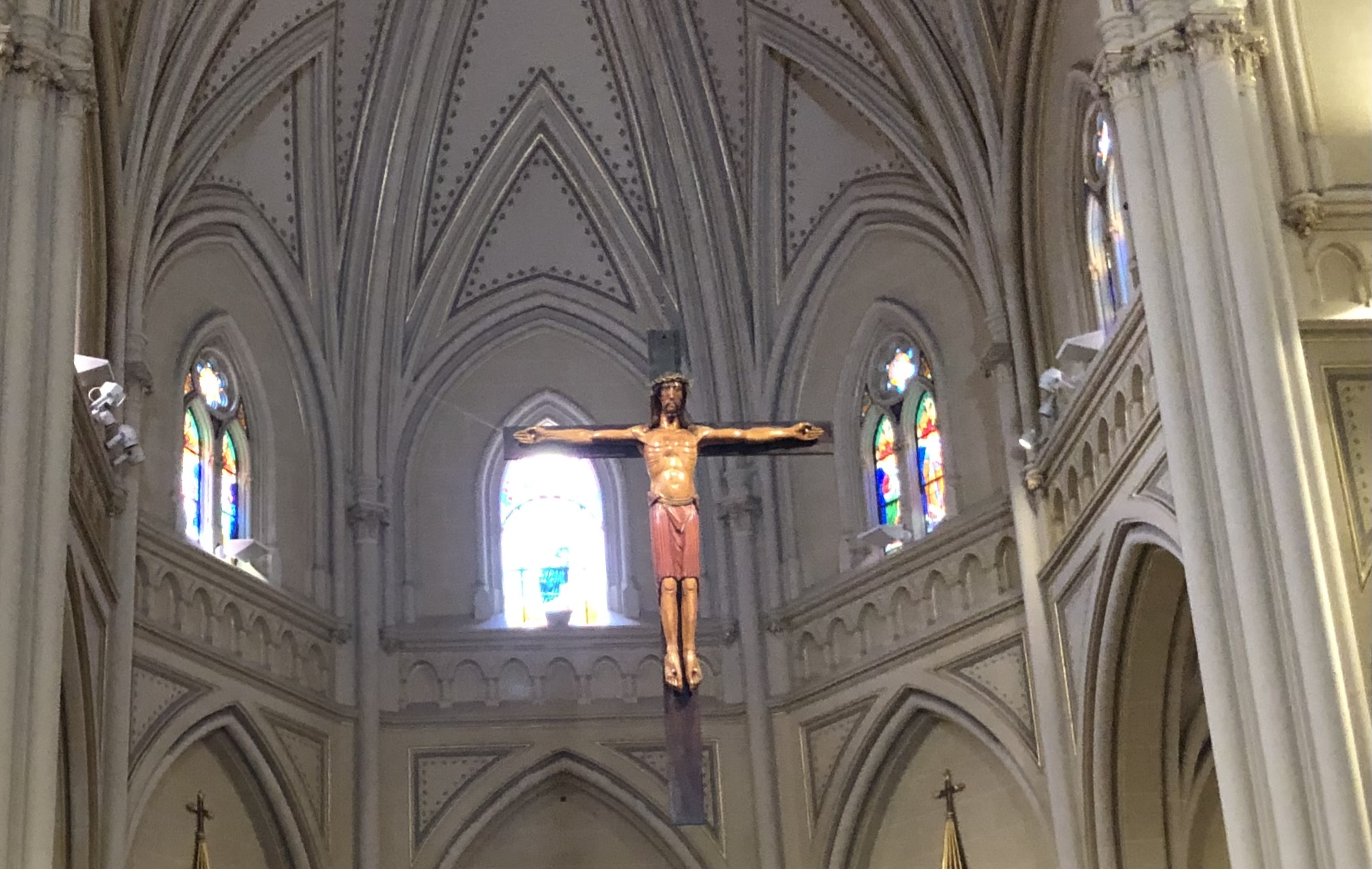
Catehdral de San Isidore in Argentina

I recall the historic theories of the atonement.  Jesus’s death is portrayed as Ransom, Substitute (suffers for), Penal (suffers instead), Example, and Victor. Each theory today is understood in decidedly individualistic ways.  It is a quid pro quo formula as in Jesus did this and I get some reward. Such theology appears deeply embedded in St. Paul’s perspective (I Corinthians 15 or II Corinthians 5).  

It was my beloved New Testament professor, Robert Lyon, who challenged me to think beyond this; to think more deeply and widely.  The word study he assigned me was on the word λύτρον, meaning either redemption or ransom (Mark 10:45 and Matthew 20:28).  I can still see the twinkle in Bob’s eye as he said, “And the context? Who is this ransom for and why?  What is the larger Biblical frame?”  These were the years of the Vietnam War and Civil Rights struggles over racism and sexism.  Bob wasn’t dismissing classic atonement theories out of hand; he was asking for more – for a deeper grasp of the whole of the scriptural story.  What does “ransom” have to do with justice?  What if this is bigger than an individualistic transactional act? What if it is transformational for the entirety of God’s purposes?  What if it is not primarily about one’s personal “free of sin” credit card?  What if it is for ALL and for the entire Creation!

Walter Brueggemann suggests we speak of the execution of Jesus rather than his crucifixion. ALL THINGS are seen as potentially redeemed and redeemable: corrupt institutions, the violence of every empire, the despoiling of creation.  Brueggeman speaks of God’s purposes as displayed in the life of Jesus as prophetic imagination.  He speaks of “the alternative world that God has promised, and that God is birthing before our very eyes.

For me, even with food stains on my shirt, the questions in my spirit find greater meaning. This is the GOOD in Good Friday – God’s promise displayed for all persons and all creation.  If we have eyes to see it and the will to live into it.

Pick-Up Theology

Pick-up Theology

It happened again, recently.  A public gathering, I prayed or presided in some fashion.  A reception follows. All seems “normal” until one of the folks nearby starts to share a story and stops, “Woops, I forget, a preacher is here.” Often, I could anticipate what was going to be said. I have heard the story or off-color joke previously… I do not have “virgin ears”… but, somehow, I represent a purity zone. Clergy are thought to reside in the “Area 51” of polite conversation.

At times it is even worse. I am cornered as “an expert?” Some long-stored-up theological questions are brought forward. Many are just silly.  Some would require a semester course in seminary, or perhaps the completion of a dissertation. Many are qustions that require attention throughout a lifetime. Some questions are asked as a “gotcha.” They are meant to make the preacher squirm.

Often, it begins with the words, “Pastor, I am not very religious, but I am spiritual and am troubled by some things; can you help me understand?”  Here are a few I have encountered:

  • “What kind of fish swallowed Jonah?”
  • “Did Jesus really walk on water, or did he know where the rocks were?”
  • “If Jesus was alone when tempted in the desert, who knew to write about it?”
  • “Do you believe in Hell?”
  • “Do dogs go to heaven?”
  • “Did Adam and Eve have belly buttons?”
  • “In the Prodigal Son story, doesn’t the older brother get a bad rap? What did he do wrong?”
  • “Is everyone forgiven no matter what they do?
  • “Where did Cain find a wife? Isn’t marrying a sister incest?”
  • “Wasn’t Catholicism invented in 1054 so political leaders could break with the Eastern Church?”
  • “Does U.S. House of Representatives Speaker, Mike Johnson, have a Biblical Worldview?”
  • “Don’t you think Pope Francis is a Socialist?

Only a sample of the queries are here, some serious and knowledgeable, others an effort to be cute, too many with monistic (either/or) assumptions that miss the discovery and value of paradoxes within the theological task. (e.g., “If one would be master he/she must first be servant.”) I have learned the value of the rabbinic method of answering a question with a question.  This is not the time for an overview of differing Biblical texts and literary scriptural devices. Much as I would like, there is little time to teach about the call to live in terms of the realm of God. (And there is certainly not time to speak of my preference for Kindom of God rather than Kingdom.) Often personal faith-journeys, current events or some family disputes are at the core of the seriously asked questions. 

I find it a little like the “pick-up” basketball games played while growing up in Indiana. You call your own fouls and get to choose your team mates. The game unfolds “on the spot” but there are certain moves and shots that need to be tested against the other players. Could I make that hook shot now? Could I guard that more experienced player this time?

If possible, when these “questions for the pastor” spontaneous moments come my way, I invite folks to do their own study, later, and suggest a book or two to read. Then, I look for JOY. Is there a way to find in this moment the wide and wonder-filled sense of holiness carried within a smile or even a light chuckle?  Perhaps thereby, faith is made more durable, understood with a richer complexity, and invitationally rather than a collecting up the right set of answers.  So, when recently asked “Did Adam and Eve have a belly button?” I paused for a moment and said, “O yes, I think so, and I am certain God continues to have stretch marks from such births.” I was rewarded with a smile.

I am told that Thomas Langford, the former Duke Divinity School Dean, enjoyed driving a red pick-up truck around Durham and especially on the university campus.  The license plate on the truck read “JOY N IT.”  Folks who didn’t know Tom, might have mistakenly thought he was expressing his joy in driving that pickup.  Others knew better.  He was perhaps speaking of the joy of the truck, but I suspect he was also talking about the joy of a life of faith, of living and leaning forward into the questions, of imagining the joy of a life of gospel relevance… filled with gratitude and delight.

The poet John Keats wrote “Call the world, if you please, the Vale of Soul-making.”  This task of “Soul-making” involves asking good questions and establishing habits of the heart. Habits of study, meditation, observation and being open to new imaginative insights, and yes, humor.  It is the keeping of these patterns, until these patterns keep us. 

So, I look forward to the next set of “questions for the pastor.”  Maybe I can do better next time.  Until then, I will remember the words from correspondence that is included in the Bible, James 1:2-5: My brothers and sisters, whenever you face trials of any kind, consider it nothing but joy, because you know that the testing of your faith produces endurance; and let endurance have its full effect, so that you may be mature and complete, lacking in nothing. If any of you is lacking in wisdom, ask God, who gives to all generously and ungrudgingly, and it will be given you. (NRSV).

Christmas Emptiness

Christmas Emptiness

Emptiness. Manger Square, Bethlehem, December 23, 2023, is abandoned.  Most years, every square meter of the space would be filled, maneuvering among the crowd, difficult. Christian Palestinians in Bethlehem, in solidarity with those in Gaza, have canceled Christmas. The Lutheran pastor says, “if Jesus were born today, it would be under the rubble of Gaza.”  And nearby, among Israelis, the horror and grief of October 6 when families were ripped apart, children murdered, women raped, and hostages taken, and who even now are being tortured persists and widens.

Israelis and Palestinians deserve better. Still, decades long pent-up anger and distrust has erupted in an unimagined violence. Slow boiling political chicanery, terrorism, and bigotries mostly built on lies and prejudices now rob the people on all sides of options. Emptiness. No room left for rational thought or basic humanity.

No room left for recognition of another as a human being. Robbed by millions of deceits, papercuts on the soul, there is no space for mutuality, companionship, or love. The prefrontal cortex is severed from the reptilian parts of the brain. A single option appears the only one — revenge, revenge, revenge.  Empty of alternatives, life on all sides is reduced to terror. 

For those of us, observers with broken hearts and conflicted loves, there is another kind of emptiness. Those who know, respect, and love both Jews and Palestinians, live in a wasteland of uninhabited hope. Our carefully crafted dreams and visions for humanity are shattered. And what of our own bigotries and behaviors? What of the ways we discount and exclude those we fear? What of our treatment of those without shelter, who struggle with addictions or who come to us as immigrant?

We suffer with a similar, yet a differing void.  For so many Christians, the mangers of our souls will seem vacant, emptied places this Christmas.

The Wilderness of Bullies and Victims

The Wilderness of Bullies and Victims

Whether national politics or elementary school, we observe bullies and victims. It is not a new phenomenon.  Seventy years ago, at West Spring Street School in New Albany, Indiana – I saw it – and felt it – on the playground. This ancient human reality goes all the way back to Cain and Abel, Joseph and his brothers, King David and Uriah, Pharoah and the Israelites, or King Herod or his wife murdering John the Baptizer.  Bullies and victims are forged deeply into our emotional and moral foundations.

Literature is built on the anti-hero, victim, and hero motiff.  It is a delicious formula that fits well in literature, movies, and television series.  Still, this easy pattern is missing something critical and complex.  It is the place of responsibility. It is the paradox of the cross. As H. Richard Niebuhr noted in his classic “The Responsible Self” (1963) ethical behavior requires sorting through the ambiguity and distortions of real life.  Ethical behavior requires attention to a universal community and honest observation of the best intentions and failures brought by each and every actor.

A victim can often turn into the bully; the research is clear.  The story of the man bullied at work who comes home to kick the dog is a familiar one. Most adult abusers were abused as children. Limiting our frame to either bully or victim is a gestalt that has gained a wide purchase in our society. It is the core “stuff” of the MAGA movement. It plays out in the courtroom, city halls and, even in the church. Politicians market in meanness. Tough talk and threats are confused as “strong leadership.”  On the other side many can only see themselves as victim. So much of our social service efforts and congregational life assumes a primary task to rescue the victim from the bully – and, of course, we are to be cast as heroes rescuing the victim.

In the wake of the trial of United Methodist Bishop Minerva Carcaño there are persons on each side suggesting they have been victimized – and “the other” was a bully.  What’s missing? I would argue it is responsibility to the larger community. Was it a struggle over power, gender, culture, money?  Perhaps all of these, yes. How did we arrive at the point when good folks on each side are to be sorted into the “bully/victim” divide?  Perhaps one party was unwilling to seek a responsible remedy before going to trial. Perhaps both parties were unwilling.  But here we are… still living in the bully/victim wilderness.

There are many ways forward.  (Many will point to Matthew 18 counsel on how handle a dispute. It is a good place to begin.)  However, I will start by borrowing from Robert Greenleaf’s notion of Servant Leadership.  He writes of a servant leader’s responsibility in this way: “The best test, and difficult to administer, is: do those served grow as persons; do they, while being served, become healthier, wiser, freer, more autonomous, more likely themselves to become servants?  And, what is the effect on the least privileged in society; will he or she benefit, or at least, will he or she not be further deprived?” (The Servant Leader, p. 7)

Might it be that while dollars, publicity, trust and energy were put into a drama of victimhood or bullying, the opportunity to act on the behalf of the least privileged among us has been lost?

The Transformed NonConformist (#4)

The Transformed NonConformist

In November 1954, Dr. Martin Luther King Jr. preached his inaugural sermon at Dexter Avenue Baptist Church in Montgomery, Alabama. In retrospect, it was his future ministry’s thesis statement[i].  His text?  Romans 12:2: “Do not be conformed to this world, but be transformed by the renewing of your minds, so that you may discern what is the will of God—what is good and acceptable and perfect” (NRSV). The sermon was titled “The Transformed Nonconformist.” He was proposing that Christians sometimes needed to act in ways that didn’t always “go along to get along.” Civil, nonviolent nonconformity, was a preferred option when democratic institutions failed, and discrimination continued unabated.[ii]

There were scores of other faith leaders, expressing such a witness, prior to and alongside of, Dr. King.  The church had a rich history of persons acting as Transformed Nonconformists.[iii]  Urban Training Centers were active across the nation in the mid-1960s, most notably in Chicago, Detroit, and Cleveland. There were many models unfolding ranging from the East Harlem Protestant Parish in New York to Church of the Savior in Washington D.C., to Operation Push in Chicago. In Boston, Cleveland, Nashville, Atlanta, and Los Angeles such efforts were institutionalized and often funded by mainline denominations.  In the rural south there was the witness of the Koinonia Farm in Georgia and Voice of Calvary in Mississippi.[iv]

In Indiana the Rev. Luther Hicks in Indianapolis founded Dignity Unlimited. Hicks, a pastor, also set up work with youth in a storefront outreach effort near Shortridge High School at 34th and Meridian. Hicks was arrested on several occasions for leading nonviolent protests over racial injustices. Urban legend has it that the “Methodist” bishop would call the “Methodist” mayor to intervene.  Hicks’ crime?  Seeking to de-escalate possible violence and “promoting patience and reason.”[v]

In earlier decades, Gary (Indiana) Central Methodist Church championed racial justice efforts as the Reverend S. Walton Cole encouraged members to confront their own prejudices, welcome new members from diverse backgrounds and march in demonstrations for equal pay and education. At Trinity Church in Muncie, Indiana, Rev. J. C. Williams’ activities in Civil Rights struggles lead to his candidacy for Mayor of Muncie as “Poor People’s Party Candidate”[vi]

Back to Evansville, and to the topic the closing of desegregation and the closing of inner-city schools, the counsel “You cannot fight city hall” was heard, and it was reframed to a need the importance of speaking directly to school administrators.[vii]  In the process, changes did come.  Culver School was not closed, and a new building was constructed. Elaine Amerson was elected to the county-wide school board where she served for eight years, three of them as board president. Resources that had been heavily directed to suburban schools were shared more equally across the school system. And, yes, county-wide busing did occur, while at the same time several “naturally racially integrated” schools continued to serve a neighborhood.

Despite the range of these efforts, little research, or documentation of the import of such faith-initiated efforts at transformation has been produced. Dr. King’s legacy endures. It has been revived by persons like the Rev. William Barber II. Taking a longer view, while significant advances have occurred, perhaps a deeper and wider story has gone untold.[viii]  There has been little reporting on the breadth of the many faith-based activities.[ix]  

Denominations have turned inward. The slow and critical work of building up neighborhood parishes appears pushed to the sidelines. Examples of genuinely interracial and multicultural congregational life are little-known or valued only at the margins in Mainline Christianity. The death of Dr. King in 1968 dealt a severe blow to the call made to the church in his “Letter from Birmingham Jail.”  The time of Non-conforming Transformationalism abated but it has not disappeared.

In the wider culture, since Dr. King’s death, change has come fast and hard, resulting in questions as to the relevance of the church and much handwringing among church leaders. A decline in attendance began in the late 1960s. Baby Boomers emerged as a new and different demographic. At colleges and congregations on university campuses interest in church attendance declined dramatically at the end of the 1960s. Many campus pastors and priests point to 1967, or thereabouts, as a critical juncture when students who had once filled the pews began to disappear in large numbers from worship. Meanwhile, in urban neighborhoods, those expanded church facilities that had been built in the decades following WWII for all the children, were emptying out.

The Vietnam War, the birth control pill, and the weak response by churches to support the civil rights exposed how insular, self-absorbed, and out of touch religious institutions were in the culture.  Going along and Getting Along had taken a toll. We were said to be entering “a post-denominational era.” The call of Dr. King and the work of scores of faith-based initiatives designed to engage the church in seeking transformation in society was seen more as an artifact than a calling. 

For denominations these realities accelerated the anxious casting about for ways to find or retain relevance. There was a willingness to try many things to stop the growing loss of membership. Ironically, efforts to value and benefit by affirming a core denominational identity and neighborhood parish locations was typically missed or overlooked. The megachurch movement was off and running.  It has served as a central hoped-for-solution among denominational bodies.[x]  Now, in hindsight, it appears exclusive focus on a megachurch model was destined to be insufficient to the changes that continue.

Less attention was given to taking seriously the need for in-depth lay theological education.  Popular narrow cultural ideologies, “seeker-friendly” worship that avoided symbols of sacrifice like a cross, along with contemporary music, mixed with safe political perspectives were the tail that wagged the theological dogs of this era.  As church historian Martin E. Marty put it: “To give the whole store away to match what this year’s market says the unchurched want is to have the people who know least about the faith determine most about its expression.”[xi]

Especially notable, in the 1980s through the 2010s, were the more agile, drive in, folk-based religious mega-church expressions.  Willow Creek Community Church in the Chicago suburbs or Mars Hill Bible Church in Michigan are often-cited examples. These “independent community church” expressions are now in second or third generations of leadership and appear to be going through their own identity crises — and decline. The recent exclusion of Saddle Back Church from the Southern Baptist Convention is worth considering as persons consider what the future of the megachurch will be. 

The story of the megachurch in United Methodism is more complex.  At places like the Church of the Resurrection in Kansas, St. Andrew UMC in Colorado, or Ginghamsburg UMC in Ohio, there have been deliberate efforts to encourage thoughtful theological discourse and support for nearby neighborhood parishes. Typically, however, these types of megachurch congregations are the exceptions among the large church expressions.

Anxiety was the driver. There was a widely held belief, a self-fulfilling prophecy in fact, that we had entered a post-denominational era.  This anxiety was a symptom of what might be diagnosed as“Church Growth fever.” Such fear-based views and flight to “safe places” continues. There have been few efforts to stop to consider what gifts may already be present in smaller and more local parish settings. Megachurch models were advocated that were too often independent from a denomination’s core identity.[xii]

The response over the past four decades has only reinforced the self-focus and self-concern in many settings. Denominations and philanthropic entities focused attention on leadership training and congregational development. These efforts, while not bad in and of themselves, turn attention toward inwardly directed programs. They also, inadvertently perhaps, set up a system where pastoral performance is measured against the “successes” of the booming megachurch in the suburbs.  Looking inward, it was the pastor or the congregation that needed to change to be “more valued.”  One might say the time of Non-transformational Conformity had arrived.

Sadly, in many places, the value of neighborhood congregations was lost; the importance churches as a local center of informal gathering and values-production among residents living nearby was sacrificed. Starbucks, neighborhood eateries and bars now filled the civic void left behind in urban neighborhoods.

BUT WAIT, THERE IS MORE! 

In many urban neighborhoods, congregations have survived, even prospered. They have persisted despite often being undervalued and overlooked.[xiii]  While thousands of neighborhood congregations have disappeared, thousands of others are being transformed. Not all continue as worshipping communities only, or primarily. It is often not the church as known it in the past. Some places are more traditional but in almost all, there is a willingness to be Nonconforming Transformationalists.

There is a remarkable phenomenon, for example, of church buildings being transformed into low-income residences.[xiv] In other places congregations are building tiny houses on church property and are forming communities of care where church members build fellowship with persons finding health and spiritual care for chronic difficulties. There are at the same time new models of faith life bubbling up that don’t require a building, as in coffee shop Bible studies and parenting fellowship groups. There are new forms of believers assembling to “be transformed together” working on immigration reform or providing shelter or health care for low wealth persons that have begun and are beginning.  These are signs of hope and joy and celebration. They are places where diversity is celebrated, where multicultural expressions are honored, and where everyone, no matter race or sexual preference, is welcome.

COMING NEXT: Parish-based Renewal and Seeing Christ in the Neighbor and Neighborhood.


[i] McCullough, Marcus, “Go Along to Get Along,” The Graduate Journal of Harvard Divinity School, 2023.

[ii] Passages from Romans chapters 12-15 have been cited to undergird both conformity and nonconformity with government practices across the centuries. In Romans 13:1ff, Paul seems to argue that Christians should simply submit to civil authority. However, King and others suggested Romans 12 set the terms for any such submission. When faced with evil institutions, conformity is predicated on the ever continuing the call for transformation? Discrimination, Jim Crow laws, lynching, unequal economic, societal, employment and education systems could and should be transformed.

[iii] Too often forgotten or overlooked were the many others who were part of Urban Training Centers shaping urban ministry around the country.  Gibson Winter’s book The Suburban Captivity of the Churches helped set the stage as did his work with the Urban Training Center in Chicago. There were the folks like Clarence and Florence Jordan at Koinonia Farm and Gordon and Mary Cosby at Church of the Savior in Washington D.C.  There was the ministry of Father Jack Egan for the Chicago Catholic Diocese and Vincent Harding with the Mennonite communities in Chicago and Atlanta. Folks like Don Benedict, Archie Hargraves, Bill Webber, and Letty Russell at the East Harlem Protestant Parish New York.

[iv] I mention these few, of many, because much of this history has been overlooked.  Dr. King’s work, and that of the Southern Christian Leadership Conference, was essential to the changes brought about by the civil rights struggle. At the same time there were dozens of localized ways people of faith were engaged in taking their faith to the streets.

[v] https://www.connerprairie.org/black-history-month/

[vi] https://digital.library.in.gov/Record/BSU_othermiddle-105

[vii] We heard my supervisor’s admonition that one “can’t fight city hall” as a call “not to turn city leaders into the enemy.”  This led to many lunches with school administrators and city officials.  Some of the best allies in seeking more equity in public education came from teachers and administrators within the school system. 

[viii] Examples come in many dimensions: In housing (Habitat for Humanity grew out of the witness of Koinonia Farm with Millard Fuller and Clarence Jordan in Georgia), with economic structures (e.g., Rev. Faith Fowler at Cass Community in Detroit provides a model, as does John Perkins with Christian Community Development Associations, or incubator businesses out of several congregations), and resources linking spirituality and social action continue (e.g., Fr. Richard Rohr’s at the Center for Action and Contemplation and Rev. Jim Wallis’ leadership at the Sojourners in Washington, D.C.).

[ix] Research waits to be done. In the early 1970s, for example, Project Understanding looked at the efficacy of programs designed to bring racial change through religious congregations – little has followed.

[x] Dr. Scott Thuma at Hartford Seminary has done considerable research on the rise (and decline) of the megachurch phenomena. See: mhttp://hirr.hartsem.edu/megachurch/research.html.

[xi] Marty, Martin E., Goodreads, https://www.goodreads.com/quotes/7201126-to-give-the-whole-store-away-to-match-what-this.

[xii] It is not surprising that many of the same folks who pushed a singular focus on tinkering with the patterns of congregational life warned we were entering “a post-denominational era.” From “Keys to Growth” and the “Habits of Successful Congregations” the remedies proposed included more parking, new member campaigns, management by objectives, leadership training, changing music or moving the location of the congregation to a “better place.”  Long established denominational connections or linkages with other institutions in a community were not highlighted. Mostly, the unspoken assumption was that larger congregations of like-minded people were the answer.  Seldom was there a focus on the parish surrounding the church – and when there was such a focus, the parish was seen as a place of scarcity, even danger. A place needing outside help rather than a resource for congregational vitality.

[xiii] Some researchers speak of these examples of heath where there is perceived poverty and decline as “positive deviance.”  I choose to see it as the work of the Holy Spirit.

[xiv] A remarkable initiative is being carried out by the United Methodist Foundation in the New England Annual Conference where “redundant” church buildings are being evaluated as places for potential residences or for new ministry/mission sites.

Going Along and Getting Along #3

Going Along and Getting Along

You can’t fight city hall.” my friend said. After I shared efforts to keep several inner-city schools open, he gave this response.  My children attended one school on the docket to be closed – Culver Elementary, in Evansville, Indiana. It was the late 1970s. The Federal Court desegregation orders were being enforced.  School busing was underway across the nation. In places like South Boston, there was angry, even violent, resistance.  In Evansville folks were uneasy.  My friend was also my supervisor.[i]  His counsel was appreciated, well-intentioned. In fact, it was considered “progressive” as a support for desegregation efforts.

Public schools in the city were to “adjust” and “comply.” Our children’s school was naturally racially integrated. Along with others, all children could walk to school from home.  No school bus needed, thank you. There was a natural racial mix. School desegregation orders, although imperfect, were a response to the prevailing patterns of separation and providing unequal resources based on race. The evil of systemic racism has plagued our nation from its founding, shaping the ecology of our cities. In the wake of this, white flight left thousands of formerly predominantly white urban congregations struggling to survive.[ii]

How to best respond to the effort to “desegregate” schools in my community?  On the one hand, my children already attended a racially integrated school; on the other, there were deep systemic problems in cities across the land. In many places – no, in most places – the church lived by the notion “you can’t fight city hall.” It might be called a Go Along and Get Along theology.  In earlier posts, I noted the multiplicity of ways congregational life was reshaped, distorted really, by racist activities, after WWII.  Housing, transportation, education, and economics were woven together on a loom shaped by deeply racist social designs.

THAT WAS THEN. Alternative voices were also emerging. The Rev. Dr. Martin Luther King Jr. represented the best known of such an alternative vision.

In upcoming posts we will look at Dr. King’s prescription for change and how mainline denominations responded. We will also suggest some ideas for a more hopefilled furture. Perhaps Christendom as it has existed in recent generations in the United States is passing — and, perhaps, there are ways Christianity will flower in surprising new manifestations.

Next: Dr. M.L. King’s Nonconforming Transformationalism.


[i] Clergy supervisors in the Methodist tradition are known as district superintendents and bishops. My district superintendent was a good man and the urban ministry work we were doing at Patchwork Ministries in Evansville was made possible through his connectional support.  This support was not primarily money; mostly it was permission for a group of young idealistic pastors to attempt something different in terms of urban ministry.

[ii] Tragically the current US Supreme Court is attacking legislation intended to secure voting rights, affirmative action and equal justice that accompanied these desegregation efforts.