Where the Light Enters

apollo8.jpg

Where the Light Enters

Philip A. Amerson                                              Isaiah 9:2-7; Luke 2:15-20

December 24, 2018                                             Christmas Eve 8:00 and 10:45 PM  

Welcome:

Beloved in Christ – we gather again on this evening to tell of the loving purposes of God and the glorious redemption possible for the world through Jesus Christ.  We gather to affirm our commitment to peace and good will across the earth, within and among our various denominations and faith traditions and within this great city and nation.   We remember those at the margins tonight: the poor, helpless, sick, cold, depressed, lonely and unloved; and those who know not God.  Before God, we join all who tonight celebrate the word made flesh – who through the Lord Jesus has shown us the way of peace and has called us to be one family.

Sermon: Where the Light Enters

Introduction:

Ring the bells that still can ring,

Forget your perfect offering.

There is a crack in everything.

That’s how the light gets in.

(From Anthem by Leonard Cohen.  See also The Soul’s Journey, Alan Jones, p. 219)

Prayer: O Christ of Christmas, lite our way that we may see your pathways of hope.  Amen.

At 7:00 AM this morning, Elaine and I listened to the broadcast on BBC of Lessons and Carols from King’s College Cambridge.  You might say it is our annual nostalgia bath… when revel to hear remarkable choirs and the retelling of the story of Jesus’ birth. As I listened, I couldn’t help wondering what does this story call upon me to do differently in the year to come? 

This evening you heard our own Bradley Ladrido singing the first verse – Once in royal David’s city, Wasn’t it lovely?  And what about you?  Are you called to anything different in the year stretching before you?

My guess is that some of you have come to one of the Christmas Eve services in this place for years, right?  Perhaps decades?   Or, perhaps this is the first time you have come to this place on the night before Christmas.  Whichever it is, WELCOME.  We receive anew the light of Christ, a light we so often fail to see.  What does this call upon us to do?

Dorothy Day said: “It is no use saying that we are born two thousand years too late to give room to Christ. Nor will those who live to the end of the world have been born too late.  Christ is always with us, always asking for room in our hearts.” (Day, Dorothy, “Room for Christ” in Watch for the Light, Walden Publishing, New York, p. 176.)

2018 is a year of anniversaries:

  • Lessons and Carols from King’s College celebrate its 100th anniversary today.
  • It was 200 years ago Silent Night (Stille Nacht) was first sung in the St. Nicolas Church in Oberndorf Austria.
  • Our congregation FUMC is on the eve of celebrating our 150th anniversary in San Diego—next year is the year.
  • But there is one other anniversary we mark. [Show Slide of “Earthrise”].  

Fifty years ago, on Christmas Eve, William Anders, James Lovell and Frank Borman, the crew of Apollo 8, were orbiting the moon.  The first humans to do this, they broke into the evening news. Anders began: “We are now approaching lunar sunrise, and for all the people back on Earth, the crew of Apollo 8 has a message that we would like to send.”  And he began to read: In the beginning God created the heaven and the earth… And God said, Let there be light: and there was lightLovell and Borman continued the reading ending with “and God saw that it was good.”  The Frank Borman closed: “And from the crew of Apollo 8… good night, good luck, a Merry Christmas – and God bless all of you, all of you on the good Earth.”  [Woods, David; O’Brien, Frank (December 27, 2008). Day 4: Lunar Orbits 7,8,and 9”. The Apollo 8 Flight Journal. NASA History Division.]

apollo8Later the crew sent a photo back to earth.  It was unscheduled, unplanned.  Yet, when they saw it, they knew it needed to be shared.  This iconic image, called earth rise, shows the glory and fragility of our planet.  The blue marble brims with life – a dot of beauty against darkness all around.

What does Christmas Eve mean to you in 2018?  What new traditions might you begin this year?  What questions emerge about our care for God’s creation, about how we can learn to live together on this precious galactic real estate?  How will we answer the ancient questions like: who is my neighbor?  [END SLIDE]

Some of us bring a brokenness of body or spirit tonight, some of us are ready to spread our blankets by the pools of narcissism so prevalent in our society, some of us bring doubt, some come with renewed hope and join the poet John Keats in saying: “There is a budding morrow in every midnight.”

Whatever your state of belief or attitude, you are welcome here – it is a time to begin again.  Time to recommit to following the one who first entered our world as an infant in Bethlehem.  Don’t be afraid – Jim Wallis points out that this is the most frequently spoken command in scriptures.  It appears 365 times – once for every day in the year to come.  How will you change in the year ahead – what new traditions will you begin?  What repentance will you make?  In the comic strip Broom Hilda she asks her friend Irwin about how to make a better world. “Start with yourself! He says… give up your bad habits.  Then… you’ll stand as a shining example to others!”  Broom Hilda thinks and responds, “O.K.  What’s the second best way?”

We all face changes, even as we hold to our traditions.  The world is changing, the church is changing.  My beloved tradition of Lessons and Carols is a part of a European encapsulated expression of the faith.  It is good.  However, the years ahead will require new expressions, new anniversaries, new ways of being church.  The growth of the church with people from the cultures from of Asia, Africa and Latin America.  How will we welcome them and learn from them?                                      

St. John’s Church in Edinburgh Scotland stands near the downtown rail station.  For decades it has been under construction.  On the scaffolding are two signs: One says: “Caution, Under Construction” and on the other are the words: “Business as Usual: Peace and Justice Center.”

We love our traditions – and well we should.  Even so, like us, are always under construction.  We celebrate our anniversaries, even so, the world is changing.  God’s purposes are seeking places where new light will shine through the cracks of what has been already present to illuminate the ongoing work of seeking peace on earth and good will among all.

The people who walked in darkness have seen a great light; those who lived in a land of deep darkness — on them light has shined.  For a child has been born for us, a son given us; authority rests upon his shoulders; and he is named Wonderful Counselor, Mighty God, Everlasting Father, Prince of Peace. (Isaiah 9)

 Amen.  Even so, come Lord Jesus.                         God Bless Us, Every One!

++++++++++++++

Howard Thurman:

I Will Light Candles This Christmas
Candles of joy despite all sadness,
Candles of hope where despair keeps watch,
Candles of courage for fears ever present,
Candles of peace for tempest-tossed days,
Candles of grace to ease heavy burdens,
Candles of love to inspire all my living,
Candles that will burn all the year long.

Isaiah 9:2-7 (NRSV)
9:2 The people who walked in darkness have seen a great light; those who lived in a land of deep darkness on them light has shined.  9:3 You have multiplied the nation, you have increased its joy; they rejoice before you as with joy at the harvest, as people exult when dividing plunder.  9:4 For the yoke of their burden, and the bar across their shoulders, the rod of their oppressor, you have broken as on the day of Midian. 9:5 For all the boots of the tramping warriors and all the garments rolled in blood shall be burned as fuel for the fire.  9:6 For a child has been born for us, a son given to us; authority rests upon his shoulders; and he is named Wonderful Counselor, Mighty God, Everlasting Father, Prince of Peace. 9:7 His authority shall grow continually, and there shall be endless peace for the throne of David and his kingdom. He will establish and uphold it with justice and with righteousness from this time onward and forevermore. The zeal of the LORD of hosts will do this.

All in the Family

All in the Family:

[A sermon for the fourth Sunday of Advent, 2018]

Philip A Amerson                                                                               December 23, 2018

Fourth Sunday of Advent                                                                 Micah 5:1-5b, Luke 1:39-49

First United Methodist Church                                                        San Diego, California

Poem: On the Mystery of the Incarnation by Denise Levertov

It’s when we face for a moment
the worst our kind can do, and shudder to know
the taint in our own selves, that awe
cracks the mind’s shell and enters the heart:
not to a flower, not to a dolphin,
to no innocent form
but to this creature vainly sure
it and no other is god-like, God
(out of compassion for our ugly
failure to evolve) entrusts,
as guest, as brother,
the Word.

Prayer: May the words of my mouth and the meditation of all of our hearts be acceptable in thy sight, O God, our strength and our redeemer.  Amen.

Introduction:

Genesis 4:9: הֲשֹׁמֵר אָחׅי אָנׄכִי   (English pronunciation: ha•sho•mer a•csi a•no•csi?)

This is a most ancient and challenging question for all humankind.  It is recorded in Genesis the 4th chapter, 9th verse.  ha•sho•mer a•csi a•no•csi?

My pronunciation, no doubt, has bruised the Hebrew.  I hope I have done no permanent damage!  It is a question that waits for our answer.  This Advent, in this nation, in our world, in San Diego, here is our question, “Am I my brother’s keeper?” When asked the whereabouts of his brother Abel, Cain hurls the words back into God’s face.

In counterpoise, in Luke’s Gospel, we have the exchange between two women – Mary and Elizabeth.  Each is pregnant with the answer.  Each is carrying God’s incarnational response to Cain.  They are carrying an answer to the sinful, endemic, selfish proclivities in our human condition.

Mary and Elizabeth are kinfolk – two women, one older, the respectable wife of the priest.  The other, her cousin is a young, unmarried girl from the back waters of Galilee. Neither Mary or Elizabeth fit my picture the way I would tell the Christmas story.  In the face of social disapproval, they sing beautiful songs.

Walt Wangarin writes of this story:  “Mary, when she heard the news, ran south to a particular province named Judea, to a particular hill and on that hill, to one particular house and particular woman in that house to her friend, her cousin, Elizabeth.  “Elizabeth, hello.”  Just as the angel had greeted Mary, Mary greeted Elizabeth and Elizabeth began immediately to laugh. 

And just as the angel had sung a celestial song for her, Mary sang a song for Elizabeth.  “My soul,” sang Mary. “Oh cousin, my soul does magnify the Lord.  My spirit rejoiceth in God my Saviour.  He is keeping his promise to us.  Elizabeth, I’m going to have a baby!” 

So then, in the middle of a gloomy world there were two women, (singing and) laughing.  They laughed until they couldn’t laugh anymore and then they began to weep for gladness and God looked down from heaven and saw them and God laughed.  (From Wangerin, Walter, The Manger is Empty.)

Biblical Scholar Raymond Brown points out the birth narratives in Luke’s Gospel contain three of the most famous hymns of Christianity beginning with Mary’s Magnificat  – “My soul magnifies the Lord and my spirit rejoices.”  Then, the Nunc Dimitis, the hymn Simeon, Elizabeth’s husband sings and then the hymn of the angels — Gloria, in Excelsis Deo.  In fact, the entire gospel of Luke continues, full of ballads – told and sung.

I encourage you to read Mary’s song in the first chapter of Luke, this Christmas.  She sings of a world turned upside down – where the human family is rewoven into a kinship network where the lowly are lifted up and the hungry are filled with good things.  Mary’s song arises from the Biblical call for a time of Jubilee.  Her song is a little introduction to the Beatitudes, the blessings, her son would teach in a few years. Here is our introduction to Christmas – Cain’s question is answered by with the joy and prophecy of Elizabeth and Mary.

We have heard Bob Wilson’s experience this morning. The surprising realization that when one seeks to bless the stranger – it is the giver who is also blessed. I have known others, like Bob.  There are many in this church, do you know the story of Gary and Myrna Cox and their befriending a homeless man?  It’s told in a little book Gary wrote.

Or, I could tell you of Alberta Dink the violin teacher in her late seventies who decided to teach violin to inner city children.  At her funeral a dozen years later over 60 children stood in the chancel of her church and played in her honor – one of those young man was by then in the Detroit Symphony Orchestra.  Or, there was Francis Neighbors who lived on a modest income but saw that every child in her congregation received a birthday card each year with a few dollars tucked in to help celebrate.

Christmas is a time for rethinking what we mean by family.  There was a little-known phenomenon in many communities in this nation of parents who lost a son on active duty in Vietnam.  I knew such a family.  Their son was always bringing someone home for dinner.  These parents decided the best way to honor him after his death was to frequently welcome a stranger to their table.

Let me close with a recent story of women: Tanuel Major and Grace Imathiu.  The Rev. Grace Imathiu is the pastor of our sister congregation in Evanston, Illinois.  On November 19th she received word that a woman, simply identified as “homeless,” was found bludgeoned to death on the church’s doorstep, the outside alcove.  Can you imagine?  What would we do?

Tanuel Major, 49 years old, had bedded down for the night next to the doorway when she was murdered.  The shocked congregation sought to find their way after this tragedy.  Pastor Grace, one of the fine preachers in Methodism, was born in Kenya and now pastor of this historic church faced the question, What to do?  Unsure, she said, “Violence crossed the line and showed up in church.”  “We are here because Tanuel Major was homeless… We are here because homelessness is an affront to human dignity… an affront to God… We are here because Tanuel’s story has been woven into our story. We are here because stories wake us up and give us clarity.”  She was asking how to join in the song of Mary in this situation?

The congregation organized a memorial service and other actions.  It wasn’t too late. They sought to “adopt” themselves into Tanuel’s family.  Persons from the congregation – trustees, food ministry, educators and more — were involved.  Tanuel’s sister came from a distance to one worship service.  She spoke, “Tanuel was a person – not a homeless person, she was a person.” Afterward, Pastor Grace asked who would sit with the sister, a visitor, more than twenty people left their normal pew perches and joined her. They placed Tanuel’s ashes in the church’s columbarium.  Imathiu said. “What does this say about God and what does this say about us who are disciples of Jesus? We’re taking it from a very different perspective. This is challenging us to … open our doors even wider, and to be even more connected and involved with the community of people that are either homeless or face violence.”  (Sources: Jonah Meadows, Patch, 11/20/18 and Kristina Karisch, The Daily Northwestern, 11/25/18)

This is a season when we consider who is in our family, and who is left out – this is a time when folks travel for miles to be with those they love.  The middle class and upper middle-class folks in Evanston discovered they had been overlooking family members.  These were family members God’s son Jesus was always welcoming to his table.

How far from our front door are unseen members of our family?  Well, it’s 590 miles from San Diego to Paradise, California.  It’s 2,084 miles from San Diego to Evanston and it’s 17 miles to Tijuana.  And, there are some, we call the “homeless,” who live up the hill, a few hundred yards above us.  Saint Paul’s answer to Cain’s question is summarized in Romans 7:14, “No one lives to himself.”

Who would believe a pregnant teenager about to give birth, out of wedlock, would bring to the world the Messiah?  She heard the word of God and responded – with song and laughter.  She gave birth to Jesus, the rebuilder of the human family.

Rachel Farbiarz is an artist, attorney and scholar of Hebrew scriptures. In a commentary on Genesis 4:9.  She writes: “The ‘neighbors’ for whom you must care are not only the people around you, but the entirety of this large, unruly human family from which you are a lucky, and burdened, descendent. Each member of this family is your ‘brother.’ And none, therefore, are you free to abandon.”…We are simply not at liberty to allow the gulfs created by national, cultural, linguistic, religious, or racial differences to separate us.  Instead, we must step up to this haunting question whenever it is asked and answer resolutely: “I am my brother’s keeper.”  (Becoming Every Brother’s Keeper: All Humanity Descended from One Family, By Rachel Farbiarz, in My Jewish Learning)

AMEN.

+++++++

Micah 5:2-5a
5:2 But you, O Bethlehem of Ephrathah, who are one of the little clans of Judah, from you shall come forth for me one who is to rule in Israel, whose origin is from of old, from ancient days.  5:3 Therefore he shall give them up until the time when she who is in labor has brought forth; then the rest of his kindred shall return to the people of Israel.

5:4 And he shall stand and feed his flock in the strength of the LORD, in the majesty of the name of the LORD his God. And they shall live secure, for now he shall be great to the ends of the earth;  5:5 and he shall be the one of peace.

Luke 1:39-45, (46-55)
1:39 In those days Mary set out and went with haste to a Judean town in the hill country, 1:40 where she entered the house of Zechariah and greeted Elizabeth.  1:41 When Elizabeth heard Mary’s greeting, the child leaped in her womb. And Elizabeth was filled with the Holy Spirit  1:42 and exclaimed with a loud cry, “Blessed are you among women, and blessed is the fruit of your womb.  1:43 And why has this happened to me, that the mother of my Lord comes to me?  1:44 For as soon as I heard the sound of your greeting, the child in my womb leaped for joy. 1:45 And blessed is she who believed that there would be a fulfillment of what was spoken to her by the Lord.”

1:46 And Mary said, “My soul magnifies the Lord,  1:47 and my spirit rejoices in God my Savior, 1:48 for he has looked with favor on the lowliness of his servant. Surely, from now on all generations will call me blessed; 1:49 for the Mighty One has done great things for me, and holy is his name.  1:50 His mercy is for those who fear him from generation to generation. 1:51 He has shown strength with his arm; he has scattered the proud in the thoughts of their hearts. 1:52 He has brought down the powerful from their thrones, and lifted up the lowly; 1:53 he has filled the hungry with good things, and sent the rich away empty. 1:54 He has helped his servant Israel, in remembrance of his mercy, 1:55 according to the promise he made to our ancestors, to Abraham and to his descendants forever.”

pdf copy of All in the Family 12-23-18

Blood Letters — Faith Faces Despotism

Blood Letters — A Witness to the Church

Earlier this year, the book “Blood Letters: The Untold Story of Lin Zhao, A Martyr in Mao’s China” written by Lian Xi was published (New York: Basic Books, 2018).  I commend it to you.  Lin Zhao’s story is that of a young woman who confronted with tyranny, regained a centering point by reexamining and recommitting to her Christian faith.  She moved from being a dedicated member of the Communist Party, then experiencing the tyranny of Mao Zedong, to become a voice against totalitarianism.  Awakened again to her Christian faith she rejected the deceits and brutality around her exhibited by authorities. 

In seeking to find a life of integrity and truth amid the brutality and despotism, this remarkable woman drew on the Christian faith she had learned as a youth when educated in Methodist Schools.  Her faith became the source of hope — and truth.  She wrote letters and essays that circulated among the faithful outside of prison.

blood letters cover

In prison, authorities took away her paper and pens.  Lin Zhao continued to write.  She wrote on torn pieces of bedding, using her own hair and blood from pricked fingers to compose her letters and reflections.  Later, when she was given writing implements again, she often continued to write with her blood.  Lin Zhao was martyred in 1968 for her beliefs.  She is seen as the most famous of the martyrs of this time. Today, thousands in China continue to be inspired by her resistance to evil.

As intolerance, bigotry and suppression of descent rise in our world today, the witness of Lian Zhao becomes especially significant.  As attacks on a free press surge threatening to overtake truth and decency, this singular voice is a gift to us all.

My sermon on November 25th referencing her story — and that of many others.  If you wish, you can read it here: God’sMirrorforChurch 11-25-18.

We give thanks for the courage and witness for all of God’s people, especially for the witness of Lin Zhao.

Mirrors of Truth

Mirrors of Truth

We are arriving at the Reign of Christ Sunday (Christ the King).  It is the conclusion of the seasons known as Kingdomtide and Pentecost.  2018 is one of the unusual years when the Reign of Christ Sunday comes after Thanksgiving.

The scripture lesson is from John’s Gospel, the 18th chapter.  The lesson tells of Jesus’ encounter with Pilate — the Roman Governor who questions Jesus and has yet to be answered verbally for two millenia.   Pilate asks “What is truth?”  Jesus is SILENT —  He just stands there.  He has already given the answer by how he has lived.  Truth is discovered in right relationships rather more than in right answers.

Parker Palmer in To Know As We Are Known writes “In prayer I begin to realize that I not only know but am known.”  Palmer says “Truth is in relationship… “The hallmark of a community of truth is in its claim that reality is a web of communal relationships, and we can know reality only by being in community with it.”

So the sermon tomorrow will focus on the mirrors of truth I have known over the years — those who included me in the conversation toward truth.  [You can find it on the church’s webpage at http://www.fumcsd.org.]  I will be speaking of Olive and Sidney Anderson.  We knew them in Atlanta when in graduate school and teaching at Emory.  They worshiped, as did we, at Trinity UMC in downtown Atlanta.  Here is a part of the story that unfolded slowly as we knew them:  Anderson, Sidney (An Disheng) (1889 ~ 1978) – Methodist Mission Bicentennial.

Their amazing lives – the lives of these two were mirrors into the Reign of Christ which came into view as we were blessed to know folks like these and call them friends.

More recently another has demonstrated what God’s realm is about.  Bob Wilson worships every Sunday at San Diego First UMC.  He sits about six rows back on pulpit side.  His wisdom and good will exudes to those around him.  Recently Bob has made a generous response to the victims of wildfires in Paradise, California.  You can read about it here: Bob Wilson’s Generosity.  [http://enewspaper.sandiegouniontribune.com/infinit/article_share.aspx?guid=68587f94-6283-4340-ae0f-107fc920b4d9.

Folks like Sid and Olive Anderson and the Bob Wilson, each in their own special way, leave behind a legacy that answers the question “What is truth?” They answer through their lives, each in his/her own unique way.

Yeats speaks of the truth of legacy-making through relationships in this poem.

Though leaves are many, the root is one;
Through all the lying days of my youth
I swayed my leaves and flowers in the sun,
Now may I wither into the truth.

William Butler Yeats, The Coming of Wisdom With Time

Response to the Violence at Tree of Life Synagogue in Pittsburgh

October 27, 2018

Members and Friends of First United Methodist, San Diego,

We learned on national news of the terrible assault on members of the Tree of Life Synagogue in Pittsburgh, Pennsylvania.  Immediately our thoughts turned to friends in the Jewish communities here in San Diego.  I want us, as members of First United Methodist, to speak with a loud and clear voice against any such anti-Semitic acts of terror.  In this time, we will stand with these our neighbors. 

I ask you to join me in prayer.  We will have special prayers in our services tomorrow and we will continue to raise a voice against such crimes in the days ahead. For nearly forty years our congregation has joined in an annual Thanksgiving worship with friends at Beth Israel of San Diego.  Just this past week members of our staff met with Rabbis Michael Berk and Arlene Bernstein to plan for our service together on November 21st at Temple Beth Israel.  Dr. Fanestil will be preaching at the service this year.  Let’s show our solidarity with our neighbors by joining in this service.

First United Methodist Church will stand against such intolerance and violence.  It is evidenced so frequently in our nation and world today.  I want us to be such a voice for any group targeted for abuse or discrimination in our city.  Especially now, however, we stand with these friends at Beth Israel and Jewish communities around the globe.

The peace of Christ,

Philip Amerson

Strong Leaders Serve

Strong Leaders Serve

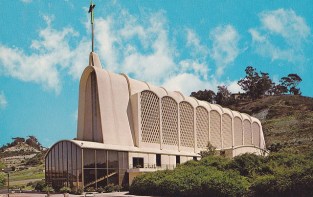
8661153044_41a654cfbe_zWeek by week we gather at First United Methodist Church in San Diego.  I learn more about this good congregation and the ministries they provide.  The photo shown here is of the church shortly after it moved to the Mission Valley area over 50 years ago.  At the time it moved to a place of dairy farms and orchards. 

Today, it can truly be said this is a place that reflects the old hymn “Where Cross the Crowded Ways of Life.”

This past Sunday we spoke of the importance of leaders who serve — HANDS OF THE STRONG.  Little did I know when I chose this topic back in June that it would also be a week of indictments, guilty pleas, new disclosures of the abuses of Catholic clergy or the tragic misguided leadership at Willow Creek Church, the well-known and influential mega church in Illinois.  Nor, did I know that this would be the weekend we would grieve the passing of Senator John McCain.  In the sermon preached on 8/26 we spoke of leadership and remembered the remarkable life of integrity and humility lived by Senator McCain.  It can be read here: HandsofStrong BLOG 8-26-18.

IMG_0860
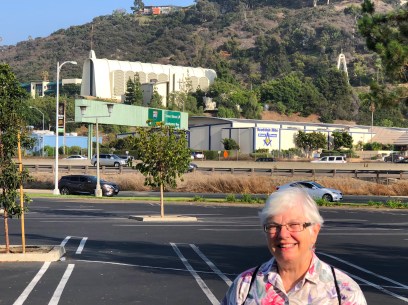
Elaine beside “The 8” Freeway and the Church Beyond. Where Cross the Crowded Ways of Life

So, what of the future?  The photo to the right was taken last week.  It is image of the church taken from a department store parking lot across the busy I-8 freeway.  Elaine, my spouse, is pictured here.  As I consider our future and the leadership that will be required, my prayers go out to the people who will continue the great ministries of this congregation long into the future.  As the United Methodist denomination seems to have lost its way — and is caught up internal controversy — in what Bishop Ken Carder has rightly described as “tacky” (with attribution to Will Campbell).  It is places like San Diego FUMC — and hundreds of churhes across the nation —  in the middle of the busyness all around that offer hope.  Here the vision of a world beyond the corrupt present will endure.  In such places.


Forever Abiding

FUMCSD-01.jpgForever Abiding

My God my bright abyss                                  Into which all my longing will not go        Once more I come to the edge of all I know And believing nothing believe in this.    Christian Wiman

Abiding.  In a new place, with new people.  New friends.  Our second Sunday at San Diego First United Methodist Church. 

Attached is the sermon entitled “Forever Abiding” preached on August 19, 2018.

Prayers are appreciated for this fine congregation.  Forward we go.

Shalom,    Philip Amerson

++++++++++++++++++++++++++++++++

Sermon — Forever Abiding 8-19-18 BLOG


Forever Beginning

67.jpgForever Beginning

From T.S. Eliot’s poem Little Gidding:

We shall not cease from exploration
And the end of all our exploring
Will be to arrive where we started
And know the place for the first time.

Exploring, this time, lands me in the pulpit at First United Methodist Church in San Diego as Interim Pastor.  I have preached in this great church in the past; however, this time is different.  This time, I will have a weekly assignment.  To show up, listen, learn, study and then seek to share truths about the transforming love of God.

This is not an easy task in any season.  Yet, as I face the task now, it seems more challenging than any time in my 52 years of ministry.  Attached is the sermon entitled “Simply Beginning” preached on August 12, 2018. 

Prayers are appreciated for this fine congregation — and for the “weak reed” who will be giving his best in the year ahead.

Shalom,

Philip Amerson

++++++++++++++++++++++++++++++++

Sermon — Forever Beginning 8-12-18 PRINT


… A Little Like a Day Care Center

… A Little Like a Day Care Center

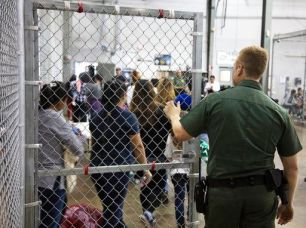
New York Times reporter Julie Hirshfield Davis describes the detention centers for refugees in Texas border towns as being “a little like a prison and a little like a day care center.”  (The Daily podcast 6/19/18).  A little like a day care center?  Really?

17006355_G

Texas Border Youth Facility, AP 6/18/18

What nonsense.  How can these holding tanks be benignly described as daycare facilities?  Ms. Davis, however, should be cut some slack.  She suffers from the same national cognitive dissonance disorder millions of us suffer.  What we see, we think, can’t be real.  We are facing the sinister riddle of who we have become as a society.  We ponder over how it happened.  Who are these people, mirrored back to us on television?  Pogo was right — We have met the enemy and it is us!  How did we arrive at this place?  Is this me, my nation? 

Let me help Ms. Davis — these are NOT daycare facilities.  These are prisons — for children.  Children sleep on the floor, have little choice in how to spend their days and are kept in floor-to-ceiling fenced cages.  No matter the rosy stories told by the “care givers” this is a prison… this is incarceration.  Families are torn apart because they feared for their lives and they sought a safe place where they might begin again and scratch out a living. Babies, toddlers, wee little children are being used as pawns.  Can our cruelty deter others?  Might we trade better treatment of these families for a political win — something about this likes a wall.

We didn’t arrive in this place overnight, or over an election cycle.  We have come a long way from President Reagan’s first inaugural address describing the United States as a shining city on a hill.  He spoke these inspiring words:  “And she’s still a beacon, still a magnet for all who must have freedom, for all the pilgrims from all the lost places who are hurtling through the darkness, toward home.”

Sadly, what we have believed deep in our bones, that the United States was a place of refuge, of new opportunity, is being lost, sacrificed to political expediency.  There has always been an uglier side to our identity.  This broken reality of our humanity is now on full display in our treatment of the refugee. 

Reagan’s soaring language was, sadly, tied to a “Southern Strategy” of thinly veiled racism and jokes about welfare queens.  The uglier side of our nation’s story was also at work when George Herbert Walker Bush who understood the U.S. to be a moral leader, nevertheless was elected in part, by his appeal focus to television spots about Willie Horton, an ex-con who was said to have been released on society early and then committed fresh acts of violence.  Be afraid… This became a potent symbol of racism designed to elicit fear, especially among white working class folks.  But now we have fallen further — we have forgotten those fundamental values to which we aspire and now live under the sadly misguided focus on new enemies who offer us new fears.  From every podium of the White House we are told, in one way are another, that we should “be afraid, be very afraid.”

th

How is this possible?  What to do?  I confess to being confused myself — almost confused enough to call a prison a daycare center — but not quite.  What does it mean to be a citizen in these times?  Prayers are essential, as are protests.  This is not who we are as U.S. citizens.  This is not who we are as people of faith.  We cannot allow this to be the definitive word on how we treat “the stranger in our land.”  The nation is not quietly accepting that children should be separated from mothers and fathers in a journey from terror without dissent.

There is an upside-down, inside-out quality to what is occurring.  Let’s be clear — I have not been blind to the drift in our nation’s identity in recent years.  People in cities, small towns and countryside across the U.S. have been struggling.  Tens of thousands of manufacturing and mining operations have been closed over the past twenty years.  Small farms continue to disappear.  Investments in education have dwindled.  Our nation has become better at hiring people to run prisons than building much-needed infrastructure.  No wonder, then, that our imaginations turn to incarceration rather than welcome centers.

We have allowed false dichotomies, false economies, to be used as political theory and practice.  This is a complex issue and the demagogues want us to believe that there are only two choices and one simple answer.  Just a little thought about the situation on the border causes a rational person to say — how do we bring imagination to this?  What other alternatives are there?  What might be done in El Salvador, Guatemala and Honduras that can alleviate this?  There must be dozens of ways to allow entry and do close monitoring of refugees that are less expensive than imprisoning mothers, fathers and children.

th

The stage was set for our foolish binary choices years ago.  It did not begin in 2016.  Many so-called “leaders” especially on the right, preached a narrative of  “me first” and “fear the other” for years: us or them… either/or… my way or the highway.  When one lives in a binary world regarding social interaction and possibilities, every choice is a false choice. Cable television and talk radio have laid out the predicate — a world was composed of distrust, soft prejudices, implicit and sometimes outright racism.

Meanwhile churches focused on entertainment and worried about numerical decline — they were too busy with this to speak on behalf of the immigrant or the poor among us.  The tragic, sickening, self concern of Christian leaders, scurrying to “fix” our broken institutions, without stopping to consider the inevitable changes related to secularization and demographic shifts, meant that important voices on the behalf of the most vulnerable were silent or muted at best. 

Years ago, Parker Palmer, anticipated our current state.  It is almost as if he knew Attorney General Jeff Sessions was going to pull Romans 13 out of context last week and use it to justify the tragedy on our borders.  Palmer wrote “traditional Christian language has been taken hostage by theological terrorists and has been tortured beyond recognition” (Parker Palmer, The Promise of Paradox, p. xxi). 

A type of theological malpractice has found ascendancy in the rhetoric of our public life.  When there are pictures of pastors endorsing and praying over the POTUS, who on the same day is implementing horrific policies, I want to shout out in protest: “there has been identity theft!”  In this, Biblical Christianity has been traded in for a cheap imitation of the faith — something that may sell as comfort in the short-term but will bear little long-term fruit.  Like the POTUS, these religious leaders are day-traders, seeking to ride the cultural swing of the moment.  The life-giving, life-transforming language of restoration and reconciliation has been replaced with a distorted gospel giving license to exclusionary, selfish, violent and war-condoning ideologies.

Here is one way to recast what is occurring and offers some guidance as to how we proceed — every time some national official suggests that there are drug dealers, gang members, thieves or rapists coming across the border and this justifies the cruelty we see, we need to stop and shout “who do you think you are kidding?  Where is your evidence?” Evidence is scant, almost nonexistent, you see.  Good research shows that refugees contribute much more than they require of their new home.  They are, like ALL PEOPLE, to be cherished more than feared.  How we treat them and their children reflects how we ought to be treated… Yes, that is Biblical… and also the guidance of other faith traditions.

Is there no hope of redemption or restoration for those who might bring their own set of brokenness or troubles?  We should and must screen those who would do us harm.  The calculus, however, isn’t even close.  There is enormously more potential for good than evil arriving at our portals.  Do we have such limited imaginations that we will simply define everyone arriving, even children, as our enemy?   When I see the young ones standing, crying as their mother side, as she is being taken away, I believe I see in that little one a future medical doctor, a chemist, a university president, a journalist, a teacher or a pastor — and, if we are lucky, that little one may one day be a friend to one of my grand children.  That is what I see — that is what our nation must see.

On Earth As In Heaven

On Earth As In Heaven

As a preacher I am blessed to hear a great sermon.  I know the challenge of crafting words and theology designed to move believers to live more faithfully or welcome unbelievers into the faith.  Fortunately, I hear such preaching often as I travel or attend worship at my home congregation St. Marks United Methodist Church in Bloomington, Indiana. 

Recently I heard one such finely crafted and moving sermon delivered by one of my pastors, the Rev. Jimmy Moore.  I invite you to read it, to consider the wisdom it contains and to be moved by his call to live with a more robust theology of Creation.  Here it is:

Creation Groans, Creation Glories

[Prior to this sermon, Rev. Moore Interviewed Dr. Jeffrey White, Professor in the School of Public and Environmental Affairs and Director of the Integrated Program on the Environment at Indiana University.  This interview is available through St. Marks United Methodist in Bloomington.]

Sermon:  I want to tell you about a friend of mine.  She is great.  She is one of the most reliable friends I have ever had.  When my dad died when I was fourteen, she was there for me.  She just didn’t place any restrictions on what I needed.  When I reached my late-thirties and had a time of depression she was there for me.  She just said, “you come and be where I am, and you don’t need to say anything. Just be here and it is fine.” She is intriguing. She is graceful, and she is full of mystery and wonder.  And her name is Nature.  I have found that she has a really big job to do.  This is a big world with a lot of people in it.  She helps feed and clothe this world. 

I think that part of what I needed to know this week is that she is still present for me.  You see, this is not how I expected this sermon to begin.  This has been one of the more challenging weeks in my pastoral ministry.  Some of that I won’t be talking about and some of that I will.  I am doing a funeral tomorrow night for a family Mary Beth and I know.  This is public story, so I am not speaking out of turn, but a twenty-three-year-old man took his life. Then on Thursday, one of you called me to let me know there was a seven-month-old baby in Riley Hospital who was nearing the end of her life.  The family wanted a baptism. I went over there, was with this family and baptized this baby who is still on life support, only so that her organs can be harvested for other children in the hospital.

Often during the week I wonder how what is happening the week is going to run into what is going to happen on Sunday morning.  I didn’t see this one coming… but my heart has been super heavy and full.  My mind knows it is not smart enough for what I’m having to deal with.  I needed my friend.  So, ironically, I was doing a wedding in Greenwood and because I am not of good cheer when I drive up Indiana highway #37 (with all the construction), I drove through Nashville and up Highway 135. And the woods were there.  And, she brought some of her healing… and I will need more.  And so, will some of these people. 

What I will tell you is that I know most of you here.  I know you and I know if you had a friend and someone was treating your friend badly, you would intercede.  My friend needs help.  My friend needs you.  So, I actually do believe that the Doctrine of Creation is as potent for us as the Doctrine of Redemption.  It tells us how we are here and how God’s life breathed into the life of the world, and breathes still. 

Dr. White, in our interview, used the word, “sanctuary.”  I told the Sunday School class this morning if someone vandalized this room with ugly graffiti, you would be livid.  I would be.  Yet, the world is our sanctuary.  The cosmos is our sanctuary.  I do not believe it is the will of Jesus for us to ignore the fact that this world is in need.  I think one of the things that happened in the Christian tradition is that in earlier translations of Genesis, the word “dominion” was used to describe what humans were to be given in terms of our responsibilities in creation – we had “authority.”  I think that came subtly, and not so subtly, to mean we could do whatever blessed thing we wanted to do with the world and it would be alright.  More recently those who study scripture are liking and valuing the word “stewardship” more than “dominion.”   Stewardship says we have this care, this gift that has been given to us. 

I know that you have people in your lives that have been given to you – your children, your friends, your parents, your partners and your congregation members.  I am deeply convinced, deeply convinced, that the responsibility we have is the responsibility of love. We are called to treat creation like we would our children, our partners and our friends.  To love it that much.  To love it exactly that much.  And so, the Psalmist says, in Psalm 19 “The heavens are declaring the glory of God.”  Now, I have already told you that I don’t believe that science and religion are at odds. I do believe that when I step into this world I am stepping into a holy place filled with glory — FILLED with the possibility of being healed and blessed, filled with the fact that I am in a world that is here for us and in a world for whom we are to be present and caring and responsible. 

I will also reject the notion that somehow it is a violation of Christian calling to care for the environment.  I have heard people say, “if it is going to be burned up anyway, why should we care?”  Please don’t take that view toward my home!  It makes no sense.  This is the world you are given… right now, this is it.  This is the world where unless something unbelievable happens, your children will be living, and their children will be living, and their children will be living.  It is part of Christian calling to invest in that.

So as the Romans passage tells us, all Creation is groaning.  This groaning is swept up into reconciliation, into the longing of God to bring all things together.  Not only by creation but also by redemption, God is bringing us together to care for this world.  There are some bad things happening in this world.  There are some bad things happening in this State.  In Indiana, we are one of the most polluted states in the country.  That is not an opinion, that’s a fact.  So, we could talk about arctic temperatures warming.  We could talk about draughts in Australia or Africa. We could talk about what climate change is doing in the world.  But, I am asking you to do something different today.  I want you to know that our call today is to recognize what is given to us.

So, In the span of eight days I will do a funeral, a memorial service, I will have baptized an infant and will have done a wedding.  What all of these have in common is the word “cherish.”  In funerals and memorial services, we are invited to cherish the memory of the ones we love and cherish the faith that calls them to God.  In our marriages we are called, not only to endure marriage, but to cherish each other. You can laugh at that.  Everyone who is married knows what I’m talking about.  If you feel you are doing more enduring than cherishing, there is a problem. Right?  When we baptize babies, even when babies only have a few hours to live, we are cherishing the breath that is in them and the hope that is in them and the love that surrounds them.  And, we are called to cherish this world.

IMG_3998.jpg
Oregon Coast, Spring 2017

Let me close mentioning two theologians.  One is named Matthew Sleeth who was an emergency room doctor until he was on a vacation with his wife.  Sitting on a beach, she asked, “What is the biggest problem in the world?”  He said, “It is the fact that we are poisoning ourselves and it makes my job as a doctor more difficult.”  She responded, “Well what are you going to do about it?”  He quit as a doctor and became a pastor and works in creation care. 

He tells the story that around this time he took his son fishing.  It was a small town on a river and they took a guy named John with them.  He said my boy caught a fish and John said “Well, that’s a trout.”  The boy said “Dad, can we keep it?” and Matthew said, “No it needs to grow some more.” He released the fish and John looked at him in a strange way.  Then his boy caught another fish, not quite as big as the first and asked, “Dad can we keep it?”  Sleeth said, “No son, it’s smaller than the other one, right John?”  John said, “Well, frankly, I’ve lived here all my life and the trout you are holding up there is the second largest trout I have seen in my life.  The one you threw back was the largest.”  Sleeth said to his son, “Okay, we’ll take it home.”  As they were walking back to their car, John grabbed Sleeth’s arm and said, “I need to tell you something.  Do you see that sign right there?  It says that ‘This river is full of dioxins’.  Your boy, if he takes a bite of that fish, take it away from him and don’t let him eat anymore.  Children in this area aren’t supposed to eat more than one fish a year.”   

You, you good people of God aren’t supposed to eat fish more than twice a week.  This is a problem, in the making of paper and other products we have released these toxins and all over the community this is happening.  As Walter Brueggemann would say “This is an issue of neighborliness.”  What we do, does impact the other.

One more theologian is A. J. Swoboda, who is a Pentecostal Christian.  He calls himself a Pentecostal Environmentalist.  He says we should know that there are three things about Pentecostals.  He says: 1) “We believe the Spirit is moving and so God is involved in what is happening right now.” 2) “We believe in caring for the marginalized. This issue is marginalizing people everywhere because of what it is doing to their environment.  It effects the poor more than those who can get away from it.  3) Finally, he said, “We cry.  If you go into a Pentecostal church, you will find Kleenex all over the place that means we can be moved.”

Then he says this, “We believe in two conversions.  The first conversion is to God.  The second is a conversion (which sounded outright Wesleyan to me) is a conversion to be back to the world.  This is the conversion I am preaching today – that the God who loves you says, “love my world.”  Don’t pretend that what is true is not true. Christians don’t do that.

Wendell Berry said “We have lived by the assumption that what was good for us was good for the world.  We were wrong.  Rather we should adopt the assumption that what is good for the world is good for us.”  To go back to my earlier point, Wendell Berry, like Jeff, like me, like you, finds grace in the world. 

This is Berry’s poem The Peace of Wild Things that many of you know:

“When despair for the world grows in me

and I wake in the night at the least sound

in fear of what my life and my children’s lives may be,

I go lay down where the wood drake

rests in his beauty on the water, and the great heron feeds.

I come into the peace of wild things

who do not tax their lives with forethought

of grief.  I come into the presence of still water

And I feel above me the day-blind stars

Waiting with their light.  For a time

I rest in the grace of the world, and am free.”

Good people of God, this world, this grace-filled world, this groaning world is given to us. The call in the invitation of today, the request of today, is to take care of what we do with it.  It is full of glory and full of longing and we are called to be in it.  That’s the Gospel too.  Amen.

++++++++++++++++++++++++++++++++++++++++++++++++++++++++++++++++++++++++

IMG_3968.jpg

Thy kingdom come on earth” is a core element of our foundational prayer… the Our Father.  How then shall we live?  How can we sing the great hymn “For the Beauty of the Earth” in these days?  What if we had the eyes to see God’s realm in our every day living?