Sickness Unto Death

Sickness Unto Death

Philip Amerson                                              May 1, 2025

Hope, when joined with mutual respect, becomes the oxygen supply for the lungs of a healthy democracy. In these troubled times, 19th Century Danish Philosopher Søren Kierkegaard offers perspective, a challenge, and a way beyond suffocating despair. In his classic “Sickness Unto Death,” this Christian theologian speaks of despair as a sin. Despair is, he suggests, a sin even worse than death. The reader is counseled to find the small pathways ahead, to persist, even when tempted to be captured in the clutches of fear and doubt – even when tempted to be held hostage to despair.  While anxiety may be unavoidable; Kierkegaard argues life calls us to continue forward, step by step, with whatever small light available.

Fear and disrespect are endemic in our nation. There is a tariff on HOPE. Many national and state officials are intent on destroying our “Commons” – the institutional trust established over the past two centuries. They act in ways to paralyze, to control, to tie us in contemporary knots of despair. Normality, civility, and decency are submerged in autocratic surges washing across our society.

This deluge is intended to overwhelm, to control, to undermine.  Such a “flooding the zone” strategy comes ceaselessly at us and from many tributaries: threats to the funding and governance of our universities: ending humanitarian aid to the poorest in our world; closing of scientific research necessary for public health; attacks on the judiciary and law firms; the deconstruction of a free and independent press; pressures on elected officials that leave one U.S. Senator saying “we are all afraid”; and, at base, there is the undoing of the personal constitutional rights for ordinary citizens and anxious refugees. These all coincide with what can be identified as practiced strategies from an autocratic playbook, one that has been tested and proven effective in other nations.

Alongside this national deluge of intolerance, the Indiana Legislature ended its recent session passing bills that can only be understood as a war on health care, on public education and on the poor. Indiana Senate Bill 289 was adopted as an “anti-DEI measure.” Touted as “bringing balance” to the teaching of history, civics and the social sciences, it instead is designed to censor, punish, place a chilling effect over public school districts or university curricula. It is a threat to any who dare depart from the ‘official truth’ presumed by those in power. It is an effort deny the tragic realities of racial, economic, religious, and sexual discrimination in our past and to end discussion of systemic economic disparities that continue.  Limits to funding Medicaid and public health resources will have devastating consequences on the poor in the state, delaying and denying needed care.

Persons without shelter in Indiana can now be placed in jail and/or face a $500 fine for “camping on the streets”! To add insult to injury, the final draft of the state’s budget contained a Trojan Horse, with the insertion, without public input, calling for “productivity reviews” of university faculty. It also included dramatically altered board governance structures for Indiana University giving the governor power to select all the university board members.

Apart from such legislation, other efforts to upend the truth and distort reality are astonishing. Indiana Lieutenant Governor, Micah Beckwith, posted a recent video celebrating what he misleadingly calls a “great compromise” made at the 1787 Constitutional Convention. Beckwith asserts the decision to count persons held as slaves as 3/5ths human (as property) was “a great move forward that led to the abolishment of slavery.” He turns history on its head, ignores the resulting decades of abuse, lynchings, and systemic discrimination. He quite literally whitewashes the dehumanization of slavery, the segregation that followed with Jim Crowe laws, mortgage redlining and the enduring systemic discrimination. Beckwith attempts to tell us that “what is up is down and what is true is false.” He ignores the tragic reality of more than a million men killed or severely wounded in the bloody U. S. Civil War and undercuts the Thirteenth, Fourteenth and Fifteenth Amendments to the constitution passed to assure the rights for all and designed to undergird equality. 

A good friend recently said, “For the first time in my adult life, I am embarrassed to be a Hoosier and related to Indiana University.”  Referring to the deluge of discriminatory initiatives taken by the governor and state legislature, he was also noting, with sadness, a compliant university administration, that has over and again failed to support academic freedom or stand against the bigotry of supercharged bullies. My friend spoke his sadness over the growing and blatant displays of racism and intolerance. Even so, despite such recent efforts, my friend said he was not giving up or dropping out.

Yes, these are unsettling times. The drift – make that the flood – toward intolerance, deception, and fascism is upon us.  We dare not hide or take cover in some false cocoon of isolation, thinking we can somehow choose to avoid the sin of despair.

During the recent Little 500 Weekend in Bloomington horrible, racist posts were placed on social media. They spoke of “the smell of welfare” and “turning Bloomington’s Kirkwood Avenue into Atlanta.”  There was more racist language, much worse than this, designed to encourage bigotry and foster white nationalism. These days such social media posts are likely generated by bots, foreign and domestic. They are designed to inflame passions and make false claims about marginalized others and are intentionally framed to spread fear and do harm.

Those of us who have the privileges accompanying “safe” racial identities, or our education, or other accidents of history dare not give in to despair.  As Dr. Martin Luther King Jr. put it “We are caught in an inescapable network of mutuality, tied in a single garment of destiny.” King was not simply suggesting all our histories and futures are connected and interdependent; he is also saying the struggles for civil rights for everyone must not end.  There continues to be work that needs to be done and injustices to be addressed.

Kirkegaard’s insights 175 years ago still ring true: despair that immobilizes is worse than death. Anxiety is a human given, but despair is a sin. Eleanor Roosevelt proposed “No one can make you feel inferior without your consent.” Social scientists W. I. and Dorothy Thomas offered that “What we perceive to be real becomes real in its consequences.”  How then shall we act?

Kirkegaard’s “Instead of Death” is based on the story of Lazarus as told in the eleventh chapter of the Gospel of John. On hearing the news of Lazarus’ passing, Jesus responds, “This sickness will not end in death.” Those captured in despair, will miss the potential for life. We have the power to choose how we react to horrible news, to deadly external influences.  Despair is a loss of perspective, a loss of agency, of self-worth.  It is a loss of hope.

What now are our choices?  What then can we do?  We begin by repudiating the climate of fear.  We can act and not be washed away in the fascist flood.  We can make a difference. 

Here are three areas to explore:

  1. When you see something, say something. An African American friend tells of being disrespected while shopping. In checking out, a clerk used clearly disrespectful and demeaning language. To my friend’s surprise, another customer, nearby, overhearing the exchange, gently but firmly in a quiet and clear voice said, “We are all better than this.”  Later, in the parking lot, the surprising voice offered support and friendship. We can welcome difference.  Maybe it is as simple as responding to a frown with a smile. A phone call, a visit that may help another. We can thank others for what they do. Ask how you might help. Encourage a teacher, a coach, a nurse, a therapist. Express appreciation to those who serve as police officers, fire fighters, local government officials.  Support public radio and television now are under attack.
  2. Reach out, make a new friend, and/or make a difference somewhere. Loneliness and fear are often the source of distrust and misunderstanding. This is a time to find ways to support the good work of programs like Exodus Immigration Refugee, NAACP, the Human Rights Commission. Host a dinner or picnic where persons from diverse backgrounds are welcomed and introduced. Perhaps make a new friend and together support our public schools in new ways, perhaps as a tutor or in support of a teacher. In Bloomington there are ways to support the healthcare for those with few resources through groups like HealthNet or by offering gratitude to our After-Hours Ambassadors working with the Community and Family Resource Department. We can write the university president asking why her administration does not better respond to attacks on academic freedom or to racist tweets that damage the sense of wellbeing among our students and other residents.  Ask the president why the university doesn’t join in efforts provide more for low-income housing, while it is the university driving up enrollments contributes to housing shortage and expense? Ask your banker, pastor, corporate leader how they might contribute to a more diverse racially community?  For some of us, who have the opportunity and occasion, we need to encourage broad representation from marginalized populations on boards and as candidates for leadership positions.
  3. Do one thing daily to challenge bigotry and discrimination.  Yes, I am going to say it – call or write your congressional or state representative challenging them to act against the flood of disinformation and intimidation. This is basic.  Write a letter to the editor.  Some days it may be as simple as being a friend to someone you know or a stranger you meet.

No need to be a crusader – some have that calling.  Others of us can do just one thing a day. Every day we can chose action and not fall into the sin of despair.

Jesus Wrapped in a Flag

Jesus Wrapped in a Flag

So-called Christian Nationalism appears to have mushroomed in our body politic. Books like Taking Back America for God (Andrew Whitehead and Samuel Perry) and The Kingdom, The Power and The Glory (Tim Alberta) document the spread and extent of this ideology across American faith communities. Is this new? Or is it reappearing after years buried in the subsoils of our common life?

Do your recall the l-o-n-g word Antidisestablishmentarianism? In elementary school I learned it was the longest word in the English language. Well, not quite. At only 28 letters, it now is said to be the fourth longest. I won’t try to spell or pronounce the top three. The folks at Merriam-Webster say it doesn’t qualify for a dictionary; it is so little used. Okay – but I have burned too many brain cells learning to spell it. Antidisestablishmentarianism arises from historic struggles in Britain over the role of religion in government. This word argues religion (the Church of England in this case) should receive special government benefits, support, patronage.

Increasingly unmerited claims that the United States was to be an exclusive Christian Nation are made. Stephen Wolfe’s book The Case for Christian Nationalism, widely read and oft cited, is a core effort in this “restorationist” project. This desire to return a simplistic narrative about our nation’s founding, our diverse communities of faith, and multiple cultural expressions is misleading, even antithetical to what Jefferson referred to as our “Great Experiment.” In fact, the First Amendment to the U.S. Constitution (known as the Establishment clause) opens with the words, “Congress shall make no law respecting an establishment of religion, or prohibiting the free exercise thereof.” Something fresh, never seen before, was being birthed with the American experiment. Something untethered to a monarch, or a single faith tradition was begun.

Evangelical scholar Kevin DeYoung acknowledges an understandable hunger among some Christians for something like Christian Nationalism; however, after reviewing Wolfe’s book, he concludes “Biblical instincts are better than nationalist ones, and the ethos of the Christian Nationalism project fails the biblical smell test.”

DeYoung offers a clear window on the rootage of Wolfe’s narrowly drawn and grievance informed “research” as he writes “The message—that ethnicities shouldn’t mix, that heretics can be killed, that violent revolution is already justified, and that what our nation needs is a charismatic Caesar-like leader to raise our consciousness and galvanize the will of the people—may bear resemblance to certain blood-and-soil nationalisms of the 19th and 20th centuries, but it’s not a nationalism that honors and represents the name of Christ.” He concludes“Christian Nationalism isn’t the answer the church or our nation needs.” (DeYoung, Kevin, “The Rise of Right-Wing Wokeism”, Christian Living, Nov. 28,2022)

As a teenager, in the early 1960s, I recall sermons warning if John Kennedy were elected, our first Roman Catholic President, he would receive orders directly from the Pope and the Vatican. Fortunately, a majority of U.S. voters didn’t buy that argument. Today, the benefits of Kennedy’s presidency and the tragedy of his assassination continues to shape and haunt our national self-understanding.

In my early adulthood (late 1960s and early 1970s), I heard the black evangelist Tom Skinner preach. He said “All the pictures of Christ were pictures of an Anglo-Saxon, middle-class, Protestant Republican. There is no way that I can relate to that kind of Christ.” (See Jamar Tisby, Footnotes, October 24, 2023.). Skinner painted the image of a white Jesus wrapped in an American flag. He was saying “the Jesus long marketed by the American church wasn’t a faithful representation of the Jesus of the Gospels.” Teaching in a United Methodist school in the Republic of Panama in these years further sharpened my awareness. Skinner was right.

Today’s Christian Nationalism continues to market a fraudulent version of the Christ. It is often linked to the “great replacement” theory that rests on the notion that immigrants and nonwhite, nonChristian persons (especially “Jewish elites”), are engaged in an international plot to take power away from those with birthright privilege in the United States. Do you remember the torchlight parade and the chant “Jews will not replace us” in Charlottesville, Virginia in 2017? Such entitlement beliefs are not only profoundly racist and antisemitic, but they are also neither faithful to U.S. history nor the Christian message.

Whether as Christians or patriotic Americans, or both, how shall we respond?

My friend, Lovett H. Weems, has outlined seven strategies “for responding to Christian Nationalism in measured and faithful ways.” (Leading Amidst Christian Nationalism, LEADING IDEAS, Lewis Center for Church Leadership, June 25, 2024).  Weems offers a helpful overview especially reflecting on the church’s historic endorsement of a civil religion. He is clear about the dangerous ties to the racist agenda of many that Christian Nationalism brings. The strategies offered start with “Be Cautious” and conclude with advice to “Understand the broader social, historical and political landscape.” In between are calls to love of country, to be humble, to stay positive and focused, and to remind others that Christians are called to give witness. These are more a starting point than a guide.

Missed is an awareness of the multiple and diverse contexts and callings of Christian congregations. Few people understand this more than Weems. In many places a more robust response is appropriate. The cautious tone of these “strategies” reflects the tendency of many denominational leaders in recent years to avoid conflict. It reminds one of the crouching stances that have marked too many “leaders” in handling the recent divisions in United Methodism. Perhaps it is, as Weems admits, a “soft civil religion,” but it can none-the-less be misunderstood as a draping of the American flag across the shoulders of the cautious contemporary U.S. church. I suspect the author knows the suggestions offered focus more on what should be avoided and miss some options of what Can Be Done to faithfully respond to Christian Nationalism.

In future days I will offer what I believe may be more effectual responses. I close remembering the words of British Methodist leader Donald English when he said, “The world has enough salesmen of the Gospel.  What we need is more free samples.

We are the Antidote to Hate

February 25, 2023: a “National Day of Hate.” Astonishing, this headline!

I doubted anyone would be this publicly misguided, this wrong-headed, this evil. Still, the call for public displays of antisemitism, racism and the hate mongering are genuine phenomena. 

A quick online search found law enforcement agencies across the country, from New York to Miami to Seattle, are extending this warning.  A coalition of neo-Nazi and White Supremacists are calling for hate-filled speech and actions on Saturday.  It is not new; it is a more open call for abuse against anyone who differs. Sadly, this is a part of a freshly emerging pattern.

Only two days ago, on Ash Wednesday, Christians were reminded of our common humanity and our need for repentance.  Ashes symbolize a “humas,” central to our identity.  From “dust you have come and to dust you shall return.” All of us; we hold this in common.  We are but temporal and temporary vessels, each carrying the potential for hope and healing or harm and hatred. 

In her book “People Love Dead Jews,” Dara Horn points poignantly to the ways antisemitism is deeply embedded and intertwined in our culture.  Among the haunting illustrations is the story of a Jewish child visiting a Christian church and while there asking the mother, “Where are the security guards?”  It was for this Jewish child normal for any space of worship, like his own synagogue, to always need security guards present.

There has been much news about a spiritual awakening at my alma mater Asbury University. Honestly, I have been fearful that this phenomenon offers a simplistic, pietistic, and personalistic response to the divisions, deceits and challenges we face as a nation. Folks quite rightly say that the impact of this spiritual awakening will not be known for decades. True enough. Still there is a good test to be had on Saturday, February 25th. Will we stand against hatred and turn the so-called National Day of Hate into a Day to Overcome Hatred with Words and Acts of Love of Neighbor. All neighbors!

The Short, Long Way or the Long, Short Way?

The Short, Long Way or the Long, Short Way?

We pray the COVID pandemic is ending. Or, at least moving toward what might be called endemic where, like the flu virus, we can receive protection from a mutating disease with an annual vaccination. Looking back we can see the messy and confused ways our society lurched from stage to stage, denial to denial, and fear to fear in these months.

Our experience reminds me of an ancient rabbinic tale: A traveler attempting to reach a distant city approached a child playing at a crossroads. He asked directions to the city. The child answered, “do you want the short, long way or the long, short way?” The traveler replied, “Well, I wish the short, long way, of course” and the child pointed a direction. After an hour or two the traveler saw the city on the horizon; however, he was soon standing on the bank of a large swirling river separating him from the city.

Retracing his steps back to the child, he said, “Why did you send me to a place where I can see the city, but cannot not reach it without much time and danger?” The child replied, “You wanted the short, long way.” The traveler then took the other path and after several hours finally entered the city, crossing a bridge. (Talmud, Eruvin 53b, Rabbi Yehoshua be Chananiah)

For two years now, many have shought a shortcut bypassing the COVID pandemic, journeying the short, long way forward. One day, I pray we will re-learn, together, that the role of our national agencies, when guided by unfolding science, mutual respect and trust, offer the best “long, short way” ahead. As a child, I remember receiving the polio and small pox vaccines as part of such a national consensus. Millions since have been spared suffering and death. Vaccines, then and now, may serve as a bridge for the long, short journey.

There is another, more pernicious, pandemic that continually rages across our common life — it is the pandemic of racial bigotry and discrimination. It threatens our future, our being our best, and the hope of a just and moral way forward. Many people of good will want to act in ways that are anti-racist. Let me suggest that, here too, one discovers the option of a “short, long way” or a “longer, short way.”

Let me explain. In October 2020 when our nation was reeling form the many tragedies of racism laid bare, as symbolized by the murder of George Floyd, I was asked to offer some advice and teaching. How might we untangle the snares of racial injustice? How will we find a hopeful way forward and begin a journey toward more respectful and loving communities?

Based on earlier research on racism and my life experience, I was asked to lead several Zoom sessions (remember this was during the pandemic) on the seeking of racial justice. Looking back now, I recognize that my counsel was to travel the “long, short way.” There were no easy short cuts. I knew that establishing relationships with those unlike me was central; working together with persons of different racial backgrounds and experiences on addressing places of injustice was needed at a grass roots level as a way to seek racial justice. I said to preachers, “Don’t preach that sermon, until there is a way to build such relationships.” Many preached their finger-wagging sermons anyway. I encouraged persons to read a book on racism, hold conversations, but working together with neighbors who were unlike you was more essential for change. Many read the books and talked but did little else of real substance. As I watched the many efforts at “diversity training” and “book clubs reading about racism” unfold, I was hopeful but knew these might end up being a “short, long way.” We act our ways to new ways of thinking more often than we think our way to new ways of acting. Preachng, reading and talking are good — but insufficient in crossing this swirling river of division.

Since that time, I have watched “Critial Race Theory” and accusations about “defunding the police” or the “1619 Project” used to reinforce divisions by demagogues. Political and media actors make the building of relationships for the common good even more difficult. We are witnessing a pandemic of voter suppression as a way to avoid equal representation. A renewed use of the ‘Willie Horton strategy’ stiring up racial fear and animosity was evident in the hearings of Supreme Court nominee Ketanji Brown Jackson. Sadly, it will take more than churches doing diversity training and reading groups, to respond to the waves of racially-stoked fear in our body politic. It will take more than curricular changes in our schools. It will take even more than this for the church and our society to move beyond our racial brokenness.

There is hope. I see it. It is a Long, Short Way ahead — If you do your diversity training, read those books on racism, please DO MORE. BUILD NEW RELATIONSHIPS. Reach out to those you perceive to be ‘different.’ Listen to their stories, find some small ways to work together. Leave your top-down ideas at home. Be quiet and listen for the signals of how you can best walk beside others. Together discover the long, short journey ahead. Join John Lewis in ‘making good trouble’ by crossing over that bridge.

Lest, I be misunderstood, racial injustice, tribal and ethnic discrimination is a human problem… it is in China, Myrnmar, India, Russia, Latin America, Africa, the Middle East. White surpremacy is playing out during the trigic events in Ukraine just now. In each instance, there will be the temptation to deny or point to the sins of others… or to seek the short, long way forward. Hard questions await for us as to how our responses differ in Ukraine from Ethopia or Syria. For now, we can find a place in our hometowns to begin our own long, short journey.

The piece below as written last October. It is about a friend who helped teach me the long, short way toward racial justice. Her name was LaVerta Terry.

++++++++++++++++

How to NOT Cure an Illness

This week a note popped up on my calendar dated, October 1st, 2020. It was a reminder to do a little one-year analysis of progress made regarding racial justice in the U.S. It read: “Next year consider if any thing more than reading and talking about racism has been done in your networks over the past year. Let’s check annually.”

I chuckled to myself. Since writing that note I had sat in on a number of conversations. Back in the summer and fall of 2020, following the tragic murder of George Floyd, and several other murders, folks were ready — to talk. I preached a few times. There was much conversation and study. Many church folks joined reading groups. There are many fine, fine books and some good conversation that has taken place. I am encouraged and at the same time dubious that real progress was being made.

If one has a headache, and the doctor prescribes aspirin, is it enough for the patient to sit and read the aspirin bottle label and not take the medicine? If a person is diagnosed with cancer, should the patient only review the research on carcinogens and treatments? Racism is endemic in our nation. We seek to make a difference every generation or so, only to fall back into old patterns of bigotry, separation and discrimination. Ours is a repetitive cycle of two steps forward and then one back. Yes, we are making progress, but we have miles to go and we are only progressing a few yards each decade.

My dear friend, LaVerta Terry once told me that “It’s going to take a lot more than reading and talking for things to change.” She reminded me of the quote by Frederick Douglas, “I prayed for twenty years and received no answer until I prayed with my legs.”

Research done decades earlier, in the 1970s, part of a program named Project Understanding, taught me that church people like to sit and talk. Getting up and doing something is much more challenging. Many like hearing challenging sermons about justice — well, okay, some folks like them, not all. I laugh thinking of folks who would leave worship following a “prophetic” sermon seeming so grateful I had railed against racism or sexism or homophobia. One fella, many years ago, thanked me at the door following such a sermon saying, “That was good, we like it when you talk dirty to us.” Yikes, is that all some these sermons were? Just a scolding? Treating the congregation like a collection of bad adolescents? Are they just a public rehearsal of “oughts, musts and shoulds” that cause folks in the pew to squirm?

Since that research on racism now nearly fifty years ago, I have seen over and again that there is a better way to deal with racism than reading or preaching. In the 1970s we would challenge congregations by asking “Did your church spend more on light bulbs or toilet paper in the past year than on programs in the community supporting racial justice?” Maybe we should be asking that question again. There are ways to engage with persons across the racial lines that continue to separate and harm. There are ways to “walk our prayers into existence.” Whatever your race or ethnicity, we can do more than read — we can ACT, LEARN, BEFRIEND, TOUCH, LAUGH as we PRAY.

Yes, marches for justice are necessary. Yes, passing the voting rights act is essential. We also need to take account of how our institutions spend time and money. What will have changed for us when October 2022 comes around?

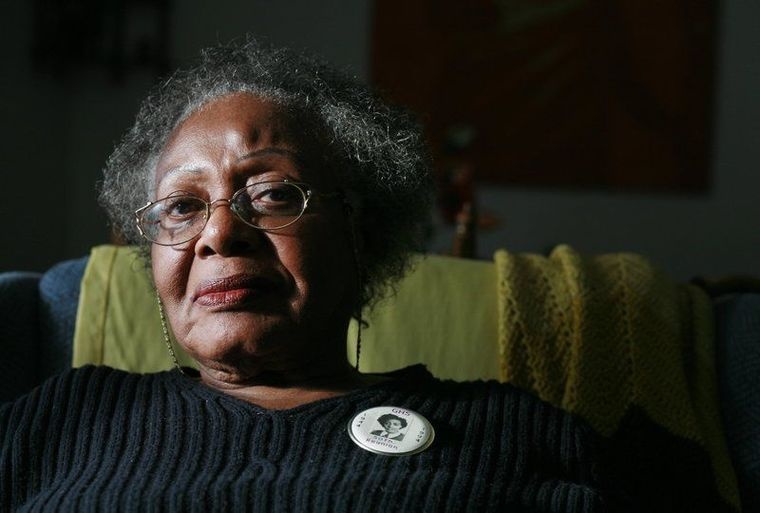
My friend LaVerta Terry, died five years ago. She worked with the Black Student programs at Indiana University. More importantly, I now realize that her best gift was as my friend. We laughed often and well. We went to the opera and marched to address racist behaviors or in support of a student who had been excluded or verbally wounded by hateful language. LaVerta would say “The more opposition I faced, the more I decided I could make a difference, but to do this I had to make some people uncomfortable.” We strategized as to how to make changes and not only talk about them. I can hear her still, saying “If all we are going to do at church is talk, talk, talk, I’ll be waiting outside the door to walk, walk, walk.” LaVerta taught me much — talking is good; walking is better; strategize to get up and make a change; make a new friend; and, laughing together can’t be beat.

How not to cure an illness? Just read the label? Okay, what are you planning for next year? Any new friendships in your future? Let’s check in again next October.

Fortnight – Day13: All Saints

Fortnight – Day13: All Saints

All Saints Day 2020 arrives two days ahead of the Presidential Election. We remember lives well lived — and others lived not so well. We consider the fraying of our national identity and the evident threats to our commonweal. Mortality lurks as a backdrop on the nation’s theatrical stage this year. I think of the friends who have died. Many wonderful folks. There are 230,000 others in the United States and 1.2 million around the world who have died in the COVID-19 pandemic since February. We know only a handful of their names or life stories. Still, this is ALL SAINTS DAY.

The New York Times today (11/1/2020) carried an opinion piece entitled “Obituaries for the The American Dream 1931-2020.” It was inspired by Lizania Cruz, a Dominican artist and museum curator, who asked other artists When and How The American Dream Died For You? The Times opened the question to a wider audience and invited readers to respond.

One of the original responses was from, Marsha McDonald who wrote: “The American Dream died for me when I realized how many of my fellow Americans valued selfishness over community, power over justice, prejudice over generosity, demagoguery over science. For me, the 2020 pandemic is very real, but also a metaphor. How sick our national soul is! The old dream should pass away. Isn’t it time for us to dream new dreams, better dreams, that include us all?

Since All Saints Sunday 2019, I have spent countless hours looking into the history of Methodism and the Ku Klux Klan in Indiana.** This research led to libraries, books and articles, old newspapers along with dozens of conversations and email exchanges. There are mysteries yet to be solved. Even so, I have sadly learned more of the broad swath of racism and religious bigotry that infected (and still infects) the church. At the same time my research uncovered the lives and witness of dozens of remarkable persons of faith in the early 20th Century who opposed the Klan and worked against this corruption of the Gospel and human dignity. In their day, these women and men dreamed “new dreams, better dreams, that included us all.”

If I were I to write my letter as a part of an Obituary for the American Dream today it would be a rolling set of dates — times of death, trauma and despair — and times of hoped for rebirth. Scores of times, a refrain, recurring rhythms of loss and return. Times when the dream died – along with Dr. King or the Kennedy brothers in the 1960s, or the twenty children and six adults at Sandy Hook Elementary School in 2012, or the treacheries of hunger, violence, betrayal and death witnessed while working in impoverished settings filled with saintly people in the U.S. and Latin America, and on and on and on. THEN – times when hope was rekindled.

Shortly after the death of Pope John XXIII in 1963 author Morris West wrote an appreciation titled “Good Pope John” for Life Magazine in which he wondered: “Will they canonize him and make him, officially, a saint in the calendar?  In a way, I hope not… I want to remember him for what he was — a loving man, a simple priest, a good pastor and a builder of bridges across which we poor devils may one day hope to scramble across to salvation.” In 2014, Pope John XXIII was canonized — so much for the wishes of Mr. West.

I don’t know that any one American Dream should be canonized. In truth all of our best dreams will end up in some graveyard of good intentions. In fundamental ways, our society and culture are flawed and destined to continuing corruptions — as are all human political and institutional designs. Our hope is not in finding the perfect president, or political ideology or government program. In truth, there is no “draining of the swamp”; instead we require an honest assessment of the human dilemma and self-critical response — where better oversight and care of all of our swampy places is required — social and personal. The future is not yet clear, even so I join in cautious hope.

I pray that Jon Meachem is correct in offering that: “In our finest hours…the soul of the country manifests itself in an inclination to open our arms rather than to clench our fists; to look out rather than to turn inward; to accept rather than to reject. In so doing, America has grown ever stronger, confident that the choice of light over dark is the means by which we pursue progress.” (The Soul of America: The Battle for Our Better Angels)

+++++++++++++++++++

Thomas Merton wrote: “What makes the saints saints is a clarity of compassion that can find good in the most terrible criminals. It delivers them from the burden of judging others, condemning others. It teaches them to bring the good out of others by compassion, mercy and pardon. We become saints not by conviction that we are better than sinners but by the realization that we are one of them, and that all together we need the mercy of God.” (Merton, Thomas. New Seeds of Contemplation, p 57)

+++++++++++

Ordinary Saints, Malcolm Guite

The ordinary saints, the ones we know, 
Our too-familiar family and friends, 
When shall we see them? 
Who can truly show 
Whilst still rough-hewn, 
the God who shapes our ends? 
Who will unveil the presence, glimpse the gold 
That is and always was our common ground, 
Stretch out a finger, feel, along the fold 
To find the flaw, to touch and search that wound 
From which the light we never noticed fell 
Into our lives? 
Remember how we turned 
To look at them, and they looked back? 
That full- -eyed love unselved us, and we turned around, 
Unready for the wrench and reach of grace. 
But one day we will see them face to face.

(Malcolm Guite, From Plough, March 22, 2018)

++++++++++++++++++

**[My interest was in part linked to my appreciation for the research by retired Indiana University Professor James Madison, whose book The Ku Klux Klan in the Heartland arrived in September 2020. Madison rightly argues that the Klan was made up by more than the “hillbillies and Great Unteachables” as some claimed. Klan membership extended into the ranks of community and church leaders. My interest, of course, was given more urgency by the tragic murders of George Floyd and Breonna Taylor in the past year.]

Response to the Violence at Tree of Life Synagogue in Pittsburgh

October 27, 2018

Members and Friends of First United Methodist, San Diego,

We learned on national news of the terrible assault on members of the Tree of Life Synagogue in Pittsburgh, Pennsylvania.  Immediately our thoughts turned to friends in the Jewish communities here in San Diego.  I want us, as members of First United Methodist, to speak with a loud and clear voice against any such anti-Semitic acts of terror.  In this time, we will stand with these our neighbors. 

I ask you to join me in prayer.  We will have special prayers in our services tomorrow and we will continue to raise a voice against such crimes in the days ahead. For nearly forty years our congregation has joined in an annual Thanksgiving worship with friends at Beth Israel of San Diego.  Just this past week members of our staff met with Rabbis Michael Berk and Arlene Bernstein to plan for our service together on November 21st at Temple Beth Israel.  Dr. Fanestil will be preaching at the service this year.  Let’s show our solidarity with our neighbors by joining in this service.

First United Methodist Church will stand against such intolerance and violence.  It is evidenced so frequently in our nation and world today.  I want us to be such a voice for any group targeted for abuse or discrimination in our city.  Especially now, however, we stand with these friends at Beth Israel and Jewish communities around the globe.

The peace of Christ,

Philip Amerson