
Shoveling Alone

Shoveling Alone

Shoveling alone. It is the story in almost all our communities in the United States. The poorest of the poor are shuffled to the edges of our economy and end up living on the streets — or in jail!

As I turned the shovel in Bloomington on a recent Wednesday, at the groundbreaking for our new Beacon center, I realized I was alone in that moment… no one on either side… but so many had gone ahead, and others would follow. Is it true in your community as well?
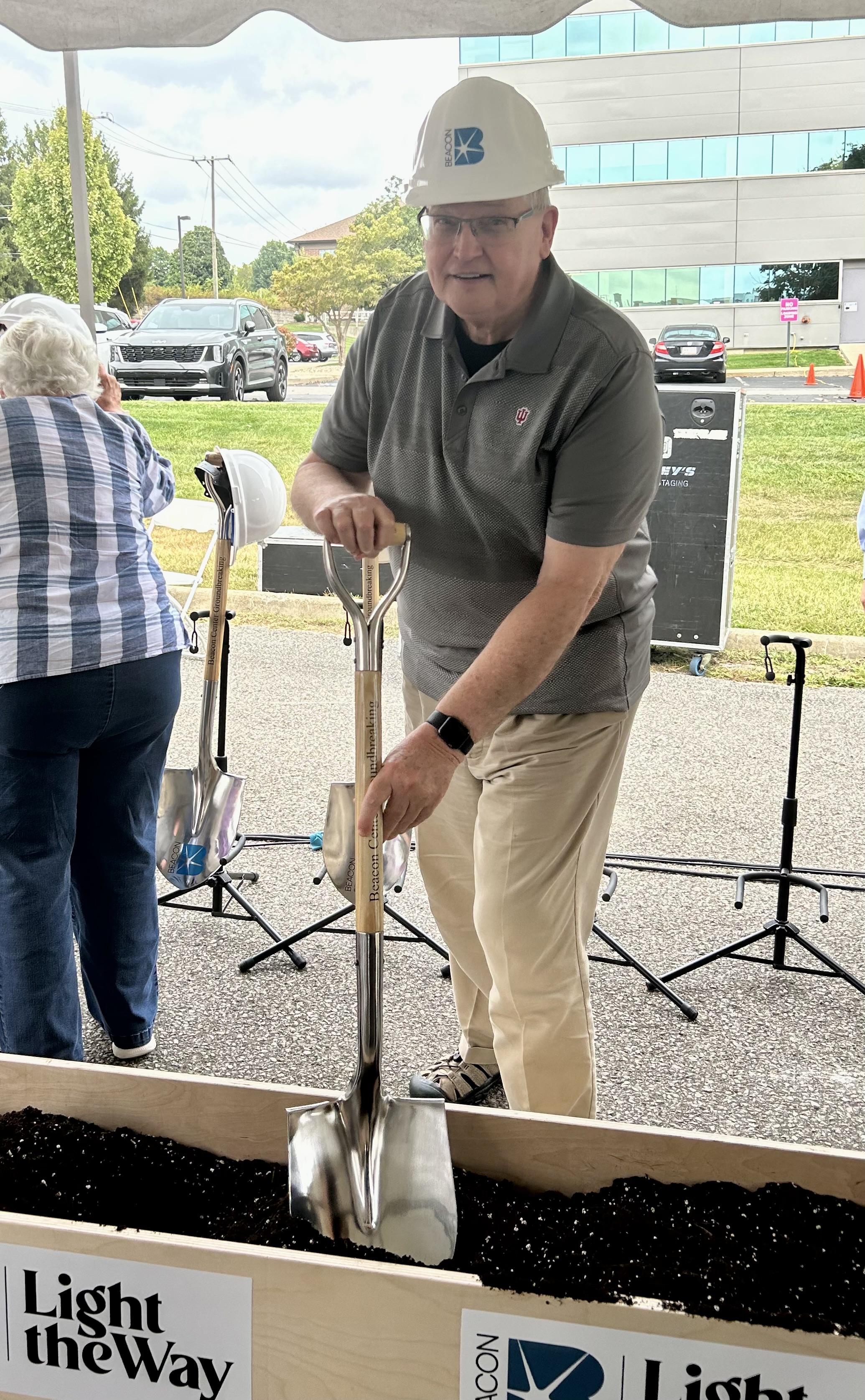
Not just on a given afternoon but across the years, I knew others in the faith community and beyond, who didn’t attend this groundbreaking… but who had ‘turned the soil’ of change in many places. They have been at this turning the soil, and turning our souls, in the past and will be in the future. In the process our souls are returned to an original place of hope and sharing among all.

I believe our local faith community, and others whereever you live, will do more in the months ahead, not just for places like Beacon. We must do this because our challenges cannot be fully handled by any one social service agency. Beacon, and similar agencies are a good, but insufficient response.

Bloomington Mayor Thomson is right, a comprehensive response to the challenge of persons without shelter is needed. Rise up now, faith communities and others, show more muscle, join in to assist the Emergency Winter Shelters, programs like Heading Home, the Recovery Alliance, New Leaf/New Life. Offer more mutual respect and support for all! The massive cuts to Medicaid will touch us all and especially the poor. Emergency rooms will be more crowded, retirement homes and clinics will close, healthcare will be rationed and delayed. Time for more to pick up the shovel and turn the soil toward the planting of new seeds of hope.

“When did we see you…?” the scriptures ask. “When you did it to the least among you” comes the answer. I live with the firm knowledge this shelter, even with a “better” setting where healthcare, employment assistance, public safety, addiction recovery and other resources, are provided is but a small beginning. It is not THE answer. Still, it is a needed step. Many can and will raise needed funds, offer to volunteer, and challenge public policy to do better… in God’s name.

The road is long and filled with twists and turns, social detours, myths about addiction, mental health and blindness to our own complicity in the “social welfare” practices in this country, and the misdirected, cruel political impulses and assault of so many in power in this time. Our culture lives with the myth of hero and victim. It is the “Hero Journey” story that Jung and Campbell identified as embedded in all we perceive as possible. It is so fully ingrained in our psyche and social systems that, sadly, we turn others into “clients” rather than “neighbors” and are more comfortable in speaking of THEY rather than with US.

It will take time — this turning the soil. Still as a Christian I recall the hymn refrain “We are not alone, for God is with us.” ‘Naive’ you say, of course it appears that way, of course. Others are using their constructions of false gods to continue cruelty. I know. That is why those who have theologies more tied to the larger, historic faith story must now speak the truth, afresh. Until some have seen a life changed, a person healed from addiction and communities moving away from cruel patterns of greed and domination, we are stuck. And, until a community is seen pulling together to solve such challenges, many will call me naive. I prefer to call it our shared hopes, foundational for the future — that we can care for one another. Check it out. This is a core teaching of Christianity and other great faith traditions. Interdependence is more essential to humanity’s long-term survival than independence.

Paul Farmer, remarkable physician and founder of Partners in Health (PIH) understood his life’s work as “The Long Defeat.” He said, “I have fought the long defeat and brought other people on to fight the long defeat, and I’m not going to stop because we keep losing. Now I actually think sometimes we may win. I don’t dislike victory. … You know, people from our background-like you, like most PIH-ers, like me-we’re used to being on a victory team, and actually what we’re really trying to do in PIH is to make common cause with the losers. Those are two very different things. We want to be on the winning team, but at the risk of turning our backs on the losers, no, it’s not worth it. So you fight the long defeat.” [From Tracy Kidder, “Mountains Beyond Mountains: The Quest of Dr. Paul Farmer, a Man Who Would Cure the World.”]

So, pick up a shovel, write a check, welcome the stranger, say ‘hello’, ask the stranger her/his name, smile… and keep doing it in your community, whereever you are. Keep at it, even when times are tough. My friend Wes Jackson put it this way, “If you think your life’s work can be accomplished in your lifetime, you are not thinking big enough!”

I Will Call Her ‘Elizabeth’

I Will Name Her ‘Elizabeth’

A block ahead of me, she slowly trod. She wears a blanket falling from her shoulders like a train dragging behind as if a royal gown. She turns at the corner, and I notice her bare feet. No crown, just matted hair from a rough night on the streets. Late March, evening temps were cool, but tolerable, I guess.  Still a blanket helped warm from to the chilly breeze.  Her gait made me think of her as “royalty on these mean streets” and I decided to name her ‘Elizabeth Rex.’

Another block, I have caught up and pass as we cross the street together.  At the corner of Kirkwood and Walnut, she stops and slowly turns. The grimy blanket end has gathered sidewalk debris.  Across from the Courthouse, near a restaurant I frequent, Elizabeth looked my way. Our eyes met and she quietly asks, “Do you know where I can get some shoes?”  I asked her name and where she was staying. She said she lives on the streets.  Had for nine years.  I doubted that, but I didn’t want to argue. 

Then from nowhere she says, “I’m an addict… a drug addict.”  I nod and ask what she was using.  “Meth, and some other stuff.”  “It can be dangerous,” I say.  I tell her that I have lost some friends to addiction.  She nods.  “What size shoes do you need? She stares into space for a long moment, then answers “nine-and-a-half.”  I doubt this as well.  Then, catching her eye again, I say there is a place nearby that can help.  Have you heard of Beacon? She stares off in the distance and nods “no.”

Calling her name, which was not Elizabeth, I said I would ask someone to bring some shoes if she wished.  She nod “yes.”  I call Elaine and ask if she could find something in our closet.  Elaine agrees and heads our way in her car.

I tell ‘Elizabeth’ that shoes and socks were on the way.  I then said again, “We can take you to a place that can offer more help.”  There was no sign of recognition, just that distant stare. We sat quietly for a few minutes near the crosswalk. Shortly a horn was sounding nearby.  It was Elaine.  I asked my new friend “Elizabeth,” if we could give her a ride to a place where she could have more help.  Over and again, I pointed and told her about Beacon, a place only a few blocks away that could help.  I opened the front door of Elaine’s Prius and invited her to take a seat.  “No, no,” she said, “God doesn’t want me to ride in cars, NO!”

Taking the bag from Elaine the woman and I sat on a nearby bench. I gave her the bag with socks and shoes and a few other healthcare aids.  She slowing pulled on the socks.  The shoes were TOO LARGE but the best we had to offer. She put them on.  I smiled, and feeling very Christian, I handed her a $20 bill.  She walked away – and I, experiencing an all too familiar voyeur’s guilt, took a photo.

Then, to my surprise she turned and walked back.  “Will you pray for me?” she asks. “Yes, yes,” I reply, “How about now?” We stood in the middle of the sidewalk and with my hand touching the royal blanket over her shoulder, I pray.  I prayed for her as a beloved child of God.  I pray that she would be delivered from her addiction.  I pray that she would know health and the love of others and discover places where she would not be harmed. “Amen” we said together.

Then to my surprise she said, “I cannot take this, none of it.”.  Handing me the $20, she sat down and removed shoes and socks. Putting them back in the small sack, she stood replacing the blanket over her shoulder she started away.  I tried to persuade, “Please keep them, the socks and shoes.” There was that glazed stare, birthed from addiction, abuse, fear, illness, poverty, or all-of-the-above… and more.  I tried again.  “Why don’t I sit the bag over there?” pointing to a nearby site.  “You can have it when I go away.”

“That would work,” she mumbled, repeating it over. I was pleased and sat the full bag on a step about 10 feet away.  I left.  Or I pretended to leave.  I crossed to the other side of the street and hurried down the block. Using the corner of the old Ladyman’s Restaurant as a shield, I watched.  I saw her pick up the sack.  She stood a long time at the corner, then crossed to my side of the street.  “Yes!” I whispered as I saw her carrying the bag.  When she turned and headed my way I quickly retreated, out of sight. 

I hustled past a church where I once served as the pastor, a quarter of a century ago, where we had begun a day center for persons without shelter. Turning east at the next corner, Fourth Street. I was out of sight, but “Elizabeth” and the millions of others like her, was not out of my thoughts.

What does it mean that our society cannot do better to aid persons without shelter, persons who struggle with addictions or mental illness?  What does it say about effectiveness of congregations, like this good one, that there are more persons on the streets without shelter than there were twenty-five years ago?  What does it say about me? My city? This university town filled with all our so-called experts? Why am I still so clumsy in honoring the humanity, the divinity, the royalty, of persons like Elizabeth?