The Short, Long Way or the Long, Short Way?

The Short, Long Way or the Long, Short Way?

We pray the COVID pandemic is ending. Or, at least moving toward what might be called endemic where, like the flu virus, we can receive protection from a mutating disease with an annual vaccination. Looking back we can see the messy and confused ways our society lurched from stage to stage, denial to denial, and fear to fear in these months.

Our experience reminds me of an ancient rabbinic tale: A traveler attempting to reach a distant city approached a child playing at a crossroads. He asked directions to the city. The child answered, “do you want the short, long way or the long, short way?” The traveler replied, “Well, I wish the short, long way, of course” and the child pointed a direction. After an hour or two the traveler saw the city on the horizon; however, he was soon standing on the bank of a large swirling river separating him from the city.

Retracing his steps back to the child, he said, “Why did you send me to a place where I can see the city, but cannot not reach it without much time and danger?” The child replied, “You wanted the short, long way.” The traveler then took the other path and after several hours finally entered the city, crossing a bridge. (Talmud, Eruvin 53b, Rabbi Yehoshua be Chananiah)

For two years now, many have shought a shortcut bypassing the COVID pandemic, journeying the short, long way forward. One day, I pray we will re-learn, together, that the role of our national agencies, when guided by unfolding science, mutual respect and trust, offer the best “long, short way” ahead. As a child, I remember receiving the polio and small pox vaccines as part of such a national consensus. Millions since have been spared suffering and death. Vaccines, then and now, may serve as a bridge for the long, short journey.

There is another, more pernicious, pandemic that continually rages across our common life — it is the pandemic of racial bigotry and discrimination. It threatens our future, our being our best, and the hope of a just and moral way forward. Many people of good will want to act in ways that are anti-racist. Let me suggest that, here too, one discovers the option of a “short, long way” or a “longer, short way.”

Let me explain. In October 2020 when our nation was reeling form the many tragedies of racism laid bare, as symbolized by the murder of George Floyd, I was asked to offer some advice and teaching. How might we untangle the snares of racial injustice? How will we find a hopeful way forward and begin a journey toward more respectful and loving communities?

Based on earlier research on racism and my life experience, I was asked to lead several Zoom sessions (remember this was during the pandemic) on the seeking of racial justice. Looking back now, I recognize that my counsel was to travel the “long, short way.” There were no easy short cuts. I knew that establishing relationships with those unlike me was central; working together with persons of different racial backgrounds and experiences on addressing places of injustice was needed at a grass roots level as a way to seek racial justice. I said to preachers, “Don’t preach that sermon, until there is a way to build such relationships.” Many preached their finger-wagging sermons anyway. I encouraged persons to read a book on racism, hold conversations, but working together with neighbors who were unlike you was more essential for change. Many read the books and talked but did little else of real substance. As I watched the many efforts at “diversity training” and “book clubs reading about racism” unfold, I was hopeful but knew these might end up being a “short, long way.” We act our ways to new ways of thinking more often than we think our way to new ways of acting. Preachng, reading and talking are good — but insufficient in crossing this swirling river of division.

Since that time, I have watched “Critial Race Theory” and accusations about “defunding the police” or the “1619 Project” used to reinforce divisions by demagogues. Political and media actors make the building of relationships for the common good even more difficult. We are witnessing a pandemic of voter suppression as a way to avoid equal representation. A renewed use of the ‘Willie Horton strategy’ stiring up racial fear and animosity was evident in the hearings of Supreme Court nominee Ketanji Brown Jackson. Sadly, it will take more than churches doing diversity training and reading groups, to respond to the waves of racially-stoked fear in our body politic. It will take more than curricular changes in our schools. It will take even more than this for the church and our society to move beyond our racial brokenness.

There is hope. I see it. It is a Long, Short Way ahead — If you do your diversity training, read those books on racism, please DO MORE. BUILD NEW RELATIONSHIPS. Reach out to those you perceive to be ‘different.’ Listen to their stories, find some small ways to work together. Leave your top-down ideas at home. Be quiet and listen for the signals of how you can best walk beside others. Together discover the long, short journey ahead. Join John Lewis in ‘making good trouble’ by crossing over that bridge.

Lest, I be misunderstood, racial injustice, tribal and ethnic discrimination is a human problem… it is in China, Myrnmar, India, Russia, Latin America, Africa, the Middle East. White surpremacy is playing out during the trigic events in Ukraine just now. In each instance, there will be the temptation to deny or point to the sins of others… or to seek the short, long way forward. Hard questions await for us as to how our responses differ in Ukraine from Ethopia or Syria. For now, we can find a place in our hometowns to begin our own long, short journey.

The piece below as written last October. It is about a friend who helped teach me the long, short way toward racial justice. Her name was LaVerta Terry.

++++++++++++++++

How to NOT Cure an Illness

This week a note popped up on my calendar dated, October 1st, 2020. It was a reminder to do a little one-year analysis of progress made regarding racial justice in the U.S. It read: “Next year consider if any thing more than reading and talking about racism has been done in your networks over the past year. Let’s check annually.”

I chuckled to myself. Since writing that note I had sat in on a number of conversations. Back in the summer and fall of 2020, following the tragic murder of George Floyd, and several other murders, folks were ready — to talk. I preached a few times. There was much conversation and study. Many church folks joined reading groups. There are many fine, fine books and some good conversation that has taken place. I am encouraged and at the same time dubious that real progress was being made.

If one has a headache, and the doctor prescribes aspirin, is it enough for the patient to sit and read the aspirin bottle label and not take the medicine? If a person is diagnosed with cancer, should the patient only review the research on carcinogens and treatments? Racism is endemic in our nation. We seek to make a difference every generation or so, only to fall back into old patterns of bigotry, separation and discrimination. Ours is a repetitive cycle of two steps forward and then one back. Yes, we are making progress, but we have miles to go and we are only progressing a few yards each decade.

My dear friend, LaVerta Terry once told me that “It’s going to take a lot more than reading and talking for things to change.” She reminded me of the quote by Frederick Douglas, “I prayed for twenty years and received no answer until I prayed with my legs.”

Research done decades earlier, in the 1970s, part of a program named Project Understanding, taught me that church people like to sit and talk. Getting up and doing something is much more challenging. Many like hearing challenging sermons about justice — well, okay, some folks like them, not all. I laugh thinking of folks who would leave worship following a “prophetic” sermon seeming so grateful I had railed against racism or sexism or homophobia. One fella, many years ago, thanked me at the door following such a sermon saying, “That was good, we like it when you talk dirty to us.” Yikes, is that all some these sermons were? Just a scolding? Treating the congregation like a collection of bad adolescents? Are they just a public rehearsal of “oughts, musts and shoulds” that cause folks in the pew to squirm?
Since that research on racism now nearly fifty years ago, I have seen over and again that there is a better way to deal with racism than reading or preaching. In the 1970s we would challenge congregations by asking “Did your church spend more on light bulbs or toilet paper in the past year than on programs in the community supporting racial justice?” Maybe we should be asking that question again. There are ways to engage with persons across the racial lines that continue to separate and harm. There are ways to “walk our prayers into existence.” Whatever your race or ethnicity, we can do more than read — we can ACT, LEARN, BEFRIEND, TOUCH, LAUGH as we PRAY.

Yes, marches for justice are necessary. Yes, passing the voting rights act is essential. We also need to take account of how our institutions spend time and money. What will have changed for us when October 2022 comes around?

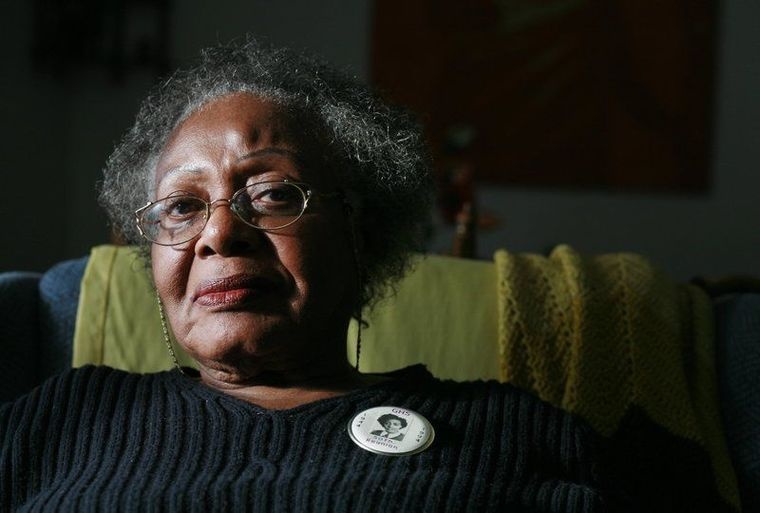
My friend LaVerta Terry, died five years ago. She worked with the Black Student programs at Indiana University. More importantly, I now realize that her best gift was as my friend. We laughed often and well. We went to the opera and marched to address racist behaviors or in support of a student who had been excluded or verbally wounded by hateful language. LaVerta would say “The more opposition I faced, the more I decided I could make a difference, but to do this I had to make some people uncomfortable.” We strategized as to how to make changes and not only talk about them. I can hear her still, saying “If all we are going to do at church is talk, talk, talk, I’ll be waiting outside the door to walk, walk, walk.” LaVerta taught me much — talking is good; walking is better; strategize to get up and make a change; make a new friend; and, laughing together can’t be beat.

How not to cure an illness? Just read the label? Okay, what are you planning for next year? Any new friendships in your future? Let’s check in again next October.
Dream This Dream

The lion and the lamb shall lie down together;
The kid and the panther shall play in the sun;
No one shall know the strange word "soldier";
And war shall be a shameful deed that long ago was done.

And rest for the weary, and food for the hungry,
And peace for the comfortless shall not be far to seek;
And beauty in labor, and beauty in laughter,
And beauty in loving shall come to the meek.

Mountain calls to mountain top -
Sinai unto Calvary;
Whispers rise from ancient fields -
They push up through the sod;
        
       "Tell all the children
           To tell their children's children
                To dream this dream for God."

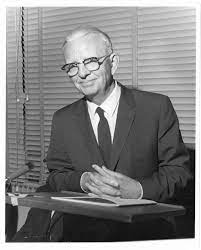
Ernest Cadman "Pomp" Colwell
President, Claremont School of Theology (1957 - 1968)
Dr. Calwell, ca. 1960

‘Untied’ Methodism: Ten Turnings

‘Untied’ Methodism: Ten Turnings

The wedding was to be an oppulent affair. No detail overlooked. Expensive floral boquets adorned every corner of the sanctuary. The string quartet rehearsing, women attendents doning gorgeous gowns and men were in tuxedos, all in anticipation as a stretch limo waited at the door to parade the bride and groom to a reception for hundreds following the wedding. As pastor, I observed it all with embarrassment. These were fine young people; I liked and prayed for them. This event was detailed in bridal magazines as one costing hundreds-of-thousands-of-dollars! This, at a time when our congregation was giving considerable attention, energy and resources to aid the homeless and hungry around us. What witness did this extravagence offer?

Preparing to preside, heavy hearted, I put the robe over my shoulders and picked up the order of service. Immediately, my sadness melted; I began to laugh. This perfectly planned wedding would be remembered, not so much for the wealth displayed but for a typo atop the custom-printed bulletin. There it was on the second line, the church was identified as “The First Untied Methodist Church.” Amid all the preparations, the printer and spell-check had missed it. The church was not named the “First United Methodist,” but rather indellibly printed were the words “First Untied Methodist.” We were UNTIED, and at a wedding!

Steve Harper recently wrote that the “The Future of the United Methodist Church is Now.” The denomination’s 2020 General Conference (an event scheduled for every four years) has now been delayed for the third time due to the COVID pandemic. It will now be convened in 2024. In response, a break-away group, identifying itself as “traditionalist,” indicated they can “wait no longer.” They are forming a new and seperate denomination, the Global Methodist Church to be initiated in May 2022. Our denominational un-tiedness is on full display. Dr. Harper advises that for the large majority who do not exit, the phrase “United Methodist” should be understood as a verb. He suggests to be about intentionally and actively forging a renewed identity. To be passive, he writes, is for “congregations to be impotent and irrelevant.”

It is time to move from being “untied” to being “united” again. Earlier Methodists and Evangelical United Brethren, shaped by the likes of the Wesley brothers, Philip Otterbien, Jacob Albright, Barbara Heck, E. Stanley Jones and Georgia Harkness, James Thomas, Leontyne Kelly each pointed to God’s redemptive work as resource. Even so; the doors opening to the future require new eyes to see the ways forward. Isaiah 43 comes to mind — behold, God is doing a new thing. The New Testament is filled with the call to “turn around” (metanoia) and walk a renewed and ever-renewing path.

Emerging from my observations as pastor and seminary administrator, and thinking of United Methodism as a verb, I offer here ten turnings for a renewal of identity and mission for United Methodists:

  1. Repentance, not Reactivity: Let us repent of the damage done to the “other.” Our healthiest future will involve repentence. I do not suggest this is easy, or obvious, or perfectly done, or that we should give up core beliefs/commitments/actions, or our welcome of LGBTQ+ persons throughout our church. However, we can give up the practice of “talking about” rather than “talking with” one another. We have been too quick to react and too slow to repent. Repentance takes a lifetime, reactivity is a quick fix, that in my experience doesn’t work and damages more than it heals. My dear friend, Walter Wangerin, Jr., died last summer. Watching the warfare inside of our Untied Methodist Church these days, I recall what Walt shared with me on more than one occassion. Walt left his beloved Missouri Synod Lutheran ancestry, the denomination of his birth, early in his pastoral career to join another Lutheran body. He would remind me that “schism in the body of Christ was a mark of sinfulness on all sides.”
  2. Resurrection, not Rebuilding: This is God’s work. We are privileged to join. Jesus spoke of those who lose their life “for my sake” might find it. Much energy has been spent and is being spent on trying to “save the denominaton.” As a wise pastor-friend of mine once observed, “People don’t get burned out, It’s mostly that they were committed to the wrong thing in the first place.” Saving a denomination has left us in a place where the melodrama obscures God’s first purpose — bringing life and hope to the world. It is time to let the many assumptions about power, place and authority die and trust our future in God’s hands. Prayer more than plan, laughter more than grievance, humility shaped by community and friendship more than caucus will be signs of resurrection. In these years it may be more important to “give up” rather than “gain up” in restructuring. At the center of our story is death and resurrection. Yet, it is the thing that scares us most of all.  We seem not to believe that resurrection doesn’t come without a death.
  3. Welcome, not Exclusion: Let us unite in acting as a loving community with the poor, the immigrant, the disenfranchised. Our denominational squabbles have turned us inward, unable to accept the interruptions of the Spirit at work at our doorsteps. Let us turn to know the names of our neighbors and their stories, not as those who we seek to fix but rather the others with whom we share, together, the transforming love of Christ.
  4. Heart Religion, not Statute: At our best we are a people who value Christian Experience, a people who practice a faith that is confirmed by a tranformed heart and mind (a metanoia) that is sustained and flourishes by living in loving relationship with other believers. Rather than more rules to keep things as they were, we might look to less standing still and more turning to live in loving relationships with other believers. The Shaker hymn “Tis a Gift to Be Simple” speaks of “turning, turning, till we come round right.”
  5. Ecumenical, not Faith Enclave: Let us turn to truly be a global and ecumenical church, not in words but in practice. Let us see the beauty all around in the practice of grass-roots ecumenism and interfaith sharing. Let’s do this, moving past the often thinly veiled paternalism and colonialism that has shaped much of our talk and action about “mission.” This will involve the essential task of learning from those in other places and who seek to follow Christ in different ways.
  6. Economy of Love, not the Marketing of Scarcity: Let us turn from, and give up, the “business facade and facination” that has distorted our core Christian identity and purpose. Too much time, energy, and resources have been directed to “best practice” models from business or from scarcity models designed to hoard resources. There are certainly lessons to draw from business and commerce, but where is our witness to “faith, hope and charity?” Strategies and designs that turn congregations into branch offices have done real damage. Rather than seeing God’s people gathered in unique communities, with distinctive gifts, expensive programs have been established that, while well-meaning, in too many places are counter-productive. Pastors are bombarded with the message that unless they do it like corporate America, or a megachurch somewhere, they are failing. They are told by some authority unfamilar with the ministry context, or the gifts of the people they know, how to “be fruitful.” (There are important parallel lessons coming from well-intended but ultimately destructive models in modern agriculture whose full damage to our environment and food resources is only now becoming apparent.)
  7. Encourage Positive Deviance, not Scaleable Formulas: Let us celebrate the overlooked places, sometimes small or nontraditonal, where ministry results in changed lives, new ways of being church, and witness that is otherwise overlooked. Such places of “positive deviance” offer dozens of exciting examples of witness in finding community with homeless persons, in caring for God’s creation, in welcoming the immigrant, in giving witness in the corporate board room, in demonstrating our opposition to war and violence in all forms. Let these be the ministries we seek to replicate, more than a mega-church or a drive-in restaurant chain.
  8. Watching Over in Love, not with Sanction: Let us turn to focus again on building and sustaining small group relationships and the practice of “watching over one another in love.” As my friend Michael Mather puts it, “If we watched over one another in love, we would not keep missing the abundant acts of grace, charity, and encouragement that happen in all of our churches and that would pull our heart and attention to somewhere that would certainly please God.” Whether called “class meeting” or “covenant discipleship” or any other name, we United Methodists have a remarkable tradition here.
  9. Horizontal, rather than Vertical: Let the connection be rewoven — horizontally. This could model for the world a different way of being community, a way that has been lost. This will involve discovering again and turning toward the value of circuits, of districts, subdistricts, relationships with and among our schools, colleges, seminaries, hospitals and other institutions. It would change what we counted and valued. General Boards and Agencies (whichever ones remain) should turn toward acting as weavers and reweavers of connections, turning from perceiving themselves as the center of action and returning to the earlier practice of assisting others in flourishing and being sustainable. The models await development and our moving from the heavily top-down and bureaucratic approaches of the past generation. Too many laypersons were placed on the sidelines as conferences merged, institutions drifted away from positive connections with the wider church. More attention to our colleges and universities is overdue. Our seminaries too need to think horizontally. Some will need to merge, some should close or discover another mission. All should become more cooperative. In preparing pastors, United Methodist theological students should spend at least one year in a United Methodist seminary as a part of this reweaving and building relationships for mission.
  10. Democratic doorkeepers, not Border Guards. Perhaps we need to stop merging conferences and allow for core polity and mission structures that are smaller, more agile and more adaptable. Perhaps these units might be the size of a couple of districts today with an elected presiding elder or table of leadership. Focus could be on the social and cultural ecology of each place – urban, suburban or rural. Perhaps there would be no bishops or superintendents at all, as is the case in other Methodist bodies. Or, if we continue in the episcopal format, explore a term limited episcopacy rather than life-episcopacy. Perhaps all appointments beyond the local church should also be expected to serve in a local congregation as well as in a non-congregational setting.

These, then, are Ten Turnings that might be considered as we move from being the Un-tied church. They are, in the Protestant tradition, a call to be a people who are Forever Reforming (Semper Reformanda), or as the Methodist Bicentennial motto in the United States put it “Forever Beginning.”

In recent days there has been much talk about a conspiracy around the postponing of the General Conference, yet again. It is charged that General Conference 2020 is being further delayed for some political advantage and suggested that those “moderates” and “progressives” who plan to stay in the United Methodist church, have successfully plotted to postpone any the General Conference until 2024, as a way to undercut the plans of the “traditionalists.” I laugh at such notions. Having spent much of my life around the corridors of authority in the denomination, I know that our church leaders have problems organizing a three float parade! Something as dramatic as a power play to change the General Conference dates three times, for a power advantage, is as likely as a Southern Baptist giving up immersion. Further, the COVID pandemic that shut down the gathering of persons from around the world, leving a singnificant minority unable to obtain visas, is not a conspiracy of anyone’s planning.

Let’s face it, we live and serve in an anacronistic institution. It is one we don’t know how to handle. We need let go of the foolish conspiracy thinking that has marked too much of our brokenness, and for too long, and which is, let me say it again – sinful.

My friend Noah was a Trappist monk who two decades after the changes in the Roman Catholic Church from Vatican II, shared with me an insight about his disappointment that there was not more renewal in denominational practices, structure and mission. Speaking of his sadness that positive changes were painfully slow to come, Noah said, “At the monestary, we changed our dress, our leadership patterns, and the arrangement of our furniture in the chapel. We changed our music, our liturgy, and our educational curriculum.” He paused and smiling said, “We tried changing everything… but our hearts.”

California-Pacific Annual Conference worship, June 2019

There is much in our United Methodist tradition(s) that is of great value… and much that need be changed. I look and chuckle to see the multiple ways folks are trying to arrive at perfection, like the effort at that wedding service where I presided so many years ago. In remembering, I begin to laugh out loud. We who call United Methodism home are indeed more UN-TIED than we are UNITED. There are now, and will be, many plans as to how the future should be approached. We are indeed a verb — but too often in the passive tense. And knowing this, and knowing human nature, I chuckle. As God’s church, perhaps we can find ways whereby our hearts might be changed and not just our structures and ways of sanctioning. Perhaps these “Ten Turnings” offer a few ideas, hunches really, as to where we can discover the God already at work among us.

Free Ukraine, Free Joey

Free Ukraine, Free Joey

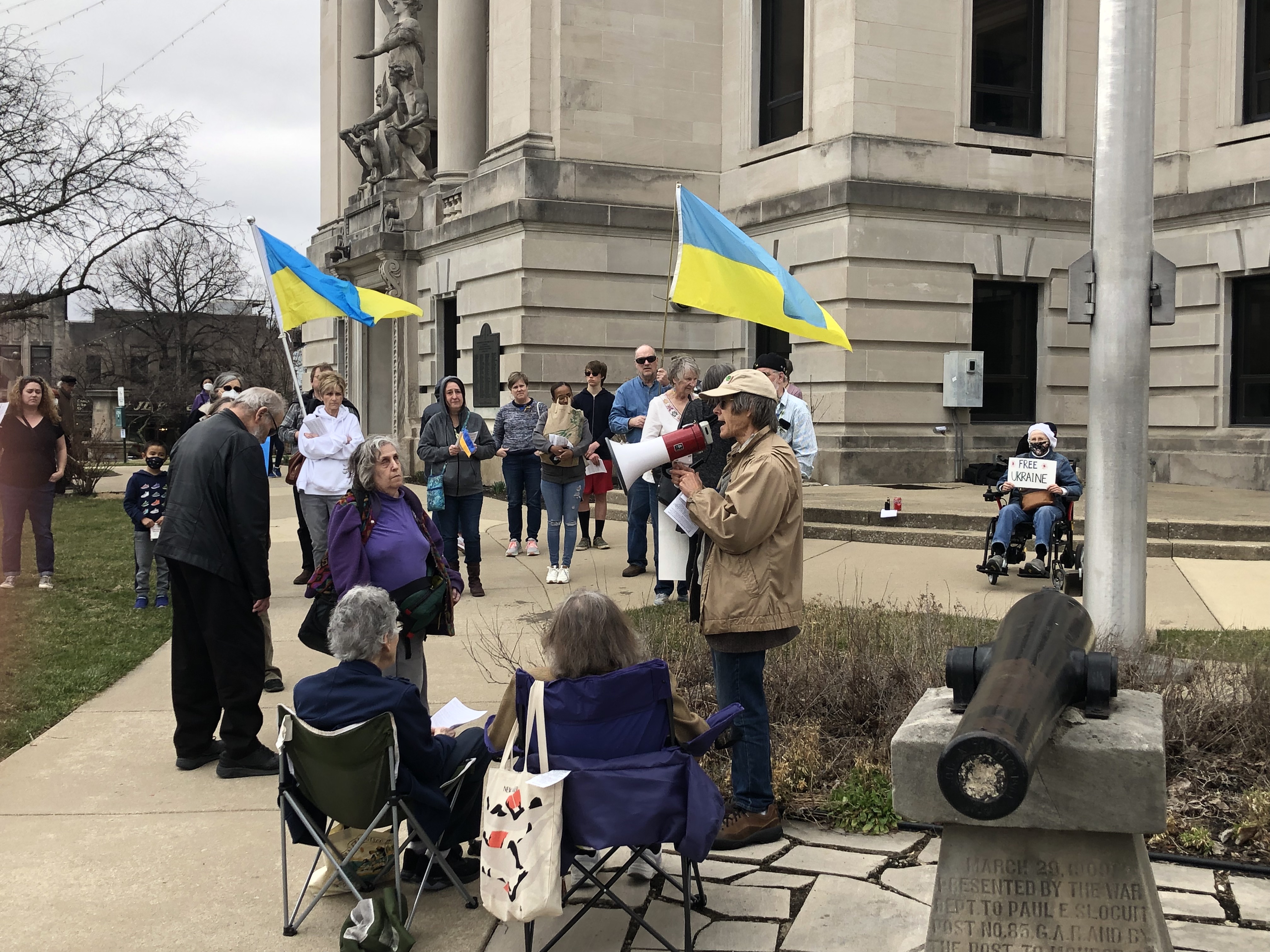
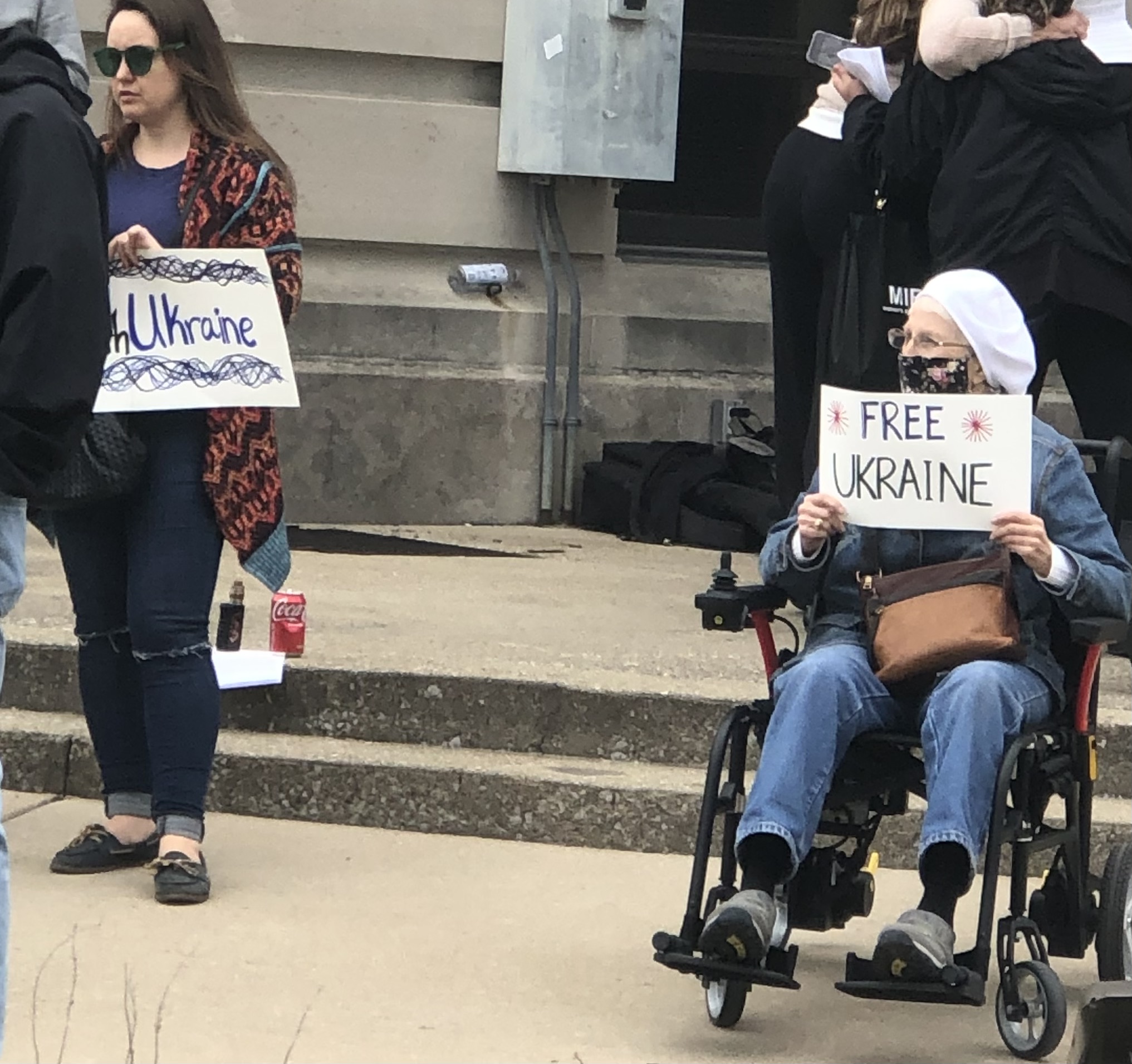
He showed up after most of the group had gathered. Speeches were being made against the war in Ukraine. There was also a clear accounting of the continuing threat of nuclear conflagration in our world. The group started small, perhaps two dozen. I recognized some from demonstrations thirty years earlier. It was an interfaith gathering. Truth is, it was mostly folks from the Quaker, Unitarian and Jewish traditions. There were a few Methodist types attending — but not many. Here we were, gathered again, persistant voices against violence and war. I had shown up early to join “my people,” and I also came to observe and to learn. As the speeches began, others joined, the crowd slowly grew. Some had brought Ukranian flags. Others carried signs calling for the end of war and stopping the aggression by Mr. Putin.

Demonstration supporting Ukraine Freedom

As the crowd grew, by my count, to just over one hundred, others passed by enjoying the warm March weather. We were on the south lawn of the County Courthouse in Bloomington, Indiana. One woman wove her way through the crowd distributing packets of Sun Flower seeds, a sign of peace in Ukraine. A few passing motorists blew horns in support. Mostly, people on the sidewalks barely noticed, on their way to the coffee or ice cream shops nearby. A speaker, standing beside an old Civil War canon, finished his reflections by saying “I don’t have any easy answers, but we must stay vigilant. In these difficult days we must do all we can to stop such tyrrany.”

From the back of the crowd a man shouted “Bomb Ukraine.” He scolded the speaker, “What do you mean you don’t have any answers?” We turned to see him, swaying behind us, clearly under the influence of alcohol or drugs. He erupted again, “That’s no good. We need to bomb the hell outta somebody.” As the inebriated shouts continued, someone begain to sing “I ain’t gonna study war no more.”

I joined in for a verse or two and watched as the man uncertain on his feet swaying and occasionally shouting. It is not surprising that this too was ridiculed by the drunken man. “Singing ain’t going to do any good against bullets and bombs. This is stupid.” He weaved and stumbled before shouting again, “Bomb Ukraine. Get Poland to join the fight, they are mean SOBs.” Folks moved away — others began to disburse — still others sang louder.

Slowly approaching him, I asked, “How are you do’in? Anything I can do to help?” Our eyes met and we both understood. He knew my modus operandi as much as I knew his. Laughing, he slurred, “You a preacher or someting?” Caught. I chuckled and said, “My name is Phil.” “Phil the pill,” he responded. He had me pegged, preacher, social worker, or a physician or counselor, or someone experienced around addiction. I asked his name, “It’s Joey, showy Joey.” We talked on for a few minutes. Not arguing but speaking out of our deepest hopes. Joey said he had recently lost his job, was from Texas. When he asked again if I was trying to “save him,” I replied, “God is already working on you… and on me too. You are about to be caught. God bless you, showy Joey,” I said. He stuck out his hand to shake. I touched his shoulder. Our eyes met again. Two children of God recoginizing each other.

Turning for home, this all seemed to me to be an apt metaphor. Joey, shouting for attention. Others like me who only know to sing the songs of Zion from our past while in this wilderness, while many of our politicians, drunk on narcissism, grievance, or thirst for power speak as foolishly as Joey about bombing and killing. The greed and drunkeness for power in our nation has contributed to our dilemma. The senior senator from South Carolina publicly calls for an assination of the Russian leader. Violence is the only tool he seems to know. While the senior senator from West Virginia, so drunk on his addictions to fossil fuels, calls for increased drilling and mining in the U.S., not wanting to miss the opportunity to supplant the Russian production of petroleum and turn a profit for himself and his friends. Will this violence, greed and hunger end without an enormous expenditure of life and treasure? I fear not; even as the violence spirals across Ukranian communities? We grope for a way forward amid the darkness and grieve the suffering of the innocents.

As the sun set, I journeyed to prayers at a local church. On a different liturgical calendar, this year the Lenten Season in Eastern Christianity begins a week after ours. Lent starts with “clean Monday” or “pure Monday” and prayers are held on the Sunday evening prior with a time of forgiveness. At the service in Bloomington there were prayers for Ukraine and for Russia… and for Europe and for Ethopia and for Syria and for the U.S. There were prayers for our leaders – the wise and the foolish. And there were prayers for all the people of Ukraine. And there were prayers for Joey — and the Joey that resides in each and every one of us.

2-2-2-2uesday

2-2-2-2uesday

Today is a Twos-Day. This, the twenty-second (22) day, of the second (2) month, of the year twenty-twenty-two (2022), has me considering the things that might be “twinned” together. What are two places, two events, or two persons that share something in common.

Briefly then, I write of two persons who come to mind on this day of 2s. I join author John Green in not being a fan of heroizing individuals; even so, I risk it here. The belief that there is some hero in a white hat who will come along and save the day, is a deeply inculcated myth in our culture. It does much damage. One the one hand, some folks chose to wait for the hero to appear, not stepping forward to join others in seeking to address some injustice of shared dilemma. On the other hand some think they are called to act as hero and come up with “the great fix” that will solve whatever problem they perceive to be at hand. One doesn’t have to live long in low-wealth communities to see the damage done by the continuing cycle of “heros” who appear and believe they are going to fixt things, all the while ignoring the gifts of the persons or neighborhoods they were scheming to FIX.

Even so, on this day of twinning, there are some difference-makers who come to mind. They show up in our world to point us to noblier paths. On a day when tyrants, like Vladimir Putin, act as bullies on the international stage, there are other options. On a day when one can, in hindsight, see through the thinly veiled efforts of our former U.S. president to take us out of NATO, and undermine the democratically elected government of the Ukraine, I want to hold up two other persons. If Putin and Trump can be seen as twinned — at least in their preference for autocratic governance, there are two men who have shown a different path forward: Paul Farmer and Jim Wallis.

The news came yesterday that Paul Farmer had died. I only met Farmer once and briefly. Still his life, his writings, and his witness standout. He would not accept that healthcare should limited to only the wealty or privileged neighborhoods in our nation or world. He did his work encouraging the resources at hand — whether with the people by establishing neighborhood health worker corps or building clinics and hospitals using the natural resources and gifts of the communities where they were built. Read more about Paul Famer here: https://www.washingtonpost.com/opinions/2022/02/21/how-paul-farmer-saved-millions-of-lives/.

Farmer was clear and persistent. His calling was to act along with others, to make a difference, to give access to health care FOR ALL. A friend tells of a time Paul Farmer was asked to meet with executives of a large pharmaceutical company in the Midwest. In his presentation, he said he could make a difference in a nation in Africa if a donation of $3 million in specific medicines could be made available. At the close of this talk, the executives quickly huddled, then came back saying the best the company could do was $1 million of these medicines. Dr. Farmer responded that, then, he wouldn’t be able to accept their donation because it wasn’t sufficient to the challenge the people were facing. As he stood to leave, the executives asked for a moment to discuss the matter further. Upon their return to the room, they assured Paul Farmer he would receive ALL the medical supplies he requested. Clarity and Persistence. We grieve Paul Farmer’s early death and celebrate the gifts he shared.

The second man that comes to mind is Jim Wallis. Jim is still very much alive and I give thanks for this. My friendship with Jim has been a long one, beginning back in San Francisco in 1974 when we were both called Young Evangelicals. I was teaching in an urban studies progam and invited Jim to come speak at a conference on the role Christians might play to address discrimination and poverty in our cities. As the editor of a new magazine, The Post American, later to become Sojourners Magazine, Jim was one of several persons who were emerging as important Christian witnesses. Jim would be the first to say he is not a hero; and my years of friendship would confirm his assessment. Like every person I know, he has his blemishes. Still, I suspect, that when a list of the saints of our generation is written, his name will be on that list (or at least he will be in a place of honorable-mention!).

Currently, I give thanks that Jim Wallis’ voice and experience in making it clear that voting rignts for all in the U.S. today is a moral issue: https://www.washingtonpost.com/religion/2022/02/18/sojourners-jim-wallis-voting-rights-religious-left/. As Wallis puts it, “For me it’s the first book of the Bible. We were all made in God’s image and likeness. Voter suppression on the basis of skin color is a throwing away of Imago Dei.” Jim has spent more than fifty years giving witness to the ways the Gospel calls us to live beyond the prejudices and discrimination still so prevelant. Clarity and Persistence.

These two men are connected by Clarity and Persistance: 1) they believe every human being is made in the image of God; 2) No matter the evil patterns and powers and persons who seek to exclude and dominate, God’s way of love for all is the preferred way for humanity. Paul and Jim have demonstrated THE BETTER WAY on this Twos-Day.

Along the Way: A Telling False Allegation

Steve Harper identifies what I have also seen as a rising effort to narrow the clear-Gospel-call for social holiness, into a narrow and dangerous individualism. Dr. Harper clearly and courageouly points to this sad attempt to re-boot the Evangelical message.  In gratitude, I re-post his thoughts here.

Steve Harper's avatarOboedire

Since the first of the month I have come across a book, a blog, and an article that reveal fundamentalist Christianity has identified yet another “enemy of the Gospel”—social justice. It’s a telling and false allegation.

I have seen periodic references to fundamentalists caricaturing “wokeness” (which includes a resistance to injustice) as a liberal attack on America and the Church, but its only in the past few weeks that I have come to connect the dots and recognize that “social justice” is a code phrase for a concerted opposition to progressive Christianity. The book, the blog, and the article have combined to reveal the bigger picture.

The book…..Owen Strachan has written ‘Christianity and Wokeness: How the Social Justice Movement Is Hijacking the Gospel — and the Way to Stop It’ (2021). Until recently, I did not know about him or his book. And to be fair, he is too extreme…

View original post 684 more words

Deeper and Wider

Deeper and Wider

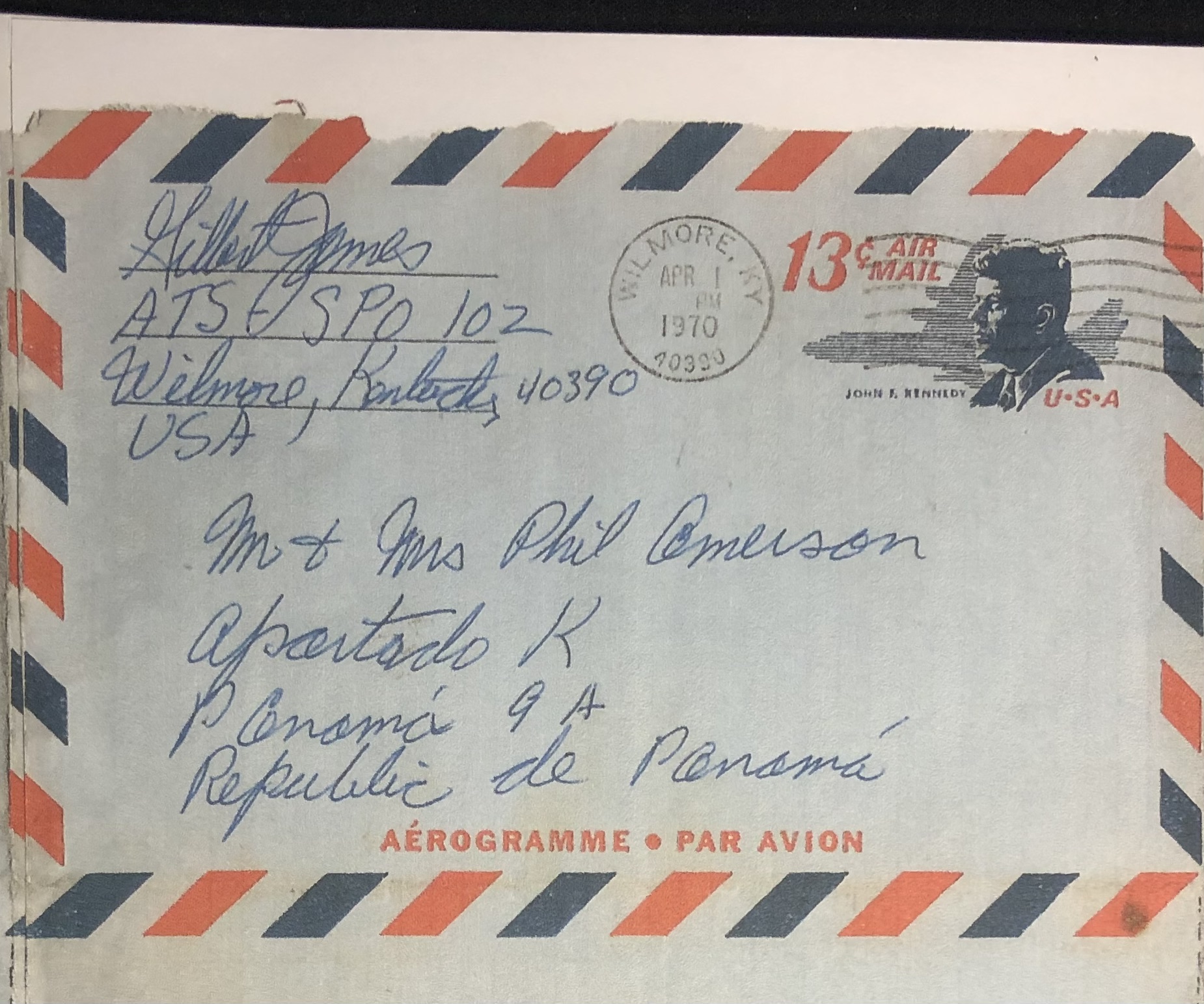
Recently while sorting though an old file, I found the letter from Professor Gilbert James written in 1970. I had taken a leave from my formal seminary education in Kentucky and was in a year-long intership, teaching at the United Methodist School IPA, in the Republic of Panamá. Professor James at Asbury Seminary and I exchanged correspondence during the year. I was taking a reading course from him while away from campus.

Dr. Gilbert James,
Used Courtesy of the Archives and Special Collections of Asbury Theological Semina
ry

In the letter I recently discovered, Dr. James asks that I not share its contents because “if expressed openly on campus would be considered high treason.” Hyperbole is all too comon in the academy. However, I think Gilbert was quite serious. His comments in the letter would have created problems and perhaps even censure.

My spouse, Elaine, and I were in Panama. Back in the U.S. Gilbert was confronted with a “spontaneous revival” which had begun at the college across the street. Others have since spoken and written about the 1970 Asbury College Revival in positive terms. There are, indeed, powerful stories of persons finding emotional and physical healing and being restored in their faith.

What were these controversial comments in the letter? Gilbert writes of his dismay watching folks “getting high on ‘mass enthususiasm.'” As a social scientist, educated in both sociology and psychology, what he observed was a religious fanaticism, interpreted with narrow fundamentalist language, and celebrated with “abysmal Biblical ignorance.” Only that!

Gilbert and Esther James with Abbie Christian Establishing a Work in Indianapolis for the Department of
Interracial Evangelism for the Free Methodist Church (circa 1955).
(Used with Permission of the Asbury Seminary B.L. Fisher Archives and Special Collections)

Some saw in the enthusiastic fervor at Asbury College in 1970 a great time of spiritual renewal. Gilbert noted there was good, but expressed concerns rooted in his years of experience with such spiritual awakenings. There is irony in the fact that Gilbert James had spent much of his life as an evangelist, attending and preaching in many camp meetings and revivals. Between 1946 and 1960 he was the Superintendent of the Department of Interracial Evangelism for the Free Methodist Church. He knew the genuine article and celebrated it. In 1970 he also was troubled.

Knowing my teacher as a world class provocatuer, I suspect that his fear of being accused of being a traitor to the faith is correct. He might have been charged with something like “high theological treason” in that particular time and place five decades ago — and in many places still today. He saw some of the fanaticism of the events at the college across the street, spilling over into the seminary. My guess is that during the 1970 Asbury Revival his wife, Esther, had to tone him down each evening; although, I suspect she shared many of his perspectives.

With some discomfort I recall that Gilbert was a revivalist. He believed in seeking both personal and institutional renewal. My discomfort is primarily due to the fact that his breadth of theological vision seems to be in short supply in today’s world. Evangelism has been given over to a narrow set of understandings. It has been limited to only a change in an individual — who is being introduced into thinly disguised social and political understandings. Unlike the revivals in the Second Great Awkening, where a wide array of societal injustices were addressed (poverty, slavery, voting rights for women, etc.), there is scant focus on institutional practices that need transformation, apart from a short list that includes fights against abortion and homosexuality.

Gilbert, the evangelist, believed in personal conversion — in transformation, possible through faith in Christ. Such change is affirmed in the letter — but he knew of an evangelism that was much deeper and wider. And he knew of the threats of individualism and fundamentalism that were at play. There were troublesome signs for him in the events surrounding the 1970 Asbury Revival that I don’t believe have been made public before.

So, here, 52 years later I offer this insight into his perspective of the 1950 Asbury Revival. I have highlighted in bold some passages mentioned above, the underlining was his.

++++++++

Letter from Dr. Gilbert James – March 31, 1970 – Wilmore, Kentucty To: Phil and Elaine Amerson – Republic of Panamá

Dear Phil and Elaine,

            “Thanks for your good letters and your patience with me… “ [Professor James then writes a few paragraphs about a reading course for Phil.] The letter then continues speaking of the 1970 Asbury Revival.

“I am sure you have read of the revival and all of the excitement around here with teams going out in all directions – classes suspended – and the academic quarter an educational shambles.

Letter from Gilbert James to Phil and Elaine Amerson, March 31, 1970

There were some remarkable individual examples and changed lives and I am grateful for every one of them.  There has been, however, I must in all honesty confess, a great deal of shear non-sense that was nothing more than “getting high” on mass enthusiasm.  I have never witnessed in my life more expressions of atrocious theology and abysmal biblical ignorance than I heard from the “witnessing” lips of those college students.  As a result, we underwent the usual “exorcism of demons” at the college until it was suppressed and now we have the most frightful outbreak of “tongues” at the seminary that we have ever suffered. The word is out that Asbury Seminary is the “Mecca” for the tongues movement.  I am just sick about it.  The most remarkable aspect of the whole affair is not that it occurred, but rather that as much good was accomplished as was with all the inane and disrespectful antics that went on with it.

Please do not write back to anyone about this, for what I am writing to you, if expressed openly on the campus would be considered high treason.”  I repeat, I am glad for the work of a sovereign God, in spite of man’s ignorance and sinfulness, but I predict it will be years to fully recover from the unfortunate results that have damaged the reputation of Asbury and reflected on the sound biblical basis of her message.

I am right in the midst of the elaborate planning necessary for the Chicago program.  We received $50,000 from Lilly for the experiment, and this is our big chance to try to seek some new directions in theological education. After a full day’s consultation with the Minister’s Study Board director of the NCC.  He said, in great seriousness, “This is one of the most exciting and unique experiments in American theological education.  He has agreed to direct our evaluation of the program and we hope to get a monograph out of it.

Love to you both – I must close.  Write soon about books you want.  Pray for me – please.

Gilbert James

++++++++++++++++

Teaching in Panamá, I was thousands of miles away from the spiritual, emotional, psychological cyclone richocheting in and around Wilmore, Kentucky. I was far from the events my teacher, Gilbert, saw at close proximity. However, a “spiritual awakening” was continuing for me at the time in Panamá. There I saw more clearly the injustice, racism and violence of institutions and nations. Gilbert James had been insturmental in alerting me of similar structures in the U.S. in my earlier years as his student. In Panamá, these were brought into even sharper relief. I saw, up close, what it was like to live in a nation suffering under a dictator who was propped up by the U.S. I saw the racism institutionalized in the practices of the Canal Zone and the abuses of so called “aid projects” privileging of wealthy, both in Panamá and the U.S. I saw hungry children dumpster diving to have something to eat. And there was the corruption of young women sold into sexual arrangements as teenagers. Evangelization needed to be wider and deeper than “individuals getting high on mass enthusiasm.”

In my review of materials from the 1970 Revival and from reports I recall receiving from others at the time, there were many testimonies about giving up cheating, lying, gossip, drinking alcohol, smoking, sexual petting, premarital sex or persons having an “insufficient prayer life.” It is almost exclusively about individual sins or a shortcoming of one’s self. Where are the witnesses who say, “We must now speak out against racism, war, poverty or violence?”

I do not agree with all of Gilbert’s perspectives, including some in this letter. That would make him happy… and he would, no doubt, want to have a conversation about where we differ and what we might together learn. Even so, I very much believe his call to an intelligent faith that combines personal and social transformation, informed by careful biblical and theological work was right then, and continues to be right today.

I can already hear some saying, but you must begin with the individual, then “changed persons will change society.” My response: Where is your evidence? It has now been fifty years. If you disagree, please point me to how this “revival” made the kind of difference in our society that came from the revivals of the Second Great Awakening. The Cane Ridge Revival began forty-six miles from Wilmore and one-hundred-and-sixty-nine years earlier.

[Attached is an extended reflection comparing the Cane Ridge Revival of 1801 and the Asbury Revival of 1970: https://documentcloud.adobe.com/link/review?uri=urn:aaid:scds:US:8c3d4bbf-2e81-39c1-bbf9-d054ae64f7ef.

Other “Awakenings” or revivals involved more than an adjustment of personal pieties or individual behaviors and beliefs. For early Evangelicals like John Wesley or John Calvin, institutional changes accompanied personal change. For the Anabaptists, a new personal faith meant a commitment to pacifism and the persecution that ensued. There is the conversion of John Newton who wrote the lyric we now sing as “Amazing Grace.” Newton’s conversion led him to become an abolitionist, after serving as the captian of slave ships. More recently one thinks of the bombing of Coventry Cathedral in England and the ensuing spiritual awakening resulting in international work at peacemaking (See: Fire in Coventry, Varney, Stephen: Hoder and Stoughton Ltd., 1974). Dozens of other examples could be cited; the sadness is that even today Asbury College and Seminary have fallen into the narrow valleys of a tamed evangelism and pursue cultural stances that are more informed by reactionary political elites and shaped by categories of individualism.

Professor Gilbert James and Eugene Carson Blake, General Secretary of the World Council of Churches,
Taize Community, circa 1971. Used Courtesy of the Archives and Special Collections, Asbury Theological Seminary.

Gilbert James was way ahead of me in 1970, and I suspect even now. When traveling with him for a seminary class in Chicago, New York, Detroit or Minneapolis, it was always amazing how he nudged us forward to see the broader ecology and the challenges of ministry in urban settings. It was even more astonishing meeting the people he brought to those seminars. Today I think of Letty Russell, Bill Stringfellow, Bill Pannell, George Riddick, Richard Leuke, Stan Hallett and George Weber, to name only a few.

A 1974 article by Gilbert entitled “The Use and Abuse of Power: A Study of the Principalities and Powers” demonstrates his understandings of the challenges Christians face in urban ecologies. He understood the need to seek transformation that is more than individual renewal (http://place.asburyseminary.edu/firstfruitspapers/15/).

My last visit with Gilbert was, I believe, in the fall of 1978. Having finished my doctoral work, I was asked to cover his seminary classes for a semester. My brilliant teacher was decending into early onset dementia. He would die in 1982 at the age of 66. I traveled to the seminary from my home at the time in Evansville, Indiana.

As I walked down a hallway in the seminary’s administration building, there was Gilbert heading toward the mail room. As he approached, we both began to weep. Then he gave me a hug and said, “I should know but I can’t place who you are.”

Ah, Gilbert, my friend, my beloved teacher, what is truly sad is that too few today remember who YOU are!

Practitioner of Intelligent Love

Practitioner of Intelligent Love

When the student is ready, the teacher will appear. So goes the aphorism. Another version of this idea, attributed to Buddha Siddhartha Guatama, is: “Teachers are like enzymes. Nature’s go-to facilitators of change.” Even if only partially true, there is much wisdom here — at least in my experience.

Dr. Gilbert James,
Used Courtesy of the Archives and Special Collections of Asbury Theological Seminary.

By the late 1960s, my generation in the U.S. were “teacher-ready.” We watched as young men, many of them friends, were being shipped off to an inexplicable war in Vietnam. Too many returning in body bags. State governors stood in univeristy doorways blocking entrance to African American students. We witnessed the assinations of M. L. King, Jr. and the Kennedy brothers. Riots were breaking out in many cities and the emerging “counter culture” saw a growing interest in drug use. Given the availability of “the pill,” a sexual revolution was afoot.

Like other young men, my name was placed in the military lottery; I was one of the lucky ones with a high number, so after college I headed to Asbury Seminary in Kentucky. There I met Gilbert James. He was teaching courses on The Church in Society, Race Relations and Sociology of Religion. The teacher appeared and I was “ready.”

Gilbert James: Free Methodist pastor, sawdust revival preacher, boxer, university professor, union organizer, poet, brilliant social researcher, friend of the poor, worker for racial justice, comfortable in a corporate board room and on skid row. Great “teachers” are not limited to the classroom. Fortunately, for many of us, Gilbert offered graduate-level insights wherever you found him. He challenged us to learn, whether in a classroom, on a Chicago “L” train, in a Congressional office, or, on a street corner in Harlem. Socratic in approach, he would ask probing questions, frame a situation so that those within earshot began to teach and learn from one another. How does one cipher the complexities of this man?

Not far beneath the surface was Gilbert James’ commitment to an historic Wesleyanism that encouraged vital piety, valued knowledge and sought social justice. He was one of several teachers at Asbury Seminary in those years who found ready students. I think of Bob Lyon who helped us explore serious Biblical interpretation and modeled a faith that included deep commitments to nonviolent action.

Gil James spoke easily of personal conversion and Christian experience; after all, he had come to faith by such a personal spiritual journey. However, he was critical of an individualism that ignored the Biblical mandates to love God and the neighbor. He spoke of a church that might live in terms of a “Jubilee sharing” of resources with the poor. He was suspicious of fanaticism and cautioned against the abuses of those seeking power for power’s sake – especially in the church. He had seen enough chicanery in the church and beyond. He knew the dangers of fanaticism when mixed uncritically into the religious life.

Gilbert encouraged us to be “both faithful and forward leaning.” At the same time he wanted us to know our ancestry. James reminded us of the insights of Eighteenth Century Methodists (including Free Methodists, Wesleyans and others). Our legacy included those who opposed pew rentals privileging the wealthy, who supported abolitionist struggles against slavery, who welcomed women in leadership, who encouraged ecumenism and unity, and who practiced peacemaking — often as pacifists.

Gilbert knew of the dangers of individualistic theology and the drift away from a balancing of personal conversion with social justice. In my next blog, I will share a letter from Gilbert written 52 years ago in the midst of an extended revival at Asbury College (a neighboring undergraduate institution to the seminary, seperate in curriculum and faculty).

James knew of the marginalization experienced by religious conservatives and foresaw a time when greivance would spill over and could lead to a insatiable hunger for power and status unmoored from Biblical ethics. He noted the transformation of Fundamentalism into Evangelicalism — that brought a sophistication in the use of political power. It might result, he suggested, in danger for our nation and the ruin of our churches. I remember thinking, as we were reflecting on the writings of Reinhold Neibuhr, that James was being overly grandiouse. Today, I see how on target he was about this threat that faith could to be compromised by a lust for approval and blind acquisition of institutional power these fifty years later.

Over coffee in the seminary cafeteriaI, I recall many informal “debates” with other faculty and students. Such exchanges were common and truly a gift. Students might be asked to “grab a cup and join the conversation.” I recall, one well-known faculty member offering up a common trope used at the time. Assuming the notion that there were two camps in American Protestant Christianity, this faculty member said that “Evangelicals were always rooted in ultimate authorithy of scripture, but Liberals always let the dominant culture set the agenda for their theology.” I recall Gilbert wriley smiling and responding, “Your culture does not set the agenda for how you read the scripture?”

Other exceptional teachers followed (Jackson Carroll, Earl Brewer, Gwen Neville) at Emory University. I then went on to my days of university teaching and Gilbert stayed in touch. In Atlanta, at Candler School of Theology, I helped him bring a group of Asbury students to that city, just as he had brought me as a student to Chicgo, Detroit and New York a decade earlier. He was still learning, teaching, making connections and demonstrating to students the ways a life of faith might be practiced among the institutions of the powerful and the gifts in low-wealth communities that were often hidden.

Gilbert James touched many lives and shaped the work of pastors and laity in diverse places. We found him to be a READY teacher and friend. Still, his concerns about the corruption of Evangelicalism ring true; and, are more applicable than ever. At his funeral in 1982 the great African American pastor and theologian James Earl Massey stood to speak of Gilbert and his influence. Massey summerized my teacher’s greatness in these simple words: He was a “practitioner of intelligent love.” It is my sense that we have a whole new generation of students ready to find such teachers today. May it be so.

Both Sides Now

Anocracy – an unfamiliar word becoming ever more common. It is used by those who study the health of democracys. Anocracies are places where democratic institutions are being diminished and autocratic practices are growing. In such states legal, electoral, economic and legislative functions shift to more and more autocratic behaviors. Sometimes referred to as illiberal democracies or reduced democracies, such governments, without countermeasures, move inevitably closer to full blown dictatorships and in many places civil war ensues.

Johnson and Czeck Sramek
Pulling togther? Source: METRO.co.uk

I carry in my mind a 2017 image of British Prime Minister Boris Johnson and Czech Foreign Minister Ivo Sramek rowing a small boat on a lake in Kent. Considering the anocratic tendencies in Czechoslovakia of late — and for that matter Great Britain — one wonders if these two men at the time were pulling together or against one another as the currents of illiberalism were surging? The strength of democratic institutions is being challenged the world around. We see it up close in the United States.

An insurgent mob attacks the Capitol building a year ago seeking to block the installation of a new president; state legislatures pass measures to challenge voting rights and favor one set of citizens over another in electoral districts; school board meetings turn ugly with threats and name-calling substituted for honest debate; the ideological divisions evident in our media grow; health measures like vaccinations and wearing face masks to protect from the Covid-19 virus are turned into political wedge issues; and, even (especially) one’s religious perspective is tied to one partisian political agenda. Barbara F. Walter, political science professor at UC San Diego has studied the emergence of anocracies for years. She says “the United States, a democracy founded more than two centuries ago, has entered very dangerous territory.” (See Dana Milbank, The Washington Post, 12/16/21)

Source: Seahopperfoldingboats.com

Perhaps you have heard of the illustration of a person in a row boat who will only pull on one oar. Yes, as the metaphor goes, the rower will simply go around in circles. If one is to make it to a distant shore, both oars are necessary. In healthy governments, there needs to be the safe and secure contribution made by those who are in power balanced by the safe and secure participation of those who are being governed.

For years I have been troubled by the tendency to turn every issue into a dichotomy, a binary choice with little room for hearing, seeing or learning from another side. This is common in anocracies — forcing complex issues into simplistic either/or choices. My guess is that in times of change, fear or unrest, there is a tendancy toward this inability to see another view. In the process divisions increase and become even more accute. My brain scientist friends tell me this is the case. The prefrontal cortex takes over. The ability to see more broadly or think more clearly is reduced. It is fight or flight time.

What is true in nations, large systems, and community institutions is also true within persons. I recall the Joni Mitchell song “Both Sides Now.” Many singers recorded the song — my favorite was Judy Collins’ rendition. The lyric closes with:

Tears and fears and feeling proud
To say, “I love you” right out loud
Dreams and schemes and circus crowds
I’ve looked at life that way
But now old friends are acting strange
They shake their heads, they say I’ve changed
Well, something’s lost but something’s gained
In living every day

I’ve looked at life from both sides now
From win and lose and still somehow
It’s life’s illusions I recall
I really don’t know life at all
.

++++++++++++

Life’s Illusions

For people of faith, especially for Christians and Jews, our scriptures are full of images that call us beyond simplistic illusions. Dualistic thinking tempts us to miss the mark. For example, there is the illusion that religion is primarily an individual’s experience and option. Others suggest it is soley a social engagement. Some seem to proclaim that faith is sufficient as a guide toward piety, while others see faith as only valuable if it focuses on social justice. Healthy, whole, and wholesome religiousity moves beyond such simplistic patterns of either/or toward the richness of inclusion, paradox, and a welcome to ever-new-unfolding-understandings of transcendence.

I was struck then, and deeply saddened, by a news article last fall of my alma mater joining in the efforts against a national vaccine mandate proposed to curb disease and death. As Kate Shellnutt writes in Christianity Today, Novmber 5, 2021 (Updated 12/20/21). Asbury Theological Seminary (joined Southern Baptist Seminary) in a legal challenge seeking emergency relief “from enforcement of the mandate, which asks businesses with over 100 employees to require COVID-19 vaccination, with any unvaccinated workers required to wear mask and undergo regular testing.”

Such “one-oared perspectives” endanger and misslead. They seem to miss entirely the gospel’s call of caring for the neighbor. One can almost overhear in this legal challenge the question of the young man to Jesus, “And, who is my neighbor?” One wonders if the seminary should not be returning the more than $780,000 from the federal government in the Higher Education Emergency Relief Fund (HEERF) received during the pandemic.

No doubt, were the issue about “government interference” related to scholarship aid for the students or receipt of federal funds to keep the community roadways and railways safe, the seminary might decide there is a “greater good.” Did the seminary speak up when, only a few years ago, medicaid relief was denied the poor in Kentucky? Or, what about the current challenge to the child tax credit that has lifted millions out of poverty? Surely the seminary has spoken out about this injustice. Crickets… nothing on such “federal interventions” related to how our society treats the poor.

Sadly, it is transparent that Asbury Seminary’s opposition to public safety and the commonweal are more about joining school’s mission to that of the Republican Party. In the likelihood that Row vs. Wade abortion laws are overturned or made moot by upcoming Supreme Court decisions, the seminary’s support for individual freedom will no doubt melt away.

The seminary’s choice to prefer a political stance, “masked up” as individual or institutional freedom displays a tragic disregard for the health of the larger community. At a time when a witness could be offered to the love of neighbor, it is rather set aside for a political agenda. In so doing, the whole gospel becomes an illusion. A great opportunity has been missed — and a disregard for sharing and living the wider Biblical narrative is lost. A one-sided, dualistic choice, this political stance is evident. Sadly, such a narrow view is put to use by those who seek to diminish our democracy. It no doubt pleases many constituents whose theology and politics are shaped by believing the scriptures are simply about individual sin and salvation. It causes one to wonder where the wisdom of Luther or Wesley, who spoke of choosing the common good in times of pandemic, has gone. It is, to my great sadness, a contributor to the anocracy apparent in our nation.

There have been many in this Asbury family who taught that individual freedom always comes in clear linkage with social responsibility. I think of beloved professors like Gilbert James and Bob Lyon — and before them Claude Thompson and Bob Shuler II. (I will be sharing more about Gilbert James in the next blog.) In my time as a student in the late 1960s and early 1970s, we were still suffering from the de facto racial segregation that had kept Asbury institutions rowing around in circles — an important witness to the wider world lost. Only a handful of African American students were welcomed. Many at the time felt it was not the government’s role to encourage racial integration in schools. Fortunately, others at the school and in society saw a larger vision, one that cared for the whole and not just for the political advantage of the segregationists.

My prayer is that God’s spirit will allow the faithful at Asbury, and in other such settings where options are narrowed to simple dualistic choices, to remember and revise their message announcing the breadth of God’s care for all people, communities and creation – personal and social – Both Sides Now.

Strangers’ Friend: It’s About Time

You don’t have to go to Pharoah to design a course on freedom, so says Professor Michael Eric Dyson, of Vanderbilt University.  Per usual, Dyson puts the pith into pithy.  We need his clarity as we enter Black History Month 2023. Right on time, Michael Eric Dyson nails the ugliness, the meanness and inappropriateness of Governor Florida Governor Ron DeSantis’ efforts to block the content of AP African American Studies curriculum. 

This is but a contemporary example of a governor standing in the schoolhouse door.  It is like George Wallace in 1963 who sought to block African American students Vivian Malone Jones, Dave McGlathery, and James Hood from enrolling in the University of Alabama.  This time it is a governor seeking to block the free exchange of ideas and a shared knowledge of a painful history.  It is an attempt to keep us from acting like respectful adults, as people open to the free expression of differing ideas.

But, what about us?  It’s too easy to pick on a demagogue stirring up racial animosity as he prepares to run for the presidency. How might churches faithfully respond in this time?  Let me speak for my group, the United Methodists.  We, who are heirs to John Wesley’s legacy, have a ready response built into our theological DNA. Sadly, many of our congregations and denomination institutions have forgotten and often don’t display it. Early Methodists, in cities like London and Newcastle, formed a Strangers Friend Society. Wesley taught Christians “should meet strangers in their own habitation.” These societies designed “to visit and relieve the sick and distressed” were expressions of acceptance and inclusion. One such society still meets, weekly, in John Wesley’s New Room in Bristol near a clock identified as the Strangers’ Friend clock.

In the United States, the distressing illness of racism continues – sometimes it seems to overwhelm.  Let me suggest it is time for United Methodists to turn STRANGERS INTO FRIENDS.  What if United Methodist congregations across the nation and world offered classes in Critical Race Theory or on Being “Woke” to Racial Injustice?  Okay, not realistic, you say.  Well, what if… oh, let’s say 50%, or 25%, or even 10% of United Methodist congregations offered such courses?  What if pastors and lay leaders in these places taught complementary classes based on Biblical sources and drawing on curriculum already developed by fine faculty in our seminaries?

 In a time when all Christians, especially United Methodists, are too focused on much less relevant matters like institutional survival, or on how to handle our divisions, what if we called for healing of the disease of racism in our nation. What if we acted like we believed in a conversion (a wokeness).  What if we called for the need of repentance and conversion from our chronic racism?

I can imagine certain politicians’ discomfort when they passed the church with the sign “Critical Race Theory Taught Here, Monday evening at 7:00 PM, Register NOW.”  It’s about time!

https://www.newroombristol.org.uk/strangers-friend-clock/

Kenneth Carder's avatarShifting Margins

What an interesting coincidence that the violent attempt to overturn the presidential election of 2020 occurred on the day Christians celebrate Epiphany! On the first anniversary of that ugly day and as another Epiphany arrives, it seems appropriate to reflect on the relationship between them.

Epiphany comes from a Greek word meaning “appearance,” “manifestation,” or “revelation” and is commonly linked with the visit of the Magi to the Christ child (Matthew 2:1-12). The Magi, from the region of what we know as Iraq and Iran, were foreigners who studied the stars for signs of divine presence and revelation.

An implication of Matthew’s story is that the God made known in Jesus the Christ reveals God’s self in multiple ways and to ALL people. God’s saving presence is not limited to our religion, our race, our nation, our culture, our political party. God is sovereign over ALL!

Matthew portrays Jesus’ birth…

View original post 512 more words