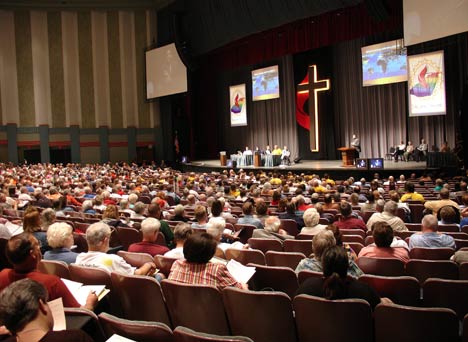
In June 1979, the Indiana United Methodist Annual Conference met in the I.U. Auditorium. The presiding bishop, Leroy Hodapp,[i] set an agenda for the future “We must go to where the people are!” The subtext was clear, we must go to the suburbs and invest talent, time, and resources there. As pastor in a core-city neighborhood at the time, I leaned to a friend beside me and whispered, “What are the people in our neighborhoods? Chopped liver?
The post-WWII Baby Boom population surge was slowing. A “population shock wave[ii]” or “Agequake”[iii] disrupted assumed church practices. Denominational anxiety about the future was on the upswing. In 1970 Alvin Toffler, with his wife Adelaide, published the popular Future Shock.[iv] It spoke of the events of these years as “too much change in too short a period of time.”
Urban neighborhoods, perceived as dangerous and in inevitable decline, were changing rapidly. Homes were abandoned by families, mostly of European ancestry and sold to real estate speculators. The houses left behind were often subdivided into multiapartment residences. The new arrivals came mostly from non-Caucasian ancestry. Typically, they were families with lower wealth. Dramatic population and neighborhood changes continued, wavelike over the next decades, as residences and local businesses were turned into rental properties. Only a couple of decades later, change came again as younger folks who were given the rather ironic label of “urban pioneers”[v] arrived and refurbished the older houses again into single-family dwellings.
In an earlier post,[vi] I wrote of the demise of the Central Avenue United Methodist Church in Indianapolis. A version of Central Avenue’s story was replicated in thousands of churches in the U. S. during the middle-and-late Twentieth Century. The underpinnings of parish life were vanishing as linkages with surrounding neighborhoods diminished. This pattern, like rolling ocean waves, washed across city neighborhoods. Social connections withered, were then rebuilt, and again diminished, and then reestablished again.
Gentrification was only beginning. White flight had speeded changes.[vii] The none-to-subtle subtext of the bishop’s counsel in 1979 was that primary attention should be directed to those leaving the core-city and refocused on suburban church growth. Ironically, of course, the population density in core-city neighborhoods was growing to levels higher than ever.
The good bishop’s analysis and strategy failed to perceive the ways in which the “left behind” neighborhoods were becoming more global, more multicultural.[viii] There was also a failure to discern the gifts being brought by the new residents. Even as new Asian, Hispanic enclaves emerged, and African American communities were enlarged, at the same time many of these “re-establishing” neighborhoods became more multiethnic in composition.[ix]
A listening to, visiting with, and welcoming of the people of the neighborhoods near the church buildings by church leaders was rarely practiced. The focus was on who was leaving, following “our” people. There was a blindness. Importantly, and in truth determinatively, the financial base for many city congregations was diminishing as members left for the suburbs. In the Baby Boom years of the middle 1950s and early 1960s, many church buildings were expanded beyond what could be afforded by those left behind or newly arriving in the following decades.
The call to “go to where the people are” failed to consider options other than an exit strategy. Left behind were paternalistic responses welcoming the new arrivals. If there was an outreach to the newcomer, it was typically an effort to “fix” these new in-migrants. Rather than seeing these persons as resources, with gifts to share, they were thought of as “the needy” and as such, well-meaning ministries like food pantries, thrift shops, and tutoring programs became the primary mission of many inner-city churches.
As was noted in the previous post, “It is one thing to restore buildings and houses, quite another to re-establish (or perhaps rediscover) a parish.”[x] What lessons might we discover from this history? We ask: why?what if? and why not?
Why did these parishes evaporate or vanish? In the next two postings I will offer what I believe are the two primary reasons for this phenomenon: 1) the social and political ecology of embedded racism in the nation; and 2) Ineffectual denominational and congregational responses to these changes lacking in theological clarity.
Coming Next: 2-B, The Social and Political Ecology of Embedded Racism in the Nation.
Your thoughts? — Please enter these in the comment section.
ENDNOTES:
[i] Bishop Leroy Hodapp was a good and intelligent man and a good friend. Still, he was a product of the mid-twentieth century church culture that selected him and shaped him for leadership. He would be considered a Christian “progressive” and generally friendly to many urban ministry efforts at the time. However, the pressures of office and desire to balance competing expectations of over 1,100 congregations and 300,000 Hoosier United Methodists limited what he perceived to be the best way forward. There were dozens of urban congregations and pastors that might have helped widen his vision, but the dye was set by the prevailing myths of the inevitability of suburban growth and urban decay.
[ii] Rizvi, Abul, Population Shock, Monash University Publishing, 2022.
[iii] Wallace, Paul, Agequake: Riding the Demographic Rollercoaster, Shaking Business, Finance and Our World, UNKNO, 1999.
[iv] Toffler, Alvin and Adelaide, Future Shock, Random House, 1970. Society was said to move through the three stages: agrarian, industrial, and post-industrial and with each transition there was a period of societal disruption and stress. Toffler’s analysis followed in follow-up books, The Third Wave and Powershift.
[v] Hwang, Jackelyn, Pioneers of Gentrification: Transformation in Global Neighborhoods in Urban America in the Late Twentieth Century, Demography, February 2016, 189-213.
[vi] Amerson, Philip, Recentering the Parish – Part 1, see: https://wp.me/p5lzr1-3Kc. Upon reading the earlier piece on the decline of Central Avenue church a friend reminded me of other changes including the interstate highway system where Interstate Highways I-64 and I-70 sectored off neighborhoods from one another. He also noted the consolidation many city and county functions in a new structure known as Unigov in Indianapolis. He was right. There are multiple other contributors as noted in this essay and each one seems shaped by racial discrimination.
[vii] Semuels, Alana, White Flight Never Ended, THE ATLANTIC, July 30, 2015.
[viii] Buccitelli, Anthony, Bak, City of Neighborhoods: Memory, Folklore, and Ethnic Place in Boston, University of Wisconsin Press, 2016.
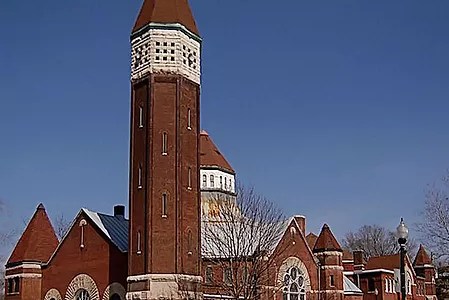
Indianapolis: early morning tv news, April 12, 2022. In the predawn shadows I recognize it. The tower of The Centrum, formerly Central Avenue United Methodist Church, greets the dawn. The Twelfth and Central intersection pictured is blocked off with yellow “crime scene” tape.
The story of Central Avenue Methodist Episcopal Church is a tale of great success, ending in a disappointing closure. It concerns the loss of a true center – for a community and a denomination. A familiar and oft repeated pattern across cities in the Rust Belt, this. A similar plotline has played out around the nation over the past century. At one-point, Central Avenue was a civic and cultural center and then, abandoned by the Methodists. “Redundant” as the Brits say. This is the tale of a faith group’s loss of clear identity, mission, and vision; a loss of “true north.” A building was “redeemed;” a parish was lost.[i]
Bill Cook, medical device inventor and visionary, from Bloomington came to the rescue in 2008. With Indiana Landmarks, restoration began on the grand old Romanesque-Revival structure. Good thing. Fine for the grand old facility, and the neighborhood. The Centrum is now a center of civic activities. The abandoned church captured Cook’s imagination — and dollars. Bill and Gayle Cook gave careful attention to preservation efforts in dozens of locations across the Midwest. Lovely this.
Central Avenue Methodist Episcopal Church was built in the horse and buggy era (1891) in one of Indianapolis’ first suburbs. It stood only a mile-and-a-quarter, twelve blocks, from city center – the Circle. Soon automobiles came to town. Following decades saw the Great Depression, two World Wars, and accompanying urbanization. Central Avenue prospered. An influential center of civic and social service efforts in the city and beyond, it offered much leadership and support for fledgling institutions. For example, the Methodist Hospital opened in 1908 a short distance to the west carrying with it the undergirding of several congregations, but Central Avenue was a leader. However, in the following decades, the prominence of the congregation changed.
Economic patterns shifted. Employment and housing ecologies were re-sorted. Newer neighborhoods in more distant suburbs were built. Depending on location, real estate values spiked or plummeted. The actual and perceived quality of various public schools was altered. Urban parishes, like Central Avenue, faced decline and redundancy. In the early decades of the 20th Century urbanization brought “improvements” and fresh investments, especially for those living further out from Center Township.
Thousands more workers were needed. While most in the working class lived on the south and west side of town the addition of even more hands and heft required finding additional living space. New migrants found this near the church. There was also an expanding racial diversity. Those leaving behind grand old homes and churches were moving on to newer, more prestigious addresses. It was the early-and-mid-century American Way; a prevailing residential and economic wave was playing out across the nation. Apartment buildings began to dot nearby streets and avenues. Folks moved into town from farms across the Midwest to find work; soon, to support “war efforts.” Others, from Appalachia (mostly Kentucky and Tennessee) and a greater number of African Americans (from the deep South) came to the city. Manufacturing, especially on the south and west side was booming and a robust pharmaceutical industry expanded.
The need for a low wage workforce of clerks, secretaries, cooks, janitors, and food service workers meant that many poor families were competing for a place. They arrived seeking shelter wherever it could be found. Near Central Avenue church, most single-family homes were slowly but steadily transformed into rental properties. Former one-family houses were sectored into three, four, five or even six apartment units. The carriage houses and garages, off the alleys nearby, were turned into one-room residences. Often, a family with several children might reside in these conversions. There would be a little coal-burning cookstove in one corner and a shallow loft for sleeping. By the early 1960s many of the graceful residences along Central, Park, Broadway, Alabama, College, Pennsylvania and Delaware Streets had fallen into disrepair. Apartment units, built to handle the migration during the World Wars, became roach and rat-infested, places of squalor.
Tree-lined neighborhood streets were widened into bustling three-and-four-lane, one-way thoroughfares. No longer was parking allowed along many of these byways. Commuters could speedily travel to and from work or entertainment downtown. Many who formerly resided in the neighborhood, now rushed through it, past it. This “transition” accelerated and expanded during the 1950s and 1960s.
The fabric of neighborhood relationships and human commitments, often overlooked or beneath the surface, suffered. Fear of the “stranger” shaped social and spiritual underpinnings. Like tectonic plates quaking beneath the earth’s crust, the Central Avenue parish was shaken, broken. By the early 1960s the neighborhood and congregation were seen as places of decline, even danger. This quaking left this congregation (and thousands of others like it across the nation), facing an existential crisis. Church members transferred to other congregations, primarily Methodist or another mainline denomination, mostly on the northside.
Some unethical real estate speculators, “slum lords” truly, invested little and extracted much. Like their cousins, still out on the farm, these real estate strip miners couldn’t resist the impulse to turn-a-quick-profit. There was an ignoring of the stewardship of a neighborhood’s fabric, just as farming malpractice fails to properly steward the land. The impulse, in too many cases, was to accrue ever larger profits, skip over best sustainable practices, ignore the long-term health and stability of the ecology of the farm or human residences in the city. Like the erosion of the soil of a farm, an erosion of the parish around Central Avenue was underway. It was the depletion of neighborhood institutions, shops and churches, community pride and a sense of commonweal.
Prevailing myths “explaining” why these neighborhood changes were occurring grew out of the individualistic notion that such patterns were the necessary, unfortunate, but unavoidable stages in urban progress.[ii] The resulting poverty surrounding the church was said to be “inevitable,” tragic perhaps, but essential to the larger success of the city. The poor would have to “make their way out” by individual hard-work and bootstrap initiative. These newly arriving poor ones, “the industrious unfortunate” could one day “escape” their plight through hard work – and perhaps a little luck.
Congregational assistance/charity programs to meet the needs of these new arrivals were commonplace and included a usual array of efforts – food pantry, a thrift shop, rummage sales, recovery groups, summer programs for children and youth, and emergency assistance. So it was, at Central Avenue Methodist in middle years of the century; so it was, in core city congregations across the nation.
The neighborhood ecology was believed to be rooted in a biological model, like the human life cycle: neighborhoods were born, grew up, then declined. Low wealth persons who lived around the church in the 1950s and 1960’s were understood to be “born to poverty,” or ones who suffered some misfortune, or were destined to their circumstances due to some individual human failing. If they had sufficient imagination, initiative, or opportunity they too could join the upwardly mobile path to the suburbs.
In some places, in other northern Rustbelt cities, the abandonment of lovely neighborhoods was even more dramatic. Banking practices of red-lining and racist government housing mortgage guidelines aided and abetted the decline. Lost, were opportunities for poor and minority persons to benefit from home ownership. Richard Rothstein’s excellent book the “The Color of Law: The Forgotten History of How Our Government Segregated America” documents the multiple ways local, state, and federal governments incentivized this deleterious turnover in neighborhoods, all the while limiting or outright blocking opportunities for homeownership for racial minorities and the poor.[iii]
By 1961, other voices, like Jane Jacobs and Gibson Winter offered alternative views of how urban neighborhoods might thrive[iv] and urban congregations might give witness.[v] Alternative urban parish models were emerging in the mid-century. Places like the East Harlem Protestant Parish in New York, the Church of the Savior in Washington D.C., and in Chicago, Woodlawn Mennonite Church, and the Ecumenical Institute were challenging old assumptions.
There were a few attempts at incorporating alternative approaches to the traditional congregational life emerging in Indianapolis. As one observer commented, “Indianapolis is a city that is long on charity and short on justice.”[vi] Mainline congregations confirmed a preference for charity as the primary hallmark and missional goal of urban parish life.
However, the story is more complex, isn’t it? It turns out to be more circular. Today a fuller view of the development cycle of economic, housing and neighborhood vibrancy is clearer. It is “wash, rinse and repeat.” Decline and decay were not inevitable. Indianapolis is more fortunate than many other cities where the loss of entire neighborhoods was and is more profound. It only took a few short decades, along with the vision and resources of folks known as Urban Pioneers for this cycle to be obvious.
Still, a blindness remains. Congregations and neighborhoods once benefitting from the population turnover and changes around Central Avenue now face their own demise. They now experience the loss of any sense of parish cohesiveness. False options offered by the prevailing view of inevitable development and/or decline persist and shape understandings. Today Indianapolis’ Old North Neighborhood has mostly been “gentrified.” There is good in this. There has also been harm. The Centrum, is a symbol of a neighborhood rediscovered and being “preserved.” One wonders for how long?
It is one thing to restore buildings and houses, quite another to re-establish (or perhaps rediscover) a parish.
This leaves one today (and hopefully future leaders of congregations and denominations) with three questions: why?what if? and why not? Future installments will seek to address these three queries. The hope is to better understand and offer suggestions as to alternative futures for faith-based communities. Might there be multiple ways to “re-parish” the urban landscape?
Endnotes.
[i] This story is one I know well, as I lived much of it. My father was pastor of Central Avenue, 1962-1966. He was a good and respected pastor. Prior to moving to Indianapolis, he had served growing congregations with predominantly working-class memberships. However, sixty years ago, Central Avenue was viewed as a “dying inner city congregation.” This work proved to be tough duty for my papa. He seemed to age too rapidly over those four years with speedily graying hair and the burdens of such a parish spiraling downward he seemed to stoop in his shoulders. He was one of five or six talented younger pastors across two decades of the 1950s and 1960s who were sent to “turn the place around.” It was not to be. ++There is more. As it turns out, just twenty years later I was appointed pastor to nearby Broadway United Methodist, just seventeen blocks to the north. The story of Broadway and the surrounding neighborhood was not unlike the story of Central Avenue. A once prominent congregation had fallen on hard times. In 1986 my family bought a home near the church, and I became one of those younger white professionals (urban pioneers) fortunate enough to own a home in a neighborhood that was beginning to regentrify.
[ii] Much of the work of the University of Chicago sociologists (e.g., Robert Park and Ernest Burgess) assumed that such patterns or variations thereof, known as the “Concentric Zone Model,” were predictable and normal in every city. Their book, The City, was published in 1925 and the model they offered, based largely on Chicago, shaped understandings of an inevitable pattern in all American urban ecologies.
[iii] Rothstein, Richard, The Color of Law: A Forgotten History of How Our Government Segregated America, Norton Publishing, 2018.
[iv] Jacobs, Jane, The Death and Life of Great American Cities, New York: Random House, 1961.
[v] Winter, Gibson, The Suburban Captivity of the Churches, An Analysis of Protestant Responsibility in the Expanding Metropolis, Doubleday, 1961.
[vi] This perspective, of Indianapolis being a city “long on charity and short on justice,” was discussed on several occasions by this author with Indianapolis Mayor William Hudnut III, mayor from 1976-1990. Hudnut had been pastor of the influential Second Presbyterian Church in the city. He was a graduate of Union Theological Seminary. Among his seminary classmates was his friend and mine, Dr. Carl Dudley, a leading observer, researcher, and proponent for new models of urban parish life. (Dudley was an urban pastor in St. Louis who later taught at McCormick Seminary in Chicago and Hartford Seminary.) “Mayor Bill” also knew the history of neighborhood decay and renewal set down in this piece. Hudnut knew the alternative approaches to urban parish life emerging in other cities. He did not disagree that individual charity was the preferred norm for the city and as such, the challenge for urban pastors was problematic. Even so, he offered cautionary counsel about “moving too quickly” to organize opposition that would confront underlying assumptions held by leaders in the city or denominational bodies.
February 25, 2023: a “National Day of Hate.” Astonishing, this headline!
I doubted anyone would be this publicly misguided, this wrong-headed, this evil. Still, the call for public displays of antisemitism, racism and the hate mongering are genuine phenomena.
A quick online search found law enforcement agencies across the country, from New York to Miami to Seattle, are extending this warning. A coalition of neo-Nazi and White Supremacists are calling for hate-filled speech and actions on Saturday. It is not new; it is a more open call for abuse against anyone who differs. Sadly, this is a part of a freshly emerging pattern.
Only two days ago, on Ash Wednesday, Christians were reminded of our common humanity and our need for repentance. Ashes symbolize a “humas,” central to our identity. From “dust you have come and to dust you shall return.” All of us; we hold this in common. We are but temporal and temporary vessels, each carrying the potential for hope and healing or harm and hatred.
In her book “People Love Dead Jews,” Dara Horn points poignantly to the ways antisemitism is deeply embedded and intertwined in our culture. Among the haunting illustrations is the story of a Jewish child visiting a Christian church and while there asking the mother, “Where are the security guards?” It was for this Jewish child normal for any space of worship, like his own synagogue, to always need security guards present.
There has been much news about a spiritual awakening at my alma mater Asbury University. Honestly, I have been fearful that this phenomenon offers a simplistic, pietistic, and personalistic response to the divisions, deceits and challenges we face as a nation. Folks quite rightly say that the impact of this spiritual awakening will not be known for decades. True enough. Still there is a good test to be had on Saturday, February 25th. Will we stand against hatred and turn the so-called National Day of Hate into a Day to Overcome Hatred with Words and Acts of Love of Neighbor. All neighbors!
You don’t have to go to Pharoah to design a course on freedom, so says Professor Michael Eric Dyson, of Vanderbilt University. Per usual, Dyson puts the pith into pithy. We need his clarity as we enter Black History Month 2023. Right on time, Michael Eric Dyson nails the ugliness, the meanness and inappropriateness of Florida Governor Ron DeSantis’ efforts to block the content of AP African American Studies curriculum.
This is but a contemporary example of a governor standing in the schoolhouse door. It is like George Wallace in 1963 who sought to block African American students Vivian Malone Jones, Dave McGlathery, and James Hood from enrolling in the University of Alabama. This time it is a governor seeking to block the free exchange of ideas and a shared knowledge of a painful history. It is an attempt to keep us from acting like respectful adults, as people open to the free expression of differing ideas.
But, what about us? Easy to pick on a demagogue stirring up racial animosity as he prepares to run for the presidency. How might churches faithfully respond in this time? Let me speak for my group, the United Methodists. We, who are heirs to John Wesley’s legacy, have a ready response built into our theological DNA.
Sadly, many of our congregations and denominational institutions have forgotten and others often don’t display it. Early Methodists, in cities like London and Newcastle, formed a Strangers Friend Society. Wesley taught Christians “should meet strangers in their own habitation.” These societies designed “to visit and relieve the sick and distressed” were expressions of acceptance and inclusion. One such society still meets, weekly, in John Wesley’s New Room in Bristol near a clock identified as the Strangers’ Friend clock.
In the United States, the distressing chronic illness of racism continues – sometimes it seems to overwhelm. The tragic death of Tyre Nichols in Memphis in recent days is an expression of our dilemma. Let me suggest it is time for United Methodists to turn STRANGERS INTO FRIENDS. What if United Methodist congregations across the nation and world offered classes in Critical Race Theory or on Being “Woke” to Racial Injustice? Okay, not realistic, you say. Well, what if… oh, let’s say 50%, or 25%, or even 10% of United Methodist congregations offered such courses? What if pastors and lay leaders in these places taught complementary classes based on Biblical sources and drawing on curriculum already developed by fine faculty in our seminaries?
In a time when all Christians, especially United Methodists, are too focused on much less relevant matters like institutional survival, or on how to handle our divisions, what if we called for healing of the disease of racism in our nation. What if we acted like we believed in a conversion (a wokeness). What if we called for the need of repentance and conversion from our chronic racism?
I can imagine certain politicians’ discomfort when they passed the church with the sign “Critical Race Theory Taught Here, Monday Evening at 7:00 PM, Register NOW.” It’s about time!
A familiar folk axiom is as follows, “institutions are designed to serve the needs of people, but before long those people serve the needs of the institution.” In my experience, this truism is evident in a variety of settings and across every organizational type.
Let me affectionately pick on a category of institutions I value and have come to know rather well – theological schools. Seminaries are established by religious denominations to teach, prepare leaders, develop resources, and do research. A midwestern seminary, with which I am very familiar, recently invited me to join a “video conversation” scheduled for the evening of February 22, 2023. A “select group” of us were asked to learn about exciting initiatives of the field education program. I opened my calendar to add the date, stopped, double checked, and laughed out loud.
The event was scheduled for Ash Wednesday evening, when most congregations I know will be holding a worship service. Ash Wednesday is the beginning of Lent leading up to Easter. In many Christian traditions it is among the more significant days in the liturgical calendar. The scheduling of this event was an unforced error; more, it was a sign of disconnection. Since then, the date of this seminary’s video conference was rescheduled. To repeat, seminaries were begun to serve congregations and denominations, but… well, the seasons and gifts of congregational ministry, are sometimes missed in the planning. This was a failure in awareness as to who was serving whom.
At another seminary where I was in leadership, I visited a gathering of interfaith congregations in Tucson Arizona. It included a wide range of faith traditions who engaged in regular, innovative joint gatherings. A young faculty member was with me on this visit. A few days later, back on campus, a faculty committee shared their plans to “teach congregations how to do interfaith work.” Sadly, this committee had failed to explore what was already taking place among congregations in places like Tucson. I waited before speaking, expecting my young professor friend to share her experience. Later she confessed she didn’t want to challenge the plans of more senior professors. Instead of discovering the gifts already evident in the ecology of existing congregations like those in Tucson these well-meaning faculty folks had seen their role as being the producers of knowledge, the source of innovation. Sadly, the connective tissue, the patterns of reciprocity and mutuality were missing.
I could write of dozens of other examples where institutional expectations and design missed the mark. Denominations often exhibit this blindness as to gifts already present at their own seminaries or their own congregations. I think of denominational efforts to establish in house “leadership training” or “research programs” when the very schools they started and support, offer some of the best resources in the nation. To be fair, we shouldn’t miss the reality that congregations themselves are too often quick to start projects without knowing the gifts in the neighborhoods or cities where they are located.
A very different example is evident as a “new denomination” is being formed among dissidents from the United Methodist Church. Who is serving whom? Are some seminaries and powerful caucus groups misrepresenting the denomination’s institutional practices for their own purposes? Have congregations been being encouraged to disaffiliate based on the needs of institutions who have little or no awareness of the context and neighborhoods where the congregations are in ministry?
At the outset I suggested our world is full of similar examples of this disconnection. In government, health care, education, law, agriculture, economics and on and on we see it. The Dilbert comic strip by Scott Adams was built around such institutional blind spots. I have no sympathy for anarchy; I do not suggest all institutions inevitably fail and should be abandoned. To the contrary we have seen the tragic results of the “deep state” myth and conspiracy nonsense in our local, state, and national governmental institutions. I am arguing that sometimes basic linkages and necessary relationships are lost. Not all institutions should be saved. Slavery is an example. Institutions designed to exclude other humans of basic rights should be ended.
I am suggesting that the connective tissue allowing for mutuality and dialogue needs to be exercised, like the muscles of a human body. Our human institutions need to be continually, evaluated, strengthened, and open to democratic reform. In the process, a complex web of reciprocal teaching and learning is essential. All healthy institutions will seek democratic renewal and will be attentive to what can be learned from the gifts and assets of those at the grass roots of society.
Do you recall looking at your image in one of those fun house mirrors, concave and convex and otherwise bent, in an amusement park? It can illustrate the way we might miss-image ourselves based on an out-of-whack, taken-for-granted, reality. It is a distortion, a skewed reflection of what is real. What if our spiritual quests and faith understandings are vulnerable to the concave and convex bends in our worlds taken-for-granted.
In contemporary North American society, frames of reference are constrained by the dominant role individualism plays. It distorts. Societal understandings, economics, politics, culture, even language are limited. Cormac Russell and John McKnight compare this with the African notion of Ubuntu and write: “Individualism is a superhighway to a sick, depressed, and dissatisfied life and a fragmented society. Ubuntu, by contrast, says we are not self-reliant, we are other reliant: that life is not about self-fulfillment and leaning into work and money. Instead, a satisfying life is largely about leaning into our relationships and investing in our communities; it is about interdependence, not independence, (The Connected Community, Berrett-Koehler Publishers, 2022, p. xiv).
I would suggest our views of prayer have been focused too narrowly as an individualistic practice, to be personal prayer or meditation, primarily. There is Corporate Prayer, typically in a worship service or as the Invocation or Benediction in religious or civic gatherings.
Recently I wrote that the focus on Centering Prayer has gained much acceptance in religious life. While of value; still, I ask if it might be balanced by what I would call Othering Prayer.
To my mind, Othering Prayer is rooted in the prayer Jesus taught the disciples (Luke 11 and Matthew 6). What we refer to as The Lord’s Prayer draws on elements from multiple earlier Hebrew prayers. In English translations the opening word “Our” says a great deal. It begins with an awareness that we are part of a community.
I do not write this to suggest Centering Prayer, or deep personal religious experience is not of equal or often greater value. Rather, it is to suggest that there is reflection to be done on how Othering Prayer might carry benefits in acting toward God’s purposes in our world.
It was Trappist Abbot Thomas Keating, St. Joseph’s Abbey Trappist Monastery who played a significant role in opening awareness to the value of Centering Prayer more than fifty years ago. For Keating, Christian Centering Prayer was in continuity with the practices of other religious traditions.
I am assisted by the insights of Richard Rohr and the good folks at the Center for Action and Contemplation. Since 1987 this Center has sought to integrate contemplation and action with Rohr arguing they are inseparable. In fact, Rohr emphasizes this when he says the most important word in the Center’s name is neither Action or Contemplation but the small word “and.”
Recently a friend commented that her experience is that when she practices quiet, contemplative, centering prayer, it seems richer when done as part of a community. Hmmn.
They asked to pray. Out of the blue it came. Now? Right here in the middle of an otherwise “perfectly normal” conversation? Twice, in as many days. Two friends, very different in backgrounds and experience, who had no other connection asked if we could pray together. After not seeing each other for months, years, we were able to easily speak, share, laugh, confess, and delight in the goodness of friendship. Then, prayer.
Not in church, or in a “spiritual” conversation. The request stopped me… cold. On both occasions, then and there, we shared concerns and prayed. While I didn’t have a mystical experience, when we departed that day, there was a deeper sense of connection. It was, I believe what Brother Lawrence spoke of as God’s presence arising amid the routine activities of life — a deeper sense of joy and mutual love. (Brother Lawrence was a 17th century lay Carmelite monk whose small book “The Practice of the Presence of God” has been treasured by believers across the centuries as a call to seek God’s presence everywhere from the chapel to the kitchen.)
Yes, prayer has been misused by charlatans and abused by spiritual pretenders. Prayer has also been reduced to a magical formula, a one-time “believer’s prayer” for example sold as a one-way ticket to heaven, separate from any daily life of faith.
A day or so before these two serendipitous prayers, another friend wrote mentioning he was reading The Spiritual Brain: Science and Religious Experience by Professor Andrew Newberg. I ordered the book, part of The Great Courses lecture series. Again, was this a coincidence? Newberg’s research looks at the way prayer, especially what might be called “Centering Prayer,” contemplative prayer, or mystical experience can shape human perception. There are measurable changes in perceptions of reality and often a sense of joy, unity with the universe and purposefulness. My look at Newberg’s rich research linking individual prayer with brain research, however, left me with a whole other set of questions.
I am not particularly well-schooled in a wide range of spiritual practices. I know some basics but can’t distinguish, say, among types of contemplative prayer. In fact, over recent years much of my praying has occurred on “prayer walks.” I am not very practiced at what is referred to and valued as “Centering Prayer.” Most of my praying is better described as “Othering Prayer.” Not exclusively, I do prayer that my personal intentions and understandings align with God’s purposes. I also seek the heart of God on the behalf of others in the world beyond my own interests. As I walk the streets of my city, I pray for those in prison as I walk by the jail, or the judges who are passing sentences, or families of those being incarcerated. I pray for the bakers passing the bagel shop; the bankers as I pass an ATM machine; those without shelter who spread their blankets in front of the library and churches.
So much of our culture’s understanding of prayer is individualistic in focus. It is decanted into a magical thinking drink… a negotiation with God… or a shaking of the begger’s cup in the face of the Almighty. What if contemplative prayer were seen as always caught up in the prayers of a community — prayers that were joined with, and for, others. This Advent we will think further about the potential of Othering Prayer.
Thanksgiving arrives! I realize my gratitude for many things. Family, friends, home, nation, church, education, even the Chicago Cubs! There were surprisingly lessons of gratitude learned during the COVID Pandemic. One for example was leaning to bake chocolate chip cookies. Had the pandemic not occurred, I would not have become so accomplished. My memory was that these attempts at baking cookies were awesome, (he said in a modest voice).
So, early Thanksgiving Morning 2022, I decided to strut my baking skills. Wanting to offer my excellent cookies to friends, Betty and Tony, when we shared dinner together later today, I began with confidence. What could go wrong?
It had been nearly a year since I baked my last batch. In the meantime, we had moved to a new condo, a new oven. I had my secret recipe. This should be a “cake walk” – or should I say, “cookie walk.” Alas, it must have been the new oven, or something missed in my recipe, or that we only had mini chocolate chips in the house. Taking the first batch from the oven, they looked unusually “toasted and flat.” At first bite I thought “well, this is better than eating shoe leather.” No prize-winning cookies these.
It set me to thinking about my gratitude even for imperfections. Some of life’s best lessons are learned here. What other times was there an occasion to learn? Or did I too quickly turn a disappointment into a source of disgruntlement, a blaming of others, or a grievance, or complaint?
Anthropologist Mary Douglas wrote of the dangers of dividing the world into the binary categories of the “pure” and the “polluted.” She traces the meaning of “dirt” and what is considered “filth,” through history and multiple cultures. Douglas identifies rituals used to cleanse or purify defilement, persons or groups seen to be “dirty” or considered an “abomination.” Douglas noted that this effort to identify others as “filthy” often was the precursor, a contributor, to racism and fascism. What lessons can be drawn from the Jewish holocaust? What lessons might there be from the mass murders of LGBTQ persons? What of the hatred and division that is spread across social media in our time?
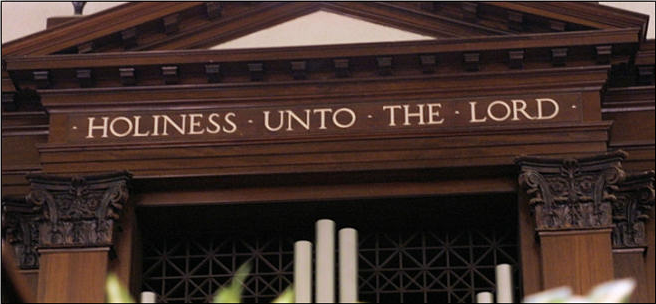
Having grown up in Methodism’s Holiness movement, where part of my education was centered in Wilmore, Kentucky at Asbury College and Seminary, I know well the efforts made to exclude and isolate the “in group” from those things that are seen as impure. These schools have been significant institutions advancing “spiritual holiness,” I sat through scores of college chapel services where the words “Holiness unto the Lord” were boldly inscribed above the chancel.
Often preachers would call for purity. In what theologians speak of as sanctification, the desire was to encourage a life of perfection. At base a good thing – but a dangerous instrument as well. (No one mentioned perfect cookies as I recall, but in many other aspects of life and faith there was the assumption of purity and filth.) Some believed purity was found in avoiding certain activities (e.g., dancing, going to movies, drinking alcohol, etc.). Others suggested there was a doctrine of “perfection” and a need to reject any theological perspectives that differed.
It is my sense this search for holiness as an end point has done much harm, even caused the splintering of families, marriages, congregations, and denominations. It leads to divisions over who is pure and who is polluted. I do not doubt that some folks lived a “sanctified” way of life.
Usually, it was not the teachers or preachers who claimed to be “sanctified” who demonstrated this best. Instead, I think of folks like Ms. Warner, the history teacher, a quite Quaker woman, who practiced her holiness in the loving ways she lived toward others and care for her students.
In my reading of Christian scripture, the holiness sketched across those pages and any evidence of holiness discovered in human history is always best seen as a process, a verb, and not an end point. It is an ever-maturing love for God and neighbor, an openness to imperfection – especially one’s own.
Good reader, don’t take to much comfort from growing up in other traditions, not burdened with the language or theology of “holiness.” The human story is one where there is a dividing the world up into what is pure and polluted takes many forms — and seems to be a universal trait.
This past week former Secretary of State Mike Pompeo denounced Randi Weingarten, the president of the American Federation of Teachers, as “the most dangerous person in the world.” Really? Not even a thought of Kim Jong-un or Vladimir Putin? Pompeo went on to say that our nation’s schoolteachers are teaching “filth” in their classrooms. Careful there, Mike. Methinks your presidential ambitions have fallen into a toxic hole where a need to divide and harm others clouds the language you use. Is there any acknowledgement of your own failings? You might check out Matthew 7:5 (“You hypocrite, first take the log out of your own eye, and then you will see clearly to take the speck out of your neighbor’s eye.” — NRSV)
Our nation, our communities, our institutions are amid an entangled and dangerous struggle. It is often manifest as a desire for purity. The irony, of course, it that speeches against “filth” come from the mouths of persons who have supported bigotry, deceit and even insurrection – or have looked the other way when it took place. This Thanksgiving, I am grateful for imperfections – but chose to seek to move past them. This is how one learns – and the second batch of cookies today were better. I look forward to quality of my future chocolate chip cookies! And I am even grateful for the gift of imperfections.
“Preaching leads to changed lives,” I recall one of my seminary homiletics professor’s assertation. Another professor, a diminutive Scot, with a marvelous Scottish brogue (involving the trilling of ‘r’s in his speech), offered instead that “Ser-r-mons are r-r-eminder-rs of where God is al-r-r-eady active in the lives of the people.”
In my experience, sermons typically aren’t life-changing events for the hearer — or the preacher. Like workshops they can be helpful, but not often transformative. Now, after more than five decades, I have much appreciation for my Scottish professor’s understandings. A sermon may assist others in taking a step along faith’s journey. I don’t recall anyone greeting me after worship and saying, “that sermon was transformative.” On the other hand, years later a few have said, “You didn’t know it but that word came at a time in my life when I was ready to hear.” Amazingly, years or decades later, some have said, “I remember that sermon back in 19??. It came at a time when I was seeking another path, another vocation, or a new partner. Thanks.”
Recently, I wrote about well-intentioned but ineffectual Diversity, Equity and Inclusion workshops. Like sermons, such events rarely lead to substantial change in racialism and discrimination. But this is not written as a screed against workshops or sermons. Instead, it is the proposition that when these activities are accompanied by a clear invitation to join with others in witnessing and addressing racial discrimination, remarkable transformation is possible.
So, why this focus on preaching and racism? Well, put simply, addressing racism is about more than words or ideas. Racism is often distilled into the belief that it is only about personal attitudes or prejudice. For Whites — for all people – sermons are effective as they are joined to changes in the ways we live. Parker Palmer suggests “Changed thinking doesn’t lead to changed actions so much as changed actions lead to changes in the ways one thinks.” Sermons and workshops are insufficient, helpful perhaps, but in isolation they may serve as an inoculation avoiding fundamental change.
Several Open Housing campaigns in the 1960s carried the slogan: Your heart may be in the right place, but are you? As hundreds of thousands were moving to the suburbs avoiding racially integrated schools and neighborhoods, the church was… well, preaching a lot about racial justice. Meanwhile in only a few cities were churches at the center of racial justice and integration efforts. In 1961 Gibson Winter, theologian and social scientist, documented this in the book “The Suburban Captivity of the Churches.”
Dr. William Pannell
A cherished friend of mine, Professor William Pannell of Fuller Seminary, is now in his nineties. We met in the late 1960s when as a young seminarian his book “My Friend, the Enemy” spoke powerfully about racism being more than personal prejudice. As friends, he taught me that it was not enough to have a “changed heart.” I needed to acknowledge the enemy we both faced of white privilege, culture and discrimination.
Sermons, workshops, and conferences can be mechanisms of avoidance. Bill speaks of the 1966 World Congress on Evangelism. The theme for the 1966 gathering was One Race, One Gospel, One Task. Evangelical leaders invited more than 1,200 delegates from 100 countries to Berlin for this World Congress on Evangelism (an important precursor to the historic 1974 Lausanne Congress). Pannell speaks of a small group of African American Christians who discover that even though the theme was One Race, One Gospel, One Task, there was a silence about racial injustice. Imagine this in the middle of the Civil Rights struggles of those years. As Pannell tells it, (see: https://www.youtube.com/watch?v=AkpYIg8tpOI) those concerned about this omission confronted the conference leadership and, as is often the case, they were asked to write a document on racism to be approved by the Congress. Pannell then reports, these more than fifty years later, that document must be “sitting on a shelf somewhere.” You see, the passing of a nicely worded document, was not connected to concrete institutional and cultural change. Or as Pannell would have it, “Vital and Biblical evangelization.”
All around we have the opportunity to join in activities to address racial injustice and do more than attend workshop or preach sermons. However, those of us who are now, or have been, a part of Mainline Christian leadership need to learn to listen to and support others. There are some remarkable young persons ready to teach and lead us. Persons who come from different racial experiences. I will share more in future chapters. Urgently now, look for places where persons are addressing the evil of White Christian Nationalism. Check out the upcoming event: https://www.eventbrite.com/e/how-white-christian-nationalism-threatens-our-democracy-tickets-439763242697#search. Then do more. A true addressing of racism involves deep change in the ways our institutions understand, and act differently based on the structural, financial and cultural options pursued.
One of my other heroes was Thomas Broden on the faculty of Notre Dame Law School. Tom joined a team working on an initiative called Project Understanding, back in the early 1970s. It focused on city congregations across the country (Chicago, Los Angeles, Atlanta, Dallas, Indianapolis, Bay Area, South Bend). My work was to carry out research on ways racial attitudes might be changed and how racism in many forms might be addressed.
I recall the day we recommended to Broden that lay persons from many denominations be gathered to study and consider ways to address racial injustice. Tom’s response was “That’s okay as far as it goes.” He had my attention! He went on, “We will want to get them involved in some activity with persons who differ racially and in situations where discrimination can be clearly seen.” In South Bend, one of the activities he suggested was to have lay people sit in welfare offices and observe the cheating going on there. I was appalled – Tom laughed – “Oh, he said, cheaters will be found, but few of them will be those seeking assistance!” He was right, so very right. Today, in Indiana every welfare office must post “the rights of those who seek assistance.” That came directly from the work of lay people in Project Understanding. In Chicago and Dallas, change came from teams who sought to rent an apartment (some teams were White only, some Black only, some mixed racially). After visiting the same apartment and seeking to rent it, the teams would gather and learn about the ways discrimination was seen in the prospect of renting the same apartment. In California, there were engagements with persons seeking immigration or work documents. Sermons helped, workshops were okay, but the research showed that true and lasting changes in racial attitudes were rooted in real and concrete efforts to address discrimination and unjust institutions.
Or, as my seminary preaching professor would put It, “Serr-r-mons are r-r-eminder-rs of where God is al-r-r-eady active in the lives of the people.”
Avoiding Deep Change: Racism and the Ineffectual Church, Chapter 1
A year ago, October 1, 2021, I made a calendar note, “Write about this next year!” A year ago today, I had just read of another “Diversity, Equity and Inclusion” workshop planned by a denominational group. My heart sank. One could find dozens of such events planned — and, no doubt, there were consultants who were happy to have the work!
Please understand. I am not against “Diversity, Equity and Inclusion” commitments. A good thing this. I’m not as enthusiastic about workshops, training events, webinars, etc. that are unhinged from engagement in the communities nearby where undiscovered neighbors, real people, live and work. Workshops can become tools of avoidance, especially as stand alone, one-off, efforts. Without a deeper look at institutional and cultural strata shaped by racism over decades there are well intentioned but shallow responses. Tragically, they sometimes result in representational leadership (a minority person promoted to a leadership role) without addressing the deeply embedded patterns upon which institutions function.
Let me confess that I delayed a year in writing this because I didn’t want to be reactive. Perhaps, if I waited, something would emerge to assuage my doubts. Or, I could give a more measured response than simply concluding most church leaders would prefer to avoid, delay and placate all the while appearing to make progress by offering training sessions. Perhaps I would see real, deep and sustainable change. As of a year — I still wait for something substantial to address the racial injustice in which we are mired. Even worse, in this year it appears white nationalism sentiments have grown, sadly often within congregations.
A year ago, following the murders of George Floyd and Breanna Taylor I had been involved in several conversations, web seminars, zoom meetings and the like, where I attempted to share research that showed education and sermons were not sufficient to bring enduring change. I attempted to argue that DEI workshops would not be enough — they would be ineffectual. I even warned pastors “Don’t preach that sermon” until you have in place a way to work with neighbors on antiracism measures in your setting. This advice was not based on a hunch, but on research on addressing racism that had been done decades earlier as part of a program called Project Understanding. That research made it clear that real and enduring change to address racism at a root level involved action with others who brought their differences, as well as education.
A true addressing of racism involves deep change in the ways our institutions understand, and act differently based on their financial and cultural options. There are instruments designed to address institutional racism. These were not requested. There was work to be done beyond training sessions — work to support minority owned banks, address racial discrimination in housing, business, and real estate. Any true addressing of racism in the church would take more than sermons, minority clergy serving as pastors in predominantly white settings or pulpit exchanges once a year with a racial ethnic congregation down the street. There were concrete, measurable ways congregants could be deeply involved, spiritually alive and committed to take common action with persons of different racial and religious groups — action for fundamental change.
An early Inventory of Institutional Racism, from 1973
The year has past… Surely some good has resulted. Please share this in the comments section. Even so, I don’t hear much being reported that is substantial and sustainable. I write a year later of my concern and will in the next few postings offer again insights regarding other approaches. I will share insights from saints who are nearing the end of life or have now passed on — persons like William Pannell at Fuller Seminary, Thomas Broden at Notre Dame, Joseph Taylor and LaVerta Terry at Indiana University, Gilbert James at Asbury Seminary and Jicelyn Thomas who was a gifted preacher and theologian taken from our earthly fellowship too soon, too soon.








 urce of disgruntlement, a blaming of others, or a grievance, or complaint?
Anthropologist Mary Douglas wrote of the dangers of dividing the world into the binary categories of the “pure” and the “polluted.” She traces the meaning of “dirt” and what is considered “filth,” through history and multiple cultures. Douglas identifies rituals used to cleanse or purify defilement, persons or groups seen to be “dirty” or considered an “abomination.” Douglas noted that this effort to identify others as “filthy” often was the precursor, a contributor, to racism and fascism. What lessons can be drawn from the Jewish holocaust? What lessons might there be from the mass murders of LGBTQ persons? What of the hatred and division that is spread across social media in our time?
Having grown up in Methodism’s Holiness movement, where part of my education was centered in Wilmore, Kentucky at Asbury College and Seminary, I know well the efforts made to exclude and isolate the “in group” from those things that are seen as impure. These schools have been significant institutions advancing “spiritual holiness,” I sat through scores of college chapel services where the words “Holiness unto the Lord” were boldly inscribed above the chancel.
urce of disgruntlement, a blaming of others, or a grievance, or complaint?
Anthropologist Mary Douglas wrote of the dangers of dividing the world into the binary categories of the “pure” and the “polluted.” She traces the meaning of “dirt” and what is considered “filth,” through history and multiple cultures. Douglas identifies rituals used to cleanse or purify defilement, persons or groups seen to be “dirty” or considered an “abomination.” Douglas noted that this effort to identify others as “filthy” often was the precursor, a contributor, to racism and fascism. What lessons can be drawn from the Jewish holocaust? What lessons might there be from the mass murders of LGBTQ persons? What of the hatred and division that is spread across social media in our time?
Having grown up in Methodism’s Holiness movement, where part of my education was centered in Wilmore, Kentucky at Asbury College and Seminary, I know well the efforts made to exclude and isolate the “in group” from those things that are seen as impure. These schools have been significant institutions advancing “spiritual holiness,” I sat through scores of college chapel services where the words “Holiness unto the Lord” were boldly inscribed above the chancel.
 Often preachers would call for purity. In what theologians speak of as sanctification, the desire was to encourage a life of perfection. At base a good thing – but a dangerous instrument as well. (No one mentioned perfect cookies as I recall, but in many other aspects of life and faith there was the assumption of purity and filth.) Some believed purity was found in avoiding certain activities (e.g., dancing, going to movies, drinking alcohol, etc.). Others suggested there was a doctrine of “perfection” and a need to reject any theological perspectives that differed.
It is my sense this search for holiness as an end point has done much harm, even caused the splintering of families, marriages, congregations, and denominations. It leads to divisions over who is pure and who is polluted. I do not doubt that some folks lived a “sanctified” way of life.
Usually, it was not the teachers or preachers who claimed to be “sanctified” who demonstrated this best. Instead, I think of folks like Ms. Warner, the history teacher, a quite Quaker woman, who practiced her holiness in the loving ways she lived toward others and care for her students.
In my reading of Christian scripture, the holiness sketched across those pages and any evidence of holiness discovered in human history is always best seen as a process, a verb, and not an end point. It is an ever-maturing love for God and neighbor, an openness to imperfection – especially one’s own.
Good reader, don’t take to much comfort from growing up in other traditions, not burdened with the language or theology of “holiness.” The human story is one where there is a dividing the world up into what is pure and polluted takes many forms — and seems to be a universal trait.
Often preachers would call for purity. In what theologians speak of as sanctification, the desire was to encourage a life of perfection. At base a good thing – but a dangerous instrument as well. (No one mentioned perfect cookies as I recall, but in many other aspects of life and faith there was the assumption of purity and filth.) Some believed purity was found in avoiding certain activities (e.g., dancing, going to movies, drinking alcohol, etc.). Others suggested there was a doctrine of “perfection” and a need to reject any theological perspectives that differed.
It is my sense this search for holiness as an end point has done much harm, even caused the splintering of families, marriages, congregations, and denominations. It leads to divisions over who is pure and who is polluted. I do not doubt that some folks lived a “sanctified” way of life.
Usually, it was not the teachers or preachers who claimed to be “sanctified” who demonstrated this best. Instead, I think of folks like Ms. Warner, the history teacher, a quite Quaker woman, who practiced her holiness in the loving ways she lived toward others and care for her students.
In my reading of Christian scripture, the holiness sketched across those pages and any evidence of holiness discovered in human history is always best seen as a process, a verb, and not an end point. It is an ever-maturing love for God and neighbor, an openness to imperfection – especially one’s own.
Good reader, don’t take to much comfort from growing up in other traditions, not burdened with the language or theology of “holiness.” The human story is one where there is a dividing the world up into what is pure and polluted takes many forms — and seems to be a universal trait.



 Hands of the Strong