
Full text of Bloomington Rotary Reflection Notes 2-7-24 (Parts were edited out at presentation for brevity.)
Mark Twain once said: “When I was a boy of 14, my father was so ignorant I could hardly stand to have the old man around. But when I got to be 21, I was astonished at how much the old man had learned in seven years.”
There is another side to this wisdom. For me, now that I am in my late 70s, I am often surprised by how little I know. Wendell Berry and Wes Jackson have written we need to often add an “Ignorance-based world view.” Philosophers call this the Principle of Clarity. The administration of Indiana University would benefit from a familiarity with this Principle of Clarity. Clearly the administration’s failure to support the Kinsey Institute and canceling of the exhibition of Palestinian artist Samia Halaby at the last minute after months of planning demonstrate an abandonment of Academic Freedom that is dependent on open conversation and dialogue.
I mention Wes Jackson in honor of our speaker today who, of course, offers much valued alternative perspectives on agriculture. Wes is a geneticist, farmer, winner of MacArthur Genius award for research on perennial polycultures at The Land Institute in Salina Kansas.
As we enter Black History month while facing continuing racism exhibited by candidates for the highest offices in our nation and in a world filled with violent problems that seem intractable, there is need for open-minded clarity. If you are like me, it is too easy to live in an information bubble, supported by confirmation biases. Without looking at events from multiple perspectives, it becomes easier to argue than to respectfully disagree. It leaves us in zero-sum worlds where an understanding the opposite person’s perspective and experiences are disregarded.
Last week, Traci Jovanovic offered a helpful word about knowledge of others related to the war in Gaza. It caused me to think of my second visit (of what I think are now six trips) to Israel/Palestine; this in the 1988. Mickey Mauer invited many civic, corporate, and religious leaders from Indianapolis. We met with Israeli and Palestinian leaders in political, economic, and educational arenas. Near the end of trip, several of the Indy leaders held an unscheduled meeting seeking to come up with a solution they could offer after hearing from a few of the many sides in the region. It was 40th anniversary of State of Israel and in the early years of First Intifada.
My friends, these leaders, were going to suggest ways to fix things. After a few minutes, feeling discouraged by the well-intentioned naivete of some, I left the meeting and sat in the bar with our Israeli tour guide and Palestinian bus driver. We chuckled together about the well-meaning effort to find easy solutions to struggles that had gone on for decades, centuries, well… millennia. Indiana Jones movies were popular in those years. I recall the Palestinian bus driver saying, with a wink to the Israeli tour guide, “Well, maybe these Indiana Joneses can solve things. I wonder have they fixed all the problems in Indiana?”
Humility is a virtue that is enhanced by honoring the Principle of Clarity. For those of us who are Christians, it is worth noting that the keys to the Church of the Holy Sepulcher in Jerusalem have been entrusted to Muslim families for hundreds of years because the various “Christian” denominations and sects struggle and disagree over who should have what spaces in the church. Alas.
One of my friends over the years was Palestinian Christian Rev. Alex Awad. He worked with United Methodists who visited the region, was pastor of the East Jerusalem Baptist Church and taught at the Bethlehem Bible College. Several years ago, Rev. Awad suggested that perhaps the future will need something more connected at the grass roots, something deeper than politics. He said, “People must start dreaming about Palestinian and Jewish children playing together without refugee camps, segregation walls and tanks. Then we can truly call it a Holy Land.”
Israeli peace activist Amos Oz has written “I believe that if one person is watching a huge calamity, let’s say a conflagration, a fire, there are always three options. 1. Run away; 2. Write a very angry letter or hold a demonstration; 3. Bring a bucket of water and throw it on the fire, and if you don’t have a bucket, bring a glass, and if you don’t have a glass, use a teaspoon, everyone has a teaspoon.” In his book “How to Change the World” Oz suggests everyone can join The Order of the Teaspoon.
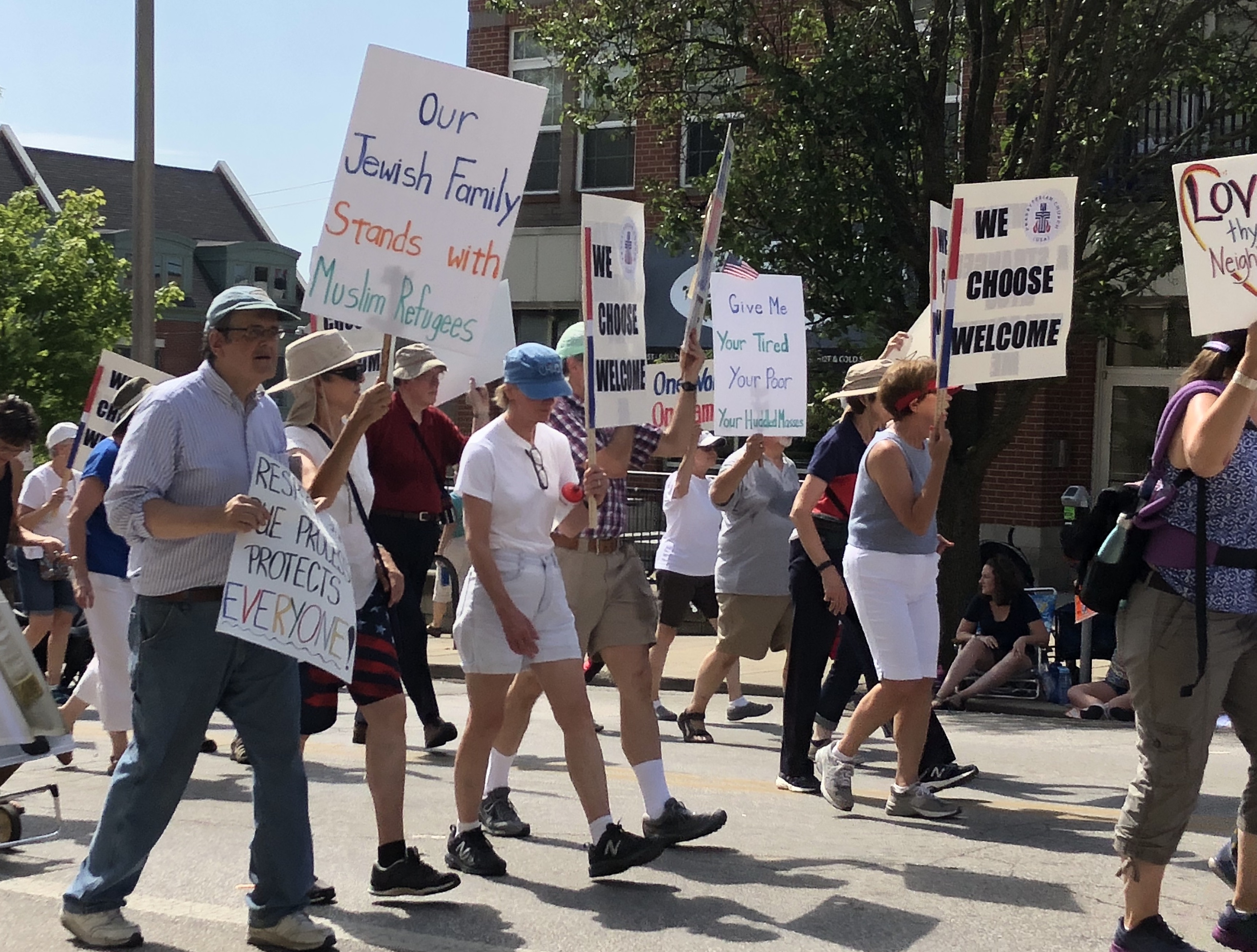
I am glad there are some people in this room working to find BIG SOLUTIONS to war and violence. There are also small things we can do, right here, now, at home. Welcoming the immigrant, finding shelter for the unhoused, saying no to racial prejudice and discrimination, seeking to mitigate domestic violence and gun play on our streets.
Jon Paul Dilts heads our club’s peace building committee. He reminded me that February is Rotary’s “Peacebuilding and Conflict Prevention Month.” The February issue of Rotary Magazine offers several grass roots ways to seek clarity – to work across differences. Much of the brokenness in our world has been ongoing for centuries, millennia. Big steps and small ones toward peace are required.
I close with the wisdom of my friend Wes Jackson who said, “If your life’s work can be accomplished in your lifetime, you’re not thinking big enough.”
 Hands of the Strong
I came in a little late to Rotary the other day, so am very glad to see and read your full statement! I heard most, but not all of it.Thanks! Well done! Tim
LikeLike
Phil,
Thanks for sending this. Your editing in real time is impressive. I didn’t realize you were leaving things out.
I am struggling to understand the university’s decisions about Samia Haley’s exhibition and about Professor Abdulkader Sinno’s suspension. I suspect these decisions speak mostly to administrative inexperience, lack of courage, and mission uncertainty. I understand how difficult it is for institutional leaders to stay grounded in values that matter. I am reminded that for many years Herman Wells, while serving as University Chancellor for IU, also served as a Trustee for Earlham College and for Howard University, schools well grounded in mission and courage. Wells used to say that standing firm for Academic Freedom was a priceless public-relations asset for a university president.
Jon
LikeLike
Yes, Jon, good insight. I had some of the same wonderings about administrative inexperience. I recall Dr. Wells’ commitments to academic freedom. IU was blessed by his leadership.
LikeLike
Hey Phil,
Are the political, world situation, and social relationships worse now than they have ever been?
I miss my Rotary friends. Going to try to get a copy of the Rotary magazine.
<
div>Jim
Sent from my iPhone
<
div dir=”ltr”>
<
blockquote type=”cite”>
LikeLike
Good question, Jim. I doubt they are worse than during WWI or WWII. In US, certainly the Civil War was worse — although, give the realities our nation is facing, one wonders if the violence and divisions that lead to the 1860s don’t just keep recycling wearing different political clothing.
LikeLike