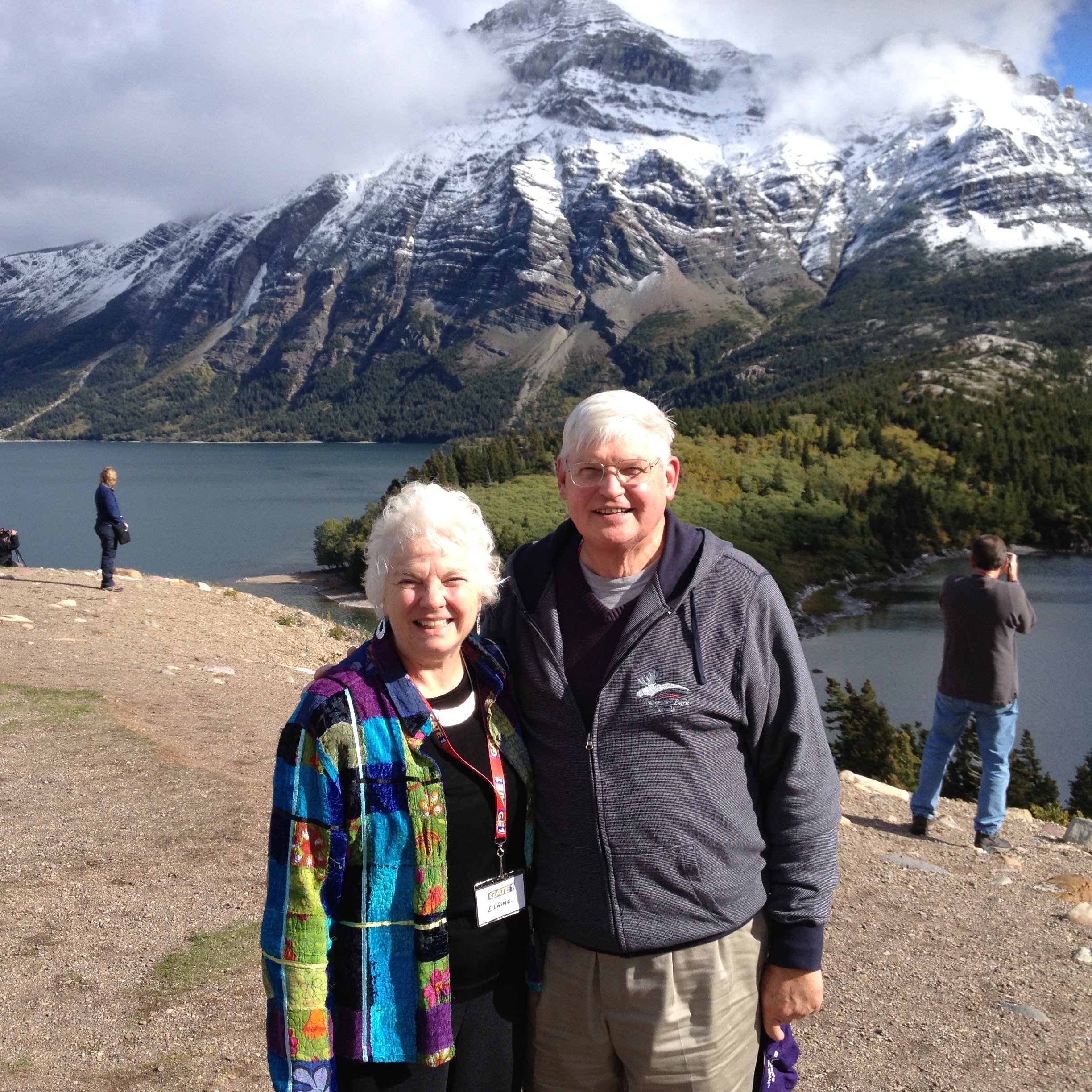
It was mid-September 2016. Elaine and I were traveling in the Canadian Rockies; part of our 50th years of marriage celebration. Walking in the lovely city of Banff, Alberta I spied a t-shirt in the tourist shop window. We laughed. I pointed it out to others who were on the trip. I shared my concerns about Donald Trump.
Two in our group were retired attorneys now living on Long Island. One was volunteering as a Catholic lay deacon who shared my concerns about “the Donald’s” mean-spiritedness, misogynistic behaviors, and racial bigotry. The other attorney laughed saying, “I worked in the prosecutor’s office in NYC for years. Everyone knew he liked to pretend to be something he was not. We all knew Trump was ‘mobbed up’ with the Russian mob.” “Don’t worry,” he said, “a guy like that will never be elected.” “Okay,” I thought, “if you say so. You have seen him up close.”
That was then. He was wrong about Mr. Trump’s possible election. Ever since, I have recalled the “mobbed up” comment. As president, Mr. Trump spoke fondly of Mr. Putin and his dictatorship in Russia. There were other troublesome moments like a phone call that appeared to be asking for a bribe from the Ukrainian president. In the intervening years as Mr. Trumps actions have become more bizarre. Now, he says the quiet part out loud about admiring dictators and hoping to be a totalitarian leader of the U.S. I keep thinking about that conversation in front of the shoppe window in Banff.
This past week (2/2024) at a rally in South Carolina, Trump, railed against NATO countries suggesting they didn’t pay enough in dues. He claimed, “one of the presidents of a big country asked whether the US would still defend that European country if they were invaded by Russia.” Astonishingly, Trump replied “No, I would not protect you. In fact, I would encourage them (Russia) to do whatever the hell they want. You got to pay. You got to pay your bills.”
The words “mobbed up” keep recurring, ever gaining more salience for me. I didn’t buy the t-shirt on that September day in 2016. I buy that he was unelectable. I was wrong. Our nation keeps living though what seems to be an unending nightmare. A nightmare that could endanger the future of our democracy and the freedoms of my grandchildren and the hope for freedom for children around the world.
There is much beauty in our world — in nature and in our flawed but essential institutions of democracy. Will truth and liberty and civility be easily combed over? Don’t fall into the trap I did — believing that IT CAN’T HAPPEN.
Full text of Bloomington Rotary Reflection Notes 2-7-24 (Parts were edited out at presentation for brevity.)
Mark Twain once said: “When I was a boy of 14, my father was so ignorant I could hardly stand to have the old man around. But when I got to be 21, I was astonished at how much the old man had learned in seven years.”
There is another side to this wisdom. For me, now that I am in my late 70s, I am often surprised by how little I know. Wendell Berry and Wes Jackson have written we need to often add an “Ignorance-based world view.” Philosophers call this the Principle of Clarity. The administration of Indiana University would benefit from a familiarity with this Principle of Clarity. Clearly the administration’s failure to support the Kinsey Institute and canceling of the exhibition of Palestinian artist Samia Halaby at the last minute after months of planning demonstrate an abandonment of Academic Freedom that is dependent on open conversation and dialogue.
I mention Wes Jackson in honor of our speaker today who, of course, offers much valued alternative perspectives on agriculture. Wes is a geneticist, farmer, winner of MacArthur Genius award for research on perennial polycultures at The Land Institute in Salina Kansas.
As we enter Black History month while facing continuing racism exhibited by candidates for the highest offices in our nation and in a world filled with violent problems that seem intractable, there is need for open-minded clarity. If you are like me, it is too easy to live in an information bubble, supported by confirmation biases. Without looking at events from multiple perspectives, it becomes easier to argue than to respectfully disagree. It leaves us in zero-sum worlds where an understanding the opposite person’s perspective and experiences are disregarded.
Last week, Traci Jovanovic offered a helpful word about knowledge of others related to the war in Gaza. It caused me to think of my second visit (of what I think are now six trips) to Israel/Palestine; this in the 1988. Mickey Mauer invited many civic, corporate, and religious leaders from Indianapolis. We met with Israeli and Palestinian leaders in political, economic, and educational arenas. Near the end of trip, several of the Indy leaders held an unscheduled meeting seeking to come up with a solution they could offer after hearing from a few of the many sides in the region. It was 40th anniversary of State of Israel and in the early years of First Intifada.
My friends, these leaders, were going to suggest ways to fix things. After a few minutes, feeling discouraged by the well-intentioned naivete of some, I left the meeting and sat in the bar with our Israeli tour guide and Palestinian bus driver. We chuckled together about the well-meaning effort to find easy solutions to struggles that had gone on for decades, centuries, well… millennia. Indiana Jones movies were popular in those years. I recall the Palestinian bus driver saying, with a wink to the Israeli tour guide, “Well, maybe these Indiana Joneses can solve things. I wonder have they fixed all the problems in Indiana?”
Humility is a virtue that is enhanced by honoring the Principle of Clarity. For those of us who are Christians, it is worth noting that the keys to the Church of the Holy Sepulcher in Jerusalem have been entrusted to Muslim families for hundreds of years because the various “Christian” denominations and sects struggle and disagree over who should have what spaces in the church. Alas.
One of my friends over the years was Palestinian Christian Rev. Alex Awad. He worked with United Methodists who visited the region, was pastor of the East Jerusalem Baptist Church and taught at the Bethlehem Bible College. Several years ago, Rev. Awad suggested that perhaps the future will need something more connected at the grass roots, something deeper than politics. He said, “People must start dreaming about Palestinian and Jewish children playing together without refugee camps, segregation walls and tanks. Then we can truly call it a Holy Land.”
Israeli peace activist Amos Oz has written “I believe that if one person is watching a huge calamity, let’s say a conflagration, a fire, there are always three options. 1. Run away; 2. Write a very angry letter or hold a demonstration; 3. Bring a bucket of water and throw it on the fire, and if you don’t have a bucket, bring a glass, and if you don’t have a glass, use a teaspoon, everyone has a teaspoon.” In his book “How to Change the World” Oz suggests everyone can join The Order of the Teaspoon.
I am glad there are some people in this room working to find BIG SOLUTIONS to war and violence. There are also small things we can do, right here, now, at home. Welcoming the immigrant, finding shelter for the unhoused, saying no to racial prejudice and discrimination, seeking to mitigate domestic violence and gun play on our streets.
Jon Paul Dilts heads our club’s peace building committee. He reminded me that February is Rotary’s “Peacebuilding and Conflict Prevention Month.” The February issue of Rotary Magazine offers several grass roots ways to seek clarity – to work across differences. Much of the brokenness in our world has been ongoing for centuries, millennia. Big steps and small ones toward peace are required.
I close with the wisdom of my friend Wes Jackson who said, “If your life’s work can be accomplished in your lifetime, you’re not thinking big enough.”





 Hands of the Strong