Deeper and Wider: Toward a Faith Ecology

For years, actually decades, I have watched and worked to build respectful connections among the warring tribal groups of the United Methodist Church. My assigned label was that of “Progressive”; although as with most of us, such binary categories do more to confuse than to explain.

There is much story to tell of my own journey among the Asbury institutions in Wilmore, Kentucky and then on to other pastoral and leadership roles in United Methodism. Along the way, it became clear that much of the struggle (mine and others) had to do with a desire for validation. Family System Theory would speak of the dynamic of weak self differentiation or an insatiable hunger for approval by a perceived competitor. Of course the battles among so called “traditionalists” and “progressives” are more than this, still for many this need for validation fuels the ongoing battles.

Just now, at Mt. Bethel UMC north of Atlanta, the battle is on full display. As I watch and listen, I hear some of the Wesley Covenant Association folks saying “the world is watching us.” That is the need for validation speaking. Most of the world is watching the Olympics. And, I fear, those who are watching the battle between the WCA and North Georgia UMC don’t see much of the love of Christ to be admired and valued.
I wrote a friend this morning who has been sharing information about the situation at Mt Bethel this: “Do you know of the habits of the cowbird? We have many cowbirds in Indiana. While it is an imperfect metaphor, it is still apt. The cowbird, known as a brood parasite, does not build its own nest but rather invades the nest of other birds, removing an egg of the other bird and leaving one of its own to be incubated and nurtured. Even though the cowbird egg is larger, the nesting bird still cares for the cowbird egg and infant. From the Audubon society: ‘Cowbird chicks don’t directly harm their nest mates (by pushing them out of the nest, for instance, like some cuckoo species), but tend to grow faster and out compete them for resources.’ The Audubon Society does not encourage the removal of these eggs. What is true in the world of birds may also be the case in humans — although in our world the invading species sometimes take over entire institutions.”

The institutions we believe we can build will never be perfect ones apart from the love of Christ. No matter traditional or progressive there will be others who will disagree and perhaps even act to out compete.

As a child I learned the Sunday School song, “Deep and Wide”. I would encourage all my friends to think deeply and widely about the future and the past. There is a deeper ecology as expressed in Ephesians 3 which is to be “rooted and grounded in love” and “comprehend with all the saints the breadth and length, and depth and height of the love of Christ which passes knowledge.”

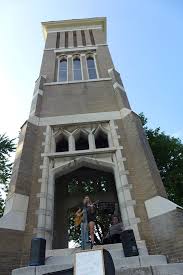
For many years I was privileged to be a part of a ministry that was ecumenical in vision and reach. In fact, I often think of how blessed we were at Patchwork Ministries in Evansville to welcome folks from many faith traditions to join in our work. For me this openness to seeing the world more broadly is symbolized in the tower that stands at Patchwork. It was part of a synagogue when originally built. Then after a fire destroyed much of that original building, the decision was to leave the tower standing. Now I look and see it can symbolize the prospect of looking beyond the past toward what is yet to be.

Much as I love my United Methodist tribe, the infighting among our various clans can cause us to miss the greater spiritual possibilities. In the larger scheme of things we are, as they say, “small potatoes.” There is so much more to discover from other persons of faith. There is an opportunity for us to live as persons who see the world with a wider lens than our own narrow understanding of God and faith. There is so much more to what God is doing — all around us — to be explored and celebrated. I choose to look more widely… and deeply.
The Maps We Carry

My grandson, Colin, and I were in upstate New York on our way to Boston. We had stopped off at Niagara Falls. Enjoyed the marvelous views. We rode under the Falls on the Maid of the Mist boat and came out drenched on the other side. We were then off to the hotel nearby. As we collected our luggage, I grabbed my road atlas from the pocket behind the passenger seat. It was time to make some old-fashioned travel plans, done the right way, with a map. I was weary of following the GPS system in the car or on my cell phone.

Upstate New York is lovely country. I wanted to check alternative possible routes to Boston. Then, explore a route back west, perhaps stopping off at one of the Finger Lakes? Didn’t I remember that I-86 was a lovely alternative to the heavily traveled I-90? I would check it out. There was much less traffic on I-86, and no tolls! Perfect way to enjoy the beauty of the Mohawk Valley. Perhaps we could check out some remaining stretches of the old Erie Canal. Yes, I would use the atlas.

We checked into our room. Settled in for a little rest before dinner. I grabbed my trusted road atlas, opened it, and began to laugh out loud.

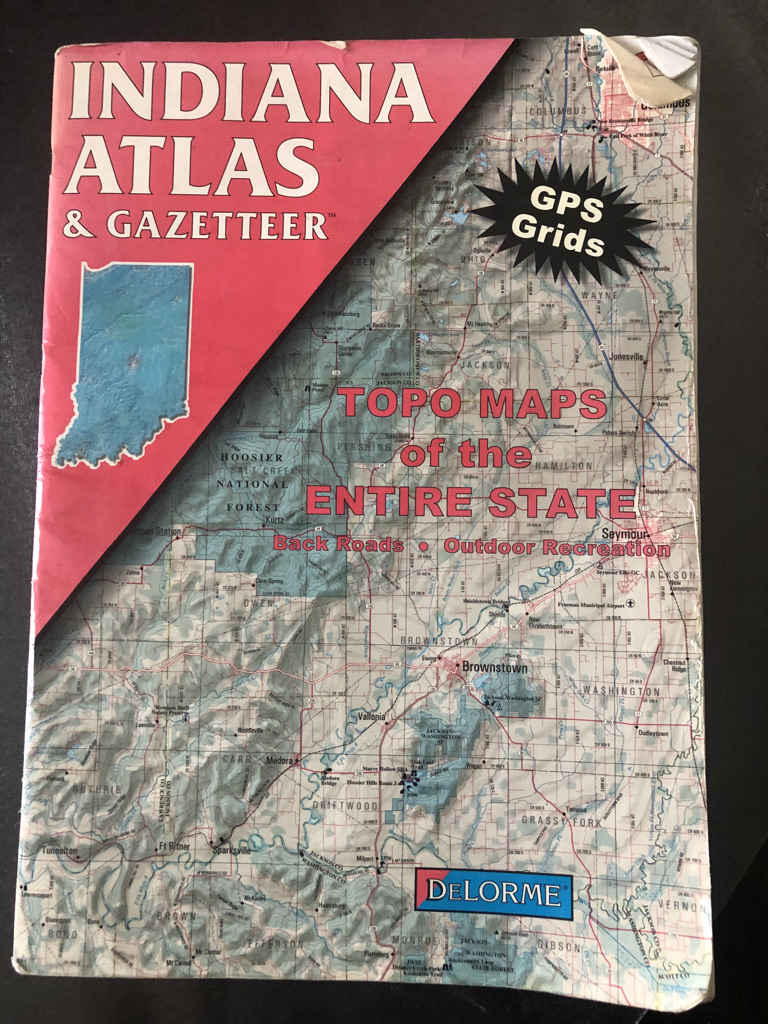
What I had brought to the room in order to check out travel routes through upstate New York was not an atlas of the United States at all! It was my dog-eared Indiana Gazetteer. A collection of local topographical maps that included every street and back road in the state of Indiana – at least in 1990! This Gazetteer was over twenty years old. It had been a treasured friend when seeking shortcuts in my home state. Well worn, I had used it often. As I leafed though the pages, memories of trips in Indiana came to mind.

Then there was a rush of understanding that this was a good metaphor of our human situation. How much of our understanding today comes from the out-dated and out of context maps carried in our memories? I once read of an adventurous people who sought to travel “off the map.” Had we forgotten this as a possibility? Are we locked into old patterns or electronically limited GPS systems? There was a time, as a boy scout, I had known how to find my way with a compass and rudimentary map.

Sometimes we carry intricate details of a world that once was but is no more. We can believe there is a return to a “safe and familiar” world long gone. Interesting human artifacts, these; but not much help in a newly evolving world. Our culture, our mores, our routines, our faith expressions, our educational systems and our governance patterns are transitioning — and quickly. It can be, understandably, a threatening time. This, in some ways, explains the hunger for authoritarian certainties that wash across our nation and our world.

We can be locked into mental maps that are simply too small for the journey ahead. Just when I need to have a more expansive view, I can get stuck with an out-of-date set of categories and images of reality. The nostalgic MAGA belief that one leader will help “Make America Great Again” is one of the most dangerous, and small minded maps of our time. This is, I believe a dead end, rather than a route forward. Or, it is like a religious denomination that seeks to return to a world that no longer exists.

The landscape ahead is of another territory all together. This, just when I thought I had retired! The most detailed mapping of streets and roads in Indiana, that I carry with me, isn’t much help in planning a trip through Upstate New York. There is no value for me when in New York planning a trip on back roads from Rushville to LaPorte, Indiana. New understandings, new companions on the journey ahead, a fresh reading of our scriptures and great documents like the U.S. Constitution can provide compass points — a sense of direction.

There are some maps that appear to help for short passages of the journey ahead. And, there are some parts of the travel that will require a compass of righteousness, the wisdom of spiritual guides and willingness to travel off the old maps I carry. My personally-crafted gazetteer will need some updating. As Rick Steves puts it, we should “Keep on Traveling.”

Neighbors or Fools?

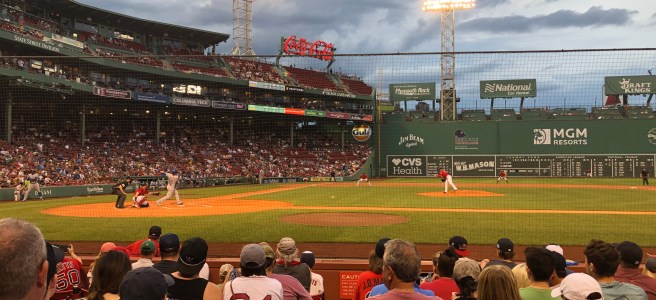
In Boston, of course at a Red Sox game. Joy. Wonderment. Old Fenway Park is a marvel.

Also an awareness that the folks around me who were strangers just an hour ago are now more. They are not friends — but they could be. We have already laughed, joked and talked a little philosophy. All around folks come from different places, speaking with wonderful accents that delight my hearing. Mostly from the Bay State a gathering that is racially and economically diverse. We teased about who would put ketchup on a hot dog? There is conversation — real conversation with folks who a few minutes ago were strangers. On the field there are diverse players — each one celebrated or feared for his baseball talent.

The rain that delayed the game was a blessed relief from the heat. Let me say it plainly — the heat IS an indicator of climate change. The fellowship in the stands is a relief from the pettiness, the lies and the anger in our nation. It is a relief to be away from the focus on grievance, victim-hood, abuse and denials being displayed by so-called “public officials.” I turn to Fox News and am amazed at the narrow distorted, and yes, deceitful language there. I turn to CNN or MSNBC and grow weary of the ways it is evident we have become the dis-united states of America. We are a broken society.

Martin Luther King, Jr. had it right when he said “We must learn to live together as brothers or perish together as fools.”

Is Fenway Park, and the democratic impulses it represented, a relic? (I am aware there are vast economic differences between my seat in the stands and those in the sky boxes above me. Still, like baseball itself, the gathering is a marvel.) It may be a slowly dying game, but its slower pace allows for time to learn about becoming a neighbor again.